
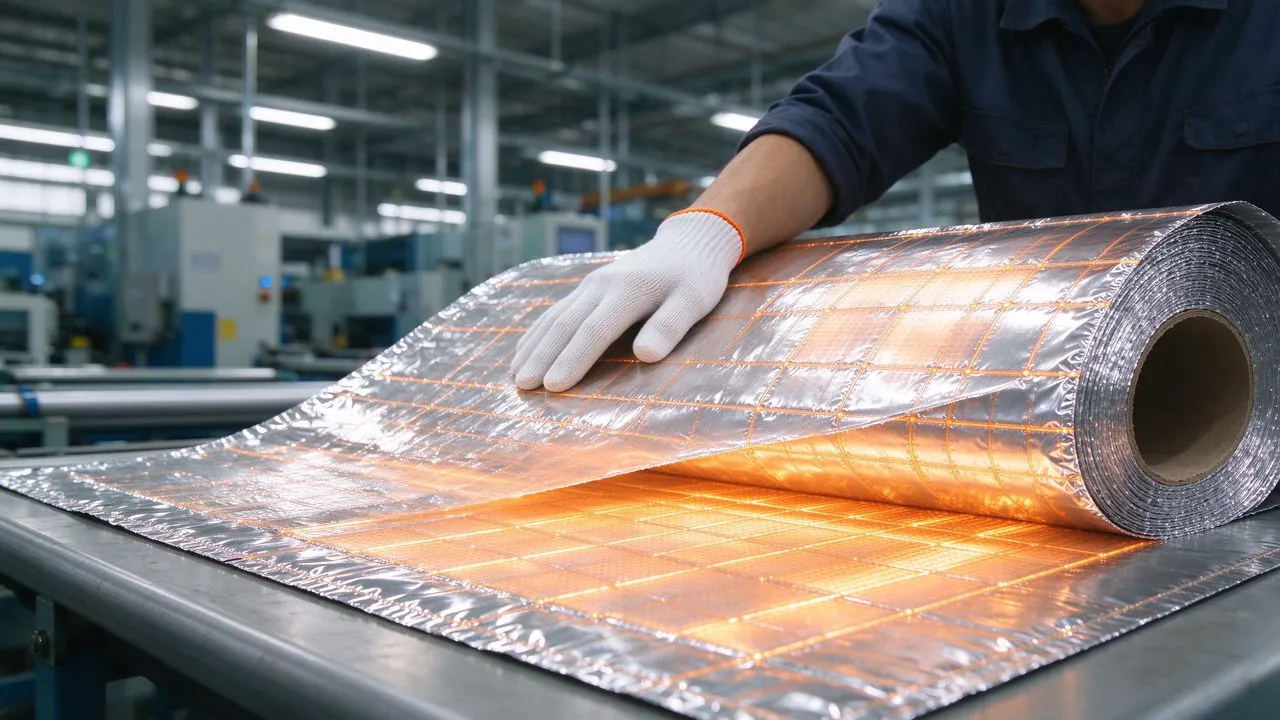
Floor build-up height is one of the most common blockers in an electric underfloor heating retrofit. A traditional heating mat laid in adhesive adds 10–15 mm; a screed pour adds more. For homeowners, architects and installers working with existing doors, thresholds and floor levels, every millimetre matters. The aluminum film heating mat answers that problem directly: a 0.5 mm ultra-thin heating element that brings radiant comfort to low-profile renovation projects without raising the finished floor.

What Is an Aluminum Film Heating Mat?
An aluminum film heating mat is a resistive heating element laminated between thin aluminum foil carriers, factory-terminated with cold leads. The active heating layer sits in the middle; the aluminum faces conduct heat evenly across the surface and act as mechanical protection. Because the whole construction is only about half a millimetre thick, the mat can be installed directly under laminate, engineered wood, vinyl or tile with no measurable floor build-up.
Why Low-Profile Matters in Renovations
Most European and North American retrofit projects share the same constraints: existing doors must still close, stairs must not gain a trip step, and skirting boards stay in place. A floor rise of more than a few millimetres forces door trimming, threshold rework and floor transitions across every room boundary. The ultra-thin aluminum heating mat eliminates most of that work because it sits inside the floor covering build-up itself. For renovation work where floor height is fixed, that is the difference between a project going ahead and a project being abandoned.
How It Compares: Aluminum Film vs. Heating Mat vs. Heating Cable
| Criteria | Aluminum Film Mat | Standard Heating Mat | Loose Heating Cable |
|---|---|---|---|
| Total element thickness | ≈0.5 mm | ≈3.6 mm including cable | Varies with fixing method |
| Floor rise added | Negligible (inside covering build-up) | 10–15 mm with adhesive | 10–20 mm typical |
| Best floor coverings | Laminate, engineered wood, vinyl, tile | Tile, stone in adhesive | Any layout |
| Installation speed | Fast — dry lay, no screed | Fast for regular rectangles | Slower, custom routing |
| Ideal use case | Low-profile retrofits | Bathrooms, kitchens | Irregular shapes, cold zones |
Installation: Dry-Lay Build-Up for Existing Floors
The dry-lay method is what makes this product family so popular with installers. Over a clean, level subfloor you lay insulation board or reflective foil, position the mat without overlaps, connect the cold leads to the thermostat wiring, test the resistance, and lay the final floor covering directly on top. For laminate and engineered wood, the mat sits under the underlay; for vinyl, it sits directly under the plank. A floor sensor in a protective conduit between two heating runs keeps the surface temperature inside the floor covering’s limit.

Wiring and Control: What the Installer Needs to Know
Each mat ships with factory-fitted cold leads of sufficient length to reach the thermostat, which keeps the electrical connection out of the heated area. The circuit must be RCD/GFCI protected and terminated by a qualified electrician following local wiring rules. For zonal control, pair each mat or room zone with a smart thermostat for underfloor heating — a floor-probe thermostat is strongly recommended so the surface temperature never exceeds the flooring limit, and weekly scheduling alone typically cuts running time by 20–30%.

Where the Aluminum Film Mat Fits Best
- Multi-room renovations where doors and thresholds must not move.
- Wood floors — laminate and engineered wood benefit from the even surface heat and low profile.
- Apartments with concrete slabs where screeding is impractical or banned.
- Second-floor rooms where a screed pour would add structural load.
- Over-tile renovations where the old tile stays and the new mat goes under a floating floor.
Data and Evidence: What the Factory Tests Show
SunAura Thermal has manufactured electric heating products at our Qingdao, Huangdao factory since 2008 — 17 years of continuous production — and the aluminum film mat line follows the same controlled process (per SunAura factory records). Every roll is resistance-tested before and after lamination, the insulation withstand test is performed at 3 kV for one minute per batch, and production operates under ISO 9001 quality management with CE and RoHS documentation for the product range. Heat distribution is verified with a thermal imaging pass on sample mats from every production batch. We export to more than 50 countries and support OEM/ODM programs for distributors and private-label brands.

Buying Considerations and Sample Programmes
When you compare the electric heating mat family for a project, ask three questions: what is the maximum floor rise you can accept, what floor covering is specified, and what voltage does the project use. If the answer to the first question is “very little”, the aluminum film mat is almost certainly the right specification. Trade samples are available for installers and distributors, and the aluminum heating mat wholesale price is quoted per square metre with volume pricing confirmed in writing. For a factory-direct quotation, send your room plan, floor build and voltage to our sales team.
Frequently Asked Questions
Can the aluminum film mat be cut to size? The mat can be trimmed within the non-heating margin zones per the layout diagram, but the heating element itself must never be cut. Factory-cut mats to your dimensions are available for larger orders.
Does 0.5 mm really make a difference? In renovations, yes. Door clearances, thresholds and skirting all sit within a few millimetres of tolerance, so saving 10 mm of floor rise often removes the need for door trimming and level transitions entirely.
Which thermostat works with it? Any floor-probe thermostat rated for electric underfloor heating works; we recommend our WiFi smart thermostats for scheduling and energy reporting, and we can match the NTC sensor type per order.
Is the mat suitable under tile? Yes — when installed in a thin adhesive bed per the electric heating mat installation under tile tutorial, the aluminum film mat performs reliably under tile and stone.
Thermal Performance and Heat Distribution
An aluminum film heating mat distributes heat differently from a traditional cable mat. The heating element is laminated between continuous aluminum carriers, so the heat spreads laterally across the whole surface instead of radiating from discrete cable runs. In practice this means the floor temperature is uniform — no warm lines above each cable, no cool gaps between runs. For wood floors this evenness matters more than for tile: an even surface temperature avoids the localised expansion stresses that can slowly loosen laminate joints, and it lets you run a lower surface temperature for the same perceived comfort. That is one of the quiet engineering reasons the aluminum film heating mat underfloor performs so well in renovation projects where the final floor covering is wood.

Heat-up response is also fast. With the element close to the surface — inside the covering build-up rather than buried in a screed — the floor reaches temperature in minutes rather than hours. That makes the system feel responsive: you can schedule it to start warming shortly before you wake or return home, and the floor is already comfortable when you arrive. For retrofit users used to waiting out a slow boiler, the responsiveness of low-profile electric floor heating is one of the strongest first-week impressions.
Zoning and Room-by-Room Control
Because each aluminum film mat is a complete heating unit with its own cold leads, zoning is natural. One circuit and one thermostat per room gives you independent schedules for the bathroom, kitchen, bedroom and hallway — the configuration that most retrofit projects settle on after comparing options. The bathroom can start an hour before you wake, the kitchen can run during cooking hours, and unused rooms can stay off entirely. With a WiFi thermostat in each zone, the whole house is managed from one app, and each zone reports its own energy consumption so you can see exactly which room is costing what. Installers appreciate zonal layouts for a simpler reason: if a fault ever develops, the zone is isolated, the rest of the house keeps heating, and repair stays a one-room problem.

Durability, Warranty and Factory-Direct Sourcing
Underfloor heating must outlast the floor covering it hides beneath. SunAura Thermal has manufactured electric heating products at our Qingdao, Huangdao factory since 2008 — 17 years of continuous production — and the aluminum film mat line is built on the same controlled process as our film and mat families (per SunAura factory records). Every roll is resistance-tested before and after lamination, production runs under ISO 9001/14001/45001, and the product range carries CE and RoHS documentation with LVD and EMC compliance tested per market. Warranty terms are confirmed in writing per order — typically 10–25 years by product family — so the specification you receive includes the protection period, not just the product.

Buying factory-direct changes the conversation. Instead of a distributor quoting from a catalogue, you send your room plan, floor build and voltage, and the factory returns the correct mat layout, output and bill of materials — plus trade samples and volume pricing for the aluminum heating mat wholesale price. Our OEM program applies the same test protocol to private-label products, which is how distributors build their own brands on factory-verified quality. If you are planning a low-profile retrofit line for 2026, ask for the test procedure and the warranty terms in writing; that document is your first quality gate.
Common Specification Mistakes with Ultra-Thin Mats
Low-profile systems invite a few recurring specification errors. The most common is heating under fixed furniture: the heated area must be measured around islands, bathroom units and fitted wardrobes, not across the whole room. The second is choosing a 0.5 mm mat where the real constraint is thermal output — an ultra-thin element suits low-profile wood and vinyl builds, but a tile floor in a cold bathroom may need the higher surface output of a standard mat. The third is skipping the floor sensor: because the element sits close to the surface, surface-temperature limiting matters more, not less. And the fourth is assuming the circuit can carry whatever you install — confirm the total wattage against the RCD/GFCI circuit rating before ordering. A specification review at the quotation stage costs ten minutes and prevents a floor tear-out later.
Frequently Asked Questions
Can I install the mat myself? The element laying is straightforward for a competent DIYer, but the final circuit connection must be done by a qualified electrician following local codes. Factory guidance and installation templates are provided with every order.
What is the typical lead time for low-profile mats? Standard widths ship from our Qingdao factory on a written schedule; volume orders for distributor programmes are planned against confirmed production slots. Ask for the lead-time commitment before you book your renovation.
Do you support OEM private-label programmes? Yes — the same test protocol, the same traceability and your label on the carton. OEM terms, MOQ and lead times are confirmed in writing per programme.
Ordering Checklist for Low-Profile Projects
Before you place an order, run this checklist. Confirmed heated area in m² (fixed furniture excluded); floor covering type and its temperature limit; mains voltage and circuit rating; insulation board thickness and whether reflective facing is included; thermostat model with floor probe and the sensor type; total wattage per zone against the circuit; and the written warranty term for the product family. Send these seven items to the factory with your plan and you receive a specification that cannot drift — the mat layout, output and bill of materials are all calculated from the same inputs. Installers who order this way report fewer site surprises, and distributors who standardise the checklist find that quotations become faster and more comparable. It costs one minute to prepare and saves the costliest mistakes in floor heating.
Conclusion
The aluminum film heating mat is the answer to the retrofit problem nobody wants to talk about: floor height. At 0.5 mm it delivers radiant comfort inside the floor covering build-up, so doors, stairs and skirting stay untouched. For installers and distributors looking for a 0.5mm heating mat factory-direct supply partner, SunAura Thermal provides samples, written warranty terms and volume pricing from the manufacturing source.
About the author: Ethan Sun is the Founder and CEO of SunAura Thermal, a heating-systems manufacturer based in Qingdao, China. Under his leadership the company has grown from a single workshop into an ISO-certified factory exporting electric underfloor heating, heating cable, heating film and snow melting products to more than 50 countries worldwide.