
Overview
SunAura graphene heating film is a slim, flexible far-infrared heating element engineered for underfloor, wall and ceiling heating. Its heating core uses a specially formulated graphene–carbon composite whose performance is determined by the material ratio and coating density — giving stable, uniform heat across the entire film surface with an electrical-to-thermal efficiency of more than 99%.
Because the film is printed and laminated on our own production lines, we can deliver any width from 10 cm to 100 cm and any length to match your project — from a single bathroom to a 3,000 m² commercial development. As an established graphene heating film manufacturer shipping to more than 50 countries, we supply distributors, contractors and OEM brands directly from our Qingdao factory, with no trading-company mark-up.
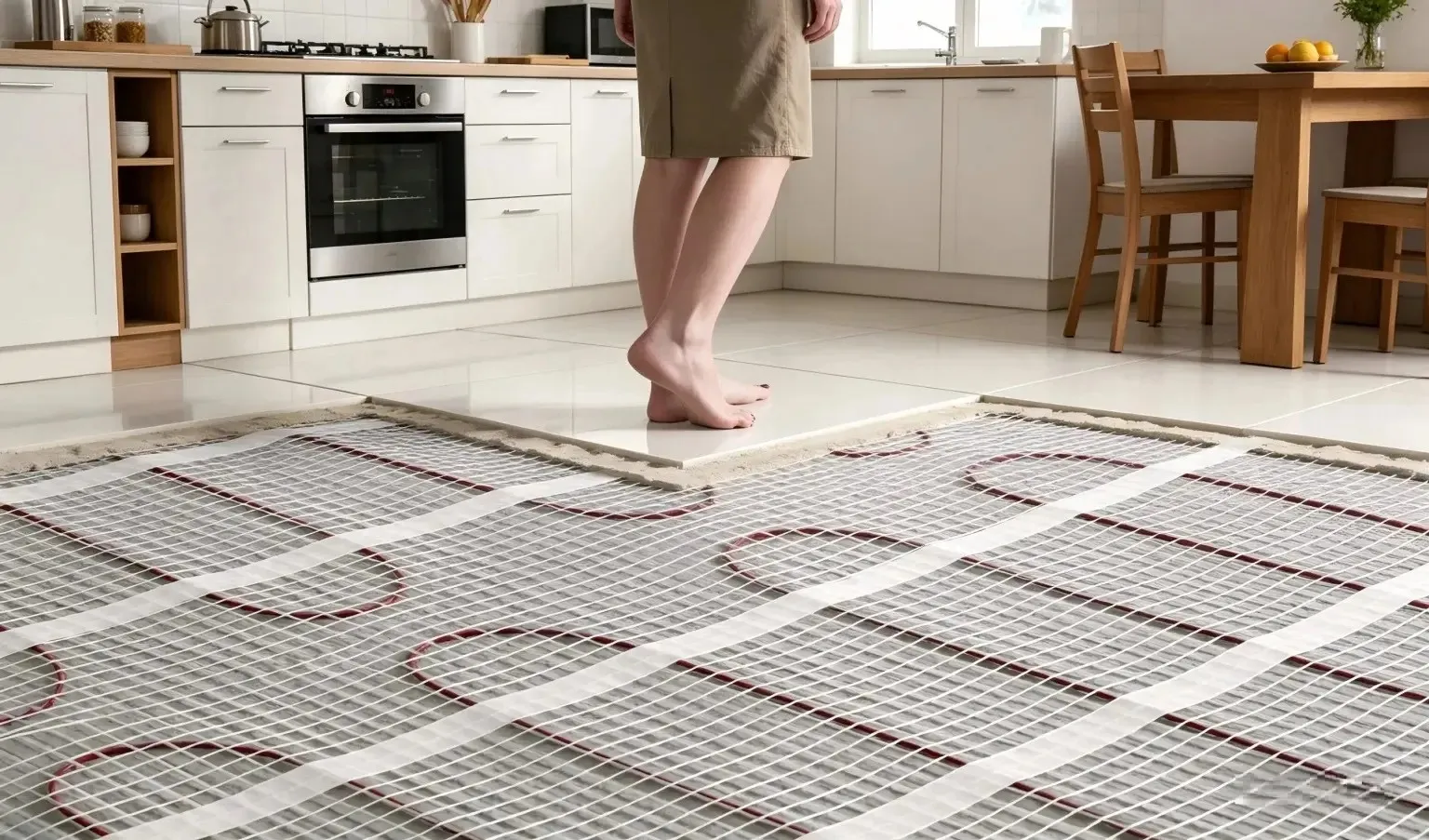
Key Features
- Over 99% heating efficiency — a graphene–carbon composite printed on PET converts electricity to far-infrared heat with more than 99% electrical-to-thermal efficiency.
- Twelve standard widths, any length — widths from 10 to 100 cm in twelve sizes, cut to your exact room length; bespoke widths opened for large OEM programmes.
- IP67 fully waterproof — encapsulated film safe for wet-room builds when paired with a floor-sensor thermostat.
- Underfloor, wall and ceiling use — the same element fits dry underfloor installs, invisible wall panels and ceiling heating where floors must stay free.
- Tunable power density — coating density is controlled in-house, so output is tuned from around 100 W/m² ceiling heating to higher industrial densities.
- PTC self-limiting option — a PTC variant automatically trims power as temperature rises, preventing hot spots on safety-critical and OEM elements.
Key Specifications
| Parameter | Value |
|---|---|
| Heating element | Graphene–carbon composite printed on PET film |
| Standard widths | 10, 15, 20, 25, 33, 40, 50, 55, 60, 75, 80, 100 cm |
| Length | Custom cut to project requirements |
| Voltage | 110 V / 220–230 V |
| Heating efficiency | >99% electrical-to-thermal |
| Waterproof rating | IP67 (fully waterproof film) |
| Heating mode | Far-infrared radiant heat |
| Optional | PTC self-limiting technology on request |
| Compliance | CE, RoHS (EU) 2015/863, ISO 9001:2015 |
How Our Film Is Made
Each heating film starts as a high-grade PET substrate. Conductive carbon and silver–aluminium composite pastes are precisely screen-printed onto the PET in the pattern that defines the heat output, then copper busbars are laminated along the edges to distribute current evenly. The finished film is encapsulated for waterproofing, tested for resistance and dielectric strength, and only then cut, terminated and packed.
Because we control the material ratio and coating density in-house, we can fine-tune the power per square metre for your application — from 100 W/m² for ceiling heating to higher densities for industrial use. This in-house control is what lets us act as a genuine graphene heating film supplier rather than a reseller: the ratio, busbar layout and encapsulation are all tuned on our own six automated Qingdao lines under ISO 9001/14001 manufacturing.
Infrared and Far-Infrared Heating Film Explained
SunAura heating film is an infrared heating film — it warms people, walls and furnishings directly by thermal radiation rather than by heating the air first. In engineering terms this puts it in the far-infrared band: the surface of the film runs at a moderate temperature (typically held around 27–28 °C at the floor surface by the thermostat) and radiates long-wave heat that travels across the room until it is absorbed by solid objects. That is why a far infrared heating film feels warm on your skin within minutes, even when the air temperature is still rising.
Two practical consequences follow. First, because heat is radiated rather than convected, there is no fan, no dust lift and no air movement — which is why our film is described as EMF-shielded, quiet and allergen-free. Second, the response time is short: the film sits close to the finished floor surface, so the floor reaches comfort quickly instead of waiting for a thick screed slab to warm up. The same physics applies whether the element is laid under laminate, hung as a wall panel or fixed to the ceiling — it is still a far-infrared radiant film, only oriented differently.
If you are comparing suppliers, ask for the test report that backs the efficiency and wavelength claims. We publish our SGS RoHS reports, ZCT EMC / IEC 60335 reports and the CNAS inspection report from the Qingdao Product Quality Supervision and Testing Research Institute on our certifications page.
Typical Installation Structure
Under a finished floor, our heating film sits in a proven multi-layer build-up:
- Laminate / finished flooring
- Vapour membrane
- Copper busbar (film edge connection)
- Graphene heating film
- Thermal insulation
- Base floor
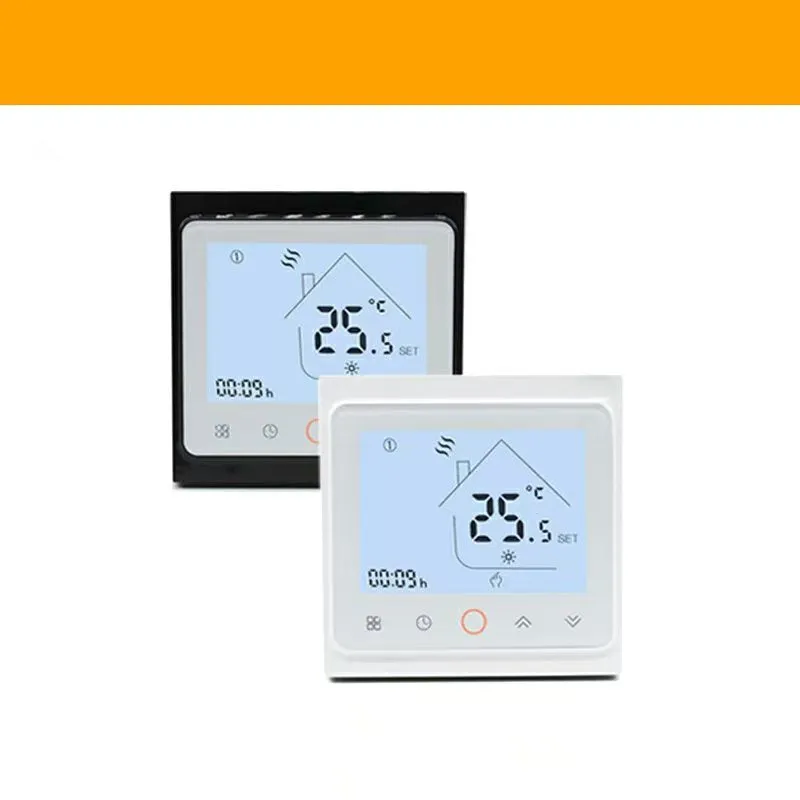
The system is completed by a room or floor thermostat with a temperature sensor, which switches the film on and off to hold the target floor temperature. For wiring and sensor placement detail, see our floor heating thermostat wiring guide, and browse the full range of thermostats and controls matched to this film.
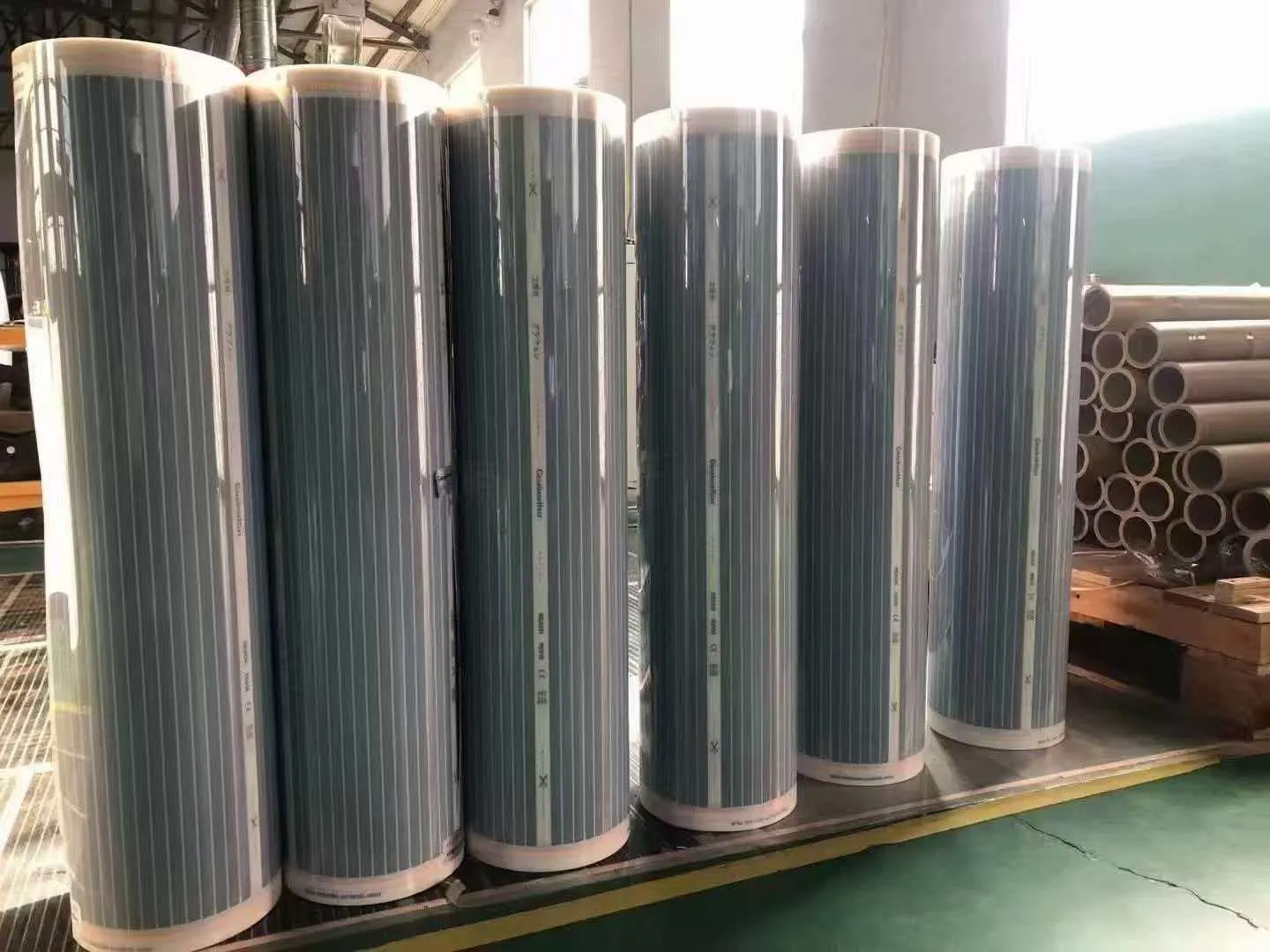
Carbon Crystal Heating Film vs Graphene Heating Film
Carbon crystal heating film is a widely used competing technology in which the heating layer is a pressed or printed carbon-crystal sheet on a polyester substrate. In everyday room-heating terms, carbon crystal film and graphene–carbon film look similar on the floor — both are thin, cuttable PET elements radiating heat under laminate. The honest engineering differences are in the material ratio, the busbar construction and the long-term resistance stability.
SunAura uses a graphene–carbon composite rather than a pure carbon-crystal layer. The graphene flake inside the composite improves lateral conductivity across the film surface, which is what lets us tune output from around 100 W/m² for ceiling heating up to higher industrial densities while keeping the surface temperature even. A pure carbon-crystal sheet tends to be more sensitive to coating thickness variation, which is why we control the paste ratio and screen-print density on our own lines. For buyers comparing quotes, the practical question to ask is not the brand name on the element but the independent resistance-test data and the warranty — ours is a 15-year warranty against manufacturing defects, with a 15–25 year rated service life under our ISO 9001:2015 quality system.
| Aspect | Graphene–carbon film (SunAura) | Conventional carbon crystal film |
|---|---|---|
| Heating layer | Graphene–carbon composite printed on PET | Pressed / printed carbon crystal sheet |
| Electrical-to-thermal efficiency | >99% | Typically comparable at rated load; stability depends on coating control |
| Power density tuning | ~100 W/m² ceiling to higher industrial densities, tuned in-house | Often fixed at one or two density levels |
| Encapsulation | IP67 fully waterproof | Varies by manufacturer |
| Voltage options | 110 V / 220–230 V | Varies by manufacturer |
| Warranty on defects | 15 years | Usually shorter (ask for the written terms) |
For very wet-room or appliance-grade duties where the element must be built into a product rather than a floor, our custom encapsulated heating film is the spec to ask for.
PTC Heating Film: Self-Regulating Radiant Element
PTC heating film — PTC stands for Positive Temperature Coefficient — is a self-regulating variant of the same radiant element. As the film surface warms, its own resistance rises and power automatically trims, so the element cannot run away into a hot spot even if a section is covered by a rug, cabinet or appliance. This makes PTC heating film the default choice for safety-critical elements, appliances and OEM products, and it is available as an option on our standard underfloor film for renovation projects where coverage is partial.
Standard fixed-output film is normally the better economic choice for open, well-designed underfloor layouts; PTC is specified when over-temperature protection must be built into the element itself rather than relying only on the thermostat. We manufacture PTC graphene heating foil on the same Qingdao lines as our standard film, so widths, voltage, encapsulation and branding follow the same OEM/ODM options. Details of the self-regulating element range are on our OEM/ODM programme page.
110 V and 220–230 V Heating Film for Export Markets
Our heating film is produced at 110 V and at 220–230 V to match the local grid of your market. The voltage choice is set at manufacturing time — the paste laydown, busbar cross-section and thermostat rating are all sized for the supply voltage — so always state your target market on the quotation request.
| Voltage build | Typical markets | Notes |
|---|---|---|
| 110 V heating film | North America (US / Canada), Japan, parts of Central America | Matched to 110–120 V branch circuits; thermostat and cable sizing specified for the local code |
| 220–230 V heating film | EU / UK, mainland China, Australia, most of Asia and the Middle East | Matched to 220–240 V grids; CE / RoHS documents issued with the shipment |
We already supply customers in more than 50 countries, and we prepare the correct plugs, voltage build and certification documents with each export order. If your quotation request does not state the market, our sales team will confirm it before production starts to avoid a voltage mismatch.
Applications
- Underfloor heating — residential, commercial and public buildings
- Wall heating — invisible panels, ideal for renovations and bathrooms
- Ceiling heating — for spaces where floors must stay free
- PTC heating elements — self-regulating elements for appliances and industrial products
Buying Guidance: How Many Watts per Square Metre Do You Need?
One of the first questions distributors ask us is how to size the film for a room. The short answer: start from the heat loss of the room, not from the film catalogue. As a practical starting rule of thumb for a reasonably insulated European or temperate-climate room, plan for roughly 100–150 W/m² of covered floor area on an open-plan living room, and up to ~200 W/m² for a cold bathroom or a poorly insulated retrofit room. Because the film only covers the open walking area (never under fixed furniture), the covered area is typically 60–80% of the room floor area, so the installed output scales with that coverage.
| Room type / insulation | Typical design output on covered area | Film density we recommend |
|---|---|---|
| Well-insulated new-build living room | ~100 W/m² | Standard density film |
| Temperate-climate retrofit bedroom | ~120–150 W/m² | Standard density film |
| Cold bathroom / poorly insulated room | ~180–200 W/m² | Higher density film (or PTC variant for safety) |
| Ceiling heating | ~100 W/m² | Low-density ceiling film |
These are starting figures for specification, not a substitute for a heat-loss calculation. Our engineers size each zone from your floor plan, insulation level and climate zone and return a free layout drawing with the film widths per zone, busbar positions and estimated electrical load — that drawing is what we quote against. Browse a real-world example in our graphene heating film home retrofit case study.
Certifications & Independent Testing
Our heating film is manufactured under ISO 9001:2015 quality management and carries CE marking with RoHS (EU) 2015/863 compliance. Independent test evidence includes SGS RoHS reports, ZCT EMC / IEC 60335 reports and a CNAS inspection report from the Qingdao Product Quality Supervision and Testing Research Institute — all available on our certifications page or on request. Manufacturing also runs under ISO 9001/14001 certified production, and every roll is resistance-tested and dielectric-tested before packing.
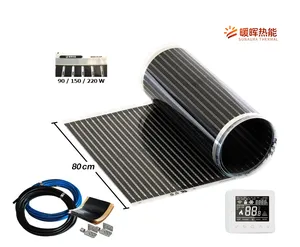
Graphene Heating Sheet — Standard Width Range
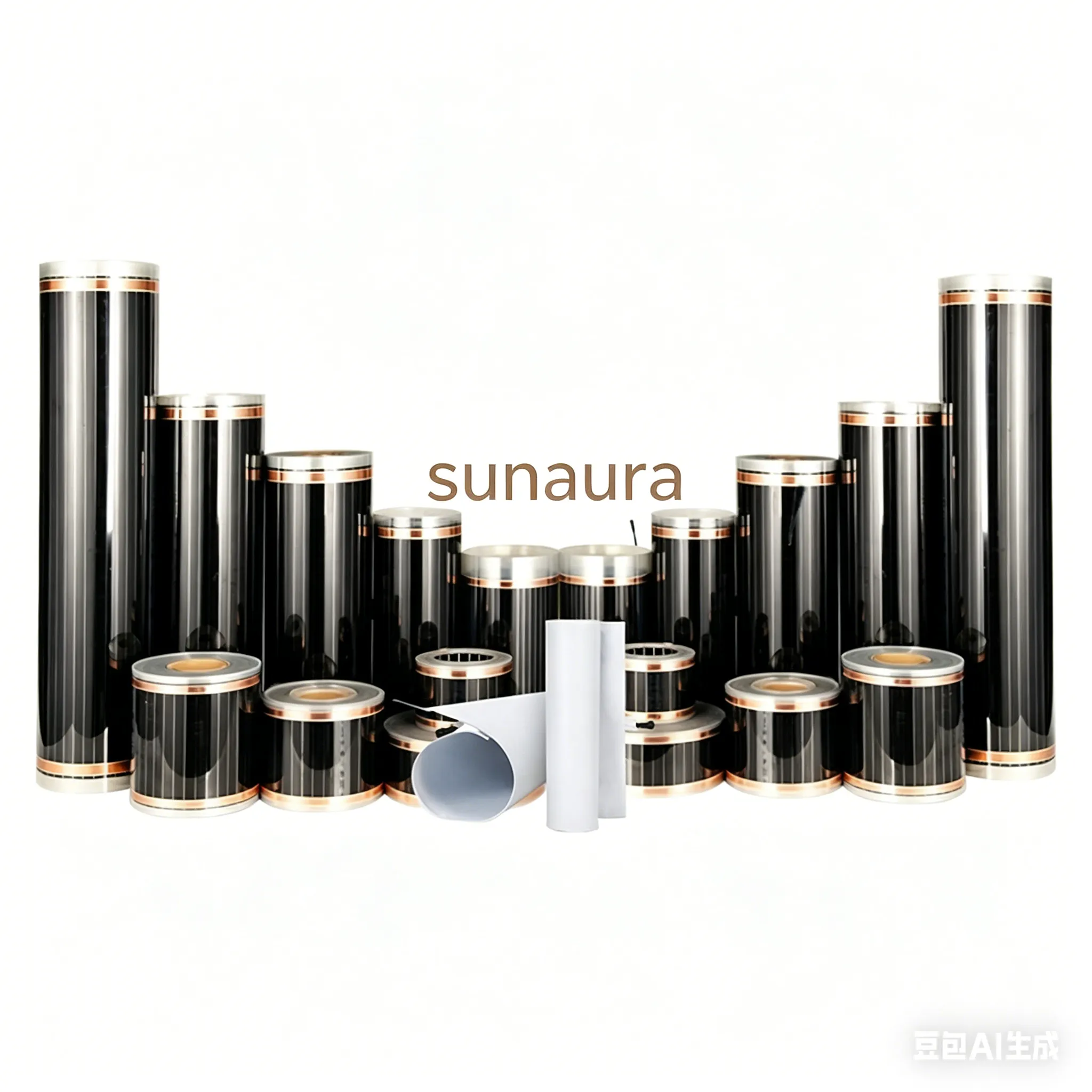
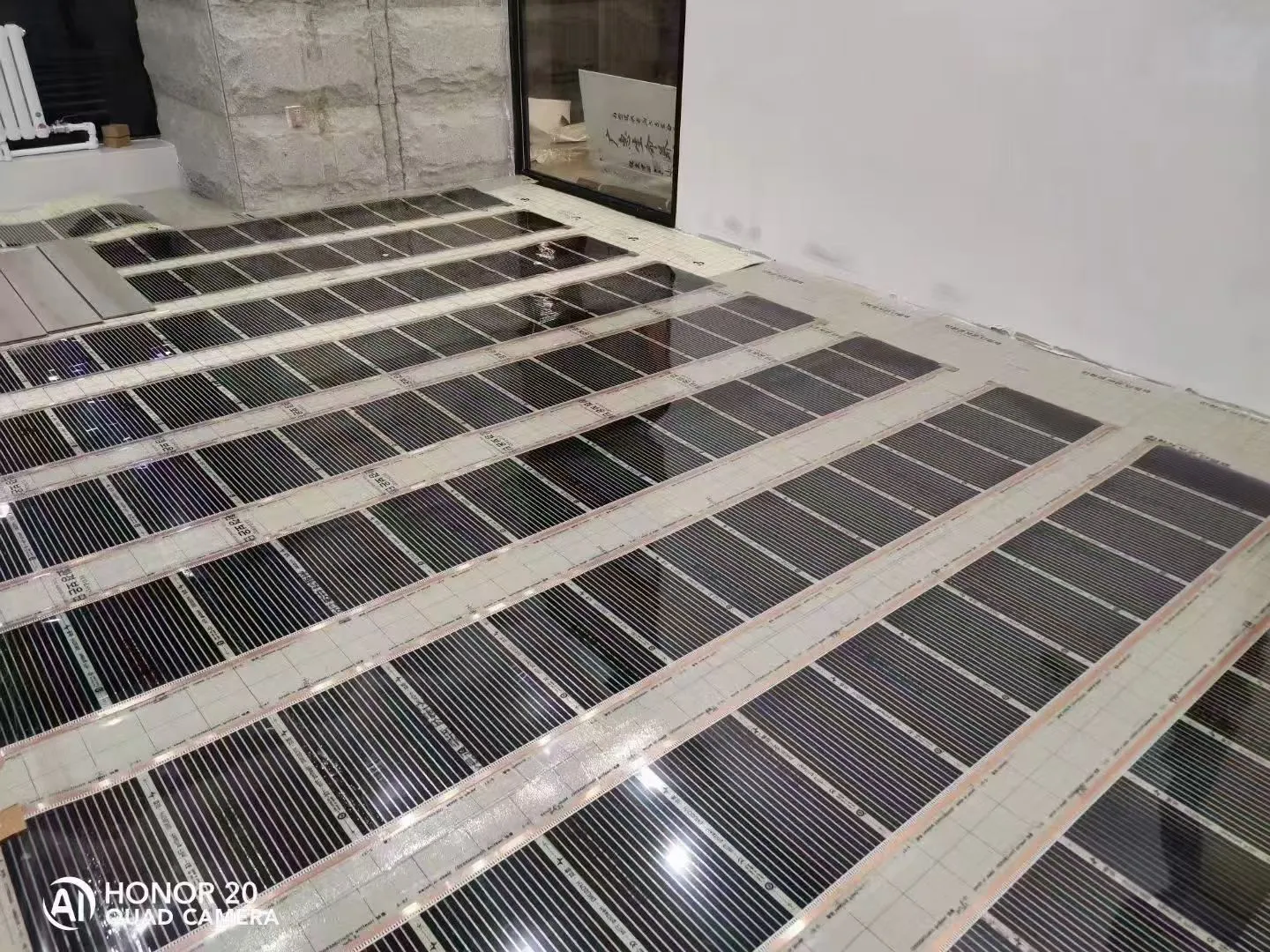
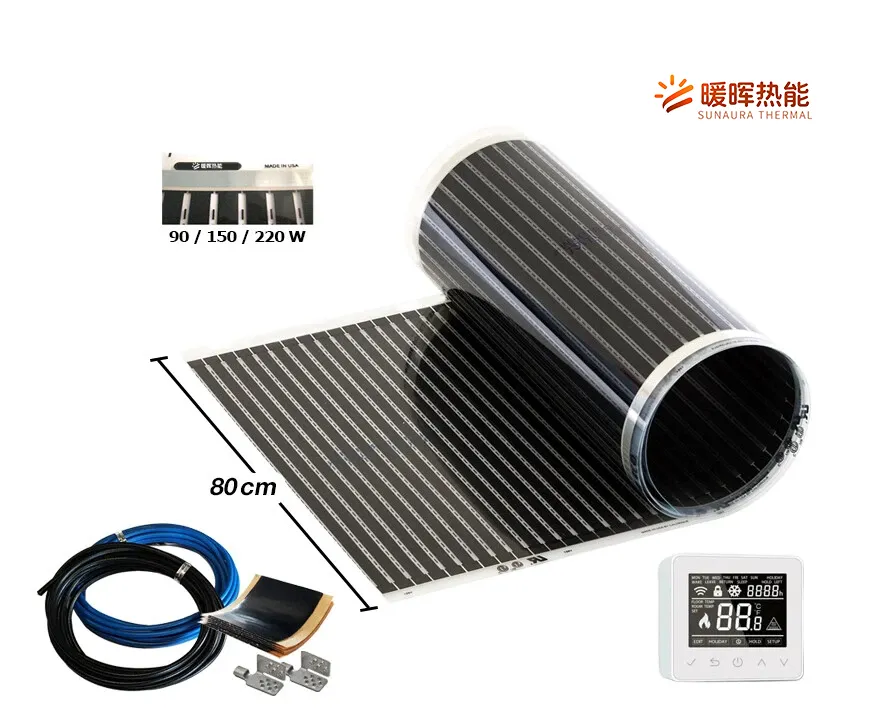
Our graphene heating sheet is produced as continuous rolls in twelve standard widths, with custom widths available for OEM/ODM projects. Each width is available in any length and can be cut to your exact room layout during installation.
| Standard Width | Typical Use |
|---|---|
| 10 cm / 15 cm | Skirting zones, narrow corridors, floor edge strips |
| 18 cm / 20 cm / 25 cm | Standard residential rooms, retrofit under laminate |
| 33 cm / 40 cm / 50 cm | Main heating zones, open-plan living areas |
| 55 cm / 60 cm / 75 cm | Large rooms, halls, commercial spaces |
| 80 cm / 100 cm | Full-width room coverage, warehouses and workshops |
Other widths can be customised — send your project drawings for a free layout design. For the larger roll format used in commercial fit-outs, see the flexible planar heating film roll (70 cm / 140 cm wide).
PTC Graphene Heating Foil — OEM/ODM Flexible Radiant Film
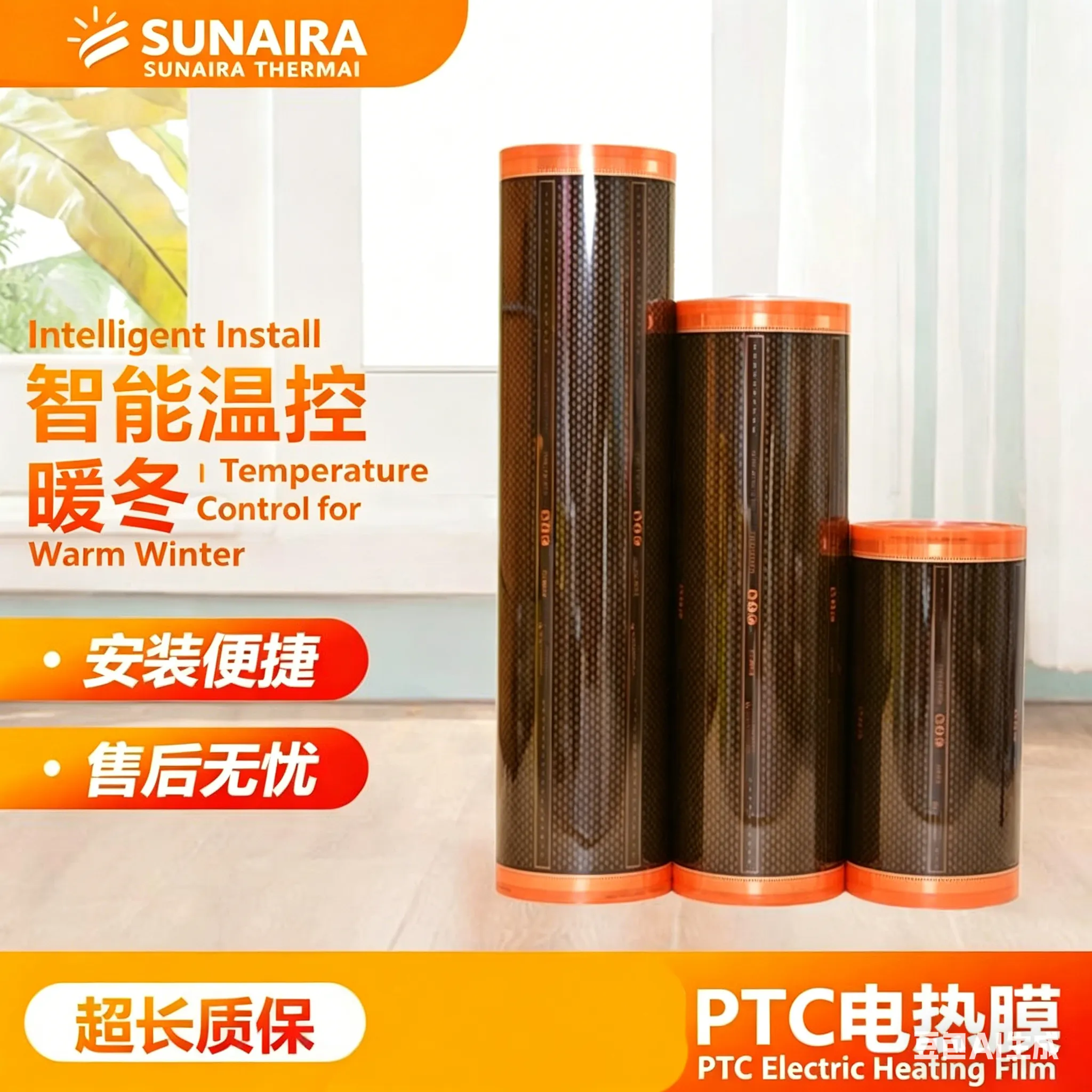
In addition to the standard graphene sheet, we manufacture PTC graphene heating foil — a self-regulating radiant film engineered for modern underfloor and wall heating systems. PTC (Positive Temperature Coefficient) technology automatically reduces power output as temperature rises, preventing overheating zones and improving safety and efficiency without extra control circuitry.
- PTC self-regulating technology — automatically limits temperature, eliminating hot spots.
- Fast, uniform warmth — full-surface radiant heat with industry-leading efficiency.
- Flexible and cuttable — adapts to rooms, walls and bespoke layouts.
- Custom OEM/ODM — custom widths, roll lengths, voltage and branding for wholesale programs.
- Quiet, EMF-free, allergen-free — no fans, no dust, no noise.
PTC foil is ideal for residential renovations, commercial fit-outs, wall heating panels and OEM/ODM projects that require custom sizes and specifications. As the factory behind the product, we support private-label branding, packaging design and full technical documentation.
Whole-House Graphene Heating Solutions
Beyond single-room film, SunAura supplies complete whole-house graphene heating systems. A whole-house solution combines our graphene heating film, cable mats and WiFi thermostats into one engineered system with a single control schedule — warm every room exactly when it is used, and cut heating costs in rooms that are not. See the full range on the whole-house graphene heating page.
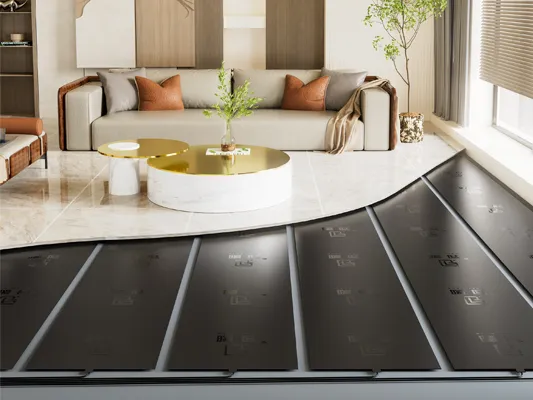
Every system is backed by our Qingdao production base — six automated production lines, ISO 9001/14001 certified manufacturing, CE/RoHS/EMC certified products with 15–25 year rated service life, and thermal conversion efficiency above 99%. Our products are trusted in more than 50 countries across Europe and Asia.
- Room-by-room zoning — independent thermostats per zone so each room heats only when needed.
- Engineered to your floor plan — our engineering team produces a layout drawing with film/cable selection per room, free of charge.
- Retrofit or new build — thin profiles suit renovation without removing floors; also ideal for new constructions.
- Smart scheduling — pre-heat bedrooms in the morning, hold living areas in the evening, set-back overnight via app or voice.
- OEM/ODM whole-program support — for developers and distributors we provide complete packages, packaging, documentation and private-label branding.
From a single apartment to a full housing project, our engineers size, design and support the complete installation.
Looking for a graphene heating film for bathrooms, kitchens or whole-house renovations? This section gathers the practical purchasing information we send every day to distributors, contractors and specifiers: factory-direct wholesale pricing, custom widths and cut-to-length production, OEM/ODM private-label support, and the free layout design that comes with every project enquiry. Whether you need far-infrared heating film for underfloor retrofit in a single apartment or for a multi-room commercial fit-out, the process below shows exactly how to order from our Qingdao factory.
Factory-Direct Wholesale Pricing & How to Buy
As the manufacturer behind SunAura, we supply heating film directly from our own production lines — no trading-company mark-up. The wholesale price, bulk discounts and MOQ depend on film width, power density, order volume and export destination (EXW or FOB terms), so the fastest route to a firm number is to send us your floor plan or room list. Our engineers size each zone, draw a free layout and come back with a same-day quotation.
| Item | Details |
|---|---|
| MOQ | Flexible — sample rolls for evaluation; production MOQ and pricing depend on model and quantity, confirmed in your written quotation |
| Bulk discounts | Volume tiers for distributors and project orders; larger roll quantities receive preferential wholesale pricing |
| Lead time | Standard widths from stock where available; custom cut-to-length orders produced to schedule after confirmation |
| Samples | Sample rolls and cut pieces available for testing — ask our sales team for current sample terms |
| OEM / ODM | Custom widths, private-label packaging, PTC self-limiting variant and custom roll lengths for wholesale programmes |
| Export terms | EXW / FOB Qingdao; CE, RoHS and ISO 9001 certification documents issued with the shipment |
To start an enquiry, contact our sales team with your project details — or message us on WhatsApp for a fast reply during working hours. We normally respond within one business day, including weekends for urgent project quotes.
Ordering & Shipping Process
Most wholesale enquiries follow the same four steps. First, send your room list or floor plan — room dimensions, floor covering type, insulation level and target climate. Second, our engineering team returns a free layout drawing showing film widths per zone, busbar and thermostat positions and the estimated electrical load, together with a same-day quotation. Third, after confirmation we produce, resistance-test and dielectric-test every roll, terminate and pack it, and prepare the CE/RoHS/ISO documentation for customs clearance. Fourth, we ship by sea, air or express courier under EXW or FOB terms in export-designed packaging; installation drawings and commissioning guidance travel with the goods.
For distributors who stock film for the local market, we can hold agreed standard widths and roll lengths in a rolling-stock programme, arrange neutral or private-label packaging, and supply bilingual installation manuals. Drop shipping is available for selected e-commerce partners — ask our sales team whether your region qualifies.
Customization & OEM Support
Because we print and laminate the film on our own lines, customisation happens in-house rather than through a sub-contractor. Standard widths run from 10 cm to 100 cm in twelve sizes, and for large OEM programmes we open bespoke width tools; voltage can be specified at 110 V or 220–230 V for your market; power density is tuned per application, from 100 W/m² ceiling heating to higher industrial densities; and the PTC self-regulating foil is offered where over-temperature protection must be built into the element itself. Private-label branding, custom roll lengths and printed packaging are all routine for our wholesale customers. The full programme is described on our OEM/ODM page.
Choosing the Right Element for Your Project
Film is the right choice where the finished floor is laminate, engineered wood, vinyl or carpet, and where installation must stay thin and fast. If your project is tiled or stone, many installers instead choose our 160 W/m² self-adhesive heating mat under tile, which beds into tile adhesive at a 3.6 mm profile. For screed-embedded floors, pipe antifreeze or snow-melting duties, the double conductor heating cable is the preferred element, while our slimmest retrofit option — the 0.5 mm aluminum film heating mat — suits old buildings where floor height cannot change. The complete range is listed on the underfloor heating category page.
For real-world layouts before you buy, browse our applications gallery of film installations across residential and commercial buildings, and check the general FAQ hub for answers to common wiring, sensor and control questions.
Frequently Asked Questions
What is the difference between graphene heating film and heating cable?
Film delivers large, even radiant surfaces at low profile (ideal under laminate, engineered wood and in renovations), while cable is best for embedding in concrete, screed or tile adhesive where a higher power density is needed. Film also warms up faster because it sits closer to the floor surface.
Can heating film be cut to any length?
Yes — film is manufactured as continuous rolls and cut to your exact length on our lines. Widths are fixed at the 12 standard sizes, and we can also produce custom widths for large OEM orders.
Is the film safe under wood or laminate flooring?
Yes. The film is IP67 waterproof and EMF-shielded, and works with laminate, engineered wood, vinyl and carpet provided the floor manufacturer’s maximum surface temperature (typically 27–28 °C) is respected via the thermostat.
What is the warranty on heating film?
Heating film is covered by a 15-year warranty against manufacturing defects, with the full warranty terms available on request.
How long does graphene heating film take to warm a room?
Because the film sits close to the finished floor surface rather than inside a thick slab, the floor reaches a comfortable temperature within minutes of switching on, and the far-infrared warmth then rises evenly through the room. This quick response is the main advantage of a graphene heating film over heavy screed systems, which can take an hour or more to respond.
Is far-infrared heat from the film safe for children, pets and allergy sufferers?
Yes. The construction is EMF-shielded, there are no fans to circulate dust, and the floor surface is held below the thermostat limit rather than running hot. Families with children or pets often choose a far-infrared heating film precisely because it delivers silent, dust-free radiant warmth without any moving parts.
Can the film be used for wall or ceiling heating, not just underfloor?
Yes. The film is engineered for underfloor, wall and ceiling installations alike, and the power density can be tuned per application — from around 100 W/m² for ceiling heating to higher densities for industrial use. Wall heating film is especially useful in renovations where floor space is limited, while ceiling heating suits rooms that must stay floor-free.
What is the difference between standard film and PTC graphene heating foil?
Standard film delivers a fixed, uniform heat output across the surface, while PTC graphene heating foil is self-regulating: it automatically reduces its own power as temperature rises, preventing hot spots even if sections are covered. PTC variants are typically specified for safety-critical elements, appliances and OEM heating products rather than basic room heating.
How much floor area should the heating film cover in a room?
The film covers the open walking area only — it must not sit under fixed furniture, baths, cabinets or appliances, and the manufacturer’s edge distance from walls is respected. For an accurate heating film coverage calculation, send us the room plan with furniture positions and our layout drawing marks the exact strips per zone free of charge.
Can I terminate the film busbar connectors myself, or does an electrician have to do it?
Positioning and unrolling the film is straightforward, but the copper busbar terminations and the mains connection to the thermostat should be finished by a qualified electrician. Each zone is then resistance-tested before covering, so any film busbar connector issue is caught while the floor is still open.
Do you supply PTC heating elements for appliances and industrial products?
Yes. Beyond room heating, we manufacture PTC self-limiting elements for OEM appliance and industrial customers, with custom sizes, voltages and branding. Tell us the target temperature range and surface area of your product, and our engineering team will develop the element spec.
How much floor height does heating film add under laminate?
Very little: the film itself is a slim flexible sheet, and together with the vapour membrane the build-up is thin enough for most renovations without touching door frames. That low profile is why an under-laminate heating film renovation is the preferred format in old apartments where the floor level cannot be raised.
How do I get a wholesale price for graphene heating film for underfloor projects?
Send us your floor plan or a room list (dimensions, floor type and climate zone) and our engineers return a free layout drawing with a same-day quotation. Wholesale tiers apply to distributor and project volumes; exact MOQ and pricing depend on width and quantity and are confirmed in writing. For an instant first step, request a free layout drawing.
Can I buy a sample roll of far-infrared heating film before ordering the full project?
Yes — sample rolls and cut pieces are available for evaluation so you can check thickness, flexibility and heat output on site before committing to a full order. Sample terms are handled case by case because widths range from 10 cm to 100 cm; tell us which standard width matches your typical rooms. For a formal trial quote, request a written quotation.
What voltage options do you export for the US and EU markets?
The film is produced at 110 V and 220–230 V to match your local grid, and we already supply customers in more than 50 countries. Always state your market when requesting a quotation so the correct voltage build, plugs and certification documents are prepared.
Does the heating film need insulation underneath, and can it go over old floorboards?
Yes — a thermal insulation layer beneath the film directs heat upward and cuts energy loss, and the film can be laid over a sound, flat old subfloor before the new floor covering goes down, which is what makes it popular for renovations. The vapour membrane and floor build-up follow the standard structure described above.
How do you ship wholesale orders and what documents are included?
Orders ship by sea, air or express courier under EXW or FOB terms in export packaging, and every shipment carries the CE, RoHS and ISO 9001 documents plus resistance-test records. For urgent projects, check current stock widths on WhatsApp before you commit.
Is carbon crystal heating film the same as graphene heating film? Which one should I buy?
They are similar on the floor but not identical. Carbon crystal film uses a pressed/printed carbon-crystal heating layer; our graphene heating film uses a graphene–carbon composite printed on PET, which gives more even lateral conductivity and lets us tune output from ~100 W/m² ceiling heating up to higher industrial densities. For most residential underfloor jobs both will work; buy graphene–carbon where you want even heat, tuning control and a 15-year defect warranty, and compare the written warranty terms on any carbon-crystal quote.
How many watts per square metre do I need for a room heating film installation?
Plan from the room’s heat loss. As a starting rule of thumb, design for roughly 100 W/m² on covered area in a well-insulated new-build, 120–150 W/m² in a temperate-climate retrofit bedroom, and up to ~180–200 W/m² for a cold bathroom or poorly insulated room. Because the film only covers open walking area (about 60–80% of the room), the installed output scales with that coverage. Send us the floor plan and our engineers return a free layout drawing with the exact density and load per zone.
What is the rated service life of the heating film, and how is that different from the warranty?
Two different numbers apply. The warranty is 15 years against manufacturing defects. The rated service life under normal operating conditions is specified as 15–25 years for our CE/RoHS/EMC certified products, based on our ISO 9001/14001 production and accelerated test data. The rated life is an engineering estimate, not a warranty claim — the written warranty terms are what is covered in a dispute.
Can I run 110 V heating film in a 220–230 V country, or vice versa?
No. The voltage build is fixed at manufacturing time — paste laydown, busbar cross-section and thermostat rating are all sized for one supply. A 110 V film connected to 220 V will over-dissipate and fail, and a 220 V film on 110 V will deliver roughly a quarter of its rated output. Always state your market on the enquiry so we produce the correct voltage build with matching plugs and certification documents.
Related Products You May Need
Pair this product with compatible SunAura components — one factory, one warranty.
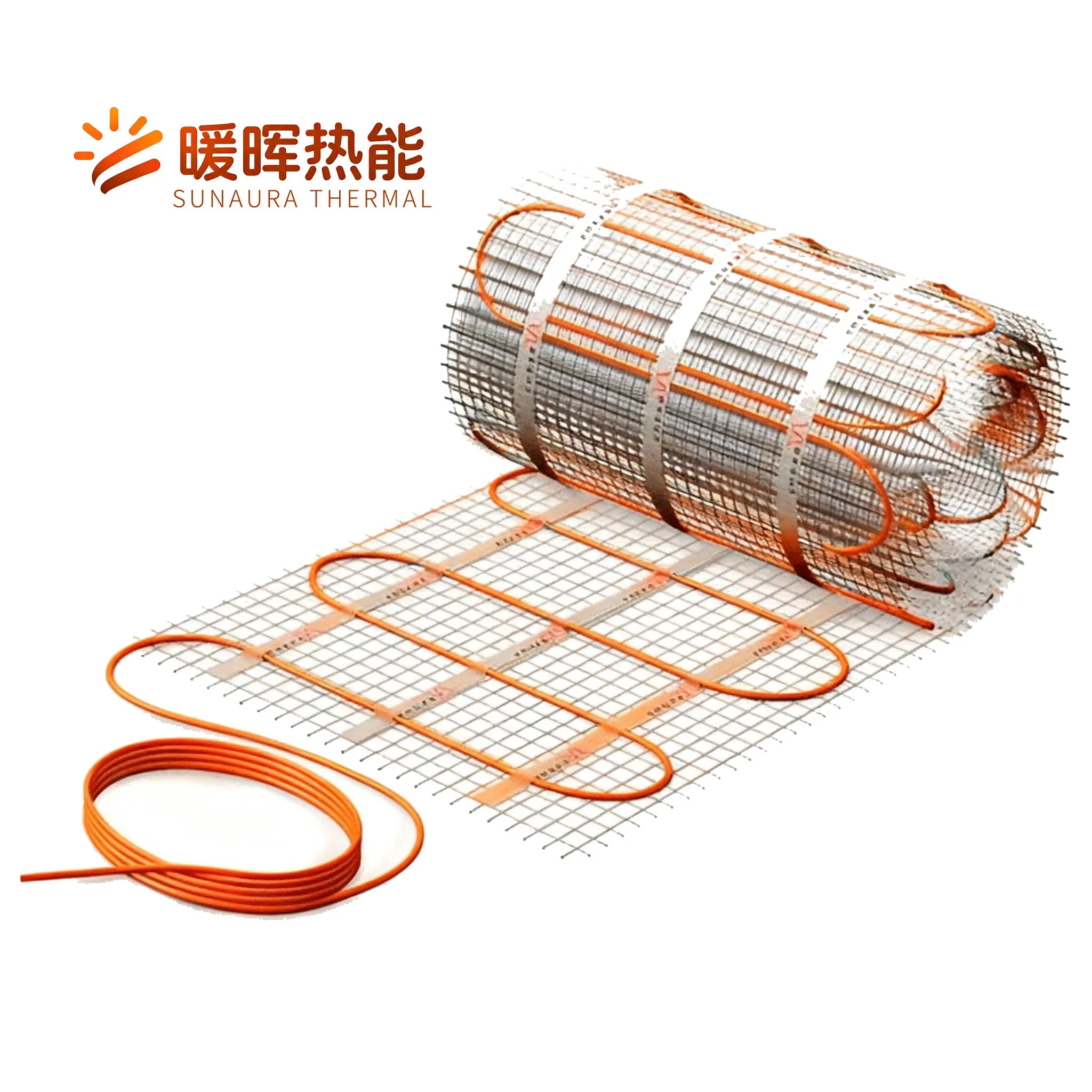
Electric Heating Mats
Self-adhesive 160 W/m² mats for ceramic and stone floors. 3.6 mm thin, EMF-free, 25-year warranty, ready to install under tiles.
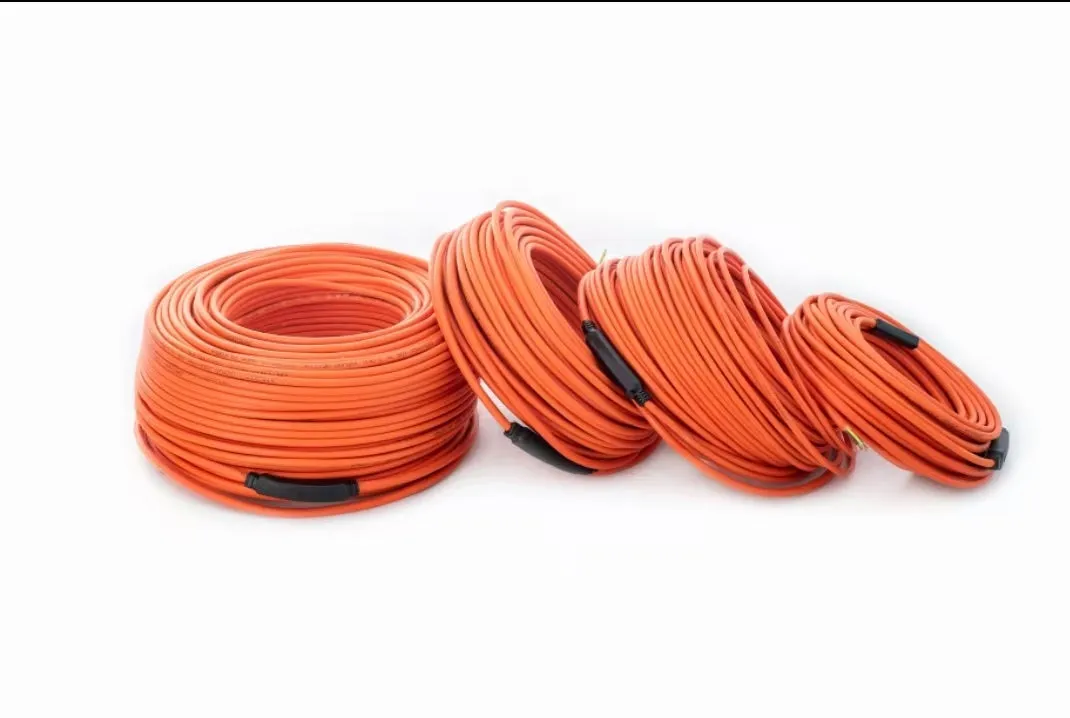
Heating Cables
Durable alloy-resistance cables for underfloor heating, pipe antifreeze, roof and road snow melting and equipment insulation. IPX8 rated.
Tile Floor Heating
Graphene film underfloor heating for ceramic, porcelain and stone floors — fast warm-up, EMF-free, no screed required.
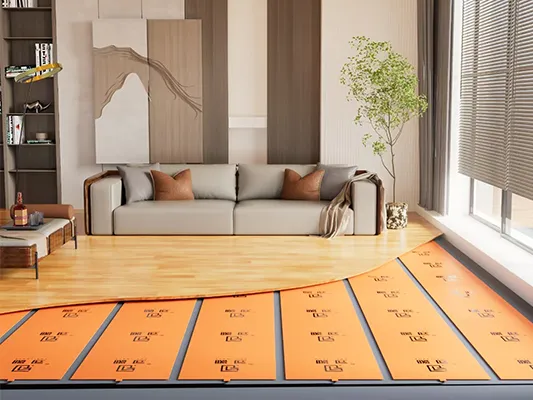
Wood Floor Heating
Low-profile film heating engineered for engineered wood and laminate floors, with insulation options for energy savings.