
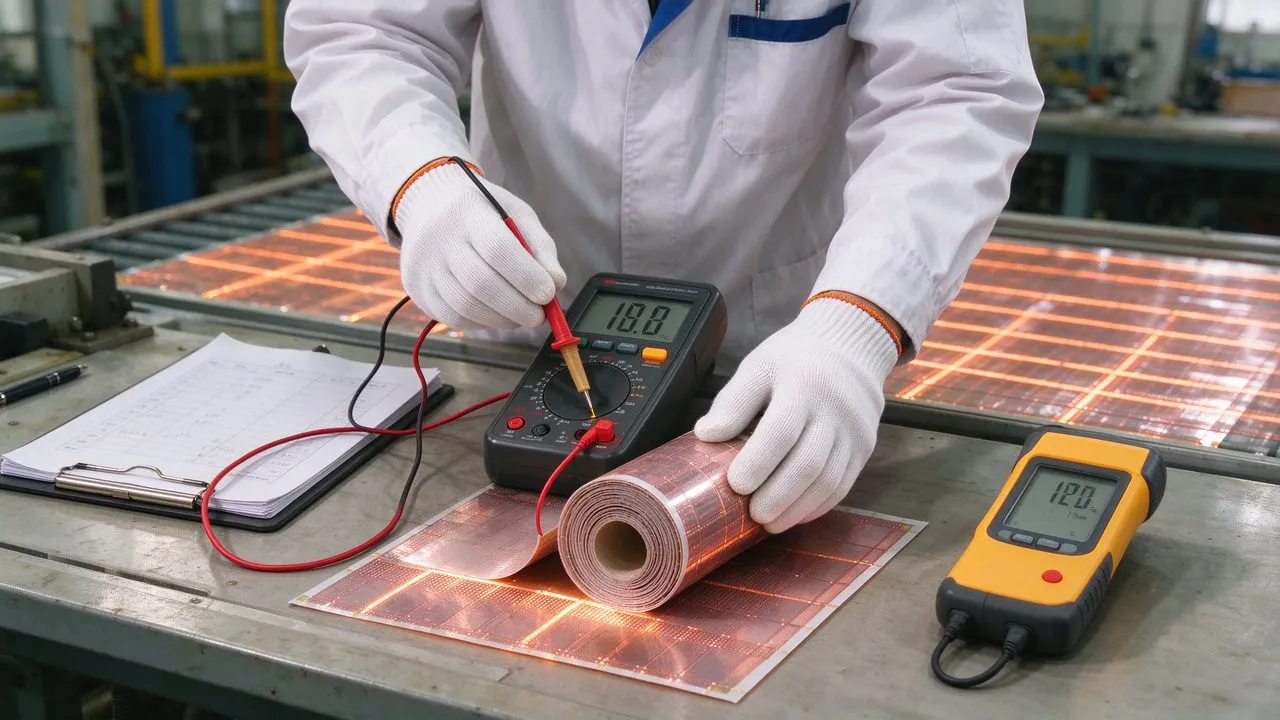
A heating element is a safety-critical product: it carries mains voltage, sits under a finished floor, and must perform reliably for decades. That is why factory testing is not a formality — it is the difference between a heating product you can stand behind and one you cannot. This article explains how a serious manufacturer validates every heating element before shipment, and specifically what happens inside the SunAura Thermal factory in Qingdao before any heating element factory testing quality control process signs a batch off for export.

Why Testing Matters More Than the Element Itself
Underfloor heating elements are hidden products. Once the floor covering goes down, nobody can see the element, adjust it, or repair it without lifting the floor. The only protection the end customer has is the quality of what was tested at the factory and the competence of the installer. A single defective element means an expensive floor tear-out, a dissatisfied homeowner and a damaged reputation for the distributor who sold it. Factory testing is therefore the backbone of the whole warranty chain — and buyers should treat documented test procedures as a specification item, not a sales claim.
The Testing Stages: From Raw Material to Packed Roll
1. Incoming Material Verification
Quality control starts before production. Copper conductors, aluminum carriers, insulating films and laminating adhesives are checked against incoming specifications — conductor gauge, insulation thickness and material certificates. This stage filters out batch-level issues before they reach the production line, which is why the first quality question to ask a supplier is not “do you test?” but “what do you test before you start?”
2. In-Process Resistance and Insulation Checks
During lamination and assembly, elements are tested for electrical resistance against the designed value for their rated output. A resistance reading outside tolerance means wrong output per square metre — a comfort and safety issue. In parallel, insulation resistance is checked between the heating conductor and the outer surface; this is the test that protects users from any contact hazard. These in-process checks catch problems while the material can still be reworked.

3. Dielectric Withstand (High-Voltage) Testing
Every production batch of SunAura heating elements undergoes a dielectric withstand test — a high-voltage stress applied between the live conductor and the outer insulation for a defined period (per SunAura factory records, 3 kV for one minute per batch). This is the test that proves the insulation will hold up under real operating stress and under fault conditions. It is the same class of test referenced in IEC standards for heating appliances, and it is why quality control electric heating products documentation always lists the withstand voltage prominently.
4. Thermal Imaging and Heat Distribution Pass
Sample mats from every batch are energised under controlled conditions and scanned with a thermal imaging camera. The scan confirms even heat distribution across the surface — no hot spots, no cold zones, no element kinks hidden under the lamination. Even heat distribution is what separates a comfortable system from one with warm and cold patches, and it is a quality signature that buyers can request as part of their incoming inspection.

5. Final Inspection and Packing
Before packing, each finished roll receives a final visual inspection — cold lead integrity, connector condition, labelling and length confirmation. Packed cartons are then staged for shipment with batch traceability records, so every roll can be traced back to its production date, line and test results. That traceability is what makes a written warranty meaningful: a claim can be investigated against real factory data rather than goodwill.

What Certification Actually Covers
Certification is the public, third-party layer on top of factory testing. SunAura Thermal’s Qingdao Huangdao plant operates under ISO 9001 (quality management), ISO 14001 (environmental management) and ISO 45001 (occupational health and safety), and the product range carries CE and RoHS documentation, with LVD and EMC compliance tested per market requirements (per SunAura factory records). Our CE and ISO certification article explains the scope in detail; the short version is that certification documents the system, while factory testing validates the product — buyers should ask for both.
How Buyers Can Verify Factory Quality
- Request the test procedure and the pass/fail criteria for each test stage — a serious manufacturer shares these.
- Ask for batch traceability: can the supplier trace any roll back to its production date and test record?
- Ask for the withstand voltage and insulation resistance figures in writing — vague answers are a red flag.
- Specify an incoming inspection protocol with your distributor or as part of your graphene heating film or electric heating mat purchase order.
- Visit the factory or request a video walkthrough — our factory tour article shows the production floor.
Data and Evidence: What We Test Before Shipment
Every SunAura heating element batch shipped from our Qingdao Huangdao factory passes the following before the carton is sealed (per SunAura factory records): resistance measurement against rated output, insulation resistance test, dielectric withstand at 3 kV for one minute, thermal imaging on sample mats, cold-lead integrity check, and final dimensional and labelling verification. We have manufactured heating products since 2008 — 17 years — and export to more than 50 countries, with OEM/ODM programs that apply the same test protocol to private-label products as to the SunAura brand. If you are sourcing heating elements under your own brand, ask for the same documentation; ISO certified heating element OEM partners supply it as standard.
Frequently Asked Questions
Can I get the test data for my order? Yes — batch test summaries are available per order, and full traceability records can be provided under NDA for OEM partners.
How do I test elements on site before installation? Measure the resistance between the two cold leads with a multimeter and compare it to the value printed on the label; check insulation resistance between either lead and the foil/carrier with an insulation tester. Our installation guides include the expected values.
Does the test protocol differ for OEM orders? No — OEM products run the same line, the same tests and the same traceability. That is a contractual point we put in writing for every heating cable and film OEM program.
What warranty do factory-tested elements carry? Warranty terms are confirmed per order in writing, typically 10–25 years by product family, backed by the factory test and traceability records described above.
The Test Record: What a Batch File Should Contain
When a manufacturer tells you “we test everything”, ask to see the record format. A credible batch file contains: the batch number and production date; the product model, rated voltage and rated output; the resistance measurement for each roll against its designed value; the insulation resistance figure; the dielectric withstand voltage and duration; the thermal imaging or heat distribution result on sample mats; the inspector’s name or ID; and the pass/fail decision for the batch. SunAura Thermal maintains this record for every production batch at our Qingdao Huangdao factory, and batch summaries travel with the order documentation (per SunAura factory records). When you receive a container of heating elements, the batch file is what turns a warranty claim from a negotiation into a data lookup — for you and for us.

Why OEM Buyers Should Audit Factory Testing
If you source heating elements under your own brand, the factory’s test standard becomes your product’s reputation. A distributor selling private-label heating film under its own brand cannot independently test every roll — the factory’s protocol is the entire quality chain. That is why OEM buyers should treat factory testing as a contractual specification: the test stages, the pass/fail criteria and the batch documentation should be written into the supply agreement, not assumed. Our OEM program applies the identical test protocol to private-label products and SunAura-brand products, and the batch records are available under NDA. When you compare OEM partners, ask which tests their private-label products actually pass — the answer tells you what your customers will experience.

Export Logistics: From Test Pass to Container Loading
Passing the tests is step one; getting the tested product to your warehouse without damage is step two. SunAura Thermal’s export process (per SunAura factory records) covers each stage: rolls are packed with protective edge protection, cartons are palletised and stretch-wrapped, and the export documentation — packing list, test summaries, certificates and the batch file — is assembled before the container is booked. With more than 50 export countries and 17 years of manufacturing, the shipping side of the business runs on the same traceability principle as the factory floor: every carton is identifiable back to its batch. For buyers, the practical question is whether the supplier’s documentation matches the shipment: when your incoming inspection checks batch numbers against the packing list, the process should close the loop without a single mismatch.

The Difference Between Testing and Certification
Buyers sometimes use “certified” and “tested” interchangeably — they are different layers, and you need both. Certification is the systematic layer: ISO 9001 documents the quality management system, CE and RoHS documents the product’s regulatory compliance for the EU market, and these are maintained over time through audits. Testing is the product layer: the actual electrical, thermal and safety checks performed on your batch before shipment. A factory can hold impressive certificates and still ship a bad batch if its daily testing is weak; it can test rigorously and still struggle with documentation if its management system is informal. The complete picture is certification and batch testing and traceability — which is why this article covers all three rather than stopping at the certificates.
Frequently Asked Questions
Can I visit the factory or audit the line? Yes. Factory visits and line audits can be arranged for serious buyers; video walkthroughs are available for first evaluation. Our factory tour article shows the production floor from the outside.
Do all product families follow the same test protocol? The six test gates described here apply across heating film, heating mat and heating cable families, with parameters matched to each product’s rating. OEM products run the identical protocol.
What documents ship with each order? Packing list, batch test summary, certificates for the product family, and traceability records under NDA for OEM partners. Your incoming inspection can verify batch numbers against the packing list on arrival.
Building the Quality Habit into Your Supply Chain
The strongest quality programmes are habits, not documents. On the factory side, that means testing at every stage — incoming material, in-process, withstand, thermal, final — as a routine rather than a special event, and recording results against batch numbers without exception. On the buyer side, it means checking every incoming shipment against the batch file, spot-testing resistance on sample rolls before they go to site, and logging any deviation immediately instead of in the post-season review. When both sides run these habits, defects are caught at the boundary where they are cheapest to fix — before installation, before a floor covering goes down, before an end customer is affected. That is the practical meaning of a quality-assured supply chain, and it is available to any buyer willing to specify it in the purchase order.
In short, factory testing is the quiet infrastructure behind every reliable heating product: certification proves the system, batch testing proves the product, and traceability proves the batch. Specify all three in writing and your incoming quality becomes predictable rather than hoped for.
Ask the five questions, review the batch file, and the quality conversation becomes concrete — measured, documented and auditable from factory floor to finished floor.
Conclusion
Quality is not a certificate on a website — it is a documented chain of tests that begins before production and ends only when the carton is sealed. Resistance, insulation, withstand voltage, thermal distribution, final inspection and batch traceability are the six gates every heating element should pass, and buyers who specify them in writing protect their projects, their customers and their brand. Partner with a quality assured heating element factory that treats testing as part of the product, and the warranty becomes something you never need to use.
About the author: Ethan Sun is the Founder and CEO of SunAura Thermal, a heating-systems manufacturer based in Qingdao, China. Under his leadership the company has grown from a single workshop into an ISO-certified factory exporting electric underfloor heating, heating cable, heating film and snow melting products to more than 50 countries worldwide.