
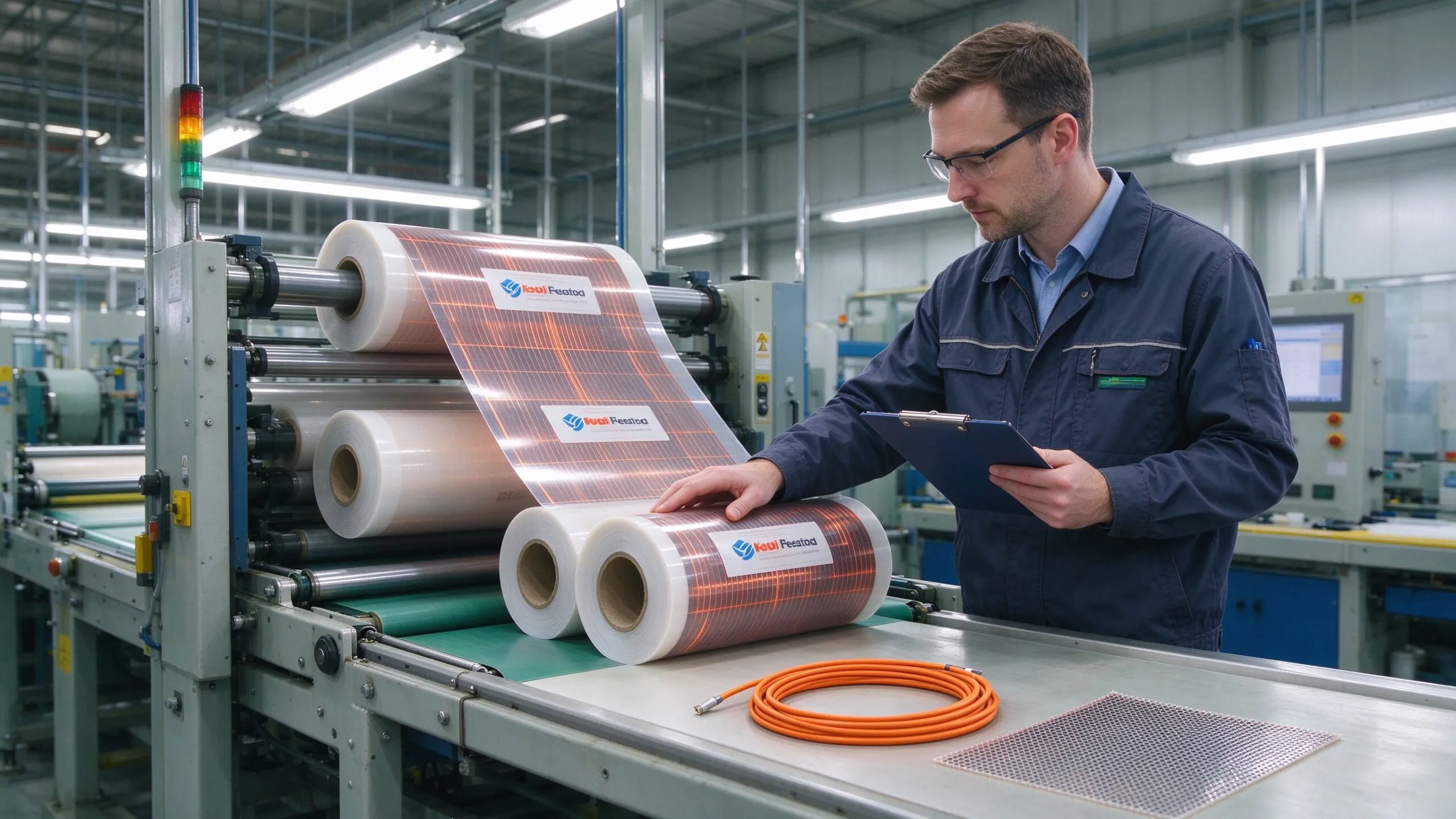
Marca branca is how many heating brands are built. Behind well-known floor-heating brands sits a factory that designs, tests and manufactures the product, while the brand owner focuses on market, sales and service. This article explains how OEM works at a heating manufacturer — the capabilities, the process and what to check before signing an OEM agreement. Written by Ethan Sun, Founder & CEO, SunAura Thermal.
What OEM Means in Underfloor Heating
OEM — original equipment manufacturing — in the heating industry means a factory produces products that carry the buyer’s brand. The buyer defines the market, the specifications and the target price; the factory provides the engineering, the manufacturing, the testing and the compliance documentation. The buyer owns the brand; the factory owns the production.
In underfloor heating, the model covers every product family:
- Heating film — branded rolls, custom widths and wattages, matched thermostat and sensor sets.
- Heating mat — branded mesh mats, custom cable lengths and spacing, private-label packaging.
- Heating cable — branded cable runs for floor and pipe heating, custom cold-lead lengths and terminations.
- Thermostats — branded controllers with the buyer’s firmware settings, display branding and packaging.
The commercial logic is straightforward: the buyer avoids the capital cost of a factory and the years of process development, and instead invests in market building. The factory concentrates production volume and testing across many brands, which keeps unit costs competitive — the same reason heating mat OEM is how several large European mat brands are actually supplied.
Why Buyers Choose an OEM Heating Manufacturer
Four reasons come up consistently in OEM conversations with our partners:
- Speed to market — a buyer with a sales channel can launch a branded heating line in weeks, not the years a factory build would take. Samples, adjustments and first production run happen against a short calendar.
- Specification control — the buyer specifies the wattage, the size matrix, the colour, the packaging and the documentation language; the factory executes the specification rather than deciding it.
- Quality leverage — a factory with certified quality systems and per-unit test records hands the buyer a quality story that would be hard to build from scratch: test data, factory records and compliance documentation come with the product.
- Cost predictability — with an agreed specification and volume, the unit cost is stable; the buyer plans margins against a fixed cost base rather than variable production costs.
For distributors entering a new market, OEM is often the difference between competing on price with generic stock and competing with a branded product that carries its own margin and loyalty. That is why private label underfloor heating is the standard growth path for many heating retailers.
What an OEM Manufacturer Should Provide
A serious OEM partner is not just a production line. The capability list a buyer should check:
| Capability | What it means for the buyer |
| Engineering support | Layout drawings, zone sizing, specification advice before production |
| Sample and pilot runs | Pre-production samples for market testing and certification |
| Custom specification | Wattage, dimensions, voltage, cold-lead length, colour and branding |
| In-house testing | Resistance, insulation and surface-temperature records per unit |
| Compliance documentation | CE, RoHS, LVD, EMC and ISO documentation transferable to the brand |
| Packaging and branding | Private-label packaging, manual and documentation in the buyer’s language |
| After-sales support | Factory support channel for the buyer’s installers and end customers |
Documentation matters more than most buyers expect. In the EU, the responsible economic operator obligations follow the brand owner’s market entry route, and the compliance documentation must transfer with the product. When we supply OEM orders, the documentation file is assembled in the brand’s name where the market requires it — so the buyer’s compliance story is complete from day one (per SunAura factory records, the CE and RoHS documentation covers the full product range).
The OEM Process: From Enquiry to Container
A typical OEM project runs through six stages:
- Enquiry and specification — the buyer sends the target product, market, voltage, wattage and volume; the factory confirms feasibility and the specification sheet.
- Sample — a pre-production sample is made against the specification; the buyer tests it in the market and requests adjustments.
- Approval — the final specification, artwork for packaging and documentation language are locked and signed off.
- Production — the order goes into production with per-unit test records and batch traceability.
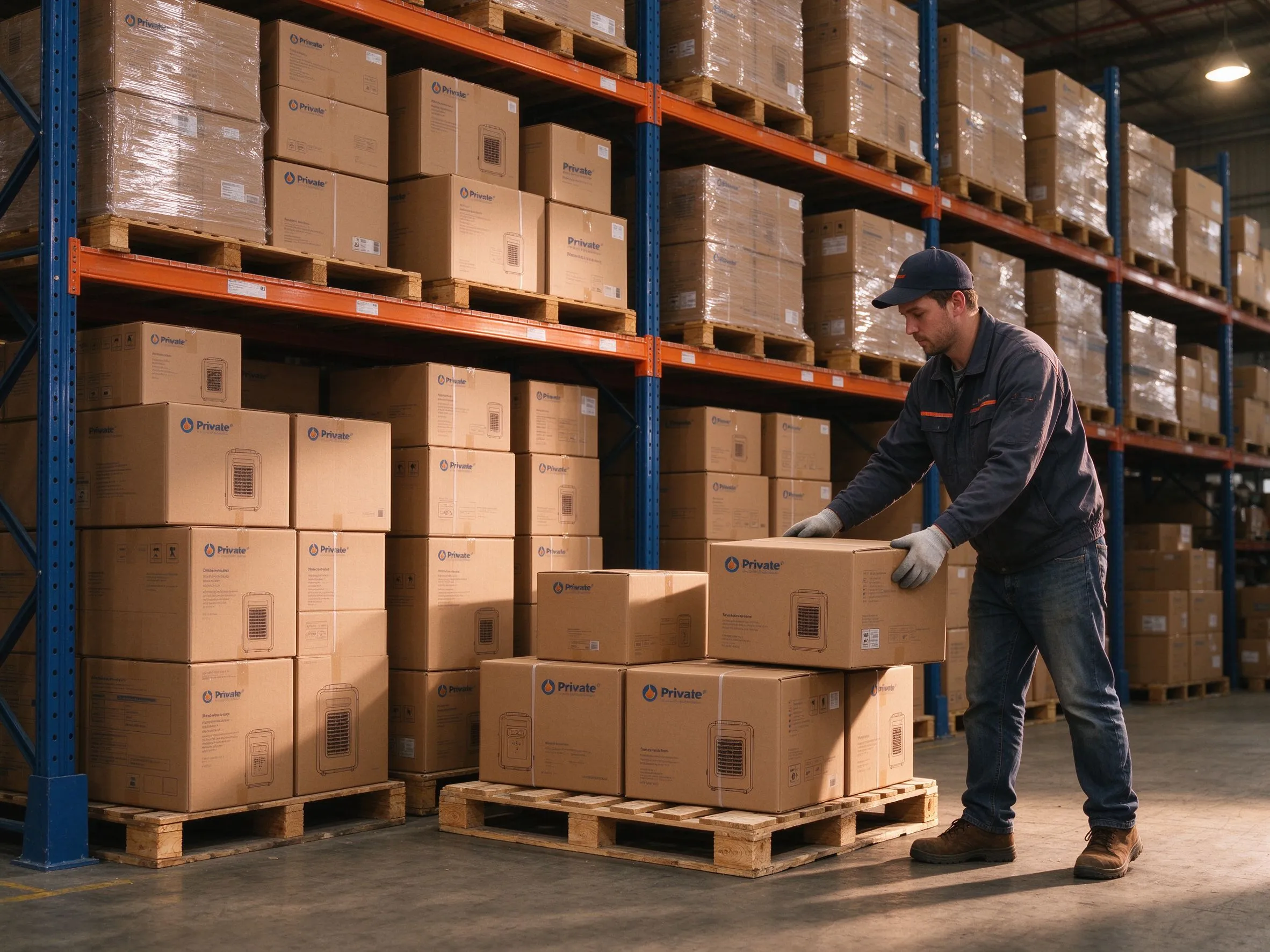
- Inspection and packaging — the buyer’s inspector or a third party checks the batch against the specification; private-label packaging is applied.
- Shipping and support — the order ships with the documentation file, and the factory support channel remains active for the buyer’s market.
The two decisions that make or break an OEM project
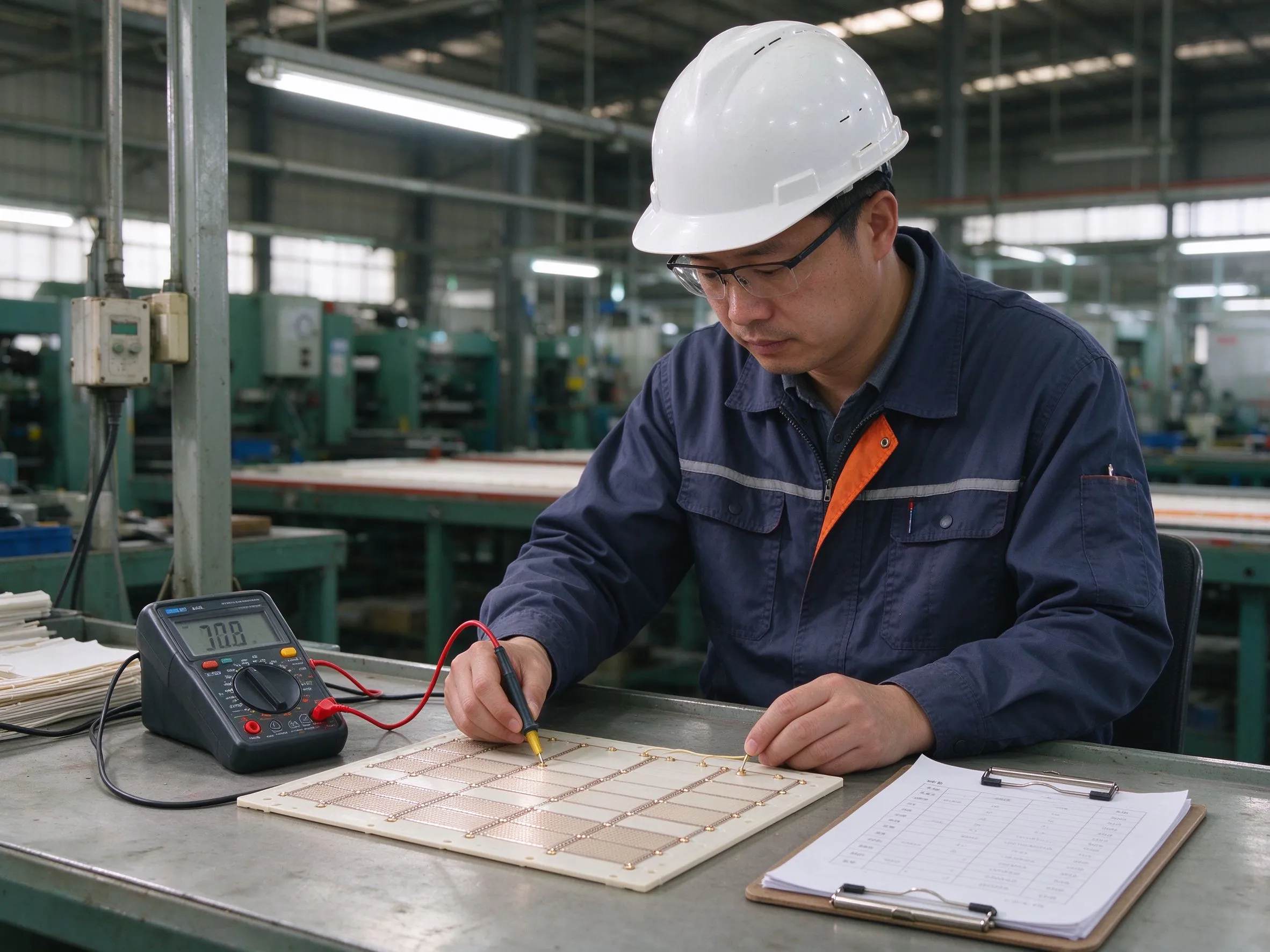
are the specification lock and the inspection step. A vague specification produces a vague product; an inspection step that is skipped produces surprises at the customer’s door. Both are standard practice in our custom heating element manufacturing program, and both are written into every OEM agreement we sign.
Quality and Compliance Under Your Brand
The compliance story of an OEM product
is built at the factory, then carried by the brand. What the buyer should expect in the documentation file:
- ISO 9001 quality management, ISO 14001 environmental management and ISO 45001 occupational health & safety certification covering the production facility (per SunAura factory records).
- CE, RoHS, LVD and EMC declarations for EU-bound orders, transferable to the brand owner under the agreed market entry route.
- Per-unit test records: resistance and insulation checks recorded for every mat, film and cable batch before packing (per SunAura factory records).
- Batch traceability so a market issue can be traced to a production date and batch, not to a brand reputation.
For the buyer, this documentation is the difference between selling “a heating mat” and selling “a documented heating product”. Our CE and ISO dual certification article explains how the certification base is maintained across the complete range.
17 Years of OEM Manufacturing Behind the Brand
OEM is not a side business for us — it is how the factory has worked since 2008. Seventeen years of manufacturing means the process, the tooling and the test discipline are mature, and the product families have been refined through many market cycles. The factory in Qingdao’s Huangdao district runs heating film, mat, cable and thermostat lines, with in-house testing and export documentation built into the flow (per SunAura factory records).
For a buyer, that history is a de-risking factor: the partner has seen specification changes, voltage corrections, packaging redesigns and market compliance shifts before, and the support channel reflects it. Our export record — 50+ countries across Europe, North America, Latin America, the Middle East and Southeast Asia — means the documentation formats and shipping routes are already proven.
Data and Evidence
This article is written from the OEM operating practice of SunAura Thermal (per SunAura factory records). Supporting facts about the manufacturer:
- 17 years of continuous heating manufacturing since 2008, based in Qingdao’s Huangdao district (per SunAura factory records).
- ISO 9001 quality management, ISO 14001 environmental management and ISO 45001 occupational health & safety certification covering the product range.
- CE, RoHS, LVD and EMC compliance for EU-bound orders; documentation provided with every shipment and transferable to OEM brand owners under the agreed market entry route.
- Products exported to 50+ countries across Europe, North America, Latin America, the Middle East and Southeast Asia.
- Every mat, film and cable batch is tested before packing, with resistance and insulation checks recorded per unit (per SunAura factory records).
No third-party certifications, logos or claim numbers are referenced beyond those listed above.
Thermostat OEM: Why Control Completes the Range
Many OEM buyers start with film or mat and discover that control is the piece that makes the range complete. A branded thermostat ties the element to the user experience — the product the end customer actually touches — and it protects the brand’s margin better than the element alone, because control carries more perceived value than heating wire.
Thermostat OEM at our factory covers more than relabelling:
- Firmware and behaviour — set points, schedule defaults, display language and operation modes are configured to the buyer’s market. A European bathroom thermostat and a North American garage thermostat legitimately behave differently.
- Voltage variants — 120 V and 240 V versions, plus the sensor types the element range needs (floor probe, room sensor or both).
- Branding and packaging — display branding, packaging, manual and documentation in the buyer’s brand and language, matching the element range’s visual identity.
- Compliance documentation — the same CE, RoHS, LVD and EMC documentation discipline that covers the elements extends to the control line (per SunAura factory records).
The commercial effect is a complete branded system: element, sensor, thermostat and manual all carrying one brand, one support channel and one specification file. That is the difference between selling heating components and supplying a branded heating solution — and it is the most common upgrade path we see from element-only OEM buyers.
Frequently Asked Questions
What is the minimum order for OEM heating products?
MOQ depends on the product family and specification — film rolls, mat sizes and cable runs are manufactured to the buyer’s matrix, so the MOQ is set against the volume that makes custom production practical. Send the target specification and market volume for a concrete MOQ and lead time.
Can I order a sample before committing to an OEM contract?
Yes, and we recommend it. A pre-production sample is made against your specification so you can test fit, finish and performance in your market before locking the production specification.
Will the factory put my brand on the packaging and manual?
Yes. Private-label packaging, user manuals and compliance documentation are produced in the buyer’s brand and language as part of the OEM program. The artwork is approved before production.
How does the buyer’s compliance responsibility work with the factory’s certifications?
The compliance documentation is assembled to support the brand owner’s market entry route — in the EU, that is the responsible economic operator model. Our documentation file transfers with the product, and the engineering team advises on what the buyer must hold for the destination market.
How long does the OEM process take from first enquiry to shipping?
For a standard product with minor branding changes, samples and first production typically complete within weeks of specification approval; fully custom products take longer because tooling and testing are involved. The timeline is stated in the quotation and reviewed at each stage of the process.
Can OEM buyers sell the same factory’s products in the same market as the factory’s own brand?
Market-exclusivity terms are agreed in the OEM contract. In practice, OEM buyers and the factory’s own brand rarely target the same customer segment — the factory’s own channel serves distributors directly, while OEM buyers typically position their brand in their own distribution network. The agreement defines the boundaries so both sides compete in their own lanes.
What to Ask an OEM Partner Before Signing
Before committing, the questions worth putting to any OEM partner are: what are your per-unit test records, and can I see a sample batch record? What documentation transfers with the product under my market’s entry route? What is the specification-lock process when I request changes mid-production? What support remains after the container ships? The answers separate a factory that treats OEM as a product line from one that treats it as an ongoing partnership — and the difference shows up in the customer’s first complaint, wherever that lands.
One final note on timing: OEM capacity is not unlimited. The factory runs a defined production calendar, and custom specifications are scheduled in advance — which is why early conversation is worth more than a last-minute order. A buyer who starts the specification discussion before the market launch season gets the samples, the approval cycle and the first production run finished calmly, instead of compressing every step against a launch date. The same discipline applies on our side: the engineering team reserves capacity around the agreed calendar, so both sides know what ships and when.
Start an OEM Conversation
If you are building a heating brand — or expanding an existing range — send the target products, market and volume to our OEM team. You will receive a specification sheet, sample terms, MOQ and lead time, plus the documentation list for your market. Email [email protected] or message the export team on WhatsApp to start.