
By Ethan Sun, Founder & CEO, SunAura Thermal | Published October 18, 2026
Why RF Wireless Thermostats Are Gaining Ground in 2026
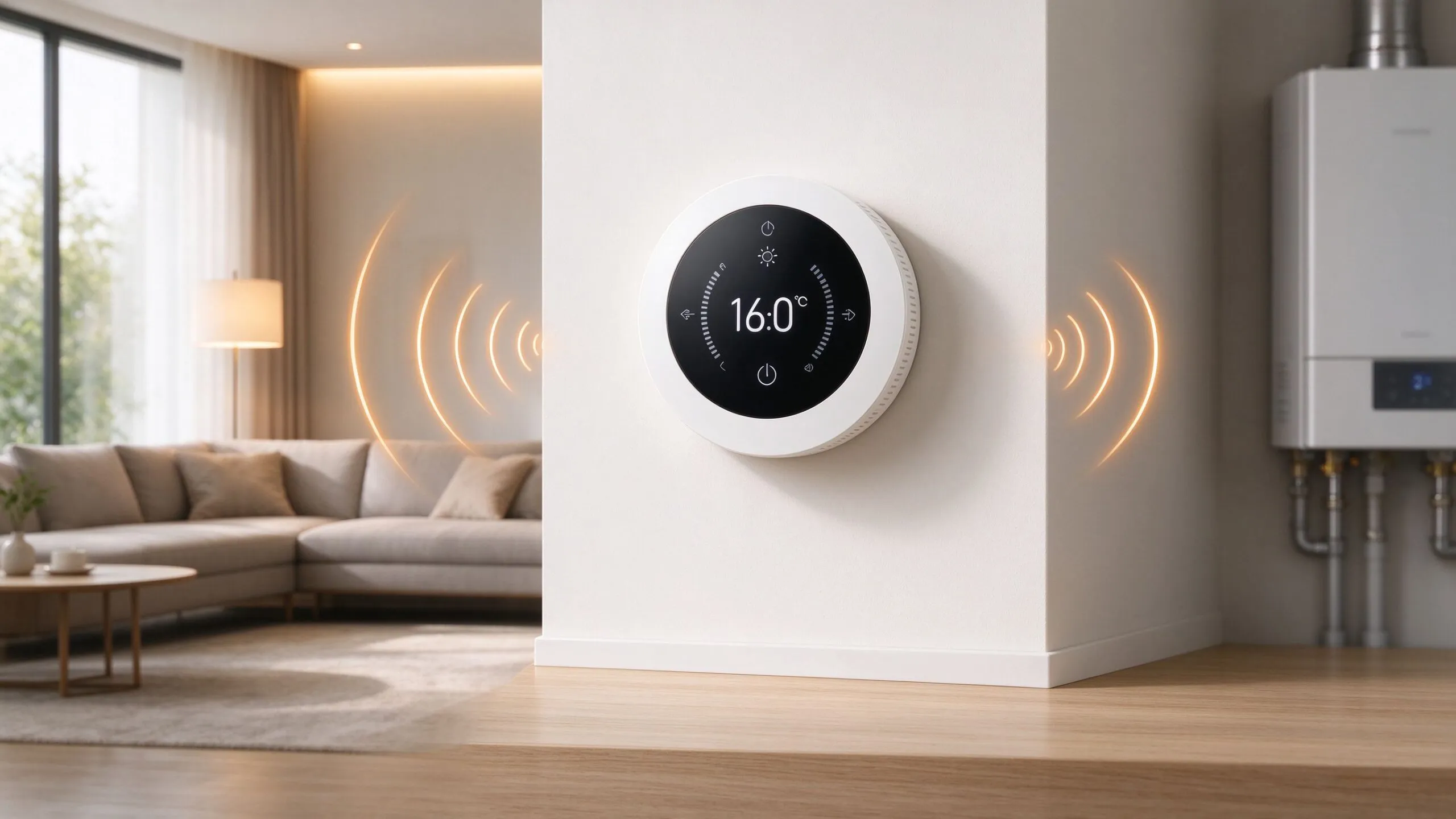
For installers and property owners alike, the wiring run between a thermostat and the heating appliance has always been the most fragile part of an electric floor heating project. Cables get buried in walls, chased into screed or routed through cold voids, and every metre of that wire is a potential failure point, an aesthetic compromise and a labour cost. The RF wireless thermostat removes that run entirely: the wall-mounted room unit talks to a receiver at the boiler or the load side over a licence-free radio link, so the temperature control signal travels through air instead of copper.
At SunAura Thermal we have shipped more than 1.2 million heating elements and thermostats to 50+ countries since 2008, and in the past three years the share of wireless controls in our export mix has grown every single year. The reason is practical: for retrofit projects, for concrete-floor installations where chasing walls is expensive, and for multi-zone homes where a single wired controller cannot reach every room, a wireless thermostat for floor heating shortens installation time, cuts material cost and keeps the clean look homeowners ask for (per SunAura factory records).
How Radio-Frequency Thermostat Communication Works
An RF thermostat system is made of three parts: a room thermostat with a built-in radio transmitter, a receiver that switches the heating load, and the pairing protocol that keeps the two on the same channel. The thermostat measures room temperature and floor temperature (via a floor probe), compares it against the set point, and sends an ON/OFF command to the receiver.
The important engineering details are in the radio link:
- Frequency band — most residential systems use 868 MHz (Europe) or 433 MHz (many other markets), licence-free bands with good wall penetration.
- Range — a well-designed receiver holds a reliable link at 30–100 m in open space and through two or three internal walls, which covers typical homes.
- Power — battery-operated room units drawing microamps in idle mode run 18–24 months on two AA cells; the receiver is mains-powered at the load side.
- Pairing and security — modern units use rolling codes and unique pairing, so two neighbouring homes do not trigger each other’s heating.
A common question is whether RF control sacrifices reliability. It does not, provided the receiver has a fail-safe: if the radio link is lost, the receiver should either hold the last command or switch to a safe low-load state, and the thermostat should raise a link-loss warning. This behaviour matters more than the radio technology itself, and it is one of the points we test on every wireless boiler thermostat and floor-heating receiver that leaves our Qingdao factory.

RF Wireless vs. WiFi Thermostats: Choosing for the Job
RF and WiFi thermostats are often confused because both are “wireless”, but they serve different jobs and they are not mutually exclusive:
| Criteria | RF Wireless Thermostat | WiFi Thermostat |
|---|---|---|
| Local control without internet | Yes — fully local link | Usually depends on the app/cloud |
| Typical range | 30–100 m through walls | Depends on home WiFi coverage |
| Best for | Boiler/floor-heating on/off control, retrofit, multi-zone | Remote app control, scheduling, smart-home integration |
| Battery life (room unit) | 18–24 months | Often shorter with constant WiFi polling |
| Installation effort | No network configuration | WiFi setup required at commissioning |
For an installer quoting a renovation, the RF unit is usually the lower-risk recommendation: it works the day it is mounted, needs no customer WiFi password, and keeps working if the internet drops. Where a client wants remote control from a phone, our smart thermostat for underfloor heating range combines both — RF to the load and WiFi to the app — which is the configuration we most often ship for villa projects.
Installation and Commissioning of an RF Thermostat System
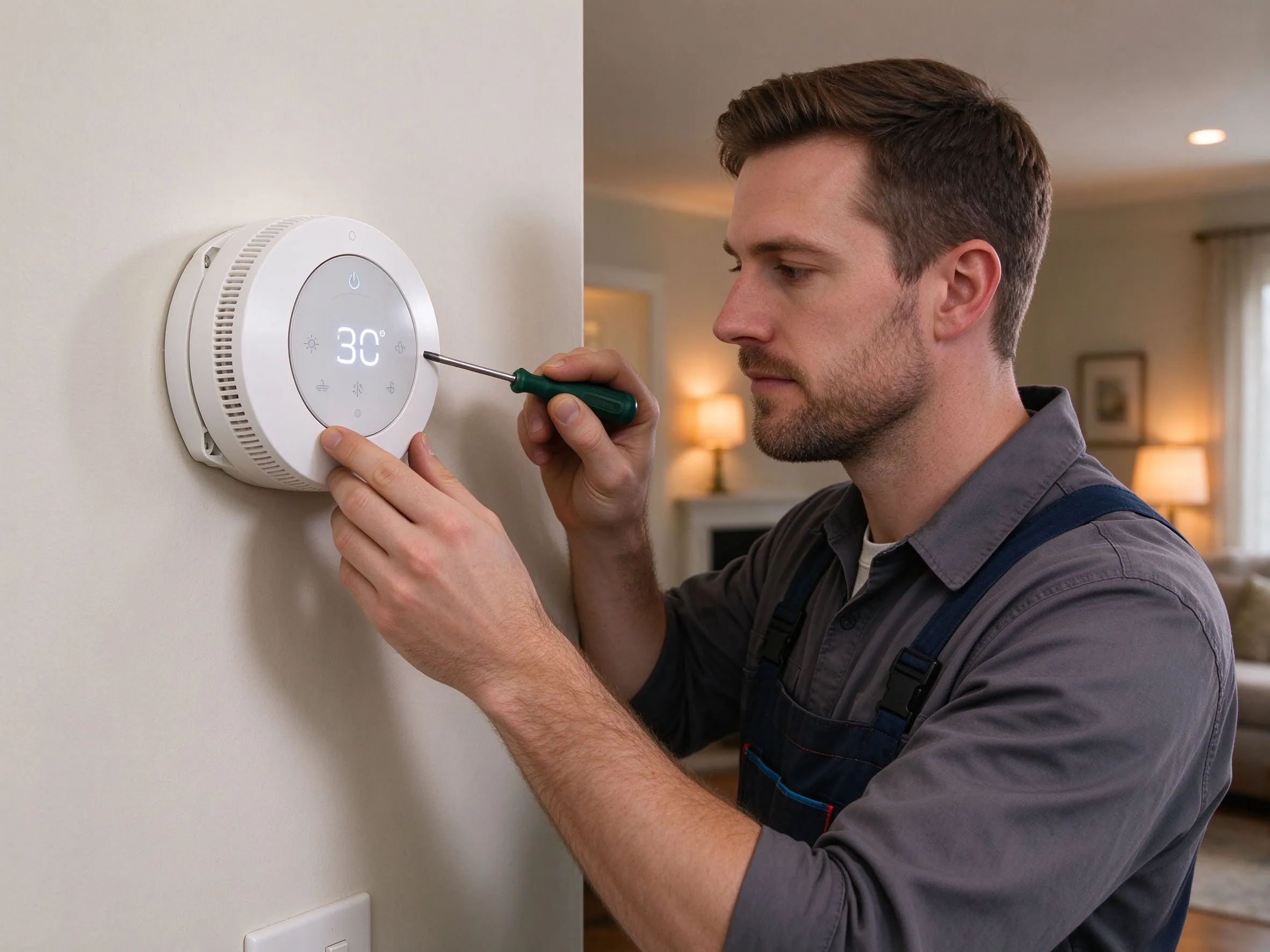
Commissioning an RF system is measurably faster than a wired one, but it still follows a strict sequence:
- Mount the receiver at the load side (boiler control circuit or relay box) and connect the heating load. The receiver stays powered at all times.
- Mount the room thermostat at 1.4–1.6 m height, away from heat sources, direct sun and cold draughts.
- Pair the units: put the receiver into learn mode, then confirm the thermostat link. Verify with a range test from the far end of the building.
- Fit the floor probe (if the model supports floor limiting) and confirm it reads ambient temperature before the floor is finished.
- Run a full heating cycle: call for heat, confirm the load switches, confirm set-point control, and check the link-loss fail-safe.
Our engineers publish the exact pairing sequence for every model in the installation manual, and our electric heating mat and heating film packages ship with the matching receiver options, so a distributor can stock one control family across the whole product range.
Data and Evidence: What Field Experience Shows
Numbers from our service records (per SunAura factory records) illustrate the difference:
- Average commissioning time for a single-zone RF retrofit in our logged projects: ~45 minutes including pairing, versus 2–4 hours when a cable run has to be chased into a finished wall.
- Return-rate contribution of wireless units in our thermostat service data over 2023–2026: below 1.5%, comparable to wired models — the radio link is not a reliability weak point when the receiver has a proper fail-safe.
- Battery life field reports on our RF room units: most customers report 18–24 months on two AA alkaline cells at normal duty cycles.
These are the same data points our engineering team reviews at every product iteration, and they are why we keep the RF receiver design (mains-powered, fail-safe, rolling-code pairing) stable across generations rather than chasing feature churn.
Selecting the Right RF Receiver for Your Project
The receiver is the part of the system that carries the load, so its rating must match the heating circuit, not just the thermostat. Two specification points dominate the selection:
- Switching capacity. The receiver relay must be rated for the connected load of the zone. A single 10 A receiver switches roughly 2300 W at 230 V, which covers a typical bathroom or bedroom floor; larger zones need a contactor or a higher-rated receiver. Under-sizing the relay is the fastest way to shorten receiver life, so our specification sheets list the maximum connected load per receiver model and the recommended contactor beyond that threshold.
- Output type. Most floor-heating receivers switch the load directly (ON/OFF control). For boiler control, the receiver usually provides a volt-free contact instead, so it can command the boiler’s own control circuit safely. Getting this right matters for wireless boiler thermostat installs: the contact type must match the boiler’s wiring diagram, and we publish the permitted wiring configurations for each receiver in the manual.
There is also a practical layout rule: mount the receiver where it can be reached for commissioning and for a future battery change, and keep the radio path clear of large metal masses (a boiler casing between thermostat and receiver can cut range noticeably). When in doubt, our engineers check the floor plan against the receiver’s stated range before shipment, and we adjust the receiver position recommendation on the layout drawing for large villas.
Long-Term Reliability: Battery, Range and Fail-Safe in Service
Field experience with RF systems teaches three maintenance habits that keep reliability high over a decade of service:
- Schedule the battery change. The room unit’s low-battery warning appears well before failure on our models, but a 24-month schedule on two AA cells removes the surprise entirely. Because the unit is battery-powered, changing it is a two-minute job that does not require an electrician.
- Retest the link after building changes. A kitchen renovation that adds a steel-framed partition can shorten the radio path. If a homeowner reports a thermostat that “occasionally ignores” changes, retest range before suspecting the electronics; in our service records, link degradation after building alterations is a recurring — and easily fixed — cause.
- Understand the fail-safe state. Our receivers default to OFF on link loss, which is the safe direction for a floor-heating load. Explain this to the end user: a lost link means the floor stops calling for heat until the link recovers, it never runs uncontrolled. This behaviour is documented in the manual and is a deliberate design choice, not a limitation.
These three habits are the reason RF systems in our installed base show field return rates comparable to wired models. The radio adds convenience; the engineering that matters is in the receiver design, the fail-safe and the documentation — which is where we concentrate the testing effort before every smart thermostat wholesale shipment leaves the factory.
Multi-Zone RF Systems: Wiring and Zoning Considerations
Once a project moves beyond a single room, the zoning decision is made on paper before any hardware is bought. Each zone needs its own thermostat and its own load path; the RF link does not change the electrical zoning, it only removes the control wires between rooms and the boiler/load side. Two principles keep a multi-zone design clean:
- One zone, one receiver path. A zone is defined by a single thermostat controlling a single load (or a group of loads switched together). If two rooms are heated from one thermostat, they are one zone and the floor layout must be sized as one — our electric floor heating mat installation guidelines show how to split mats and cables by zone without oversizing the connected load.
- Receiver location per zone. The receiver for each zone sits near that zone’s load or in a central control cabinet. Centralised cabinets keep all receivers and contactors in one accessible place — the preferred arrangement for villas — while distributed receivers shorten each radio path. Both are valid; choose based on where the electrical distribution board already is.
The radio side of a multi-zone system deserves the same care as the wiring. Each thermostat must pair to its own receiver channel, and the commissioning sheet should record which channel controls which zone. Our receivers use per-unit pairing rather than a shared house code, so adjacent installations cannot cross-trigger; the trade-off is that pairing must be done at commissioning, which is a two-minute step per zone and is covered in the manual and in our WhatsApp commissioning support.
For distributors quoting multi-zone projects, the practical recommendation is to treat thermostat, receiver and contactor as one matched kit per zone rather than assembling parts from different sources. Mismatched relays and contact types are the most common cause of multi-zone commissioning delays in our support records, and a matched kit removes that variable entirely.
Frequently Asked Questions
Does an RF thermostat work through underfloor heating screed and insulation?
Yes — the radio link travels between the wall-mounted thermostat and the receiver, not through the floor. The screed and insulation do not affect the link. The floor probe, if fitted, is a wired sensor, and its cable is specified in the manual.
Can two RF thermostats control one heating zone?
Some receivers support two room units for a single zone (average of two rooms). Our wiring diagrams show the permitted configurations; use one unit as master and the second as a linked sensor to avoid conflicting set points.
What happens if the receiver loses the radio signal?
A compliant fail-safe holds the last safe command and the thermostat shows a link warning. Our units default to OFF on link loss so the floor never runs uncontrolled.
Where to Source RF Wireless Thermostats Wholesale
For distributors and OEM brands planning a winter season launch, the practical route is a smart thermostat wholesale order with factory support: custom frequency settings per market, private-label faceplates, bilingual manuals, and a warranty handled directly by the manufacturer. SunAura offers factory-direct pricing with volume discounts, MOQ-friendly batches and lead times quoted against current production slots. Send your target market and voltage details through the contact form, and our engineering team will confirm the correct RF receiver variant and documentation set for your region.