
By Ethan Sun, Founder & CEO, SunAura Thermal | Published October 18, 2026
A New Layer of Regulation Is Changing How Heating Products Are Sold
Since the EU Energy Labelling Regulation (EU) 2017/1369 entered force, energy labels have become a fixed feature of heating appliance shelves. Electric underfloor heating products now sit inside a tightening framework: the Ecodesign rules for local space heaters (Commission Regulation (EU) 2015/1188, as amended) set minimum efficiency and maximum standby requirements, and the energy label tells the installer at a glance which underfloor heating energy label class a product carries. For a buyer comparing suppliers, that label is no longer a marketing extra — it determines whether a product can legally be placed on the market in the EU at all.
The practical consequence for importers is direct. Products below the Ecodesign threshold cannot be sold legally in the EU, period. Products at the top of the class become the easy recommendation for contractors bidding on energy-conscious projects and for developers responding to tightening building energy performance requirements. That is why our engineering team has treated energy efficiency data as a first-class spec for every electric heating mat, heating film and thermostat we export to Europe.
What the ErP Ecodesign Rules Actually Require
For electric underfloor heating elements, the relevant requirement set is the local space heater family of the Ecodesign regulation. The headline obligations are:
- Minimum seasonal space heating efficiency — electric local space heaters must reach a defined seasonal efficiency threshold to be placed on the EU market; the calculation follows the standardised seasonal energy efficiency (ηs) methodology.
- Maximum standby and off-mode power — control devices must not exceed the standby power limits when idle, which pushes manufacturers to design lean electronics rather than always-on displays.
- Product information — technical documentation must state the rated output, efficiency and control class used in the calculation.
- Declaration of conformity and CE marking — compliance is documented in the technical file and the product carries CE marking with supporting documentation (LVD, EMC and RoHS apply to the electrical product as a whole).
None of this is optional for a compliant EU launch. A distributor who imports a non-compliant batch faces customs hold-ups and withdrawal risk, which is why asking for the ErP energy label electric heating documentation before ordering is the single most useful due-diligence step a buyer can take.
How to Read the Energy Label and What the Classes Mean
The label on an electric heating product shows the seasonal space heating energy efficiency class (A+++ down to G on the current scale for space heaters), the rated heat output, the control class and the sound power level where relevant. Two products with identical wattage can sit in different classes purely because of control quality — a unit with an electronic thermostat, floor probe and adaptive control earns a better class than the same element with a simple mechanical switch.
This is where the buyer’s calculation changes. For an installer selling to a homeowner who cares about running cost, the energy class electric underfloor heating is a sales argument backed by a legal document, not by marketing copy. For a project developer, better class can feed into building energy calculations and help a building meet its target primary-energy figure.
What This Means for Buying Decisions and Product Selection
In practice, the label changes the buying conversation in three ways:
- Spec first, price second. Contractors now ask “what class is it?” before “what does it cost?”, because the class is locked into the building file.
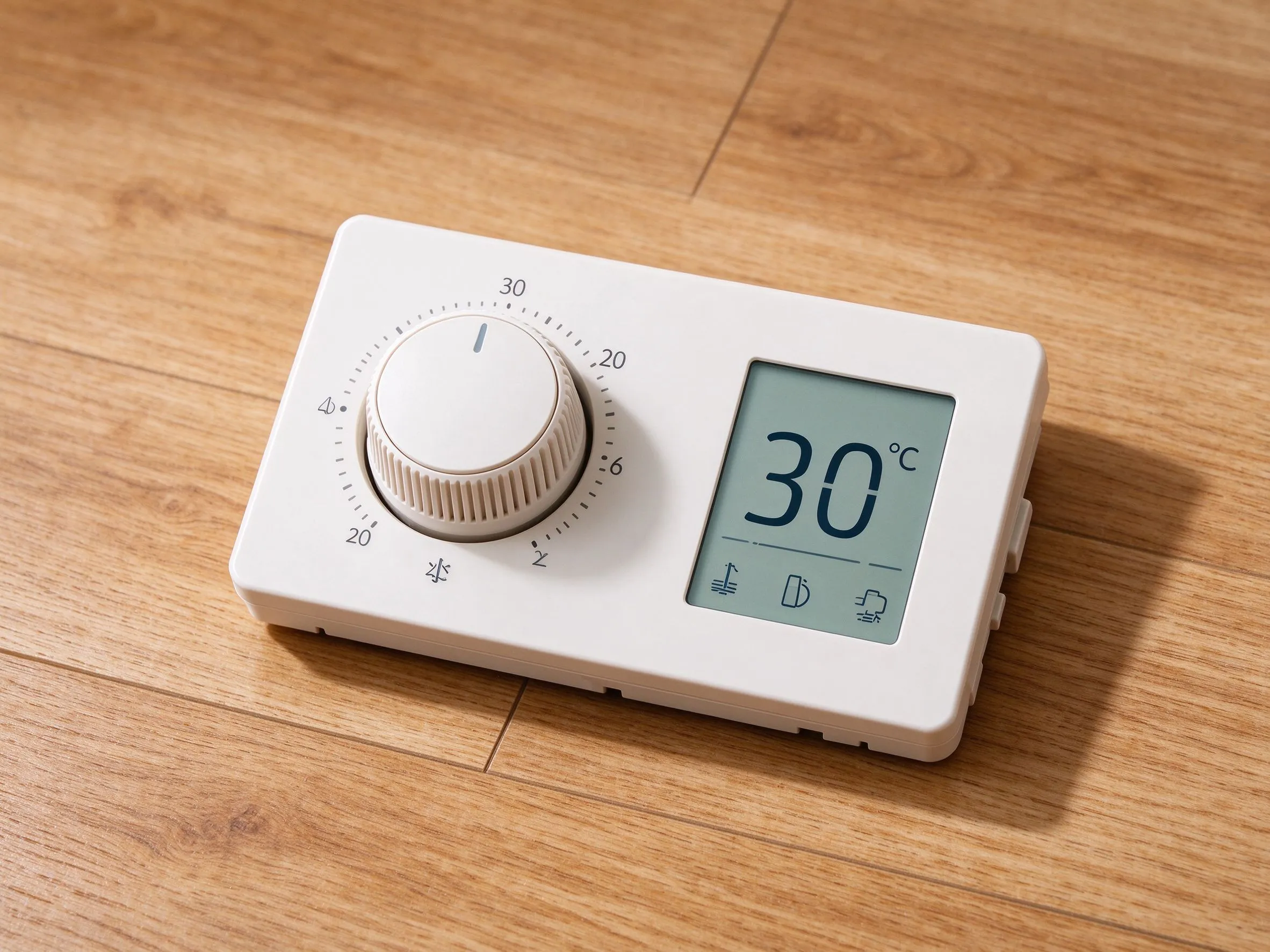
- Control electronics matter more than ever. The difference between a basic thermostat and a floor-probe-controlled unit is now a label class, so the thermostat choice becomes part of the product spec, not an accessory decision.
- Documentation is part of the product. A compliant supplier hands over the efficiency calculation, DoC and test evidence as standard paperwork. A supplier who cannot produce it is a red flag.
For our electric heating cable and mat ranges, we maintain the efficiency and control documentation as part of the product file for each market, and our smart thermostat for underfloor heating family is specified to keep the control class high when paired with the element — the pairing is designed, not incidental.
Data and Evidence: Compliance and Quality Benchmarks
Some numbers that frame the compliance discussion (per SunAura factory records):
- Our factory operates under ISO 9001, ISO 14001 and ISO 45001 management systems, and the export documentation set for each EU-bound order includes CE, RoHS and the relevant product documentation; the plant has produced CE-compliant heating elements continuously since our EU export line was established.
- Across our 50+ export markets, EU-bound orders are checked against the current Ecodesign thresholds at quotation stage, so the class stated on the quote matches the class on the shipped product.
- Standby electronics on our current thermostat generation are designed to the applicable standby limits, which is one of the reasons the same control family serves both EU and non-EU markets without a hardware split.
External references buyers can verify themselves: the consolidated text of Regulation (EU) 2017/1369 (energy labelling) and the Ecodesign framework under Directive 2009/125/EC are published on EUR-Lex, and the applicable local-space-heater implementing measures sit under that framework. We cite these in our documentation so an importer’s technical team can audit the chain end to end.
Energy Efficiency in Practice: What the Running-Cost Difference Looks Like
The label class translates into real numbers once the system is running, and the comparison is more favourable to electric floor heating than many buyers assume. An electric heating element converts its input energy into heat at close to 100% at the point of use — there is no flue loss, no distribution loss and no standing pilot. What determines the bill is how long the element runs, and that is where control quality and insulation do the work.
- Control quality. A floor-probe-controlled thermostat with adaptive start holds the floor temperature instead of overshooting the air temperature. In our field data (per SunAura factory records), properly controlled electric floors run substantially fewer hours per day than uncontrolled or switch-only installations of the same wattage.
- Set-point and schedule. A 1 °C reduction in floor set point cuts the heating demand proportionally, and a weekly schedule that drops the floor overnight removes the biggest running-cost line item. This is exactly the behaviour built into our wifi thermostat for electric floor heating models — and it is one of the reasons the same control family lifts the energy class of the product it is paired with.
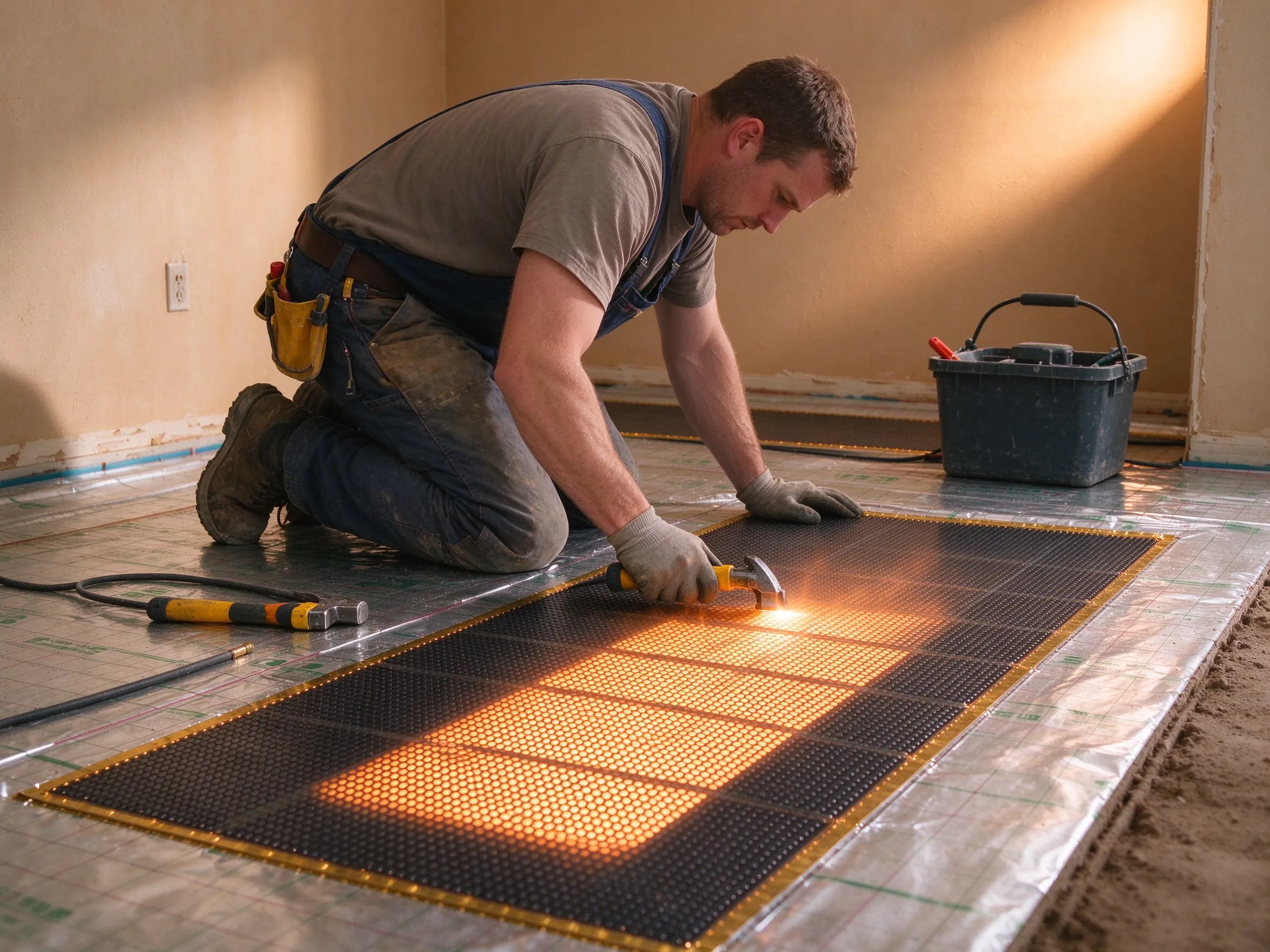
- Insulation below the floor. Insulation under the element is the single most cost-effective upgrade: it directs heat upward into the room instead of into the slab. A system with proper sub-floor insulation reaches set point faster and holds it with less energy.
The honest comparison for a buyer is not “electric versus gas” in isolation — it is the system-level figure: element efficiency, control class, insulation and schedule together. That system view is what the label framework pushes the market toward, and it is the view we present in every quotation that includes a thermostat recommendation.
How a Compliant Supplier Presents the Documentation File
A buyer should know what a complete compliance file looks like so the paperwork can be checked before money moves. For an EU-bound heating product order, the file a serious manufacturer provides includes:
- Declaration of Conformity — the manufacturer’s statement listing the directives applied (LVD, EMC, RoHS and the relevant Ecodesign measure).
- Technical documentation — the efficiency calculation with the standardised method, rated output, control class and the assumptions used.
- Test reports — safety and EMC test evidence supporting the CE marking, from the testing laboratory or the manufacturer’s accredited test setup.
- Product labels and manuals — the energy label artwork in the required format and language, plus installation and user documentation.
Every item should be reviewable by your technical team against the current regulation text. At SunAura we assemble this file at quotation stage for EU-bound electric heating mat supplier orders, so the importer can audit it before signing the PO — and we update the file when a regulation amendment changes the calculation basis. A supplier who produces the file only “after shipment” is asking the buyer to accept compliance on trust, which is the risk the label framework was designed to remove.
How the Label Feeds into Building Certification and Subsidy Programmes
The energy label does not stop at the shop shelf — it is increasingly wired into building-level certification and incentive programmes, which changes who cares about the label in a project sale.
- Building energy performance certificates. National energy performance certificate (EPC) schemes model the building’s primary energy use, and the heating system’s stated efficiency feeds the calculation. A developer who can document a high-class electric floor heating system with efficient controls gets a better modelled result than one who cannot show the figures — regardless of how well the system performs in practice.
- Renovation programmes. Several EU member states run renovation incentive schemes that reward measured efficiency improvements. The documentation trail for the heating system (label class, efficiency calculation, DoC) is part of the claim file; a supplier who produces this paperwork as standard makes the incentive claim straightforward for the homeowner or the contractor.
- New-build energy codes. Tightening building codes set maximum primary-energy figures for new buildings. Electrified heating with a documented control class is a compliant, future-proof option in that framework — provided the documentation is in the building file.
For an importer, the commercial consequence is clear: the label class and its paperwork are part of the value chain from the factory to the building certificate. When we ship EU-bound orders, the documentation file is assembled to support that chain — the buyer’s technical team can hand the same file to the project’s energy assessor. This is the difference between selling a heating element and supplying a documented heating solution.
Frequently Asked Questions
Do electric underfloor heating elements really need an EU energy label?
The label regime applies to products within the scope of the labelling regulation, and the Ecodesign implementing measures set the minimum performance. The practical rule for a buyer: request the product documentation and the seasonal efficiency figure in writing before you commit to a container.
Is CE marking enough?
CE marking is one part of the chain. For EU placement you need the full technical file behind the CE mark (safety under LVD, EMC, RoHS) plus Ecodesign compliance for the heating function. A single certificate alone does not prove the whole chain.
What is the current label scale for electric space heaters?
The scale runs A+++ down to G for space heaters, and the class shown is the seasonal space heating energy efficiency class. Because the methodology is standardised, two products can be compared on the label alone — which is exactly why buyers should demand the label figure in writing rather than accepting marketing claims about “high efficiency”.
Do the rules apply to heating film and heating cable as well as mats?
Yes — the local space heater family covers the heating function regardless of construction: film, mat, cable and panel systems are treated under the same implementing measures. The documentation obligations apply to the product as placed on the market, so a film system sold as a complete kit carries the same compliance requirements as a mat system.
Can a distributor rebrand a compliant product?
Yes, and it is common practice. When OEM branding is applied, the responsible economic operator obligations follow the brand owner’s market entry route, and the compliance documentation is transferred with the product. Our OEM orders include the documentation file in the brand’s name where required by the market, so a distributor can sell under its own brand with the paperwork intact.
Plan Your Purchase with Compliance Already Solved
For importers who want the compliance question closed before the PO is signed, the direct route is to talk to the factory. SunAura ships underfloor heating wholesale supplier orders with the market-specific documentation file, and our engineers confirm the class and paperwork against your destination market at quotation stage. Ask for the energy rated heating mat factory price list and the corresponding documentation set through the contact form — you will receive the product file together with the quote, not after months of follow-up.