
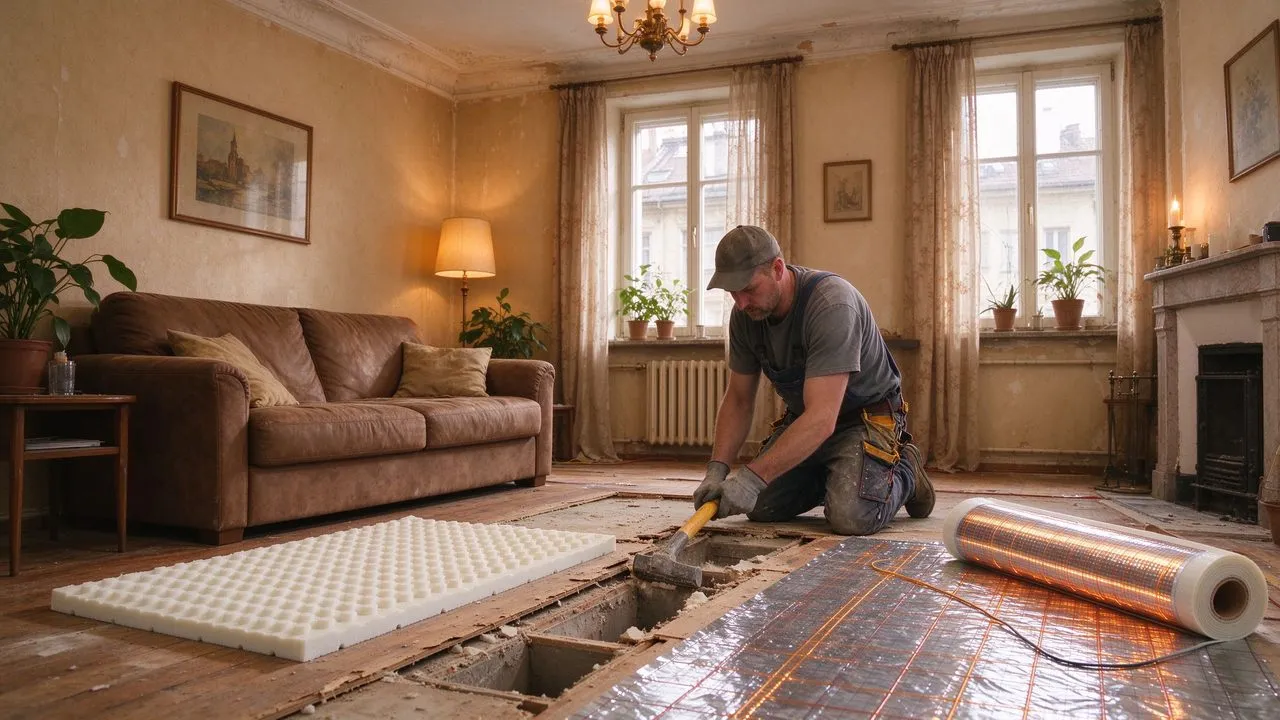
The biggest growth story in European and North American heating is not new-build construction — it is renovation. Aging housing stock, rising energy prices and the push to electrify heat are sending homeowners into retrofit projects, and electric underfloor heating is consistently the heating upgrade they choose when floors are already being lifted. Understanding the underfloor heating retrofit trends shaping 2026 helps buyers, installers and distributors plan stock, skills and quotations with confidence.

Why Renovation, Not New Build, Is Driving Demand
Across the EU, the majority of buildings that will exist in 2050 have already been built. Renovation is therefore where the energy transition actually happens: every upgraded building is a chance to remove gas boilers, improve insulation and install electric heating that can run on clean electricity. For underfloor heating specifically, renovation demand has an extra trigger — when old flooring is removed, the marginal cost of installing heating elements underneath is small, and the comfort gain is immediate. That combination is why the electric floor heating retrofit growth curve keeps climbing in renovation-heavy markets like Germany, France, the UK and Scandinavia.
Trend 1: The Rise of Low-Profile, Dry-Lay Systems
Retrofits rarely allow a thick floor build. The market response has been a shift toward low-profile elements that install dry — graphene heating film for wood floors, loose heating cable for irregular layouts, and ultra-thin mats that add almost no height. Installers increasingly specify dry-lay build-ups because they are faster, require no screed curing time and can be walked on immediately. That speed matters in occupied homes, where a renovation is a disruption to be minimised rather than a blank site to be filled.

Trend 2: Zonal Control as Standard
Retrofit projects rarely heat a whole home at once. Homeowners renovate room by room, and they expect each room to be controllable independently. Zonal layouts — a thermostat and circuit per room — have become the default specification, and smart thermostats with floor sensors make that practical by scheduling each zone separately and reporting energy use. The measurable effect is that zoned electric floor heating runs fewer hours and delivers heat exactly where it is needed, which keeps running costs competitive with wet systems.

Trend 3: Electrification Policy Pull
Policy is doing real work here. The EU’s revised Energy Performance of Buildings Directive (EPBD) pushes member states toward phasing out fossil-fuel heating in existing buildings, and national subsidy programmes reward electric upgrades. Heat pumps grab the headlines, but electric underfloor heating is increasingly specified alongside them as the distribution system, and in smaller retrofits it often replaces the old heat source outright. For buyers, the practical effect is that renovation projects increasingly require documentation — CE certification, energy labels and manufacturer test data — which favours factory-direct manufacturers who can supply it in writing.
Trend 4: Supply Chain Shortening
Retrofit work runs on short, predictable lead times — homeowners will not wait three months for a heating element. Distributors have responded by shortening supply chains and buying factory-direct from manufacturers who can quote, produce and ship reliably. The underfloor heating renovation demand europe has therefore concentrated volume in factories with in-house production of film, mat, cable and thermostat families, because buyers can consolidate sourcing in one place and hold fewer SKUs. This is the structural reason why the OEM and private-label channel keeps growing in the retrofit market.
Trend 5: Whole-Floor Comfort, Not Just Warm Tiles
Retrofit buyers are no longer treating electric underfloor heating as a bathroom luxury. Living rooms, bedrooms, kitchens and hallways are being heated floor-wide, and homeowners expect the same comfort in a renovated bedroom as in a new build. That expectation drives specifications: higher installed output per square metre, insulation board under the element, and floor-probe control so surface temperatures stay inside flooring limits. The result is a system that behaves like a primary heat source, not a top-up — which is exactly what the renovation market increasingly demands.
Data and Evidence: The Numbers Behind the Trends
SunAura Thermal’s export records support these trends with first-hand order data (per SunAura factory records). Since 2022, retrofit-related orders — low-profile film and mat, renovation-sized cable kits and zonal thermostat sets — have grown faster than new-build project orders across our export business, which reaches more than 50 countries. Our Qingdao, Huangdao factory has manufactured electric heating products since 2008 (17 years), operating under ISO 9001/14001/45001, with CE and RoHS documentation for the product range and LVD/EMC compliance tested per market. The fastest-growing export categories match the trends above: dry-lay film for wood-floor retrofits, ultra-thin mats for low-profile builds, and WiFi zonal thermostats.

What This Means for Buyers and Installers
- Specify low-profile elements for occupied-home renovations — they win on height, speed and curing time.
- Design for zones from the start; one circuit and thermostat per room is now the norm.
- Ask suppliers for written certification and factory test data — renovation funding increasingly requires it.
- Consolidate film, mat, cable and thermostat sourcing with one factory-direct supplier to protect lead times.
For installers taking on renovation work, the practical foundation is covered in our electric heating mat installation under tile tutorial and our graphene heating film under laminate guide — both written for real retrofit conditions.
Frequently Asked Questions
Is electric underfloor heating suitable for old houses? Yes. Old houses often have solid floors where wet systems are difficult or heavy to install; a dry-lay electric build-up adds minimal height and weight and is one of the least disruptive options.
Does renovation heating cost more to run than a boiler? With insulation board, zonal scheduling and a floor-probe thermostat, electric underfloor heating competes well on running cost in well-insulated rooms — and it removes boiler maintenance and gas standing charges entirely.
Which element type is best for a retrofit? Graphene heating film for wood floors, ultra-thin mats for tile and low-profile builds, and loose cable for irregular layouts. Send your floor build and room plan and we will specify the right family.
Can a distributor buy renovation stock factory-direct? Yes — as an underfloor heating retrofit supplier, SunAura Thermal offers sample programmes, written MOQ and lead-time commitments for renovation project stock.
Retrofit Project Types Driving the Market
Not all retrofits are the same, and the product mix follows the project type. The three fastest-growing retrofit segments today are full floor replacements, bathroom refreshes and whole-home electrification upgrades. In a full floor replacement — worn carpet or tile lifted, subfloor exposed — the marginal cost of adding underfloor heating is small, so most homeowners add it while the floor is already open. Bathroom refreshes are the classic electric floor heating project: a small area, a tile covering and an expectation of warm floors underfoot. Whole-home electrification is the newest driver: households removing gas boilers are specifying electric underfloor heating as the distribution system, often paired with a heat pump or as the sole heat source in smaller homes. Each segment needs a slightly different specification — which is why a home renovation heating upgrade plan should start with the project type, not the product.

Budgeting and Lead-Time Realities for Renovation Stock
Renovation projects are scheduled around contractors, and heating elements are a small line item in a large programme. That creates a hard constraint for distributors: when a contractor needs 200 m² of heating film next week, a supplier that quotes six weeks loses the order. The market has responded by buying renovation stock in advance and holding it — but holding stock is only rational if the supplier’s lead time is predictable and its quality is consistent. Factory-direct suppliers with in-house production of film, mat, cable and thermostats can commit to shorter, written lead times because all the components come from one production floor. When you plan 2026 renovation stock, ask for the lead-time commitment in writing and hold buffer quantities for the two fastest-moving families — low-profile film and ultra-thin mat.

How to Choose a Retrofit-Ready Supplier
Five questions separate retrofit-ready suppliers from catalogue resellers. First: can they produce film, mat, cable and thermostats in one factory, or do they buy in and re-sell? Second: will they put the lead time in writing? Third: can they supply certification documents and batch test data with the order? Fourth: do they support OEM labelling if you want your own brand on the carton? Fifth: what is the warranty period, and what does the claim process actually require? A supplier that answers all five in writing is a partner you can plan renovation stock around; one that hesitates on any of them is a sourcing risk that will surface mid-season. As an underfloor heating retrofit supplier, SunAura Thermal’s answers are on this page and in our factory documentation — and we encourage buyers to verify them before ordering.

Regional Differences: Europe, North America and Beyond
The retrofit opportunity is not evenly distributed. Europe leads because its housing stock is old and policy actively pushes renovation — EPBD-related rules, subsidy programmes and high energy prices all favour electric floor heating retrofits. North America is different: renovation is driven more by comfort and property value than by regulation, and the product mix skews toward bathroom and basement heating at 110 V/120 V. In the UK, the balance tilts toward whole-room heating as gas boilers age out of new policies. Each region also has distinct voltage, flooring and certification expectations, which is why the winning suppliers are those that can configure the same core technology for each market — one factory, multiple regional specifications, documented per order.
Frequently Asked Questions
Is a retrofit system eligible for subsidies? Many European subsidy programmes now cover electric heating upgrades that displace fossil fuels. Certification documents and manufacturer energy data are usually required — our factory documentation supports these applications.
Can I retrofit one room now and extend later? Yes — zonal design makes this natural. Each room is an independent circuit, so a later extension simply adds another zone; plan the distribution board capacity for the full house now.
How do I get a retrofit quotation? Send your room plan, floor build, voltage and covering to our sales team; we return the element layout, output calculation and factory-direct pricing with MOQ and lead time in writing.
The Practical Takeaway for 2026 Planning
If you are planning stock or projects for the coming heating season, the retrofit trend reading is straightforward. Expect low-profile, dry-lay elements to keep growing because they solve the renovation height problem that wet systems cannot. Expect zonal control to be asked for in almost every quote, because room-by-room retrofit schedules make it the default. Expect certification documentation to move from “nice to have” to “required”, because subsidy applications and policy audits demand it. And expect distributors to consolidate around factory-direct suppliers who can write lead times and warranty terms into the order. A supplier that checks all four boxes — full product family, written lead times, complete documentation and OEM support — is the kind of partner a 2026 renovation programme can be planned around.
To summarise the market picture: renovation is not a short-term wave but a structural shift. Housing stock ages, policy pushes electrification, and the floor remains the best place to deliver heat. Suppliers who build their renovation offer around low-profile elements, zonal control and documented quality will be the ones holding stock when the heating season peaks.
Track the signals, size the stock, and keep the documentation ready — the renovation market rewards suppliers who arrive prepared rather than reactive.
In short: renovation demand is structural, the product mix is shifting low-profile, and the buyers who prepare now will lead the season.
Conclusion
Renovation is the growth engine of the heating transition, and electric underfloor heating is its floor-level technology. Low-profile dry-lay systems, zonal smart control, policy-driven electrification and shorter supply chains are the four forces reshaping the market — and every one of them favours factories that build the full product family and ship it factory-direct. For buyers planning 2026 renovation stock, now is the time to lock in supply agreements with a manufacturer that can document quality end to end.
About the author: Ethan Sun is the Founder and CEO of SunAura Thermal, a heating-systems manufacturer based in Qingdao, China. Under his leadership the company has grown from a single workshop into an ISO-certified factory exporting electric underfloor heating, heating cable, heating film and snow melting products to more than 50 countries worldwide.