
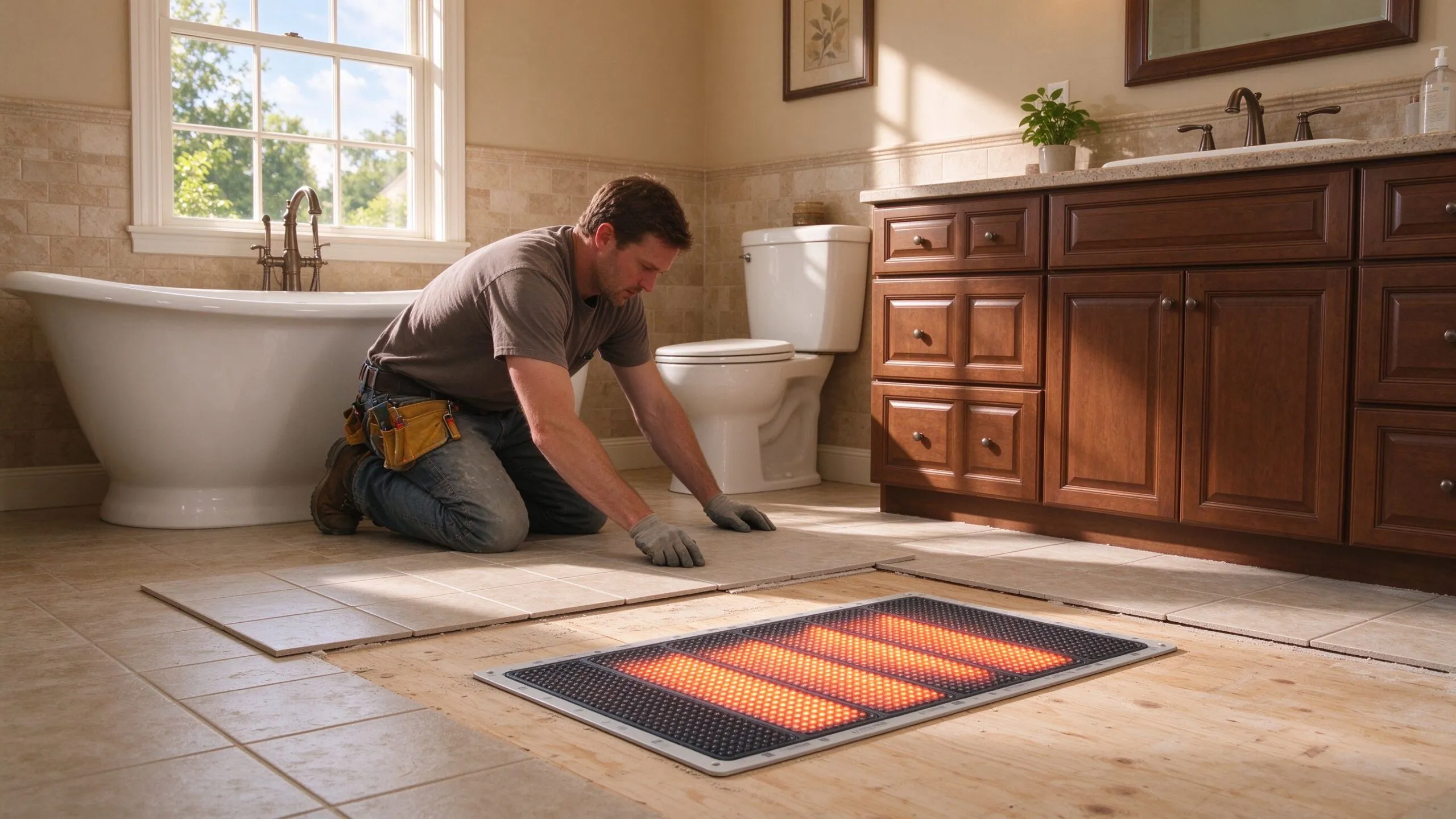
North America is in the middle of a heating transition. Gas furnaces still dominate, but electrification policy, renovation demand and a cold-climate reality are pulling homeowners toward electric options — and underfloor heating is a growing slice of that shift. This market briefing looks at the drivers, the regional differences and what buyers should check before specifying. Written by Ethan Sun, Founder & CEO, SunAura Thermal.
Why the North American Market Is Shifting
Three forces are moving North American heating demand away from the gas furnace baseline:
- Electrification incentives — federal and provincial/state programs across the U.S. and Canada offer rebates for electric heat pumps and, in several jurisdictions, for efficient electric heating upgrades. Homeowners weighing a furnace replacement are increasingly quoted an electric option first.
- Renovation-driven demand — bathroom and kitchen renovations are the most frequent entry point for electric floor heating. A homeowner already opening a floor for tile will often add a heating mat at the same time, because the marginal cost is small compared with the renovation itself.
- Cold-climate comfort expectations — in Canadian winters, a warm bathroom floor is not a luxury; it is a quality-of-life item that sells itself. The same expectation is spreading into northern U.S. states where winters are comparable.
The result is a market with two distinct buyers: the renovation homeowner buying room-level heating, and the distributor supplying that homeowner through local electrical and tile channels. Both are served by the same product logic — room-level electric zones that do not require a full heating-system redesign.
Canada vs. the United States: Two Different Pictures
It is useful to separate the two countries, because the demand drivers differ:
| Dimension | Canada | United States |
| Climate | Cold across most of the country; long heating season | Climate varies widely; cold only in the north and mountain regions |
| Entry point | Bathroom, basement, mudroom and garage comfort zones | Bathroom remodels, sunrooms, garages; snow-melting in northern states |
| Policy signal | Federal incentives and provincial programs push electrification | State-level rebates vary; federal IRA credits cover heat pumps and some electric upgrades |
| Voltage | 120 V standard residential supply, 240 V available for larger loads | 120 V standard; 240 V circuits common for major appliances |
| Typical product | Heating mat under tile; film under laminate; cable for larger areas | Mat and cable under tile; snow-melting mat for driveways and steps |
For Canadian projects, the cold climate means electric floor heating demand in Canada concentrates in rooms where a cold floor is genuinely uncomfortable — bathrooms, kitchens, basements and mudrooms. For U.S. projects, demand spreads wider, from bathroom remodels in every state to snow-melting applications in the northern tier. The product families are the same; the emphasis changes.
What the Demand Numbers Say
Industry research on electric floor and radiant heating consistently shows North America as a growth region, driven by renovation activity and electrification policy. While forecast figures vary by research house, the direction is consistent: room-level electric heating products are growing faster than traditional baseboard and forced-air add-ons in renovation channels (per SunAura export records, North America has been among the top three destination regions for our mat and film lines in recent years).
Two structural signals support that reading:
- Housing stock age — a large share of North American housing predates modern insulation standards, and renovation is the practical path to better comfort. Electric room-level heating fits renovation economics: no ducting, no boiler room, no major structural work.
- Electrification policy — federal and regional programs are training both homeowners and contractors to consider electric options. The same policy tailwind that lifted heat pump sales is broadening the conversation to include electric radiant heating.
These are directional observations, not precise forecasts — exact market size figures should always be checked against the latest industry reports at the time of reading.
Cold Climate: The Reason Room-Level Electric Heating Wins
Cold climates change the calculation in favour of room-level electric heating in one important way: the spaces people actually occupy are small relative to the house. Heating a whole house with electric radiant systems is possible but demands careful sizing; heating the bathroom, kitchen and mudroom — the rooms people stand in first thing in the morning — delivers the comfort where it is felt, at a fraction of the energy of whole-house coverage.
That is the pattern behind most of our North American orders: a heating mat for bathroom floor tile, film under laminate in a renovated basement, a snow-melting mat at the entrance. Each order is a room, not a whole house, and each room is controlled independently — the same zoning logic that makes electric underfloor heating troubleshooting simpler, because a fault affects one zone, not the whole system.
120 V vs. 240 V: What Buyers Must Check
The single most common specification error
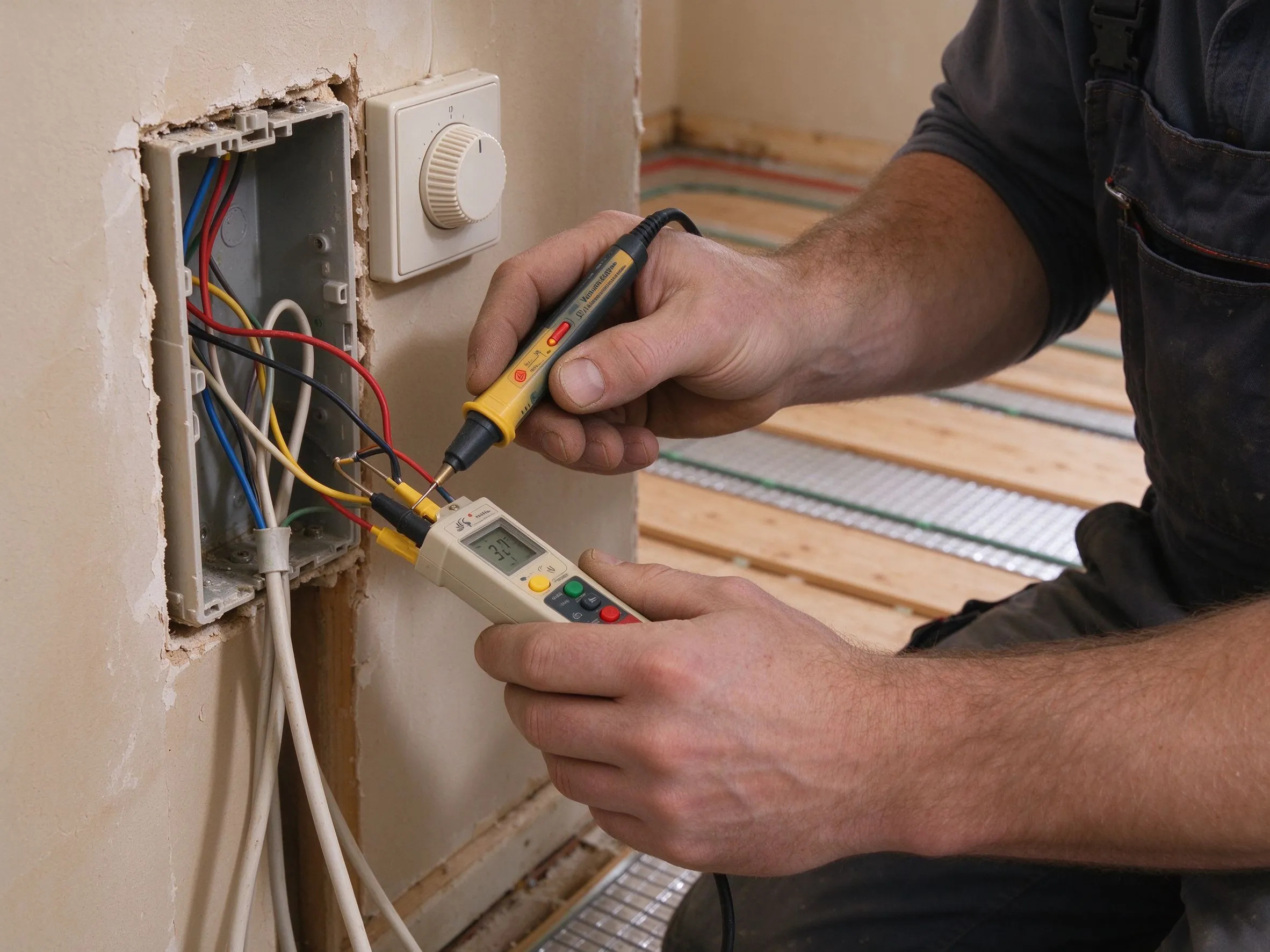
in North American projects is voltage. Residential supply is 120 V, and heating products are manufactured for either 120 V or 240 V operation — the wattage-per-metre figure is set at the factory for the stated voltage. Three checks matter:
- Match the product to the circuit — a 240 V mat must be connected to a 240 V circuit; forcing it onto 120 V halves the output, and connecting a 120 V product to 240 V is a safety hazard. Every quotation should state the voltage explicitly.
- Size the circuit for the zone — each zone needs a circuit and breaker sized to its load, with GFCI protection where code requires it. The load per zone is stated in the quotation so the electrical design is settled before installation.
- Check thermostat compatibility — thermostats are voltage-specific too; the control must match both the element voltage and the supply. Our smart thermostat exporter range includes both 120 V and 240 V versions, so the control platform follows the product.
For a distributor, voltage clarity is also a stock discipline: 120 V and 240 V SKUs should be distinct line items with clear labelling, because a wrong-voltage shipment is an installation failure at the customer’s end, not just an ordering error.
Which Products Are Gaining Ground
The product mix across North American orders
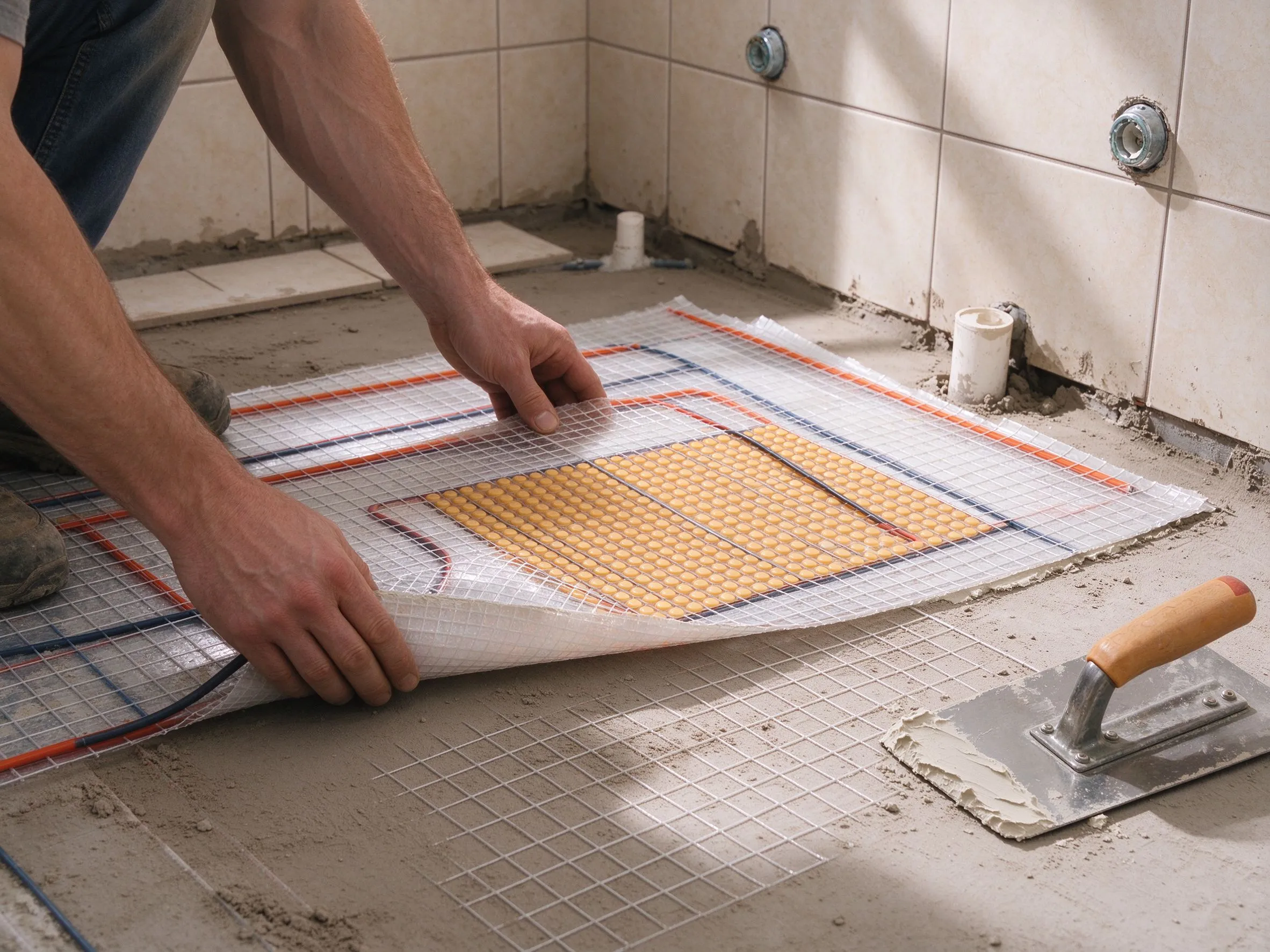
breaks down roughly by application:
- Heating mat — the default for bathrooms and kitchens under tile; mesh construction gives fixed spacing and fast installation, which suits renovation timelines.
- Heating film — growing under laminate and floating floors in basements and living areas; dry installation suits DIY-friendly renovation markets.
- Heating cable — for larger areas and irregular shapes where mat widths do not fit; also for snow-melting in steps and driveways.
- Snow-melting mat — a distinctly North American growth niche in the northern tier; entrance paths, steps and driveways are the typical applications (see our snow melting mat technology article for the technical details).
Across all four families, the common thread is room-level, independently controlled zones — the configuration that renovation buyers understand and distributors can stock without deep technical inventory.
Data and Evidence
This market briefing is written from export and customer data of SunAura Thermal, cross-checked against publicly reported policy direction (per SunAura factory records). Supporting facts about the manufacturer:
- 17 years of continuous heating manufacturing since 2008, based in Qingdao’s Huangdao district (per SunAura factory records).
- ISO 9001 quality management, ISO 14001 environmental management and ISO 45001 occupational health & safety certification covering the product range.
- CE, RoHS, LVD and EMC compliance for EU-bound orders; documentation provided with every shipment.
- Products exported to 50+ countries; North America has been a top-three destination region for the mat and film lines in recent years (per SunAura export records).
- Every mat, film and cable batch is tested before packing, with resistance and insulation checks recorded per unit (per SunAura factory records).
For policy context, Natural Resources Canada publishes the official electrification and retrofit programs: Natural Resources Canada — energy efficiency for homes.
How Importers and Distributors Should Approach This Market
For a distributor building a North American range, the market structure suggests a practical playbook:
- Start with the renovation bundle — bathroom and kitchen renovation is the reliable demand base. A mat range for tile, a film range for laminate, and a thermostat range to match: this bundle covers the majority of residential orders without deep inventory.
- Decide voltage strategy early — carrying both 120 V and 240 V SKUs doubles the stock list, so the decision belongs in the product plan, not the warehouse. In practice, most bathroom-scale orders are 120 V; larger areas and dedicated circuits are 240 V. A distributor can start with the voltage that matches the dominant local install pattern and add the other on demand.
- Prepare the documentation story — North American buyers increasingly ask for test records, compliance documentation and engineering support, not just a price. A manufacturer that ships per-unit test records and layout support is a different partner from one that ships boxes.
- Plan for snow-melting seasonality — in the northern tier, snow-melting mats follow a pronounced seasonal curve: specification in summer, installation in autumn, zero demand in spring. Stock and cash-flow planning should match that curve.
Our export program supports this playbook directly: voltage-matched production, private-label packaging, per-unit test records and engineering support from the Qingdao factory (per SunAura factory records, North America has been a top-three destination region for our mat and film lines in recent years).
Frequently Asked Questions
Is electric underfloor heating economical in cold North American winters?
At whole-house scale, gas and heat-pump systems usually have lower running cost per unit of heat. At room scale — the way most electric underfloor heating is used — the cost is modest because only the occupied rooms are heated, and the comfort gain is immediate. The economical answer is zoning, not blanket coverage.
Can electric floor heating be installed over a wooden subfloor?
Yes, and it is the most common renovation path. The subfloor must be flat and stable; mat is laid over it with a thin levelling screed for tile, or film is laid directly under floating floors. Our installation guides cover both routes.
Do I need a permit for electric floor heating?
Electrical work generally requires a permit and inspection in most U.S. states and Canadian provinces. The circuit sizing, GFCI protection and connection method should follow local code; our documentation includes the electrical data an inspector will ask for.
How does the North American market differ from the European market for electric underfloor heating?
The biggest differences are voltage (120 V vs 230 V), market structure (North America is more renovation-driven and DIY-friendly, Europe has more new-build and professional install) and compliance frameworks (CE/RoHS in Europe vs UL/CSA-style listing expectations in North America). The product families are the same; the voltage matching, documentation and sales channels differ.
What is the typical lead time for a North American order?
For standard sizes, production and shipping typically run a few weeks from order confirmation, with the exact lead time stated at quotation. Voltage-matched production and private-label packaging are planned into the schedule, so a distributor can quote realistic delivery dates to its own customers.
What to Watch in the Year Ahead
Three signals are worth watching for anyone planning North American stock or projects in the coming year: the direction of electrification incentives (which influence how often homeowners are quoted an electric option), the renovation cycle (which drives the room-level demand base), and the availability of voltage-matched product and documentation (which separates suppliers who can serve the market from those who only ship generic stock). None of these moves overnight, but together they set the demand curve that distributors plan against. The practical takeaway is the same one we give every buyer: specify room-level zones, match voltage to the market, and choose a supplier whose documentation and test records survive an inspector’s review.
Plan a North American Order
Whether you are a homeowner planning one bathroom or a distributor building a range, send the project details and the destination region to our export team. You will receive voltage-matched product selection, the load summary, packaging and documentation information, and engineering support through installation. Email [email protected] or message the export team on WhatsApp to start.