
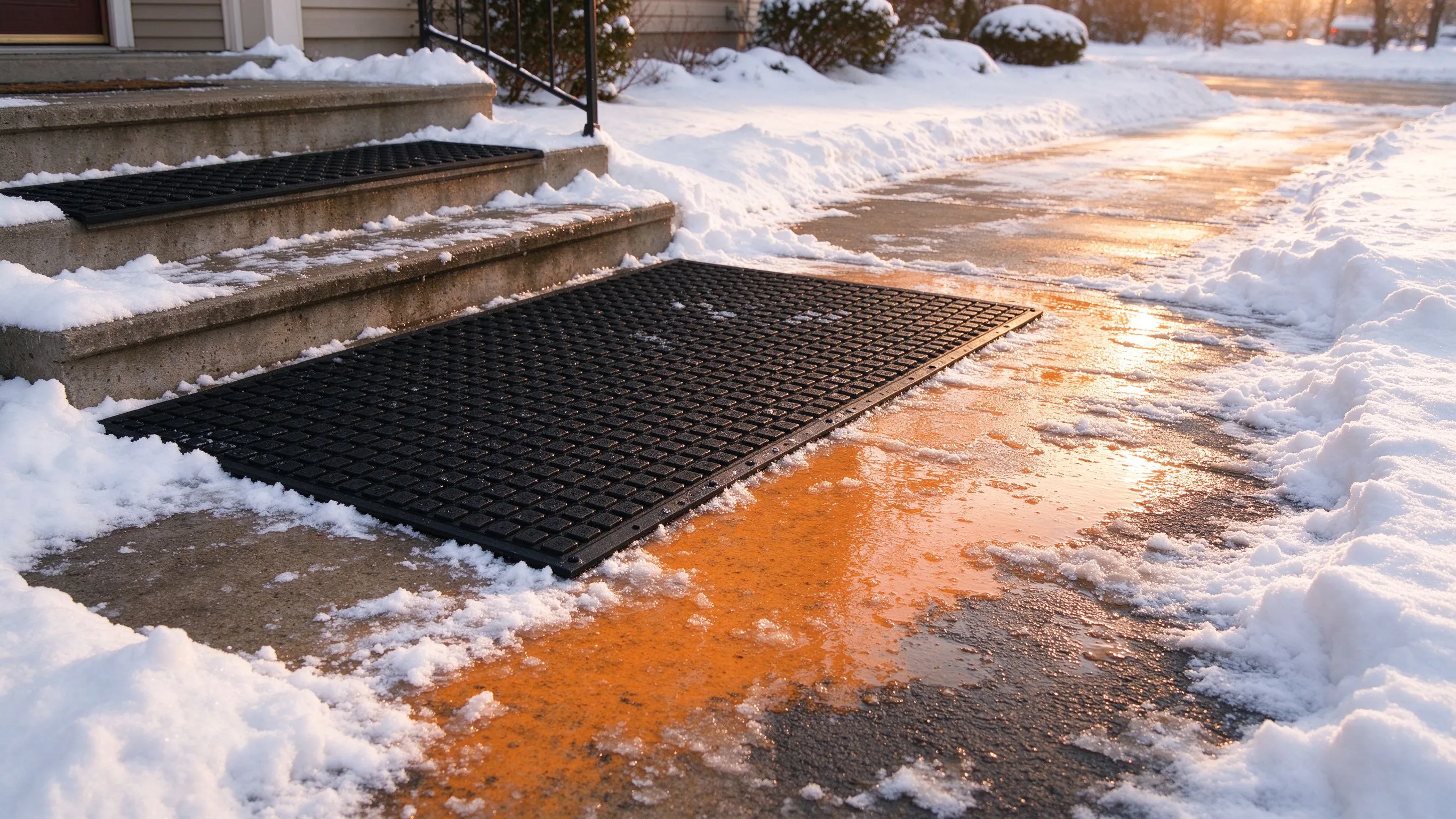
Every winter, property managers, hotel operators and homeowners in snow belts face the same recurring choice: spend hours shoveling, spread more salt than the driveway can tolerate, or slip on an icy walkway and deal with the consequences. A snow melting mat removes that choice entirely. Laid directly over a driveway, walkway or stair tread, it converts electrical energy into controlled radiant heat and keeps the surface dry and ice-free — automatically, before the first snowflake finishes settling. In this article we explain how the technology works, how to size and specify it for real projects, what drives a fair snow melting mat wholesale price, and what commercial buyers should ask before committing to an outdoor snow melting mat supplier.
Why Snow and Ice Removal Is Still a Costly Winter Problem
Manual snow removal is not just inconvenient — it is expensive, injury-prone and environmentally damaging. A single ice-related fall on a commercial property typically triggers slip-and-fall claims that run into tens of thousands of dollars in North America alone. Salt-based deicers, meanwhile, corrode rebar in concrete, damage car underbodies, kill roadside vegetation and wash into groundwater. According to the United States Environmental Protection Agency, chloride from road and walkway salt is now a contaminant of concern in thousands of freshwater systems.
For commercial properties — hotels, retail strips, municipal entrances, retirement communities and logistics yards — the economics shift further. A crew that spends two hours clearing three walkways after every storm is a recurring labor cost for four to six months a year. An installed electric snow melting mat for walkways eliminates that crew, reduces salt usage by up to the area covered, and guarantees a dry surface the moment a guest steps outside. For residential buyers, the appeal is simpler: never shovel again, and never worry about an elderly relative slipping on the front steps.
The demand side is already responding. Buyers across Canada, the northern United States, Scandinavia, Central Europe and Northeast Asia now spec snow-melting systems into new construction and renovation budgets, which is why qualified manufacturers are increasingly asked to quote factory-direct programs rather than retail catalogs.
How a Snow Melting Mat Actually Works
At its core, a modern snow melting mat is a flexible, factory-assembled heating panel. A twin-conductor heating element — usually a resistance heating cable with fluoropolymer insulation — is pre-spaced and bonded between a tough, textured top layer and a durable bottom layer. The top surface is molded with an anti-slip tread pattern so pedestrians have grip even while the mat is heating. When energized, the resistive cable raises the mat surface to a controlled temperature range that melts snow on contact and prevents refreezing.
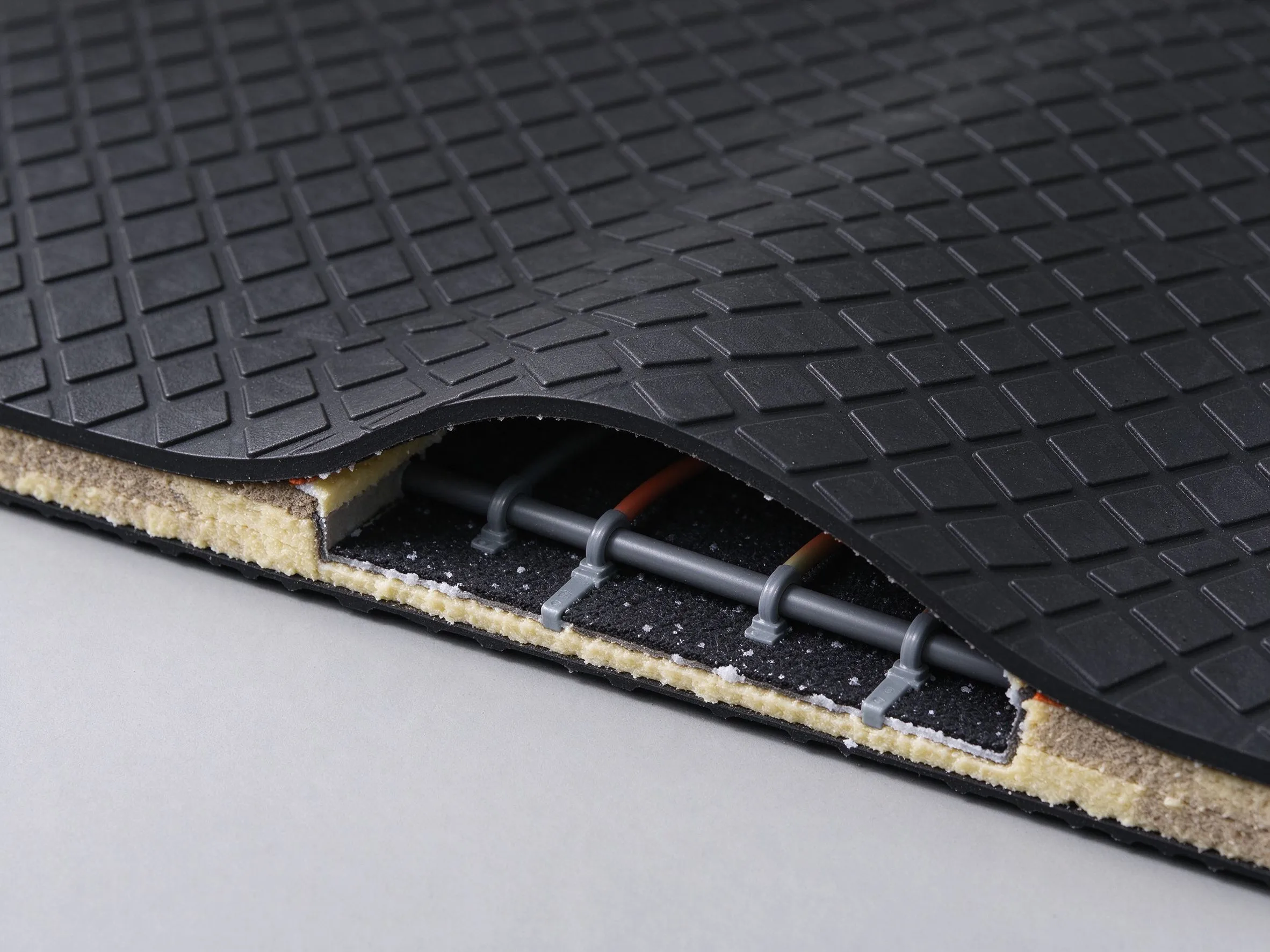
Three engineering decisions separate a durable mat from a disposable one:
- Cable construction. Quality outdoor mats use a dual-insulated heating cable with a metal-braid earth grounding layer, rated for direct exposure to moisture, freeze-thaw cycles and UV. The cold lead that runs from the mat to the power supply uses a watertight junction so water cannot track back into the electrical circuit.
- Waterproof encapsulation. The heating element must be fully bonded into the mat body, not merely sandwiched. A well-made mat is washable, rainproof and immune to sitting in slush for months.
- Thermal regulation. Relying on raw constant heat wastes energy and can overheat. Better systems pair the mat with a smart controller — either a ground-sensor-based automatic controller or a programmable thermostat — so the mat only activates when temperature is near freezing and moisture is present.
Some premium mats use self-regulating (PTC) heating elements, which lower their own output as the surface warms. That behavior is explained in detail in our guide to self-regulating heating cable and PTC overheating protection. For snow melting, self-regulation is useful because it avoids cycling on and off violently as sun and shadow alternate across the driveway.
Choosing the Right Mat: Entradas de garagem, Walkways and Steps
Sizing a system starts with area and heat requirement. A covered walkway loses heat slowly and needs lower output; an open driveway exposed to wind needs higher output to melt falling snow before it accumulates. Manufacturers typically rate mats by watts per square meter, and the supplier should confirm the rated density against the local climate zone rather than selling one product for every market.
| Application | Recommended mat type | Key installation notes |
|---|---|---|
| Driveway / parking apron | Heavy-duty roll mat, high wattage density | Must support vehicle loads; lay over a clean, even base; secure edges against shifting |
| Front walkway / path | Standard outdoor mat | Run continuously from doorstep to sidewalk; include a GFCI-protected circuit |
| Steps and stair treads | Tread-sized step mats | One mat per tread; include landing mats where people stand; waterproof lead routing |
| Ramp / loading apron | Industrial-grade mat | Higher mechanical load rating; consult manufacturer for vehicle weight class |
When buyers ask us for a snow melting mat for driveway applications, the first questions we ask back are: what is the surface (concrete pavers, asphalt, stone?), what is the snowfall history of the region, and will the mat be left permanently in place or stored seasonally? Permanent installations on paved surfaces benefit from mats laid under a protective overlay, while above-ground seasonal mats are simply rolled out and plugged in.
Installation and Control Best Practices
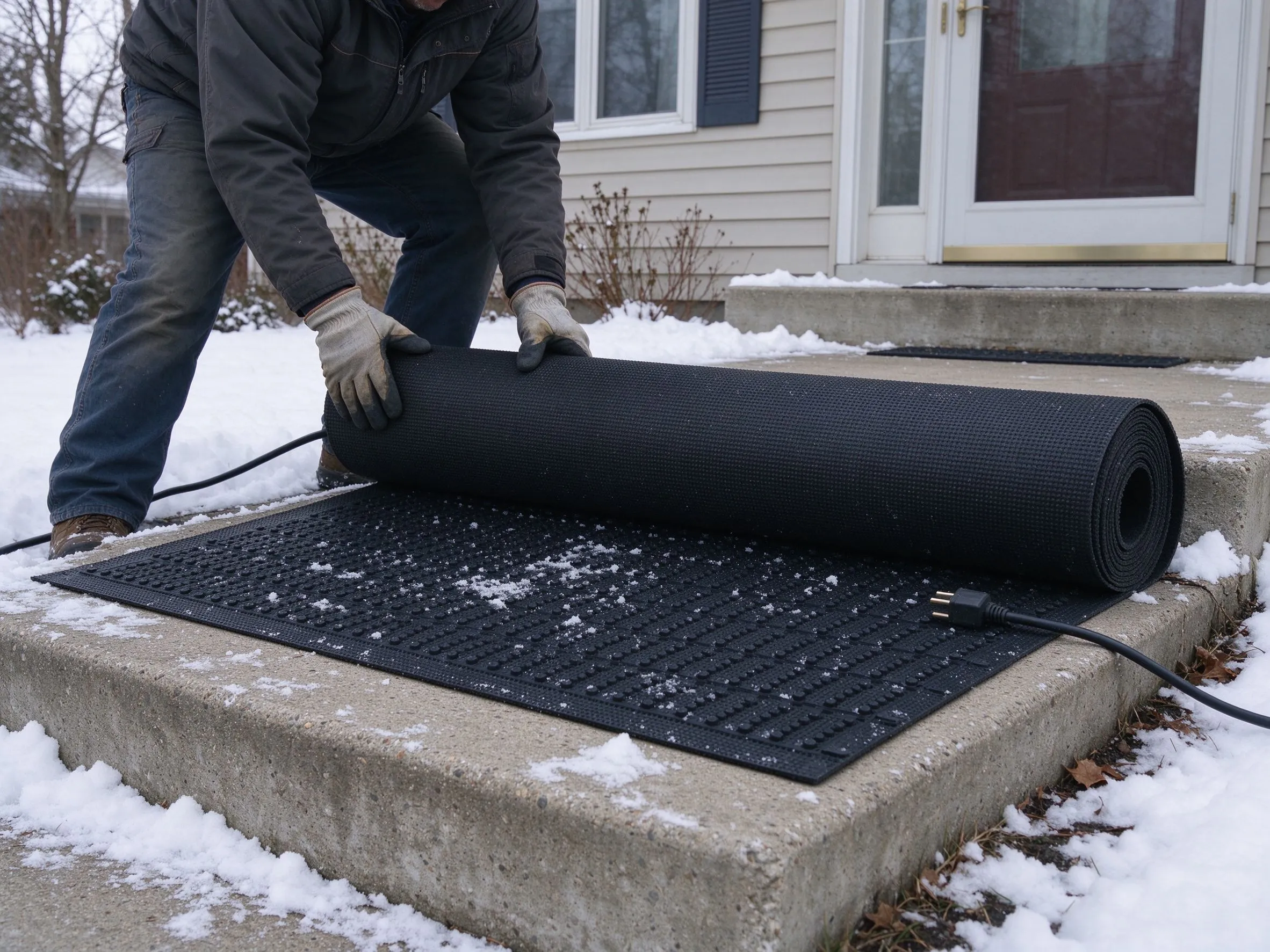
Installation philosophy depends on whether the mat is above-grade (rolled onto an existing surface) or under-grade (embedded under new pavement). Above-grade mats are DIY-friendly: clean the surface, unroll the mat, secure the edges with the supplied anchoring system, route the cold lead to a GFCI-protected outdoor outlet, and plug into the controller. Under-grade installations — mats embedded in fresh concrete or screed — should be treated as a construction-stage project, mirroring the workflow described in our electric heating mat installation tutorial, with a continuity test before and after pouring.
Controls are where energy savings live. A snow-only automatic controller uses a temperature-and-moisture sensor placed near the mat so the system fires up exactly when snow is falling on a freezing surface — and shuts off when the pavement is dry. For properties that want scheduling as well, a smart thermostat adds time programs and remote monitoring. Either way, every circuit must be protected by a ground-fault circuit interrupter, because an outdoor mat sits in wet, slushy conditions all winter.

What Buyers Should Ask an Outdoor Snow Melting Mat Supplier
Because outdoor heating products sit exposed to the harshest conditions on the building, supplier diligence matters more than unit price. When evaluating an outdoor snow melting mat supplier, ask for:
- Certification evidence. At minimum, CE marking and RoHS compliance for the electrical materials, plus the test reports that back them up. At SunAura Thermal our Qingdao Huangdao factory operates under ISO 9001, ISO 14001 and ISO 45001 management systems, and our heating product lines carry CE and RoHS documentation — see our certifications overview.
- Construction warranty and expected service life. A reputable factory will stand behind the heating element for years of freeze-thaw service. Internal reliability data is tracked per SunAura factory records across the product lines we ship to more than 50 countries.
- OEM and custom capability. Commercial buyers rarely need a catalog size. Ask whether the factory can cut custom dimensions, match a voltage, and produce private-label packaging. Our OEM/ODM program exists precisely for distributors, contractors and brand owners who need specs matched to their projects.
- Export experience. Shipping heating hardware means voltage standards, plug types and certification regimes differ by destination. A factory that already ships to 50+ markets — see our note on global distribution to over 50 countries — removes most of that friction.
Energy Use and Operating Cost: How Much Does It Really Run?
One of the first questions every buyer asks is whether an always-on melting mat will bankrupt the electricity bill. The honest answer is that operating cost is a function of three choices: output rating, control strategy and climate. A mat left running around the clock at full output in a snowy January month would indeed be expensive. A mat controlled by a snow-and-ice sensor — energized only while precipitation is actually falling on a freezing surface — typically operates for a small fraction of the heating season. In many moderate snow-belt locations, the total annual run time across a whole winter is measured in tens of hours rather than hundreds.
The other lever is sizing to need. A 20 m walkway does not need the same output density as an exposed 60 m driveway that never sees sun. Discussing local snowfall history with the supplier, and fitting the controller with an outdoor sensor, usually cuts operating cost by a wide margin compared with a fixed-timer approach. And because the system replaces salt, shoveling and slip-risk exposure, property managers increasingly tell us the running cost is trivial next to the avoided labor and liability.
Snow Melting Mat Wholesale Price: What Drives the Cost
A transparent snow melting mat wholesale price breaks down into four factors: cable grade and insulation system, mat size and wattage density, packaging and labeling requirements, and order volume. Small retail lots carry overhead that volume orders avoid — which is why buying snow melting mat factory direct through an OEM program typically improves landed cost per square meter substantially, especially when the distributor consolidates one container of mats for the season.
Buyers should resist optimizing on unit price alone. A cheap mat with thin insulation will fail in two winters, and the replacement labor on an embedded system dwarfs the material saving. Compare total cost of ownership: material price, controller included, expected years of service, and the avoided cost of salt and labor. On that basis, a quality factory-direct program almost always wins.
Frequently Asked Questions
Can a snow melting mat be left outside all year? Yes — weather-rated mats are built for UV, rain and freeze-thaw cycling. Many commercial customers leave them in place year-round; seasonal homeowners roll them up after winter and store them dry.
How much electricity does a driveway mat use? Consumption depends on rated wattage density, local snowfall and how often the system runs. Because automatic sensors activate the mat only during actual snow events — not on cold, dry nights — operating cost is far lower than leaving a heater on continuously. Ask your supplier for the rated watts per square meter and estimate your typical storm hours.
Can vehicles drive over the mats? Only heavy-duty driveway-rated mats designed for vehicle loads. Walkway and step mats are pedestrian-rated and must not be driven on. Confirm the load rating with the supplier before ordering for a parking apron.
Do the mats use a lot of salt? They should not need any. The whole point is to melt snow and ice electrically so the surface stays dry; a dry walkway needs no de-icing chemicals. Eliminating salt around doorsteps also protects stonework, landscaping and pet paws.
What happens during a long power outage? The system simply stops, the same as any electrically heated surface. For properties in outage-prone zones, plan walkway clearance as a backup — but note that modern sensor-controlled mats use little energy, and many commercial customers pair them with a standby generator where continuity matters.
Is installation DIY-friendly? Above-grade mats on steps and walkways are straightforward: clean, lay, anchor, plug into a GFCI outlet with a sensor controller. Embedded installations in fresh concrete should be coordinated with the concrete crew.
Ready to Specify a Snow Melting System for This Winter?
SunAura Thermal manufactures outdoor snow melting mats, step mats and driveway heating panels from our Qingdao factory, with OEM programs for distributors, contractors and brands serving cold-climate markets. With 17 years of heating manufacturing experience, ISO 9001/14001/45001-certified production, CE and RoHS-documented product lines, and exports to more than 50 countries, we help partners move from a snow-melting concept to a shipped container of correctly specified mats. Contact our team with your project dimensions, local climate and voltage requirements, and we will return a factory-direct quotation for the areas you need to keep ice-free.
About the author: Ethan Sun is the Founder and CEO of SunAura Thermal, a heating-systems manufacturer based in Qingdao, China. Under his leadership the company has grown from a single workshop into an ISO-certified factory exporting electric underfloor heating, heating cable, heating film and snow melting products to more than 50 countries worldwide.