
Why Ice Dams Are a Temperature Problem, Not Just a Snow Problem
When winter damage is discussed, most attention goes to driveways and walkways. For facility managers responsible for commercial buildings, however, some of the most expensive cold-weather problems start on the roof. Ice dams along eaves, frozen gutters, and blocked downspouts can force meltwater back under roofing materials, damage fascia and soffits, and create falling-ice hazards at entrances below.
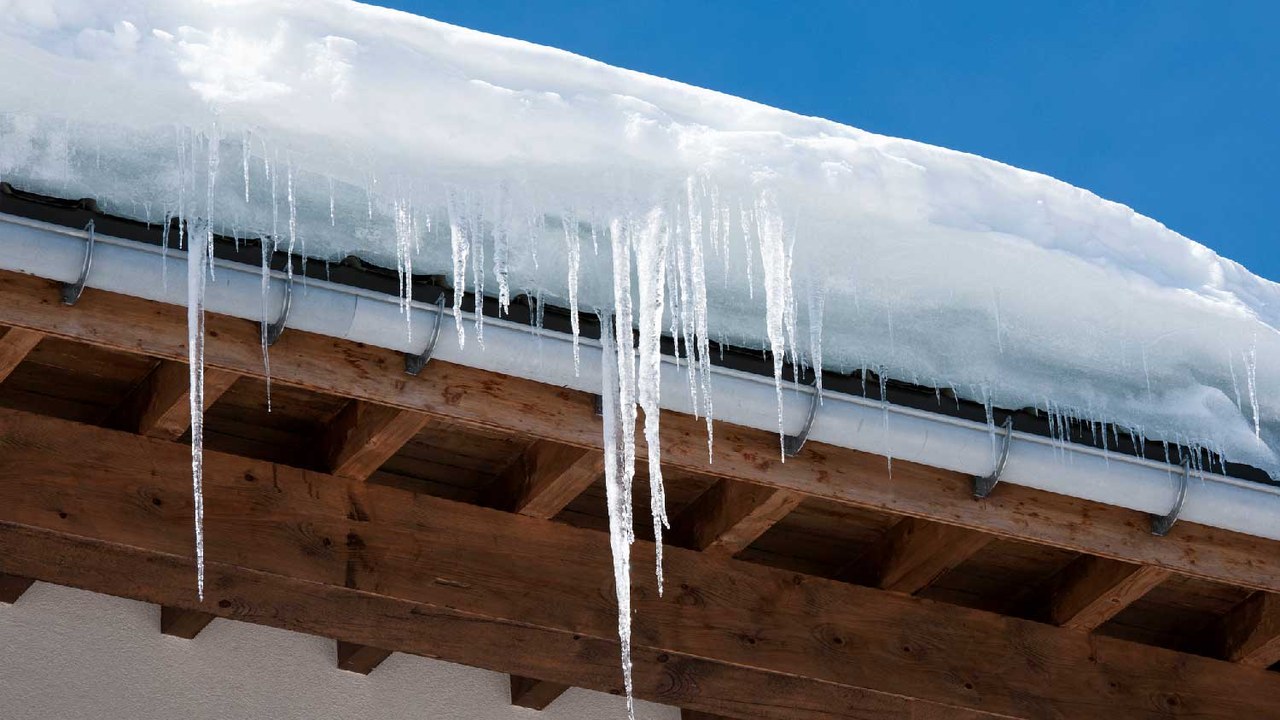
An ice dam is not simply a sign of heavy snow. When heat escapes through a roof deck and snow on the upper roof melts, the water runs down until it reaches the colder eave over the outside wall. There it refreezes, building a ridge that traps more water behind it. The backed-up water can find its way under shingles and membrane, where it causes damage that is often invisible until ceilings stain in spring. Gutters and downspouts compound the problem: once water freezes inside them, drainage stops and the added weight can strain fixings.
Roof Cable Is Specified Differently From Ground Snow Melting
SunAura Thermal is careful to distinguish the two applications, because they are not interchangeable. Ground-level snow-melting mats are designed to clear a paved area, typically with higher output per square metre and full coverage beneath the surface. Roof-edge de-icing is a heat-tracing application: the cable protects a defined path — the eave, gutter, and downspout — rather than heating the entire roof.
“Buyers sometimes ask for a single cable type across the driveway and the roof, but the installation geometry and the standards are different,” notes the engineering team. “On a roof you are protecting a drainage channel, and the cable has to tolerate UV exposure, repeated flexing, and long runs in metal gutters.”
Self-regulating cable is commonly specified for this work because its output responds to temperature along its length: it produces more heat where it is cold and less where it is warm, reducing the risk of overheating when a section is covered by insulation or runs against a warm surface. Constant-wattage cable is used where a steady, defined output is preferred, paired with suitable control.

The Components of a Complete System
A properly engineered roof de-icing installation is more than a single cable run. SunAura specifies the system as a set of matched elements:
- Heat-tracing cable rated for outdoor and roof-gutter exposure, with the correct jacket for UV and weather resistance.
- Mounting clips and spacers that hold the cable in the required pattern without penetrating the roofing membrane.
- Gutter hangers and downspout terminations that protect the cable where it hangs and where it enters vertical runs.
- A control point, often a thermostat with moisture or temperature sensing, so the system energises when freezing conditions are present rather than running continuously.
- Overcurrent and earth-leakage protection at the panel, consistent with the electrical design for the building.
Because commercial roofs vary in pitch, membrane type, and eave depth, the layout is treated as a design task: cable length, the number of eave loops, and downspout runs are calculated from the actual roof rather than estimated from a single catalogue figure, in the same way heat-trace cable is sized for pipe freeze protection.
Why Owners Specify It Before the Freeze
Retrofit repairs after an ice dam event are rarely cheap. They can include interior water damage, gutter replacement, and emergency work during the worst weather, when contractors are least available. Specifying de-icing cable during new construction or scheduled roof maintenance is materially simpler and less disruptive. The same logic applies to properties with public access beneath roof edges, where shedding ice creates a liability that heating the ground below cannot address.
It is worth comparing the alternatives honestly. Raking snow from the roof depends on someone reaching the building after every storm and carries its own risk of damaging shingles or disturbing flashing. Chemical pucks and ice-melt tablets placed in gutters are short-lived, can be washed away in the first melt, and may be unsuitable where runoff reaches planting or drainage. A fixed cable system, by contrast, is always in place and responds to the same conditions whether or not the site is staffed, which is why it is favoured on buildings that are intermittently occupied or managed remotely.
The economics are therefore assessed over several winters rather than a single season. The installed cost is known up front and largely fixed, while the avoided cost — emergency call-outs, interior repairs, gutter replacement, and the disruption of a closed entrance — recurs every year the building is left unprotected. For property portfolios, the same standardised design can be repeated across multiple buildings, simplifying tendering and maintenance.
The Practical Takeaway
Roof and gutter de-icing is best understood as drainage protection rather than whole-roof heating. Specified correctly, self-regulating or constant-wattage cable keeps a path open for meltwater, reduces the conditions that create ice dams, and protects gutters and the building envelope through the winter. For buildings in regions with repeated freeze-thaw cycles, the question is increasingly whether to engineer the system during the next roof project — or wait for the first water stain.