Get a Quote

SunAura Thermal · Qingdao

Applications

Nine application areas, one way of working out the specification: what the room needs, what the floor will carry, and what it is being laid on. The layout drawing goes out before you order, so the quantity comes off the plan instead of a guess.

  • 9 application domains
  • CE · RoHS
  • OEM / ODM
  • Factory-direct
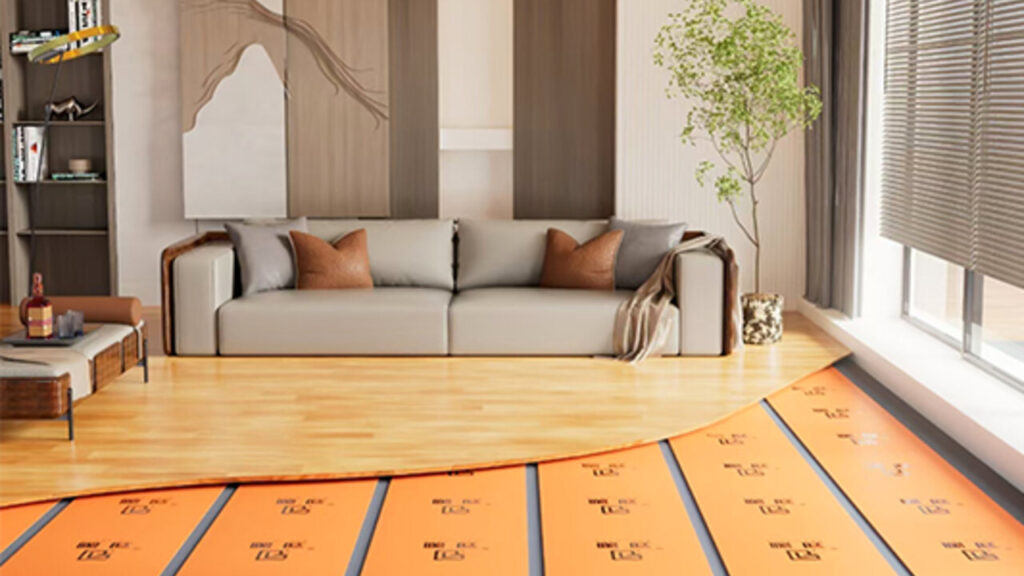
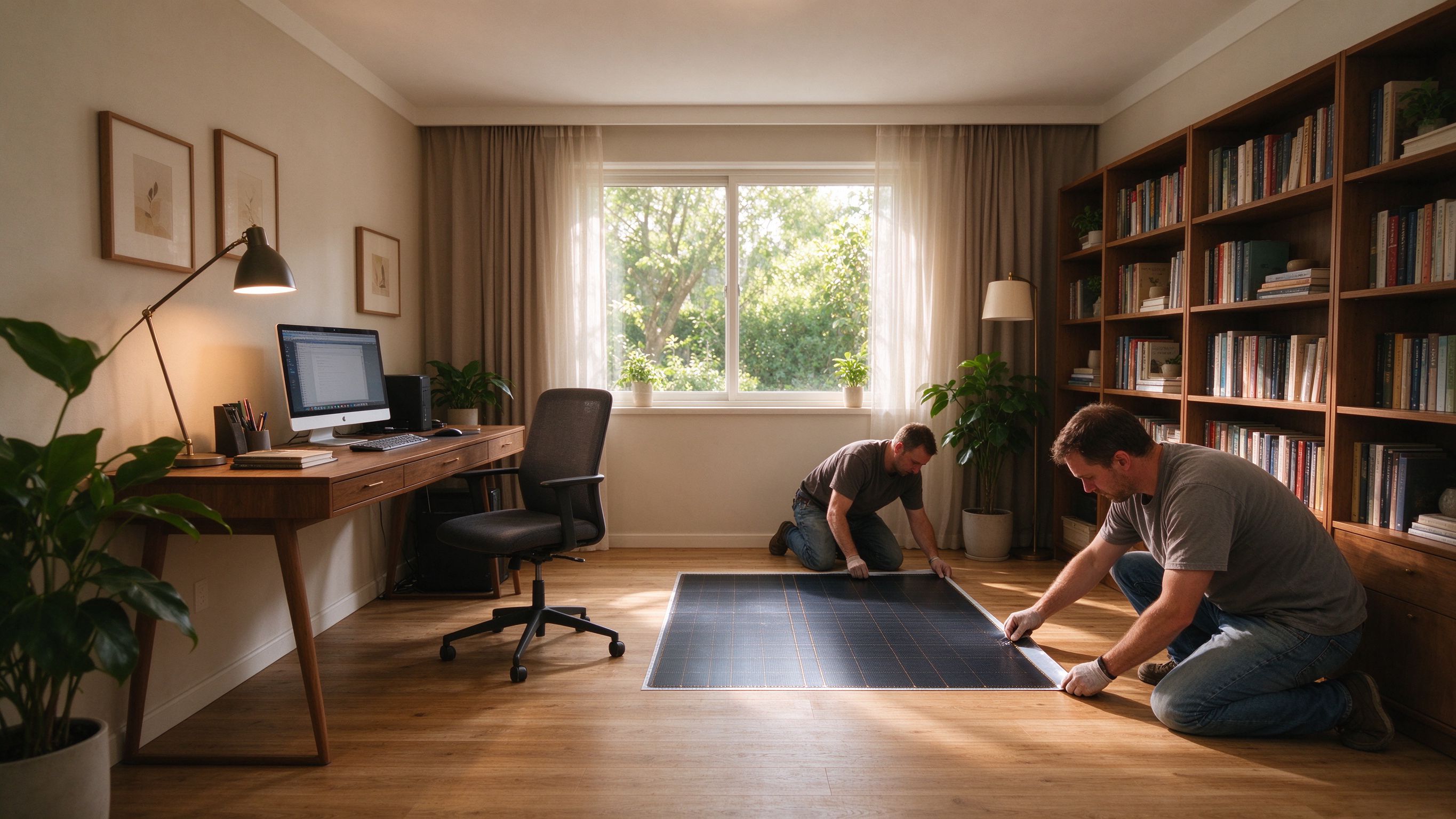
SunAura wall heating film installed beneath a living-room floorSUNAURA | QINGDAO
Two installers laying SunAura heating film in a home office retrofit

Featured application hub

Wall Heating Film

Six project types we have actually installed: apartment retrofit, bedrooms, hospitality, home office, clinics and extensions. The same three things decide each one — what is behind the wall, what goes on the face of it, and how the room gets used.

Explore wall film applications →

Featured product line · outdoor

Snow Melting Cable

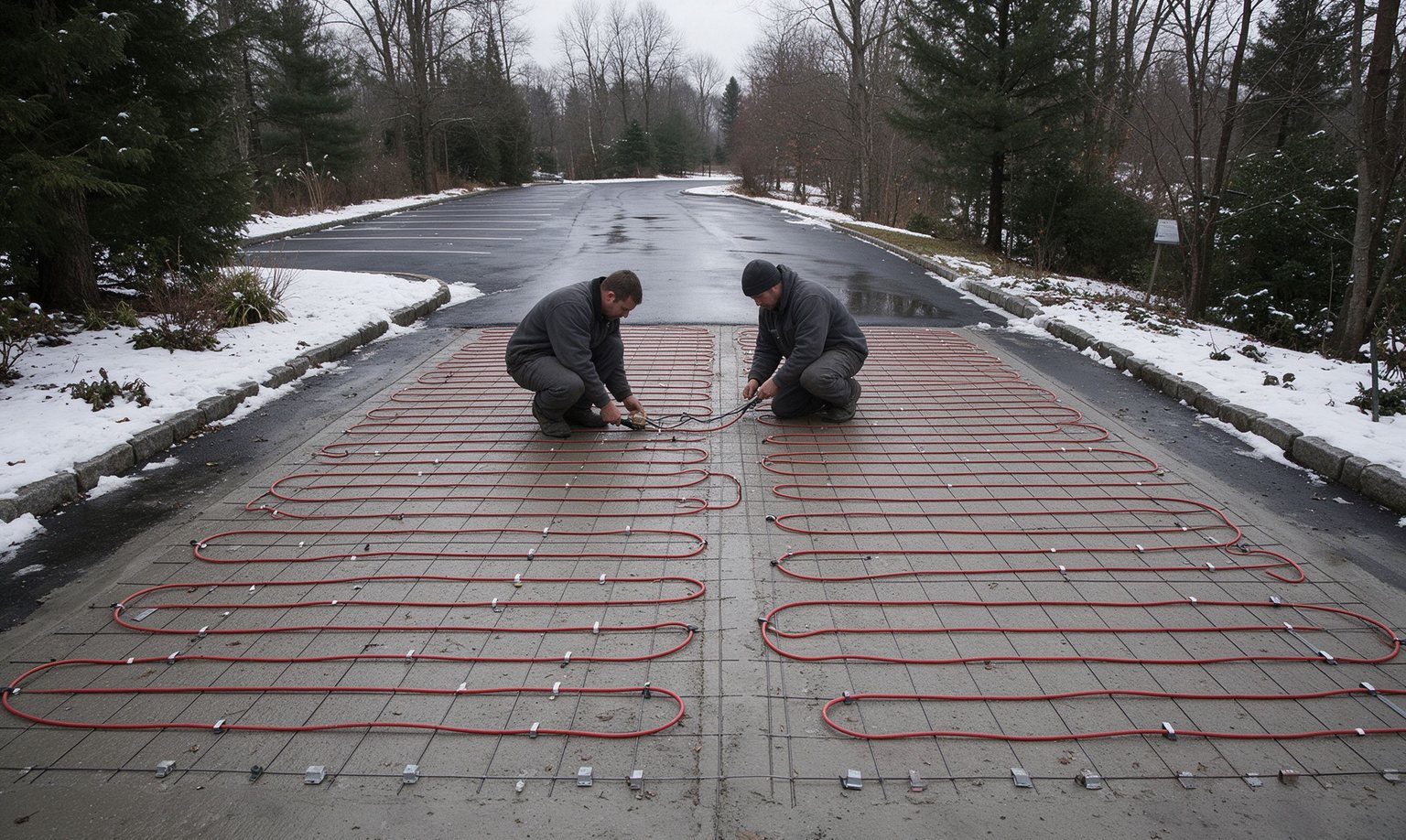
Loops go on the reinforcement mesh before the pour, so the cable ends up inside the slab rather than on top of it. Output is set by the surface, not by the room: 200–350 W/m² for driveways, ramps, aprons and loading yards, 150–300 W/m² on roof edges, valleys and gutters, where the eaves sit colder than the open deck. The slab sensor reads temperature and moisture together, so the system is already warm when snow starts, instead of switching on after it has packed into ice.

Testing is the part buyers ask about least. Insulation is measured before the pour and again after curing, because a bad loop found while the concrete is still cuttable costs a splice. Found in January, it costs a saw cut, a new loop, and a driveway nobody can use for a week.

  • 200–350 W/m² ground
  • 150–300 W/m² roof edge
  • Temp + moisture sensor
  • Tested before & after pour
Snow melting heating cable laid in loops on a driveway slab

How to Choose the Right SunAura Heating Solution

Industrial process & tank heating — SunAura application
01

Industrial process & tank heating

Tanks, process lines and viscous fluids. Fixed-resistance silicone for tank wraps; PTC where a line may sit powered and unused for weeks.

Read the guide

What counts as industrial here. Tanks and IBCs that must not solidify overnight, process lines carrying oils, syrups, chocolate, resin or chemicals, and drums that sit outdoors between one season and the next. Not a floor, not a roof — a container or a line where the fluid itself has to stay movable.

Sizing starts from the media, not the wattage. Four numbers decide it: the temperature the fluid must hold, the coldest ambient it sees, tank surface or pipe diameter with insulation thickness, and the supply voltage. A 1 m³ IBC of glucose at −10 °C and a 25 mm resin line at +5 °C land on completely different W/m. Guess, and you either cook the product or fit a cable that never gets there.

Fixed resistance or self-regulating. Tank wraps and short spouts take silicone at a fixed W/m: predictable, cheap to control, and indifferent to the tank standing full for weeks. Long lines that may sit powered while empty — or that run from a warm plant room out to a cold yard — take PTC, which trims itself instead of cooking the empty section.

What we hand over. A tank wrap or pre-terminated line sections, cold lead and end seal, a thermostat reading the tank wall or the line surface, the insulation spec, and the RCD rating. For export the drawing and wiring sheet travel in your language.

The 50 W/m silicone range carries the ratings. If the job is a pipe that must never freeze, the heat trace family is the better place to start.
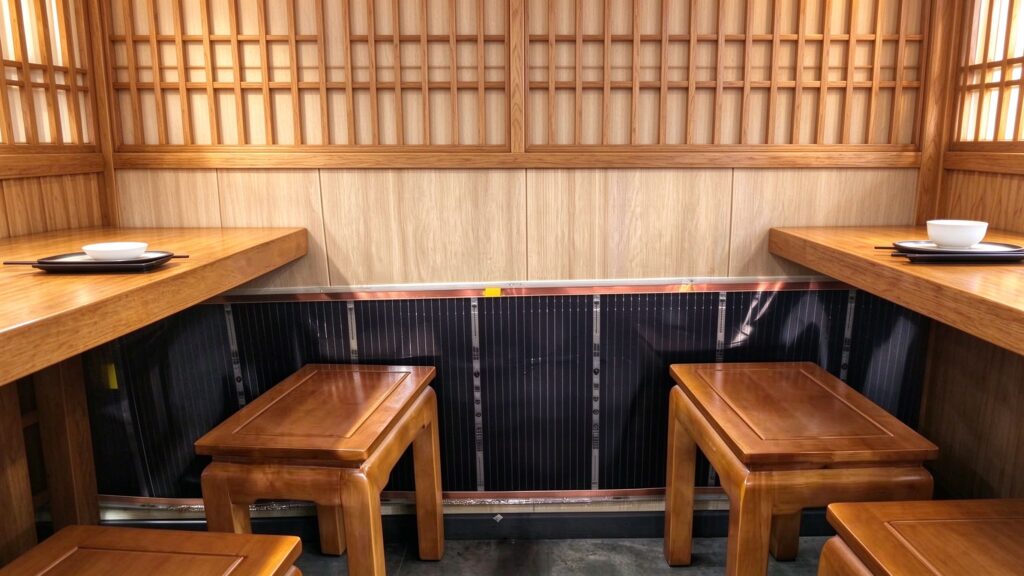
Residential Heating — SunAura application
02

Residential Heating

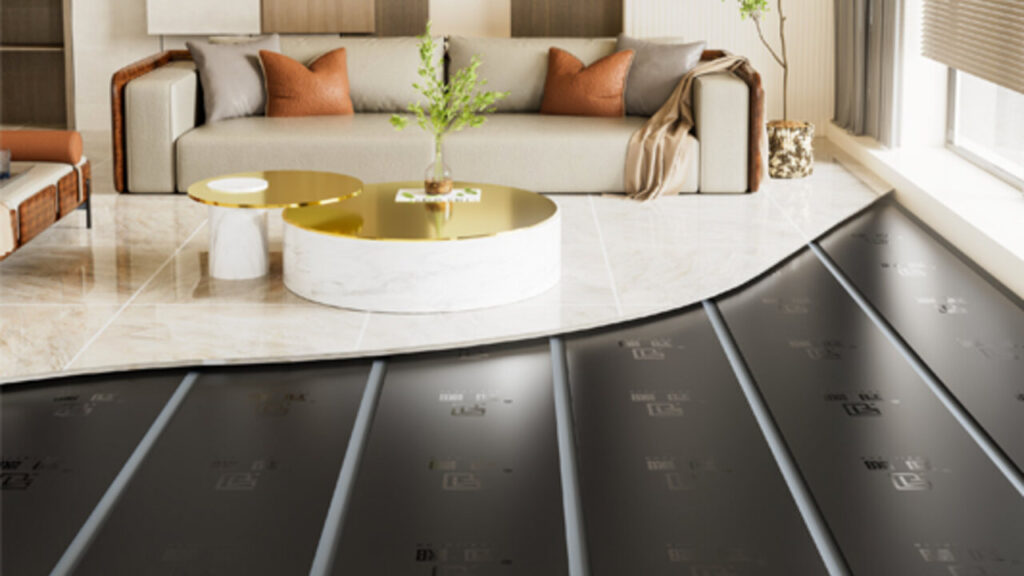
Bathrooms, living rooms, attics and whole villas. Film goes under a floating floor, mat goes into the tile adhesive; both heat the floor itself, so the warmth comes up evenly and there is no radiator to walk around.

Read the guide

Where the film actually goes. Under a floating floor or in the tile adhesive, never in the screed that gets floated over it — a film ending up under 60 mm of wet concrete is a repair you will be doing in two years. Bathroom, living room, attic conversion, whole villa: same 160 W/m² product, different coverage.

The number that matters is W/m², not total watts. A well-insulated living room holds 100–120 W/m²; a cold attic with single glazing wants 150–160. Cover 60–80 % of the floor and let the thermostat do the rest. Covering 100 % buys a faster warm-up you did not need.

One thermostat per zone, floor sensor in the build-up, air sensor in the room. Cheap kits skip the floor sensor and then overshoot on tiles. Ask for the RCD rating and the cold-lead length before ordering — the lead length is what decides where the box goes.

What ships. Film at your width, cold lead, end seal, sensor, thermostat, and the layout drawing the installer works from. The residential range carries the widths and the W/m² ratings.

Commercial Buildings — SunAura application
03

Commercial Buildings

Hotels, offices, clinics, schools and shops. Zoned floor heating that comes up fast, needs almost no servicing, and ships in bulk with the layout drawings the installer works from.

Read the guide

Offices, hotels, clinics, schools, shops. All of them ask for the same thing: heat that comes up fast, needs almost no servicing, and survives a fit-out that changes every three years. Zoned film does that. A wet system needs manifolds, pumps and a plant room; film needs a circuit and a thermostat.

Size by zone, not by building. Meeting rooms and reception at 120–150 W/m², corridors at 100, storage at 80. The usual mistake is treating the whole floor plate as one number and then wondering why the corner office cooks. Each zone gets its own thermostat and its own RCD.

Get the electrical design in early. 2,000 m² at 60 % coverage is a serious load: the board, the sub-metering and the cable routes all have to be settled before the ceilings close. Ask the client for the tariff as well — night set-back is most of the saving.

What we hand over. Film, cold leads, thermostats, zone drawings, load schedule and the commissioning sheet. The commercial range lists widths and the load per m².

Agriculture & Horticulture — SunAura application
04

Agriculture & Horticulture

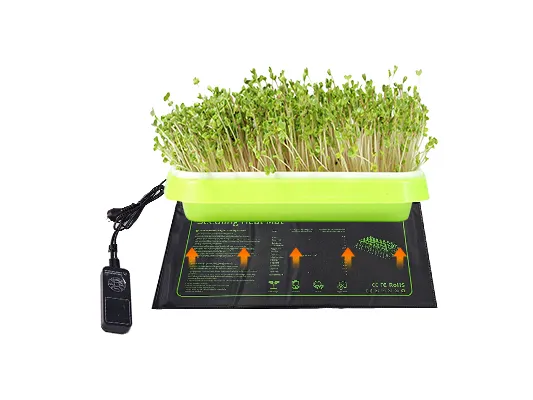
Propagation trays, greenhouse benches and hydroponic tanks — low power at the root zone, held steady through the night when the air temperature drops.

Read the guide

Propagation trays, benches, hydroponic tanks. The heat sits at the root zone and stays low: 10–30 W/m² for germination beds, up to 60 for a bench that has to hold 25 °C overnight in an unheated tunnel.

Root-zone temperature is what you control, not air temperature. A soil probe reads 2–3 °C below what the crop sees, so put the sensor where the roots are and set the thermostat against the crop’s requirement instead of the air.

Humidity is the real enemy. A wet bench with a live film and a sloppy end seal is a short. IPX8 splices, RCD protection and a drip tray under the thermostat are not optional in a greenhouse.

What ships. Narrow-width film for trays, factory-made leads, soil probes, IPX8 thermostats, and the wiring diagram for a multi-bench layout. The agricultural range.

Pet & Reptile — SunAura application
05

Pet & Reptile

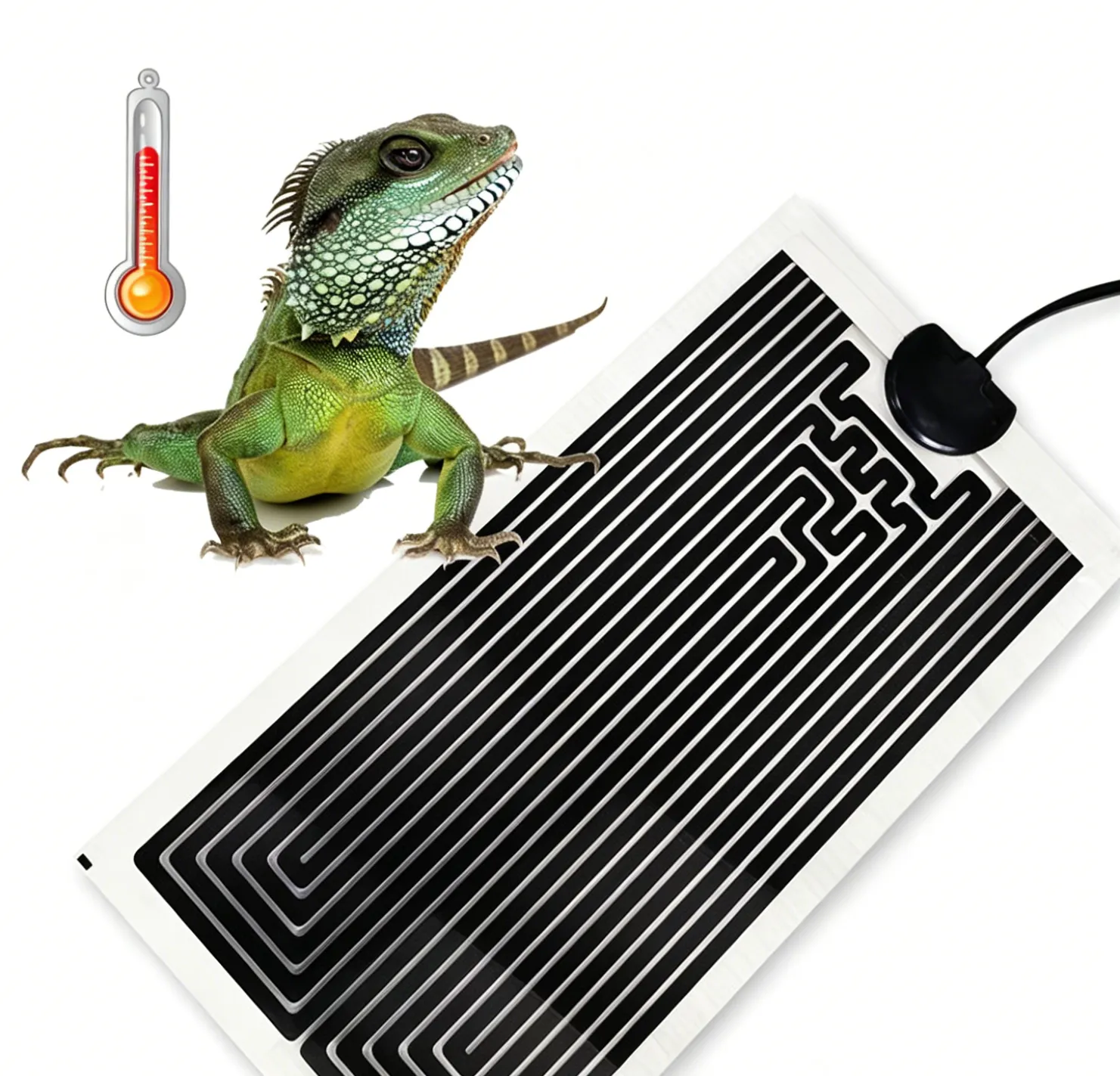
Terrariums, whelping boxes, cat and dog beds. Ten power levels on a low-EMF element, so the pad can stay on all night without a hot spot forming under the animal.

Read the guide

Terrariums, whelping boxes, cat and dog beds. Ten power levels on a low-EMF element, so the pad can stay on all night without a hot spot forming under the animal.

Surface temperature at the pad: 28–32 °C for a whelping box, 30–34 for a basking tile. Measure with the animal’s weight on it. A bare pad reads several degrees high, and that is how a litter gets cooked.

Low EMF matters more than most buyers assume. A single-conductor film with a return path cancels most of the field; cheap pads do not. Ask for the measurement, not the brochure line.

What ships. Cut-to-size pads, chew-resistant leads, washable covers, and plug-and-play thermostats with a probe. The pet and reptile range.

OEM / ODM Projects — SunAura application
06

OEM / ODM Projects

Private label run from our own factory: your widths and wattages, your branding, manuals and packaging in your languages, and a sample in your hand before the container ships.

Read the guide

Private label from our own factory. Your widths and wattages, your branding, your manuals and packaging in your languages — and a sample in your hand before the container ships.

Nail the spec before the artwork. Width in mm, W/m², voltage, lead length, plug type, thermostat pairing, roll or cut sheet, and the certification the destination market wants. Those eight lines are the whole RFQ.

Certification is the long pole. CE, UKCA, RoHS, REACH, plus UL/ETL if North America is in scope and GS for Germany. Each adds weeks, and the test samples have to come off the production line, not a lab bench.

What we do. Draw the spec, quote against MOQ, build samples, run the certification, and hand over the files your distributor needs — datasheet, declaration, packing list, barcode. The OEM/ODM programme.

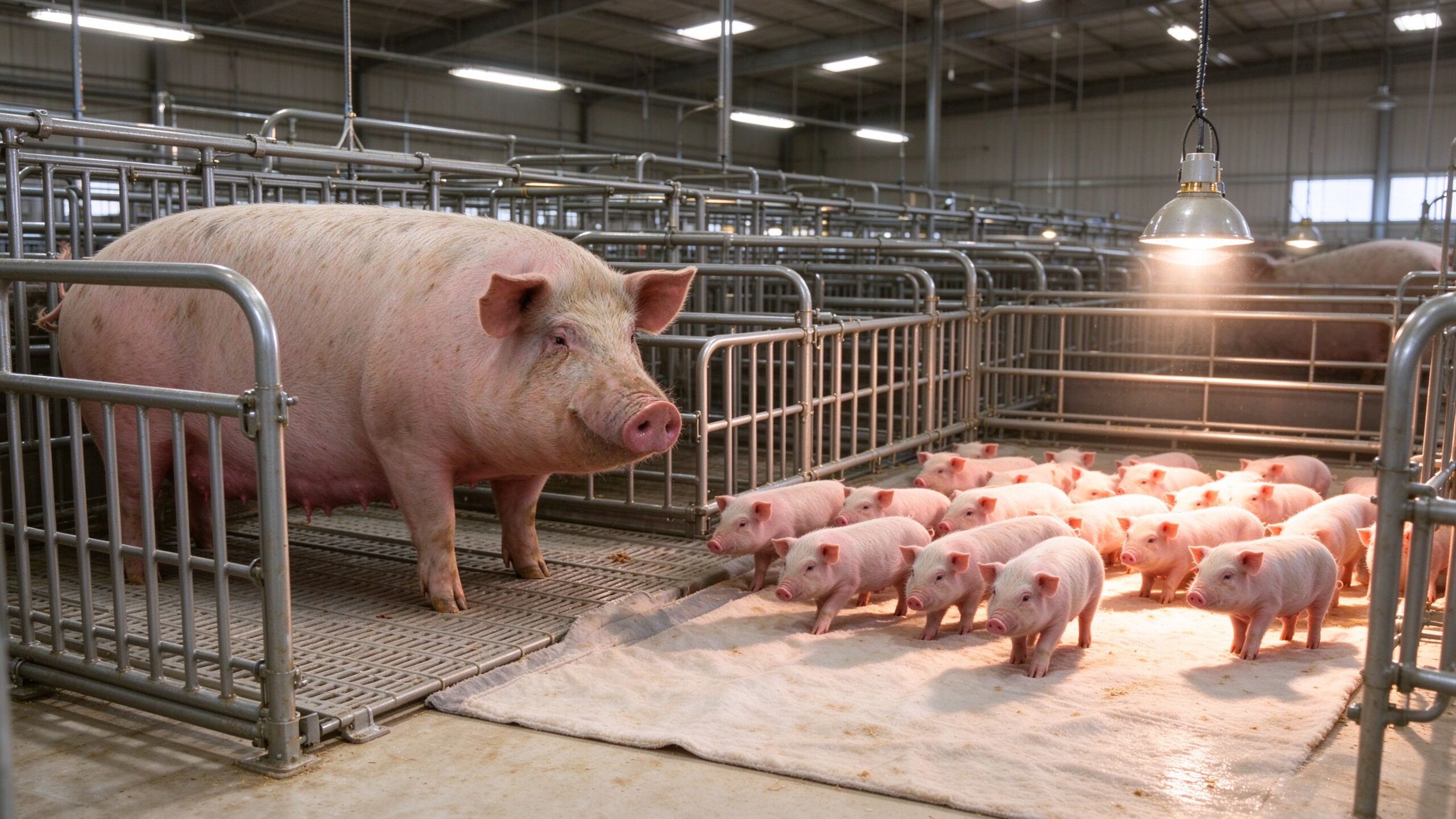
Piglets under a heat lamp in a farrowing pen with a slatted floor
07

Livestock & Poultry House Heating

Farrowing pens, brooder zones and drinker lines. Moving the heat from the lamp above the animals down to the floor under them — with the numbers from a 300-sow unit we fitted.

Read the guide

Farrowing pens, brooder zones, drinker lines. The heat belongs on the animal, not on the room. A 300-sow unit we fitted runs the farrowing house at 22 °C air and 30 °C at the pad, and the sows stay where they should.

Brooding is zoned, not room-wide. Chicks need 33–35 °C floor in week one, dropping 3 °C a week. A single room thermostat cannot do that. One circuit per zone, one probe per zone.

Ammonia and washdown kill connectors before anything else. IPX8 joints, stainless fixings and a thermostat sitting outside the wet area are the difference between a five-year install and a two-year one.

What we supply. Film cut to the pen layout, IPX8 leads, probes, controllers, and the schematic for a house of 40 pens. The livestock range.

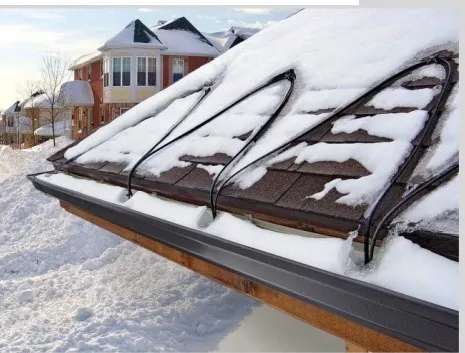
Heating cable in roof valleys and gutters
08

Roof & Gutter Snow Melting

Ice dams form at the eaves and in the valley, not out in the middle of the roof. Cable in the gutter, in the valley and in the first metre above the eaves is what keeps the meltwater running instead of refreezing.

Read the guide

Ice dams form at the eaves and in the valley, not in the middle of the roof. Cable in the gutter, in the valley and in the first metre above the eaves is what keeps meltwater running instead of refreezing.

Power density is set by climate and pitch. 200–350 W/m² at the eave for a house that sees −20 °C and regular snow; 150–300 on a milder site. Underdo it and you melt a channel that closes again overnight.

Control beats wattage. A manual switch runs all winter and costs the yearly bill; a thermostat with a moisture sensor and a low-temperature lockout runs maybe 60 hours a season. Then add the drain path — meltwater has to go somewhere.

What ships. UV-rated cable, gutter clips, downpipe loops, splice kits, sensor and controller, and the layout showing where the cable stops. The snow melting range.

Heat trace cable, 10–30 W/m — SunAura application
09

Heat trace cable, 10–30 W/m

Self-regulating and constant-wattage cable for pipes, drains, roof edges and small tanks — with the cold lead, kits and thermostat that make it a system instead of a reel of cable.

Read the guide

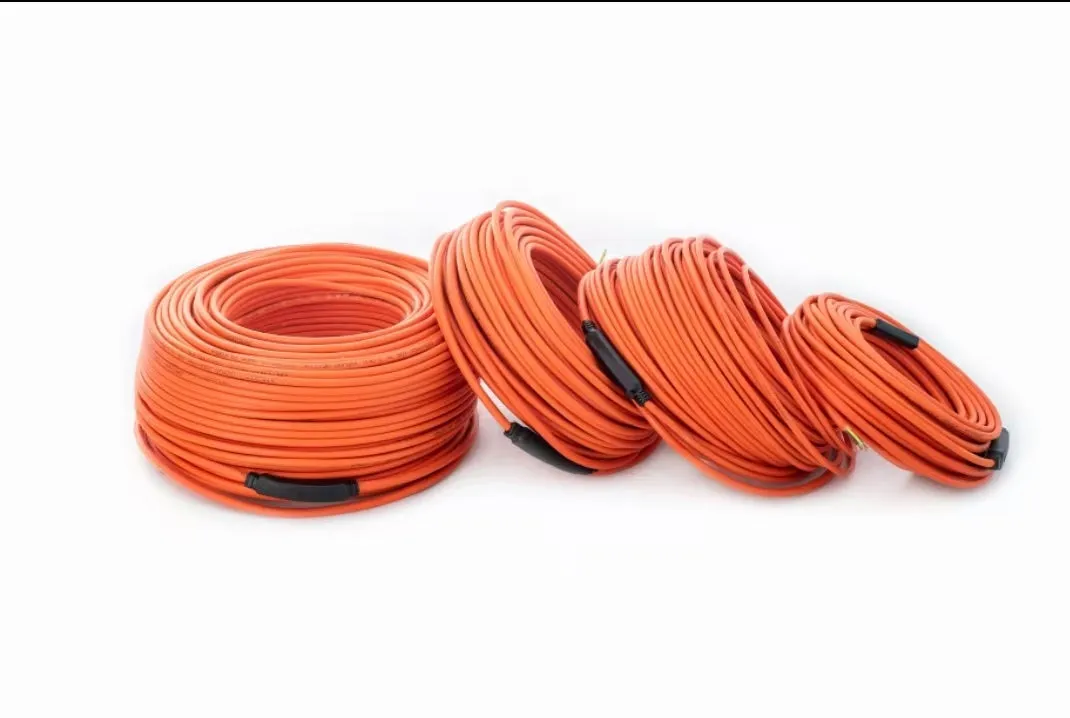
What the name covers. Heat trace cable is a family, not one product: self-regulating PTC cable that trims its own output as the pipe warms, and constant-wattage silicone cable that holds the same W/m whatever the pipe does. Both are double-insulated and IPX8, and we build them from 10 to 30 W/m for 110 V and 220/240 V.

Watt density comes off the pipe, not the room. Five numbers decide it: pipe outside diameter, insulation thickness, lowest ambient, the temperature you have to hold, and the supply voltage. A 25 mm insulated line at −20 °C holds +5 °C on far less W/m than a 100 mm bare tank spout. Send those five and we come back with the W/m, the loop length, the thermostat and the RCD you need.

Where it ends up. Water and fire lines, sprinkler and standpipe circuits, grease-prone drains and condensate runs, roof edges, gutters and valleys, small tanks and IBCs. The pipe freeze page carries the sizing tables; the self-regulating range carries the ratings.

What ships with it. Pre-terminated sections or bulk reels, cold lead and end seal, connection kit, a thermostat with a pipe or ambient sensor, and an installation sheet. PTC cuts to length on site; silicone does not, so give us the loop length up front.

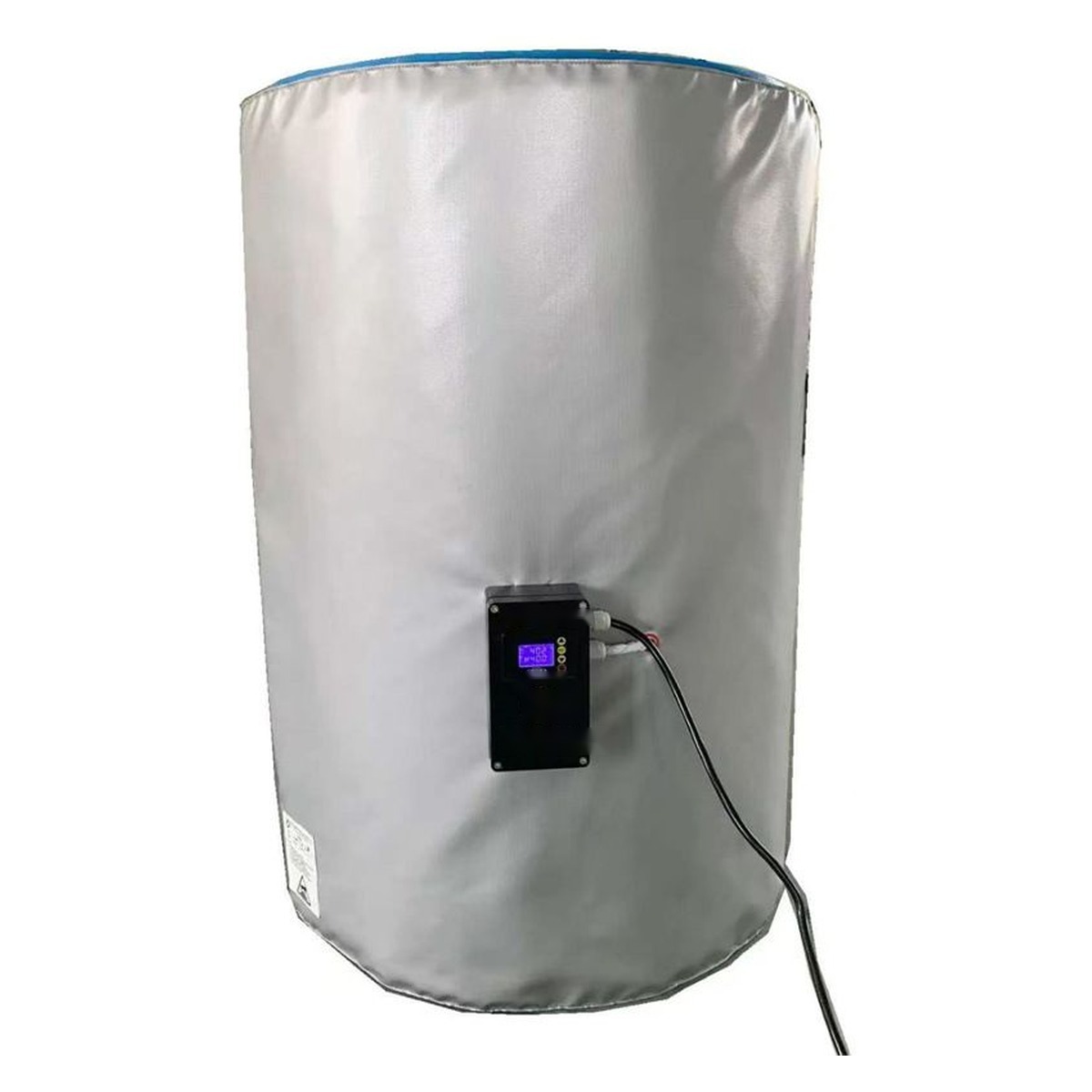
Drum heating jacket wrapped around a 200 L industrial barrel
10

Drum & Industrial Heating Blankets

Flexible electric jackets for drums, IBCs, wine barrels and equipment: viscosity control, frost protection and even process heating.

Read the guide

What it covers. 200 L/55 gal drums of oil, grease, resin, honey and chemicals that thicken or freeze outdoors, plus IBC ton-containers and flat blankets for pumps, valves and pipes that cannot be drained.

Sizing starts from the medium. Hold temperature, lowest ambient and container surface area decide the wattage; specify the food-grade jacket early for wine, beer, juice and edible products.

Sizing Your Project: A Quick Specification Checklist

  1. 01
    Application.

    Name the surface: floor, pipe, roof, tray, terrarium or bed. One line is enough — the answer changes the product, not the packaging.

  2. 02
    Area or length.

    Floors: room dimensions. Pipes: diameter, run length, insulation thickness. Roofs: area plus the snow load you design for. We size from these, not from a guess.

  3. 03
    Voltage.

    220–240 V across Europe, the Middle East, Asia and Oceania; 120/240 V in North America. Give us the local supply and we build to it.

  4. 04
    Floor or surface finish.

    Tile, stone, laminate, engineered wood, vinyl, carpet or concrete. The finish decides film or mat, and it decides the adhesive.

  5. 05
    Insulation.

    Well-insulated room, slab on grade, attic or an outdoor surface — that is the difference between 80 and 160 W/m².

  6. 06
    Control preference.

    A plain thermostat, a WiFi one with scheduling, or a sensor controller for pipes and weather. Cheap control on a good system is the usual reason a job disappoints.

  7. 07
    Quantity and destination.

    Rough quantity and destination country. That fixes the incoterm and keeps the freight from eating the margin.

Specification notes

Energy Use, Running Cost and Common Questions

Heat loss · kWh price · how the thermostat is set
Heat loss of the room

Almost every first email asks the running cost. The honest answer: it is set by how much heat the room loses, not by the film. A well-insulated room runs on a fraction of what a cold one does with the same kit.

Local electricity price

You pay per kWh, and the thermostat decides how many of them you buy. Weekly scheduling plus open-window detection usually takes 30–50 % off an always-on system.

Installation Accessories and Kits

Insulation board · edge strip · aluminium tape
Insulation boards

They cut the loss downward and shorten warm-up. On a slab on grade they pay for themselves in the first winter.

Edge insulation strips

Stop heat migrating into the surrounding walls and skirting.

Aluminium tape

Holds the element flat and spreads the heat, so no strip runs hotter than its neighbour.

Junction boxes & conduit

Protect the cold tail and keep sensor wiring serviceable. This is the part that fails first when it gets skipped.

Safety, Certifications and Warranty by Application

Floor film & mats · heating cable · pet & plant pads
Underfloor film & mats

Tested to IEC 60335 household-safety requirements, with CE and RoHS documents per batch.

Heating cables

Built to the IP rating the job needs, and hipot-tested for insulation continuity before they leave the line.

Pet & plant pads

Same low-EMF build as floor film — which is why they can run 24/7 inside an enclosure.

Thermostats

EMC and safety tested; each model carries its own CE and RoHS file, not a generic certificate.

Choosing by Climate and Building Type

Cold · temperate · hot and humid
Cold climates

Whole-house floor heating as primary heat: higher W/m², insulation boards, one thermostat per zone.

Temperate climates

Film in the bathroom and living room changes winter evenings without a full retrofit.

Mild & humid climates

Pipe freeze protection and ramp de-icing cable, plus sealed mats and sensors for greenhouses.

Why Specify SunAura for Your Application

Qingdao factory · test records · one engineer
Real Qingdao factory

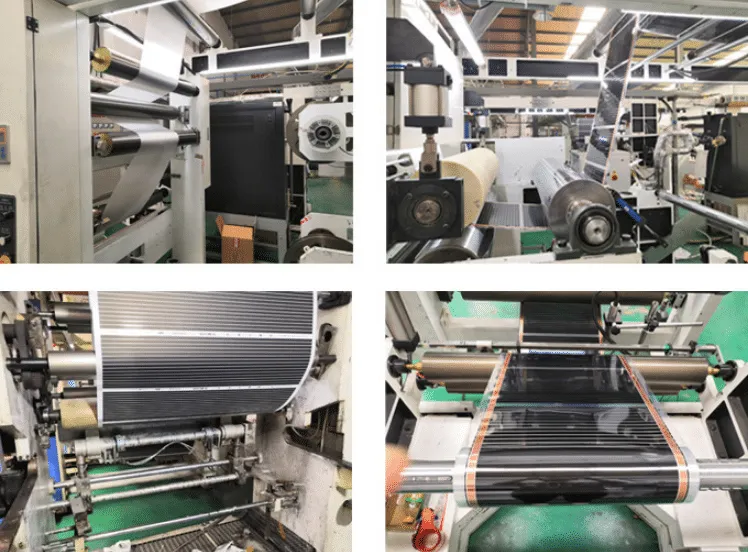
Heating elements since 2008, shipping to more than fifty countries. You can visit the line.

Documented testing

Batch records with CE, RoHS and ISO paperwork that matches the roll you receive.

Engineer-backed support

One contact from first drawing to after-sales, with traceability back to the production date.

Free Layout Drawing and Engineer Consultation

Send the plan · we mark it up · quote in 24 h
Send your plan

Floor plan, sketch or dimensions — area, floor build-up, voltage.

Engineer layout

We mark where film or mat goes, where the thermostat and sensor sit, the spacing and the insulation.

Quote within 24h

Product, power density, accessories and price on one sheet, freight included.

Product lines

Product clusters

Pick the line first, then the numbers

There are nine ways to use this cable on this page, which is too many to walk through in one go. So start from the product instead: the line, then the variant that fits the job, then the page that actually carries the wattage and the sizing. If your project needs two — underfloor heating upstairs and a driveway outside — read both before you ask for a price. That is usually where you catch the detail that would otherwise have cost you a second quote.

Cluster 01 · Pipes, tanks, roofs

Heat trace cable

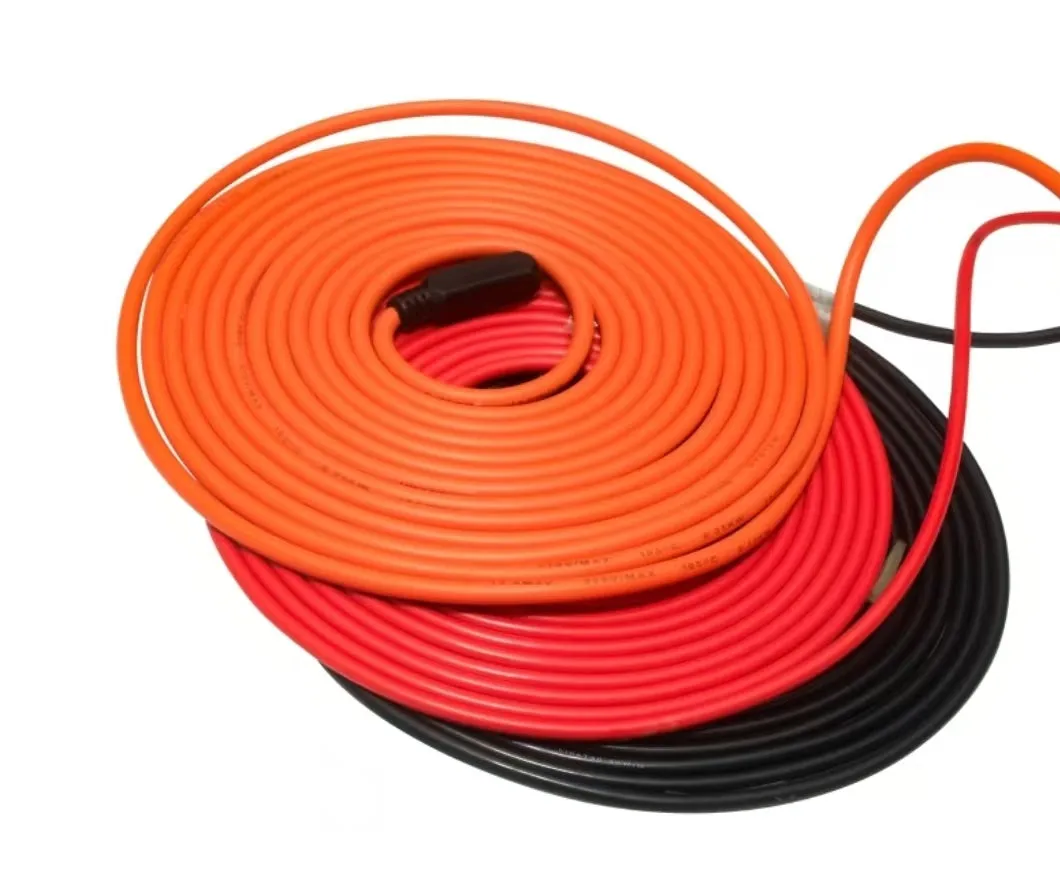
Tracing is for lines you cannot drain. Self-regulating PTC rides out ambient swings and tolerates runs that overlap; constant-wattage silicone holds one fixed output where the number has to be predictable. Both are double-insulated and IPX8, and both cut to length on site.

10–30 W/m selectable · holds a pipe above 5 °C · pipe or ambient sensor

Cluster 02 · Ground, roof, steps

Snow melting cable & mats

Outdoor de-icing is sized by the surface, not by the room. Cable goes in loops on the mesh before the pour; mats are pre-formed for steps, walkways and driveways where laying cable is impractical. Roof edges and gutters sit colder than the ground, so the sensor belongs in the valley.

200–350 W/m² ground · 150–300 W/m² roof edges · weather-sensing control

Cluster 03 · Floors, odd shapes

Heating cable

The cable that traces a pipe also warms a floor, and it is what you use where a mat will not fit: an irregular room, a tight door threshold, a finish that cannot take a 3 mm build-up. Fixed resistance gives predictable loops; PTC cuts its own output where two runs overlap.

10–30 W/m · IPX8 · one cold tail per loop, no return loop

Keyword map · Pipe heat tracing

Heat trace cable: what buyers type, and where each answer lives

Nobody searches for “heat tracing” just once. They start with what the thing is called, move on to the pipe they have actually got, then ask how many watts per metre and whether it needs a thermostat. That is the order below, so wherever you came in, the next answer is one click away. Same product, other words: Begleitheizung, ヒートトレース, 伴热带.

01 · What it is called

Heat trace cable

Almost every enquiry starts with one of these three: heat trace cable, heat tracing cable, electric heat tracing. They land on the same page because the first thing to settle is not the cable but the line — whether it needs tracing at all, or whether draining it is the cheaper fix.

10–30 W/m · double insulated, IPX8 · one cold tail per circuit

02 · What the pipe carries

The pipe picks the cable

Once someone knows they need tracing, they search by what runs through the line. Each variant below exists because of a different failure: a sprinkler main that must stay full, a waste line where grease sets at the low point, an eave that runs colder than the open roof.

Pipe or ambient sensor · cut to length on site · IPX8

03 · How many watts

The numbers, and what runs them

These searches come last and decide the order: how many watts per metre, whether the cable can be cut, and whether the circuit needs a thermostat or just a plug. The pages here carry the numbers rather than the sales line.

110 / 220 / 240 V variants · pocket or pipe probe · −20 °C rated jacket

04 · The questions that decide the order

How many W/m for a 25 mm pipe? Can it be cut on site? Does it hold at −20 °C? Can two runs overlap? Thermostat, or just a plug? 110 V or 230 V?

Typical range 10–30 W/m · double insulated, IPX8 · one cold tail per circuit · sensor on the pipe or in the ambient air

Application FAQ — Answered by Our Engineers

How much does electric underfloor heating cost to run?

Three things decide it: how much heat the room loses, what you pay per kWh, and how the thermostat is set. A well-insulated bathroom on a 160 W/m² mat draws power mainly while it warms up; once the floor is at setpoint the thermostat cycles the element and the tile holds the heat. A WiFi thermostat on a weekly schedule usually lands well below an always-on system. Send us the room dimensions and we will work the running cost from your heat loss.

Is graphene heating film safe under wood and laminate flooring?

Yes, as long as the thermostat has a floor sensor set to the maximum surface temperature the flooring maker allows. A wood-based floor should never be run off air temperature alone, which is why film floors get a floor probe and a surface limit — and a spare probe in the box.

Can heating film and mats be cut or shaped on site?

Film rolls cut to width between the busbars, following the drawing — never across a busbar. Mats are made to size and should not be cut; for an irregular bathroom we make a custom mat to your sketch, or recommend cable for the awkward angles. Cutting a mat is the mistake installers report to us most often, and it voids the warranty.

Which thermostat should I pair with my SunAura heating system?

Match it to the load and to how you want to run it. WiFi models (K1M, K2M, K9, K5, KC02, K6H, touch, knob, piano-key, SDM5, SDM6) give you app scheduling and remote control; K1 is the plain wired thermostat for when simple and reliable is the whole requirement; the RF model is for wall-hung boiler systems. The full list sits on the thermostats & controls page.

Can I buy SunAura heating as a wholesale or private-label distributor?

Yes. We supply distributors and heating brands direct from the factory: volume pricing, low MOQ, your widths and wattages, your branding and packaging, manuals in your languages, and the certification file for your market. Send target market, target price and annual volume through the contact page and you get an answer within 24 hours.

Start Your Project — Factory-Direct, Wholesale & OEM

A single bathroom kit or a full container of private-label film, mats and thermostats — both leave the same Qingdao factory, with wholesale pricing we can show you line by line, an MOQ we can actually meet, and lead times that hold. Send the application, the area, the voltage and the floor type; an engineer answers within 24 hours with the product, the power density, the thermostat shortlist and a price you can compare.

Request a Factory Quote