
Underfloor Heating Cost Australia 2026: Electric System Prices | SunAura
Working out the underfloor heating cost in Australia means budgeting three separate numbers honestly: the heating element that goes under the floor, the labor to install it, and the electricity it consumes over the years. Australian price guides jump around because they blend these three, and because a tiled bathroom in Brisbane is a different project to a whole-floor living-room install in Ballarat or Hobart. This page walks through each layer with explicit, labeled industry estimate ranges, so you can form a real budget — and catch the specification choices that quietly inflate the running cost. SunAura Thermal manufactures electric underfloor heating film, mats and cable in Qingdao, China, and exports to more than 50 countries, so the figures below reflect what factory-direct buyers typically see across the Australian market in 2026, rather than a single retailer’s ticketed price.
Important framing: every dollar figure on this page is an industry estimate range, not a fixed price. Material and installation prices move by state, finish, exchange rate and installer; electricity tariffs change seasonally and by network. Treat the numbers as a planning band, then confirm your project with a local installer and your energy retailer.
1. What Drives the Total Cost: The Three Buckets
An electric underfloor heating project in Australia has three cost layers that people routinely lump together. First, the material cost: the heating element itself — film, mat or cable — priced per square meter. Second, the installation cost: subfloor prep, insulation board, fixing the element, placing the floor sensor, connecting the safety circuit and finishing the floor over it. Third, the running cost: the kWh the element actually draws, which depends on installed watt density, the hours it cycles on, and your local tariff — especially whether you are on a controlled-load or off-peak rate. A system that is cheap to buy but uninsulated can cost more to run for two decades than a slightly more expensive, properly built one. That is why a factory supplier asks about your build-up before quoting output, not after.
2. Cost Overview: Electric Underfloor vs Alternatives (Estimate Ranges)
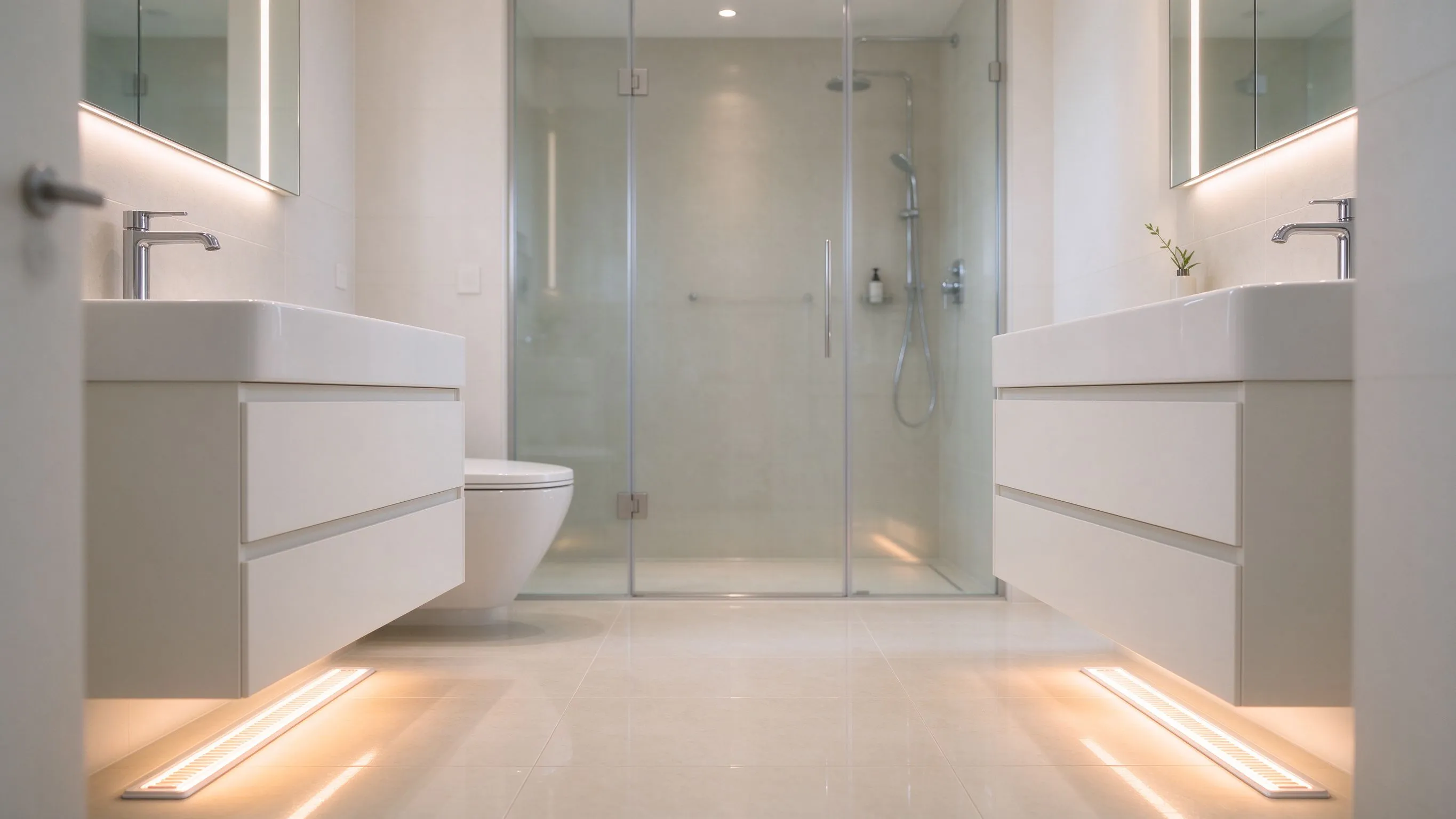
The table below shows typical turnkey cost bands for electric underfloor heating against common heating-upgrade alternatives in the Australian market. These are installed, industry estimate ranges per square meter of heated area, in Australian dollars, and they assume a reasonably prepared subfloor and a standard tile, timber-look or vinyl finish.
| System (installed) | Typical estimate range (AUD / m²) | Best fit |
|---|---|---|
| Electric film / mat, retrofit over subfloor (under floating floor, tile finish) | ~A$150 – A$280 per m² (estimate range) | Bathrooms, laundries, renovations, room-by-room retrofits |
| Electric cable in-screed / under tile (new build or re-floor) | ~A$130 – A$240 per m² (estimate range) | New slabs, tiled wet areas, whole living floors |
| Hydronic radiant slab (boiler / heat pump + PEX loop) | ~A$200 – A$380 per m² (estimate range) | Whole-home new build, slab-on-grade warm-climate homes |
| Ducted heating zone add-on / panel radiator upgrade | ~A$100 – A$220 per m² (estimate range) | Existing ducted homes, quick room comfort |
Read the band, not the midpoint. The low end assumes a modest room, a standard finish and an installer at local market rates; the high end assumes irregular rooms, premium finishes, lifting existing floor coverings, and extra electrical work. These are planning bands, not fixed prices. Multiply your heated area by the band that matches your build and you have a defensible first budget.
3. Material Cost: Film, Mat and Cable per Square Meter (Estimate Ranges)
The heating element is the part SunAura manufactures, and the part where buying factory-direct removes a layer of retail markup. The following are industry estimate ranges for the element alone, per square meter, in Australian dollars, before insulation, thermostat and labor:
| Heating element | Typical material estimate (AUD / m²) | Typical installed watt density |
|---|---|---|
| Far-infrared / PTC heating film | ~A$40 – A$80 per m² (estimate range) | ~120 – 200 W/m² |
| Mesh-mounted heating mat | ~A$35 – A$70 per m² (estimate range) | ~100 – 200 W/m² |
| Loose heating cable (by spacing table) | ~A$30 – A$65 per m² (estimate range) | ~100 – 200 W/m² by layout |
Film is the thinnest and the fastest to lay over an existing subfloor, which is why it dominates Australian retrofit jobs under laminate, hybrid timber and vinyl. Mats are the easiest to estimate for square tiled areas because the cable is pre-spaced on a roll. Loose cable is the cheapest per square meter but needs a spacing schedule to hit the target watt density. The range widens at the top for shielded, twin-conductor and higher-output builds — and because local distribution adds margin that a factory-direct order avoids. These are estimate ranges, not catalogue prices.
4. Installation Cost: DIY vs Professional, and What Moves It
Installation is where the budget either stays controlled or blows out. In a light retrofit — film over a prepared subfloor under a floating laminate, hybrid or vinyl — a competent DIYer can lay the film themselves, and the labor contribution shrinks to the thermostat and electrical connection. Professional installation for the same light job typically runs in the band of ~A$35 – A$70 per m² (estimate range), covering subfloor prep, insulation board, element fixing, floor sensor placement and commissioning. In a wet tile or in-screed installation, the band rises because of the tiling or screeding works above, and because a connection fault under tile is costly to reach.
The factors that move installation cost are predictable: the condition and level of the existing subfloor (leveling compound adds cost), whether insulation board goes in (it almost always should), the number of zones and thermostats, local electrician rates, and whether the switchboard needs an RCBO / safety-switch upgrade. Two rooms on one thermostat cost less per square meter than five rooms each separately controlled. When comparing quotes, ask each installer to break out element, insulation, thermostat, electrical work and finishing separately — a single lump sum hides the choices that matter.
5. Running Costs: kWh Estimate and a Worked Example With the Math Shown
Running cost is the number Australian homeowners most often underestimate — and the easiest to calculate once you have four inputs. The typical residential electricity rate across Australia in 2026 is an approximate regional average of roughly 25–35 cents per kWh (estimate — verify your current local tariff). Real bills vary by state and network: Victoria, NSW, Queensland, SA and WA all sit at different points, and controlled-load / off-peak tariffs (often used for storage and certain electric heating) change the economics substantially. Always check your own energy retailer’s rate before budgeting.
Worked example (illustrative, not a quote): a 20 m² living area, film rated at 150 W/m², in a reasonably insulated home, controlled by a programmable thermostat with a floor sensor. The element does not run flat-out all day — it cycles. A realistic duty cycle for background heating is about 4 hours per day in a cooler month. Here is the arithmetic:
| Step | Calculation | Result |
|---|---|---|
| Installed load | 20 m² × 150 W/m² | 3,000 W = 3.0 kW |
| Energy used per day | 3.0 kW × 4 h | 12 kWh/day |
| Cost per day at 25 c/kWh | 12 kWh × A$0.25 | A$3.00/day |
| Cost per day at 35 c/kWh | 12 kWh × A$0.35 | A$4.20/day |
| Annual cost, mild 60-day season | A$3.00–$4.20 × 60 days | ~A$180 – A$252 / year |
| Annual cost, cooler 90-day season | A$3.00–$4.20 × 90 days | ~A$270 – A$378 / year |
That is the order of magnitude for a well-insulated, well-controlled background floor: roughly A$180–A$378 a year for a 20 m² room, depending on how cold your winter runs and your exact tariff. It is not a bill forecast — it is an estimate built from the four inputs above. Three choices widen or narrow it: insulation board under the element (returns heat that would otherwise sink into a concrete slab), a floor-sensing thermostat (stops overshoot), and an off-peak or controlled-load tariff where your retailer offers one. Insulation is the single highest-return upgrade in an electric floor, which is why SunAura quotes output against the build-up, not in isolation.
6. Electric vs Hydronic Underfloor Heating in Australia’s Climate Zones
Australia’s climate zones push the choice in different directions. In the tropical and subtropical north (Brisbane, Cairns, Darwin), heating is a niche, seasonal comfort need — a bathroom mat rather than a whole-floor system — and electric film or mat is the obvious low-cost answer. In the temperate south (Melbourne, Adelaide, Hobart, Canberra, inland NSW), winters justify broader floor heating, and homeowners compare electric film against hydronic radiant and ducted gas. In the Alpine zones, whole-home heating load is heavier and hydronic loops paired with a heat pump become common in new builds.
The decision rule is consistent across zones: if you are renovating a finished room, adding a bathroom zone, or want comfort without plumbing and annual servicing, electric film or mat is the lower-entry-cost, low-maintenance route. If you are building new and already specifying a heat pump, a hydronic radiant slab is the natural partner, and electric film can still be added as a complementary wet-area zone. Electric installations in Australia also carry the electrical-code overlay — RCBO / residual-current (earth-leakage) protection on the circuit, a floor sensor, and a thermostat rated for the floor finish — which a qualified installer prices into the job.
7. Factory-Direct: Why the Cost Band Narrows When You Buy From the Manufacturer
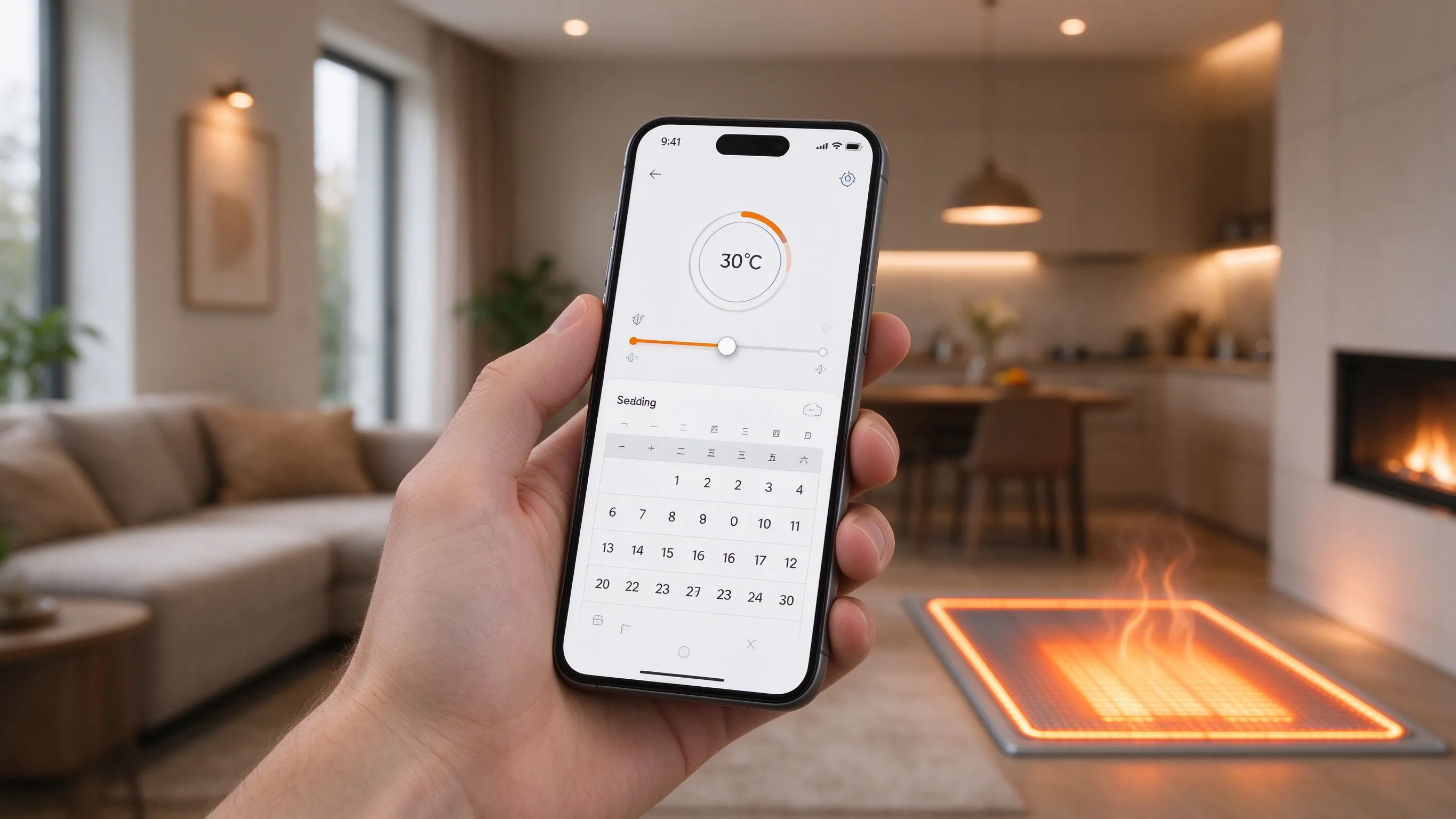
SunAura Thermal has manufactured electric heating elements at its Qingdao Huangdao factory since 2008 — more than 17 years — and exports to over 50 countries, including Australian distributors, installers and project partners. Our underfloor range is built for OEM and ODM: film, mats and cable produced to order, with CE, ISO 9001 / 14001 / 45001 and RoHS compliance documented per shipment, and warranty coverage in the typical 15–25 year band on the heating element itself. Buying factory-direct removes the distribution margin that sits between the element and the installed price band in section 3, and lets an Australian distributor or installer lock the exact watt density, width and voltage a project needs.
If you are an Australian installer, distributor or project buyer, the right next step is a real quote built around your own square-meterage, floor finish and build-up — not a generic price per meter. Get factory price and tell us the room sizes, finish type and target watt density; we will price the element to your specification.
8. System Components: Thermostat, Sensor, Insulation and Electrical (Estimate Ranges)
The element is only part of the bill. The supporting components each carry their own estimate band, and cutting corners on them is what turns a cheap floor into an expensive-to-run or unsafe one:
| Component | Typical estimate (AUD) | Why it matters |
|---|---|---|
| Programmable / smart thermostat (floor-sensing) | ~A$80 – A$200 each (estimate range) | Stops overshoot and schedules heat to occupancy |
| Floor temperature sensor | ~A$10 – A$30 each (estimate range) | Protects the floor finish from overheating |
| XPS / PIR insulation board with foil face | ~A$12 – A$30 per m² (estimate range) | Stops heat sinking into the slab; biggest running-cost lever |
| RCBO / safety-switch protected circuit | ~A$40 – A$100 (estimate range, plus electrician) | Required earth-leakage protection on the circuit |
These are estimate ranges, and the electrical work in particular is priced by the local electrician and your switchboard’s capacity. A single-zone bathroom mat needs one thermostat and one protected circuit; an open-plan living floor may need two zones. Budget the components at planning stage, because retrofitting insulation under an already-laid film is the one thing you cannot do later without lifting the floor.
9. Frequently Asked Questions
What is the average underfloor heating cost in Australia in 2026?
As an industry estimate range, electric underfloor heating typically lands around A$150–A$280 per square meter installed for a light retrofit, or A$130–A$240 per square meter in a new in-screed / tiled build. These are planning bands, not fixed quotes — your figure depends on room size, finish, subfloor condition and local labor. Confirm with a local installer.
Is electric underfloor heating expensive to run in Australia?
For a well-insulated, well-controlled background floor, a 20 m² room might run roughly A$180–A$378 per heating season at an approximate 25–35 c/kWh average (verify your local tariff). It uses electricity directly, so the running cost tracks your retailer’s rate — insulation board, a floor-sensing thermostat and an off-peak / controlled-load tariff are the three changes that lower it fastest.
Should I choose electric or hydronic underfloor heating in Australia?
In a renovation, a wet-area zone or a lighter heating need, electric film or mat is the lower-entry-cost, low-maintenance route with no plumbing or annual service. In a whole-home new build where you are already installing a heat pump, a hydronic radiant slab is the natural partner — and electric film can still be added as a complementary bathroom or laundry zone.
Can I install underfloor heating myself in Australia?
A light film or mat over a prepared subfloor under a floating floor is genuinely DIY-friendly for a competent person; the electrical connection must be carried out by a qualified electrician and include RCBO / earth-leakage protection to Australian standards. Wet-area tiling and in-screed cable are usually best left to a contractor.
Does underfloor heating need a special thermostat or circuit in Australia?
Yes. An electric floor needs a thermostat with a floor sensor (to protect the floor finish) and an RCBO-protected circuit in line with Australian electrical standards. Budget roughly A$80–A$200 for a programmable or smart thermostat plus the associated electrical work, as estimate ranges.
How long does an electric underfloor heating system last?
The heating element itself has no moving parts, no flue and no annual service contract; SunAura backs its elements with warranty coverage in the typical 15–25 year band, and the element is designed to outlast the floor finish above it. The thermostat and other electrical parts are the components that may need replacement over the life of the system.
10. Explore the Underfloor Heating Range
Whether you are scoping a single bathroom or a multi-room project, the product pages below detail the elements that sit under your floor. Start with the main range, then compare formats: electric underfloor heating systems for the whole product family, far-infrared heating film for thin retrofits under floating floors, heating mats for square tiled areas, heating cable for in-screed and custom layouts, and thermostats and controls that make the running cost predictable.
11. Get a Real Factory Quote for Your Project
The ranges on this page exist to help you budget, not to replace a proper quotation. Every room, floor finish, subfloor build-up and local tariff changes the number — and a factory-direct quote removes the distribution layers that inflate the material band. If you are an Australian distributor, installer or project buyer, get your factory price with your square-meterage and finish type, and we will price the film, mat or cable to your exact specification. Real quotes, built for real projects — that is the honest way to set your underfloor heating cost.
Ethan Sun, Founder & CEO, SunAura Thermal