
Underfloor Heating Cost Canada 2026: Electric System Prices
What does underfloor heating cost in Canada in 2026? If you are researching a bathroom in Toronto, a basement suite in Calgary, a cottage in Muskoka or a whole-home retrofit in Vancouver, the answer depends on three things working together: the material cost of the heating element, the installation labour in your province, and the long-term running cost on your electricity bill — which, in a Canadian winter, is the number that matters most. This guide is written by SunAura, an electric underfloor heating manufacturer exporting to over 50 countries, and every figure below is an industry estimate range, indicative only. It is a planning tool, not a quote. For project-specific pricing, send us your room layout and floor build-up and we will factory-quote the exact elements, thermostats and accessories.
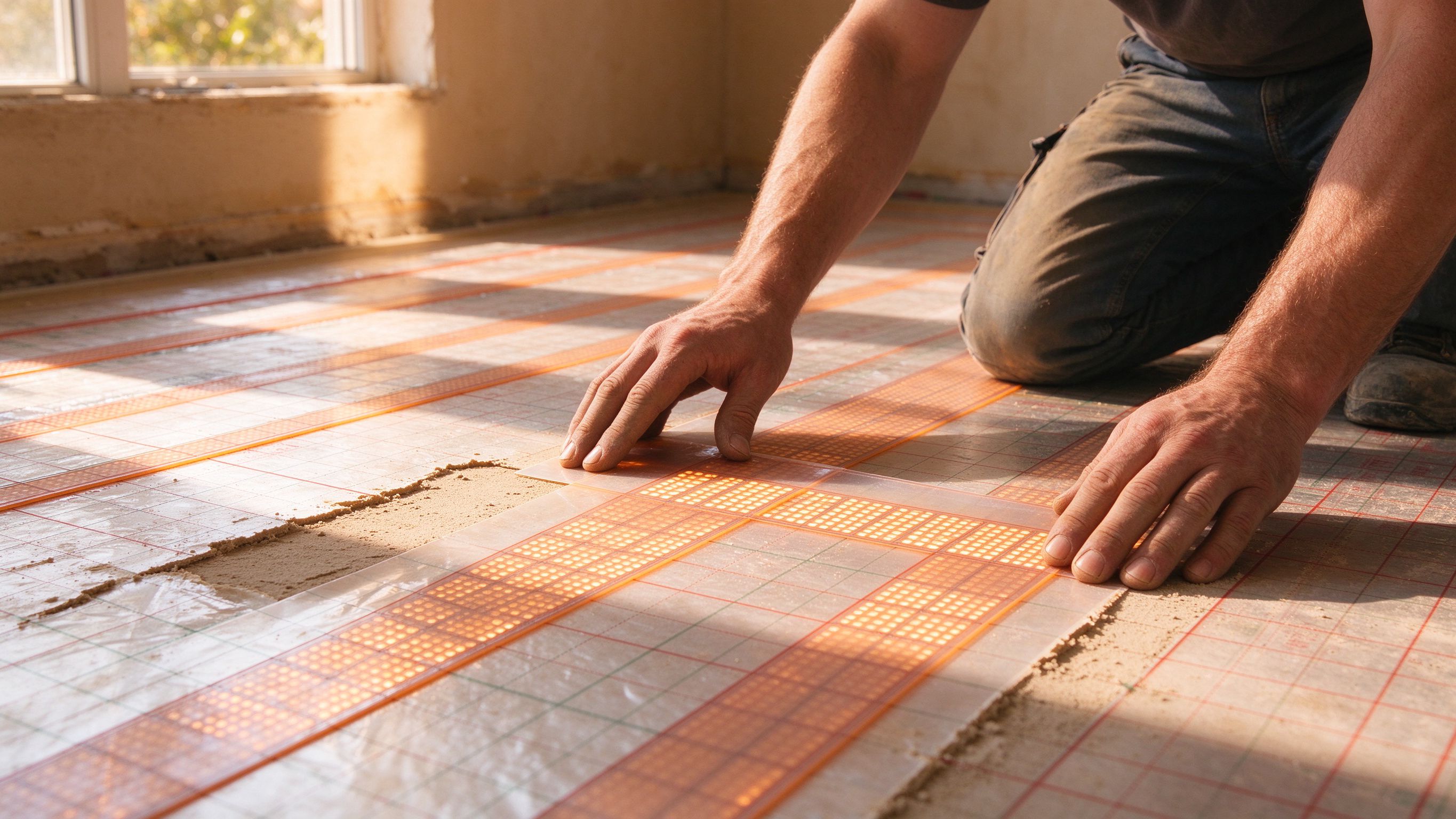
What this guide covers
We break the Canadian underfloor heating cost into its three layers: materials per square metre, installation (DIY vs a licensed installer), and annual running cost with a worked arithmetic example you can adapt to your own Hydro-Quebec, Ontario Hydro, BC Hydro, Fortis, Epcor or SaskPower rate. We compare electric underfloor heating against the two alternatives Canadian homeowners weigh — forced-air furnaces and hydronic (boiler-based) radiant floors — and we explain why electric retrofit has become the standard choice for Canadian bathrooms, kitchens and basements. We also cover the components that quietly add to the bill, the factory-direct buying advantage, and the questions we hear most often from Canadian contractors and homeowners.
A note on the numbers: Canadian electricity rates vary widely by province (Quebec is among the lowest in North America, while parts of the Maritimes and BC are materially higher), and they change with each utility’s rate review. Treat every range below as a planning estimate. Verify your kWh rate on a recent utility bill and request a factory quote for current material pricing.
Underfloor heating cost at a glance — Canada
The table below gives the indicative order of magnitude for a typical 10–15 m² retrofit room. All figures are industry estimate ranges, indicative only — request a factory quote for current pricing. They include material and, where relevant, typical professional labour in CAD, but exclude finished flooring and final electrician connection unless noted.
| System / option | Indicative installed cost range (per m², CAD) | Best suited to |
|---|---|---|
| Electric heating film (laminate / LVT / engineered wood) | $80 – $170/m² (industry estimate, indicative) | Retrofit over existing floor; minimal build-up height |
| Electric heating mat (tile / stone / concrete) | $70 – $150/m² (industry estimate, indicative) | Bathrooms, kitchens, basements under tile or slab |
| Electric heating cable (loose lay / saw-cut / screed) | $60 – $130/m² (industry estimate, indicative) | Irregular rooms, slab-on-grade, renovatable pours |
| Wet (hydronic) radiant floor (boiler or heat-pump based) | $180 – $300+/m² (industry estimate, indicative) | New builds, whole-home with boiler or cold-climate heat pump |
| Forced-air furnace replacement (for comparison) | $6,000 – $12,000 whole system (industry estimate, indicative) | Whole-home heat; no floor upgrade |
For a typical 10 m² Canadian bathroom, an electric mat project therefore lands in the region of $700–$1,500 all-in (industry estimate, indicative), depending on finish and accessories. A whole-house hydronic system with a boiler, manifold and pump can run to $20,000–$40,000+ in a retrofit because of plumbing and structural work. That gap is the central reason electric retrofit dominates Canadian room-by-room upgrades.
Material cost: heating film, mat and cable per m²
The heating element is the component where factory-direct buying changes the number most. The ranges below are industry estimate ranges, indicative only for the element itself, before insulation boards, thermostats and connection parts.
| Element type | Typical output | Indicative material cost per m² (CAD, trade / factory-direct) |
|---|---|---|
| Infrared heating film (graphene / PET) | 150 – 220 W/m² | $40 – $100/m² (industry estimate, indicative) |
| Heating mat (mesh + cable, pre-spaced) | 150 – 200 W/m² | $35 – $85/m² (industry estimate, indicative) |
| Loose heating cable (single / twin conductor) | 100 – 200 W/m² on layout | $30 – $75/m² (industry estimate, indicative) |
The band is wide for three reasons. First, output rating: a Canadian bathroom on a cold slab may call for 200 W/m², while a well-insulated bedroom calls for 150 W/m². Second, width and roll length affect packaging efficiency. Third — and biggest — the channel. A Canadian homeowner buying from a big-box or tile showroom is paying a distributor markup over an importer markup over a trading company markup over the factory price. Buying electric underfloor heating direct from the manufacturer strips out those layers and is the single largest lever on material cost, typically pulling the per-m² figure toward the lower end of the range.
Installation cost: DIY vs licensed installer
Canada’s cold climate makes good installation non-negotiable, but it does not have to be expensive.
DIY-friendly installation
Heating film and pre-spaced mats are designed for competent DIY. You unroll the element over the prepared subfloor, run the cold tail to a thermostat location, and lay the floor covering. The physical work is within reach of a capable homeowner. The final mains connection, however, must be made by a licensed electrician in every province, with a Class A GFCI / GFCI breaker (required by the Canadian Electrical Code, Part I). A single-room electrician call typically runs $150–$400 (industry estimate, indicative), depending on how far the circuit has to run from the panel and whether a new breaker is needed. Total DIY-installed project cost for a 10 m² room is therefore roughly the element cost plus $150–$400 of electrician time.
Professional installation
A licensed installer charges labour on top of materials. Indicative Canadian installation labour is $40–$90 per m² (industry estimate, indicative), covering layout, insulation board, element fixing, sensor placement and commissioning. What moves that number in a Canadian context:
- Slab-on-grade and frost depth: ground floors in Canada lose heat downward into cold earth; insulation board is not optional in our climate.
- Saw-cut grooves (concrete): retrofitting cable into an existing slab by saw-cutting channels adds labour but avoids lifting the whole floor.
- Subfloor condition: basements need damp-proofing before element lay-down.
- Number of thermostats: each independent zone needs its own GFCI-protected circuit and thermostat.
- Door and skirting height: film and mats add 3–8 mm; check door swings before ordering.
Where you are already tiling, the mat is often priced into the tiling quote as supply-and-fix. Ask your tile contractor whether underfloor heating mat supply-and-install is part of their package — many Canadian tilers buy mats at trade price and pass them through.
Running costs and a worked example
This is the number that surprises Canadian homeowners, because in cold climates the heating season is long. Running cost depends on installed wattage per m², hours the element actually heats, your provincial kWh rate, and floor insulation. We will show the arithmetic so you can swap in your own numbers.
Canadian electricity price context (approximate, verify on your bill)
Residential electricity rates across Canada vary province-by-utility and are in the broad region of 10–20 cents per kWh (approximate regional averages — verify your current rate on your utility bill). Quebec and Manitoba are typically at the low end thanks to hydro; Ontario, BC, Alberta and the Maritimes vary by rate class and time-of-use plan. None of these are fixed facts; they change with rate reviews. Always use your own utility bill’s unit cost.
Worked example: 20 m² basement rec room, 150 W/m²
Assume a finished basement rec room of 20 m² with a 150 W/m² heating mat, a programmable thermostat with floor sensor, and an average of 6 hours per day of heating output across a seven-month Canadian heating season. Tariff: 15 ¢/kWh (approximate, verify on your bill).
| Step | Calculation | Result |
|---|---|---|
| Installed load | 20 m² × 150 W/m² | 3,000 W = 3.0 kW |
| Daily energy use | 3.0 kW × 6 h/day | 18 kWh/day |
| Daily running cost | 18 kWh × $0.15 | $2.70/day |
| Monthly cost (30 days) | $2.70 × 30 | ≈ $81/month |
| Heating season (7 months, Oct–Apr) | $81 × 7 | ≈ $567/season |
That is an indicative range, not a guarantee. On a Hydro-Québec rate near 7.5 ¢/kWh the same room drops toward $300/season; on a Maritime or industrial-rate tariff near 20 ¢/kWh it can climb past $750. Poor insulation under a slab pushes it higher; 25–30 mm of XPS insulation board and a scheduled thermostat pull it lower. The lesson is the same as everywhere: insulation and a properly programmed thermostat do more for your bill than the brand of element. Read our deep dive on electric underfloor heating running costs for the four-lever breakdown.
Electric vs hydronic and forced-air in Canada’s cold climate
Canadian whole-home heating is usually dominated by a furnace or a boiler (increasingly paired with a cold-climate air-source or ground-source heat pump). Electric underfloor heating rarely replaces those; it supplements them in specific rooms. The comparison matters:
- Forced-air furnaces heat the whole house quickly and cheaply per BTU, but they blow dust, dry out the air, and leave tile floors cold to the touch even when the room air is warm. Electric underfloor heating in a bathroom solves exactly that complaint.
- Wet (hydronic) radiant floors are excellent for whole-home new builds paired with a modulating boiler or a cold-climate heat pump at low flow temperature, but they are invasive and expensive in a retrofit (indicative $180–$300+/m², industry estimate). They need a manifold, pump, mixing valve and plumbing.
- Electric UFH is thin (3–8 mm), zone-per-room, heats up in minutes, and pairs beautifully with time-of-use programs — pre-heat during off-peak, let the slab or tile retain the heat through the cold evening. In Canadian basements and bathrooms, that is the default value play.
For very cold regions, note that underfloor heating elements are also the basis of snow melting mats for driveways, walkways, steps and roof edges — the same manufacturer, the same cold-climate engineering, applied outdoors. Canadian contractors often spec both together for a single home.
System components and their indicative cost
The element is only part of the bill. The supporting components below are priced as industry estimate ranges, indicative only in CAD.
| Component | Indicative cost (CAD, industry estimate) | Notes |
|---|---|---|
| Programmable / WiFi thermostat | $60 – $200 | Floor-sensing, weekly scheduling; see thermostats and controls |
| Floor temperature sensor probe | $8 – $20 | Usually supplied with thermostat; one per zone |
| XPS / rigid insulation boards (25–50 mm, cold-climate grade) | $15 – $35/m² | Near-essential on Canadian ground floors; cuts downward loss |
| GFCI / Class A breaker and circuit labour | $150 – $400 (licensed electrician) | Required by Canadian Electrical Code |
| Aluminium spreader plate (timber / dry builds) | $12 – $28/m² | Spreads heat under wood-frame floors |
Why buy electric underfloor heating direct from the factory
When a Canadian homeowner buys a mat or film from a tile showroom or big-box retailer, the product has passed through an importer, a distributor and a retail markup. SunAura is the factory. We manufacture heating film, heating mats, heating cables and thermostats in-house under ISO 9001 and CE / RoHS certified processes, and we ship direct to contractors, installers and project buyers across Canada and the US. What that means for your project:
- Factory-direct pricing on material cost — typically the lower end of the ranges above.
- OEM / ODM flexibility: we match output width, voltage (120 V / 240 V North American), and roll length to your project rather than forcing off-the-shelf widths.
- 15–25 year warranty on the heating element itself, backed by factory resistance testing on every roll before packing.
- Compliance documentation: CE / ISO / RoHS and product test reports supplied for your electrician’s inspection and provincial permits.
- Engineering support: send us your room layout, floor build-up and floor covering, and our engineers will spec W/m² and zone count — especially useful for cold-climate basements where under-insulation is the #1 mistake.
If you are comparing quotes from Canadian installers, ask them which element they are specifying and request the same spec from us. The difference typically covers the electrician’s GFCI connection on a single-room job, and is much larger on multi-room or commercial projects.
Does underfloor heating add value in Canada?
Canadian real estate listings increasingly call out “heated floors” in bathrooms and basements as a premium feature, particularly in larger centres where bathroom upgrades are a standard pre-sale reno. The tangible return is day-to-day: warm tile feet in January, no furnace running on a mild weekend morning, no air movement dusting a home office, and silent operation. For homes being staged for sale, a heated bathroom floor is one of the lowest-cost upgrades with the highest perceived value. For cottage and chalet owners, film under laminate in a sunroom is a winter upgrade that pays back in comfort on every weekend visit.
Underfloor heating cost Canada — FAQ
Is underfloor heating expensive to run in Canada?
As the worked example shows, a 20 m² room at 150 W/m² with 6 hours/day and a 15¢/kWh tariff costs roughly $567 over a seven-month heating season (industry estimate, indicative). In low-rate provinces like Quebec or Manitoba it can be half that; in higher-rate provinces it can be higher. Insulation boards and a scheduled thermostat are the two biggest dials on the number.
Can I install underfloor heating myself in Canada?
Yes for the physical lay-down of film and mats. The mains connection must be made by a licensed electrician with a Class A GFCI / GFCI breaker per the Canadian Electrical Code. Most DIYers fit the element themselves and book an electrician for the final circuit and commissioning.
How long does an underfloor heating installation take?
A single bathroom or basement retrofit is typically completed in one to two days, including insulation board, element laying, floor covering, and electrician connection. Saw-cut retrofit into an existing concrete slab takes longer. Whole-house hydronic systems take weeks because of plumbing and curing.
Which type of underfloor heating is cheapest in Canada?
Loose heating cable is usually the lowest material cost per m² (industry estimate $30–$75/m², indicative), but it is slower to lay. Pre-spaced mats and film cost slightly more per m² but save installation time. Total project cost depends on whether the labour saving outweighs the material premium.
Do I need insulation under underfloor heating on a Canadian slab?
Yes — strongly recommended. Canadian ground floors lose heat downward into cold earth; without rigid XPS insulation, a meaningful share of energy (industry estimate up to 30–40%) warms the slab below the floor instead of the room. Boards cost around $15–$35/m² (industry estimate, indicative) and pay back quickly on a long Canadian heating season.
Can I combine underfloor heating with a snow melting mat project?
Yes — and it is common. The same manufacturer makes both indoor heating elements and outdoor snow melting mats for driveways, walkways and steps. Sourcing both from one supplier simplifies specs, warranties and shipping, especially for cold-climate Canadian homes.
Get the factory price for your Canadian project
The ranges on this page are planning estimates built from industry experience. Your real price depends on your exact room sizes, floor build-up, floor covering, 120 V / 240 V voltage, and number of zones. SunAura quotes project-specific prices directly from the factory — no importer, no distributor, no retail markup. Send us your room schedule and floor type, and we will come back with the element spec, thermostat count and a firm factory quote.
Related products and reading: electric underfloor heating systems, infrared heating film, heating mats, heating cables, thermostats and controls, and our guide to underfloor heating running costs. For outdoor winter protection, see our snow melting mats.