
Technology & R&D
Graphene–carbon composite heating, far-infrared radiant heat, PTC self-limiting technology and EMF-free construction — backed by independent testing.
Graphene–Carbon Composite Heating
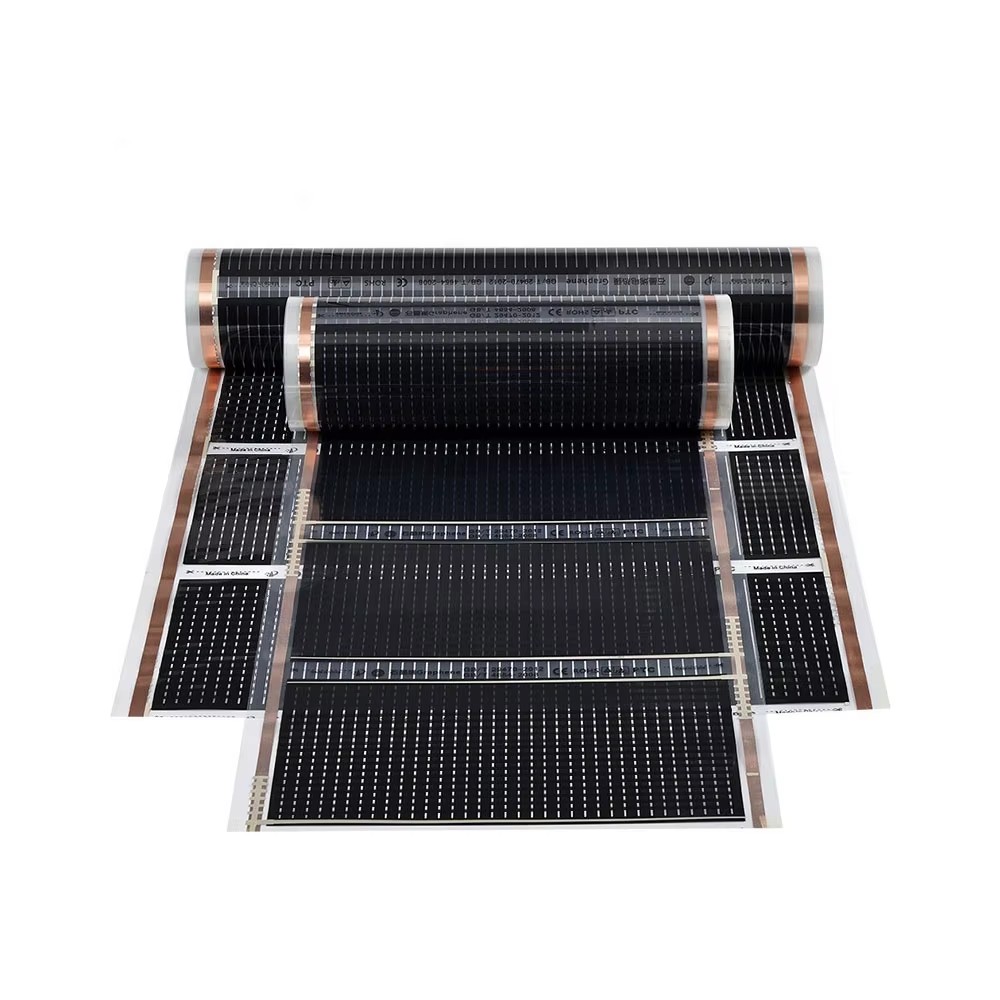
Our heating film uses a specially formulated graphene–carbon composite as its heating core. The material ratio and coating density are engineered in-house to control resistance per square metre, which in turn determines power output.
Far-Infrared Radiant Heat
Warms surfaces and people directly instead of heating the air first — the comfortable “warm underfoot” sensation.
Above 99% Conversion
Nearly every watt drawn from the wall becomes radiant heat in the room — no fans, flues, pipes or standby losses.
EMF-Free Shielded
Shielded, low-EMF construction with double insulation — safe for bedrooms and 24/7 use near animals, tested to IEC 60335.
IP67 Encapsulated
Fully encapsulated and edge-sealed film — the standard choice for bathrooms, kitchens and laundry rooms under tile.
Warm Surfaces, Not Air
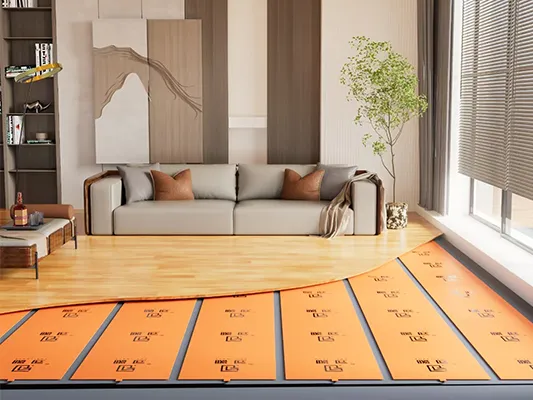
Unlike convection heating that warms the air, radiant heating warms surfaces directly — the floor, furniture and people. Far-infrared radiation travels the way sunlight travels through a window: it passes through air without warming it much, and is absorbed by the surfaces it lands on.
Because the radiation warms people and surfaces rather than the air mass, a room feels comfortable at a lower air temperature than a convection-heated equivalent — which is why radiant systems use less energy for the same subjective comfort. Convection heaters also stratify heat: warm air collects near the ceiling while ankles stay cool. A radiant film under the floor puts the warmth where you live.
Once the structure is warm, a small setpoint hold maintains comfort with very little energy. The control side of that story lives in the thermostats and controls category.
Regulation Built Into the Element
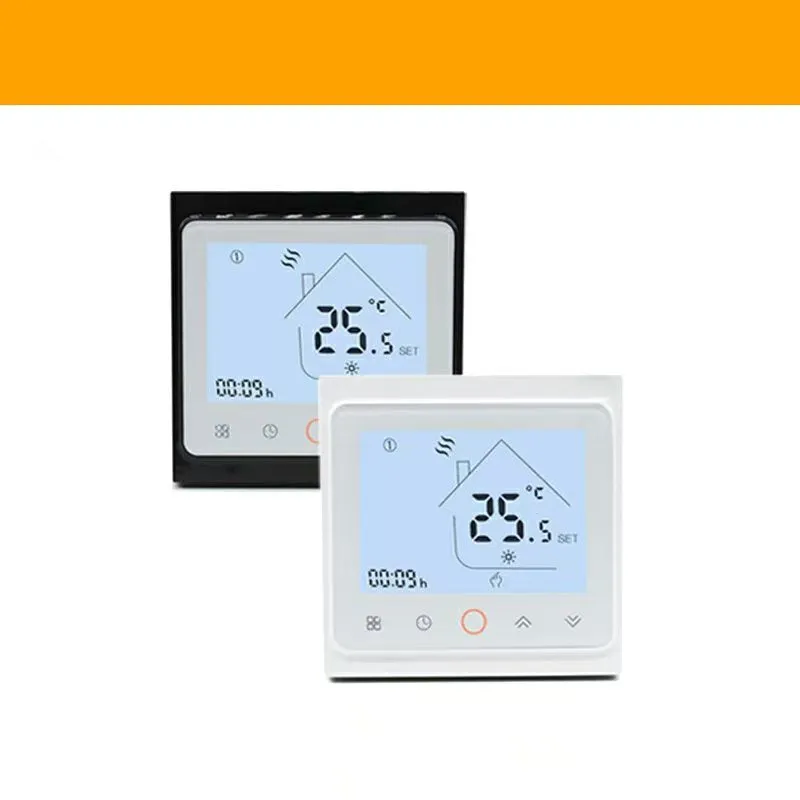
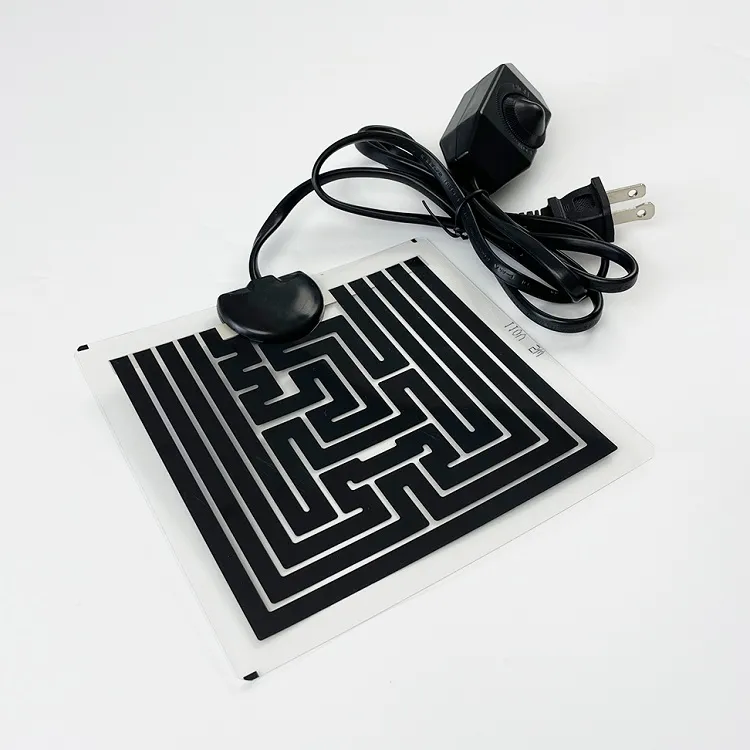
PTC (positive temperature coefficient) elements automatically reduce their power as temperature rises, and increase power when they cool. The result is a self-regulating heater that cannot overheat even in enclosed or insulated installations.
If a thermostat fails, insulation traps the heat, or airflow stops, the element dials itself back instead of pushing harder. That makes the PTC variant ideal for pipe trace heating, appliances and safety-critical products where an external controller should not be the only line of defence.
- Self-regulating — power scales down as temperature rises, no electronics required.
- Fail-safe by design — cannot overheat even in sealed, insulated enclosures.
- Dual protection option — smart thermostat for comfort plus PTC element as intrinsic backup.
Shielded, Double-Insulated Elements
Any conductor carrying alternating current creates a low electromagnetic field around it. SunAura designs every element with shielded, low-EMF construction and double insulation: a conductive shield layer around the active heating layer, plus a second insulating encapsulation outside.
The shield manages the field geometry, and the double insulation means that even if one insulation layer were compromised, no live part would be exposed. This matters most in two use cases: underfloor heating in bedrooms and living spaces, and 24/7 pet and reptile heating where animals lie on the pad around the clock.
Independent EMC testing to IEC 60335 supports our safety claims rather than relying on our own bench. Construction notes are on the pet and reptile heating page.
The Wet-Environment Question
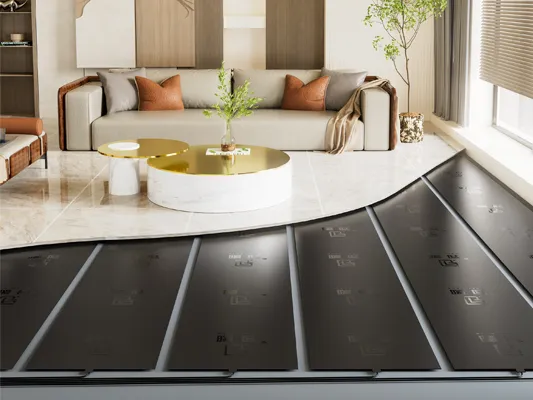
Because the film is fully encapsulated and sealed at the edges, it reaches an IP67 waterproof rating — protected against temporary immersion as well as everyday splashes, which is why it is the standard choice for bathrooms, kitchens and laundry rooms under tile.
The rating does not mean the film should be deliberately submerged; it means the moisture conditions of a bathroom floor during normal use sit comfortably inside the design envelope. Cables and mats aimed at more demanding wet or buried duties carry correspondingly higher ingress ratings.
Waterproof film does not change the underbuild: film still goes above the insulation, below the floor covering, with the vapour membrane following standard construction. The full element selection is browsable on the underfloor heating category page.
Double-Conductor Shielded Cable
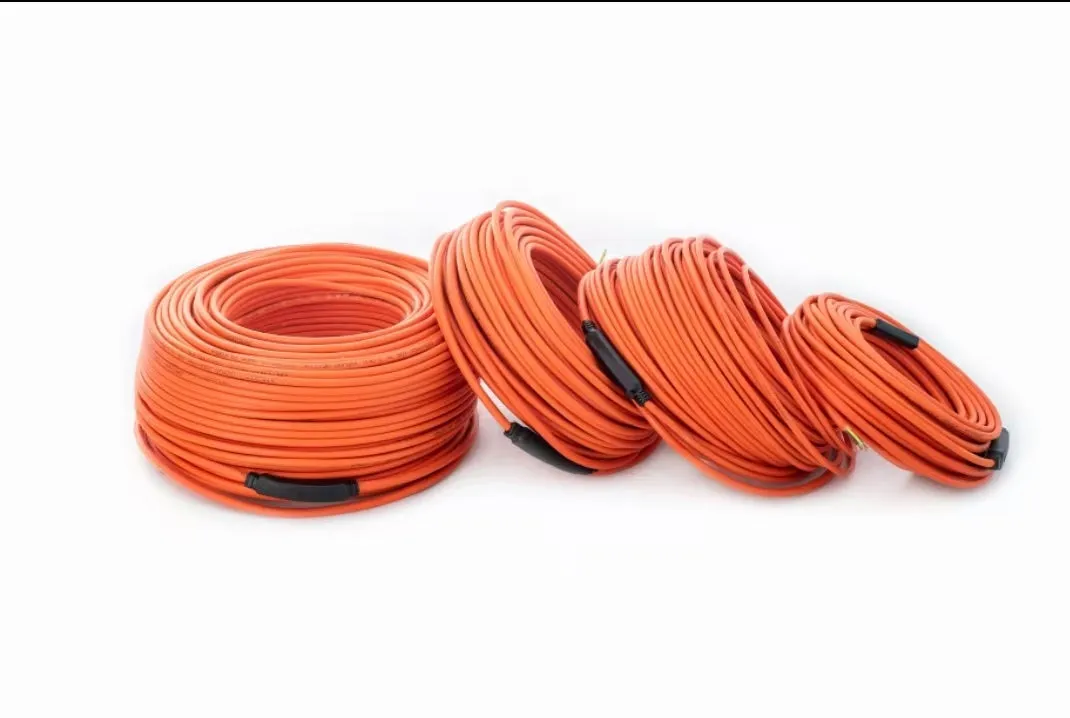
Where film cannot be used — inside a thick screed, within a concrete pour, inside a pipe run — the element becomes a cable. SunAura builds double-conductor heating cables: the resistive core and its return path are laid together inside one jacket, surrounded by insulation, a metallic shield and an outer protective sleeve.
The double-conductor arrangement cancels the external electromagnetic field far better than a single-conductor loop, and it makes the cable safe and predictable to embed beneath floors or trace around pipes. Each finished loop is resistance- and continuity-tested before packing, and the cold lead is strain-relieved at the junction so the termination is the strongest point of the loop.
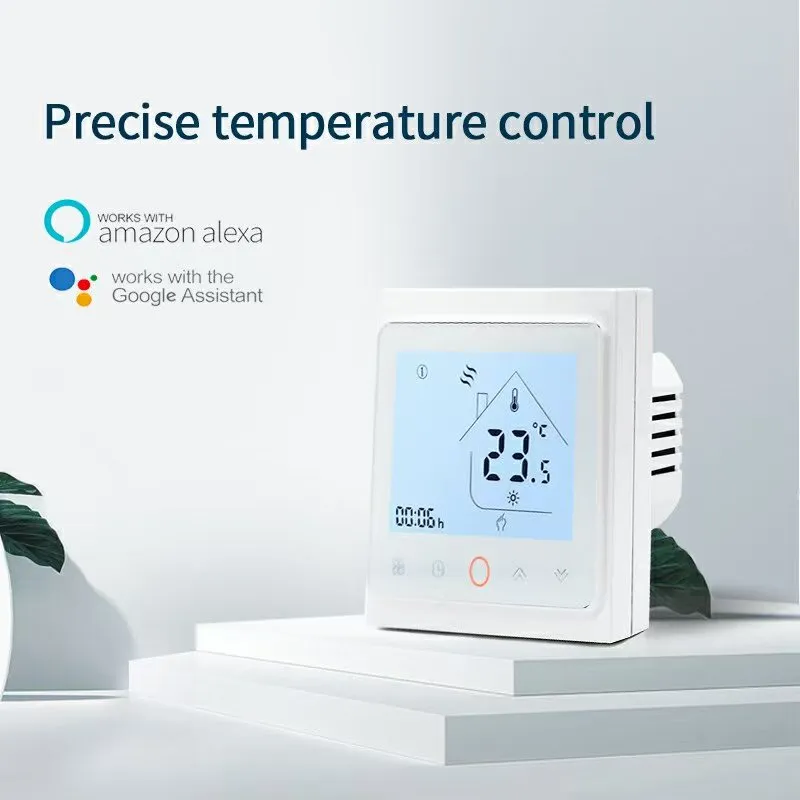
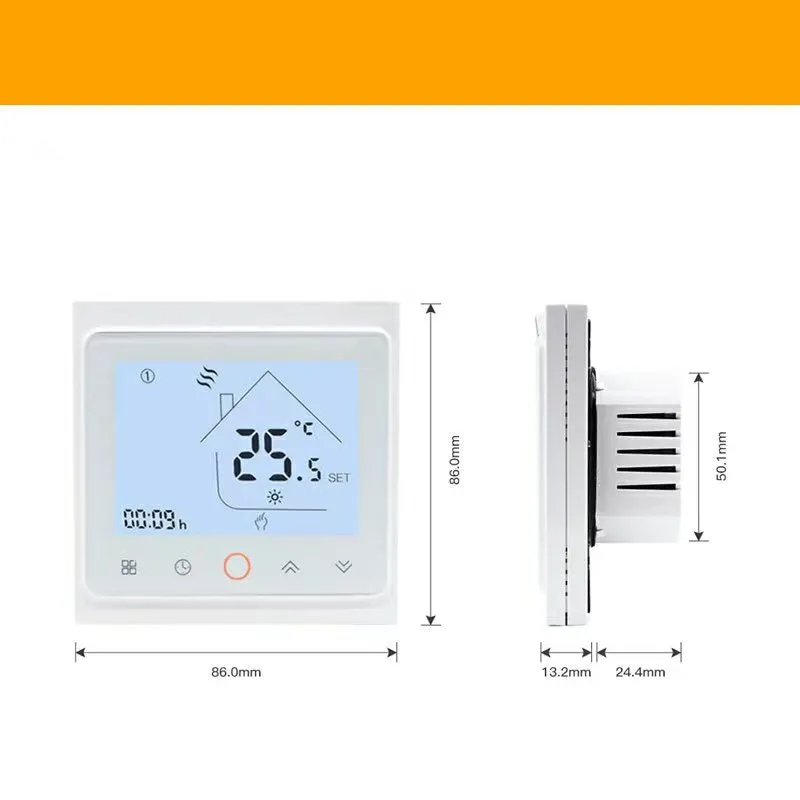
Compare constructions on the heating cable product page, and see how it pairs with room sensing on the smart thermostat page.
Electric vs. Traditional Heating
The rows below are not abstract — on a renovation job, the absence of a boiler room and pipe chase often decides the build before comfort does; on a new apartment, per-room smart zoning decides whether energy is spent on rooms nobody uses.
| Comparison | SunAura Electric | Wet (Water) Systems | Traditional Radiators |
|---|---|---|---|
| Installation | Simple, no boiler/pipes | Complex plumbing | Moderate |
| Warm-up | 15–30 minutes (film) | Slow | Medium |
| Maintenance | None | Annual service, leaks | Bleeding, service |
| Zoning / control | Per-room smart control | Complex | Limited |
| CO₂ in use | 0 (with green grid) | Depends on boiler fuel | Depends on fuel |
| Space needed | Invisible under floor | Boiler room + pipes | Wall space |
Film vs Resistance Wire vs Wet Hydronic
Buyers usually decide between these three architectures job by job. We manufacture both film and cable, so this is an honest comparison rather than a pitch.
Screen-Printed Film
A continuous resistive sheet printed on PET — uniform heat edge to edge, 15–30 minutes warm-up, low profile for thin finishes. Best for laminate, vinyl, tile-ready mats and retrofit builds.
Resistance Wire / Cable
Point conductors embedded in screed or cement. Slower warm-up, needs close spacing and thermal mass to hide stripes, but the only answer for thick pours, custom lengths and pipe trace duties.
Wet Hydronic Systems
Boiler, pumped pipe loop, manifold and annual servicing; slow warm-up and leak risk over decades. Competitive economics only on very large single buildings.
- Against wire mats and cables — a screen-printed composite film heats as a continuous sheet, so the entire floor area emits evenly; no hot and cool stripes from point conductors.
- Against wet hydronic — no boiler, pipes or annual service; per-room smart control; zero in-use CO₂ with a green grid; lives invisibly under the finished floor.
- Against radiators — removes the radiator from the room entirely, lets each room run its own smart schedule, and warms surfaces rather than air.
- Choose film — for thin, fast, uniform builds; choose cable where embedment or custom length demands it.
Backed by Testing, Not Claims
Every technology claim on this page is supported by production process control and independent laboratory evidence — available on our certifications page. If a claim matters for your compliance file, ask for the report and we will send it; the same packet ships with wholesale orders for customs and tender use.
SGS RoHS
Restricted-material compliance reports on the materials we ship.
ZCT EMC / IEC 60335
Safety and EMC testing underpinning our low-EMF shielded construction claim.
CNAS Inspection
Accredited inspection reports covering our factory quality system.
ISO 9001 / 14001
Management system and environmental control certification.
Proprietary Formulations, Developed In-House
Because the company started in 2008 as an engineering shop, R&D is not a department bolted onto a trading business — it is the core of it. Our engineering team develops the graphene–carbon composite ratio, coating density process, busbar lamination method, PTC self-limiting behaviour and shielded insulation stack in-house.
When an OEM customer brings a demanding application — a furniture-integrated heating surface, a terrarium pad with a strict temperature band, a pipe trace element that must survive a sealed insulation jacket — our engineers adjust the formulation and construction rather than reaching for a catalog part. That is why ODM projects return from our workshop as working prototypes, not drawings. Because every formulation is proven on our own production lines, it moves directly from prototype to mass production — so custom R&D outcomes are manufacturable at scale and supplied at factory-direct pricing, with wholesale and bulk programmes quoted on request.
On intellectual property: we protect our know-how through proprietary formulations and production processes, and we sign NDAs and development agreements for custom work. The company story behind this engineering culture is on the about us page.
From Technology Question to Written Quotation
If you are an engineer, distributor or procurement manager researching graphene heating film technology, the entry point is the same as for any component specification: send us your design target (area, wattage, installation environment, voltage, certification destination) and our engineers return a construction proposal, a sample for bench testing and a written quotation. The same proposal includes wholesale tier pricing and bulk-order lead times from our Qingdao factory.
| Sourcing item | What SunAura offers |
|---|---|
| Custom formulation | We tune the graphene–carbon ratio, coating density and busbar construction to your resistance-per-square-metre target, in-house — no third-party formulation house. |
| Samples | Sample film rolls, cut pieces and finished mats for your lab or pilot installation, at market-standard sample terms. |
| OEM / ODM | Private-label film and mat programmes, custom widths, PTC self-limiting variant, multi-language manuals. |
| Certification support | SGS RoHS reports, ZCT EMC / IEC 60335 reports, CNAS inspection reports, ISO 9001 / ISO 14001 documents issued with the order. |
| Export terms | EXW / FOB Qingdao, with CIF and DDP discussed; sea, air and express dispatch. |
| Engineering dialogue | Direct calls with the engineers who print the film — not a sales script. For a technical first contact, reach the R&D desk on WhatsApp. |
The Element Family, Under One Roof
Graphene–Carbon Film
PTC Variant
Under Wood & Tile
Quick Answers on the Engineering
What does “above 99% electrical-to-thermal efficiency” actually mean?
In a resistive electric heater, nearly every watt drawn from the wall becomes heat somewhere. What our film avoids are the losses that plague other architectures — fan motor losses in convection heaters, flue and standby losses in fuel boilers, pipe and distribution losses in wet systems. What you buy on the current bill is what radiates into the room.
How does PTC self-limiting protect the element without electronics?
A PTC (positive temperature coefficient) element automatically reduces its power as its temperature rises, and increases power when it cools. The heater therefore self-regulates: if the environment around it warms — because a thermostat failed or insulation trapped the heat — the element dials itself back instead of pushing harder. It cannot overheat even in enclosed or insulated installations.
Is the film really EMF-free, and what does the shielding do?
Any conductor carrying alternating current creates a low electromagnetic field. SunAura elements use a shielded, low-EMF construction with double insulation: a conductive shield layer manages the field geometry, and the second insulation layer means no live part is exposed even if one layer is compromised. Independent EMC testing to IEC 60335 supports the claim.
What does IP67 mean for film installed in wet rooms?
IP67 means protection against temporary immersion as well as everyday splashes. The film is fully encapsulated and edge-sealed, which is why it is the standard choice for bathrooms, kitchens and laundry rooms under tile. It does not change the underbuild — film still goes above the insulation, below the floor covering.
Should I choose film or heating cable for my project?
Choose film for thin, fast, uniform builds — laminate, vinyl, tile-ready mats and retrofit floors, with 15–30 minute warm-up. Choose cable where film cannot go: thick screeds, concrete pours, custom lengths, and outdoor or pipe trace duties. We manufacture both, so the recommendation follows the construction, not the catalog.
Can you tune the graphene–carbon formulation for an OEM project?
Yes. The composite ratio, coating density and busbar construction are developed in-house, so we can tune resistance per square metre, wattage builds and voltage to your design target — including the PTC self-limiting variant. Send your target specification via the contact form or WhatsApp for a construction proposal and sample.
Specify a Technology, Not a Catalog Part
Send your design target — area, wattage, installation environment, voltage, certification destination — and our R&D desk returns a construction proposal, a sample for bench testing and a written quotation.