
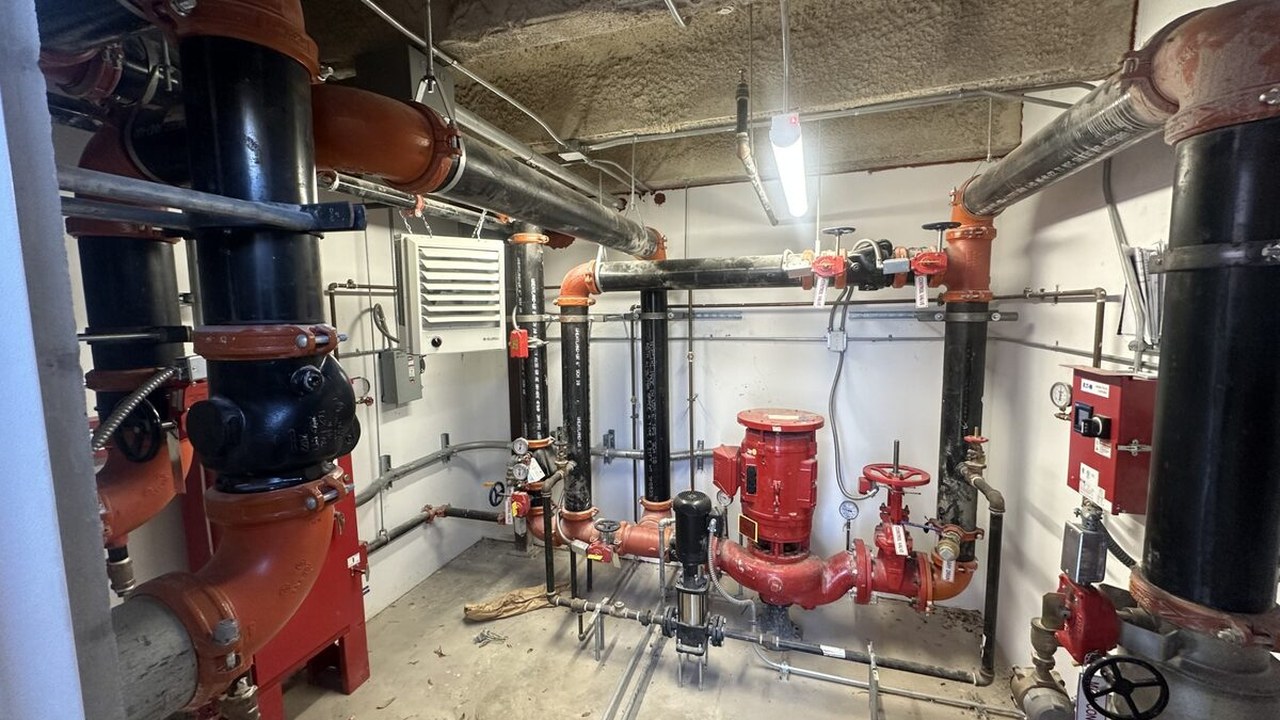
Where the Exposure Actually Occurs
Fire sprinkler systems are designed to be dependable, but their most basic failure mode is physical rather than mechanical: water that freezes expands, and a frozen riser or branch line can both block discharge and rupture pipework. When the ice thaws, a burst pipe in an occupied building can cause damage that far exceeds the original fire risk.
Not every part of a sprinkler system is equally exposed. Fully heated interiors rarely present a freezing risk, but specific segments run through spaces that are not conditioned: risers passing through unheated vestibules and loading bays; mains in unheated warehouses and attic spaces; pipes close to external walls or beneath insulated-but-unheated roofs; and branch lines in canopies, dock leveller enclosures, and exposed service corridors. The design task is to identify the segments that can fall below freezing and protect those, rather than applying cable to pipework already within a heated envelope. A freeze assessment typically considers the lowest expected ambient temperature, the level of insulation, the duration of cold exposure, and air leakage through the space.
Why Heat Tracing Is Paired With Insulation
Heat tracing does not replace insulation; the two are designed together. The cable supplies the heat lost through the insulation to maintain the pipe above freezing, while the insulation limits how much heat is required. Installing cable on bare, uninsulated pipe is inefficient and often inadequate, because the heat simply dissipates into the space. A correctly specified system uses self-regulating cable that can be cut to length on site, thermal insulation of a thickness matched to the design conditions with a weather-resistant cladding or vapour barrier, a control thermostat that energises the cable as the temperature approaches freezing, and electrical protection including earth-leakage devices appropriate to the installation.

The Particular Discipline of Fire Protection Work
Sprinkler systems are safety-critical, and heat tracing on them is treated more conservatively than ordinary comfort heating. First, the cable must not create a hazard of its own: selection accounts for the pipe environment, including whether the space is damp, exposed to weather, or subject to mechanical contact, and jacket materials and electrical ratings are matched to those conditions.
Second, reliability is built through redundancy and monitoring. Critical installations often use indication at the control point so a loss of supply or a fault is visible rather than discovered during a freeze. The control thermostat is positioned to sense the pipe or ambient condition accurately, not mounted where unrelated heat sources give a false reading. Third, the cable is routed to protect the vulnerable components — fittings, valves, and riser bases — without obstructing the access and inspection that fire systems require, and it must not interfere with sprinkler heads, control valves, or the signage used by inspectors.
Coordination With Standards and Inspection
Fire protection is governed by recognised standards and subject to periodic inspection, so the heat-tracing design is documented rather than improvised. Buyers and contractors typically need records of the cable specification, the control arrangement, and the insulation build for the project file, alongside the broader sprinkler documentation. The choice between self-regulating and constant-wattage cable follows the same procurement logic used elsewhere, and the underlying sizing approach mirrors how heat-trace cable is sized for pipe freeze protection.
SunAura is careful to note that local fire and electrical standards vary by market, and that the responsible party for the sprinkler installation should confirm the design against the applicable code and inspection regime. Heat tracing is a component within that engineered system, not a substitute for it.
Common Specification Errors
A few mistakes recur. The first is protecting the pipe while neglecting fittings and valves, which often have greater exposed surface and are the first points to freeze. The second is inadequate or poorly sealed insulation, which quietly increases the load the cable has to carry. The third is a thermostat mounted away from the coldest point, so the system energises too late. Maintenance is the fourth: a correctly installed system that is never inspected can suffer damaged insulation, a tripped circuit, or a disconnected supply, none of which is visible until a freeze arrives. The same exposure is documented in the case of a dairy farm protecting hundreds of metres of water line through a severe winter.
The Practical Takeaway
For wet-pipe sprinkler systems in unheated spaces, heat tracing is best understood as freeze protection engineered around the actual pipe layout: identify the exposed segments, select self-regulating or constant-wattage cable matched to the design conditions, insulate properly, and add monitored control and electrical protection. Done correctly and documented for inspection, it keeps the water in the system liquid and the system itself capable of performing when it is needed.
It is also worth stating what the system cannot do. Heat tracing protects the pipework it is fitted to; it does not correct a dry or poorly maintained sprinkler system, substitute for the required inspection regime, or protect segments that were missed during the freeze assessment. Treating it as one component within a properly maintained fire-protection system — rather than a retrofit that removes the need for inspection — is the mindset that keeps these installations dependable across their full service life.