
Sizing a heating mat is an arithmetic problem with three traps
Every week we receive an order where the buyer has measured the room, bought mats equal to the floor area, and then discovered that the mats do not fit around the toilet, the vanity and the door swing. The arithmetic is simple — heated area times watts per square metre — but the traps are not. They are: the difference between floor area and heated area, the fixed dimensions of a mat once it is manufactured, and the fact that a mat cannot be cut and re-joined without losing its warranty.
This guide sets out how to size an electric underfloor heating mat for a room, the mat sizes that actually exist, how cutting works and where it does not, and the layout rules that keep a mat inside its rated length. It is written for buyers ordering for their own project and for contractors ordering for several rooms at once.
Ethan Sun, Founder & CEO, SunAura Thermal
Step one: heated area, not floor area
The first number to fix is the area you actually want warm. In a bathroom, that is the floor you stand on, not the floor under the vanity unit or inside the shower tray if the tray is raised. In a kitchen, it is the open floor between the cabinets, not the strip under the units. In a living room, it is usually the whole floor, because furniture can move.
The rule we give buyers is: subtract every fixed obstruction larger than 0.2 m². A 6 m² bathroom with a 0.6 m² vanity, a 0.5 m² shower tray and a 0.4 m² toilet footprint has roughly 4.5 m² of heated area. Ordering 6 m² of mat wastes 25% of the budget and forces the installer to cut the mat, which is exactly what you want to avoid.
The second number is the coverage ratio. A mat is a mesh with a fixed cable spacing, so its wattage per square metre is fixed at the factory. You cannot make a 150 W/m² mat into a 200 W/m² mat by laying it closer; the cable is already stitched. If the room needs more power — a bathroom with a 20 mm stone floor, or a room with a very low ceiling and high heat loss — you either specify a higher-density mat or accept a longer heat-up time.
| Mat size (m²) | Typical dimensions | Wattage at 150 W/m² | Circuit at 230 V | Typical room |
|---|---|---|---|---|
| 1.0 | 0.5 × 2.0 m | 150 W | 0.7 A | Small WC, cloakroom |
| 2.0 | 0.5 × 4.0 m | 300 W | 1.3 A | Small bathroom |
| 3.0 | 0.5 × 6.0 m | 450 W | 2.0 A | Bathroom, small kitchen |
| 4.0 | 0.5 × 8.0 m | 600 W | 2.6 A | Family bathroom |
| 6.0 | 0.5 × 12 m | 900 W | 3.9 A | Kitchen, small living room |
| 8.0 | 0.5 × 16 m | 1,200 W | 5.2 A | Living room |
| 10.0 | 0.5 × 20 m | 1,500 W | 6.5 A | Open plan area |
| 12.0 | 0.5 × 24 m | 1,800 W | 7.8 A | Large open plan, small studio |
The table is the range we manufacture as standard: 0.5 m wide, 2–24 m long, 1–12 m² per section. Wider mats exist but are less flexible in a room with obstructions; narrower mats cost more per square metre because the fixed lead and mesh edge are a larger share of the product.
Step two: draw the layout before you order
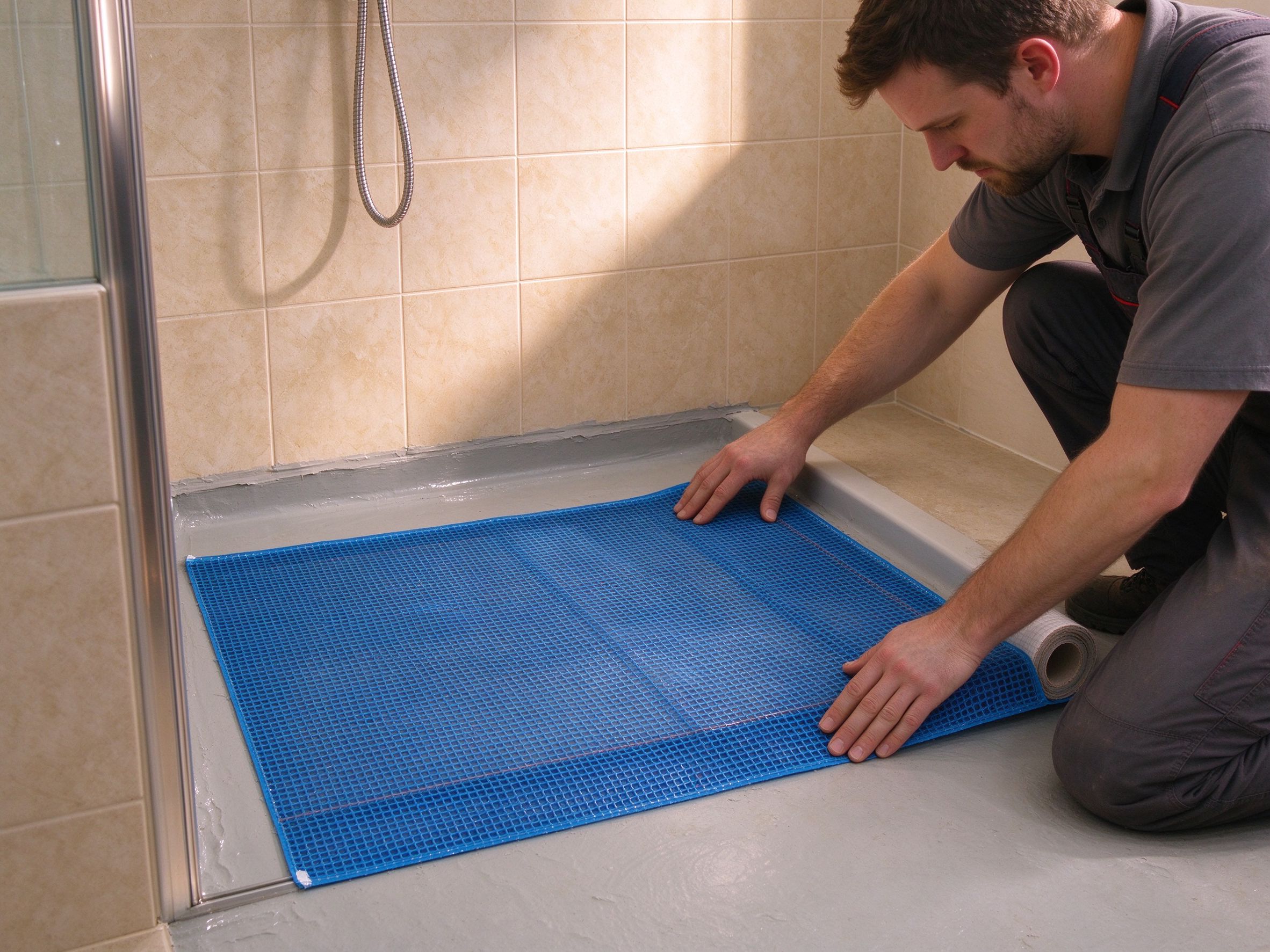
A mat has a fixed length and a fixed width, and it is laid in a serpentine or a spiral pattern depending on the product. The installer needs a drawing that shows where the mat starts, where it turns, and where the cold lead leaves the floor. Without that drawing, the mat is installed by trial and error and usually ends up short in one corner and doubled in another.
Three layout rules apply to almost every room. First, start the mat at the point nearest the thermostat and work away from it, so the cold lead is short and the joint box stays accessible. Second, keep a 100–150 mm border from the wall and from any fixed unit; the mat should not touch the skirting or run under a cabinet. Third, never overlap two runs — an overlap creates a hot band at twice the rated wattage, and that is where the adhesive cracks first.
For an irregular room, the practical approach is to split the area into rectangles and order one mat per rectangle, wired in parallel to the same thermostat, rather than to force one long mat around the shape. Two 3 m² mats in an L-shaped bathroom are easier to lay and easier to replace than one 6 m² mat cut and re-joined.
Step three: cutting — what is allowed and what voids the warranty
Most mats can be cut to fit, but only in one direction and only at defined points. The mesh can be cut between cable runs to turn a corner or to create a notch around an obstruction; the cable itself must never be cut, shortened or joined in the field. A mat that is cut through the cable is scrap, and a field joint is the most common cause of a failed installation we see.
The cold lead is the other fixed element. It is factory-fitted with a sealed joint, and its length is typically 2 m. If the thermostat is more than 2 m from the mat, the installer needs an extension on the supply side, not on the heating side. Buyers who plan the thermostat position after ordering the mat are the ones who end up with a cold lead that cannot reach.
What this means for sizing is simple: order the mat size that covers the area with the least cutting, and if the room shape forces a lot of cutting, split into two mats. The cost of a second mat is usually less than the labour of fitting one oversized mat around three obstructions.
Step four: circuit, thermostat and load
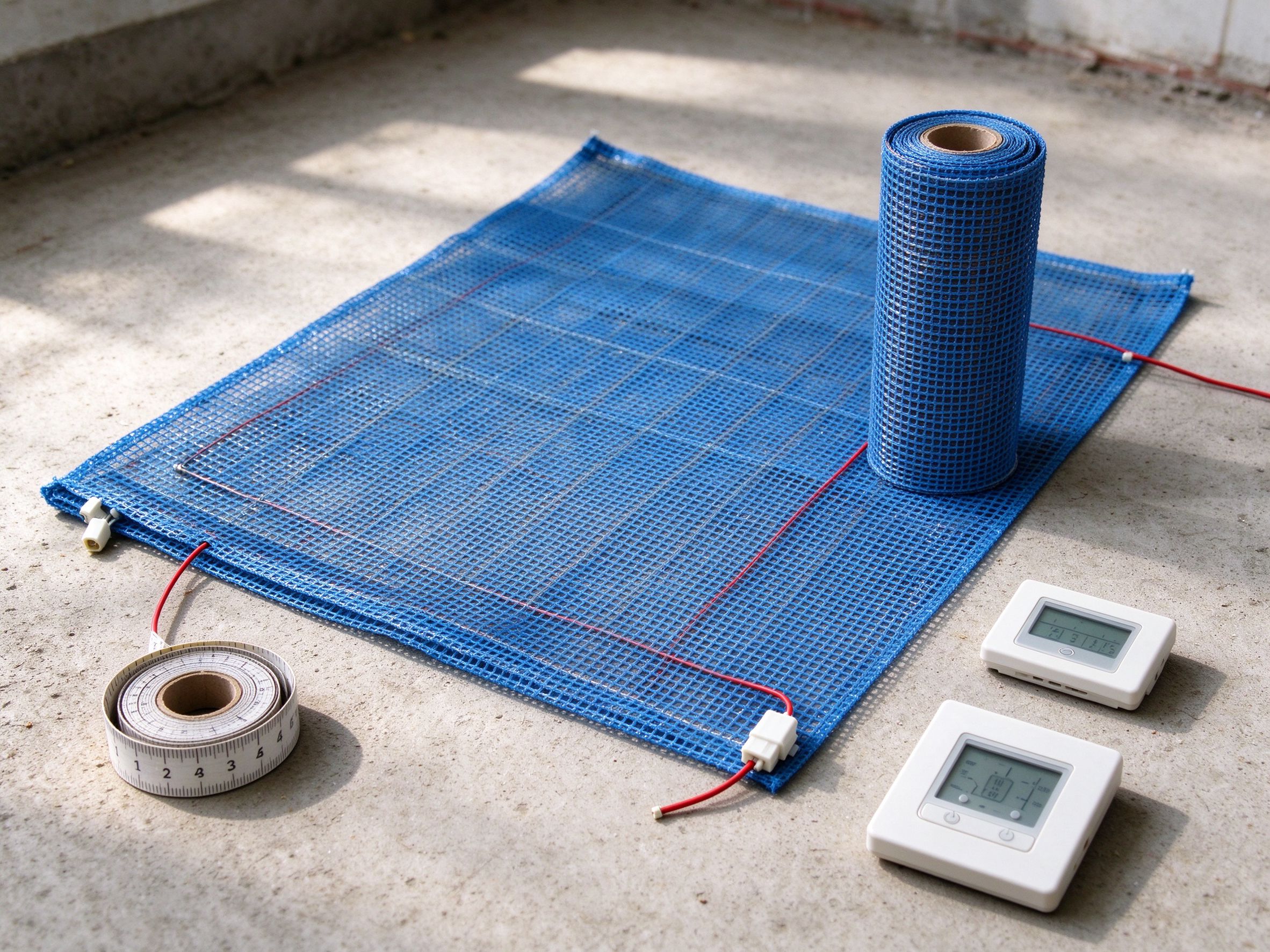
A mat’s load is small — a 6 m² mat at 150 W/m² is 900 W, under 4 A at 230 V — so most rooms can share a circuit with other equipment, provided the total stays within the breaker rating. The constraint is not the mat, it is the thermostat: a standard thermostat relay is rated 16 A, which covers 3.6 kW at 230 V. Above that, a contactor is needed.
For a bathroom, the thermostat usually sits outside the room or on a plate beside the light switch, with the floor sensor routed into the screed or adhesive. The sensor position matters: it should be in the heated area, not at the edge, and not directly under a mat run, or the reading will be 5–8 °C higher than the floor average and the room will feel cold.
If the room has more than one mat, they can be wired to one thermostat in parallel as long as the total load is within the relay rating. If the room has two zones — for example a bathroom and a separate cloakroom — two thermostats are cheaper than one thermostat plus a zone valve arrangement, because electric heating has no water to divert.
Step five: the build-up and the heat-up time
Sizing does not stop at the mat. The build-up decides how long the floor takes to reach temperature, and that decides whether the mat is adequate. A 6 mm tile on a 10 mm adhesive bed over a mat heats in 30–45 minutes. The same mat under a 40 mm screed takes 3–4 hours. Under a 20 mm stone tile with an insulating underlay beneath, the surface may take 90 minutes but the room takes longer to feel warm.
For bathrooms, the practical target is a floor surface of 27–29 °C at a room temperature of 20 °C, which a 150 W/m² mat reaches comfortably. For a living room with a thicker build-up, 160–200 W/m² is the usual specification to keep heat-up within an acceptable time. For a conservatory or a room with high heat loss, the mat alone may not be enough and the answer is insulation, not a higher wattage.
Insulation under the mat is the single biggest lever on running cost. A 6 mm insulation board under a mat on a concrete subfloor reduces downward loss enough to cut running time by 15–25% in our own measurements, and it costs less than upgrading to a higher-density mat.
How many mats for a typical house
For a 90 m² apartment with a bathroom, a kitchen and a living room, a typical specification is: 4 m² in the bathroom, 6 m² in the kitchen (open floor only), and 10 m² in the living room, for 20 m² of mat across three thermostats. That is 3 kW connected load, which is well within a normal consumer unit.
For a 200 m² house with four bathrooms, a large kitchen and a living area, the heated area is usually 45–60 m², split across 6–8 zones. At 150–180 W/m² the connected load is 7–11 kW, and the design question becomes circuit distribution rather than mat sizing.
The mistake at this scale is ordering all the mats at once without a room-by-room schedule. Mats are cheap to store but hard to identify once the labels are off; a schedule that maps each mat to a room and a thermostat is worth more than a discount on the total.
Data and evidence
The standard sizes, wattages and circuit figures in the table are the published values for our mat range: 0.5 m width, 2–24 m length, 1–12 m² per section, 150–200 W/m² depending on the model. The heat-up times are the ranges we quote from installation records and depend on the build-up; they are indicative rather than guaranteed. The 15–25% reduction in running time from an insulation board comes from our own comparative measurements on a concrete subfloor and should be treated as a range, not a fixed saving.
Factory facts follow SunAura factory records: manufacturing in Qingdao, Huangdao District since 2008 (17 years), ISO 9001, ISO 14001 and ISO 45001, CE and RoHS marked products, LVD and EMC tested, exports to more than 50 countries. Current declarations and batch test reports are available with each order.
Electrical installation practice — breaker sizing, RCD type, zoning — is governed by national wiring rules and must be confirmed by a qualified electrician. The figures here describe the mat’s own load, not the final circuit design.
Common sizing mistakes
Ordering the floor area instead of the heated area. The most common and most expensive mistake; it usually ends with a cut mat.
Assuming the mat can be cut anywhere. The mesh can be cut between runs; the cable cannot be cut at all.
Forgetting the cold lead length. Two metres is standard, and the thermostat position is decided before the order, not after.
Putting one thermostat on a bathroom and a kitchen. Two rooms with different schedules need two zones.
Upgrading wattage instead of insulation. A higher-density mat heats faster but loses more downward if the subfloor is uninsulated.
FAQ
Can I use one mat for two rooms? Only if the two rooms are one open space and share a thermostat. A mat crossing a wall or a door threshold is not a sensible installation.
What if the mat is slightly too long? Turn it back on itself in an area that will be covered by a fixed unit, or cut the mesh between runs. Never overlap.
Do I need a bigger mat for a cold room? Usually the answer is more insulation or a higher-density mat, not a bigger mat over the same area.
How accurate is the wattage on the label?
Our production test band is ±5%; a mat is a fixed-resistance product, so the label value is what you get.
Next step
Send us a room plan with dimensions and the position of fixed units, and we will return a mat schedule: one line per room, with mat size, wattage, thermostat and circuit. It takes about a day and it prevents the most common ordering error we see. The current sizes and wattages are listed on our heating mat range page; if the room needs a different build-up, the heating cable range covers irregular shapes that a mat cannot.
Ethan Sun, Founder & CEO, SunAura Thermal