
QINGDAO, 14 November 2026 — SunAura Thermal Newsroom
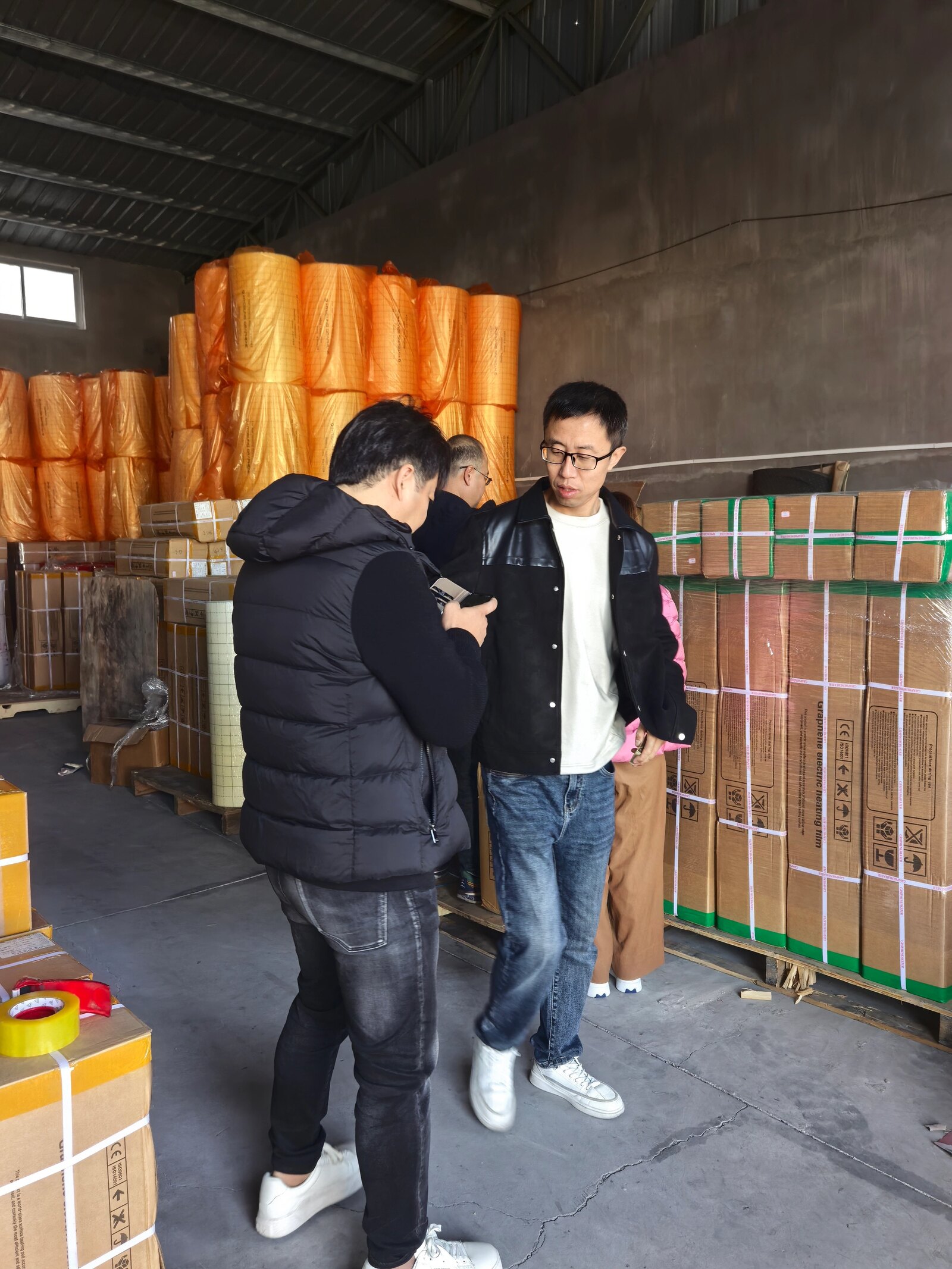
On 12 November, Mr. Nakamura, founder of an Osaka-based building-materials and campervan-fitting company, spent a full working day at SunAura Thermal’s Qingdao plant with three of his engineers. They walked four production stages, retested eight randomly drawn batches with their own insulation tester and thermal camera, and that afternoon signed a three-year framework supply agreement for 110 V graphene far-infrared heating film. The first order covers two projects: the radiant panel inside a Japanese kotatsu, and the electric heating system of a campervan retrofit programme.
This was not a courtesy visit. The party spent four hours and twenty minutes on the floor. The technical annex to the agreement is not a commercial template either — it is fourteen pages of acceptance clauses rewritten line by line by both engineering teams in the meeting room, covering surface-temperature uniformity, insulation resistance, power drift after ageing, and the maximum shell temperature rise of a kotatsu panel after three hours of continuous energisation.
1. Why he came to Qingdao instead of signing at a trade fair
Purchasing heating film for the Japanese market carries one specific constraint: household electrical appliances fall under the Denan Law (PSE regime), the mains voltage is 100 V, not 110 V, and Japan runs two frequencies — 50 Hz in the east and 60 Hz in the west. Mr. Nakamura had seen samples at a fair. His requirement was blunt: “A catalogue sheet that says 110 V tells me nothing. I want to see how much power is left after three hours at 100 V and 50 Hz.”
That single sentence set the agenda. A film rated at 110 V running on a 100 V grid sees about 9% less voltage, and power falls with the square of voltage — theoretically to 82.6%. If the product also sits at the low end of its own power tolerance, delivered output can drop below 75% of design, and a kotatsu top simply never gets warm. This is where a number of exporters come unstuck in Japan: not an unsafe product, an insufficient design margin.
The GSF-110 series was specified for a 90–120 V operating window: 200 W/m² at a 110 V rating, and 172–178 W/m² measured at 100 V input, above the 165 W/m² design floor. Mr. Nakamura’s own measurement on the day read 174 W/m², consistent with the factory record.
2. The four stages he actually inspected
Printing and sintering. Sheet resistance of the graphene-carbon paste sets power consistency. He asked for the sheet-resistance records of three batches and then asked how ±4% was measured, not what the conclusion was. The process engineer took nine points across a 1 m² web with a four-point probe on the spot; the spread between highest and lowest was 3.1%.
Lamination and encapsulation. Service life is set by encapsulation, not by the heating element. This line runs PET/PVC double-layer lamination with an aluminium reflective layer, 0.08 mm adhesive, hot-press at 118 °C. His concern was whether the foil would delaminate in a humid environment — the central risk of the campervan project. The annex therefore added a clause: peel strength not below 1.5 N/mm after 48 hours at 85 °C and 85% RH.
Electrical safety. Dielectric testing took the longest part of the day. Samples were held at 3,750 V AC for one minute; all eight passed with no breakdown and no flashover. Insulation resistance measured 120–180 MΩ at 500 V DC against an acceptance floor of 100 MΩ. His own tester tracked the line record within 3%, and he accepted the method on the spot.
Ageing and life data. The ageing rack holds samples already energised for 1,000 hours; measured power drift is 2.1% and emissivity holds at 0.89 in the 8–14 μm band. That number is the most important clause in a three-year framework: a kotatsu panel runs six to eight hours a day, so power decay is user experience decay.
3. Project one: the kotatsu panel, where “traditional” becomes a 0.6 mm film
The kotatsu is the most recognisable winter heating object in a Japanese home: a low table, a quilt, and a heat source underneath. The conventional source is a quartz tube or a carbon-fibre element, with known drawbacks — local hot spots, a visible glow, uneven surface temperature, and a fire risk when bedding presses against the element.
Mr. Nakamura’s design intent was precise: move the heat source from “a point under the table” to “the whole underside of the tabletop”. A 0.6 mm GSF-110 film is bonded to the inner face of the tabletop with a 3 mm aluminium reflector, so the energy that used to radiate downward now heats the top by conduction and radiation together. Measured at 20 °C ambient and 100 V input, the centre of the tabletop stabilises at 46–52 °C over three hours, with the four corners within 3 °C of the centre; draw settles at 78 W, roughly 22% below a quartz-tube unit of the same size.
Three safety decisions follow. First, the surface ceiling is set by the material itself — the film cannot develop the 200 °C-plus local hot spot a bare resistance wire can. Second, a 55 °C bimetallic thermostat and a one-shot thermal fuse are wired in series, giving two independent disconnects. Third, a 5 mm air gap is kept between the quilt and the tabletop so fabric cannot press directly onto the heater and trap heat.
Mr. Nakamura put the commercial logic this way, and I record it verbatim: “What a kotatsu sells in Japan is not heating, it is memory. Older customers recognise the shape, children recognise the warmth. We can change the element, but not the feeling — legs warm underneath, face cool above. Your film gives an even surface source, and that is what keeps the feeling.”
4. Project two: campervan retrofit, where both 12 V and 110 V must work
Japanese campervan conversion demand splits into two patterns: long stays on campsites running from 100 V shore power, and driving or wild camping running from a 12 V/24 V auxiliary bank. His customer base includes both, which is why the agreement covers a dual-voltage platform rather than a single product.
The 12 V/24 V DC path. Low-voltage film is specified at 80–160 W/m², laid under bed platforms and seat bases, driven by a 12 V DC thermostat. Measured inrush is 6.8 A on a 12 V, 100 W configuration, halving on a 24 V system. The difficulty at low voltage is not wattage but line loss and connector oxidation, so the annex requires tinned connectors and a full-load harness drop below 0.4 V.
The 110 V AC path. On shore power the film runs from a 1,000–1,600 W inverter, laid on the floor substrate at 150 W/m². Three real campervan constraints went into the acceptance clauses: vibration (10–500 Hz sine sweep, one hour, no delamination), moisture (insulation resistance not below 50 MΩ after a rain test), and space (film plus reflector held within 4 mm so floor height is unaffected).
What conversion shops fear most is “fine in year one, back in the workshop in year two”. The agreement therefore carries a clause rarely seen in this trade: 5% of the first 250 m² is sampled for 500 on/off cycles (45 minutes on, 15 minutes off), and any batch drifting more than 5% is returned in full.
5. The agreement itself: three years, two projects, one capacity commitment
The structure has three layers. A three-year framework with a minimum annual volume rising 15% each year. A first order of 2,000 m² — 1,750 m² of kotatsu panel and 250 m² of campervan kit. And a capacity commitment: SunAura reserves a dedicated 600 m²/month production window for the Japan direction, with a 25–30 day lead time, FOB Qingdao.
Pricing is banded by encapsulation grade and volume, landing between USD 9 and 16 per square metre ex-works, with dual-voltage kits and thermostatted assemblies priced separately. The band matches the price range published on SunAura’s own product pages; no special discount was given to the Japanese customer. He approved of that, in fact: “I don’t need the cheapest quote. I need the same price logic three years from now.”
Warranty is three years — replacement in the first two, pro-rata in the third. Spares cover thermostats, connectors and the dedicated tape, with 2% shipped alongside the first batch.
6. Compliance: PSE is a design input, not a certificate
The Japanese Denan regime tests heating appliances on insulation, temperature rise, abnormal operation and marking. SunAura’s engineers converted those requirements into design inputs at project kick-off rather than waiting for a sample to fail: double insulation throughout, earth continuity below 0.1 Ω at 25 A test current, and abnormal-operation coverage for three scenarios — thermostat failure, fan stall where applicable, and a fully covered heater.
EU documentation is in place in parallel: CE declaration of conformity, RoHS and REACH test reports, and IEC/EN 60335-2-96 (the safety standard for flexible sheet heating elements for room heating). US supply is available with UL configuration as an option. Mr. Nakamura checked eight document numbers and expiry dates on the day; two RoHS reports expire in June 2026, and the parties agreed to submit renewals 60 days before expiry — that clause is in the agreement too.
One disclosure matters here: the power, temperature-rise and insulation figures in this release come from factory bench tests and line records. They are factory verification data, not the type-test conclusion of a notified body. The PSE mark is granted on the certificate issued by the certification body; the corresponding clause in the agreement is “certification completed before first mass production, with a copy of the certificate supplied by the vendor”, not “already certified”.
7. What it means for the Japanese market
Japan’s film heating market has long been split between domestic manufacturers and Korean suppliers, with Chinese suppliers concentrated at the low-price end. The middle layer — brand owners with channels and retrofit capability, like Mr. Nakamura — is the hardest segment for a Chinese supplier to enter. They are not buying price. They are buying batch consistency, a three-year decay curve, and someone who answers the phone when something goes wrong.
Three things follow from the signing. The 110 V line’s behaviour on a 100 V grid has now been verified with the customer’s own instruments, and that dataset is reusable across the Japanese market. Kotatsu and campervan are entirely different duty cycles — one needs an even surface source, the other needs vibration and moisture resistance — and the same film platform passed both, which says the platform’s configurability is real. And a three-year framework with reserved capacity turns a quote-by-quote scramble into a scheduled delivery commitment, which matters more to Japanese buyers than unit price.
SunAura currently operates eleven independent language sites; the Japanese site (/ja/) has localised product pages and hubs, and range pricing for the heat-trace and snow-melting lines went live across all eleven languages on 14 November. The Japanese signing lands in step with that localisation schedule.
8. What ships in the next 90 days
- Days 1–15: 300 m² of kotatsu panel sampled, with the 55 °C thermostat and fuse assembly, shipped to Osaka for full-appliance assembly validation.
- Days 16–45: 50 m² campervan kit trial installation, focused on 12 V harness drop and floor-thickness fit; the customer supplies two vehicles.
- Days 46–75: PSE certification submission, plus packaging, marking and Japanese instruction manual finalised.
- Days 76–90: first mass-production batch of 2,000 m² delivered, 2% spares, quarterly review in year one.
Before leaving the floor, standing in front of the stack of orange rolls in the finished-goods area, Mr. Nakamura said: “These rolls all look the same. The difference shows up in three years.” One of our engineers later wrote that sentence on the label of the ageing rack.
9. Five questions buyers ask most about this project
Will a 110 V product be underpowered on Japan’s 100 V grid?
Yes, if no margin was designed in. The GSF-110 operating window is 90–120 V; measured at 100 V input it delivers 172–178 W/m², above the 165 W/m² design floor. Buyers should ask for a measured 100 V/50 Hz curve, not a 110 V nameplate figure.
How stable is the kotatsu surface temperature?
At 20 °C ambient, 100 V input, three hours continuous: 46–52 °C at the centre, corners within 3 °C. The ceiling is limited twice — by the material and by the thermostat — so local overheating does not occur.
Should a campervan use 12 V or 110 V?
It depends on duty. Shore power at a campsite runs 110 V; driving and wild camping run a 12 V/24 V auxiliary bank. Both can coexist on one film platform; the differences are the thermostat and the harness.
What is the power decay after three years?
2.1% drift after 1,000 hours of accelerated ageing. At six hours a day the kotatsu reaches roughly 6,500 hours in three years; engineering estimate puts decay within 8%, and the warranty terms are set against that estimate.
Is PSE certification in hand today?
The design meets PSE requirements and certification completes before first mass production, with the certificate supplied. That is a contractual clause, not a verbal promise.
10. Why graphene rather than quartz or carbon fibre
Mr. Nakamura asked this more closely than he asked about price. The differences across three element types reduce to three physical quantities: surface power density, temperature uniformity, and the decay curve.
Quartz tubes are point or line sources that deliver heat to the tabletop by air convection, so efficiency depends on tabletop material and air movement. They are fast — three to five minutes to temperature — but local surface temperature can exceed 300 °C, bedding pressed against them is a fire risk, and life falls sharply with switching cycles. A kotatsu built on a quartz tube usually needs an added heat shield, or the top becomes too hot to touch in one spot.
Carbon-fibre heating wire is a line source that can be woven into a surface and costs less than graphene film. The problem is the gradient across the wire direction: in the 2–3 cm gaps between wires the tabletop runs 5–8 °C cooler, and a hand can feel the stripes. On a campervan floor this is invisible; on a kotatsu top it is not.
Printed graphene-carbon film is a surface source whose sheet resistance is set by the printing process: 3.1% spread across nine points on a 1 m² web, emissivity 0.89. It heats more slowly than quartz — ten to fifteen minutes to steady state — but the curve is flat, there are no local hot spots, and decay is slow. Both projects here need stability, not speed.
| Parameter | Quartz tube | Carbon-fibre wire | Graphene film (GSF-110) |
|---|---|---|---|
| Source geometry | Point / line | Line (weavable) | Surface |
| Spread over 1 m² | above 15 °C | 5–8 °C | 3.1 °C (measured) |
| Time to steady state | 3–5 min | 8–12 min | 10–15 min |
| Peak surface temperature | above 300 °C local | 80–120 °C | 45–55 °C across the face |
| Power drift at 1,000 h | 8–15% | 4–6% | 2.1% |
| Thickness with reflector | 25–40 mm | 3–5 mm | 4 mm |
| Risk under bedding | High | Medium | Low (dual cut-out) |
The figures come from three sources: quartz and carbon-fibre values from published technical handbooks and common industry test practice, graphene values from this customer’s own retest on site. Process differences between manufacturers are large, so a buyer should require measured values for the batch being supplied rather than industry averages.
11. An eight-point factory audit checklist for Japanese buyers
The checklist Mr. Nakamura brought has since been turned into a standard version by our sales team. In order:
- Sheet resistance records first, appearance second. Ask for the distribution of the last three batches and re-measure nine points on the spot.
- Adhesive and lamination. Ask for adhesive type, thickness and hot-press temperature, plus peel strength after 85/85 damp heat.
- Dielectric and insulation resistance. Witness 3,750 V for one minute and see the 500 V DC insulation reading.
- The ageing rack. Samples must have run 1,000 hours or more, with a drift curve — not a sentence saying “low decay”.
- Thermostat and fuse. See the measured trip temperature of the thermostat and the rated breaking temperature of the fuse.
- Abnormal operation. Ask how the heater disconnects under thermostat failure, full covering, and voltage excursion.
- Document validity. Check number and expiry date of every CE, RoHS, REACH and IEC 60335-2-96 report.
- Capacity and spares. Ask monthly capacity, dedicated window, lead-time commitment, spares ratio, and who owns repair liability.
12. Three ways buyers misjudge this
Mistake one: treating rated voltage as operating voltage. A 110 V product on a 100 V grid loses 17% of its power — physics, not a quality defect. The test is whether the supplier publishes a 90–120 V power curve.
Mistake two: judging life by initial power. Every new film looks good. The difference appears after 1,000 hours. Ask for the ageing curve and reject “our film does not degrade” as an answer.
Mistake three: treating certification as quality control. PSE and CE are market-entry gates, not batch-consistency guarantees. Consistency lives in three quantities you can measure on the floor: sheet-resistance spread, adhesive thickness, dielectric pass rate.
About SunAura Thermal
SunAura Thermal manufactures graphene and carbon-based flexible heating materials: wall heating film, underfloor film, heat-trace cable, snow-melting cable and low-voltage heating fabric, serving residential, commercial and industrial applications. The company runs independent sites in eleven languages, publishes specifications, test methods and price ranges, and accepts customers who bring their own instruments to the factory for retesting — which is exactly how this audit came about.
Media and procurement enquiries: /contact/. Technical dossiers and sample test reports are available on request; customer project data is not disclosed without the customer’s consent.
Reviewed by the SunAura Thermal technical team. Test figures come from Qingdao line records and bench measurements on 12 November 2026. The customer’s name and project details are disclosed with his permission; specific commercial amounts remain confidential under the agreement.