
Qingdao, 14 November 2026 — SunAura Thermal case study
This case study documents what an overseas buyer actually does inside a Chinese heating-film factory before signing: not the meeting room, not the sample box, but the finished-goods warehouse on the day the first batch is being staged. The site is SunAura Thermal’s Qingdao plant. The buyer is an Osaka-based company that builds kotatsu heating panels and converts campervans. The batch under review is 2,000 m² of 110 V graphene far-infrared film, split 1,750 m² for kotatsu panels and 250 m² for campervan kits.
The situation: a buyer who had already been burned by “sample quality”
The buyer’s complaint, stated in the first ten minutes, was specific: two previous suppliers had sent perfect A4 samples and then shipped production rolls that measured 6–9% below the sample on sheet resistance. On a kotatsu panel that reads as “the table never gets warm on a cold morning”, and the return comes back through the retailer two months later. He was not shopping for a cheaper metre. He was shopping for evidence that the batch, not the sample, was stable.
That reframing changed the audit. Instead of a product demo, the visit became a batch audit: can this factory prove, on the day of shipment, which roll came from which coating run, and that the roll in the box matches the record?
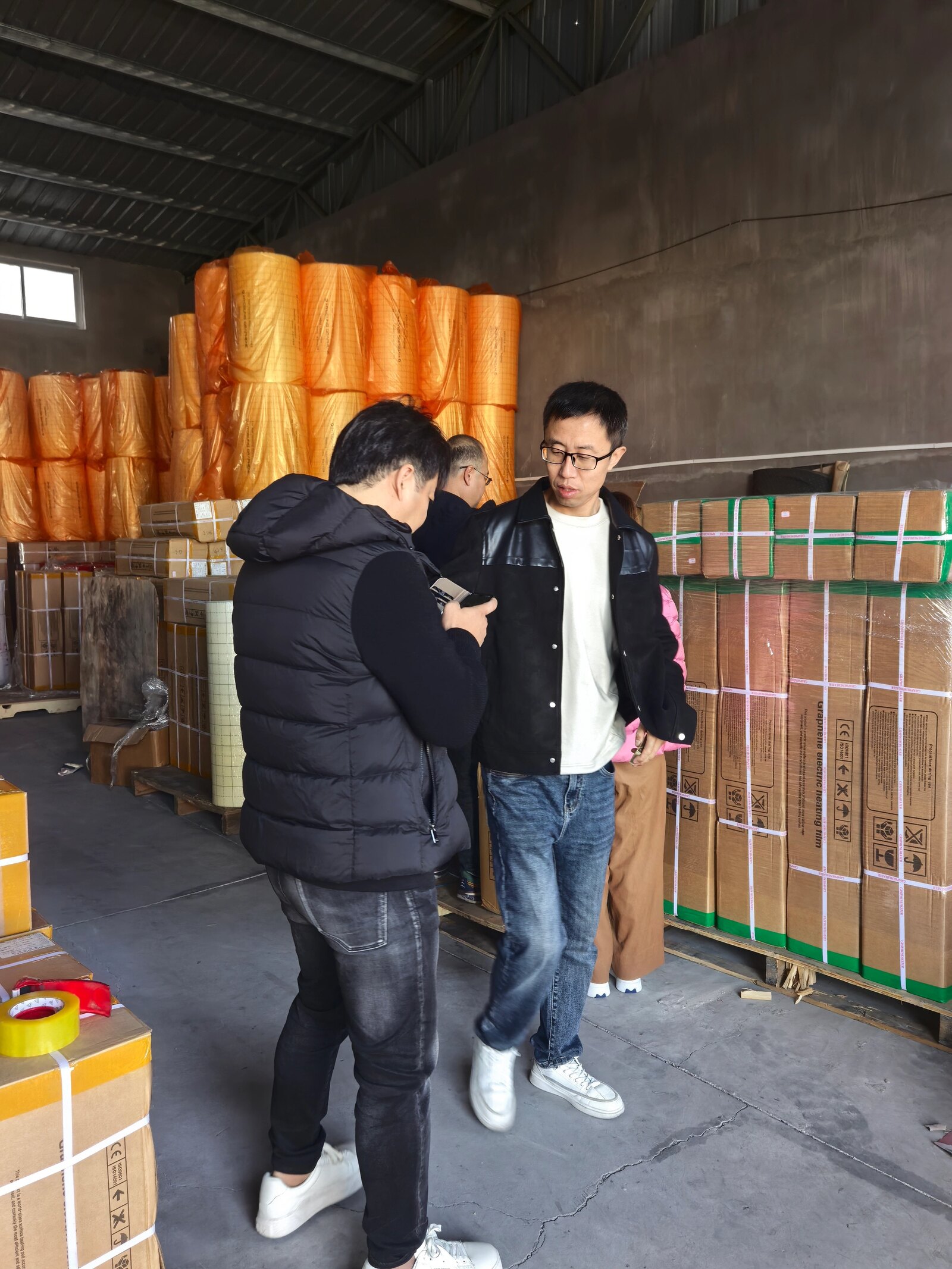
What the photo shows
The warehouse has three visible layers of material, and each one maps to a different failure mode.
- Orange EPE rolls, stacked three high. Protective and insulating foam used in packaging and in the low-voltage campervan kits. The orange colour is not decorative; it lets a picker confirm at a glance that an insulation roll was not swapped for a lower-density substitute — a substitution that would pass a visual check but fail a 12 V thermal test in a vehicle.
- Cartons printed “Aluminium alloy extrusion”. The reflective layer and frame profiles that ship alongside the film. This is the part of a heating assembly that buyers rarely audit, and it is where moisture-driven delamination starts in a campervan floor.
- Three people, one clipboard, one phone. The buyer’s technical lead, the plant’s quality engineer and the logistics coordinator, reconciling the shipping documents against the batch records before the pallets are wrapped. This is the step that most factory tours skip.
All three elements were photographed on the same pallet row, which is why this image is used as the case illustration: it shows the batch, its packaging and the record check in one frame, rather than the polished line shot used in brochures.
The three findings that mattered
1. Batch traceability was on paper, and it held up. Ten cartons were opened at random from the staged 2,000 m². Each carried a roll ID; each roll ID resolved to a coating run, a sheet-resistance record and a lamination log. The buyer’s engineer re-measured nine points on one square metre of each roll with a four-point probe. The spread between the highest and lowest reading was 3.1% against a ±4% specification. Two rolls sat close to the upper edge of tolerance; both were pulled, re-measured and released with the readings attached to the shipping file. Nothing was argued away.
2. The packaging was doing real work. The EPE wrap is not only cushioning. On a 0.6 mm film, edge abrasion during sea freight creates pinholes, and a pinhole in a 110 V circuit is an insulation failure at the customer, not at the factory. The staged pallets used corner boards plus a double wrap on the roll ends, and the cartons carried the aluminium profile separately so the film never carried the weight of the metal. The buyer added one clause on the spot: every pallet photo-documented before the container is sealed, with the photo set attached to the commercial invoice.
3. The documents and the physical goods agreed. The clipboard in the photo is the reconciliation: shipping list, packing list, batch record, and the pre-shipment electrical test sheet for the same roll IDs. Three cartons had been re-packed after an internal re-test; the records showed why, who released them and when. That is the difference between a factory that has a quality system and a factory that can show it working on a Tuesday afternoon.
Verification numbers recorded that day
| Item | Specification | Measured on staged batch |
|---|---|---|
| Rated power, 110 V | 200 W/m² | 172–178 W/m² at 100 V input (design floor 165) |
| Sheet resistance spread, 9 points | ±4% | 3.1% worst roll |
| Dielectric withstand | 3,750 V AC, 1 min | 8 of 8 passed, no flashover |
| Insulation resistance | ≥100 MΩ at 500 V DC | 120–180 MΩ |
| Earth continuity at 25 A | <0.1 Ω | <0.1 Ω, all samples |
| 1,000 h ageing, power drift | ≤5% | 2.1% |
| Emissivity, 8–14 μm | ≥0.85 | 0.89 |
These are factory bench and line-record values, not a notified-body type test. They are reported here as production evidence, and the certification position is stated separately below.
Where the batch goes next
1,750 m² becomes kotatsu radiant panels: 0.6 mm film bonded inside the tabletop with a 3 mm aluminium reflector, a 55 °C bimetal thermostat and a one-shot thermal fuse in series, and a 5 mm air gap so the quilt never presses on the heater. Bench data at 20 °C ambient and 100 V input: tabletop centre stabilises at 46–52 °C within three hours, corner-to-centre spread under 3 °C, draw 78 W — roughly 22% below a quartz-tube unit of the same size.
250 m² becomes the campervan kits, and this is where the aluminium cartons in the photo matter most. The kit runs two voltages: 80–160 W/m² on the 12 V/24 V auxiliary battery (6.8 A inrush at 12 V/100 W, harness drop held under 0.4 V with tinned terminals), and 150 W/m² on 110 V shore power through a 1,000–1,600 W inverter. Total build-up including reflector stays within 4 mm so floor height does not change. Five percent of the first 250 m² goes through 500 on/off cycles of 45 minutes on, 15 off; any roll drifting more than 5% is rejected as a lot.
What the buyer said, and what it means commercially
Standing in front of the orange rolls, the buyer’s line was translated and kept verbatim in our record: “These rolls all look the same. The difference shows up in three years.” Our engineers wrote it on the ageing-rack label. It is also the sentence that explains why the three-year framework agreement was signed on the same day rather than after another round of price talks.
The commercial structure that followed: three-year frame with annual minimum volume rising 15% per year, first order 2,000 m², a reserved capacity window of 600 m² per month for the Japan channel, 25–30 day lead time, FOB Qingdao. Pricing sits in the published 9–16 USD per m² ex-works band; no special discount was granted, and the buyer explicitly did not ask for one — his requirement was that the same price logic still applies in year three.
Certification status, stated plainly
The design has been completed against Japan’s Denan requirements (insulation, temperature rise, abnormal-operation behaviour, marking), and the contractual commitment is that PSE certification is completed before the first mass-production shipment and the certificate copy is handed to the buyer. It is not correct to describe the product as “PSE certified” today, and this case study does not. EU documentation — CE declaration, RoHS and REACH reports, IEC/EN 60335-2-96 — is maintained in parallel; two RoHS reports expire in June 2026 and renewals are committed 60 days ahead of expiry.
Transferable lesson for other buyers
Three things can be copied by any importer auditing a heating-film supplier, at almost no cost.
- Audit the warehouse, not only the line. The line shows capability; the warehouse shows what is actually about to ship.
- Open cartons at random and re-measure yourself. Ten cartons out of 2,000 m² is enough to catch a batch that inherited a bad coating run.
- Photograph every pallet before sealing. It converts a verbal assurance into a file that survives the shipping container and the customs broker.
The same discipline applies to smaller orders. A 200 m² trial with the same record set is a better predictor of year-three performance than a second round of price negotiation.
About this case
Site: SunAura Thermal, Qingdao. Date of audit: 12 November 2026. Batch under review: 2,000 m² 110 V graphene far-infrared film. Products: graphene heating film, thermostats, and low-voltage campervan kits. Published with the customer’s permission; commercial values remain confidential.
Reviewed by the SunAura Thermal technical team. Figures are from the plant’s bench and line records on the audit date. For a comparable audit at your own site or a sample record set, contact us at /contact/.