
Introduction: What a Snow-Melting System Is Really Buying
Before the technical decisions begin, it is worth being clear about the outcome being purchased. A snow-melting system is not a comfort upgrade and it is not a substitute for every winter maintenance task. It is a reliability investment whose payoff appears at a specific moment: the hour a storm arrives, when access has to be maintained and the people who would normally clear the surface may not yet be on site. The value is therefore concentrated in continuity for a business and safety for pedestrians, rather than spread evenly through the year. That framing matters because it argues against specifying the system on the cheapest possible basis and then expecting it to perform during the worst weather.
It also explains why the design is treated as a sequence of connected decisions rather than a single product choice. Coverage, power density, electrical supply, controls, and the base build each affect the others, and a weakness in one — an under-sized panel, a sensor in the wrong place, a base that holds water — can undermine parts that were specified correctly. The sections below work through that sequence in the order it should be approached, so the result is a system whose parts are matched rather than a collection of components bought separately.
What an Electric Snow-Melting System Actually Is
A snow-melting system is one of the few building services whose value is measured in safety and continuity rather than comfort. For a homeowner it means a clear driveway after a storm; for a business it means entrances, loading areas, and access ramps that remain usable without relying on manual labour that may not be available at the critical hour. Electric snow melting has become the default choice for many projects because it is installed beneath the surface, has no moving parts in the heated zone, and can be controlled automatically.
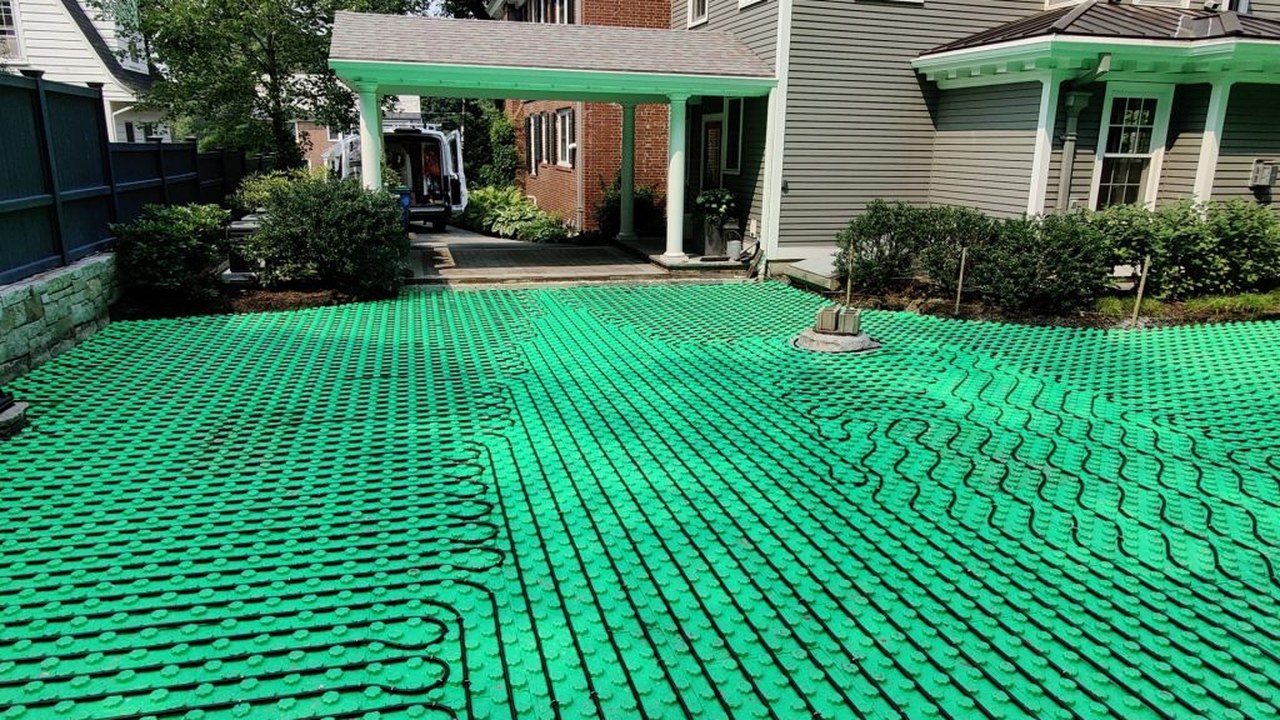
Two element types dominate. Heating mats pre-assemble the element onto a backing and are laid across the area, with cold leads connecting back to the supply, speeding installation and giving consistent spacing across a flat surface. Heating cables are flexible conductors shaped to the geometry, making them suited to irregular areas, steps, and custom layouts where a mat cannot follow the contours. The element is typically protected to a high ingress rating — IP67 is common for outdoor embedded products — because it spends its working life in wet, freezing, and salt-exposed conditions. Connections are factory-sealed or terminated to controlled procedures, since the joint is the most vulnerable point in any buried installation.
Deciding What to Cover
The first design decision is coverage, and it is partly an economic one. Full coverage heats the entire usable area — the whole driveway, walkway, or ramp — and delivers the most complete result, with no cold zones that require manual clearing. It is preferred for safety-critical surfaces such as commercial access ramps and public walkways where any residual ice creates liability. Tire-track or partial coverage heats only the wheel paths of a driveway or the high-traffic strip of a walkway, reducing both material cost and electrical load. It is a practical choice for long residential drives where the vehicle travels on defined paths, but it leaves areas unheated and is not appropriate where pedestrians use the full surface.
Coverage should also account for the areas easiest to overlook. Drainage points need meltwater to run freely; transition zones between heated and unheated surfaces can refreeze; and stairs often require dedicated elements sized to the treads rather than a rolled mat. A good design identifies these zones before the element is ordered, because adding them after the surface is finished is rarely possible.

Power Density: Why 300 and 500 W/m² Are Not Arbitrary
The output per unit area determines whether the system can keep up with a storm. Outdoor snow melting is more demanding than indoor underfloor heating because the system has to overcome falling precipitation, cold surfaces, and wind at the same time, rather than simply holding a comfortable temperature. A standard output of around 300 W/m² suits many temperate applications and typical residential surfaces. Higher-density builds of around 500 W/m² are specified for severe climates, exposed sites, heavy snowfall rates, and surfaces with high thermal mass that take longer to bring to temperature.
The choice is not a matter of “more is better.” Over-specifying raises the electrical load, panel requirements, and cost without proportional benefit in a mild climate; under-specifying in a severe one produces a system that cannot keep up during the storms that justified installing it. The responsible calculation considers the local snowfall rate, the lowest expected temperature, wind exposure, and the surface material — asphalt, concrete, and paving each conduct heat differently. Because output and area together determine total load, the power-density decision feeds directly into the electrical design, which is why it is made early rather than adjusted on site.
Electrical Load and Panel Capacity
This is the step most often underestimated in residential projects. A snow-melting system draws a substantial resistive load, and the total wattage — power density multiplied by heated area — has to be supplied by a circuit and panel that can carry it. The design establishes the total current, divides it into circuits where the area or load requires, and confirms the available panel capacity. Retrofit projects in particular need this check before anything is ordered, because an older panel may not have the spare capacity and an upgrade changes both budget and timeline.
Where the load exceeds the direct rating of a basic controller, a contactor is used: the control device switches the contactor, which carries the heating load. This keeps the control device within its rated capacity while the heavy current is handled by a component built for it, following the same principle documented in the guide on thermostat load capacity and contactor sizing. Overcurrent protection and earth-leakage devices are specified for the outdoor environment, and the insulation resistance of the circuits is tested during installation and again before the surface is closed.
Controls: Manual, Scheduled, and Automatic
How a system is controlled has a large effect on both convenience and operating cost. Manual control requires an operator to start the system; it is simple and low-cost, but depends on someone being present and reacting early enough, since a system switched on after snow has accumulated has to work far harder. Automatic control uses snow and temperature sensing — often an aerial or pavement sensor that detects moisture and sub-freezing conditions — to energise the system when a storm begins and shut it off once the surface is clear. Scheduled or semi-automatic arrangements combine timed operation with manual override, useful for commercial sites with predictable operating hours.
The most effective automatic systems start early, heating the surface so falling snow melts on contact rather than trying to clear an accumulated layer. That early start is precisely what manual control tends to miss, which is why automatic sensing is common in well-specified installations. Control placement matters as it does for indoor thermostats: sensors should represent the actual exposed surface, not a sheltered spot that reads warmer than the driveway.
Electric Versus Hydronic: An Honest Comparison
Buyers weighing a large project sometimes ask how electric snow melting compares with hydronic systems that circulate heated fluid through tubing. The two can achieve the same surface result, but their cost and complexity sit in different places.
A hydronic system requires a heat source — a boiler or water heater — together with a pump, manifold, and fluid loop, and it carries the maintenance that comes with moving parts and a fluid circuit. It can be economical where a suitable heat source already exists and where very large areas are heated continuously. An electric system has no boiler, pump, or fluid in the heated zone; the buried elements are passive, and the mechanical parts are confined to the control panel. Installation is simpler, there is less to service, and individual zones can be switched independently. The trade-off is that electric operating cost follows the electricity tariff, so on exceptionally large, continuously heated areas the running cost comparison should be modelled rather than assumed.
For most residential drives, walkways, ramps, and smaller commercial surfaces, the simplicity of electric systems tends to win; for very large areas with an existing heat source, hydronic deserves a genuine comparison. The decision should be made on the installed cost, the local energy tariffs, and the maintenance capacity of the owner, rather than on a general preference for one technology.
Installation: New Build Versus Retrofit
In new build, the element is laid before the final surface is poured or paved, with cold leads and junction points positioned during the groundwork. This is the cleanest and most economical route, and it allows full control over the base, insulation, and drainage. In retrofit, the existing surface has to be opened or removed, which adds cost and disruption. Retrofit layouts are designed around the practical limits of the site — available depth, existing drainage, and the panel location — and may favour cable over mat where the geometry is constrained. Regardless of context, the base preparation matters: a stable, well-drained substrate prevents movement that could stress the element, and insulation beneath the heated zone reduces heat lost downward into the ground, improving both response time and efficiency. Skipping the base layers is a common source of disappointing performance.
Operating Cost
The running cost follows a straightforward equation: total kilowatt-hours are the load multiplied by the hours the system energises, and the cost is those kilowatt-hours at the local tariff. Two factors keep actual consumption well below the theoretical maximum. First, the system does not run continuously through winter; it energises during storms and, under automatic control, only when moisture and freezing conditions coincide. Second, sensible control shuts it down once the surface is clear rather than holding heat indefinitely. Buyers can estimate seasonal cost by combining the connected load, the expected number of operating hours based on local snowfall, and the electricity tariff, weighing it against contracted snow clearance, slip liability, and the operational cost of inaccessible premises.
A worked example makes the method concrete. Consider a 40 m² driveway at 300 W/m², which gives a connected load of 12 kW. If automatic control energises the system for roughly six hours across an average storm and the region sees, say, eight such events in a winter, the seasonal operating time is around 48 hours and the consumption about 576 kWh. At a representative tariff that produces a seasonal running cost that can be compared directly with a season of contracted ploughing and salting. The figures are illustrative — real hours depend on storm severity and the control strategy — but the method is what matters: load multiplied by realistic operating hours, never the connected load running for an entire winter, which would overstate the cost by an order of magnitude.
Maintenance and Reliability
A properly embedded electric system has little that can mechanically wear, but it is not maintenance-free. The control and electrical components should be checked before the season, including the sensor, contactor, and residual-current devices, and insulation resistance readings confirm the buried circuits remain sound. Because the elements are inaccessible once the surface is finished, the documentation installed during construction — layout drawings, circuit identification, test records — carries real value, allowing any future fault to be located and the correct zones isolated without excavating blindly. The broader snow-melting mat technology and the driveway heating cable guidance cover the element choices in more detail.
Common Design Mistakes
A handful of errors account for most disappointing installations, and nearly all occur before the surface is finished. The first is treating power density as a default rather than a calculation. The second is neglecting the transition and drainage zones, so a heated driveway simply moves the ice problem a few metres. The third is ordering a system without confirming panel capacity, forcing a late upgrade or a reduced layout. The fourth is poor base preparation, where a surface that moves, holds water, or lacks insulation stresses the element and wastes heat downward.
Specification Checklist and Conclusion
Approaching a project in order, the key questions are: which surfaces must be clear, and is full or partial coverage appropriate; what power density suits the local climate and surface type; what is the total connected load and how many circuits are needed, directly or through a contactor; will control be manual, automatic, or hybrid; for retrofit, what surface and depth constraints apply; what are the base, insulation, and drainage arrangements; what seasonal operating cost follows; and are test records, layout drawings, and conformity documentation complete. Specified as a connected system rather than a mat and a switch, an electric snow-melting system provides something manual clearance cannot guarantee: a surface that stays open, safe, and usable from the first hour of a storm, for years of winters.