
If you have ever stood next to a radiator on a winter evening and noticed that the air two metres away still feels cold, you have already felt the difference between convection heating and radiant heating. Convection heats the air; radiant heat heats surfaces and people. The SunAura Graphene Wall Heating Film — a far-infrared wall heater our Qingdao factory has shipped to more than 50 countries — sits on your wall, turns the wall into a large, warm, silent surface, and warms you directly. This article explains the physics, the construction, the energy balance, the comfort science, and the safety engineering behind the product, so that you — as a buyer, installer, distributor, or specifier — can decide where it fits and why it behaves the way it does. Written by Michael Thompson, Product Engineer, SunAura Thermal.
In the next ten minutes we will walk through seven things: (1) why far-infrared radiation heats people, furniture and walls rather than air; (2) what is actually laminated inside the film; (3) why a >99 % electric-to-thermal conversion matters when you compare it with convection; (4) what thermal comfort means without a fan; (5) the safety rules that are printed on the film itself; (6) the certifications, factory capacity and warranty; and (7) the room types where this wall-mounted electric heater earns its keep. We will also give you a worked 500 W panel energy comparison and a short FAQ at the end.
How Far-Infrared Radiation Heats People, Not Just Air
Radiant heating works the way sunlight works. The sun is 150 million kilometres away, but you feel it on your face because electromagnetic radiation in the far-infrared band travels through air and is absorbed by solid surfaces — skin, clothing, walls, wood, furniture. Air itself is nearly transparent to these wavelengths. That is why you can be cold in the air but warm on your face: the energy is being absorbed directly by your body, not by the room.
The SunAura wall film converts electricity into far-infrared radiation across the printed graphene-carbon stripes. The film’s working surface sits at 45–55 °C under thermostat control, and an uncovered panel typically reaches close to 60 °C (our demo unit measured 67.7 °C). At those temperatures, the peak emission sits firmly in the long-wave far-infrared band that human skin absorbs well — the same wavelength band that underfloor heating and large warm walls use. You feel the warmth on your skin, on your chair, on your desk, on the bookshelf, and on the wall behind you.
Mean Radiant Temperature (MRT), Not Just Air Temperature
Human comfort is not measured by air temperature alone. It is measured by a combined index called operative temperature, which blends air temperature with mean radiant temperature (MRT) — the average temperature of all the surfaces around you, weighted by how much of your view they occupy. A warm wall in front of you raises MRT. You then feel comfortable at a lower air temperature. Field studies and heating-handbook practice both show that when MRT is raised by a few degrees, you can set your air thermostat 1–3 °C lower and feel the same comfort. That is the physical reason a radiant wall heating panel lets you run a lower thermostat and still feel warm.
Convection heaters do the opposite. They heat the air. The air rises to the ceiling, stratifies, and mixes unevenly. Your ankles are cold, your head is hot, and you keep raising the dial because the air near the ceiling is what the sensor reads. With our radiant film on the wall, the wall mass absorbs the radiation, then slowly re-emits it. The room feels even, and you do not have to overshoot the setpoint to feel warm.
Wavelength and the Body: Why Far-Infrared, Not Near-Infrared
You may have walked past a near-infrared heat lamp at a garage or hairdresser. Those units run at 500–800 °C and emit short, intense waves that scorch skin and bleach furniture. Our wall film runs at 45–55 °C and emits long, gentle far-infrared waves that the body absorbs as a soft, diffuse warmth. There is no glare, no sightline glow, and no hot-spot on your skin. That is the engineering reason this product is sold as a silent wall heater for bedroom and nursery use rather than as a spotlight-style patio heater.
Radiation Does Not Lose Energy in the Air Layer
One counter-intuitive point: far-infrared radiation travels through cold air without warming it. The energy crosses the room at the speed of light and lands on the first opaque surface it meets — your skin, a wall, a sofa cushion, a bookshelf. Only when it hits that surface does it convert back to heat. Compare that to a convection heater, which spends its first two minutes warming a column of air that then has to drift over to you. In a 12 m² bedroom, the radiative pathway delivers the energy to you in a fraction of a second; the convective pathway spends a minute or two warming the air layer above the bed before you feel anything. That is why the film reaches operating surface temperature in roughly one minute and you start feeling warmth within the same minute, while a convector in the same corner may take fifteen to twenty minutes to lift the room to a comfortable air temperature.
The Lower-Thermostat Effect, in Plain Language
Comfort in a room is a weighted average. Your body loses heat in four ways at once: radiation to the walls, convection to the air, evaporation from the skin, and conduction through the chair you are sitting on. When the walls are cold — say 12 °C in a poorly insulated bedroom in winter — your body radiates heat to them and feels chilly even if the air is 20 °C. When the walls are warm at 45–55 °C on the surface and the room-side mass holds a steady 18–20 °C, the radiation balance flips: the wall now gives you back more than it takes away. Your body stops losing heat, and you feel comfortable at an air temperature 1–3 °C lower than you would otherwise set. That is the entire reason radiant heating is associated with lower energy bills, and it is the physical mechanism behind most far-infrared wall heater energy saving claims in the field.
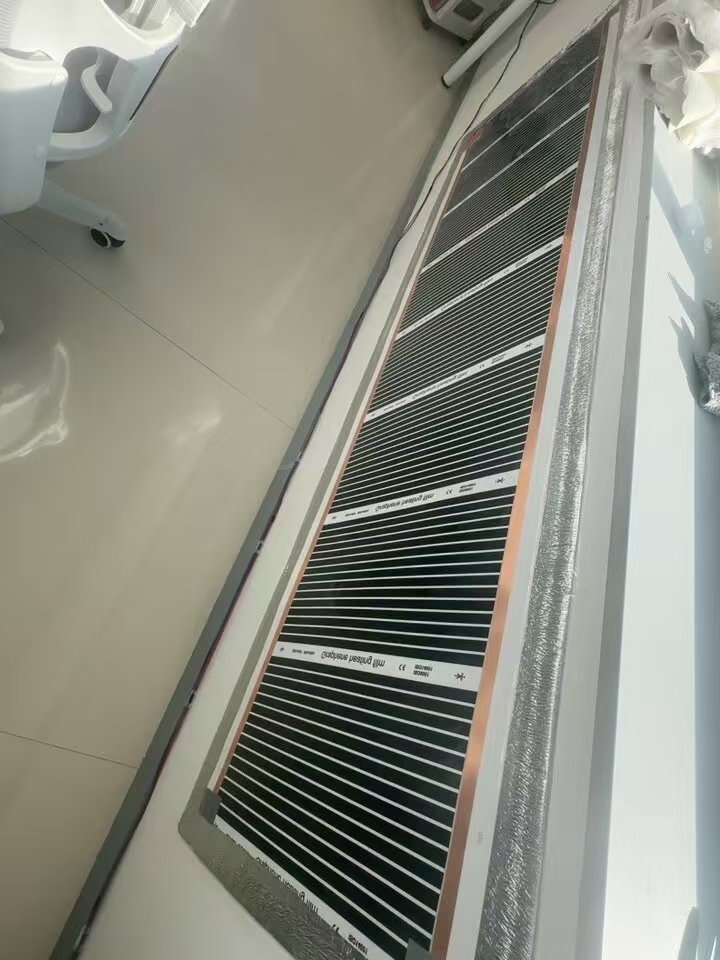
Inside the Film: Printed Graphene Elements, Reflective Backing, Full Shielding
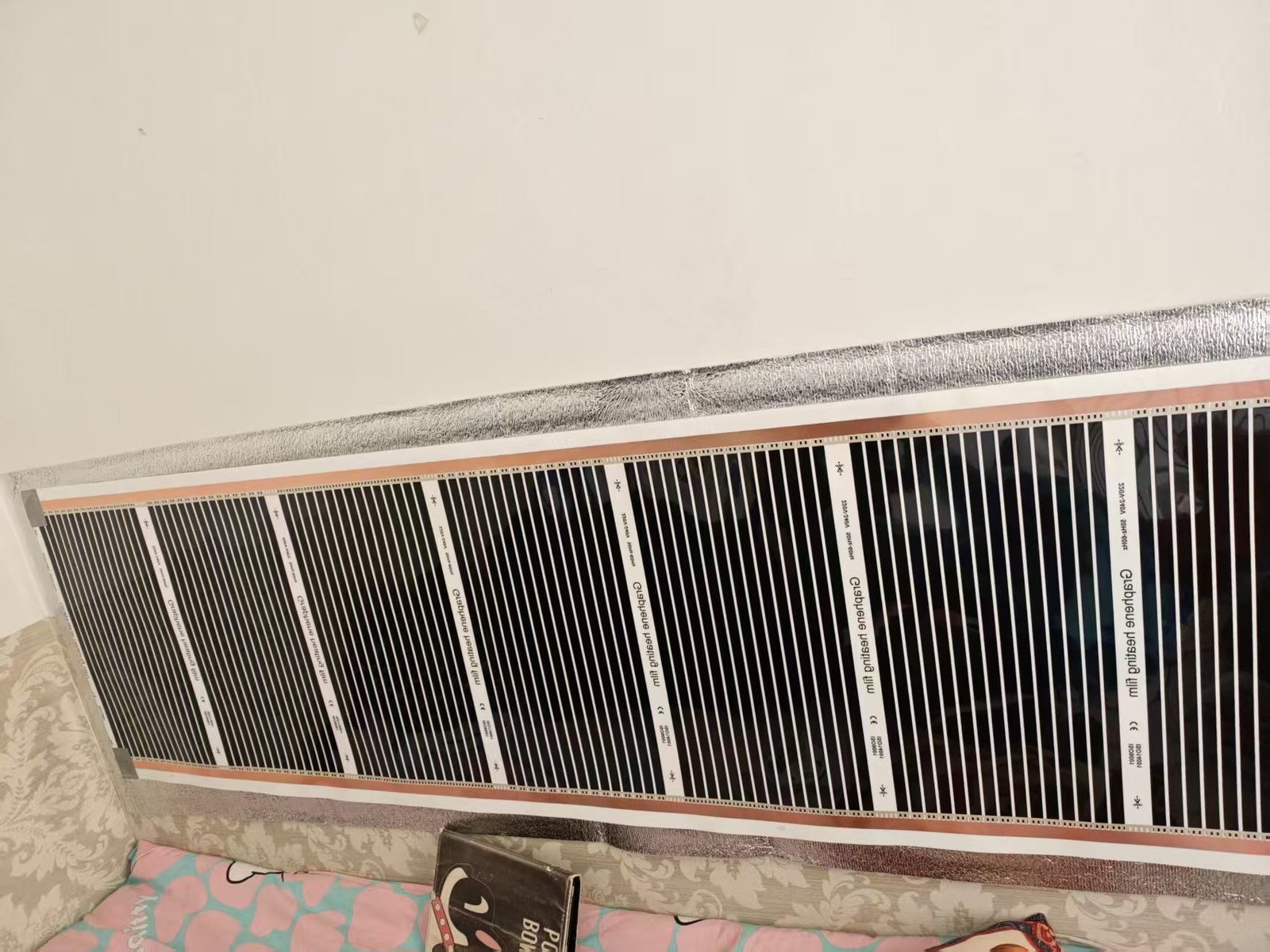
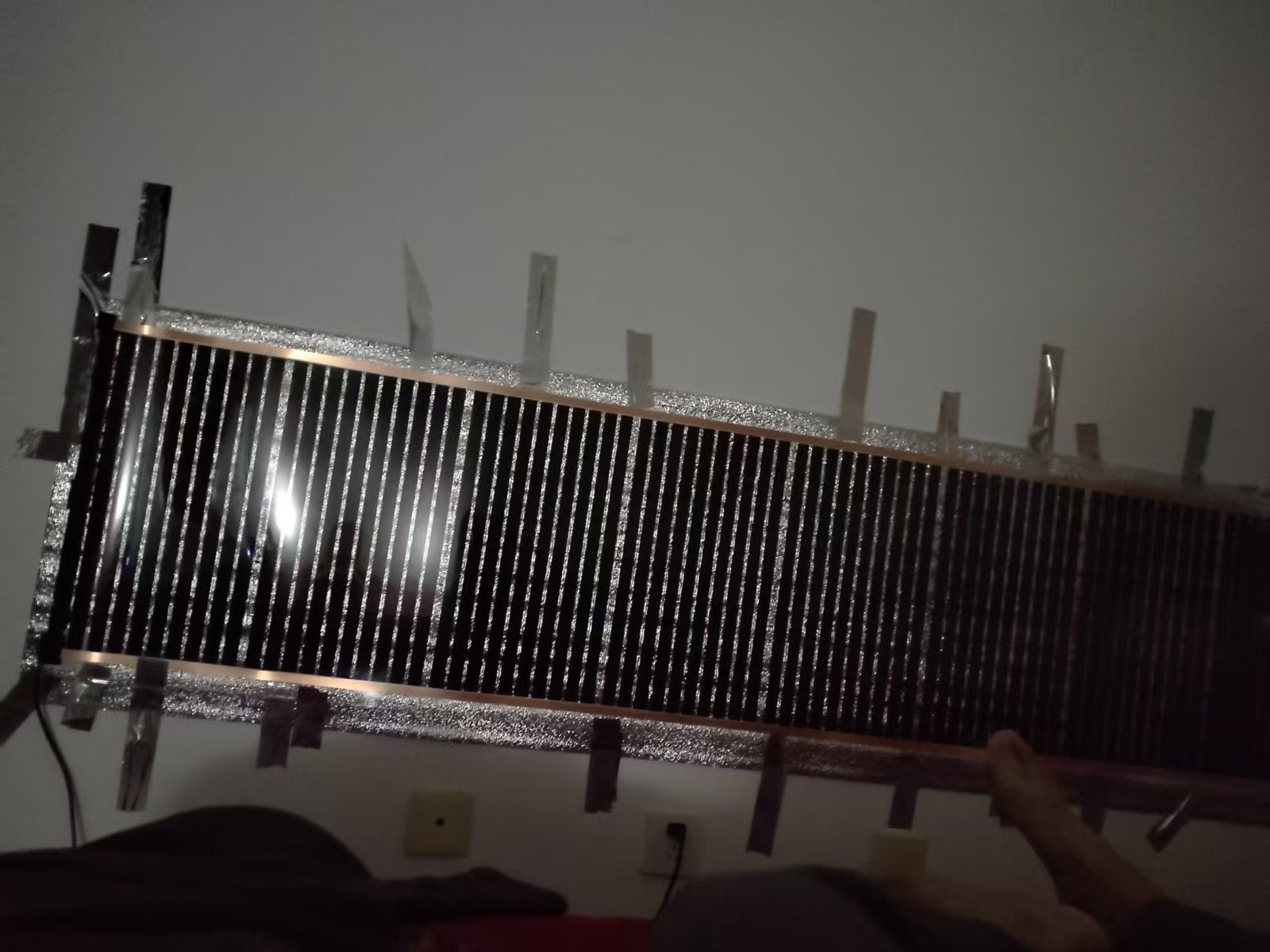
From the outside, the product looks like a thin laminated sheet with a silver border. Inside, it is a five-layer construction built to be stuck on an interior drywall, plaster, tile, wood paneling or wallpaper surface. Understanding the layering explains both the performance and the price.
Printed Graphene-Carbon Resistive Stripes
The heating element is not a metal wire. It is a screen-printed composite of graphene and carbon, applied as parallel stripes on a polyester substrate. Graphene’s high in-plane conductivity spreads current laterally across each stripe so the surface heats uniformly. We measure surface uniformity at ≤ 3 °C across a panel — no hot spots, no cold rows. Because the stripes are printed rather than wound, the whole panel stays ultra-thin, flexible enough to follow an inside corner, and free of the mechanical fatigue that kills a wire element when it expands and contracts thousands of times.
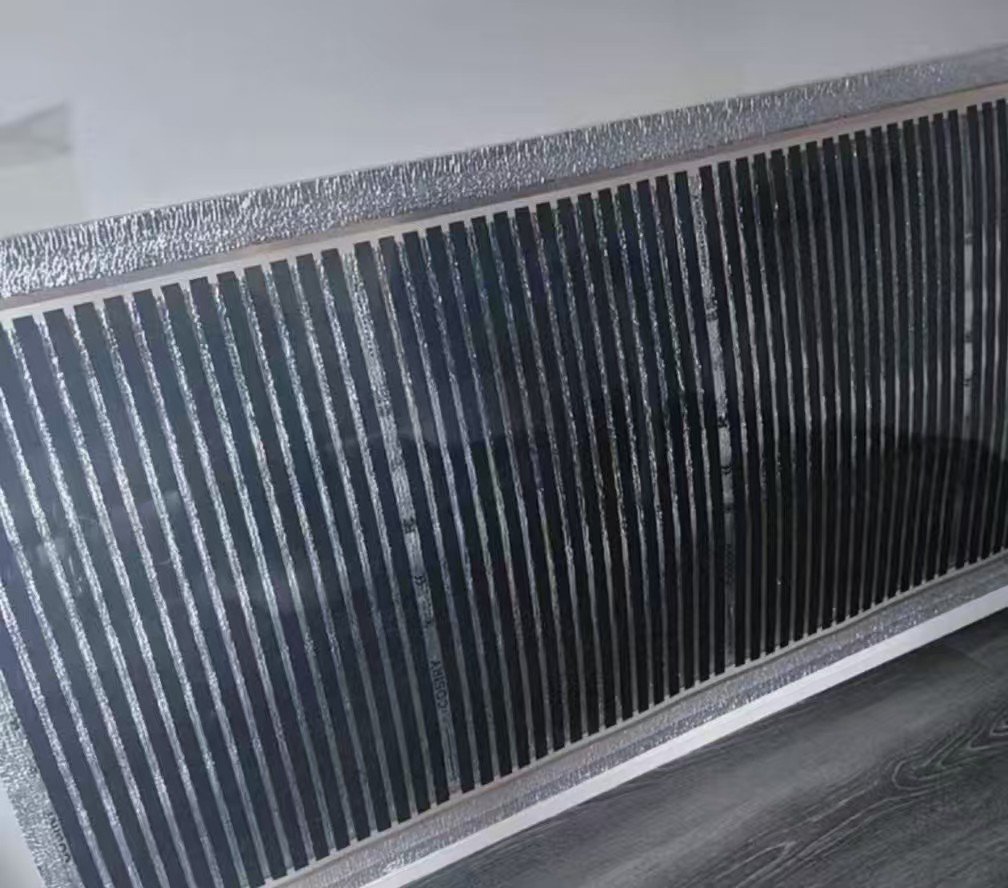
Silver Reflective Insulation Backing
The side that touches the wall is a reflective foil. Without that backing, part of the radiated energy would go backward into the plaster and into the structural wall — useful to the building, not to you. The silver foil reflects that backward radiation back into the room. On a cold external wall, this matters: without reflection, you are heating the brickwork. With the reflective backing, you are heating the room. The same principle is why underfloor insulation boards are mandatory under water-based underfloor heating.
Full Electromagnetic Shielding
Every resistive heater connected to the mains has a tiny alternating electromagnetic field around it. For most rooms this is irrelevant, but for nurseries, bedrooms, and home offices where the user sits within a metre of the panel for hours, buyers ask about it. Our construction wraps the heating circuit in a full shielded layer that terminates to earth. The product is sold as a wall heater with no electromagnetic radiation emission — not a marketing slogan, but a design rule that lets the panel sit above a child’s bed.
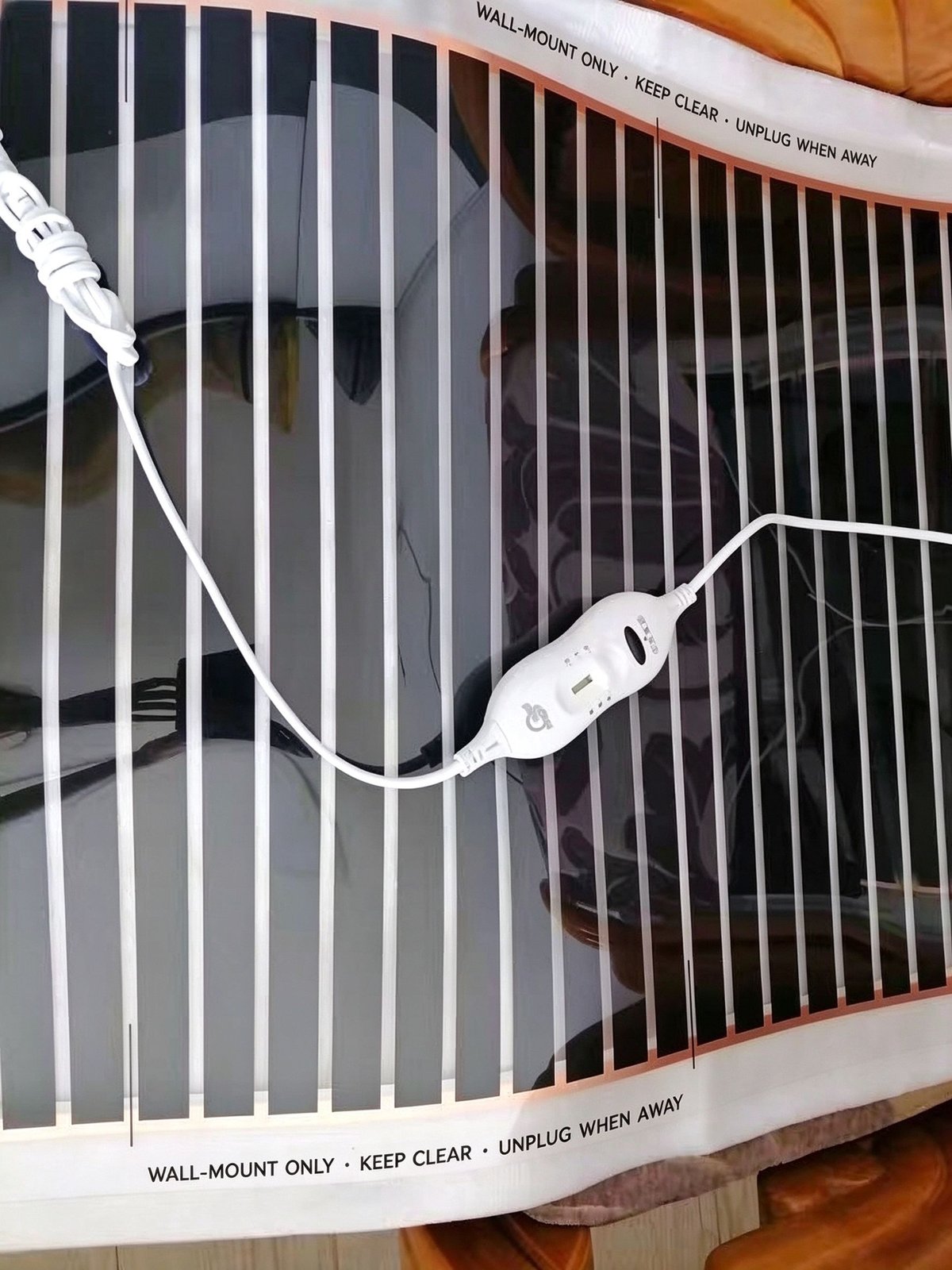
In-line High / Low / Off Thermostat
The film ships with an in-line thermostat that plugs straight into a wall socket. It has three positions: High, Low, Off. On High, the panel runs at its rated wattage. On Low, it cycles through reduced power — useful in a nursery or overnight. No electrician is needed for a standard room install because the unit is 220 V plug-and-play. For multi-room projects, the same panel can pair with SunAura room thermostats for scheduled, zoned control.
Why Radiant Wall Heating Beats Convection on Energy
This is the section most procurement teams ask us about. Let us do the numbers.
> 99 % Electric-to-Thermal Conversion
The film is a pure resistive load. There is no fan motor to draw parasitic power, no blower to wear out, no duct, no heat exchanger, no pilot flame. Of every watt you pay for, more than 99 % leaves the panel as heat. The remaining under-1 % is a tiny amount of resistive loss in the leads and in the controller. For a buyer, that means the rated wattage printed on the panel — 60 W for the 30×50 cm size, 125 W for 50×50, 250 W for 50×100, up to 1000 W for the 50×400 cm panel — is essentially the heat delivered to the room, not the heat after losses.
Where the Energy Goes: Convection vs Radiant
Look at where the joules actually end up.
| Energy destination | Convection heater (fan / oil / radiator) | SunAura radiant wall film |
|---|---|---|
| Heats air near the ceiling | High — hot air stratifies up to 1–2 m above head | Low — air warms only by secondary convection off the wall |
| Lost on door opening / window infiltration | High — the warm air you paid for leaves first | Lower — warmth is stored in wall mass and furniture |
| Blows dust, fluff and allergens | Yes, fan units | No, fanless |
| Parasitic fan motor wattage | 20–50 W typical | 0 W |
| Wasted into the structural wall | n/a | Reflected back by silver backing |
| Warms people and surfaces directly | Indirect | Direct via far-infrared radiation |
Worked Example: A 500 W Panel in a 4 m² Bedroom Corner
Say you put a 50×200 cm, 500 W panel above the headboard in a small bedroom. It is the auxiliary heat source — the primary heat pump or central heating still runs, but you want to take the morning chill off. On High, 500 W flows into the film for, say, 4 hours a morning. That is 2 kWh. At €0.30/kWh, you are spending €0.60 per morning. A 2000 W fan heater that warms the same corner will run for roughly 30 minutes to deliver 1 kWh, but because the heat is in the air, half of it rises to the ceiling and the room still feels cold at ankle level. To feel the same comfort, the fan heater usually cycles longer — closer to 1 hour of runtime — and you pay 2 kWh for a comfort level the 500 W radiant panel reaches in half the felt effort, because MRT is doing the work.
Multiply that across a bedroom, a home office and a small tea shop, and the economics show up in two places: a lower billed kWh per degree of comfort, and a lower setpoint on the main thermostat. We are not claiming a magic 80 % saving — that would be dishonest. What we will tell you, as a factory that has shipped to 50+ countries, is that buyers who size the panel correctly and set the thermostat lower typically report the same comfort at a lower air temperature, which is the physical mechanism behind far infrared wall heater energy saving claims in the field.
Panel Ratings and Coverage Guide
The film ships in eight standard panel widths and lengths. The standard film width is 50 cm, with one exception — the 30×50 cm panel, which is 30 cm wide. Panels wider than 50 cm are delivered as multiple 50 cm strips joined in the factory. Power density is 500 W/m² at 220 V.
| Panel (W × L) | Rating | Coverage as primary heat | Coverage as auxiliary |
|---|---|---|---|
| 30 × 50 cm | 60 W | 0.3–0.5 m² | 0.4–0.7 m² |
| 50 × 50 cm | 125 W | 0.7–1 m² | 0.9–1.2 m² |
| 50 × 100 cm | 250 W | 3–5 m² | 5–7 m² |
| 50 × 150 cm | 375 W | 4–6 m² | 6–8 m² |
| 50 × 200 cm | 500 W | 5–7 m² | 7–9 m² |
| 50 × 250 cm | 625 W | — | — |
| 50 × 300 cm | 750 W | 7–10 m² | 8–12 m² |
| 50 × 400 cm | 1000 W | 10–15 m² | 12–16 m² |
These coverage numbers are indicative. The actual required area depends on your wall insulation, window U-values, ceiling height, local winter design temperature, and whether the room already has a primary heat source. Treat them as a starting estimate, not a purchase order. Our engineering team will re-size for you once you send the room dimensions and the wall type.
Where the Reflective Backing Saves You Real Joules
On an external brick wall at −5 °C outside, the uninsulated plaster-side temperature can sit near 8–10 °C. If you mount a non-reflective radiant panel on that wall, roughly a third of the radiated energy goes backward into the brick and never reaches the room. That energy heats the wall — it does not heat you. On a well-insulated internal wall the backward loss is small. The silver reflective backing on the SunAura film reflects that backward radiation back toward the room, so almost all of the 500 W leaves through the front face. On a cold external wall, the reflective layer is not a nice-to-have; it is the difference between a panel that warms the room and a panel that warms the wall.
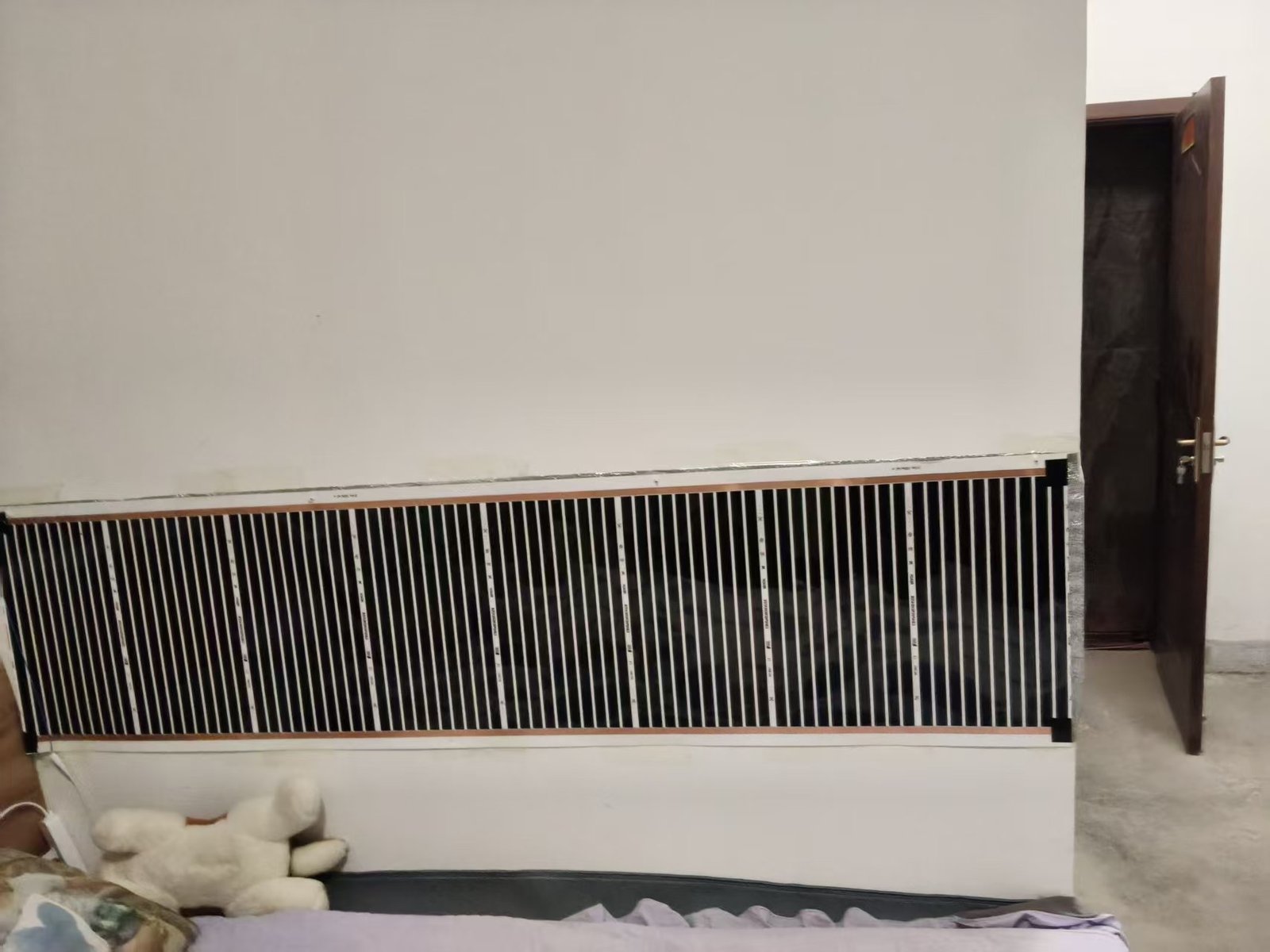
Thermal Comfort: No Fans, No Noise, No Dust, Warm Walls
Engineering comfort is about four things at once: air temperature, radiant temperature, air movement, and surface humidity. A fan heater tackles only one of them. The film tackles all four without moving air.
No Wind, No Noise, No Dust
Because the panel has no blower, it moves zero air. That matters to buyers who have asthma, who have dust allergies, or who run a retail space where the display shelves collect dust. It also matters in a bedroom. The unit runs at the same acoustic level as a wall — silence. People sleep through it. There is no click, no hum, no draft from the grille. This is why the product is marketed as an electric wall heater no fan and a silent wall heater for bedroom.
Warm Walls, Not Warm Air
Wall surfaces around 45–55 °C feel warm to the back of your neck, your elbows, your chair. Your chair absorbs the radiation and warms you from underneath. Your desk absorbs it. Your bookshelf absorbs it. The air itself stays only mildly warmed because the wall re-emits slowly. The effect is not a blast of heat on switch-on; it is a slow, even warmth that builds over a few minutes. The film reaches operating surface temperature in about one minute (our factory demo footage), and then the wall takes over the slow-release.
Ankle-to-Head Evenness
Because the wall warms from behind you and from the side, the temperature gradient between your ankles and your head is small. Convection rooms often run 2–3 °C hotter at head height than at ankle level; radiant rooms typically run much closer. You can sit at a desk with your feet warm because the desk-back wall is radiating, not because the air is being recirculated.
Humidity Does Not Drop
Fan heaters and oil radiators raise air temperature and dry out the relative humidity, because warmer air holds more moisture and the water vapour moves out through the building fabric. The wall film raises wall temperature and MRT without aggressively heating the air, so the relative humidity in a bedroom typically stays closer to its natural level. Buyers with dry throats, chapped lips, or wooden furniture that warps in winter convection rooms notice this within a few nights. It is not a medical claim — it is a side-effect of not overheating the air layer.
Switching Off: The Slow Give-Back
Because the wall mass absorbs radiation while the film is on, it continues to give back warmth for several minutes after you switch the unit off. The film itself reaches operating surface temperature in about one minute; the plaster layer behind it warms more slowly and releases that heat slowly. This slow release is what makes a bedroom comfortable even twenty minutes after you turn the panel off before sleep. Compare with a fan heater, which stops contributing heat the moment the fan switches off — the room cools within five minutes.
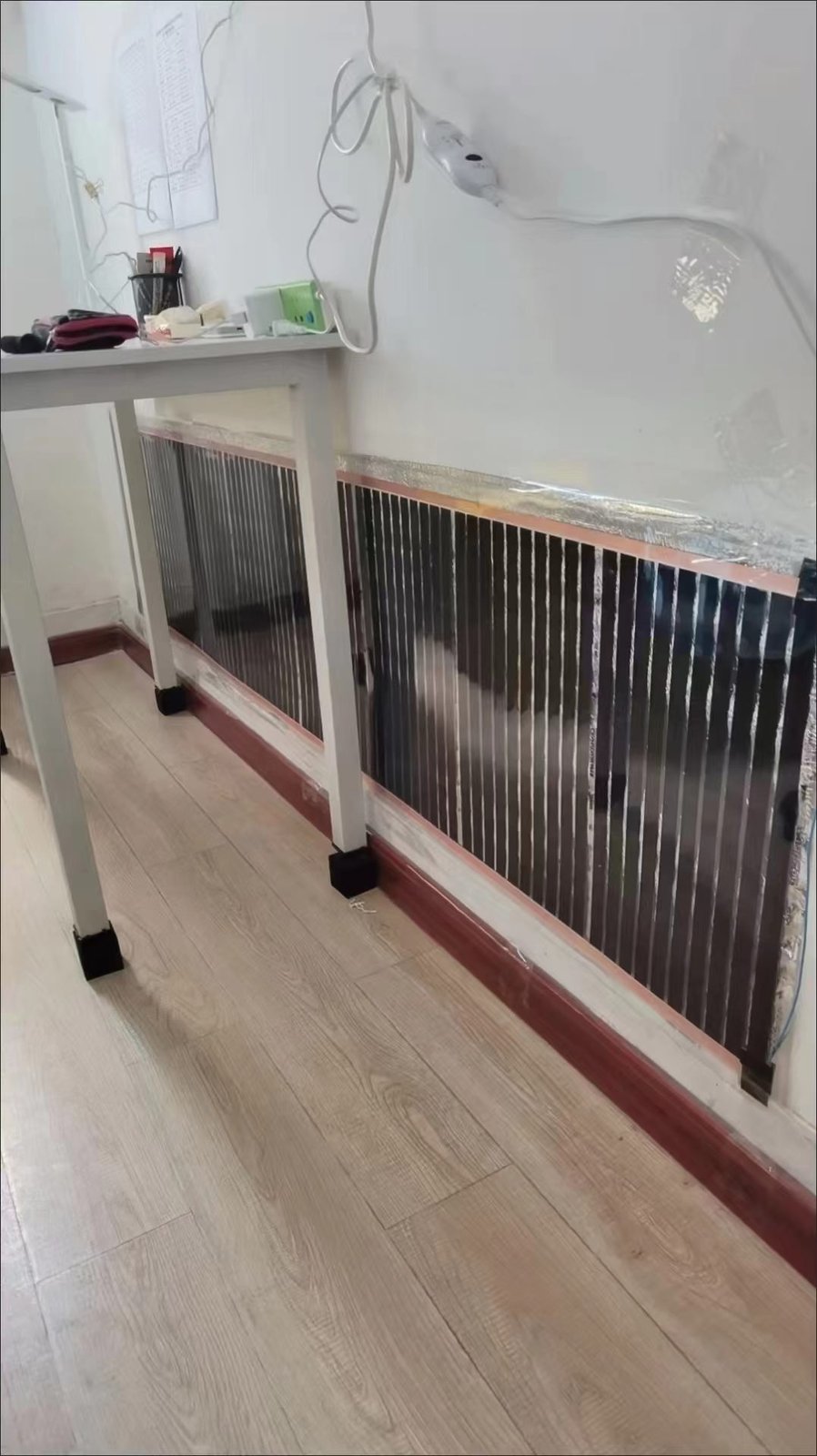
Safety Engineering: What Is Printed on the Film Itself
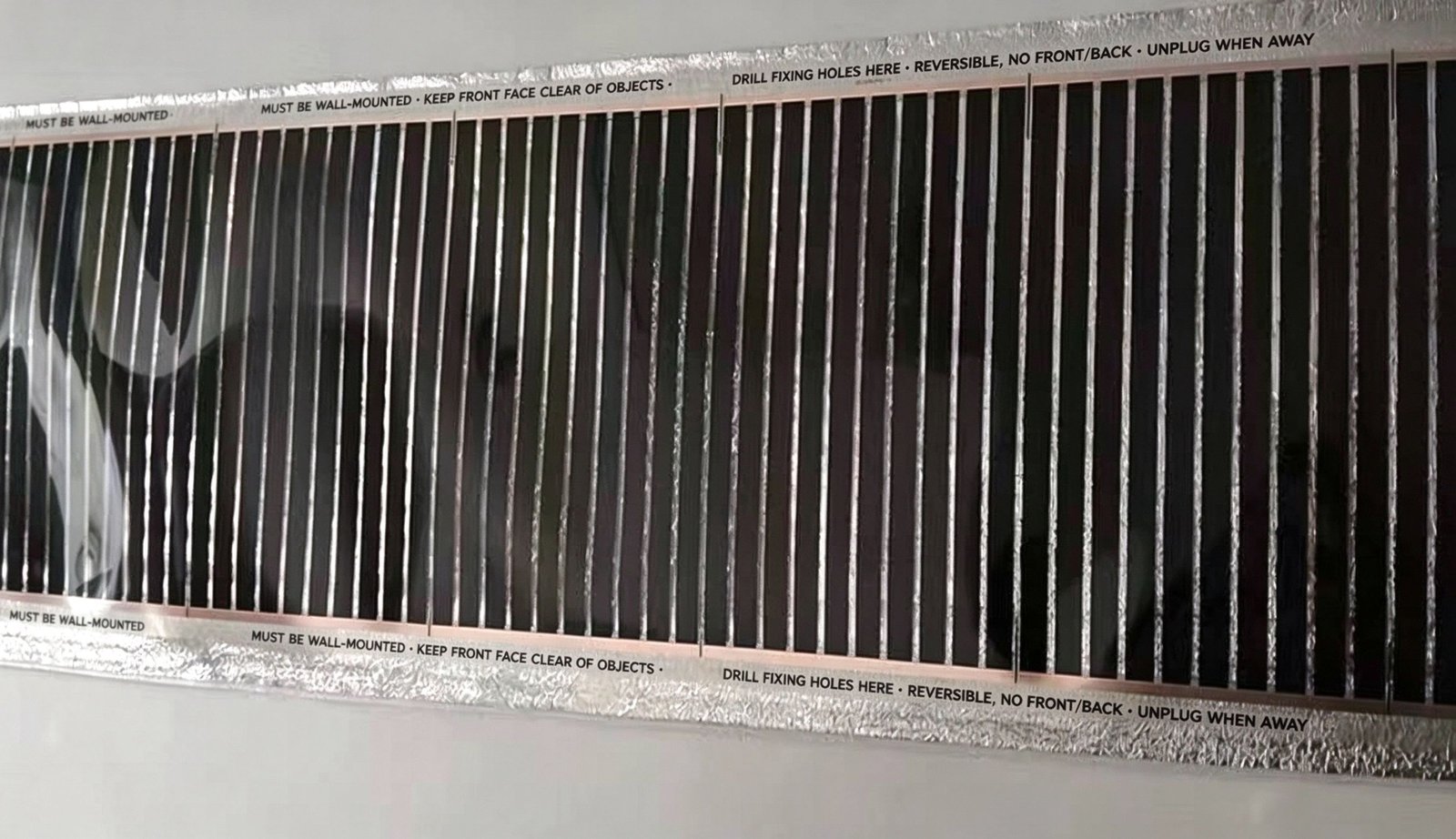
Safety is not an afterthought on this product. The rules are printed on the foil border of every panel in English and the local language, because the film will be installed by homeowners, decorators, and contractors who do not read the manual. This is what the labels say.
The Non-Negotiable Rules
- Must be wall-mounted, never on the floor, on a bed, inside a cabinet, or inside a sofa. The panel radiates from its front face. Lay it flat under a rug and you block the emission path. Heat builds up, surface temperature rises, and the panel exits its design window.
- The radiating front face must stay clear. If you hang a thick blanket, a curtain, a bookshelf or a mattress directly against the front face, surface temperature climbs above 100 °C rapidly. The panel is designed to operate uncovered at 45–55 °C; typical uncovered surface is about 60 °C; our demo measured 67.7 °C. Covered, that number does not stop at 70. It keeps going.
- Drill only on the factory-printed fixing-hole strips on the silver border. Those strips are reinforced so a screw does not pierce a heating stripe. Drilling through a printed heating stripe is the one installation error that can damage a panel.
- Disconnect when unattended. Unplug it, or switch it off at the socket, when the room is empty for a long period. This is the same discipline you apply to any mains-powered appliance.
- In a nursery, use Low on an open wall, above the head of the crib. Do not put it behind the crib rail where the child can reach or press bedding against it. Low drops the panel to a reduced power cycle and keeps surface temperature in the comfort range.
Surface Temperature and Uniformity
Under thermostat control, the working surface is 45–55 °C. That is below the temperature at which short-term skin contact causes a burn, and well below the auto-ignition of fabrics. Across a single panel, surface uniformity is ≤ 3 °C — meaning no row of stripes runs noticeably hotter than its neighbour. A red warning label on the corner of the unit points the installer to the fixing instructions and the disconnection rule.
What Happens If the Film Is Covered
We have run this in the lab so you do not have to. A panel uncovered, on High, holds 60–67.7 °C on the surface. The same panel with a thick cotton towel pressed against the front face climbs past 90 °C in under ten minutes. Because the silver backing reflects backward radiation into the room, blocking the front face traps the heat in the film laminate. The thermostat senses the surface and tries to hold the setpoint; the trapped heat defeats it. The panel does not self-destruct — the laminate is rated for elevated temperatures — but it leaves the comfort design window. This is the single most important rule we print on the foil border: keep the front face clear, keep the wall clear, and never press a soft furnishing against it.
Compatible Wall Surfaces
The film is flexible and adhesive-friendly. It goes up on interior drywall, plaster, ceramic tile, wood paneling, and wallpaper. It wraps an inside corner because it is a thin flexible sheet. It does not require a masonry substrate, and it does not require primer — the adhesive strips and the factory-printed fixing-hole strips on the silver border do the work. For external walls, pair with a reflective insulation layer behind the film if the wall is uninsulated; for internal walls, the film’s own silver backing is usually enough.
Shielding, Insulation Rating and the Controller
The in-line controller is a simple High / Low / Off switch, not a smart thermostat. The shielded layer terminates to earth. The backing is reflective. The panel is rated for 220 V and 500 W/m² power density. Standard sizes are listed in the product datasheet; if you are a distributor asking about custom lengths, plug standards, or a zone-thermostat pairing, that is a separate conversation with our OEM team.
Certification, Lifespan and Warranty
For B2B buyers, the safety story is only half of the procurement question. The other half is: can I trust the factory, and what do I do if a panel fails in five years?
Certifications on the Unit
- CE — EU conformity marking.
- RoHS — restricted substances compliance.
- ISO 9001 — quality management at the factory.
- ISO 14001 — environmental management at the factory.
For the Japanese market, PSE-related documentation is prepared per order. For OEM customers, we cut to your lengths, supply your plug standard, your controller style, and pair with your zone-thermostat line.
Factory Scale: Why That Matters to You
Our Qingdao plant has been running since 2008. We operate six automated production lines and output roughly 500,000 m² of graphene heating film per month. Product ships to 50+ countries. For a distributor, this means three things: (1) lead time on a container is measured in weeks, not months; (2) a repeat order of the same SKU will look the same as the first; (3) if a fault does appear, there is a standing engineering team behind it rather than a trading desk.
Warranty, Plain and Simple
In-box product warranty: controller 1 year, film body 3 years. That is the consumer warranty that ships with every retail unit. For registered B2B partners, we run a company-level 15-year warranty support framework — meaning long-running project accounts get a documented engineering support and replacement pathway well beyond the consumer terms. If you are specifying a multi-building retrofit or a hotel rollout, this is the clause to ask us about by name.
Where Graphene Wall Film Makes Sense
The film is not a universal replacement for central heating. It is a precise instrument for specific rooms and specific use cases. Here is where our buyers put it.
- Bedrooms and nurseries — above the headboard, out of reach, silent, shielded. The best graphene wall heater for bedrooms is the one you install on an open wall above the bed head, not on the wall the pillow touches.
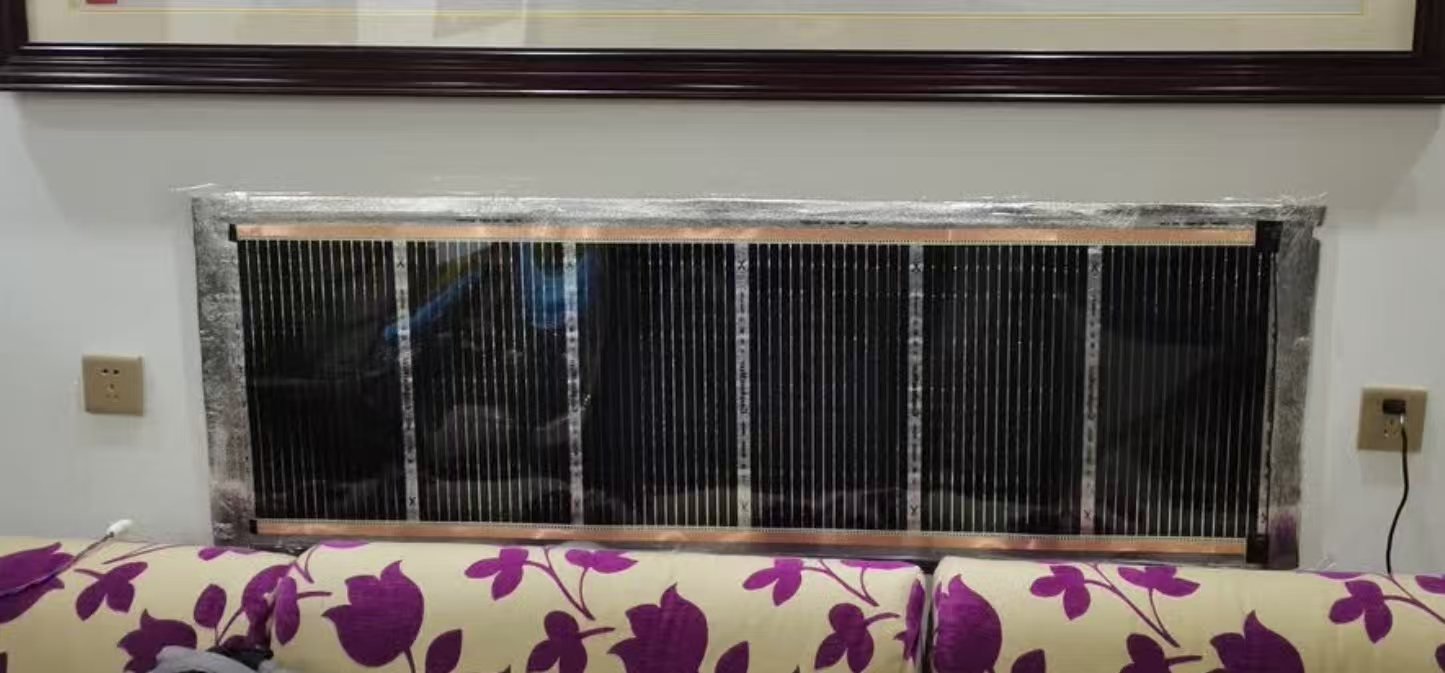
- Living rooms — below a framed artwork or behind the sofa. The wall behind the sofa becomes the warm surface you actually feel on your back.
- Bathroom walls (marble / tile) — mounted above the toilet, out of splash zone. Buyers treat this as a wall heating film for bathrooms upgrade, not as a wet-zone heater.
- Dining rooms, tea shops, small restaurants — a two-tier run behind the dining chairs warms the back wall where customers sit for an hour.
- Home offices and studies — under the window, behind the desk. The panel on the desk-back wall warms your feet and under-desk area without blowing air over your keyboard. This is the wall mounted electric heater for home office use case.
- Below windows — counters the cold downdraft that comes off a single-glazed or poorly sealed window in winter. The wall heater for under windows install is a classic retrofit.
- Rental flats and light retrofits — no wet trades, no plumber, no screed. Tape-position and adhesive fixing means a thin wall heating panel for retrofit that goes up in an afternoon and leaves no trace if you take it down. It is also our graphene film wall heating for rental flats SKU.
- Showrooms, galleries, retail walls — zero floor footprint, no visible radiator, artwork on top. The product disappears into the wall and the interior designer is happy.
Installation: Tape Positioning, Adhesive, and Printed Fixing Holes
Installing the film is not a plumbing job. You start by taping the panel to the wall to check the position, then peel the adhesive backing and press it down from one edge to the other to avoid bubbles. If you prefer screw fixing for a permanent install — for example, on a commercial wall that will be cleaned or wiped down regularly — the factory-printed fixing-hole strips on the silver foil border are the only place a screw is allowed. Those strips are reinforced so the fastener does not pierce a heating stripe. Drilling off-strip, through a heating stripe, is the one install mistake that damages the panel. It is also why the foil-border warning label and the red corner label are printed on every unit rather than shipped in a separate bag: the installer sees the instruction at the moment of drilling.
OEM and ODM Notes for Distributors
If you are a distributor or project specifier, the standard SKUs are the starting point, not the ceiling. We cut custom lengths, match your plug standard, ship the controller style you prefer (High / Low / Off as standard, or zone-thermostat pairing for multi-room projects), and prepare PSE-related documentation for the Japanese market per order. Multi-panel rooms are wired in parallel behind a single SunAura room thermostat so the schedule follows the room, not the panel. Talk to us before you quote a hotel rollout or a showroom run — the layout matters, and a row of 50 cm strips joined on site behaves differently from a single 400 cm panel ordered in the factory.
If you are comparing this product against our other lines, a useful rule of thumb: a graphene wall heating film turns an entire wall into a warm surface. If you want the same physics on the floor instead, look at our graphene home heating range and use the underfloor heating calculator to size the floor alternative. If you want the look of art on the wall plus radiant heat behind the frame, the graphene infrared heating painting line is a different SKU. If you need a free-standing unit to move from room to room, a graphene far-infrared space heater is the product to look at. And for deeper install notes, our related post on graphene film wall heating installation covers the tape-and-adhesive mounting sequence in detail.
Frequently Asked Questions
What is the difference between a far-infrared wall heater and a normal electric wall panel?
A normal convection wall panel heats the air. The air rises, mixes poorly, and leaves your ankles cold. A far-infrared wall heater like the SunAura film emits long-wave radiation that is absorbed by your skin, your chair, and the wall behind you. You feel warmer at a lower air temperature, and there is no fan moving dust.
Is this really a wall heater with no electromagnetic radiation, and is it safe above a child’s bed?
Yes. The construction uses a full shielded layer terminated to earth. The product is sold specifically as a wall heater with no electromagnetic radiation for bedroom and nursery use. Installation rule: above the head of the crib, on an open wall, Low setting, and never behind the rail where bedding can press against the front face.
Can I cover the panel with a tapestry or a bookshelf to save wall space?
No. Covering the radiating front face is the one error that pushes surface temperature above its design window. The panel operates uncovered at 45–55 °C; typical uncovered surface is around 60 °C, and our demo measured 67.7 °C. Covered, surface temperature climbs above 100 °C rapidly. Keep the front face clear.
How much does a 500 W panel actually save compared with a 2000 W fan heater?
Do not expect a magic number. The film converts >99 % of electricity to heat, has no fan motor parasitics, and lets you run the room at a lower air temperature because MRT is higher. A 500 W auxiliary panel running 4 hours a morning is 2 kWh; a fan heater delivering the same felt comfort often cycles longer. The saving shows up in two places: lower kWh for the same comfort, and a lower setpoint on your main thermostat. Size the panel to the room with our factory engineers before you commit to a number.
Can I install the film myself, or do I need an electrician?
For a standard room install, no electrician is needed. The unit is 220 V plug-and-play with an in-line High / Low / Off thermostat. You fix it with tape positioning and adhesive, and (if you choose screw fixing) drill only on the factory-printed fixing-hole strips on the silver border. For multi-room projects, zone-thermostat pairing is handled by our OEM team.
What warranty do I get as a B2B buyer?
The consumer warranty ships with every unit: controller 1 year, film body 3 years. Registered B2B partners get access to a company-level 15-year warranty support framework, with documented engineering support for repeat project orders. Our Qingdao factory has been running since 2008, ships ~500,000 m² per month, and exports to 50+ countries.
Request Wholesale Price
If your project is a bedroom retrofit, a bathroom upgrade, a small hotel rollout, or a showroom wall run, the next step is a sizing conversation with our engineering team rather than a purchase-order form. Tell us the room dimensions, the wall type, the existing heating, and the plug standard you need, and we will send back a panel mix and a quote. Request Wholesale Price for the SunAura Graphene Wall Heating Film, or read the full spec on the product page. The graphene wall heating film SKU ships with the in-line High / Low / Off thermostat, the silver reflective backing, the full electromagnetic shield, and the CE / RoHS certification you need for EU and global retail.
Further reading: Wall Heating Film Applications collects the panel sizes, room types and layout rules for this graphene film.