
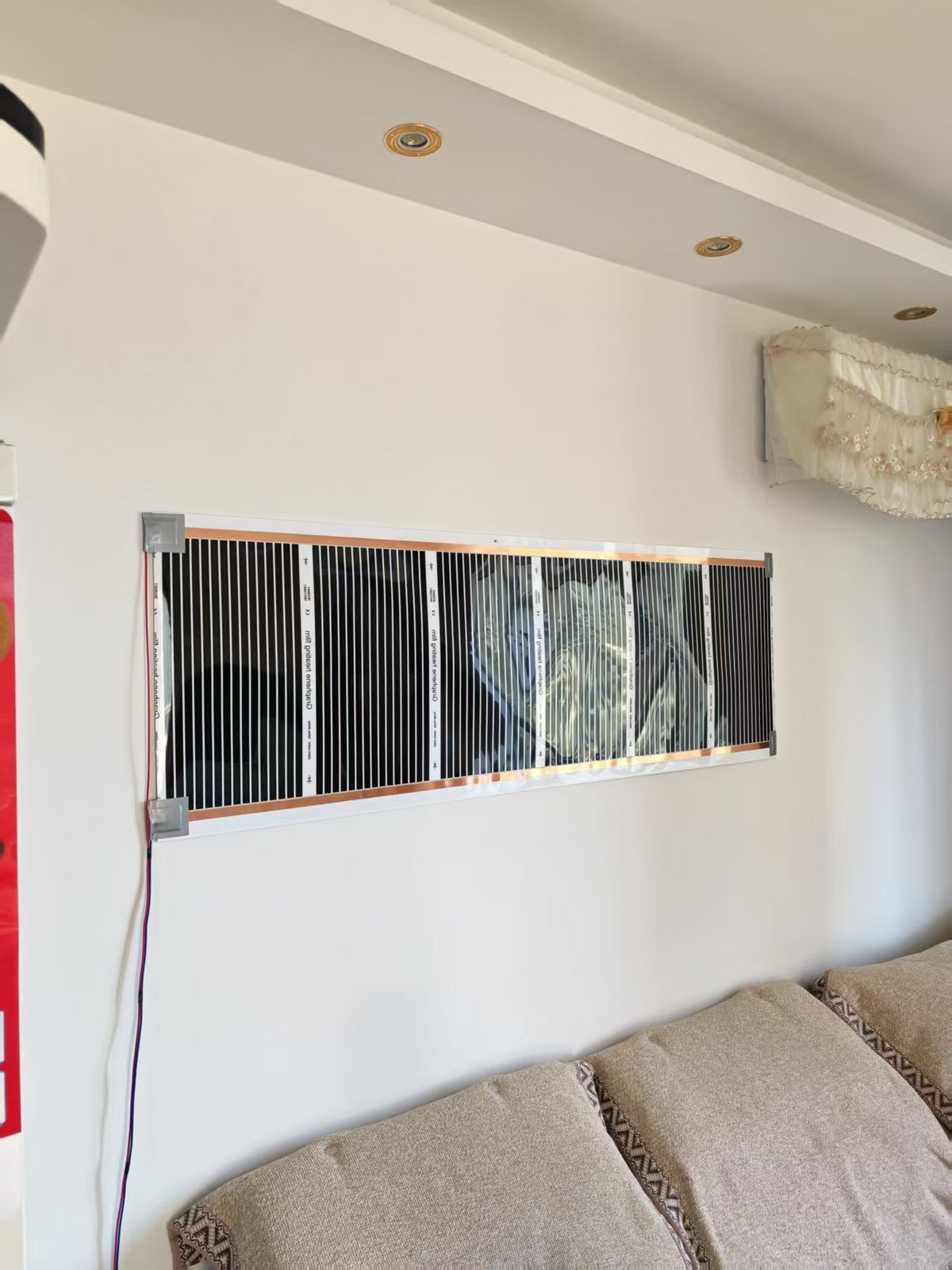
Choosing a heating system is one of those decisions that looks simple on a showroom floor and gets harder the longer you think about it. Convection heaters are cheap. Oil radiators feel trustworthy. Underfloor heating is the dream upgrade. Gas boilers are what your parents had. And then there is a newer category you may have seen on product pages and trade shows: thin graphene wall heating film that glows with far-infrared radiation off an interior wall. If you are a distributor, a property manager, a builder, or a homeowner trying to spec a room or a whole project, the honest question is not “which heater is best.” It is “which heater is the right tool for this room, this budget, this tenant, and this building stage.” This comparison walks through the five most common ways buyers heat a room today, measures each against the same engineering dimensions, and shows where a far-infrared wall heater makes sense, where it does not, and where it simply cannot compete with established systems. We are the factory that makes this film, so we will not pretend our product wins every row. It wins a specific row, and naming that row precisely is the point of this article.
Written by Daniel Foster, Heating Systems Analyst, SunAura Thermal.
How we are comparing these heaters
Before we put any product under the microscope, we need a fixed ruler. We measured every option in this article against the same twelve dimensions a professional buyer actually cares about:
- Electric-to-thermal conversion — how much of the energy you pay for ends up as useful heat rather than noise, leakage, or standby loss.
- Heat comfort — whether the system heats the air (convection) or heats surfaces and people directly (radiation), and what that does to how a room feels at a given air temperature.
- Floor footprint — m² of livable floor the product eats.
- Install difficulty and wet trades — whether you need an electrician, a plumber, a screed, a boiler flue, or a decorator to put it in.
- Warm-up speed — how long from cold switch-on to a perceptibly comfortable room.
- Operating noise — fan whine, pump hum, boiler cycling, or complete silence.
- Electromagnetic field (EMF) exposure — relevant in bedrooms, nurseries, and open-plan offices.
- Up-front cost — hardware, installation, and ancillary work, per room and per house.
- Running cost — energy delivered per kWh of input, plus any standby or cycling penalty.
- Maintenance — annual service, annual gas safety certificate, filter changes, bleeding radiators, and what happens when a single element fails.
- Service life and warranty — the realistic engineering lifetime, not the marketing brochure.
- Best-fit scenario — the one or two situations where this system is the obviously correct choice.
Keep that list in mind as we go. Each of the five technologies below is a good answer for someone; the mistake buyers make is buying the wrong answer for their own row.
Graphene Wall Heating Film: The Baseline
Before we compare against anything else, let us pin down exactly what we are comparing against. The graphene wall heating film we build at SunAura (model XGF-WALLFILM) is an ultra-thin printed resistive film fixed directly to an interior wall. The wall itself becomes a silent radiant heat surface. A reflective silver backing on the film bounces the radiated energy back into the room instead of into the structural wall behind.
Core numbers you will see referenced throughout this comparison:
- Electric-to-thermal conversion above 99 %. There is no fan motor, no pump, no convective stack, no standby pilot.
- Far-infrared radiation warms wall mass, furniture, and people directly through mean radiant temperature. Rooms feel comfortable at a lower air temperature than convection heating.
- Rated at 220 V, power density 500 W/m², working surface held by thermostat at 45–55 °C (typical uncovered surface around 60 °C, measured at 67.7 °C in our demo footage), panel-to-panel surface uniformity within 3 °C.
- Warm-up to operating surface temperature in about one minute, per factory demo.
- Fully shielded construction — no measurable electromagnetic radiation emission, which is why we sell so many panels into bedrooms and nurseries.
- Plug-and-play with an in-line High / Low / Off thermostat. Standard rooms need no electrician.
- Eight standard panel sizes from 30 × 50 cm (60 W) up to 50 × 400 cm (1000 W). Coverage guide runs from 0.3 m² up to 16 m² per panel depending on primary or auxiliary use and insulation.
- Warranty: controller 1 year, film body 3 years as standard in-box; a 15-year B2B warranty support framework is available for registered partners.
That is the baseline. Now the honest fight against the alternatives.
Convection and Fan Heaters: Fast, Cheap, Noisy, Drafty
The plug-in fan heater on a bedroom wall, the upright convector in a sitting room, the wall-mounted fan unit above a doorway — this is the heating most people actually own. It is also the category most often confused with our product, because both are “electric wall heaters.” The physics, however, are completely different.
How they actually heat
A convection heater pulls cool room air across a resistive element, warms it by 40 to 80 °C, and pushes that warmed air back into the room. A fan heater forces the airflow; a convector lets buoyancy do the work. Either way, the entire heat transfer mechanism is air. The air reaches, say, 21 °C, and because warm air rises, the ceiling ends up at 24–26 °C while the floor stays at 17–18 °C. Your feet are cold, your head is warm, and the room feels cooler than the air thermometer suggests because you are standing in the cool lower layer.
Our far-infrared wall heater skips the air. The wall surface at 50–60 °C radiates long-wave infrared across the room, which is absorbed by your skin, your clothes, the sofa, and the floor. Those surfaces then re-radiate gently and warm the air from below. Mean radiant temperature goes up, the air temperature reads lower, and you feel comfortable at air temperatures that a convection-heated room would feel chilly at.
Noise, dust, and dryness
A fan heater moves 20–40 litres of air per second past a moving impeller. That is what makes it audible — typically 45 to 60 dB(A) at one metre, loud enough to mask quiet conversation in a bedroom and a poor companion for sleep. The same airflow picks up house dust, skin cells, and lint off the floor and wall surfaces and pushes them around the room. Buyers with asthma, dust allergies, or new babies learn this within a week.
A fanless radiant wall film has no moving parts at all. It is silent. It does not stir dust. It does not blow dry air past your throat. This is the single most common reason distributors tell us they replace a bedroom fan heater with graphene infrared heating: the customer wanted a silent wall heater for the bedroom, and the only wall-mounted electric heater they could find on price was the noisy one.
Up-front cost and running cost
The fan heater wins on purchase price. A decent 2 kW convector costs what one of our 250 W panels costs. That is the honest comparison, and we are not going to pretend otherwise. A 2 kW fan heater will also heat a small room to a tolerable air temperature faster in absolute terms, because it dumps two kilowatts of heated air straight into the volume.
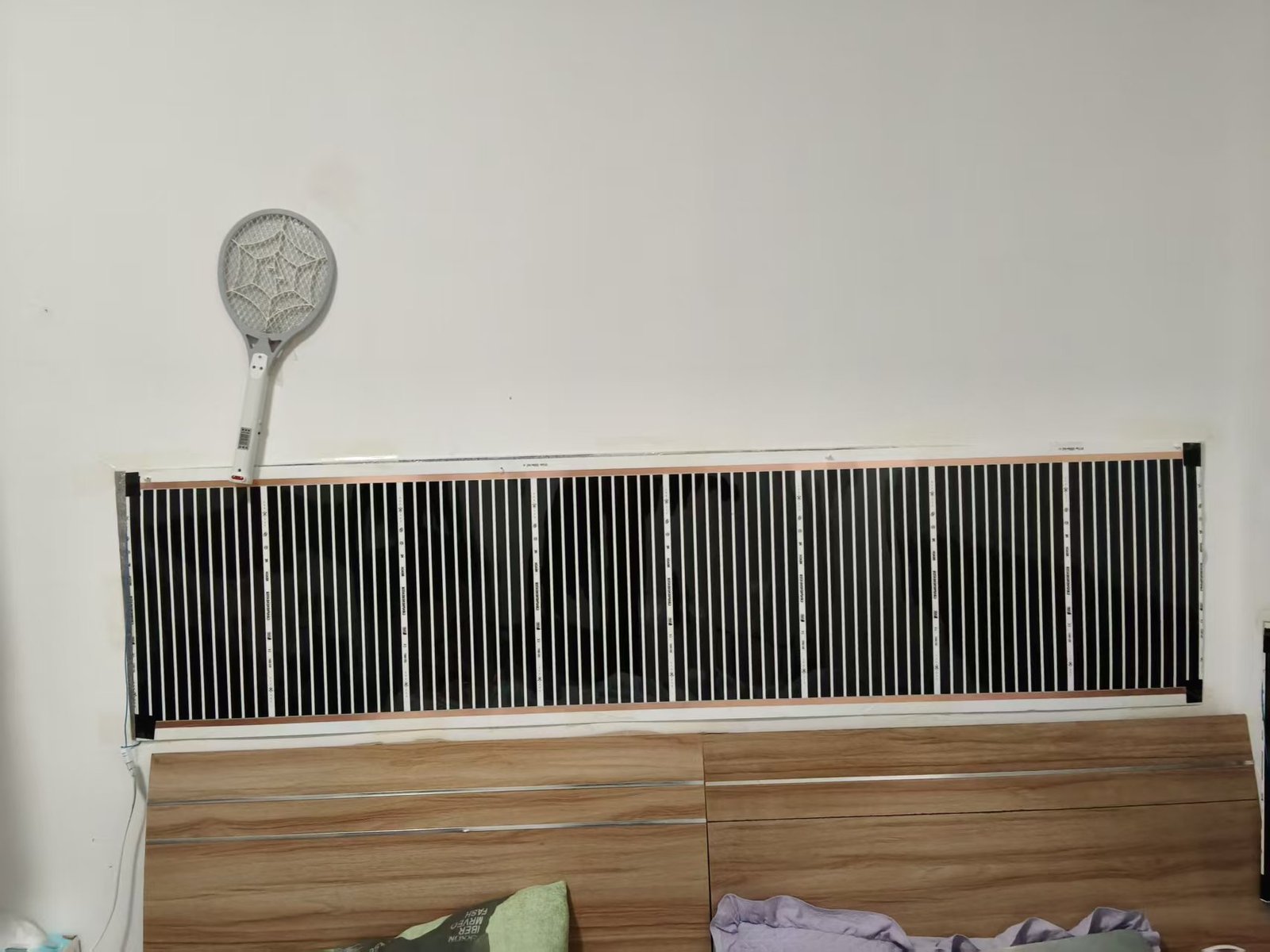
The running cost, however, depends on how you use it. Convectors heat air, and air leaks. In a draughty rental room, a convector on a thermostat can run 60–70 % of the time on a cold winter day, because every time the door opens or the window leaks, that warm air is gone and the element starts again. Radiant film keeps surfaces warm; open the door for thirty seconds and the wall mass is still radiating when you come back. Many of our repeat buyers are landlords who installed convection heaters five years ago, watched the electricity bills climb, and then retrofitted thin wall heating panels because they no longer wanted to argue with tenants about “the heater running all day.”
Where convection wins, where it loses
- Convection / fan heaters win: budget purchase price; very fast air heat-up for a short-stay room; easy to move between rooms.
- Radiant wall film wins: bedrooms and nurseries where silence matters; allergy households where dust movement is a problem; long-stay comfort where mean radiant temperature beats air temperature; rental retrofits where the tenant will actually leave it on overnight.
Oil-Filled Radiators: The Trusted Workhorse
Oil radiators are the heating appliance your grandmother bought in 1995 that is still running in a spare bedroom. They are a good product. They are also a compromise between convection and radiation that ends up inheriting the worst of both.
Physics: thermal inertia disguised as comfort
An oil-filled radiator is an electric resistive element immersed in thermal oil inside a finned steel shell. The element heats the oil, the oil convects inside the shell, the shell conducts heat to the fins, and the fins lose heat by a mix of natural convection (most of it) and a small amount of radiation (the top and front surfaces at 70–90 °C). The oil is the thermal battery: it takes 15 to 30 minutes to come up to temperature, and then it keeps radiating for 20 to 40 minutes after the thermostat clicks off.
That inertia feels “cozy” because the heat does not stop abruptly. It is also the reason oil radiators are inefficient in intermittent use. If you only need a room warm for two hours in the evening, you pay for the 20 minutes of heat-up and then another 20 minutes of residual heat dumping into an empty room once you go to bed. With our wall film, the panel reaches operating surface temperature in about a minute; the thermostat can be set to drop as soon as you leave the room, and there is no hot oil reservoir still bleeding heat after you have switched off.
Floor footprint and surface temperature
An oil radiator is a free-standing floor appliance, typically 50 cm wide, 60 cm tall, and 25 cm deep. It eats roughly 0.1–0.15 m² of floor. That does not sound like much until you have arranged a small bedroom around a double bed, a wardrobe, and a desk, and the only remaining floor space is where the radiator has to go. It blocks the wall, blocks the skirting, and blocks the curtain. We regularly see buyers come to us specifically because they want a zero floor space wall heater — they are not unhappy with their oil radiator’s heat, they are unhappy with what it does to the room layout.
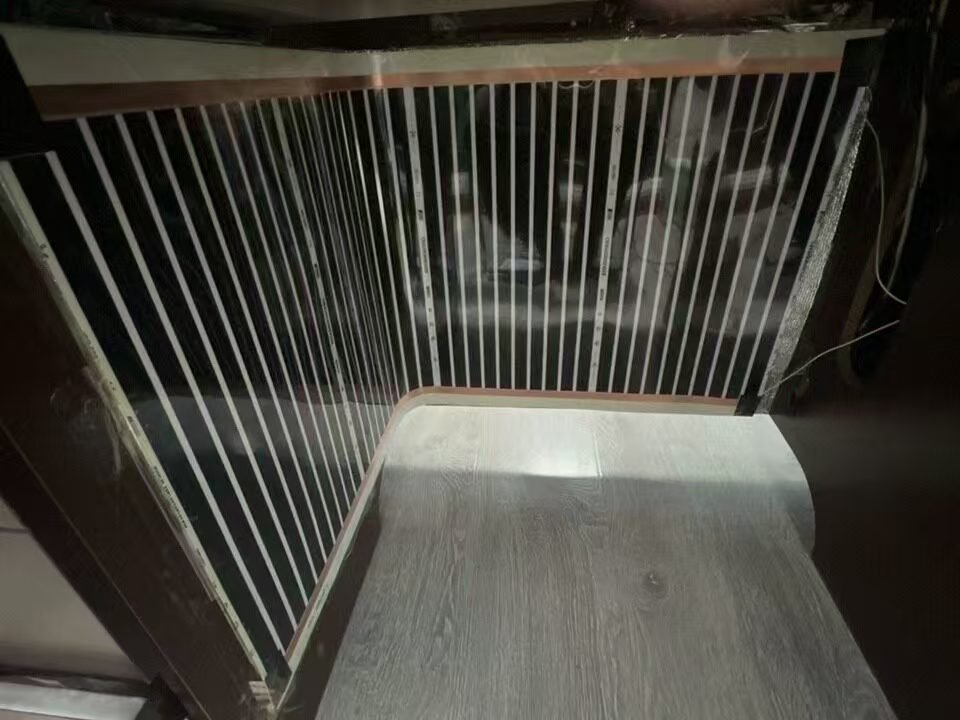
Surface temperature is the other issue. A hot oil radiator casing runs at 70–90 °C on the fins. That is safe against a brief touch, but it is a real burn risk for toddlers, pets pressing against it, and soft furnishings draped over the top. Our wall film holds a typical uncovered surface around 60 °C, with thermostat-controlled working range of 45–55 °C; the numbers are lower because the film spreads the same 500 W/m² across a larger, gentler surface rather than concentrating it in narrow fins. The safety rule is still that the radiating face must stay clear — covering it pushes the surface above 100 °C quickly — but the baseline touch temperature is materially more forgiving.
Energy and maintenance
An oil radiator is still close to 100 % efficient at the point of use: the electricity you put in becomes heat in the room. That argument is fair. What it cannot avoid is the convective temperature stratification we described above — ceiling hot, feet cold — and the fact that most oil radiators on the consumer market have crude mechanical thermostats that cycle with wide deadbands, overshooting by a couple of degrees and then coasting.
Maintenance on an oil radiator is low because there is almost nothing inside to break. That is a real advantage. The controller fails first; the element second; the oil never needs replacing. On our film, the controller is also the most likely failure point (1-year warranty), and the film body carries a 3-year warranty. The comparison is roughly even in service terms, except that a failed oil radiator means a dead unit on the floor, while a failed panel can be unplugged and replaced without disturbing the rest of the room.
When you should still buy an oil radiator
If you need a single movable heat source that you can carry between a living room in the evening and a bedroom at night, and you do not have a wall you can fix anything to, an oil radiator is still a reasonable buy. If you are fixing a heater to a specific wall in a specific room and you will not move it, the wall film is the more comfortable, quieter, floor-footprint-free answer.
Traditional Electric Heating Film: Carbon Crystal, PTC, and Generic Far-Infrared Sheets
This is the comparison buyers get wrong most often. “Graphene heating film” and “carbon heating film” and “PTC heating film” are all marketed to the same buyer on the same trade-show stand, often in the same booth. They look similar: a thin resistive sheet, wired to a thermostat, stuck to a wall or under a floor covering. They are not the same product, and the differences matter.
Material differences: graphene vs carbon-based resistance
Traditional carbon heating film prints a carbon-ink resistive track onto a PET or polyester substrate, usually in wide stripes. Power densities typically run 220–400 W/m². Over thousands of thermal cycles, carbon ink has a known failure mode: localised hot spots where the track thins, resistance rises, and temperature climbs further, in a runaway feedback that eventually burns through the substrate. Quality vendors mitigate this with over-temperature protection, but the underlying material tendency is there.
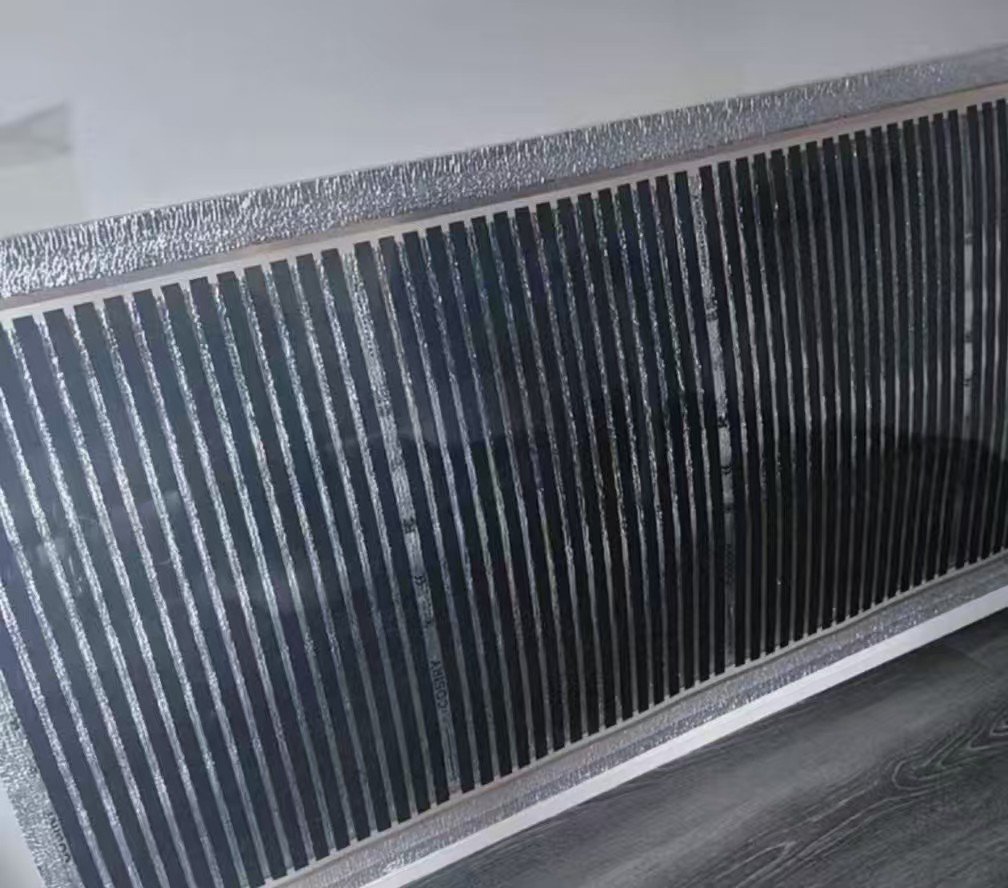
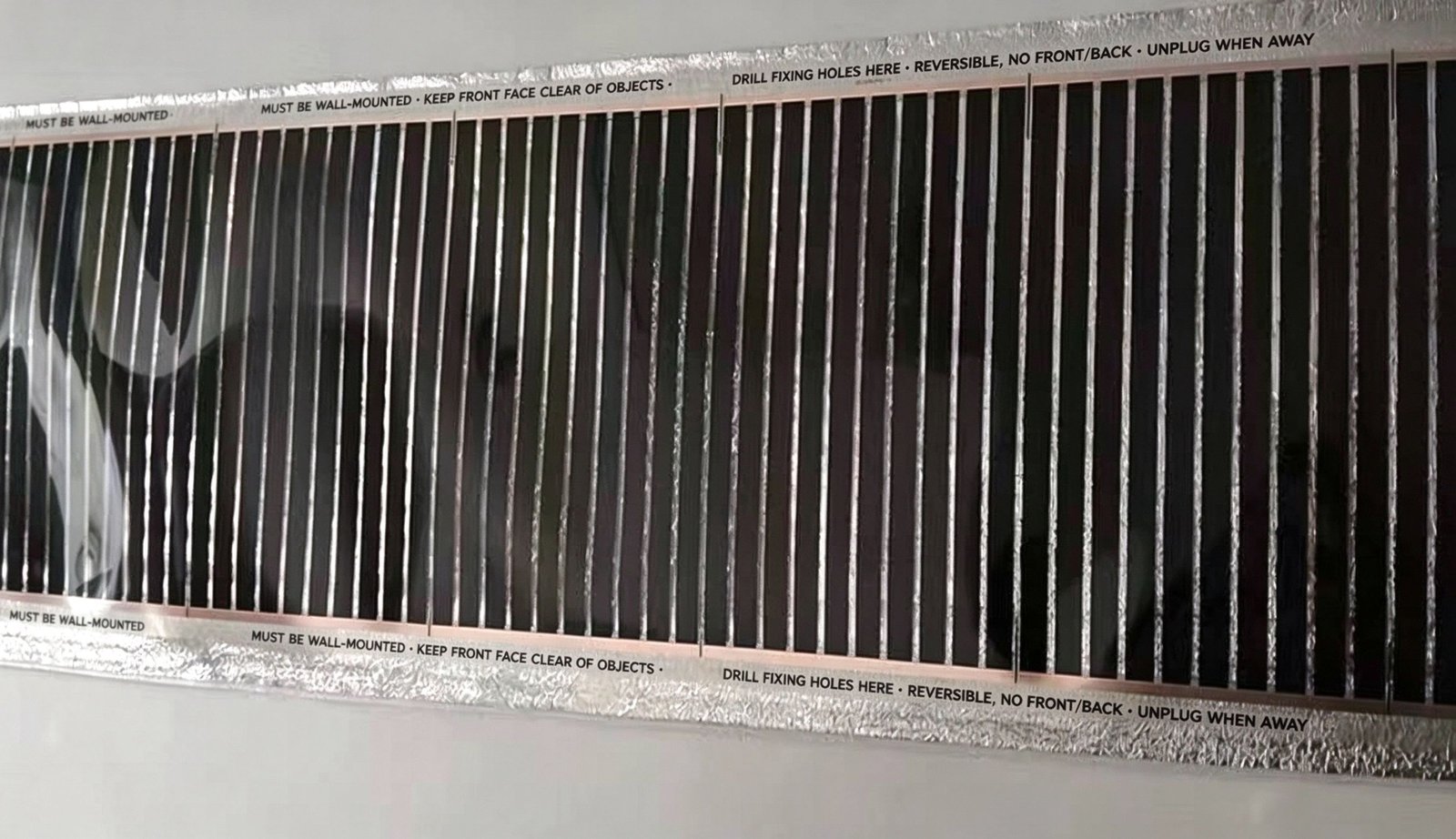
Graphene-carbon printed film uses a graphene-loaded ink printed in fine, continuous stripes across the sheet. The printed stripes on our panels are visible in the product close-up: narrow, evenly spaced, engineered to hold surface temperature uniformity within 3 °C across the whole panel. Power density on our wall film is 500 W/m², higher than typical generic carbon film, which means you need less wall area to deliver the same heat. The graphene lattice also has a higher emissivity in the far-infrared band, so a larger fraction of the heat leaves as useful long-wave radiation rather than conducted heat into the wall behind — the silver reflective backing pushes the rest back into the room.
Shielding and electromagnetic radiation
This is the point where buyers with bedrooms and nurseries should stop scrolling. Many generic carbon/PTC films sold for underfloor use are unshielded. The resistive strip runs across the sheet with no grounded conductive layer between the element and the room. The current in that strip generates a low-frequency electromagnetic field that drops off with distance but is measurable at 20–50 cm above the film. In a floor installation, that field sits a metre below your feet for eight hours a night. In a wall installation directly behind a headboard, it sits 20 cm from your skull.
Our wall film is built as a fully shielded construction. The resistive layer is enclosed between insulating layers and the reflective backing layer is grounded in the finished product, so the radiated field on the room side is suppressed to below the measurable limit. That is why we are comfortable shipping panels above a child’s bed, and why nurseries remain a steady application rather than a niche experiment. If a competitor product does not explicitly state shielded construction and does not publish an EMF test report, treat the absence of that claim as a red flag rather than a detail.
Installation surface: wall vs underfloor
Most traditional carbon/PTC film on the market is sold as underfloor film, laid beneath laminate or engineered wood. That is a different installation. It requires cutting the floor covering, routing the power cable under skirting, and usually pulling up existing flooring to retrofit. Our wall film is designed and labelled for wall mounting: fixed to drywall, plaster, ceramic tile, wood paneling, or wallpaper, with tape positioning and adhesive fixing, plus factory-printed fixing-hole strips on the silver foil border for screw fixing if you need extra hold. The drill points are deliberately limited to those printed strips, never through a heating stripe, so installation cannot accidentally puncture a resistive track.
If you are comparing on a pure wall-application basis, ask any competing film vendor four questions: maximum power density, shielded construction yes/no, surface temperature uniformity, and whether the film is approved for direct wallpaper or tile finish. The answers separate a real wall heater from an underfloor sheet being repurposed as one.
OEM and custom work
For distributors and brands, the other difference is flexibility. We run a 15-year B2B warranty support framework for registered partners, and the Qingdao factory has been producing graphene heating film since 2008 across six automated lines at roughly 500,000 m² per month, exported to 50+ countries. Cut lengths, plug standards, controller styles, zone-thermostat pairing, and PSE documentation for Japan are all configurable per order. Buyers looking for custom encapsulated heating film for a non-standard wall size or a special finish usually find the generic off-the-shelf films cannot meet that half as quickly.
Underfloor Heating: Comfort King, Retrofit Prison
Underfloor heating (UFH) is the system everyone wants when they are building a house from scratch. And for good reason. It is also the system that punishes you hardest if you try to install it in a finished building.
Why UFH feels great
A heated floor warms the lowest air layer first, so the temperature stratification that plagues convection heating is inverted. Your feet are warm, your head is cool, and mean radiant temperature across the whole floor area is high. The floor surface sits at 24–28 °C (water UFH) or 25–32 °C (electric underfloor film), which is well below skin-burn temperature. In a bathroom, a kitchen, or an open-plan living space, it is genuinely the most comfortable heating money buys. We are not going to argue with that.
Our wall film delivers the same physical principle — radiant heating raising mean radiant temperature — but from the wall instead of the floor. You get the “warm surfaces, not warm air” benefit without losing a square metre of floor covering to a screed.
The retrofit problem: wet trades, floor build-up, and tenant consent
This is where the comparison gets important. Traditional wet underfloor heating (hydronic pipes in a screed) adds 7–10 cm to the floor build-up, requires a concrete or cement-sand screed to be poured and dried for 4–6 weeks, and needs a new boiler or heat-pump loop with a mixing valve, manifold, and pump. You cannot retrofit a hydronic UFH into an occupied flat without lifting the entire floor, redoing the skirtings, rehanging the doors, and repainting.
Electric underfloor film (the thin mat or sheet type) is less invasive: it adds 2–5 mm under a floating floor finish. But it still requires removing the existing floor covering, laying the film, routing a sensor wire to the thermostat, and re-laying the floor. That is a wet-trades-free but multi-day job that disturbs furniture, and it is usually impossible in a rented flat because the tenant cannot tear up the landlord’s floor finish.
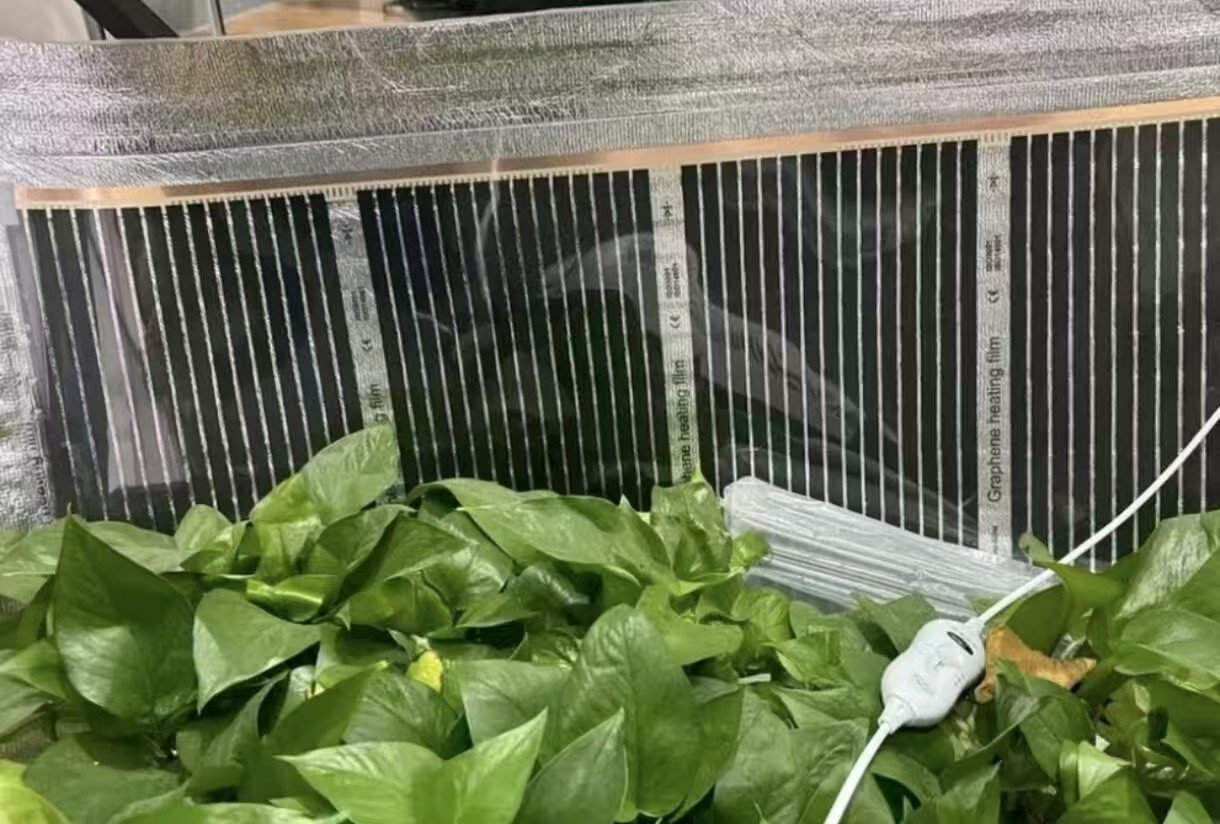
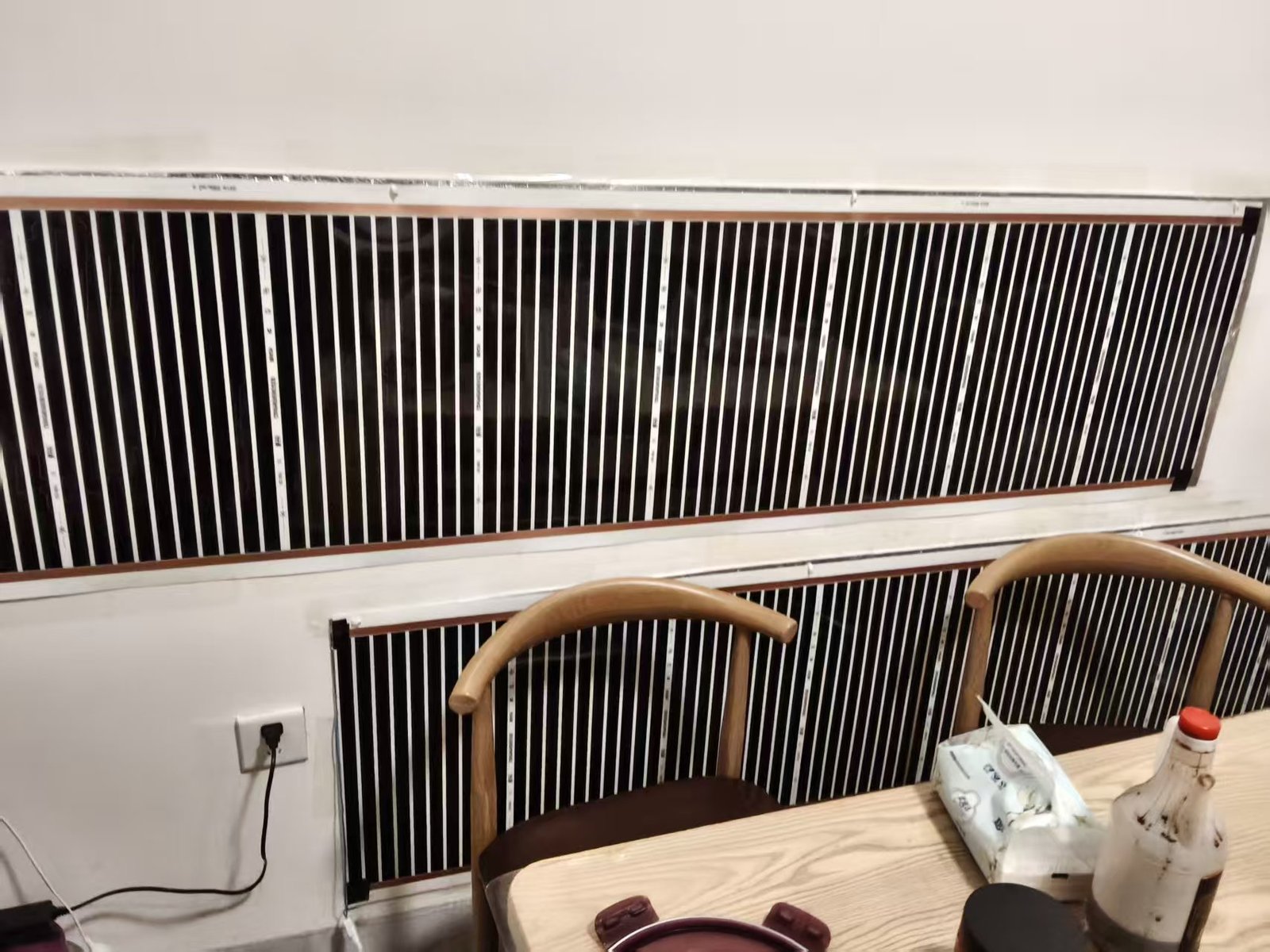
A wall film installation is the opposite. Tape positioning, adhesive fixing, plug into a socket. No floor covering comes up. No screed is poured. No door needs trimming. The typical install for one 50 × 200 cm panel is under two hours, and the room is usable the same evening. This is why graphene film wall heating for rental flats is one of the search queries we see most often: tenants who cannot touch the floor, but who can put a panel on the wall behind the sofa or above the headboard.
Warm-up speed and repair
A hydronic UFH system has a thermal inertia measured in hours. The screed takes 1–3 hours to come up to temperature, and it will continue radiating for 1–2 hours after the boiler stops. That is lovely in a continuously occupied house, and agonising in a second home you visit on weekends: you switch the system on Saturday morning and it is finally warm as you are packing to leave. A wall film reaches operating surface temperature in about one minute, which makes it well suited to intermittent occupancy and to pairing with a scheduled thermostat for rooms that are used on a timetable.
Failure mode is the other structural difference. A hydronic pipe embedded in a screed, or an electric heating film under a floor finish, that develops a fault is a floor-up repair. You are pulling up tiles or boards to find a single bad joint. Our wall film is surface-mounted and unpluggable: a failed panel comes off the wall, a spare goes on, and the rest of the installation is untouched. For a hotel, a serviced apartment, or an Airbnb portfolio, that difference alone often pays for the system.
Cost: up-front vs running
Up-front, hydronic UFH is the most expensive option in this comparison. Per m² of heated floor, including manifold, pump, screed, finish, and labour, you are typically several times the installed cost of a wall-film installation for the same room. Electric underfloor film is cheaper than wet UFH but still more expensive than a wall panel once you include floor re-finishing labour.
Running cost, however, is where UFH has a genuine structural advantage: because the floor is a huge low-temperature radiator, the water loop or electric mat can run at a lower supply temperature for longer, which plays well with heat pumps and off-peak tariffs. Our wall film runs at a higher surface temperature but for fewer hours, because the room reaches comfort faster. If you are sizing a project, our underfloor heating calculator is the right tool for the hydronic side, and our factory engineers can help you size the wall film side to the same heat-loss estimate so you can compare apples to apples. We do not lose sleep over that — sometimes the correct answer really is UFH.
When to choose UFH, when to choose wall film
- UFH wins: new-build or full renovation where the floor is already being redone; bathrooms; open-plan living spaces where you will be barefoot; homes with a heat pump that love low-temperature loops.
- Wall film wins: retrofit into occupied rooms; rented flats; listed buildings you cannot alter; adding heat to a single cold corner (under a window, behind a desk); second homes used intermittently; any project where lifting the floor is off the table.
- They complement each other: a new house can run hydronic UFH in the wet areas and living rooms, and use wall film above headboards and behind desks in bedrooms where UFH heat-up time overnight is too slow.
Gas Boilers and Cast-Iron Radiators: The Established Default
If you live in Europe, the UK, or large parts of East Asia, gas central heating is the heating you grew up with. A wall-hung condensing boiler burns methane, pushes hot water through pipes to steel or cast-iron radiators in each room, and sends the cooled water back to be reheated. It is a mature system with a million plumbers who know how to fix it.
Up-front cost and the plumbing bill
A modern condensing gas boiler itself is not expensive. The install is. You are paying for: the boiler unit, a flue through an external wall or roof, hot and cold water pipes run from the boiler to every radiator position in the house, radiator valves and TRVs, a programmer, a hot water cylinder if you do not have combi, and several days of plumber’s time. In an existing house, that means chasing channels in walls, lifting floorboards to thread pipework, and decorating afterwards. The total installed cost for a three-bedroom house runs to several thousand euros, and it is a one-time capital decision you make when you are already renovating.
A wall film system, in the same three-bedroom house, is a set of panels sized room by room, plugged into existing sockets, optionally wired to a room thermostat for zoned control. No flue. No pipework. No screed. No chasing. If you are in an apartment block where running a gas flue through the facade is not allowed, the choice is effectively made for you.
Running cost: gas vs electricity, done honestly
This is where gas wins on paper and often loses in practice. Natural gas is cheap per kilowatt-hour in most markets. A modern condensing boiler is 90–94 % efficient at the burner. So a gas user pays roughly 1 unit of gas cost for 0.92 units of useful heat, against an electric user paying 1 unit of electricity cost for ~1 unit of useful heat. Because gas per kWh is typically 3–4 times cheaper than electricity per kWh in EU and UK markets, the running-cost gap is real: gas heating a poorly insulated 100 m² house in January can cost half what direct electric heating the same house costs.
Here is the honest caveat. That calculation assumes you are heating the whole house continuously. Most people with gas central heating do heat the whole house continuously, because turning a boiler on and off against a concrete-slab thermal mass feels sluggish. Most people with electric room-by-room control do not heat rooms they are not in. A wall film behind a desk runs at 250 W for the five hours you are working, then switches off. A radiated wall panel in a bedroom runs on Low overnight. You are not running 8 kW of boiler output across 150 m²; you are running 250 W where you actually sit. In a well-insulated, occupied-by-one-person studio or a home office, the energy gap narrows substantially, and in a poorly insulated single room where the alternative is a 2 kW fan heater on full all evening, the wall film often comes out ahead on the meter.
We are not going to pretend a wall film replaces a gas boiler for heating a whole draughty house in a Scandinavian winter. It does not. We are going to say that for a single well-insulated room, a retrofit add-on, or a secondary zone, the wall film’s running cost is competitive once you account for zoned use and mean-radiant-temperature comfort at lower air setpoints.
Maintenance, safety, and carbon
A gas boiler needs an annual service. In the UK, that is a legal gas-safety certificate. In much of the EU, boiler warranties are conditional on annual servicing. The service call itself costs money, the engineer has to access the flue, and parts (heat exchangers, pumps, diverter valves) do wear out on a 10–15 year clock. The whole installation has a realistic service life of 12–18 years before the next capital decision.
A wall film has no annual service. There is no combustion, no exhaust, no gas safety inspection, no chimney sweep. The controller is the maintenance item (1-year warranty); the film body is 3 years in-box. We supply a 15-year B2B warranty support framework for registered partners, but the physical failure mode is a gradual resistance change over thousands of thermal cycles, not a sudden dangerous event.
Carbon emissions are the other line on the ledger. Gas boilers burn methane on site; they release CO₂ every hour they run. Electric wall film’s emissions depend on how the grid you are on generates its power. On a low-carbon grid (nuclear, hydro, wind-heavy), a radiant wall heater is a near-zero-emissions heat source. On a coal-heavy grid, it is not. We will not pretend otherwise. For buyers targeting future heat-pump-ready buildings, electrifying space heating room by room is at least consistent with where the grid is going, even if it is not the cheapest heat today.
Side-by-Side Comparison Table
The table below puts all five systems on one page. Numbers for wall film come from our product specification; numbers for the other systems are industry-typical ranges that vary with brand, insulation, and local energy prices. Treat them as decision aids, not as quotes.
| Dimension | Graphene Wall Film (XGF-WALLFILM) | Convection / Fan Heater | Oil-Filled Radiator | Traditional Carbon / PTC Film | Underfloor Heating (Electric / Hydronic) | Gas Boiler + Radiators |
|---|---|---|---|---|---|---|
| Electric-to-thermal conversion | > 99 %, no fan or pump loss | ~100 % at outlet but air stratification wastes effective heat | ~100 % at outlet, thermal-inertia coasting overshoots | ~90–100 %, dependent on ink quality | Electric ~100 %; hydronic 90–94 % burner efficiency | 90–94 % condensing boiler efficiency |
| Heat comfort (radiant vs air) | Radiant wall surface; high mean radiant temp; comfortable at lower air setpoint | Pure convection; ceiling hot, floor cold | Mixed, mostly convection with small radiant top surface | Radiant if wall-mounted; mostly convective if underfloor | Excellent radiant floor comfort; best-in-class | Mostly convection from radiators; some radiant from hot emitter surfaces |
| Floor footprint | Zero — sits on the wall | Zero if wall-mounted, small if freestanding | 0.1–0.15 m² on the floor, blocks skirting | Zero if wall-mounted; hidden if underfloor | Zero visible, but floor build-up +2 mm to +10 cm | Radiators eat 0.1–0.2 m² each under windows |
| Install difficulty / wet trades | Tape + adhesive, plug into socket; no electrician for standard rooms | Plug in; no installation | Plug in; no installation | Wall: similar to film; underfloor: lifts floor covering | Hydronic: screed + manifold + plumber, weeks of works. Electric: lifts floor finish, 1–2 days | Boiler flue + pipe chasing + radiator valves; multi-day plumber job |
| Warm-up speed | ~1 minute to operating surface temperature | Seconds to warm air, but room comfort 10–20 min | 15–30 min to surface temperature | 1–5 min wall; 20–40 min underfloor | Electric 20–40 min; hydronic 1–3 hours (screed mass) | 20–40 min for radiators to reach steady output |
| Operating noise | Silent, no fan | Fan 45–60 dB(A); convector very quiet | Near-silent; faint thermostat click | Silent if wall film; pump noise if wet UFH | Electric silent; hydronic pump hum 24/7 in background | Burner modulation and pump noise; cycling audible |
| Electromagnetic radiation | Fully shielded construction, no measurable room-side EMF | Element fields near the heater; drops off with distance | Element fields near top; low at bedside distance | Vendor-dependent; many generic underfloor films are unshielded | Unshielded electric mats can produce measurable fields below beds/seating | Negligible electrical field; combustion by-products are the concern |
| Up-front cost (per typical room) | Low — panel + plug, no labour specialist | Very low — €30–€150 unit | Low — €60–€200 unit | Low–mid per m²; wall install cheaper than underfloor | Electric €60–€120/m²; hydronic €150–€300/m² incl. screed | High — boiler + pipework across the whole house |
| Running cost | Moderate electricity cost, but zoned use and lower air setpoints narrow the gap | High in continuous use; cheap if used intermittently and moved around | Moderate, overshoot losses from thermal inertia | Comparable to wall film if shielded and efficient; lower-emissivity carbon films waste more | Lowest per kWh of delivered comfort, especially with heat pump / off-peak | Lowest kWh cost in gas-rich markets; rises with service callouts and parts |
| Maintenance | Controller 1 yr; film body 3 yr; no annual service | Replace fan capacitor or element when it fails | Rarely fails; replace when controller dies | Wall film similar; underfloor film buried = hard diagnosis | Hydronic: bleed valves, manifold, pump; electric mat: inaccessible fault repair | Annual gas safety service; heat exchanger / pump / valve replacements on 10–15 yr clock |
| Lifetime / warranty | 3 yr in-box film; 15 yr B2B partner support | 3–5 years typical product life | 10–15 years physically; cosmetics degrade | 5–15 years, highly vendor-dependent | UFH pipe/mat 20–50 years screed life; boiler 12–18 years | Boiler 12–18 years; radiators 30+ years |
| Best-fit scenario | Retrofit, rental, bedroom/nursery, under-window, home office, localised radiant comfort, silent/EMF-sensitive rooms | Short-stay, budget, movable heat source | Backup heat in a room you cannot wall-mount; intermittent extra warmth | Low-budget underfloor in new wet-area build; wall use only if shielded and certified | New-build full-house comfort; bathrooms and open-plan living on heat-pump loops | Whole-house heating where gas grid is cheap and a plumber can be on call |
When Radiant Wall Film Is the Right Choice — and When It Is Not
A comparison table is only useful if it ends in a decision. Here is the honest boundary.
Choose the wall film when:
- You are retrofitting into an occupied room. No wet trades, no floor lift, no redecorating. Tape, adhesive, plug in, done in an afternoon.
- You own or manage a rental property. Tenants cannot alter floors, but they can accept a wall-mounted panel on an interior wall. It pays back in lower complaints and lower bills.
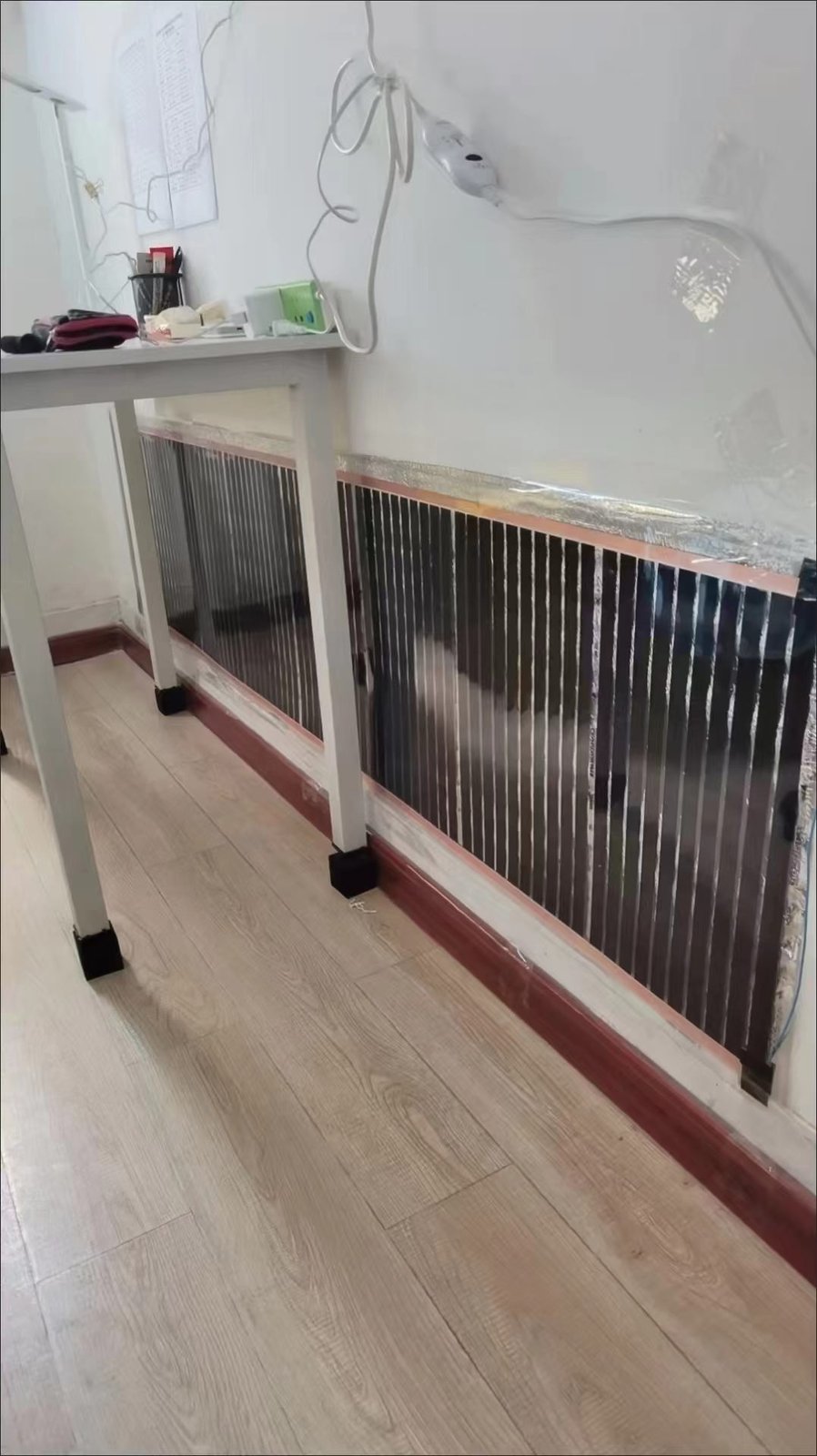
- You need local, zoned heat rather than whole-house heat. A panel behind a desk, above a headboard, below a window countering cold downdraft, or behind a dining chair heats exactly where a person sits.
- Silence matters. Bedrooms, nurseries, home offices, recording spaces, libraries. A fan heater fails this requirement immediately.
- EMF sensitivity or nursery use is a concern. Our fully shielded construction means a panel above a child’s bed is defensible, on the test data.
- You cannot run a flue or gas supply. Apartment blocks, listed buildings, inner-city conversions where the facade is protected.
- You want zero floor footprint. Small rooms, studios, accessible interiors where every m² of floor counts.
Do not choose the wall film when:
- You are building a house from scratch and can choose the floor. Hydronic underfloor heating paired with a heat pump will give you a lower running cost for a lifetime of continuous comfort. Run your heat-loss through the UFH sizing tool first and come back to wall film only for the zones UFH does not cover well.
- You are heating a very large, poorly insulated space in a severe climate. Our power density is 500 W/m² of wall. A 40 m² barn in a -15 °C winter needs 8–10 kW of heat, which is 16–20 m² of wall film — possible, but rarely the right call. You need a heat-loss survey and a system design.
- You need hot water as well as space heat. A gas combi boiler or a heat-pump cylinder is doing that job; a wall film only heats air and surfaces.
- You expect it to replace central heating in a badly insulated draughty Victorian house. It will improve the comfort of the rooms you put it in; it will not make the whole house warm. Insulate first, then zone.
- You want a single appliance to carry between rooms. An oil radiator or a portable convector is the better movable tool. Our panels are fixed to a wall.
The most useful framing we give distributors: treat the graphene home heating range as a room-level and zone-level product, not a whole-house product. Where it pairs with a primary system (a heat pump, a storage heater, a district loop), it removes the cold spots that the primary system cannot reach — under a window, behind a desk, above a bed. Where it stands alone (a studio, a home office, a spare bedroom, a rental bedsit), it is the primary system and it will do that job well on its own.
Frequently Asked Questions
Is a graphene wall heating film more efficient than a convection heater?
At the point of use, both are close to 100 % electric-to-thermal. The efficiency gap is in how the heat is delivered. A convection heater mixes warmed air, which rises to the ceiling and leaks out of the building envelope. A radiant wall film warms surfaces and people directly, so the room reaches a comfortable mean radiant temperature at a lower air setpoint. In practice, buyers running a 24-hour cycle on a well-insulated room often see the radiant panel use less electricity for the same perceived comfort, because there is no fan and no air-stratification waste.
Can a far-infrared wall heater replace gas central heating in my home?
For a small, well-insulated flat or studio, often yes. For a whole draughty house in a cold climate, probably not on its own. The right way to decide is to do a room-by-room heat-loss calculation, size panels per m² of wall available (we size up to 16 m² of heated room per 50 × 400 cm panel as auxiliary heat), and compare the resulting total wattage against your existing gas bill. If the room-by-room approach leaves some rooms undersized, pair wall film with a primary system rather than trying to force it.
Is a wall-mounted electric heater silent enough for a bedroom?
Yes, and that is one of the reasons we sell so many panels into bedrooms. There is no fan, no pump, no relay chatter from a wall film on its in-line thermostat. You can stand next to a running panel and not hear it. That is a structural difference from a fan heater, which is audibly moving air, and from a gas boiler, which cycles the burner and pump audibly several times an hour on a cold night. If you need a silent wall heater for bedroom use, a fanless radiant panel is the obvious category.
Do graphene wall heating films emit electromagnetic radiation in the bedroom?
Our XGF-WALLFILM is built as a fully shielded construction. The resistive layer is enclosed between insulating layers and the room-side field is suppressed to below measurable limits. That is not true of every generic carbon or PTC film on the market, many of which are unshielded and were designed for underfloor use, not for mounting 20 cm from a pillow. If EMF matters to you — nursery, pregnancy, EMF-sensitive household members — ask the vendor explicitly for the shielded construction and the test report. We provide ours.
How does a wall heating film compare to underfloor heating in a retrofit flat?
The wall film wins decisively on install disruption. Underfloor electric film still requires lifting the floor covering, routing a sensor wire, and re-laying the finish. Hydronic UFH requires a screed. A wall film fixes to an existing interior wall — drywall, plaster, tile, wood paneling, or wallpaper — in a couple of hours with tape and adhesive, and plugs into a normal socket. You can stay in the flat during installation. For a rental flat where you are not allowed to alter the floor, the wall film is usually the only compliant option.
Is plug-in radiant wall panel heating expensive to run in a home office?
A 250 W panel run for five focused working hours uses about 1.25 kWh. At typical EU residential electricity tariffs, that is a small fraction of the cost of running a 2 kW fan heater on High for the same period. The wall film behind the desk warms your feet, your legs, and the chair by radiation, so you can keep the room thermostat at a lower air temperature and still feel comfortable. That is the operating model that makes wall mounted electric heater for home office use cost-effective: zoned, intermittent, radiant, not whole-room convection.
Getting the Right Panel for Your Project
The five systems above each have a defensible place in a real building. Convection heaters belong in short-stay and budget situations. Oil radiators belong in movable-backup roles. Underfloor heating belongs in new-build comfort. Gas boilers belong in whole-house heating where the gas grid is cheap. Graphene wall heating film belongs in the gap those systems leave: retrofit rooms, rentals, bedrooms, nurseries, home offices, under-window cold spots, and any space where you cannot or should not wet-trade the floor or chase the walls.
If you are a distributor, installer, project specifier, or property manager, the fastest way to test this against your own room is to send us the dimensions, insulation level, and climate zone of the space you are sizing. Our factory engineers will map panel sizes — from a 60 W 30 × 50 cm aux panel up to a 1000 W 50 × 400 cm primary panel — against your heat-loss estimate, and quote you as a Request Wholesale Price that reflects the OEM and ODM flexibility we offer on cut lengths, plug standards, and controller styles. You can also browse the full product specification on the far-infrared wall heater page, see how other rooms have been installed in our case studies, or start a sizing conversation using the same heat-loss logic behind our underfloor heating calculator. Every buyer’s room is different. The right comparison is the one that ends with the right panel on the right wall.
Further reading: Wall Heating Film Applications collects the panel sizes, room types and layout rules for this graphene film.