
The containers nobody remembers to heat
Every winter the same obvious assets get attention: the heating system, the exposed pipes, the door seals. And every winter a quieter set of containers causes the most frustrating downtime — the 1,000 L IBC tote standing in the yard, the gas cylinder feeding an outdoor process, the bulk chemical bin, the rainwater and irrigation tank. These are large, awkward, often wheeled or moved, and almost never supplied with heating. When their contents freeze, thicken or lose pressure, the process they feed stops with them, and the improvised fixes — tarpaulins, space heaters, hot-water pours — work poorly or introduce new risks. A full-wrap heating blanket built for large containers protects the assets that standard freeze planning overlooks.
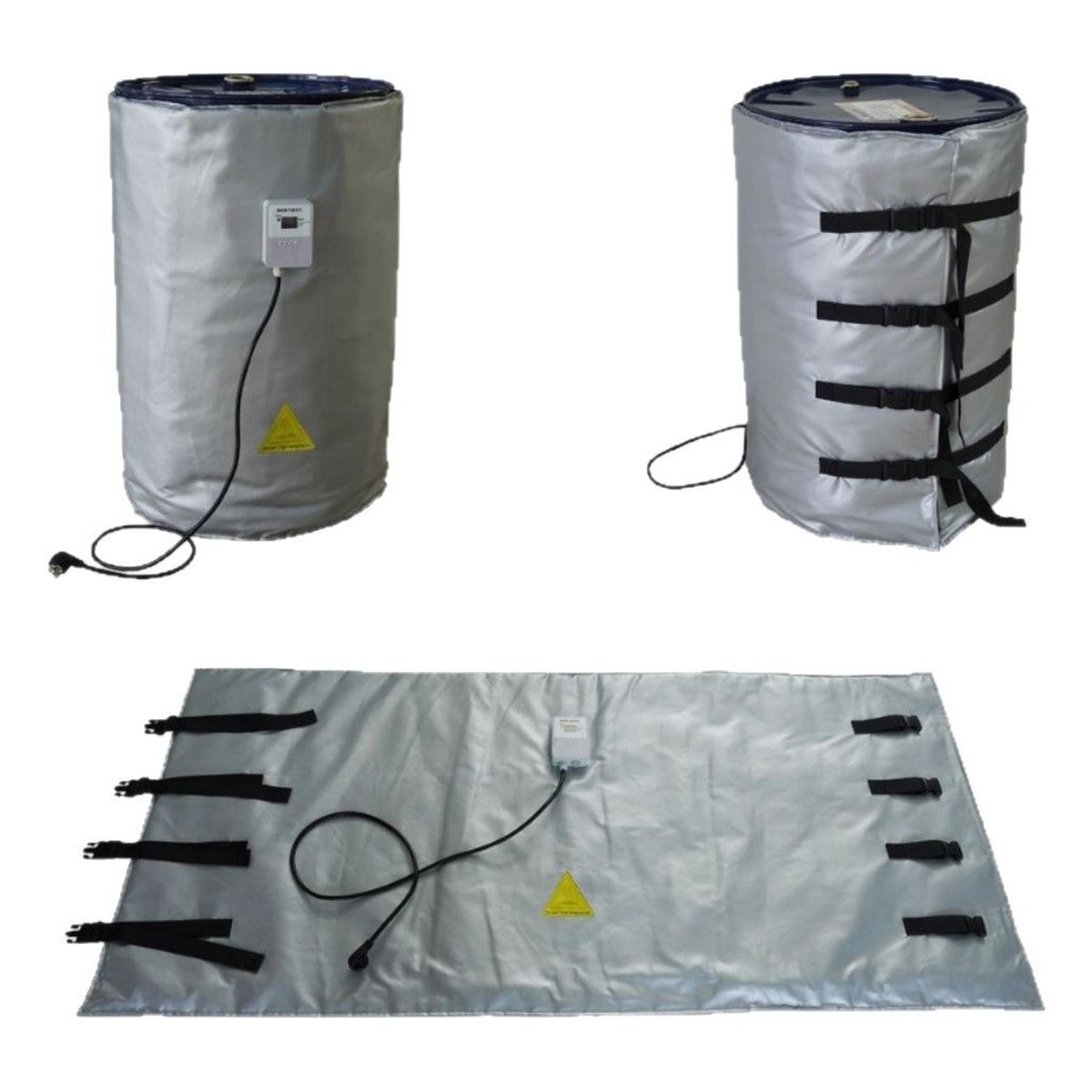
The same flexible heating technology used on 200 L drums scales up to these larger vessels. IBC jackets reach roughly 4,400×1,100 mm to wrap the full container, with or without a top cover, and the insulated, element-driven design holds the wall above freezing or at a process set point. For buyers who think of heating blankets only as drum accessories, the range of containers they can protect is wider than expected, and several of the most valuable uses are the ones that do not appear in a typical product catalogue.
Daniel Foster, Field Maintenance Adviser, SunAura Thermal
IBC totes: the most common overlooked container
The intermediate bulk container is everywhere in modern industry because it holds around 1,000 L on a single pallet, stacks and moves with a forklift, and costs little. Those same qualities make it hard to protect. A tote is a large plastic bladder inside a metal cage, often stored outdoors, and its contents — water-based chemicals, liquid fertilisers, detergents, food ingredients, process fluids — freeze or thicken as the temperature drops. The outlet valve at the bottom is the most vulnerable point and the hardest to thaw, and a frozen IBC cannot simply be brought indoors to recover. Heating a whole yard to protect a few totes is neither practical nor affordable.
A purpose-built IBC jacket wraps the container and applies even heat across the wall, with the element distributed in a uniform pattern and an aluminium reflective layer preventing hotspots. The thermostat reads the container surface, so the jacket holds the actual vessel at the set point rather than heating the surrounding air, and the insulation keeps the warmth against the wall. Jackets are made with or without a top cover depending on whether the tote is filled from above, and they strap on and off so the container can still be moved and the outlet accessed. For water-based products, simply holding the wall a few degrees above zero is enough to prevent a tonne of material turning solid.
Gas cylinders and pressure vessels
A less obvious application is the gas cylinder. The pressure and the vaporisation rate of many industrial gases depend on temperature; in cold weather a cylinder can fail to deliver the flow a process needs even though liquid product remains inside. Wrapping the cylinder with a controlled heating jacket maintains the temperature needed for consistent vaporisation and steady pressure, rather than letting the delivery rate fall with the weather. This is a specialist application that has to be matched to the gas type and the cylinder specification, with the controller holding a precise, limited set point and the appropriate safety certification in place.
Because pressure vessels are safety-critical, this is not a use for a generic heater. The jacket must be designed for the cylinder dimensions, the temperature range must stay within the limits specified for the gas, and the overheat protection and certification have to be confirmed at the order stage. Specified correctly, the jacket removes a weather-dependent variable from an outdoor process and keeps gas delivery stable through the coldest shifts. Buyers should always provide the cylinder type and the gas involved so the jacket and controller are engineered to the right limits.
Other containers that benefit from flexible heating
The principle extends to any large vessel whose contents are sensitive to cold. Outdoor storage tanks and bulk bins holding water, liquid fertiliser or process chemicals can be wrapped to prevent freezing and the expansion damage that comes with it. Rainwater harvesting and irrigation tanks, which are often left entirely unprotected, can be kept serviceable so pumps and valves are not drawing on a frozen reserve. Food-grade containers holding ingredients and concentrates can use the hygienic jacket specification to keep products fluid and pourable. In each case the heating is applied to the container rather than the space around it, which is what makes it practical for assets spread across a yard.
These larger jackets share the same construction as the drum range: a silicone-coated fibreglass or waterproof Oxford outer, a nickel-chromium element, an aluminium reflective layer, insulation and quick-release straps, with wattage selected for the larger surface area and the required hold temperature. Custom dimensions are the norm for IBC and tank work, and the available certification, the controller type and whether a top cover is needed should all be confirmed when the order is placed rather than adjusted on site.
Safety and specification for large containers
Large containers hold large volumes, so the safety margins matter as much as the heating capacity. Production jackets carry an IP44 splash-resistant rating, an overheat cut-out and protective earth, with insulation resistance of at least 500 kΩ and current normally kept below 16 A. Supplied through an RCD, they are designed for outdoor and damp locations, though the controller and plug should stay above standing water. Export versions are built for the destination voltage — 120 V, 230 V and other 110–380 V options — and carry CE and RoHS, with FCC or ETL on selected models. For gas and pressure work, the additional application-specific limits and certification take priority.
Sizing starts from the vessel and its contents: the container type and dimensions, the product and the temperature it must be held at, the lowest ambient temperature, and the supply voltage. A surface-mounted sensor keeps the wall at the set point, and a standard adjustable controller covers 0–145 °F while high-temperature variants reach further. Because the jackets are made to order, accurate dimensions and a clear note of valves, outlets, cages and top-fill requirements ensure the finished jacket fits and still allows the container to be operated.
Frequently asked questions
Can the IBC still be moved and emptied with the jacket on?
Yes. The jacket straps around the cage and is designed to leave the outlet valve and pallet access clear, so the tote can be forklifted and dispensed without removing it. A top-cover option is available separately if the tote is filled from above.
How much heat is needed just to stop a water-based tote freezing?
Only a few degrees above zero is required, so the wattage is driven by the container surface area and the lowest ambient rather than a high set point. The surface sensor and thermostat hold the wall just above freezing and cycle rather than running continuously.
Is heating a gas cylinder safe?
It is safe when the jacket is purpose-built for the cylinder and gas, with a limited, precise set point, overheat protection and the correct certification. It must never be attempted with a generic heater; the application-specific limits are confirmed at the order stage.
Can one jacket protect different containers?
A jacket is sized to a specific vessel, so it fits best on the container it was made for. The quick straps do allow some reuse across similar-sized totes, but large tanks and cylinders need their own dimensions and, for gas work, their own specification.
Related reading
The full specifications and reference price guide are on the drum heating blanket product page, with the wider family under industrial heating blankets. The full range of scenarios, including these less obvious ones, is collected in the applications guide, and for fixed pipework see our heat trace cable.
Next step
If outdoor IBC totes, gas cylinders or storage tanks are causing cold-weather downtime, send the container type and dimensions, the product inside, the lowest ambient temperature and the supply voltage. Our team will recommend a jacket, controller and set point within one working day, with the right certification for the application. Request a container layout or discuss custom jackets for an entire yard of vessels.