
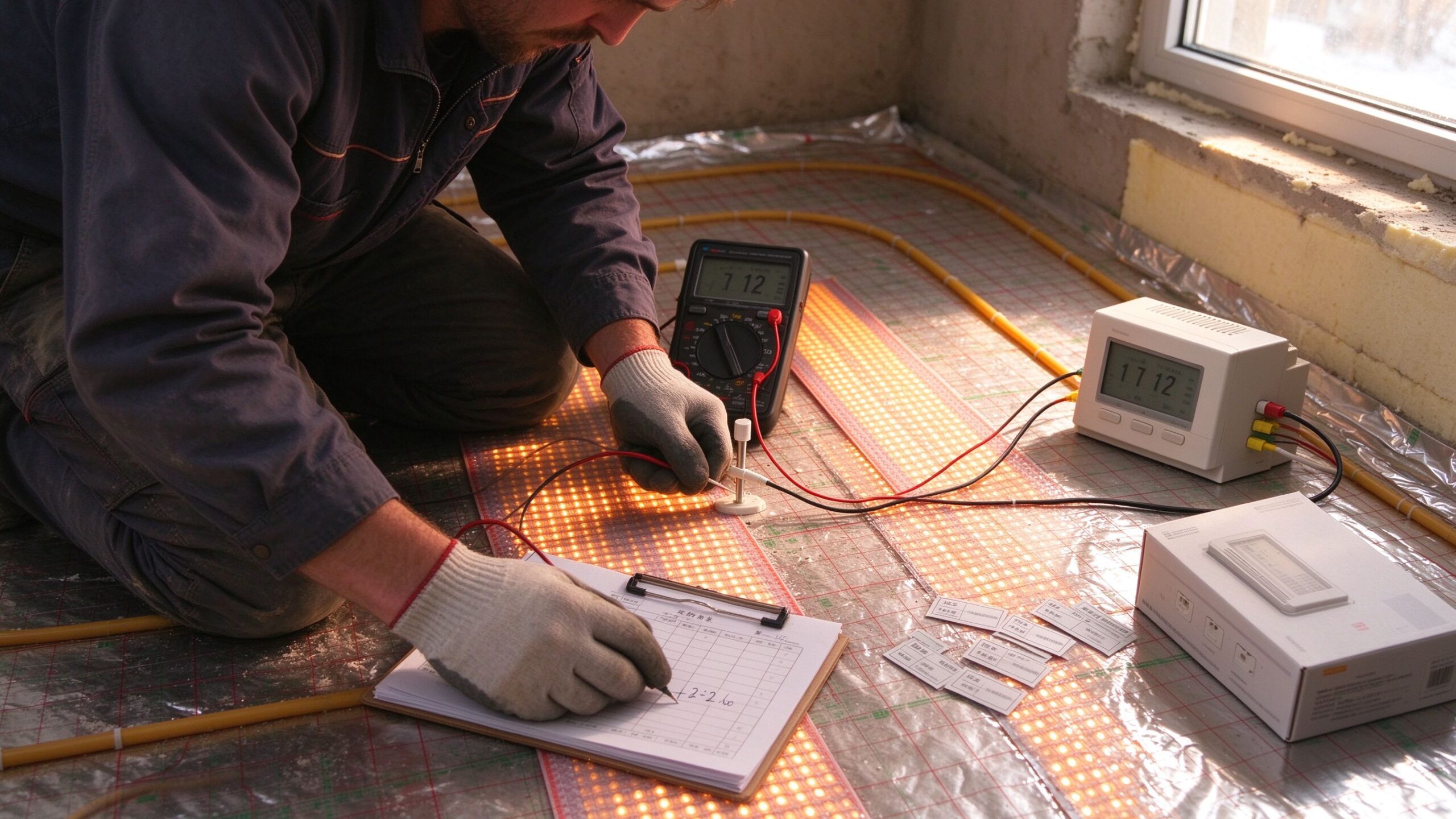
Underfloor Heating Warranty: What 10-, 20- and 25-Year Guarantees Cover, and the Checks That Keep Them Valid
A 25-year warranty on a heating cable reads like a guarantee that the floor will never fail. In practice it is a guarantee that the manufacturer will replace a tested-faulty element, once, if the installation matches the design, the controls are the approved ones, and the original invoice can still be found. The gap between what buyers assume and what the document says is where most disputed claims live.
This guide breaks down the warranty structures used across heating film, mat and cable, explains which failures are covered and which are excluded, gives the maintenance schedule that keeps a claim valid, and lists the clauses a B2B buyer should negotiate before signing a purchase order.
What a floor heating warranty actually promises

Almost all underfloor heating warranties on the European and North American market are product warranties, not installation warranties. The distinction matters:
- Covered: replacement of the element or thermostat if it is proven faulty in materials or workmanship, within the stated period.
- Usually not covered: labour to remove the floor covering, tile replacement, screed removal, refitting, loss of use, consequential damage, or the electrician’s time.
- Conditional: coverage depends on installation by a qualified or approved installer, use of the manufacturer’s thermostat or an approved equivalent, operation within the declared temperature and wattage limits, and evidence of the original purchase.
The number in the headline is therefore a measure of the manufacturer’s confidence in the element, not a promise about the total cost of a failure. For a buyer comparing two suppliers, the useful questions are how long the element is covered, how long the thermostat is covered, whether labour is included at all, and what the claim process requires in practice.
The three tiers on the market
10 years. Common for entry-level mats, thin film products and private-label ranges. It usually reflects a shorter design life or a thinner carrier rather than a different failure mode, and it is often paired with a 2-year thermostat warranty.
20 years. The mainstream figure for twin-conductor mats and quality cable systems sold through trade channels. It matches the design life assumption used in floor heating specification — a system that should outlast the floor it is buried under — and it is the tier most European distributors quote.
25 years. Usually applied to cable and film lines where the manufacturer controls the lamination and the element is fully encapsulated. Some suppliers offer it only on commercial projects with a commissioning report; others offer it on residential products with an online registration requirement.
A longer warranty is not automatically better value. If the 25-year product costs 60 % more than a 20-year equivalent and the failure rate of both is dominated by installation damage rather than element ageing, the extra five years buys very little. The meaningful comparison is the exclusions list, the spare-part commitment, and the response process.
Warranty by product type
| Product | Typical element warranty | Thermostat warranty | Common exclusions | What the period really reflects |
|---|---|---|---|---|
| Heating mat (twin conductor) | 10–20 years | 2–3 years | Installation damage, wet junction, non-approved thermostat | Mat construction and junction sealing |
| Heating cable (screed) | 20–25 years | 2–3 years | Field termination faults, screed damage during later works | Fully encapsulated construction |
| Heating film | 10–20 years | 2–3 years | Edge connector water ingress, covering overheat, cut film | Lamination quality and edge sealing |
| Thermostat | 2–3 years | — | Voltage surge, water ingress, incorrect probe, battery leakage | Electronics, not heating element |
| Floor probe | 2–5 years | — | Damage during tiling, non-replaceable conduit | Sensor and cable integrity |
The thermostat column is the one buyers consistently underestimate. A 25-year element warranty paired with a 2-year thermostat means the control — the part most likely to fail first — is outside cover for 23 of those years. When a thermostat fails in a way that leaves the element energised continuously, the resulting floor damage is usually excluded as consequential.
What voids a warranty
These exclusions appear, in some form, in nearly every document. They are the clauses worth reading before purchase, not after a failure.
Installation outside the approved method. Cutting a mat to fit a corner, modifying a cold tail, extending a cable with a junction box not supplied by the manufacturer, or laying film under a covering that exceeds the declared thermal resistance. Any of these can void cover for the whole circuit, not just the modified section.
Operating above the declared limits. Running a 160 W/m² film at full output under a high-tog rug, or setting the thermostat to 35 °C because the room feels cold, produces element temperatures the product was not designed for. Records from the thermostat are now routinely requested in claims, which makes this exclusion easier to enforce than it used to be.
Unapproved controls. A thermostat with the wrong probe resistance reads the floor temperature incorrectly; the resulting over-heating is treated as an installation error. Some manufacturers allow any thermostat that meets the switching specification, others require their own. The difference is a clause, not a technicality.
Damage after handover. Tiling tools, a dropped tile, a drill through the floor for a doorstop, or a plumber cutting into a screed for a new drain. Fixing a damaged element is not usually covered, although many manufacturers offer a repair service at cost.
Water at a junction. Wet-area failures cluster at terminations. If the waterproofing was installed below the mat rather than above it, or the junction sits in a washdown path, the claim is likely to be refused as an installation defect.
Electrical events. Lightning, voltage surges and supply faults are excluded by most policies. In regions with unstable supply, a surge-protection device at the circuit is a cheap way to keep the warranty argument out of the conversation.
Commercial use on a residential warranty. Some consumer products exclude commercial installations entirely. A café, a clinic or a holiday let may fall outside a “domestic use” definition, and buyers should confirm which warranty applies before the product is specified.
Missing registration or invoice. Registration windows are common — 30 to 90 days from installation — and a claim without the original invoice and commissioning record is usually rejected on documentation rather than on merit.
The maintenance schedule that keeps a claim valid
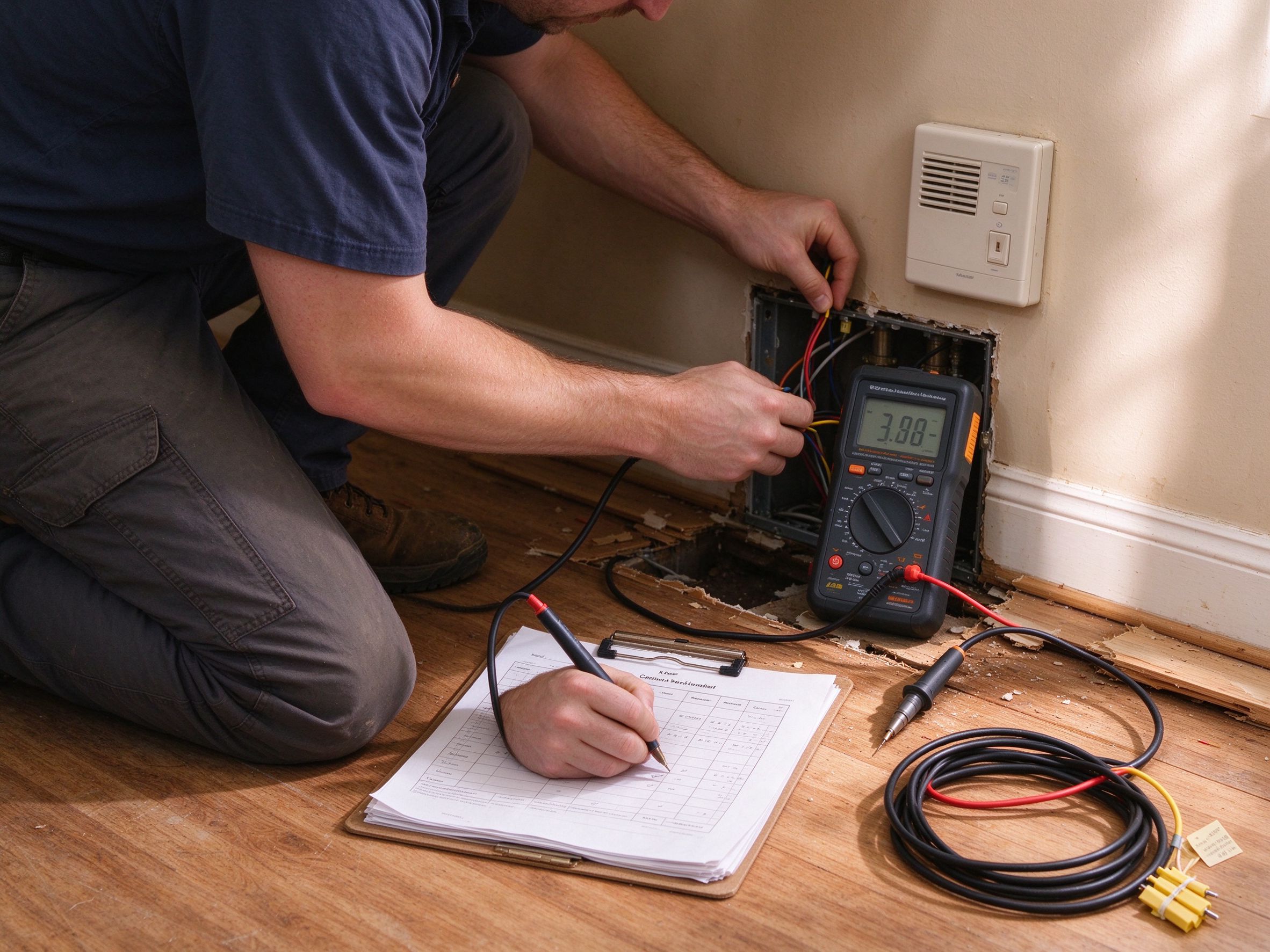
Most warranties require the system to be maintained and to remain within its operating envelope. That translates into a short, practical schedule:
Annually. Compare the thermostat’s displayed floor temperature with an independent reading at the same location. A drift of more than 1 °C suggests a failing probe, which is a cheap fix if caught early. Check the thermostat’s clock and schedule after any power interruption. Confirm that rugs, mats and furniture have not been moved onto a heated zone in a way that traps heat.
Every two years. Measure insulation resistance at the circuit with the element isolated, and compare it with the commissioning value. Measure circuit resistance and compare with the design value; a drift beyond about 10 % indicates conductor damage or a degrading joint. Record both readings in the building log.
Before any building work. Isolate the heating circuit, photograph the floor, and re-test after the work. Most element damage happens during later trades, and a test immediately before and after is what separates a warranty claim from an argument.
After any event. Water ingress, a tripped RCD, a floor that feels cold in one area, or a breaker that trips repeatedly. Test before changing anything, because the test result is the evidence.
The numbers to record and compare
Two measurements carry almost all warranty decisions.
Circuit resistance. Measured at the cold tail with a four-wire or compensated meter, compared with the design value printed on the element label. A 5 % deviation is within instrument and temperature tolerance; 10 % is a flag; an open circuit is a break. Record the ambient temperature with the reading, because resistance moves with temperature.
Insulation resistance. Measured between the conductor and the earth screen at the test voltage specified for the product — commonly 500 V DC for mains-voltage elements — after the element has been isolated. The pass value is the one in the product documentation, typically in the low megaohm range or higher; a reading that falls sharply from the commissioning value is the early warning that moisture has reached a junction. Never test at a higher voltage than the manufacturer specifies, and never test a wet-area element while the assembly is saturated.
Both values belong in the commissioning report and in the warranty registration. A buyer who receives neither should treat the warranty as marketing until proven otherwise.
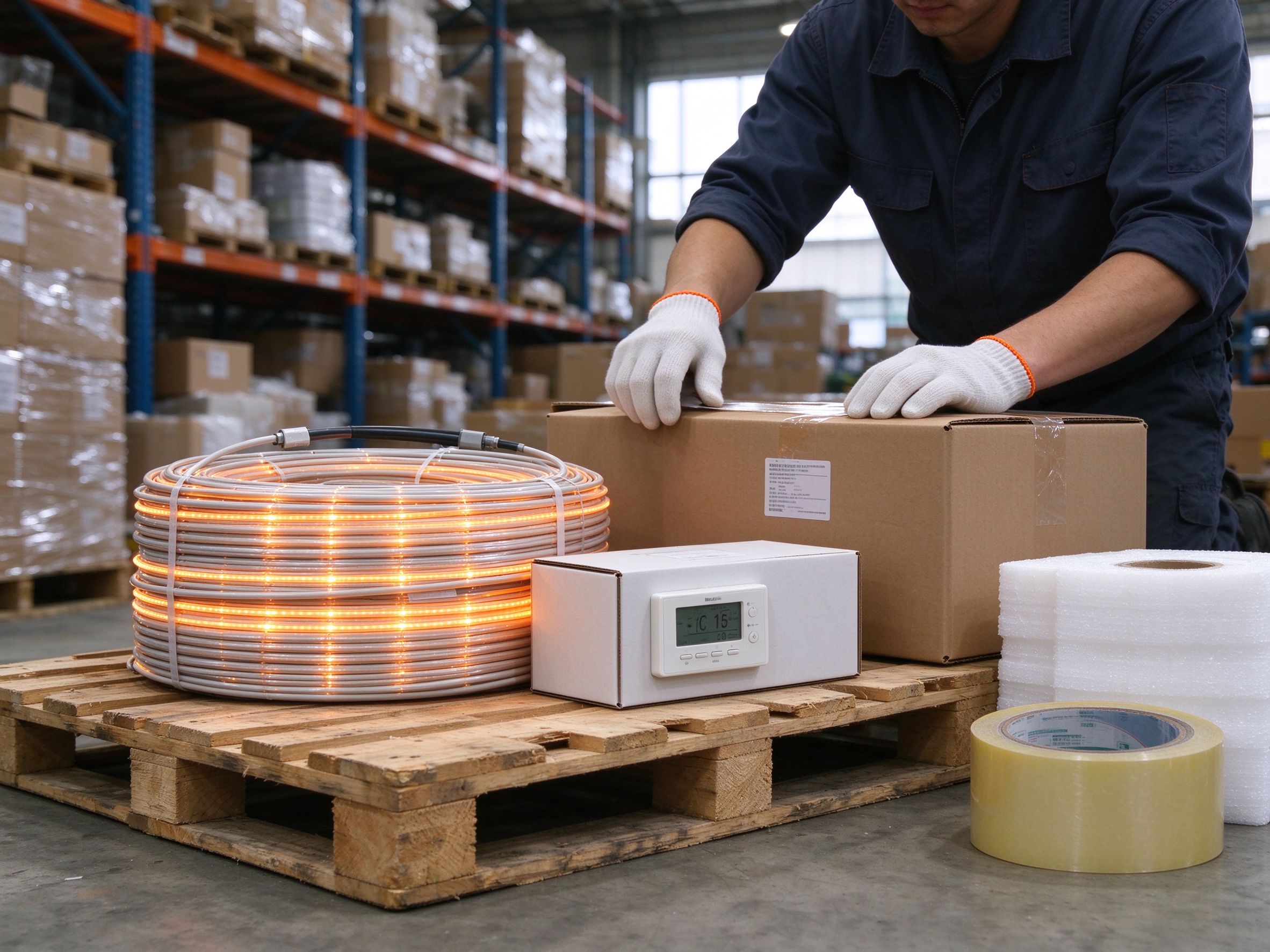
Buying from overseas: how warranty works across borders
For a distributor or contractor sourcing from a manufacturer in another country, the warranty question changes shape. The element may be covered for 20 years, but the practical question is what happens when one fails in a building 8,000 km away.
Four terms decide whether an international warranty is usable:
- Replacement-first or return-first. A supplier that ships a replacement against a test report and a photograph keeps a project moving; a supplier that requires the failed unit back before shipping anything adds weeks to a small claim.
- Spare-part availability in years. A 20-year element warranty is meaningless if the specific mat size or thermostat model is discontinued after four years. Ask for a written spare-part commitment, and buy a small stock of thermostats and probes for any project you intend to maintain.
- Who performs the diagnosis. Cross-border claims usually require a local electrician’s test report in a specified format. Ask for the format before the project starts, not when a claim arises.
- Freight and duty on replacements. Clarify who pays. A warranty replacement that arrives with a duty bill is a warranty that costs money.
What to ask before you sign a purchase order
- Element warranty period, and the exact start date — invoice, delivery or commissioning.
- Thermostat and probe warranty period, stated separately.
- Whether labour, floor covering and refitting are covered, and if not, whether a labour allowance exists.
- The full exclusions list, in writing, not a summary.
- Whether the warranty is transferable if the building is sold.
- The registration requirement and deadline.
- Required commissioning documentation, and the accepted test method.
- Claim process, response time, and who performs the diagnosis.
- Spare-part availability commitment in years, per product family.
- Cross-border terms: replacement-first or return-first, freight and duty responsibility.
- Commercial-use cover, if the project is not a dwelling.
- Surge and water-ingress positions, since these are the two most common real-world failures.
Five warranty myths
“25 years means it will not fail for 25 years.” It means a tested-faulty element will be replaced within 25 years, subject to conditions. Design life and warranty period are different numbers.
“The warranty covers the repair.” Most cover the part only. Removing tile and refitting it can cost more than the element.
“I can extend the cable myself.” Field modifications are the single most common reason a claim is refused. Terminations belong to the manufacturer’s specified method.
“A failed thermostat is the manufacturer’s problem after two years.” After the thermostat period, it is the owner’s. Keep a spare thermostat for critical spaces.
“The invoice is enough.” Claims increasingly require commissioning records and, for wet areas, evidence of waterproofing and bonding. Paperwork is part of the product.
Which warranty structure fits your project
A single dwelling with a bathroom mat: 10-year element plus 2-year thermostat is adequate, provided the installer records resistance and insulation values and the owner keeps the paperwork. A whole-house electric floor: 20-year element, 3-year thermostat, transferable cover, and a spare thermostat held on site. A commercial project — hotel, clinic, retail, wet area — should be specified with a 20–25 year element, commercial-use cover confirmed in writing, a commissioning report per circuit, and a spare-parts stock. A cross-border distribution programme: replacement-first terms, a written spare-part commitment, and a standard claim form agreed before the first shipment.
Data and evidence
SunAura factory records: heating element manufacturing at the Qingdao Huangdao plant since 2008 (17 years of production), ISO 9001 / ISO 14001 / ISO 45001 certified management systems, CE / RoHS / LVD / EMC conformity across film, mat and cable lines, export to more than 50 countries. Each circuit is resistance-tested and insulation-tested before packing, and the batch record is retained so a field measurement taken years later can be compared with the original value. Warranty terms are issued per product family with element and thermostat periods stated separately, and the exclusions list is supplied with the commercial documents rather than only with the consumer leaflet.
External reference framework: IEC 60364 for electrical installation and insulation testing practice, EN 1264 for floor heating design and surface temperature limits, and the product standard for flexible sheet heating elements (IEC 60335-2-96) for the construction and test regime behind the declared life. Values quoted are the ranges commonly used in the market, not certificate numbers.
FAQ
How long is underfloor heating supposed to last? A correctly specified and installed electric floor is designed for the life of the floor, commonly 20–25 years. The bath mat or thermostat may need replacement sooner, and installation damage is the most common cause of early failure.
Does the warranty cover the tiling? No, in almost every case. Tile, screed, adhesive and labour to reinstate are owner costs. A few suppliers offer a labour allowance; it should be in the document, not in the sales conversation.
Can I claim if the thermostat was bought elsewhere? Usually no, unless the manufacturer permits approved third-party controls. The probe resistance and switching specification have to match, and the records have to show which device was installed.
Is the warranty transferable when I sell the house? Some are, some are not. If transferability matters, it has to be confirmed in writing at purchase; it is rarely added later.
What voids a warranty fastest? A modified termination, a cut mat, or a floor run above its declared surface temperature. All three are detectable from photographs and thermostat logs.
Next step
If you are specifying a system, start with the expected service life in the underfloor heating lifespan guide, then fix the control package — the K5 floor probe thermostat page lists probe types and switching ratings, and the floor probe calibration guide explains how to verify the reading the warranty depends on. For cable-based projects, the heating cable range includes encapsulated constructions with factory terminations. If a circuit has already failed, work through the troubleshooting sequence before contacting anyone: the test results you collect are what the claim will be judged on.
Ethan Sun, Founder & CEO, SunAura Thermal