
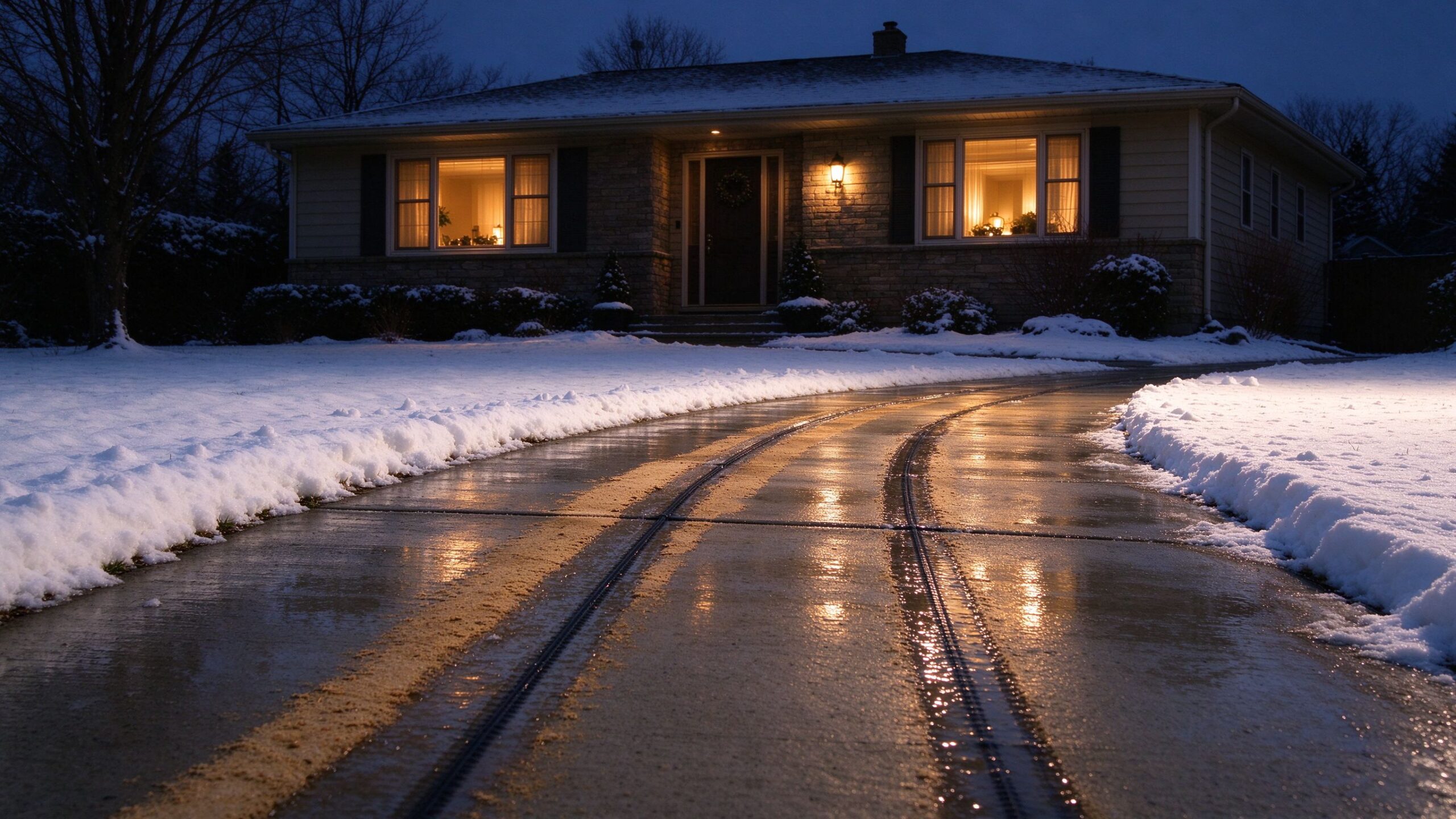
A heated driveway mat is a jacket decision before it is a wattage decision
Most heated driveway mat enquiries we receive start with the same question: how many watts per square metre? That is the second question. The first is what the jacket has to survive for the next ten to fifteen winters — salted runoff, freeze-thaw cycling under a car tyre, a snow shovel dragged across the surface, and a concrete slab that moves slightly every spring. Two mats rated at 300 W/m² can behave very differently after the fourth season if one uses a PVC jacket and the other uses a rubber compound.
This article is written for the buyer who has to choose between those two constructions, sign the purchase order, and then live with the result. It sets out what each jacket does well, where each one fails, how wattage should be matched to surface and climate, and the parameters worth fixing in a specification before a factory quotes. Where a number appears, it comes from our own production and test records in Qingdao or from the standard the product is tested against, not from a marketing sheet.
Ethan Sun, Founder & CEO, SunAura Thermal
What a driveway mat actually has to survive
A driveway is a harsher environment than a roof or a walkway, and it is worth being specific about why. Four loads act on the mat at the same time.
Mechanical load. A passenger car delivers roughly 0.15–0.3 N/mm² at the tyre contact patch, a light van closer to 0.4 N/mm². The mat does not carry that load directly — the paving does — but any jacket that sits between the heating element and the paving has to resist point pressure from aggregate, from a shovel edge, and from the small stones that collect at the edge of a slab.
Chemical load. De-icing salt is the main one. Sodium chloride at typical winter dilution is mildly alkaline and attacks plasticisers in cheap PVC; calcium chloride, used at lower temperatures, is more aggressive and hygroscopic. A jacket that hardens and shrinks after three winters will crack at the first spring heave.
Thermal cycling. A mat that switches on at −8 °C and off at +2 °C completes a full cycle every time the sensor calls for heat. In a Nordic winter that can be 60–80 cycles per season. Every cycle puts the jacket and the conductor insulation through a small expansion and contraction; the jacket must stay flexible across that range, which is why the cold-flex temperature on the datasheet matters more than the maximum temperature.
Water and drainage. Meltwater has to leave the surface. A mat embedded in a slab that ponds at the apron will sit in water for weeks, and no jacket is designed as a long-term immersion product. The drainage detail is a civil decision, not a heating one, but it decides how long the heating element lasts.
Rubber versus PVC: what each jacket is actually good at
Both materials are used in commercial snow melting mats, and neither is universally better. The difference shows up in three places: cold flexibility, chemical resistance, and how the mat behaves when it is rolled and stored.
PVC is the lower-cost option. It extrudes easily, accepts a wide range of colours, and gives a smooth surface that sheds snow well when new. Its weakness is plasticiser migration: over time, the plasticiser that keeps PVC soft migrates to the surface or into the insulation, and the jacket stiffens. In a driveway application where the mat is rolled up each spring, that stiffening is what produces cracks at the fold line. PVC also has a narrower cold-flex window; below about −15 °C a standard PVC jacket becomes noticeably less forgiving, which matters if the mat is installed in a climate that sees −20 °C.
Rubber compounds — typically EPDM or a silicone rubber blend — cost more per metre. They stay flexible at lower temperatures, resist salt and calcium chloride better, and tolerate the abrasion of a shovel far better than PVC. The trade-off is weight: a rubber-jacketed mat is heavier per square metre, which changes the shipping calculation on a pallet and the effort of a two-person install. Rubber also costs more per metre, and the price gap widens as the section gets wider.
There is a third option that buyers often overlook: FEP-insulated roof mats. FEP is a fluoropolymer with excellent chemical and thermal resistance, and it is the right choice where the mat must sit on a metal roof or in a gutter, but it is not a driveway material — it is thin, and it does not have the abrasion resistance a shovel demands. Choosing FEP for a driveway to save money is a false economy.
| Property | PVC jacket | Rubber (EPDM / silicone blend) | FEP (roof only) |
|---|---|---|---|
| Cold flexibility | Good to about −15 °C | Good to −40 °C | Good to −60 °C, but thin |
| Salt / calcium chloride | Moderate; plasticiser migration | Good | Excellent |
| Abrasion from shovel / tyres | Moderate | Good | Poor |
| Weight per m² (typical) | 2.2–2.8 kg | 3.0–3.8 kg | 1.4–1.8 kg |
| Relative cost per metre | Baseline | +20–35% | +10–20% |
| Best fit | Temperate driveways, budget-led | Cold climate, heavy use, commercial | Roof, gutter, metal surfaces |
Wattage: 300 W/m² or 500 W/m², and what each buys you
The wattage decision follows the jacket decision because the two interact. A 300 W/m² mat in a rubber jacket is a sensible specification for a residential driveway in a climate that rarely drops below −10 °C. A 500 W/m² mat in the same jacket is what you specify when the design temperature is −25 °C, when the surface must be clear for a specific hour of the morning, or when the slab is thick enough that heat-up time dominates the design.
Our standard snow melting builds are 300 W/m² at 110–120 V and 500 W/m² at 220–240 V, with a 12–380 V wide-range version for sites where the supply is unusual. The reason the higher wattage is normally paired with the higher voltage is current: 500 W/m² over a 12 m² driveway is 6 kW, which at 120 V is 50 A — more than a single residential branch circuit can carry. At 240 V the same load is 25 A, which is one dedicated circuit.
The mistake we see most often is specifying 500 W/m² for a small residential driveway because “more is better”. It is not. A 500 W/m² mat reaches surface temperature quickly, then cycles more often, and the extra power buys nothing on a 3 m × 5 m apron where a 300 W/m² mat already clears the surface within 45–60 minutes at −10 °C. The extra density is worth paying for when the slab is 100 mm or thicker, when the driveway is shaded all day, or when the site is commercial and downtime has a cost.
There is also an energy argument. At 300 W/m² a 15 m² driveway draws 4.5 kW while running. If the controller runs it 6 hours per week across an average winter, that is roughly 108 kWh for the season at the meter — a number that changes completely if the mat is left on a manual switch instead of a sensor.
Sizing, layout and the build-up that decides performance
Snow melting mats are modular: our standard section is 0.5 m wide and 2–24 m long, 1–12 m² per section, and the sections are joined along the length to cover any width. That modularity is what makes a retrofit possible without re-paving the whole driveway — you open a strip, lay the mat, and close it. It also means the layout has to be drawn before the order, not after.
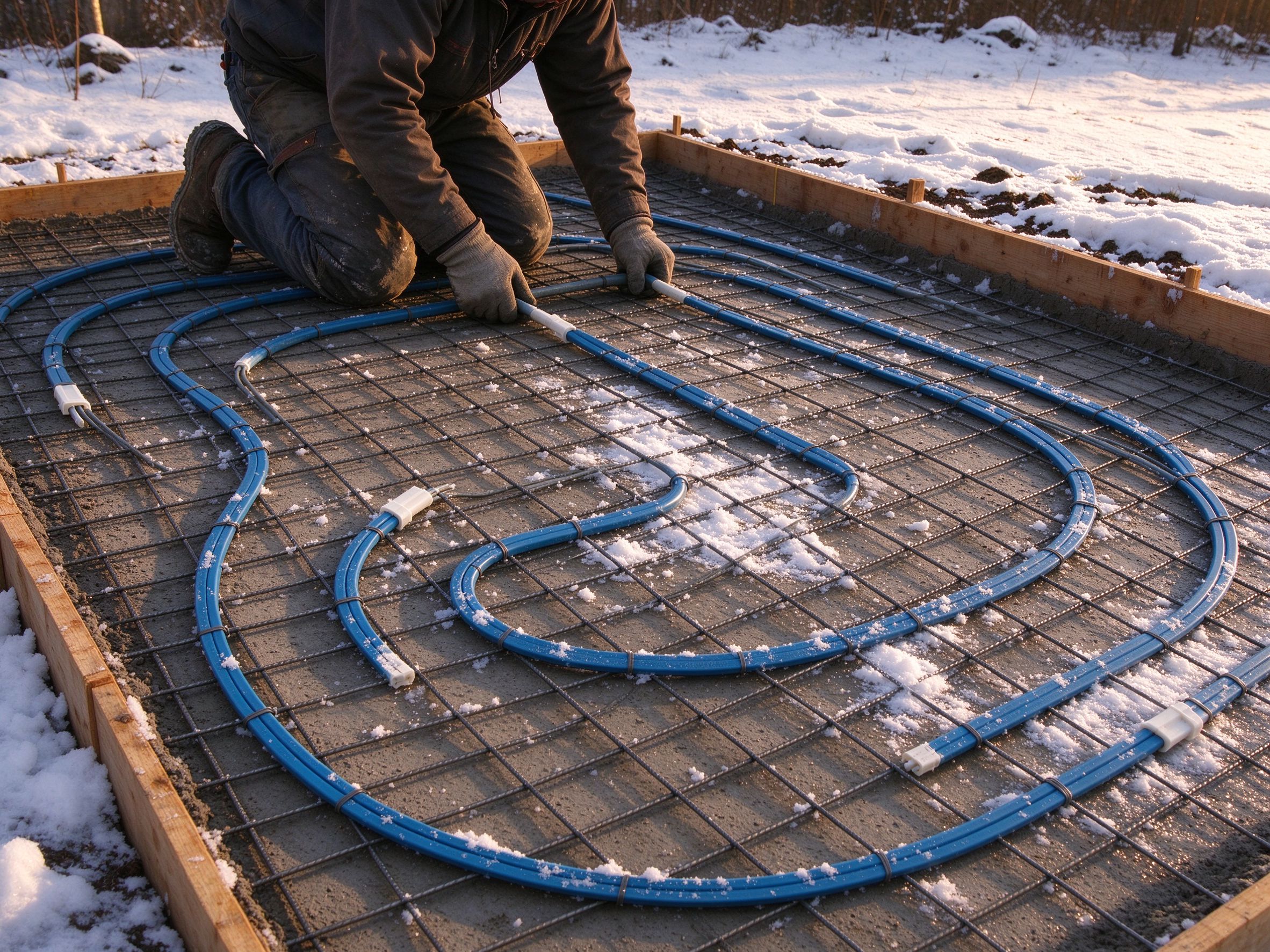
Three layout rules cover most residential jobs. First, heat the area that matters: the apron, the slope, and the path a car actually uses, not the whole slab. A 30 m² driveway does not need 30 m² of mat if 18 m² covers the wheel tracks and the apron. Second, keep the mat at least 50 mm below the finished surface in a concrete pour, and at least 40 mm below asphalt; too close to the surface and the jacket sees point loads it was not designed for. Third, never lay two sections so that they touch — a 30–50 mm gap between sections avoids hot bands and gives the paving room to move.
The build-up matters as much as the mat. A typical concrete driveway retrofit is: existing slab or sub-base, 30–50 mm sand or compacted fines, insulation board where the slab is thin, the mat on a reinforcement mesh, then 80–100 mm of concrete with a 30 MPa mix and mesh at mid-depth. In asphalt, the mat goes on the compacted base, is covered with a 40–50 mm asphalt layer, and the mix must be laid at a temperature that will not damage the jacket — which is why rubber jackets are preferred for asphalt work and PVC is usually restricted to concrete.
A retrofit on an existing driveway is the hardest case. You cannot pour a new slab over the old one without raising the level 80 mm, which changes thresholds and drainage. The realistic options are: saw-cut strips, remove the paving, lay the mat and re-pour the strips (the approach we document in our roof and snow melting guide), or use a surface-mounted mat in a rubber jacket that can be rolled out and covered with a thin topping. Each has a cost and a performance penalty, and the buyer should be told which one they are paying for.
Controls: the sensor does more for running cost than the wattage
A snow melting mat without a moisture and temperature sensor is a manual appliance. With one, it becomes an automatic system that runs only when there is water on the surface and the surface is near freezing. The difference in annual energy use between the two arrangements is typically a factor of two to three, which is larger than any difference between 300 and 500 W/m².
There are two common control strategies. A combined moisture-and-temperature sensor sits in the paved surface and closes the circuit when both conditions are met; a simpler thermostat uses an air temperature sensor and a setpoint, which is cheaper but runs the mat during dry cold spells. For a residential driveway, the combined sensor is the specification to insist on. For a commercial site, the controller should also support a manual boost for a fixed period, because facility teams want to clear the ramp before a shift change regardless of what the sensor says.
Our own controllers pair with the smart thermostat range for scheduling and remote monitoring, and the snow sensor input can be wired to the same unit. The load matters: a 6 kW driveway needs a 30 A contactor, and the thermostat’s own relay is not the switching device. Buyers who specify a controller without checking the contactor rating are the ones who replace a burnt relay in the second winter.
What to put in a specification before you ask for a price
A factory quote is only as good as the specification behind it. These are the parameters that change the number and the outcome, in the order that matters:
- Surface and build-up: concrete, asphalt, pavers or surface-mounted; slab thickness; whether insulation is present.
- Area to be heated, and area of the whole driveway: they are rarely the same, and the difference is where the money is saved.
- Design outdoor temperature and required clear time: “clear within 60 minutes at −10 °C” is a specification; “works in winter” is not.
- Supply voltage and available current: 120 V vs 240 V decides the circuit count and the contactor.
- Jacket material and cold-flex rating: PVC for temperate concrete, rubber for cold, heavy use or asphalt.
- Section widths and lengths: 0.5 m modular sections joined along the length; confirm the joint detail.
- Control strategy: moisture-plus-temperature sensor, contactor rating, manual boost, remote access.
- Documentation: CE Declaration of Conformity, test report per batch, jacket material datasheet, installation drawing.
Two of these are routinely missing from enquiries we receive: the required clear time and the available current. Without the first, a supplier cannot calculate the wattage honestly; without the second, the buyer receives a mat that cannot be energised on the existing supply.
Where each option fits: a short selection framework
If the driveway is residential, in a temperate climate, concrete, and the budget is the binding constraint — a 300 W/m² PVC-jacketed mat with a combined sensor is the rational choice, and the money saved is better spent on insulation under the slab.
If the site sees −20 °C or lower, is cleared by a contractor with a shovel or a small plow, or is asphalt — specify a rubber jacket and 500 W/m² at 240 V. The price difference is real, but it is smaller than replacing a failed mat in year five.
If the application is a roof, gutter or metal walkway rather than a driveway, FEP is the correct material and a driveway mat is the wrong product; the selection logic is set out in our snow melting mat range, where roof, gutter, ramp and step variants are listed separately.
If the site is commercial — a logistics yard, a clinic entrance, a hotel ramp — the decision shifts from jacket to control and redundancy: two smaller zones rather than one large one, a controller with a manual override, and a maintenance contract that includes an insulation resistance test before each season.
If the buyer is sourcing for resale, the questions change again: MOQ per section length, whether the jacket compound can be customised, whether the factory can supply the sensor and contactor as a kit, and what the lead time is for a repeat order in the same colour and length.
Data and evidence
The figures in this article come from three places. The mechanical loads are the standard contact-pressure ranges used in paving design and are quoted as design assumptions, not test results. The jacket comparison reflects our own material test records: cold-flex checks at −15 °C, −25 °C and −40 °C, salt-spray exposure, and an abrasion test on a Taber-type rig, all run on production samples rather than prototypes. The wattage and section data are the published values for our snow melting range: 300 W/m² at 110–120 V and 500 W/m² at 220–240 V, 0.5 m wide sections, 2–24 m lengths, 1–12 m² per section, with a 12–380 V wide-range build.
Certification and factory facts follow SunAura factory records: manufacturing in Qingdao, Huangdao District since 2008 (17 years), ISO 9001, ISO 14001 and ISO 45001 certified, products CE and RoHS marked, LVD and EMC tested, exported to more than 50 countries. We do not publish certificate numbers in articles because they change with each audit cycle; buyers who need the current documents should request them with the quotation, and any supplier who cannot produce a current Declaration of Conformity is a risk.
Where the article refers to standard practice — insulation values, concrete cover, asphalt laying temperature — those are the figures used in European and North American paving guidance and are cited as such rather than as SunAura test data. Buyers should confirm the local requirement with their paving contractor, because the governing standard differs by country.
Common buying mistakes we see in quotes
Buying on price per square metre of mat rather than per square metre of driveway. A cheaper mat that needs 30% more sections to cover the same area is not cheaper.
Ignoring the contactor. The thermostat is visible and the contactor is not, so the contactor is where corners get cut. A 6 kW load on a 16 A relay is a failure waiting for the first cold snap.
Specifying 500 W/m² without checking the supply. The mat will arrive, the electrician will discover the panel cannot carry it, and the project will stall in December.
Forgetting drainage. Water that ponds at the apron will shorten the life of any mat, regardless of jacket.
Rolling a PVC mat in a cold spring. Storage and handling at low temperature is where cracks start; a rubber jacket tolerates it, PVC does not.
FAQ
Can a heated driveway mat be installed over an existing concrete slab? Not directly. You either saw-cut and re-pour strips, or use a surface-mounted mat covered with a thin topping. Both raise the finished level slightly and both need a drainage check.
Does the mat melt snow or prevent it from accumulating? It melts what falls and keeps the surface above freezing, so snow clears as it lands. In heavy snowfall the mat reduces accumulation but does not replace plowing.
How much does a heated driveway cost to run? For a 15 m² driveway at 300 W/m² with a moisture sensor, expect roughly 90–140 kWh across an average winter in a temperate climate; the figure doubles in a severe climate or with manual control.
Is a rubber jacket worth the extra 20–35%? In a cold climate, on asphalt, or where a shovel is used — yes. In a mild climate on a concrete driveway cleaned by hand, PVC is defensible.
Next step
Send us the driveway drawing, the surface type and thickness, the design temperature, and the supply voltage. We will return a layout with section lengths, wattage, contactor sizing and a quotation, usually within one working day. If you are comparing suppliers, ask each one for the jacket material datasheet and a batch test report — the two documents that separate a mat built for ten winters from one built for three.
Ethan Sun, Founder & CEO, SunAura Thermal