
Why cable geometry decides how long a floor heating system lasts
Almost every heating cable failure we examine in our warranty lab comes back to the same two drawings: the loop layout and the detail at the bend. Not the polymer, not the conductor alloy, not the thermostat. A twin conductor cable rated at 20 W/m and 25 years will still fail inside four winters if it is pulled around a 12 mm corner, crossed over itself in a screed, or spaced so tightly that two runs touch under a tile.
This article is written for the people who draw those layouts and price them: installing contractors, electrical designers and buyers sourcing cable for a project. It sets out the numbers we publish on our own datasheets, the spacing bands that work in real screeds, and the questions to ask a supplier before a bulk order is confirmed. If you are comparing a mat, a film and a cable for the same room, the geometry argument in sections 2 and 3 is the part that decides whether cable is the right answer at all.
Ethan Sun, Founder & CEO, SunAura Thermal
What “minimum bend radius” actually means on a heating cable
The figure on a datasheet is not a manufacturing tolerance. It is the smallest radius the cold lead, the splice and the heated section can survive without thinning the insulation wall or displacing the conductor inside the jacket. Three different values usually appear in one document, and buyers who read only the first number get caught out:
- Heated section: typically 5–6 times the outer diameter. A 6.5 mm twin conductor cable therefore bends to roughly 33–39 mm without stress.
- Cold lead and splice: the factory-sealed transition is stiffer. We specify 8 times the diameter, about 52 mm, and the splice must stay straight for at least 50 mm on each side.
- At installation: the number that matters is the radius you can hold while the cable is cold and being pushed into a corner, not the radius it settles to afterwards.
A cable bent below its minimum radius does not fail immediately. The insulation is compressed on the inner side of the bend and stretched on the outer side. That stretched wall becomes the weakest point in the circuit, and it is where insulation resistance starts to drift downward two or three seasons later, usually after the floor has been heated and cooled a few hundred times.
Spacing bands that work in real screeds
Spacing is the other half of the geometry. The industry convention is to size cable by watts per square metre of heated area, then translate that into a centre-to-centre distance. The arithmetic is simple, but the tolerances are not generous: a 20 W/m cable at 150 W/m² needs 133 mm centres, and if the installer drifts to 110 mm in one corner that corner runs at roughly 180 W/m².
| Output | Cable | Target W/m² | Centres | Where it is used | Risk if compressed |
|---|---|---|---|---|---|
| 20 W/m | NHHC-01 twin conductor | 100–120 | 165–200 mm | Renovation, low heat loss rooms, supplementary heat | Low; the cable can be spaced wider without hotspots |
| 20 W/m | NHHC-01 twin conductor | 150 | 133 mm | Standard tile floors in insulated new build | Moderate; below 110 mm the local flux climbs fast |
| 20 W/m | NHHC-01 twin conductor | 180–200 | 100–110 mm | Bathrooms, small wet rooms, fast dry-out | High; never below 100 mm in cement screed |
| 40 W/m | NHHC-07 snow melting | 250–300 | 130–160 mm | Driveways, ramps, loading bays | High at edges; keep 150 mm from kerbs |
| 16 W/m | NHHC-06 roof and gutter | — | Free-hanging | Roof edges, gutters, downpipes | Not applicable; spacing rules do not apply |
Two practical rules follow from that table. First, the cable should never touch another run: a 20 mm gap is the minimum we accept, 30 mm is what we recommend. Second, the spacing at the perimeter of the room should be the same as in the middle, not tighter. Installers tighten the last two runs because the room “feels cold at the wall”, and that is exactly where a hotspot forms under a skirting board.
Loop layout: serpentine, return path and the 90-degree corner
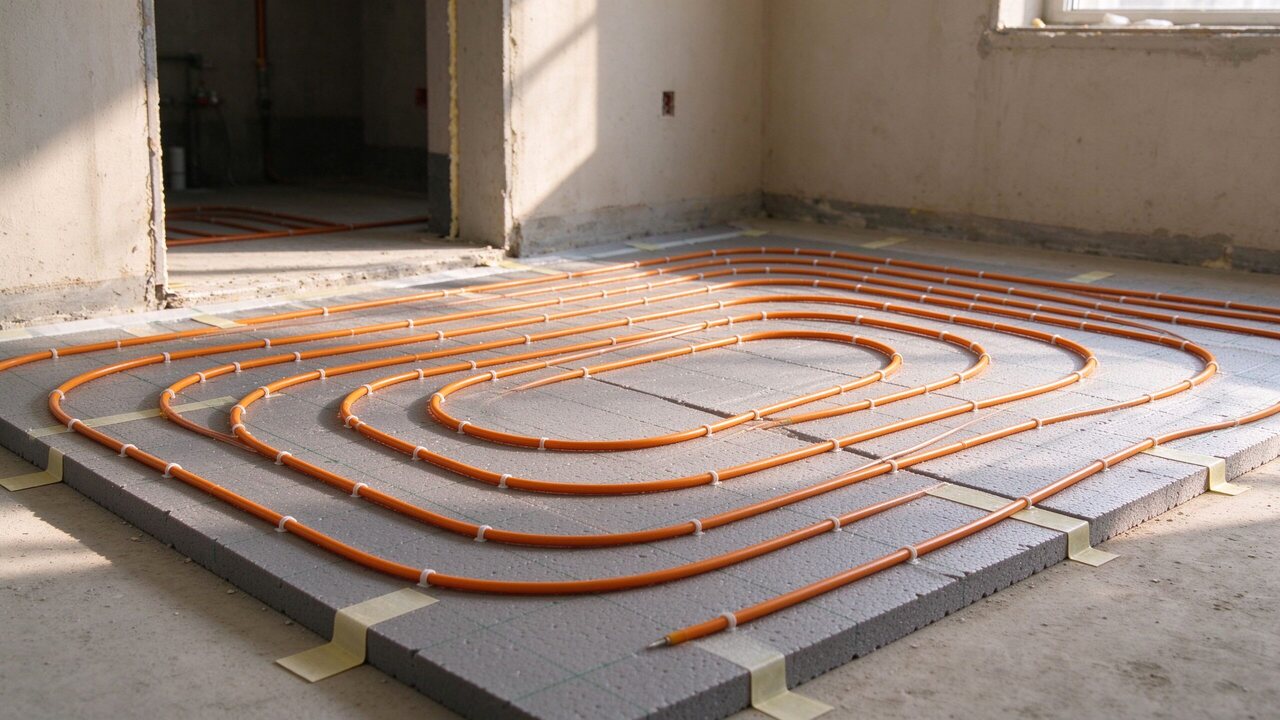
A twin conductor cable carries current out along one core and back along the other, so the electromagnetic field largely cancels and there is no need for a separate return run. That makes the serpentine the default pattern: parallel runs across the room, turning at each wall. Three details decide whether that pattern survives:
1. Turn at a radius, never at a right angle
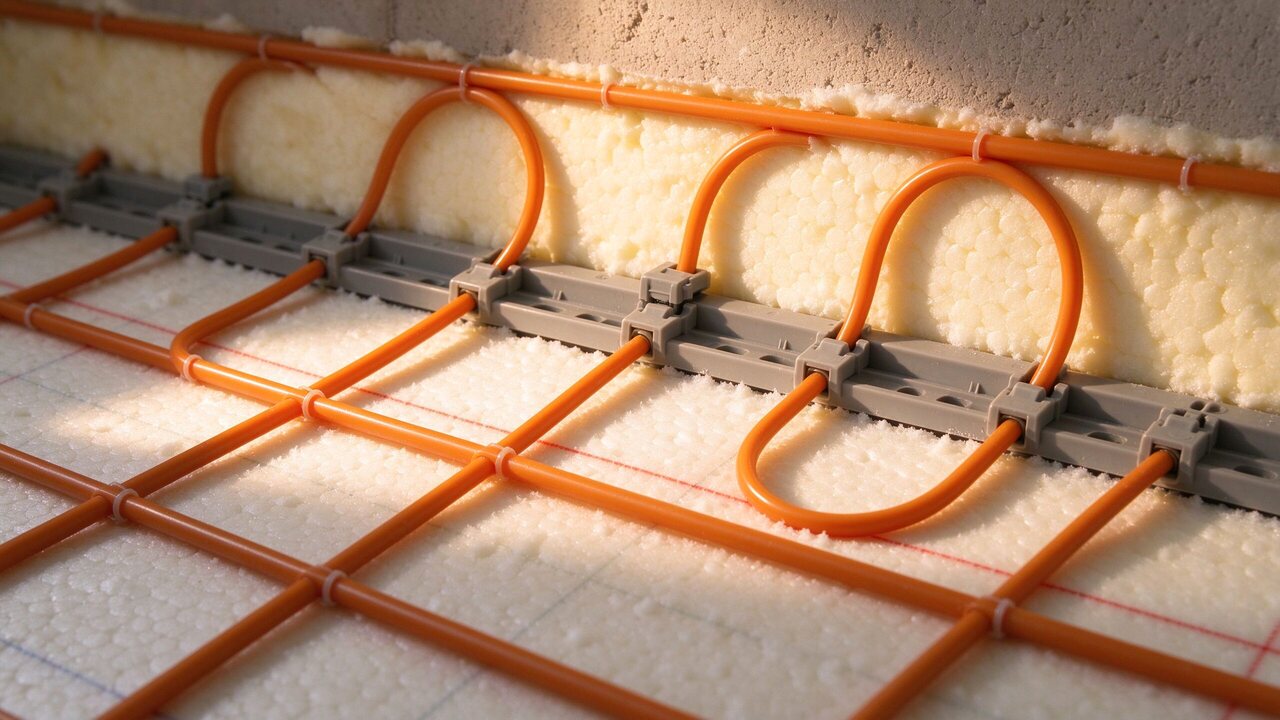
At each wall the cable needs a full 180-degree turn. Drawing it as a square corner is the single most common CAD error we see. The turn should be formed around a template or by hand with a radius of at least 40 mm, and the cable should be fixed with the manufacturer’s clips or mesh, not kinked against the profile.
2. Keep the bend away from the screed joint
Expansion joints, door thresholds and the boundary between two pour sections move. A bend sitting on a joint is loaded every time the slab moves. Shift the turn 150–200 mm inside the panel, or place the joint in a straight run between two loops.
3. Plan the cold lead before the last loop
The cold lead is the stiffest part of the assembly. It needs a straight entry into the conduit and enough length to reach the thermostat box without tension. If the layout leaves the splice in the middle of the room, the installer will bend it to get it out, and that bend is outside the specification.
How the numbers reach a price: the procurement side
For a buyer, geometry is not only a technical topic. Cable length, spacing and layout drive the quantity you order, and quantity drives the band price. A 12 m² bathroom at 150 W/m² needs about 1,800 W, or 90 m of 20 W/m cable, plus 10 percent for turns and waste. The same room at 200 W/m² needs 120 m. That 30 m difference is the whole margin on a small project.
Three questions are worth asking before a bulk order:
- Is the drum length continuous? A 50 m drum that is actually 47 m plus a splice forces a second joint in the floor. Ask for the measured length per drum, not the nominal figure.
- What is the tolerance on resistance? A ±10 percent resistance window shifts output by the same order. For projects where the design load is tight, ask for the actual test value on the drum label.
- Which cold lead length ships as standard? Two metres is typical; 3 m and 5 m are available. Getting this wrong at the quotation stage adds a joint or a return visit, and both cost more than the cable.
Our own cable range is built around those three answers: continuous drum lengths of 12.5, 25 and 50 m for NHHC-01, factory-sealed splices, and a test label on every drum carrying resistance, insulation resistance at 500 V and the date of test. For projects with a fixed layout, we quote from the drawing rather than from a square metre estimate, which removes the waste allowance from the price.
Data and evidence
The numbers above come from three places: published product datasheets, our own factory test records, and installation feedback from contractors working in Europe and North America. The relevant factory facts, per SunAura factory records:
- 17 years of heating element manufacturing at the Qingdao Huangdao plant, with cable extrusion, splice sealing and final test on one site.
- Quality and environmental management certified to ISO 9001 and ISO 14001, with occupational health and safety under ISO 45001.
- Product compliance documented to CE, RoHS, LVD and EMC for the European market, with test reports held per family rather than per model.
- Export history covering more than 50 countries, including cold-climate markets where cable geometry failures show up fastest.
- Routine factory tests on every drum: conductor resistance, insulation resistance at 500 V for one minute, and a high-voltage withstand test on the completed assembly.
Two limitations are worth stating plainly. First, minimum bend radius figures assume the cable is at room temperature during installation; at 5 °C the jacket is stiffer and the practical radius is larger. Second, spacing tables assume the cable is bedded in screed or adhesive with at least 20 mm of cover. In a dry-lay system with a thin diffusion plate, the permissible spacing narrows, and the layout should be checked against the plate width before the order is placed.
What this means for a buyer choosing between cable, mat and film
Cable wins where the room shape is irregular, where the heated area is small and the output needs to be high, and where the layout has to be drawn rather than bought off a shelf. Mat wins where the area is rectangular and the schedule is tight, because the spacing is fixed at the factory. Film wins where build-up height is the constraint.
The geometry penalty is asymmetric: a badly laid cable can lose 30 percent of its service life, a badly laid mat usually shows up as an obvious cold strip, and a badly laid film shows as a hot band along the bus bar. If the project has an installer who has never laid cable before, a mat with factory-fixed spacing removes the largest single risk — and that is a procurement decision, not an engineering one.
For a quotation on cable by layout, send the room drawing with the heated area marked. We return a loop plan, a drum schedule and a price per drum within one working day. For repeat buyers, OEM drums with your own label, custom cold lead lengths and 110 / 230 V variants are available on a 15–25 day production window.
FAQs
Can a heating cable be bent back on itself?
No. A 180-degree fold at zero radius is the fastest way to break a conductor or thin the insulation. Every turn should be formed around a radius of at least 40 mm for a 6.5 mm cable, and the cable should not be pulled tight around the turn.
What happens if two cable runs touch in the screed?
Locally, the output per square metre doubles at the contact line. In a cement screed the heat has somewhere to go, but the mortar immediately around the contact dries and shrinks, and over two or three seasons a void forms. That void is where the jacket eventually cracks. Keep a 20 mm minimum gap, 30 mm preferred.
Is 100 mm spacing ever acceptable at 20 W/m?
Only in a thin bed with a low thermal resistance above it, such as a 10 mm adhesive bed under tile, and only if the design load demands 200 W/m². In a 60–70 mm screed we cap it at 110 mm and prefer 133 mm, because the screed needs to conduct heat sideways as well as upward.
Does the cable have to be fixed before the screed is poured?
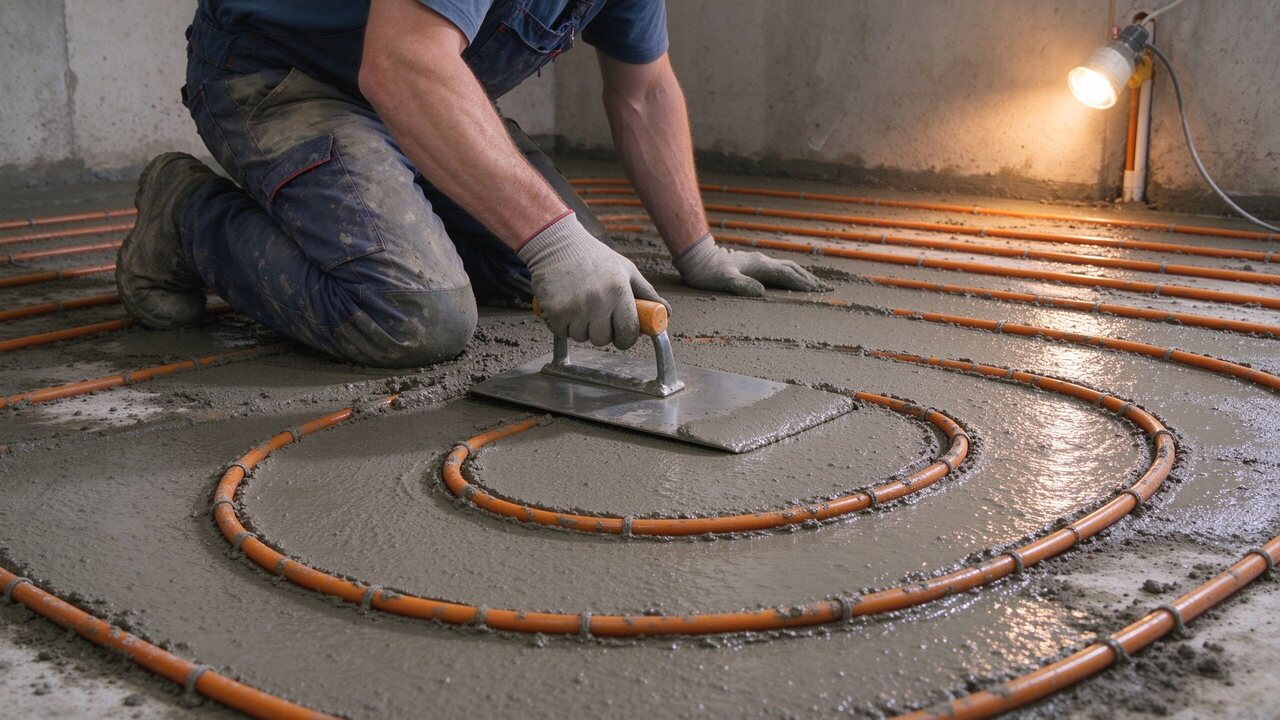
Yes. Loose cable moves under the weight of wet mortar and the spacing you drew is gone within a metre of pour. Fixing with clips, mesh or a proprietary rail holds the centres within about ±10 mm, which is the tolerance the design assumes.
How do I check a layout before ordering?
Ask the supplier for a loop plan against your drawing, with drum lengths and splice positions marked. A plan that shows splices in the middle of a heated area, or cold leads longer than the run to the wall, is a plan that will be reworked on site.
If you are specifying cable for a project and want the loop plan checked before the order goes in, review the twin conductor cable range and request a layout review. For buyers comparing formats, the factory-fixed spacing of heating mats and the build-up height of heating film are the two alternatives worth pricing side by side.