
If you have ever priced an electric heating retrofit and then stared at a half-dozen supplier brochures that all promise “far-infrared,” “energy-saving” and “healthy” warmth, you already know the problem. The brochures rarely tell you what the heating element inside actually is. The element family decides the power density, the temperature spread across the panel, the warm-up time, the shielding, the flex life and, ultimately, whether the product will survive ten years taped to a customer’s bedroom wall. In this article we pull the covers off five families of resistive heating elements that all compete for the same “thin electric heater” shelf: traditional carbon black printed film, carbon crystal panels, woven carbon fiber mesh, PTC ceramic/semiconductor heaters, and the graphene-carbon printed film that our XGF-WALLFILM product is built around. We compare them on engineering dimensions rather than marketing adjectives, and we end with the five numbers on a datasheet that decide whether a quotation is worth your time. Written by Grace Liu, Materials Engineer, SunAura Thermal.
The Comparison Framework
Every resistive electric heater converts Joule heat (I²R) into warmth. That is the easy part. The hard part is converting that heat into something a human being actually wants to live with: a surface that warms up quickly, stays even from edge to edge, does not develop local hot spots, emits little or no electromagnetic field, survives tens of thousands of on/off cycles, and costs the customer roughly what they expected to pay. Two heaters can both claim 500 W and both be made of “carbon,” yet behave like different appliances once installed. To compare them fairly we use eleven dimensions, each one traceable to a measurable engineering quantity.
- Element material and conduction path — what the resistive layer is made of, and how copper busbars contact it.
- Power density — watts per square metre of radiating face, which sets how much wall area a room needs.
- Surface uniformity — the peak-to-peak temperature spread across the face in steady state. This is the single number that separates a comfortable radiant wall from a hot strip you can feel through your shirt.
- Warm-up time — seconds or minutes from switch-on to design surface temperature.
- Far-infrared output and emissivity — how much of the heat leaves as long-wave radiation rather than conducted through the backing.
- Electromagnetic and radiated-field behaviour — whether the film needs a grounded shield, and whether a customer can truthfully sell “no EMF” into a bedroom.
- Thickness and flexibility — can it bend around an inside corner, follow an uneven plaster wall, or hide behind a slim skirting.
- Expected life — cycles to drift, and failure mode (open circuit vs runaway).
- Cost index — relative material and lamination cost per square metre, plus the installation overhead.
- Wall-installation fit — whether the element can actually be fixed flat to an interior wall, or whether it belongs under tile, under floor covering, or inside an appliance.
- Safety envelope — what happens if someone drapes a blanket over the face, blocks the air gap, or touches it for ten minutes.
We use our own XGF-WALLFILM graphene-carbon printed film as the reference baseline because its numbers are the ones our factory controls and publishes. We do not claim the other four families are bad. Each one is the right answer inside its own envelope. The point of the article is to help you, as a distributor, specifier or OEM buyer, recognise which envelope a given quotation actually lives in.
Traditional Carbon Black Heating Film
Carbon black printed film is the grandparent of the thin-film heating industry. Carbon black powder is milled into a polymer binder, screen-printed in serpentine stripes onto a PET or polyester substrate, copper busbars are crimped onto the ends, and the whole sheet is laminated between two more PET layers with an EVA or polyurethane adhesive. This is the technology that, in the 1990s and 2000s, first made low-voltage underfloor heating and infrared foot mats affordable.
What it does well
The process is mature to the point of commodity status. You can buy carbon black film from half a dozen factories in Jiangsu and Shandong at very low price per square metre. The printed stripes are straightforward to screen, the lamination line is well understood, and failure modes are predictable. Carbon black is chemically inert, does not oxidise quickly at 60 °C, and has no sharp shape memory problem. For a one-shot disposable heater, a packaging warming pad, or a low-cost under-desk foot mat, carbon black film is still a defensible choice.
Where it falls down on a wall
The physics of carbon black film works against wall heating. Carbon black particles are dispersed in a polymer matrix, and the inter-particle contact resistance changes with every thermal cycle. As the film ages, the hotter stripes drift upward in resistance and the cooler stripes drift down. Over a few hundred hours the originally uniform print develops a few “hot lanes” that run several degrees hotter than the rest of the face. On a floor, under tile, nobody notices because the floor covering averages the heat. On an uncovered interior wall, the customer will feel the hot lane with the back of their hand within the first winter, and will then call you.
The second problem is emissivity. A carbon-black-on-PET surface emits, at best, a broad and mediocre infrared band. Much of the heat leaves the front face as near-field convection from the warm plastic, not as long-wave radiation into the room. On a wall that means you are paying full watts for a heater that behaves like a warm radiator at low temperature, with all the dust-circulation discomfort that implies.
The third problem is power density. Carbon black film is normally printed at 200 to 300 W/m² because anything higher accelerates the hot-lane drift. A 500 W wall installation therefore needs two square metres of carbon black film, twice the area of a graphene-carbon strip of the same output. On a small bedroom wall, that space may simply not exist.
None of this means carbon black film is unsafe. Laminated carbon black heaters have been used for decades with good field records when they are covered by a thermally conductive floor finish. It means the material is mismatched to the specific job of an uncovered, visible, wall-mounted radiant face.
Carbon Crystal Panels
“Carbon crystal” (the Chinese term tanjing is often transliterated directly) is a different geometry. It is not a film. It is a rigid panel, typically 3 to 8 mm thick, made by compressing carbon crystal granules (a graphite-rich particulate composite) between two fibreglass-reinforced resin sheets, with electrodes bonded to the long edges. Carbon crystal panels became famous as the active layer in carbon crystal underfloor heating: you lay them under wood laminate, tile or vinyl, run a thin skim of screed over the top, and heat the floor mass.
Thermal character
Because the panel is a rigid composite with significant thermal mass, it heats slowly. A carbon crystal floor installation needs one to two hours of preheat before the floor surface reaches design temperature, and it coasts for a similar time after switch-off. That thermal inertia is a feature when you are heating a concrete slab overnight on off-peak tariff. It is a bug when you walk into a cold study at 7 a.m. and want to feel warm within ten minutes. Radiant comfort does not arrive until the panel itself is at temperature, and the panel cannot get there fast.
Why wall retrofit is awkward
Carbon crystal panels are rigid and heavy. Fixing them to an interior wall means drilling into masonry, mounting a metal rail, and then clipping a panel that does not bend around an inside corner. The joint between panels is a visible seam, and the panels cannot be cut to length on site because cutting severs the internal electrode grid. The result is a product that behaves more like a radiator replacement than a flexible wall film: it needs planning, it needs a builder, and it cannot follow wallpaper, tile upstands or inside corners.
We see this most often in European retrofit bids. A customer who has seen carbon crystal floor heating work well asks why it cannot be glued onto their living-room wall. The honest answer is that it technically can, but you will be paying for rigid panels, metal brackets and an electrician, and you will still end up with a slow thermal response and visible seams. For a rental flat or a heritage wall where drilling is restricted, carbon crystal is simply the wrong tool.
Where it remains the correct choice
Carbon crystal underfloor heating remains a respectable product in new-build slab construction, particularly where off-peak storage tariff exists and the floor finish is tile or stone. The rigid panel survives under screed for decades, the thermal mass is desired, and the cost per square metre of heated floor is competitive. The moment you move the element to a vertical wall that has to look like finished interior decoration, the advantages flip.
Carbon Fiber Heating Elements
Carbon fiber heating elements come in two geometries: a twisted carbon fiber cord (often called a carbon heating cable) and a woven mesh of carbon fiber threads sandwiched between two polyester films. The woven mesh is the one most often compared to graphene film, because it ships as a flexible sheet and looks superficially similar.
Warm-up behaviour and the hot-thread problem
Carbon fiber has a very low thermal mass and a high axial conductivity. The individual threads heat up within seconds of power-on, which gives the product its marketing line of “instant warmth.” That low mass is also its weakness. Each thread is a thin resistive line, and the gaps between threads are gaps in heat. Unless the mesh is spaced very densely and encapsulated in a thermally spreading layer, the wall surface ends up with a fine stripe pattern: hot where a thread sits, cooler a few millimetres away. Measured on a customer wall, the peak-to-peak spread across a carbon fiber mesh panel is typically 8 to 15 °C, against the ≤3 °C we measure on our graphene-carbon printed strips.
The second issue is localised ageing. A single broken thread in a woven mesh does not stop the panel, because the rest of the mesh still conducts current. But the broken thread’s neighbours now carry more current than designed, so they run hotter, and they age faster. Over years the panel develops patches of reduced output that the customer describes as “some parts of the wall do not feel as warm as they used to.” Diagnosing that on site means taking the panel down, which is rarely worth the labour cost. The customer usually lives with it.
How this differs from our dedicated graphene-versus-carbon-fiber piece
We have published a separate article that goes deep on the physics and cost case for graphene film against woven carbon fiber mesh, including sheet resistance, contact resistance at the copper busbar, and the long-term drift we have measured on accelerated ageing rigs. We will not repeat that engineering comparison here. The relevant point for this family-level overview is that carbon fiber mesh occupies one row in our comparison table: it is fast, flexible and cheap, but its uniformity and long-term drift place it below the printed graphene-carbon row for an uncovered wall application. If you are choosing specifically between a graphene wall film and a woven carbon fiber mesh for a bedroom, read the dedicated piece as related reading. Here we treat it as one member of the element family.
PTC Ceramic and Semiconductor Heaters
PTC stands for Positive Temperature Coefficient. A PTC element is a small ceramic or semiconductor block whose resistance rises sharply above a defined Curie temperature. Above that temperature the block effectively switches itself off, which means it cannot run away. This is the self-limiting behaviour that makes PTC the default choice in hair dryers, hand dryers, car seat heaters, fan heaters and in-wall convector modules.
Why the self-limiting property is attractive
For an appliance that a customer might knock over, drape a towel over, or leave on while away, PTC is a genuine safety advantage. No matter what covers the outlet side of the ceramic block, the block cannot exceed its Curie temperature. That removes the most common failure mode of resistive heaters. It is why PTC dominates the portable electric heater market, and why it is often specified in public washrooms and childcare facilities.
Why it does not compete in a wall film
PTC is a volumetric device, not a surface device. A single PTC chip is typically 5 to 20 mm across, mounted on an aluminium extrusion or fin array that distributes its heat into moving air. To make a wall heater out of PTC you have to tile the wall with many small chips, each on its own heat spreader, each wired in series-parallel, and each still requiring air movement to dump its heat into the room. The result is not a film. It is a modular convector with visible grilles, a fan (or a lot of passive aluminium fins), and a thickness of 40 mm or more. It is the product you see as a “PTC wall heater” on Amazon: a box 15 cm deep, mounted on the wall, noisy if it has a fan, bulky if it does not.
There is also the economics. A PTC module with its fin stack, thermostatic switch and terminal block costs materially more per watt than a printed resistive film. On a wall where the customer wants an invisible heat surface, the PTC premium buys a safety feature (self-limiting) that a well-designed film with an external thermostat already provides by other means. We are not saying PTC is wrong. We are saying it solves a different problem: it solves “an appliance that could be covered.” A wall film solves “a wall that should become a quiet radiant surface.” They are not substitutes.
Graphene-Carbon Printed Film as the Baseline
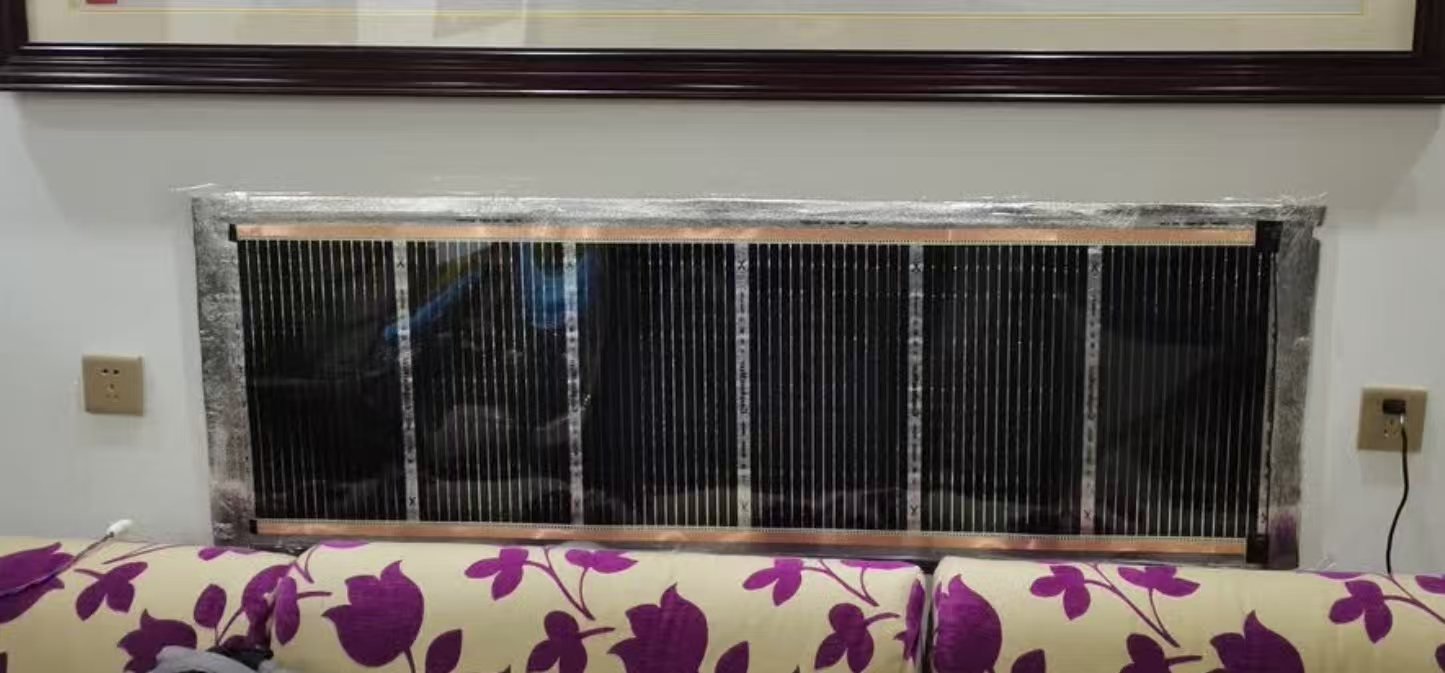
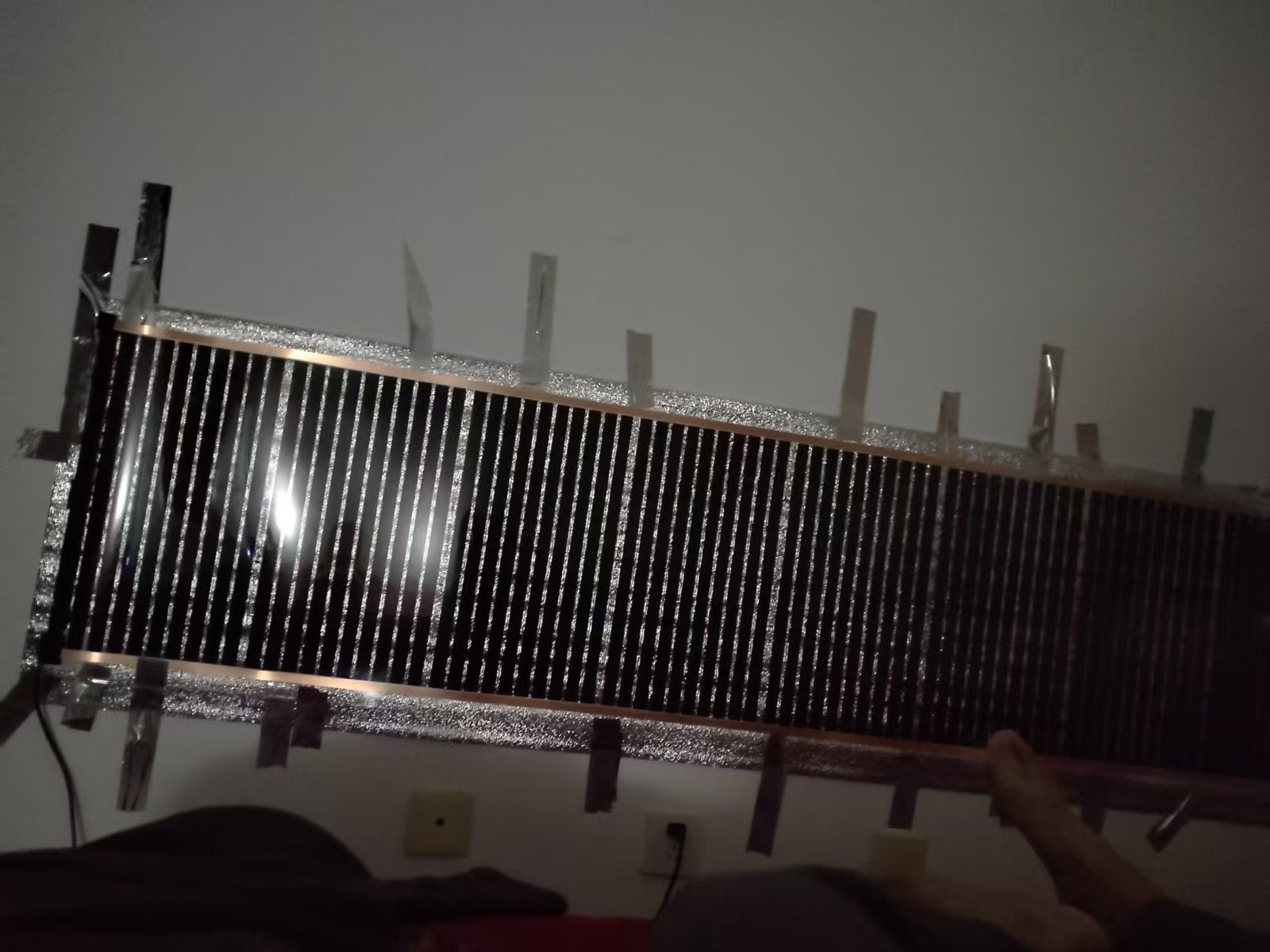
Our XGF-WALLFILM is a printed graphene-carbon resistive layer, not a pure graphene element. The active ink is a blend of graphene nanoplatelets and graphite, screen-printed in continuous stripes onto a PET-foil laminate. Copper busbars are welded along both long edges, and the whole sandwich is encapsulated between a front PET layer and a reflective silver-foil backing. The reflective backing is not decorative: it reflects the radiated energy that would otherwise pass backward into the wall, back into the room.
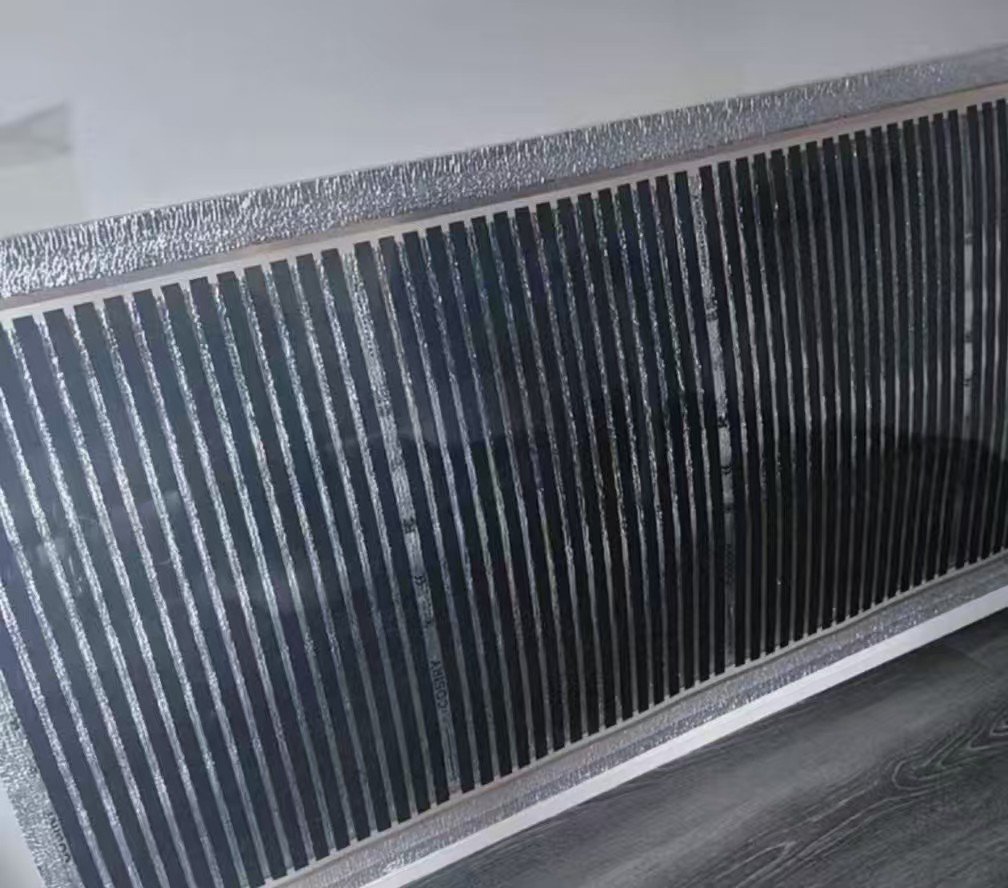
The engineering numbers that define this baseline, taken from our product datasheet, are:
- Rated voltage 220 V, power density 500 W per square metre.
- Electric-to-thermal conversion above 99 %, because there is no fan motor, no air mover and no control transformer in the heat path.
- Surface uniformity ≤3 °C peak-to-peak across the panel, measured under steady-state thermostat control at 45 to 55 °C working temperature.
- Approximately one minute from switch-on to operating surface temperature on an uncovered panel, because the active layer is a few tens of micrometres thick and has negligible thermal mass.
- Fully shielded construction with a grounded layer, marketed as no measurable electromagnetic radiation emission at the panel face.
- Standard panel width 50 cm, cut to length from 50 cm up to 400 cm, giving standard SKUs from 60 W (30×50 cm) up to 1000 W (50×400 cm).
- Silent operation, no dust circulation, zero floor footprint, flexible enough to follow inside corners and slightly uneven plaster.
The reason the uniformity number matters so much is that it is what allows the surface to sit at 45 to 55 °C continuously without hot lanes. A carbon black film at the same average surface temperature would have lanes at 70 °C; a carbon fiber mesh would have threads at 80 °C; a graphene-carbon printed film has every point on the face within three degrees of every other point. That is the difference between a surface you can lean on and a surface you have to avoid touching.
Side-by-Side Comparison Table
The table below summarises the five families on the eleven dimensions we defined at the top of the article. Numbers are indicative, based on typical commercial products we have benchmarked over the years; exact values depend on a specific supplier’s lamination and control. Treat it as an order-of-magnitude map, not as a spec sheet for any one product.
| Dimension | Carbon black printed film | Carbon crystal rigid panel | Carbon fiber woven mesh | PTC ceramic module | Graphene-carbon printed film (XGF-WALLFILM) |
|---|---|---|---|---|---|
| Form factor | Flexible sheet, 0.3–0.5 mm | Rigid board, 3–8 mm | Flexible mesh sheet, 0.4–0.7 mm | Rigid finned module, 40–80 mm deep | Flexible sheet, 0.5–1 mm incl. foil |
| Typical power density | 200–300 W/m² | 200–250 W/m² panel face | 250–400 W/m² | Module dependent, 300–600 W per unit | 500 W/m² |
| Surface uniformity | Medium, drifts with age | Good on slab, poor on visible wall | 8–15 °C spread (thread/gap) | Good on fin face, poor across grille | ≤3 °C across panel |
| Warm-up to design temperature | 2–5 min | 60–120 min (high inertia) | 30–60 s | 30–90 s (with fan) | ~60 s |
| Far-IR emissivity of face | Moderate, broad | Moderate, depends on cover layer | Good along threads, gaps emit little | Low (mostly convective) | High, designed far-IR band |
| EMF / shielding | Usually unshielded | Usually unshielded | Often unshielded, mesh doubles as antenna | Shielded appliance enclosure | Fully shielded, grounded layer |
| Flexibility / corner follow | Good | None, rigid board | Good | None, appliance box | Good, bends inside corners |
| Expected life on wall | 5–8 yr, hot-lane drift | 15+ yr under slab, limited wall data | 5–10 yr, thread-break drift | Appliance-rated, 5–10 yr | 3-yr in-box warranty, 15-yr B2B support framework |
| Relative material cost per m² | Lowest (1.0×) | Medium (1.5–2.0×) plus labour | Low to medium (1.2×) | Highest (3–5×) per heated m² | Medium (1.8–2.5×) |
| Wall retrofit fit | OK but hot lanes on visible wall | Poor, builder-grade install | OK but stripe pattern on skin | Appliance box, not a film | Tape + adhesive, no wet trades |
| Self-limiting behaviour | No, needs external thermostat | No, needs external thermostat | No, needs external thermostat | Yes, intrinsic PTC effect | No, controlled by in-line thermostat |
Read the table in two passes. The first pass answers “which family is best on each dimension.” The second pass answers “which combination of dimensions matters for my wall application.” If your customer is fitting a bathroom tile wall and wants a heater that disappears, the rows that matter are uniformity, flexibility, wall retrofit fit and shielding. If your customer is building a new slab and has off-peak tariff, the row that matters is thermal inertia, and carbon crystal suddenly looks reasonable. If your customer is buying a portable heater for a children’s playroom, PTC wins on the intrinsic safety row and the wall film discussion is moot.
Safety Differences
Every resistive film heater sold into a bedroom has to answer the same three safety questions: can it develop a hot spot, what happens if the front face is covered, and does the cable work produce an electromagnetic field that a customer will ask about.
Hot spots are a uniformity problem
A hot spot is simply a point on the face that runs hotter than its neighbours. In a carbon black film, hot spots come from print-thickness variation and ageing drift. In a woven carbon fiber mesh, hot spots are the individual threads. In a graphene-carbon printed film, the continuous printed stripe geometry and the ≤3 °C uniformity mean there is no thread-scale hot spot: every point on the face is within a few degrees of every other point. That does not make the surface cold (the working temperature is 45 to 55 °C, with uncovered panels reaching around 60 °C and up to roughly 67.7 °C in our demo footage), but it means there is no surprise 90 °C line a child might press against.
Covering the face is the universal failure mode
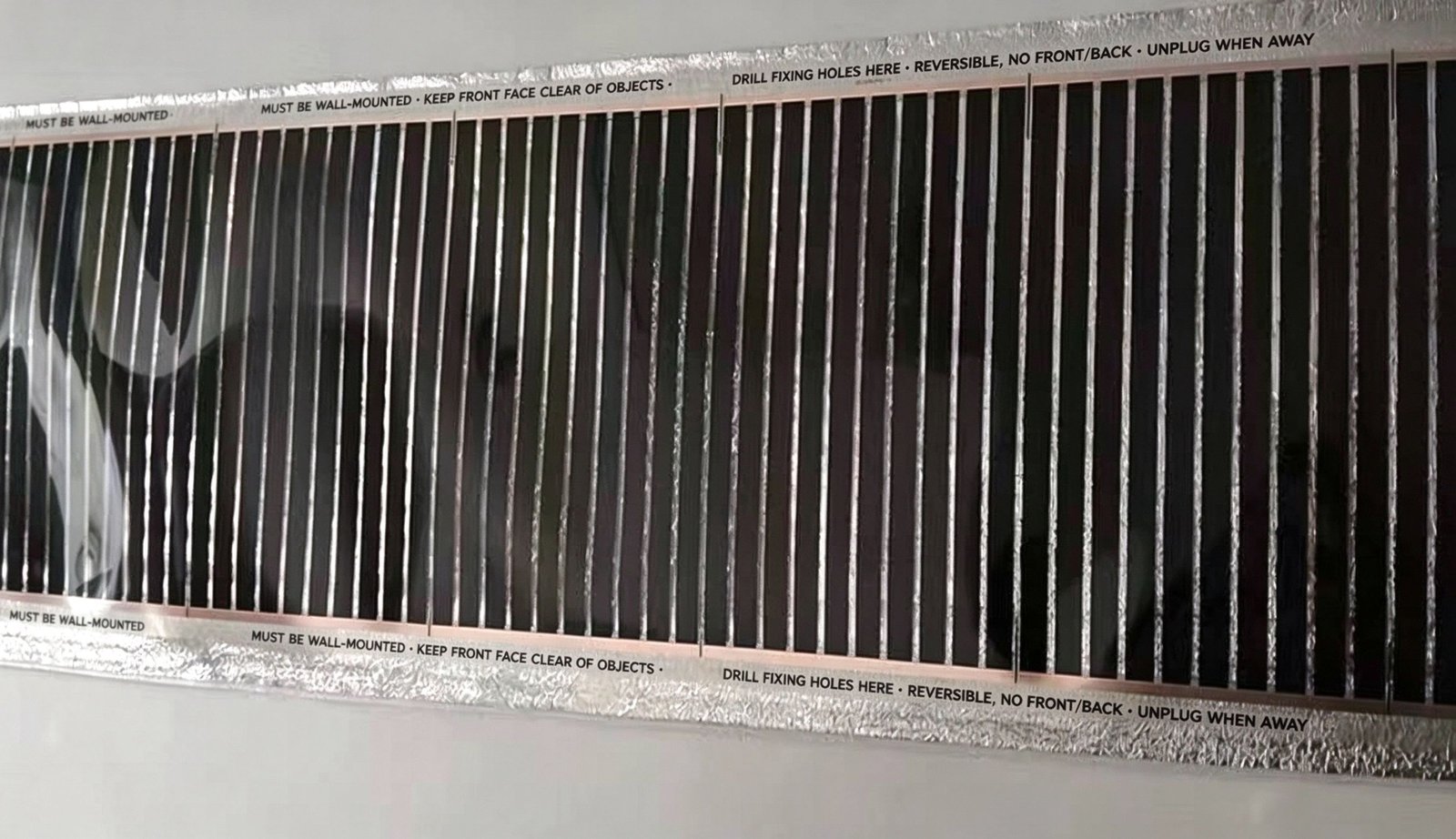
We want to be explicit here, because it is the most common warranty conversation we have. All resistive film heaters, regardless of material, require that the radiating front face stay clear. If you cover a film heater with a blanket, a curtain, a wardrobe or a pinned-up tapestry, the heat cannot leave the face, the surface temperature climbs past 100 °C within minutes, and you risk scorching the covering. This is true for carbon black film, carbon fiber mesh and our graphene-carbon film alike. PTC is the only family in the table that intrinsically refuses to exceed its Curie temperature when covered.
The practical implication for wall installation is not “choose PTC.” It is “spec the film at the right height, on an open wall, and tell the installer not to cover it.” Our installation instructions require wall mounting only (never on the floor, never under bedding, never inside a cabinet), specify drilling only on the factory-printed fixing-hole strips on the silver foil border, and recommend unplugging or switching off when unattended. For nurseries, the in-line thermostat should be set to Low on an open wall above head height. These rules work for the film families; they are not optional wording on a datasheet, they are the reason the warranty exists.
Electromagnetic shielding
A 220 V resistive film running at 50 Hz carries an alternating current that produces a weak electromagnetic field around the conductors. On an unshielded carbon black or carbon fiber sheet, that field is measurable a few centimetres from the face. It is well below the limits in every national standard, but it is measurable, and it is the reason some distributors in Northern Europe and Japan ask pointed questions. Our XGF-WALLFILM uses a grounded shield layer inside the encapsulation, which diverts the field to earth and leaves the front face with no measurable EMF at normal standing distance. That is a structural decision, not a materials decision: you can buy graphene film unshielded if you want to save money, but you will lose the bedroom and nursery segment of the market.
Cost Comparison
Cost has two parts for a wall heater: the installed cost per square metre, and the running cost per heating season. We will walk through both with a worked example so you can see the arithmetic rather than take our word for it.
Installed cost index
Taking carbon black printed film as the 1.0× baseline, a woven carbon fiber mesh is typically 1.1 to 1.3× because the yarn handling is more labour than screen printing. A rigid carbon crystal panel is around 1.5 to 2.0× for the panel itself, but when you add the mounting rail, the wiring and the electrician, the installed cost often lands at 2.5 to 3.0× per heated wall. A PTC module wall heater is an appliance, so you are buying a finished product at retail margin: per heated square metre of wall, expect 3 to 5× the film baseline. Our graphene-carbon printed film lands at roughly 1.8 to 2.5× the carbon black baseline, but it delivers 500 W/m² where the carbon black film delivers 250 W/m², so the per-watt installed cost is closer than the headline per-square-metre number suggests.
Running cost worked example
Take a 15 m² bedroom, insulated to a modern European standard, heated to 20 °C indoor on a winter day. Assume an average heat demand of 600 W for six hours a day during the heating season, and an electricity price of €0.25 per kWh (illustrative; your market will differ). Six hours at 600 W is 3.6 kWh per day, or €0.90 per day. Over a 120-day heating season that is 432 kWh, about €108, for that room.
The interesting comparison is not between heater families on running cost. Every resistive electric heater converts roughly 100 % of the electricity it draws into heat inside the room. Carbon black film, carbon fiber mesh, PTC modules and our graphene film all sit above 99 % electric-to-thermal conversion. The running-cost gap comes from three secondary effects: the fraction of heat that leaves as useful radiation into the room versus wasted conduction into the wall; the warm-up cycle, which interacts with how the customer schedules the heater; and the standby losses of the thermostat and any fan motor. A fan-assisted PTC heater has a small but continuous fan-energy penalty and moves dust; a fanless radiant wall film has no fan penalty. The reflective silver backing on our film is the single largest running-cost lever: it keeps the radiated energy on the room side instead of letting it conduct into the plaster.
We can show the same arithmetic on a larger room. A 50×300 cm panel rated at 750 W, run for four hours a day on a cold day, draws 3 kWh. At €0.25/kWh that is €0.75 a day, or about €90 over a 120-day season if run every day. These numbers are indicative, and your customers should size their own circuits with the coverage guide on our product page, which pairs each panel SKU to a recommended primary-heat or auxiliary-heated floor area depending on insulation and climate.
The total-cost-of-ownership angle distributors miss
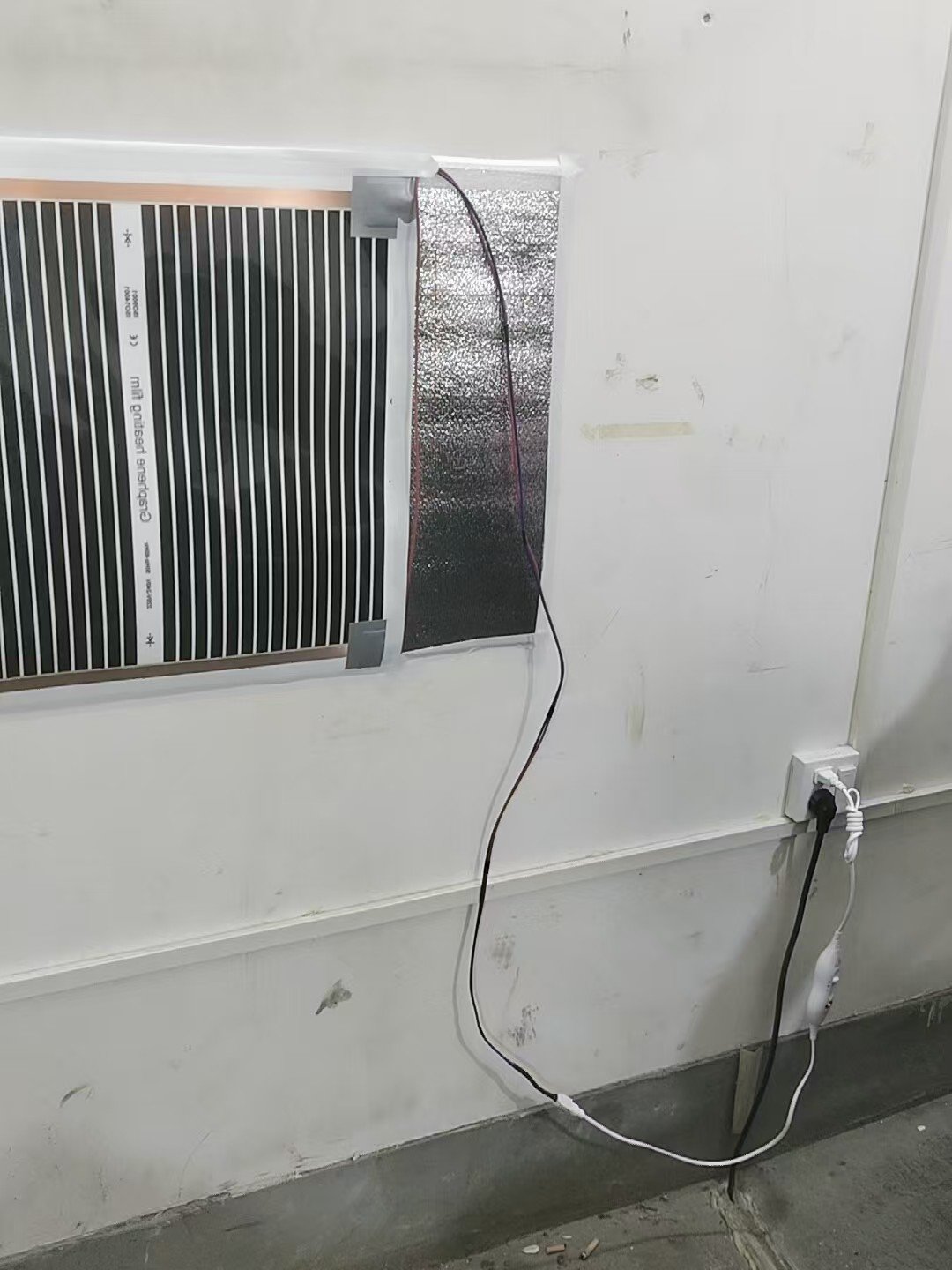
The installed-cost table above ignores labour. A taped-and-adhered graphene wall film goes up in under an hour by one installer, with no electrician needed for the plug-and-play version (it simply plugs into a wall socket via the in-line High/Low/Off thermostat). A carbon crystal wall installation takes a half day, needs brackets, and usually needs an electrician. A PTC appliance swap is also an hour, but the appliance itself costs more. When a customer compares “€40 carbon black film per m²” against “€80 graphene film per m²,” they are comparing material price, not installed price. Once labour is included, the gap narrows, and the uniformity and shielding advantages of the graphene film start to look cheap.
When Each Family Still Wins
We said at the top that no family is bad. Each one is the right answer inside its own envelope. As a procurement advisor, the most useful thing you can do for a customer is put them in the right envelope on the first call.
Carbon black printed film still wins when
You are building a covered, low-visibility application: a foot warmer, a packaging warming pad, a low-cost under-desk mat, or a temporary heating mat inside a frost-protected cabinet. The surface is hidden by a thermally conductive cover, the hot-lane drift is averaged out, and the lowest possible material cost is the dominant criterion. For an uncovered visible wall, carbon black film is a poor fit, and the customer will feel it within one winter.
Carbon crystal still wins when
You are in new-build or major renovation, you have a concrete or anhydrite slab, and you have access to an off-peak storage tariff. The rigid panel survives under screed for decades, the thermal inertia helps you shift heating into cheap-rate hours, and the finished floor is tile or stone. The same panel glued to a finished interior wall is a compromise that nobody is happy with: it looks like a radiator without the radiator, it warms slowly, and it cannot follow corners.
Carbon fiber woven mesh still wins when
You need a flexible sheet at the lowest possible flexible-sheet price, the application is covered (under a desk mat, inside a heated blanket lining, under a rug), and the stripe pattern on the face does not matter because a cover layer averages it out. For an uncovered wall where the customer will lean against the surface, the 8 to 15 °C thread-to-gap spread and the long-term thread-break drift are real complaints waiting to happen. If your customer is specifically choosing between a graphene wall film and a woven carbon fiber mesh for a bedroom, our dedicated article on that head-to-head comparison goes further than this family overview.
PTC still wins when
The heater is an appliance that a user can knock over, drape a towel over, or leave unattended in a public washroom, a childcare centre, a hair salon or a workshop. The intrinsic self-limiting property is a real safety feature that no resistive film can match, because no resistive film can refuse to heat when covered. In those contexts, buy the PTC appliance. Do not try to replace it with a wall film, because the wall film’s installation rules require exactly the open-face clearance that a portable appliance does not have.
Graphene-carbon printed film wins when
The customer wants a silent, fanless, invisible radiant wall surface on an existing interior wall, with no wet trades, no floor space taken, no drilling beyond the printed fixing strips, and a bedroom/nursery-grade shielded construction. That covers bedrooms and nurseries (film mounted above the headboard), living rooms (below art, behind the sofa), bathrooms (on marble or tile above the toilet), dining rooms and tea shops, home offices (under the window, behind the desk), and showrooms or retail walls where the customer wants warmth without a radiator. It is also the default for rental and retrofit projects where the landlord will not allow wet trades and the tenant wants zero floor space given up to a heater.
What Buyers Should Check on a Datasheet
When a supplier sends you a datasheet for any of these five families, five numbers tell you whether the product is engineered or merely assembled. We look at them in this order.
- Surface uniformity (ΔT across panel). Ask for a thermal-imaging photo of a powered panel at steady state, not just a number. If the supplier cannot produce the photo, the number is aspirational. We spec ≤3 °C on our XGF-WALLFILM. Anything above 5 °C on an uncovered wall heater is a customer complaint in waiting.
- Power density per square metre, and the panel’s rated wattage vs its area. A 50×100 cm panel should be 250 W. If a supplier quotes 250 W on a 60×120 cm panel, they are under-running the element to hide hot-spot problems, and you will not get the coverage you expected. Cross-check against our SKU list: 30×50=60 W, 50×50=125 W, 50×100=250 W, 50×150=375 W, 50×200=500 W, 50×250=625 W, 50×300=750 W, 50×400=1000 W.
- Shielding and EMF disclosure. Ask explicitly whether the encapsulation includes a grounded shield layer and, if so, at what distance the field is measured. “Low EMF” without a measurement distance is marketing. We ship our wall film with a shielded construction marketed as no measurable EMF at the face, and we can provide the test report on request for B2B partners.
- Warm-up time to design surface temperature, measured under what load. A sixty-second warm-up means little if it is measured in still air at 20 °C against an insulated back. Ask for the test condition: ambient, backing, set-point. We publish “approximately one minute to operating surface temperature” from our factory demo footage, and we mean it on an uncovered wall at 20 °C room ambient.
- Warranty structure and the failure mode it covers. A one-year controller warranty and a three-year film warranty is the standard in-box offer. A company-level 15-year support framework for registered B2B partners is a different conversation: it tells you the factory expects the product to last and is willing to stand behind it. Ask what is excluded (covering the face is always excluded) and what the replacement logistics look like. Ask also for CE, RoHS, ISO 9001 and ISO 14001 evidence, and for the factory’s monthly output (we run about 500,000 m²/month out of our Qingdao plant, which has been making heating film since 2008).
If a supplier can answer those five questions with numbers and photos, they are an engineer. If they answer with adjectives, they are a trader. The price difference between the two is usually smaller than the warranty conversation later.
Frequently Asked Questions
Is a graphene heating film actually different from a carbon crystal heater?
Yes, in form factor and thermal response. Carbon crystal is a rigid, 3–8 mm composite panel designed to be embedded under floor finish; it has high thermal inertia and needs one to two hours to reach design temperature. Graphene-carbon printed film is a flexible sheet about a millimetre thick that tapes directly to an existing interior wall and reaches operating temperature in roughly one minute. They are not interchangeable products. Carbon crystal wins under a new slab with off-peak tariff; graphene film wins on an existing wall that you do not want to rebuild.
Which is safer for a child’s bedroom: a PTC heater or a graphene wall film?
PTC has the intrinsic self-limiting advantage: if you cover it, it refuses to overheat. A shielded, properly installed graphene wall film on an open wall above head height, with the in-line thermostat set to Low, is a mature bedroom/nursery installation and produces no fan noise and no measurable EMF at the face. The safety rule on the film side is never to cover the radiating face and to wall-mount it above the child’s reach. For a portable appliance that a toddler can drape a blanket over, choose PTC. For a silent, fixed, radiant surface that stays out of reach, choose the wall film on Low.
Why does a graphene wall heater cost more per square metre than a carbon film mat?
Because the printed graphene-carbon process is engineered for surface uniformity: the continuous printed stripes, the silver reflective backing, the grounded shield layer and the lamination encapsulation each add cost that a covered floor mat does not need. On a per-watt basis the gap narrows, because the wall film delivers 500 W/m² against 200–300 W/m² for commodity carbon black film. Once installer labour is included (no electrician needed for the plug-and-play version), the installed gap is narrower still.
Can I use a carbon fiber heating mesh in place of the graphene wall film on a bedroom wall?
Physically yes, but expect a visible thread-to-gap temperature spread of 8 to 15 °C across the face, compared with ≤3 °C on the graphene-carbon printed film, and expect slow long-term drift as individual threads age and break. If the mesh will be covered by a radiator cover or a fabric wall hanging, the spread is averaged out and the mesh is fine. On an uncovered wall that the customer leans against, the printed film is the better product. We have a dedicated head-to-head article on graphene versus carbon fiber mesh if you want the deeper engineering case.
Does a wall heating film waste energy by heating the wall behind it?
It would, without the reflective backing. The silver foil layer on our XGF-WALLFILM reflects radiated energy that would otherwise conduct backward into the plaster, and redirects it into the room. Electric-to-thermal conversion is above 99 % on this product because there is no fan motor, no air mover and no control transformer in the heat path. The reflective backing is the single largest running-cost lever, and it is one reason the running-cost arithmetic stays close to the theoretical minimum for a resistive heater.
What voltage and wattage do I need for a 20 m² insulated bedroom?
Use the coverage guide as a starting point. A 50×300 cm panel at 750 W is rated for 7 to 10 m² as a primary heat source, or 8 to 12 m² as auxiliary. A 20 m² insulated bedroom typically wants two 50×300 cm panels on two walls, or one 50×400 cm panel (1000 W) on the main cold wall plus a smaller panel under the window. These are indicative: final sizing depends on insulation, glazing and local climate, and we recommend confirming the circuit with our applications engineers before ordering. Pair the panels with SunAura room thermostats for scheduled, zoned control in multi-room projects.
Next Step for Your Project
If you are specifying a radiant wall project and want the datasheet, the CE/RoHS documentation, a sample panel, or OEM/ODM terms for a private-label programme, the fastest path is to ask for a quotation. We support cut lengths, regional plug standards, controller styles, zone-thermostat pairing and PSE-related documentation for the Japanese market per order. You can also read more about the underlying product on the graphene wall heating film page, explore our graphene infrared heater range for portable appliances, look at custom encapsulated heating film if you need a non-standard form factor, and compare this element-level view with our separate pieces on wall heating installation and use cases and on how radiant walls sit against whole-room heater categories. For pricing, lead time and OEM samples, Request Wholesale Price and our applications team will come back to you with the panel selection for your room.