
Ethan Sun, Founder & CEO, SunAura Thermal
A wall heating film is a resistive load, which makes its electrical behaviour unusually simple to predict: current follows from wattage and voltage with almost no variable in between, and the load stays constant for as long as the panel is energised. That simplicity is useful for specifiers, because it means a room’s electrical load can be calculated from the panel schedule before anything is ordered — and the answer usually decides whether the project is a plug-in retrofit or a fixed-wiring job.
This guide is for the buyer, electrician or MEP coordinator sizing wall film circuits. It covers panel wattage to current, room-level arithmetic, circuit capacity, multi-room diversity, thermostat and contactor matching, and three worked examples at single-room, apartment and small-commercial scale.
What “electrical load” means for a resistive panel
The printed graphene-carbon element behaves as a resistor with a small positive temperature coefficient. At 220 V and 500 W/m², a 1 m² panel draws about 2.3 A. There is no motor, no compressor, no inrush beyond the first fraction of a second while the element reaches temperature, and the power factor is effectively unity.
That matters because a heating circuit and a motor circuit are sized differently. A 5 kW motor may need a circuit rated well above its running current to survive starting; a 5 kW resistive heater needs a circuit rated just above its steady current, with the usual protective device derating applied. Wall film is the second case.
The other characteristic worth knowing is that the load does not fall as the room warms. Unlike a heat pump, whose output drops as outdoor temperature falls, a resistive panel delivers its rated wattage regardless of conditions. The load is predictable, and so is the running cost per hour at a given tariff.
Panel wattage to current
| Panel size (W × L) | Rated power | Current at 220 V | Typical room contribution |
|---|---|---|---|
| 30×50 cm | 60 W | 0.27 A | Small supplementary panel, 0.3–0.5 m² primary |
| 50×50 cm | 125 W | 0.57 A | Under-desk or single-fixture wall, 0.7–1 m² primary |
| 50×100 cm | 250 W | 1.14 A | Small room, 3–5 m² primary |
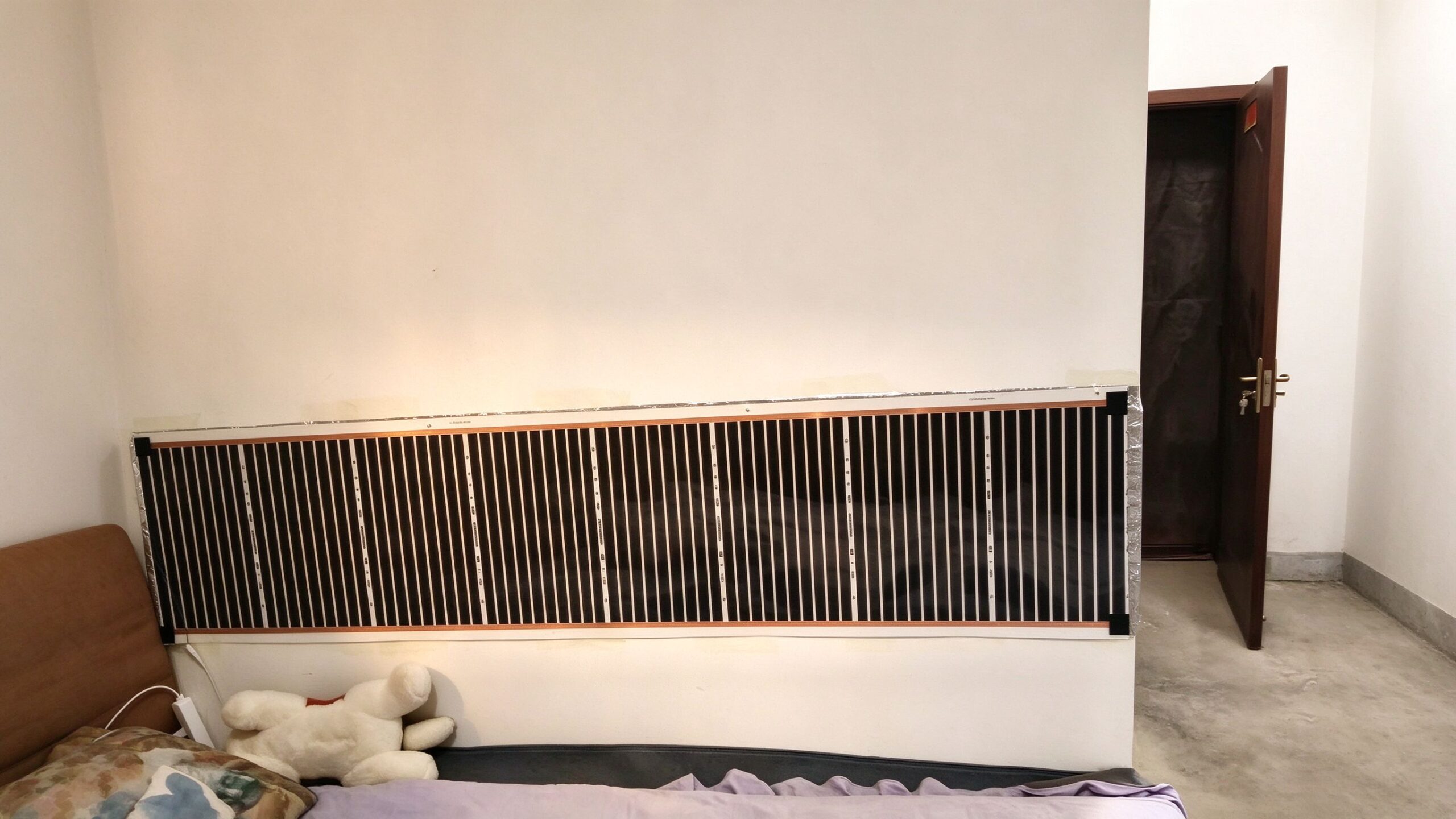
| 50×150 cm | 375 W | 1.70 A | Bedroom wall line, 4–6 m² primary |
| 50×200 cm | 500 W | 2.27 A | Standard room panel, 5–7 m² primary |
| 50×300 cm | 750 W | 3.41 A | Living area or open plan, 7–10 m² primary |
| 50×400 cm | 1000 W | 4.55 A | Large room, 10–15 m² primary |
The current column is the number an electrician needs and the number buyers rarely ask for. It is also the number that makes a small project feel feasible: a 500 W panel on a 13 A socket circuit is unremarkable, while a room full of them on the same circuit is not.
Note that panel wattages above 1000 W are not standard in the wall range — wider coverage comes from multiple 50 cm strips rather than a single larger panel. That is a manufacturing constraint (the film ships as 50 cm-wide strips cut to length) and it is also an electrical convenience, because a wall of two 500 W panels distributes load across two circuits more readily than one 1000 W panel.
One room: the sizing arithmetic
Three numbers decide a room’s load: the wall area actually covered by panels, the panel wattage, and the diversity factor you apply to the room’s total.
Wall coverage is not room floor area. A 12 m² bedroom might take a single 500 W panel covering 5–7 m² of floor-equivalent primary heating, because the panel’s job is to warm the occupied volume and the bed wall, not to heat every square metre of floor. Using floor area directly as panel area is the most common sizing error, and it produces either an oversized order or an undersized installation depending on which number the buyer picked up.
Panel wattage is fixed by the product — 500 W/m² — so the calculation reduces to area times density times count. A 50×200 cm panel is 1 m² and 500 W. Two of them are 1000 W and 4.5 A.
Diversity applies at room level only in the sense of occupancy: a bedroom panel running overnight and a bathroom panel running for forty minutes a day do not present their combined load continuously. For circuit sizing, though, the safe assumption is that all panels on one circuit can be energised simultaneously, because a cold morning is exactly when they will be.
Circuit capacity: sockets, spurs and 16 A
On a standard European 230 V installation, a 16 A circuit provides about 3.5 kW, and a 13 A socket circuit about 2.9 kW. Those figures bound the practical panel count per circuit.
Three 500 W panels — 1.5 kW, 6.8 A — sit comfortably on a 16 A circuit with room for the thermostat and controls. Six of them, at 3 kW and 13.6 A, consume most of that circuit and leave nothing for anything else on the same spur. That is the point at which a dedicated circuit becomes the sensible specification rather than an optional upgrade.
Plug-and-play panels add a second constraint: the socket. A panel supplied with an in-line High/Low controller plugs into a wall socket, and a 1000 W panel at 4.55 A is well within a standard socket’s rating — but three 1000 W panels on the same double socket, through adapters, is not. If the room needs more than about 1.5 kW of wall film, treat it as a fixed-wiring job and give the panels a dedicated circuit.
Also check what else is on the circuit before adding a panel. A socket ring that already carries a tumble dryer, a kettle and a bathroom fan is not the circuit to put 1 kW of heating on, even though the arithmetic looks acceptable on paper.
Multi-room: diversity and zoning
An apartment with wall film in four rooms presents a combined load that is rarely all-on. Bedroom panels run overnight at Low, bathroom panels run morning and evening, living-room panels run in the evening. The combined peak is usually lower than the sum, and the case for separate circuits is about control and fault isolation as much as capacity.
Zoning is the mechanism. Each room on its own thermostat and its own circuit means a fault in one panel does not take out the others, a room can be isolated for maintenance without shutting the flat down, and the control strategy can differ by room — overnight low in bedrooms, timed boost in bathrooms.
Our zoning comparison sets out where single-zone control is adequate and where per-room control earns its cost. The short version: below about three heated rooms, a single zone with a central controller is usually sufficient; above that, per-room control pays back in comfort and in fault-finding time.
Thermostat and contactor matching
A thermostat rated at 16 A can switch 3.5 kW directly. Above that — or where the total on one controller exceeds its rating — the controller drives a contactor and the contactor carries the load.
The distinction matters most on a wall-film project where several panels share one controller. Four 1000 W panels on a single room controller is 4 kW, which exceeds a 16 A device at 230 V; the correct arrangement is either a contactor or a split across two controllers.
The plug-and-play in-line controller supplied with the standard panel is a High/Low switch, not a programmable thermostat. It is adequate for a single room with manual control, and it is not adequate for scheduled operation, setback or app control. Projects that need those functions pair the film with a room thermostat from the SunAura controls range, and the wiring schematic changes accordingly.
One further check: a thermostat’s floor-probe input is irrelevant to a wall film, which has no floor sensor. Room-sensing or remote-sensing control is what a wall installation needs.
Fixed wiring or plug-and-play
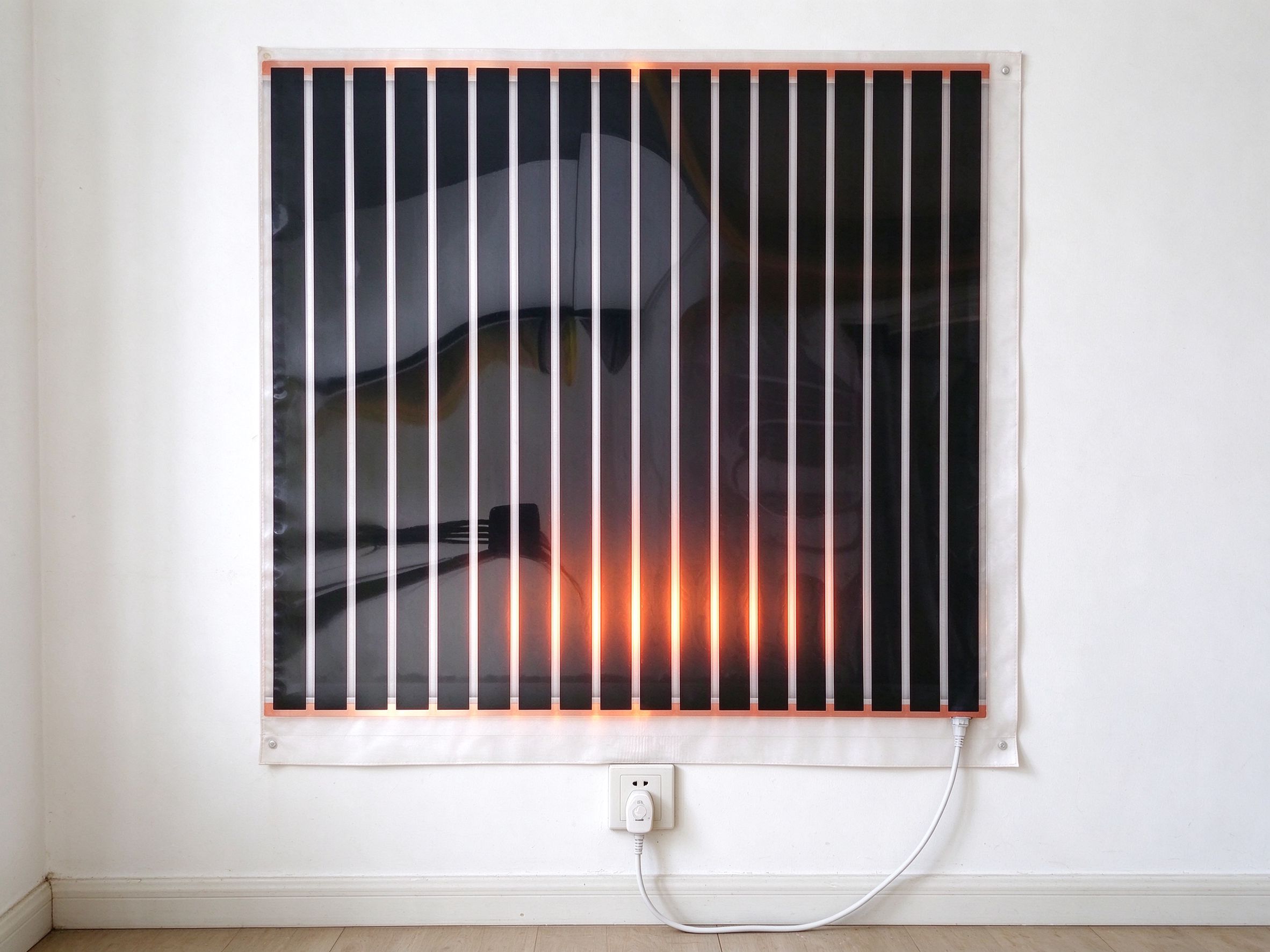
The decision is not about sophistication, it is about total load and control scope. A single panel in a bedroom, on its own socket, with the in-line controller, is a plug-and-play job that a competent DIY installer can complete in under an hour.
Anything above roughly 1.5 kW in one room, anything with per-room zoning, anything in a commercial or hospitality building, and anything where the panel needs to be controlled by a building management system belongs on fixed wiring, installed by a licensed electrician to the schematic supplied with the order.
Mixed projects exist and are common: plug-in panels in two bedrooms, fixed wiring in the living area and bathroom. That is a reasonable specification, provided the plug-in panels are on circuits that can carry them and the fixed panels are on their own.
Three worked examples
Single bedroom, 12 m². One 50×200 cm panel, 500 W, 2.27 A, on the bedroom socket circuit with the in-line controller. Circuit spare capacity remains well over 2 kW. Plug-and-play, no electrician. Overnight on Low.
Apartment, 68 m², four heated rooms. Bedroom 500 W, second bedroom 375 W, bathroom 250 W, living area 1000 W. Total 2125 W, 9.7 A. Two circuits: bedroom panels on one 16 A circuit through separate room controllers (875 W, 4 A); bathroom and living area on a second 16 A circuit (1250 W, 5.7 A). Fixed wiring for the living area, plug-and-play acceptable for the two bedrooms if the sockets are on suitable circuits.
Small restaurant, 40 seats. Wall film behind two banquette runs and along the back wall of the dining area. Four 750 W panels, total 3000 W, 13.6 A. Dedicated 16 A circuit per wall run, two panels per circuit, contactor-driven from a single programmable controller on a schedule tied to opening hours. The calculation that matters here is not the total but the peak: all four panels energise together on a cold morning, so circuit sizing assumes simultaneous operation.
Mistakes that trip breakers
Adding panels to a socket ring without counting the existing load. The ring’s rating is shared, and a heating panel is a continuous load rather than an intermittent one.
Sizing on floor area.
Panel area, not room area, determines wattage. A 20 m² room with a 4 m² panel is a 2000 W installation, not a 10 kW one.
Assuming diversity will save the circuit. Cold mornings synchronise every panel in the building. Size for simultaneous operation.
Putting four panels on one 16 A thermostat. That is 4 kW on a 3.5 kW device. Split the load or add a contactor.
Ignoring the controller type. A High/Low in-line switch cannot be scheduled. If the project needs scheduling, the load calculation has to include the thermostat and its wiring, not just the panels.
Data and evidence
Electrical values in this guide follow from the published panel ratings: 220 V supply, 500 W/m² density, panel sizes from 30×50 cm (60 W) to 50×400 cm (1000 W), with currents calculated as P/V at unity power factor. Circuit capacities quoted for 16 A and 13 A are the standard European and UK values; local wiring regulations and protective-device derating take precedence over these figures in every case.
Product data: printed graphene-carbon resistive stripes on laminated film with silver reflective backing, fully shielded construction with no electromagnetic radiation emission, surface temperature uniformity within 3 °C, working temperature 45–55 °C under thermostat control, approximately 60 °C typical uncovered surface, about 67.7 °C measured in the factory demonstration, and roughly one minute to operating surface temperature.
Factory side: SunAura Thermal has manufactured graphene heating film, mats, cables and controls since 2008 — seventeen years from the Qingdao (Huangdao) plant, six automated production lines, approximately 500,000 m² monthly graphene film output, ISO 9001 quality and ISO 14001 environmental management, CE and RoHS certification on the wall film line, and more than 50 export markets. Certificate numbers are not published in marketing copy; current documentation accompanies the quotation.
Warranty: controller 1 year, film body 3 years, plus a company-level 15-year warranty support framework for registered B2B partners.
FAQ
Can I run a 1000 W panel on a normal socket? Yes — 4.55 A at 220 V is well within a standard socket rating. The constraint is what else shares that circuit, and how many panels you add to it.
Do I need a dedicated circuit for one panel? No. For a single panel under about 1 kW, the existing room circuit is usually adequate if it is not already heavily loaded. Above 1.5 kW in one room, a dedicated circuit is the cleaner specification.
Does the panel need a contactor? Only when the combined load on one controller exceeds the controller’s rating — typically above 3.5 kW at 230 V on a 16 A device.
Is the power factor a problem? No. A resistive element runs at effectively unity power factor, so the current drawn is the wattage divided by the voltage, with no reactive component to correct.
Can panels share a thermostat with underfloor heating? They can share a controller only if the controller has the capacity and the control strategy suits both. Wall film responds in about a minute and floor heating responds in hours; a single setpoint rarely serves both well, which is why separate zones are usually the better specification.
What is the running cost per hour? A 500 W panel running continuously for an hour consumes 0.5 kWh. At an illustrative 0.30 per kWh tariff that is 0.15 per hour at full output; on Low, or on a thermostat cycling at 50 % duty, roughly half that. Your own tariff and duty cycle give the real figure.
Next step
Send us a room schedule — room names, approximate wall areas, and whether each room is primary or supplementary heating. We will return a panel schedule with wattages, currents and a suggested circuit split, so your electrician is sizing to a real load rather than an estimate. The wall heating film product page lists panel ratings, our buying guide covers room sizing, and the wattage calculation guide explains the density arithmetic in more detail. For controller selection at the loads described here, check the K5 thermostat ratings. Panel positions drive the panel count before the load calculation starts, and the mounting position guide sets out where a panel actually works.