
Ethan Sun, Founder & CEO, SunAura Thermal
A wall heating film does not heat a room the way a radiator does. It heats the surfaces and bodies it faces. That single geometric fact is what makes mounting position a performance decision rather than a cosmetic one: the same 500 W panel mounted at the wrong height delivers noticeably less comfort than the same panel mounted where the radiation actually lands on people.
This guide is for the buyer or installer deciding where a panel goes. It sets out the five positions used in real installations, the height rule that governs each of them, the obstruction test that decides whether a position works at all, and how many panels a given wall needs before the room stops feeling cold.
Radiant heat is directional, not ambient
Far-infrared radiation travels in straight lines and is absorbed by the first surface it meets. A panel facing a wall 3 metres away warms that wall. A panel facing a person warms that person. A panel facing a sofa warms the sofa — and the people sitting on it. This is why a wall film can feel effective in a room where a convection heater of the same rated power feels inadequate: the convection heater warms air that immediately stratifies toward the ceiling, while the wall film warms the objects and occupants in the direction it points.
The practical consequence is that position competes with wattage. Moving a panel from a position facing open room volume to one facing a wall three metres away can lose a meaningful share of its useful output, and no increase in panel size fully recovers it. Position first, size second.
It also means that “how warm is the room” is the wrong question and “what is the panel facing” is the right one.
The five positions used in practice
| Position | Typical height | What it faces | Best room | Main constraint |
|---|---|---|---|---|
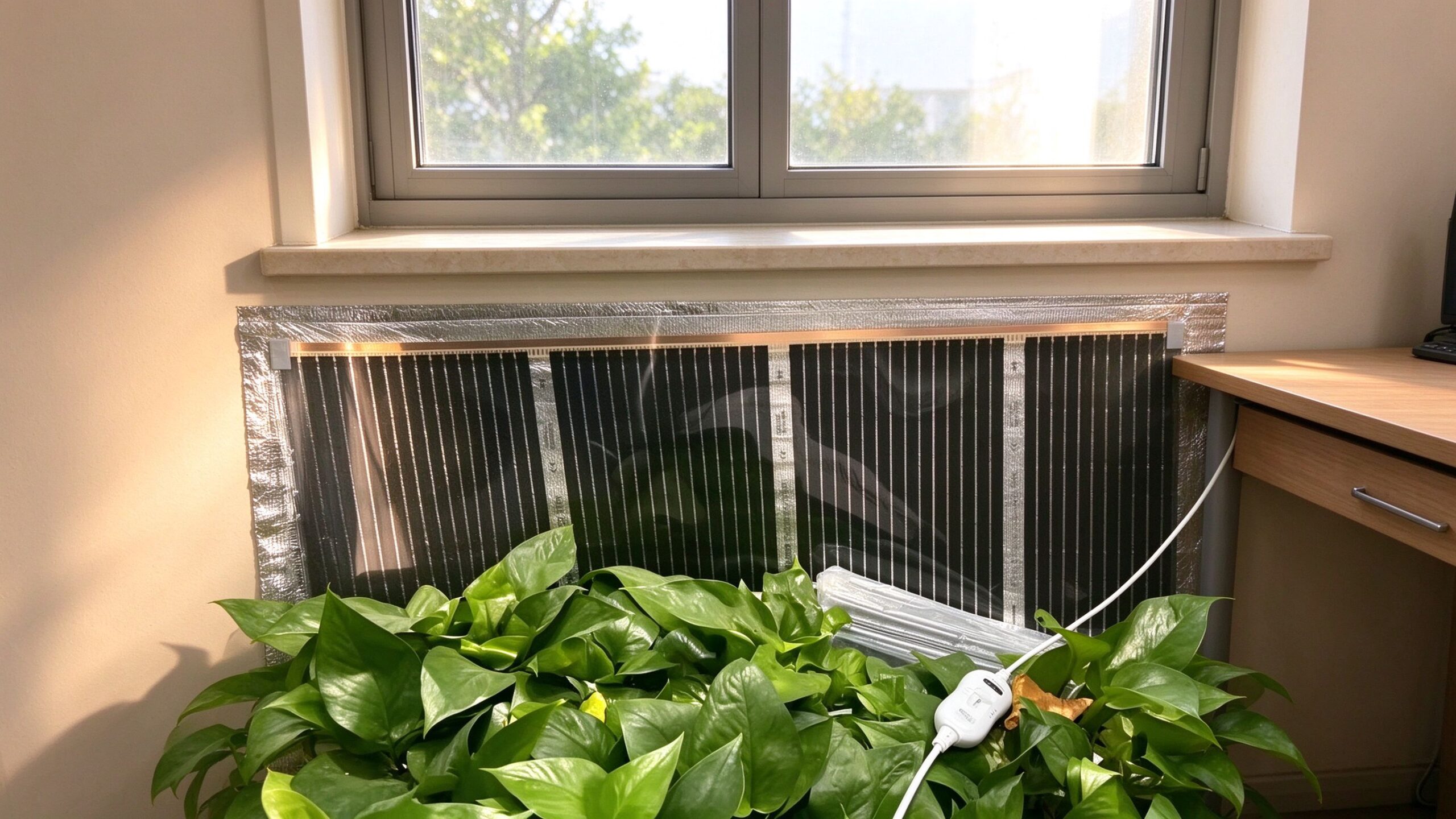
| Below a window | 300–600 mm off the floor | Room volume; counters cold downdraft | Bedroom, office, lounge | Curtains and sills must not cover the face |
| Above a headboard | 900–1200 mm | Bed and occupant | Bedroom, nursery | Bedding and pillows must stay below the panel |
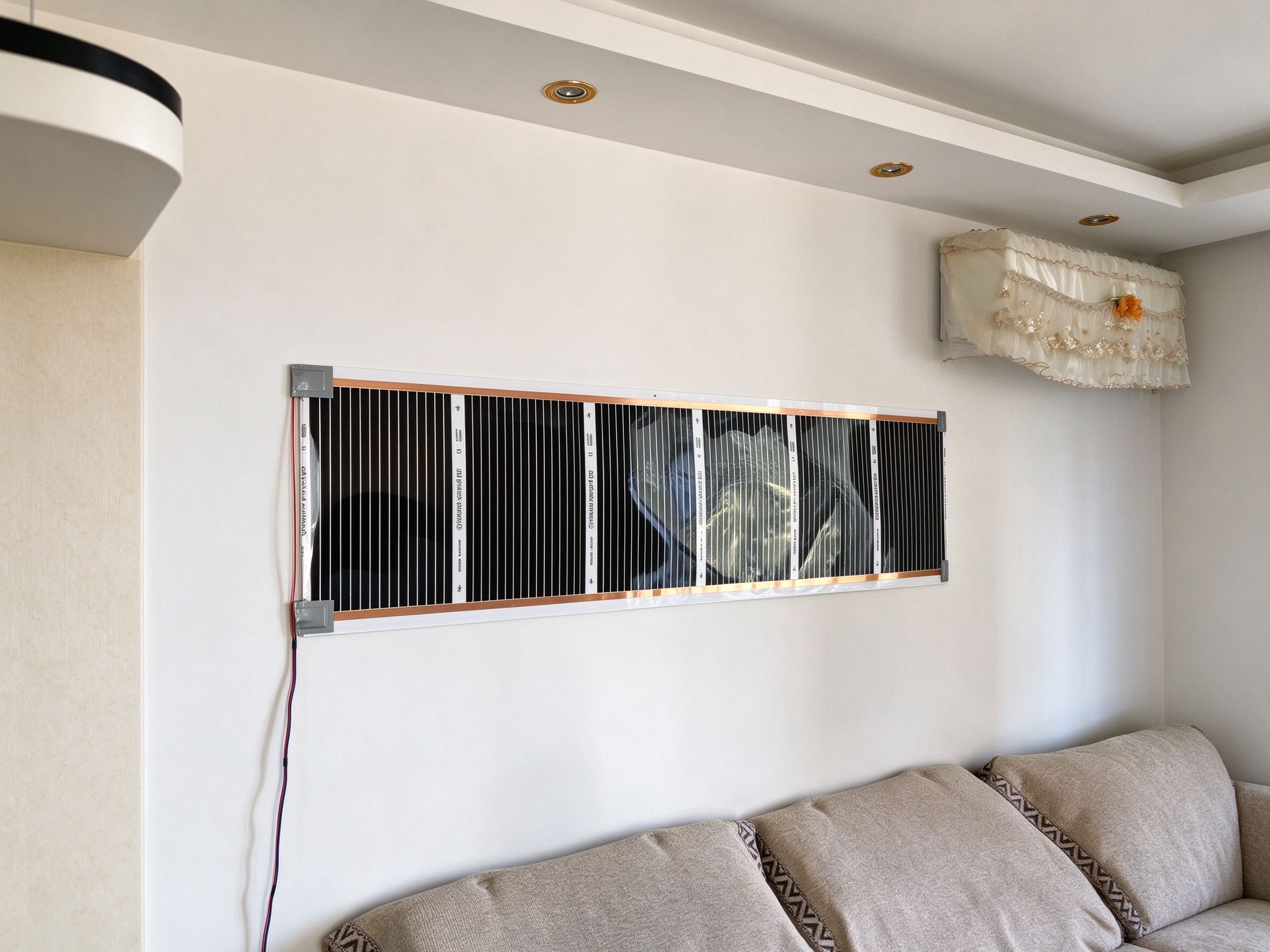
| At eye-level on a feature wall | 1200–1600 mm | Seated or standing people opposite | Lounge, dining, tea room | Artwork and shelving below it must not block radiation |
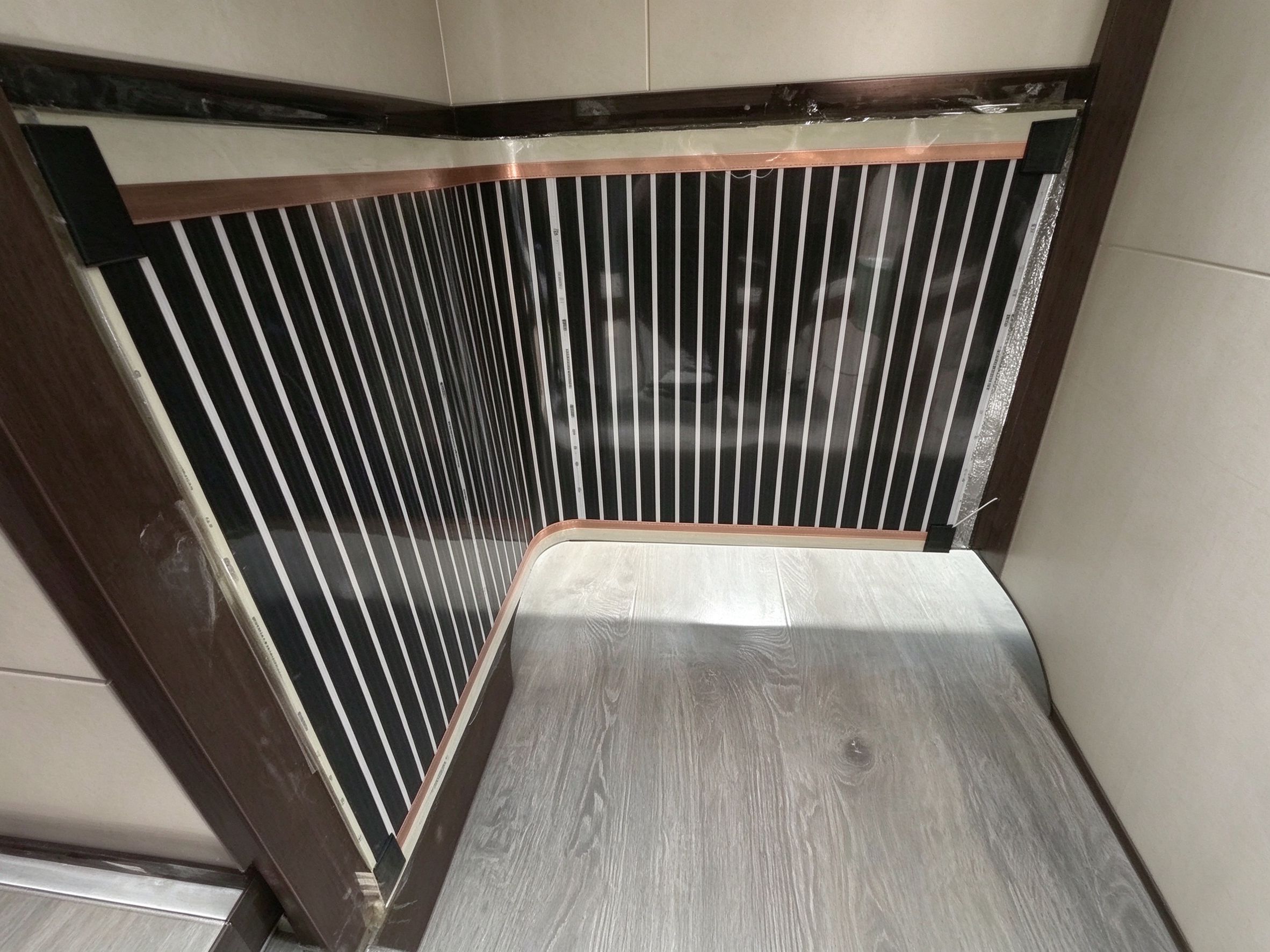
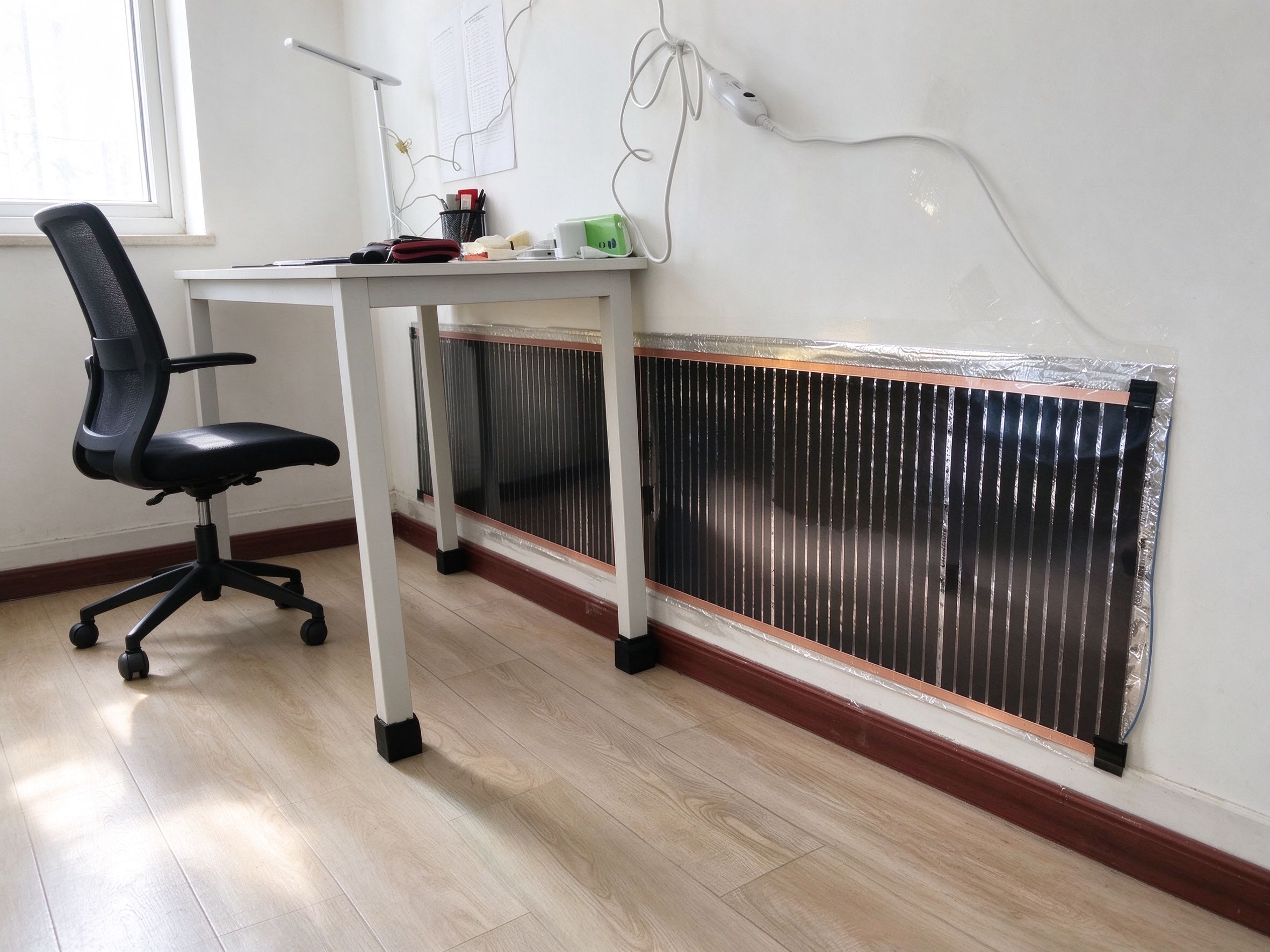
| Low wall behind a desk | 150–400 mm | Legs and under-desk volume | Home office, study | Chairs pushed back must not rest against the panel |
| Inside a corner | Follows the room, 300–1200 mm | Two wall planes, then the room | Small rooms, awkward plans | The film must wrap without bridging the corner joint |
Five positions, five different reasons. None of them is “wherever the wall is empty”, which is the approach that produces the installations buyers complain about.
Height: why floor level is usually wrong
The intuition that heat should come from low down — inherited from radiators and underfloor systems — is the most common positioning error with wall film. At 150 mm off the floor, a panel faces the floor, the skirting and the underside of furniture. The radiation is absorbed by surfaces that nobody touches, and the warm air it does produce rises past the occupants rather than through them.
The useful band for most rooms is between 300 mm and 1600 mm above floor level, and within that band the choice is driven by what is in front of the panel rather than by height alone. A panel at 1200 mm facing an open room performs better than a panel at 400 mm facing the back of a sofa.
There is one exception worth naming: the low-wall position behind a desk. It works not because low mounting is efficient in general, but because the target — cold legs and feet under a desk — is at that height. It is a targeted installation, not a general one.
Under the window: the downdraft argument
Glass loses heat faster than any other part of a wall assembly, and cold air descends along the window face, collecting at floor level. This downdraft is the reason a room can feel cold at ankle height while the air temperature reads comfortable, and it is the single most defensible reason to mount a wall panel below a window.
A panel there does two things at once: it warms the descending air layer before it reaches the floor, and it radiates into the room from a position that faces the occupied volume. On a north-facing wall in a heating-dominated climate this is often the highest-value panel position in the house.
The constraint is obstruction. A sill that projects far enough to shade the panel, a heavy curtain that hangs to the floor, or a deep window seat all block the face. The rule is mechanical: the radiating face must be clear, and anything hanging across it is both a performance loss and a safety issue — covered, the panel surface can exceed 100 °C.
If the window has a radiator under it already, the panel does not have to replace it. A wall panel below the sill and a hydronic radiator in the same location will fight for the same space; in that case move the panel to the adjacent wall section rather than stacking them.
Above the bed: overnight radiant heat
Bedrooms are where wall film earns its reputation, because the complaint it solves — a cold room with a noisy fan heater — is a night-time complaint. Mounting above the headboard, typically 900–1200 mm above floor level, gives a panel that faces the bed and the sleeping occupant.
Two rules govern this position. First, the panel must sit above the top of the bedding, with clearance so that pillows and duvets cannot ride up against the face. Second, the overnight setting should be Low rather than High: a radiant panel at low output holds a stable overnight temperature without the dry, moving-air feel of forced convection, and it uses a fraction of the boost power.
In a nursery the same position applies with a stricter version of the same rules: panel above the cot or bed, face clear, Low setting overnight, and nothing draped over the panel. The film is fully shielded and emits no electromagnetic radiation, which is the point buyers ask about first for children’s rooms; the safety instruction that matters more in practice is the clearance rule.
Bathroom walls above the vanity
A bathroom wall is a small area with a large comfort problem: the room is cold when it is used and empty the rest of the time. Above the vanity or the toilet, a panel warms the wall a person faces while standing at the basin, and it dries the wall surface that otherwise stays damp.
Height here follows the fixture, typically 1200–1500 mm, and the constraint is the mirror. A mirror in front of the panel reflects radiation back at it and blocks the face; mount the panel beside or above the mirror rather than behind it. On tiled walls, use the tile-appropriate adhesive described in our installation guide, and keep the panel out of direct water spray — the product is specified for interior dry-wall installation, not wash-down exposure.
The obstruction test
Before fixing a position, stand where the panel will be and look at what is in front of it. Anything within about a metre that blocks the straight line to the occupied part of the room will cost performance.
Run through this list: furniture that will be pushed against the wall, a sofa back, a wardrobe, a desk chair, a bed headboard, curtains, blinds, shelving, a large plant, a mirror, a radiator, a doorway that swings across the face. Any one of them is a reason to move the panel, not a reason to buy a bigger one.
Obstruction is also a safety matter rather than only an efficiency one. The printed rule on the film is that the front face stays clear; a panel behind a sofa that gets pushed back against it is a covered panel, and covered panels overheat.
How many panels for a given wall
The factory’s indicative coverage table gives a starting point rather than an answer: a 50×100 cm panel (250 W) covers roughly 3–5 m² as a primary heat source, 50×200 cm (500 W) covers 5–7 m², and 50×400 cm (1000 W) covers 10–15 m². As an auxiliary source those figures rise to 5–7 m², 7–9 m² and 12–16 m² respectively.
Two adjustments decide where in that range a project lands. Insulation quality moves the figure toward the optimistic end in a modern, well-sealed building and toward the pessimistic end in an uninsulated older one. Climate moves it in the same direction: a Mediterranean room and a Nordic room of identical size do not need the same installed wattage.
Panel count follows from the wall, not from the room area alone. A long wall takes two panels side by side more cheaply than one oversized panel, and it distributes the radiation better. A small room may take one panel at the right height and feel warmer than a larger room with two panels at the wrong height.
What not to do
Do not mount at skirting level “because heat rises”. It does rise, and it leaves the occupied zone on the way. The low position is only right when the target is at that height.
Do not put the panel behind a door. A door that swings across the face obstructs it for the part of the day the room is most used.
Do not hide it behind a decorative screen. A lattice screen, a slatted partition or a radiator cover converts a radiant panel into a poorly ventilated box.
Do not mount facing a wall. Two metres from a blank wall, most of the output warms that wall. Face the occupied volume.
Do not assume more panels fix a bad position. Additional wattage at the wrong height raises the electricity bill and the surface temperature; it does not raise comfort proportionally.
Data and evidence
Panel data used here comes from the XGF-WALLFILM specification: 220 V supply, 500 W/m² power density, standard 50 cm strip width, panels from 30×50 cm (60 W) to 50×400 cm (1000 W), indicative primary coverage from 0.3–0.5 m² for the 30×50 cm panel up to 10–15 m² for the 50×400 cm panel, indicative auxiliary coverage from 0.4–0.7 m² up to 12–16 m², surface uniformity within 3 °C across a panel, working temperature 45–55 °C under thermostat control with roughly 60 °C typical on an uncovered face and about 67.7 °C measured by infrared thermometer in the factory demo.
The coverage figures are indicative, in the manufacturer’s own wording, and depend on regional ambient temperature and room insulation. We publish them as a starting point and confirm sizing against the actual room before an order is fixed — a range that is honest about its variables is more useful than a single number that implies precision the product does not have.
Factory side: SunAura Thermal has manufactured graphene heating film and controls since 2008 — seventeen years from the Qingdao (Huangdao) plant, six automated production lines, approximately 500,000 m² monthly graphene film output, ISO 9001 and ISO 14001 management systems, CE and RoHS certification on the wall film line, and distribution into more than 50 export markets. Certificate numbers are supplied with the quotation rather than quoted in marketing copy.
Warranty: controller 1 year, film body 3 years as documented in the product demonstration, with a company-level 15-year warranty support framework for registered B2B partners.
FAQ
Can I mount two panels on the same wall? Yes, and on a long wall it is usually the better choice. Keep them at the same height so the radiant field is even, and leave the printed border strips accessible.
Does the panel work if it faces a wall 2 metres away? It works, but most of the output is absorbed by that wall. Position the panel to face the occupied volume, or accept that you are heating a wall rather than a person.
Is above the headboard safe with bedding? Yes, provided the panel sits above the top of the bedding and nothing can ride up against the face. The clearance rule is what makes the position safe, not the height alone.
What height for a bathroom panel? Typically 1200–1500 mm, following the vanity or the toilet, with the mirror beside or above rather than in front of the panel.
Can it go on a ceiling instead? Not this product. Ceiling installation uses a different film and fixing approach; adapt the wall panel and you lose both warranty and safety compliance.
Will one panel heat a whole room? In a small, well-insulated room, yes, within the indicative coverage range. In a larger or poorly insulated room, the panel supplements rather than replaces the main heat source — which is exactly what the auxiliary coverage figures describe.
Next step
Send us a photograph of the wall you intend to use, with approximate dimensions and a note of what sits in front of it. We will recommend a mounting height, a panel size and a panel count, and tell you if the wall is the wrong one. The wall heating film range lists the standard panel sizes, our buying guide explains how panel size maps to room area, and the how-it-works guide covers the far-infrared mechanism behind the positioning rules. If the room already has a thermostat strategy, check the zoning comparison before fixing the panel count. For substrate preparation and the fixing method, see the installation guide; for circuit sizing across several rooms, the electrical load guide.