
Graphene Heating Film vs Heating Cable: What the Material Comparison Means for Underfloor Projects
Buyers comparing graphene heating film vs heating cable usually ask the same three questions: which one heats a room faster, which one fits my floor build-up, and which one costs less over ten years. The honest answer is that neither is “better” in general — each is better for a specific set of conditions. Film rewards large, open, regular floor areas with low build-up requirements. Cable rewards rooms with complex shapes, islands, or zones where you need power exactly where the furniture is not. This article walks through the material, wattage, installation and cost differences from a factory procurement standpoint, so you can shortlist one technology before you start asking for quotes.
If you are new to the category, start with the watts per square meter calculation guide — the two technologies are specified and quoted on the same power-density basis, which makes comparison much easier.
1. What Each Technology Actually Is
A heating cable is a resistive conductor — typically twin-conductor with a return loop inside one jacket — that is laid in a serpentine pattern and either embedded in screed or fixed to a mesh mat. Its output per metre is fixed by the manufacturer, and total output is controlled by how much cable you lay per square metre. A graphene heating film is a flat laminate: graphene-modified heating layers between PET films, with silver-copper busbars along the edges. It comes in fixed-width rolls that are cut to length on site and stapled or taped to an insulation board, then covered by the floor finish or a thin levelling layer.
The structural difference drives almost everything downstream: film distributes heat across a wide surface, cable concentrates it along a line. That single fact decides heat-up time, surface uniformity, layout flexibility and the type of floor covering you can use.
2. Heating Film vs Heating Cable: A Side-by-Side Comparison Table
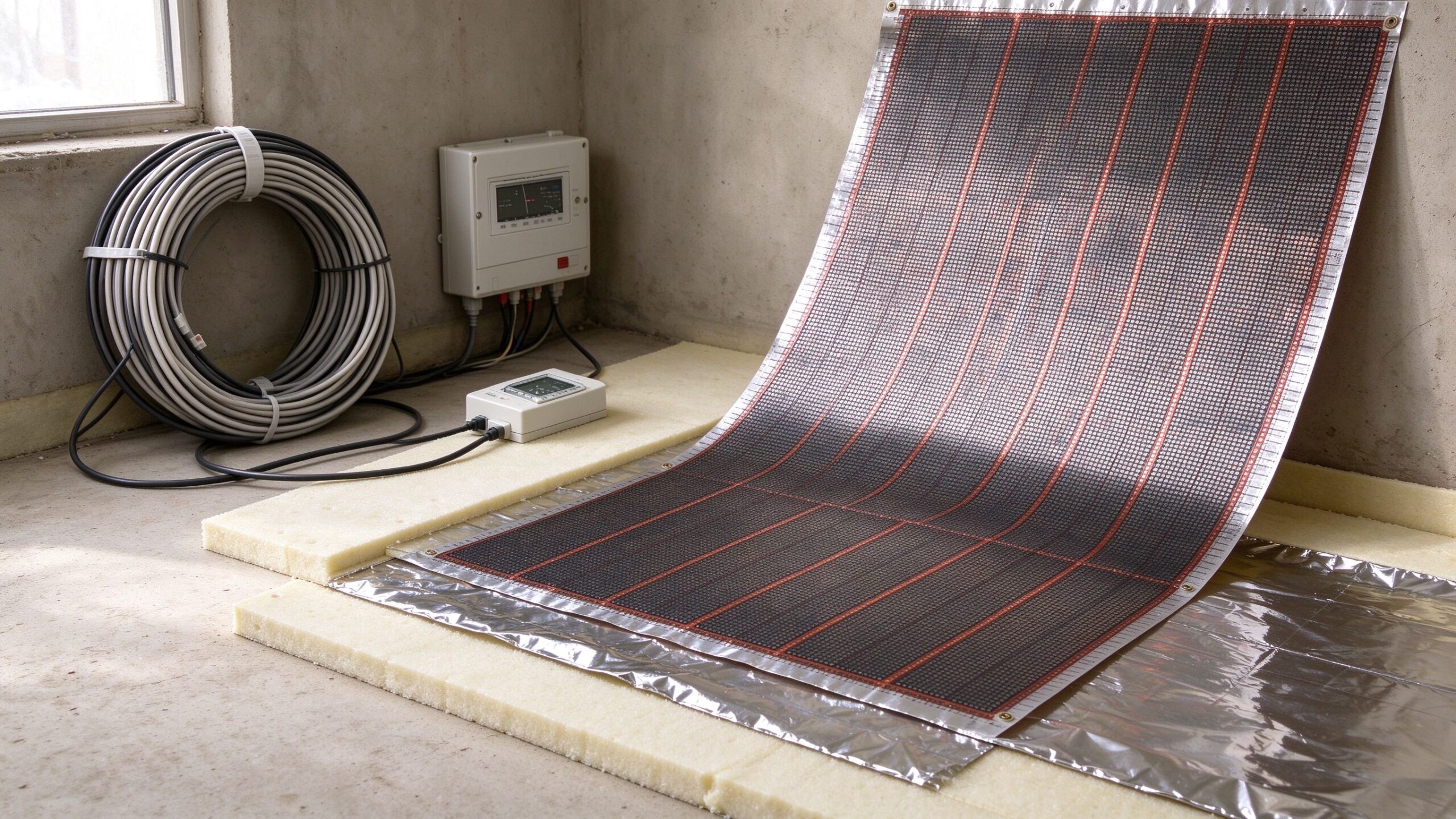
| Parameter | Graphene heating film | Heating cable |
|---|---|---|
| Element form | Flat laminate, fixed width rolls (e.g. 0.5–1 m) | Twin-conductor cable, sold by length / kit |
| Typical power density | 80–160 W/m² continuous | 10–20 W/m laid; 80–200 W/m² depending on spacing |
| Build-up height | 1–2 mm + floor finish (dry-lay possible) | 6–8 mm cable + 30–60 mm screed, or mesh mat + thin screed |
| Heat-up time | 10–25 min surface | 30–90 min through screed mass |
| Surface uniformity | Even across the whole sheet | Warm lines between cable runs, cooler gaps if spacing is poor |
| Room shapes | Best on large regular areas; cutting around islands wastes material | Bends around columns, toilets, kitchen islands with little waste |
| Floor covering fit | Laminate, vinyl, carpet, thin tile assemblies, floating floors | Screed, tile, stone, engineered wood with thicker build-up |
| Typical lifetime claim | 20+ years at rated load per manufacturer data | Similar 20+ years class; connector quality is the weak point |
| Install labour | Low — unroll, cut, connect, cover | Higher — spacing calculation, bending, fixing, screed pour |
| Repair after failure | Replace the affected sheet section | Locate the break point and splice, or replace the run |
| Indicative budget range | Roughly $12–25/m² element cost at factory-direct level | Roughly $8–18/m² for cable, plus screed labour cost |
Read that table the way a buyer does: the cable wins on price per square metre of element and on layout flexibility; the film wins on installation time, build-up height and surface uniformity. Neither number is a promise — real quotes depend on roll width, zone count, thermostats and shipping.
3. Wattage and Heat-Up Behaviour: Where the Numbers Diverg
Both technologies are specified in watts per square metre, and the same room usually ends up with a similar installed wattage whether you choose film or cable — around 100–150 W/m² for primary living spaces in a well-insulated European or North American home. What differs is how that power behaves over time.
Film heats a thin layer quickly because there is little thermal mass between the element and the room. A dry-lay film installation under laminate can reach surface temperature in roughly 15–25 minutes. Cable embedded in 40–50 mm of screed stores the heat in the slab and releases it slowly, so the room stays warm after the thermostat switches off, but the first warm-up of the day takes noticeably longer.
For intermittent use — offices, bedrooms heated only in the evening, holiday homes — that difference changes the running cost calculation, because a fast-response system lets you drop the set-back temperature deeper without paying a long recovery penalty. For continuous use — living rooms, bathrooms kept warm around the clock — the thermal mass of screed actually smooths the load and can help with time-of-use tariffs.
This is also where the material difference matters. Graphene-modified film radiates in the far-infrared band; the surface stays a few degrees cooler than a cable floor at the same room temperature while delivering similar comfort, which is one reason film systems are often paired with floor probes rather than air sensors. If you want the sensor strategy explained, the lifespan and sensor guidance article covers the practical side.
4. Installation Fit: Large Open Areas vs Irregular Layouts
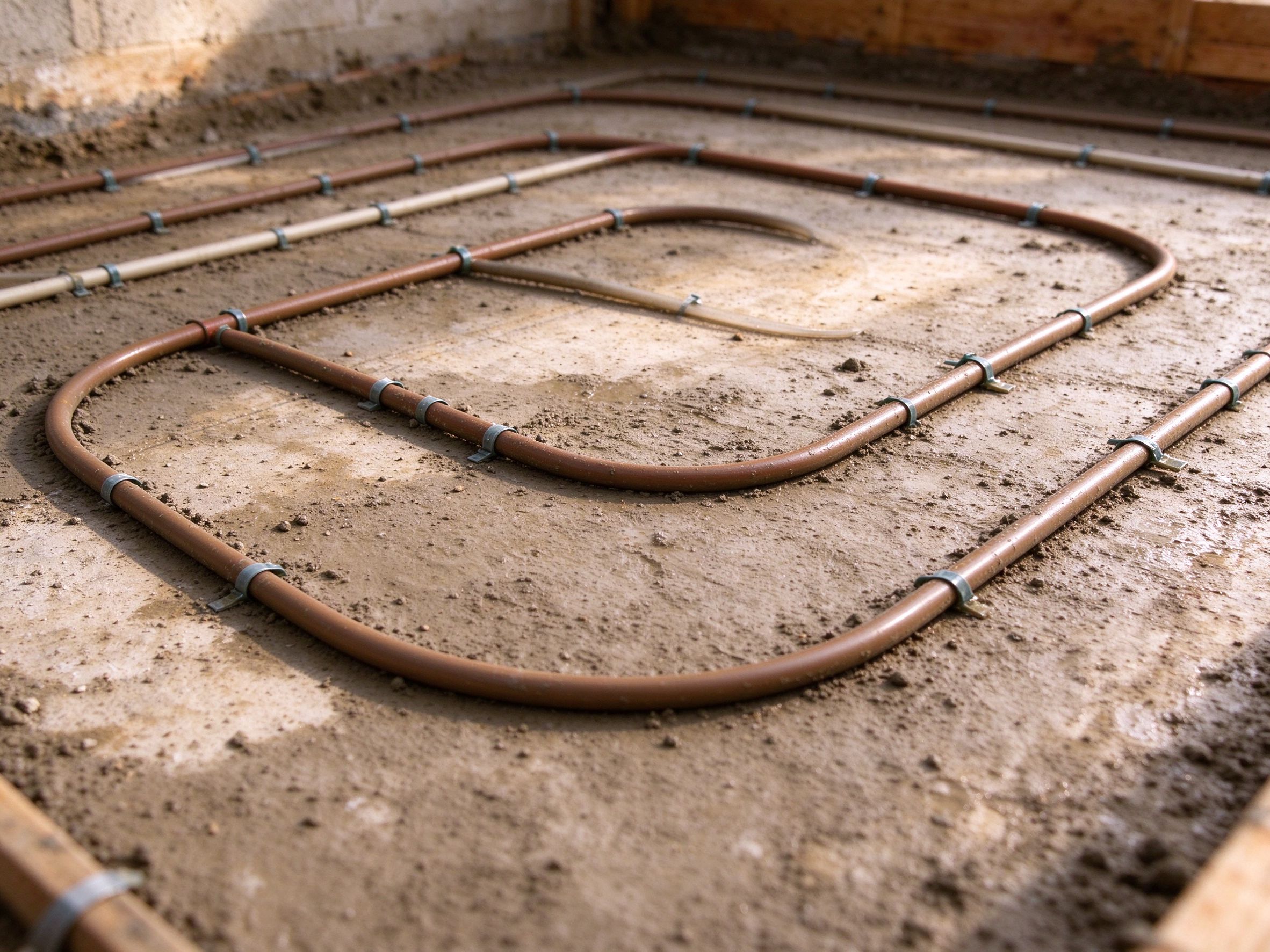
Draw the floor plan before you compare prices. Film is sold as a sheet with busbars along the edge, so it performs best on rectangles and large open spans: open-plan kitchens, living rooms, hallways, studios, warehouse break rooms. Every notch, pillar, toilet column or kitchen island you cut around leaves offcuts that you still pay for. Cable, by contrast, is priced by length and can be routed around islands, WC footprints and cabinet plinths with almost no waste — that is why cable remains the default for bathrooms and for rooms with heavy fixed furniture.
For a renovation where you cannot lift the screed, film under a floating floor is usually the only non-destructive option: insulation board, film, vapour barrier, then laminate or vinyl — total build-up about 15–25 mm depending on the board. For new builds or full re-screeding, cable gives you the option to embed heating in the slab with no additional layer, which keeps the floor profile identical to a non-heated room.
5. Material and Longevity Considerations from a Factory Perspective
As a manufacturer we run both lines, and the field-failure patterns are different. Cable failures concentrate almost always at cold-tail connections and floor-probe joints — the conductor itself rarely fails if the jacket is sound and the spacing respected. Film failures concentrate at busbar terminations and at cuts made too close to the busbar. Both are installation-controlled rather than material-controlled, which is why our graphene heating film product page and the smart thermostat range ship with termination instructions in the box, and why commissioning tests matter more than brand loyalty.
Material compliance is worth checking before you buy either technology: CE and RoHS cover the electrical and material sides, and for the film itself the PET and adhesive layers should be documented. Per SunAura factory records, our film and cable lines carry CE, RoHS, LVD and EMC compliance documentation, with the cable range additionally tested to the relevant IEC cold and heat-ageing cycles; we state this in the technical datasheet rather than inventing certificate numbers.
6. Cost Comparison: Element Price vs Installed Cost
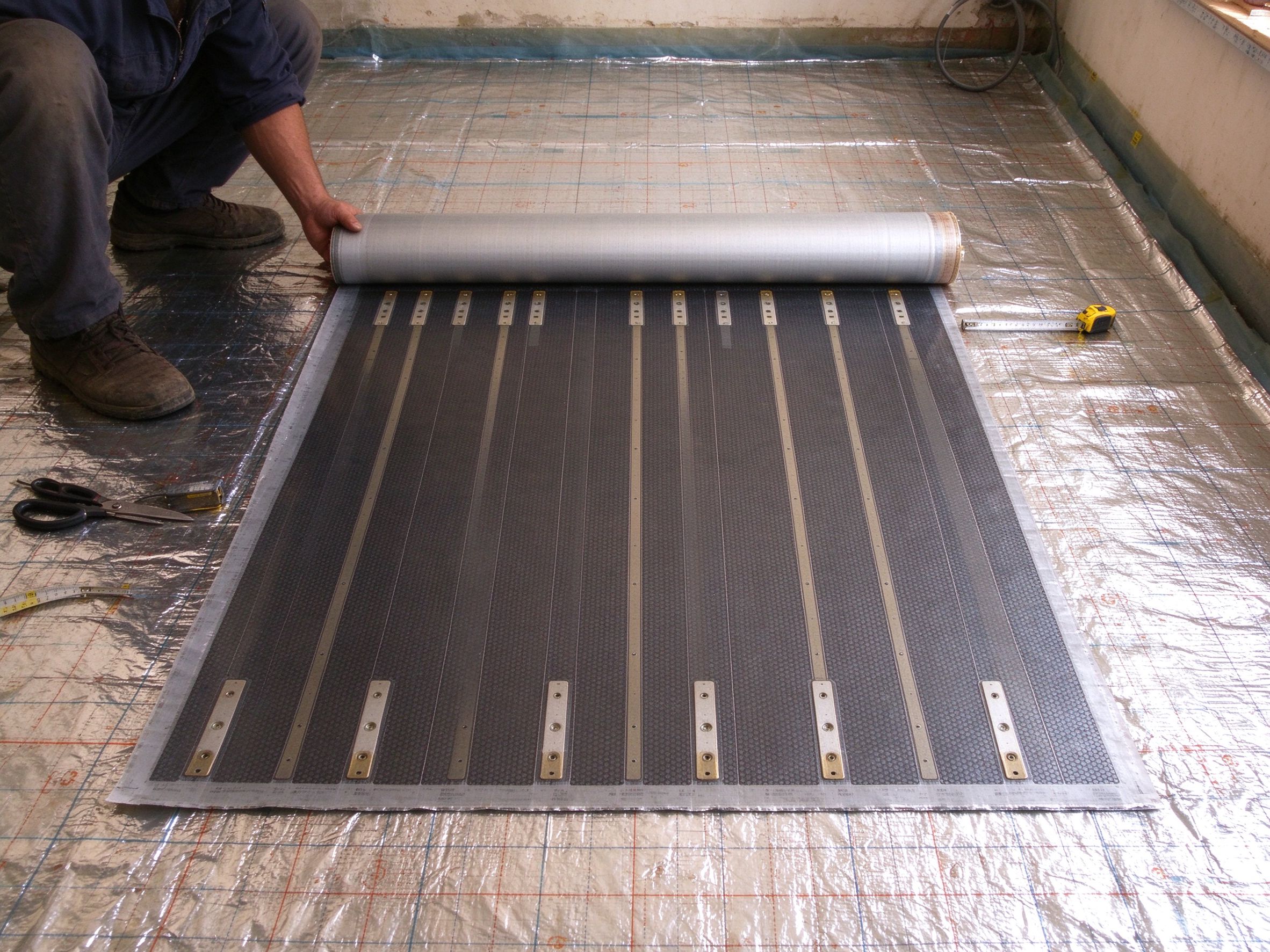
Compare total installed cost, not element price. At factory-direct level, cable element cost often runs lower per square metre, but it pulls in screed or levelling labour, longer installation time and a curing wait before first use. Film element cost is usually a little higher, but the dry-lay path removes screed work entirely and the room can be used the same day. For a typical 40 m² living area, the installed-cost gap between the two approaches is often smaller than the price difference between two suppliers of the same technology.
Budget reality in round numbers: expect element costs in the $10–25/m² band for either technology depending on width, power density and order volume, with thermostats, probes and accessories adding $30–90 per zone, and professional installation adding local labour rates on top. For a bulk heating cable order or a container-level film order, ask for the factory-direct price list with the soil and agricultural cable range as a reference point for volume pricing.
7. Control and Termination: Where Wiring Decides the Result
Both film and cable are only as good as their terminations and control. Film sheets terminate at the busbar with crimped connectors into a junction box; cable terminates at the factory-crimped cold tail. The most common field failures in both technologies happen at these joints — a loose crimp, a probe wire pulled during covering, or a thermostat wired without the floor probe in the loop. This is why the thermostat choice and the wiring plan belong in the comparison, not after it.
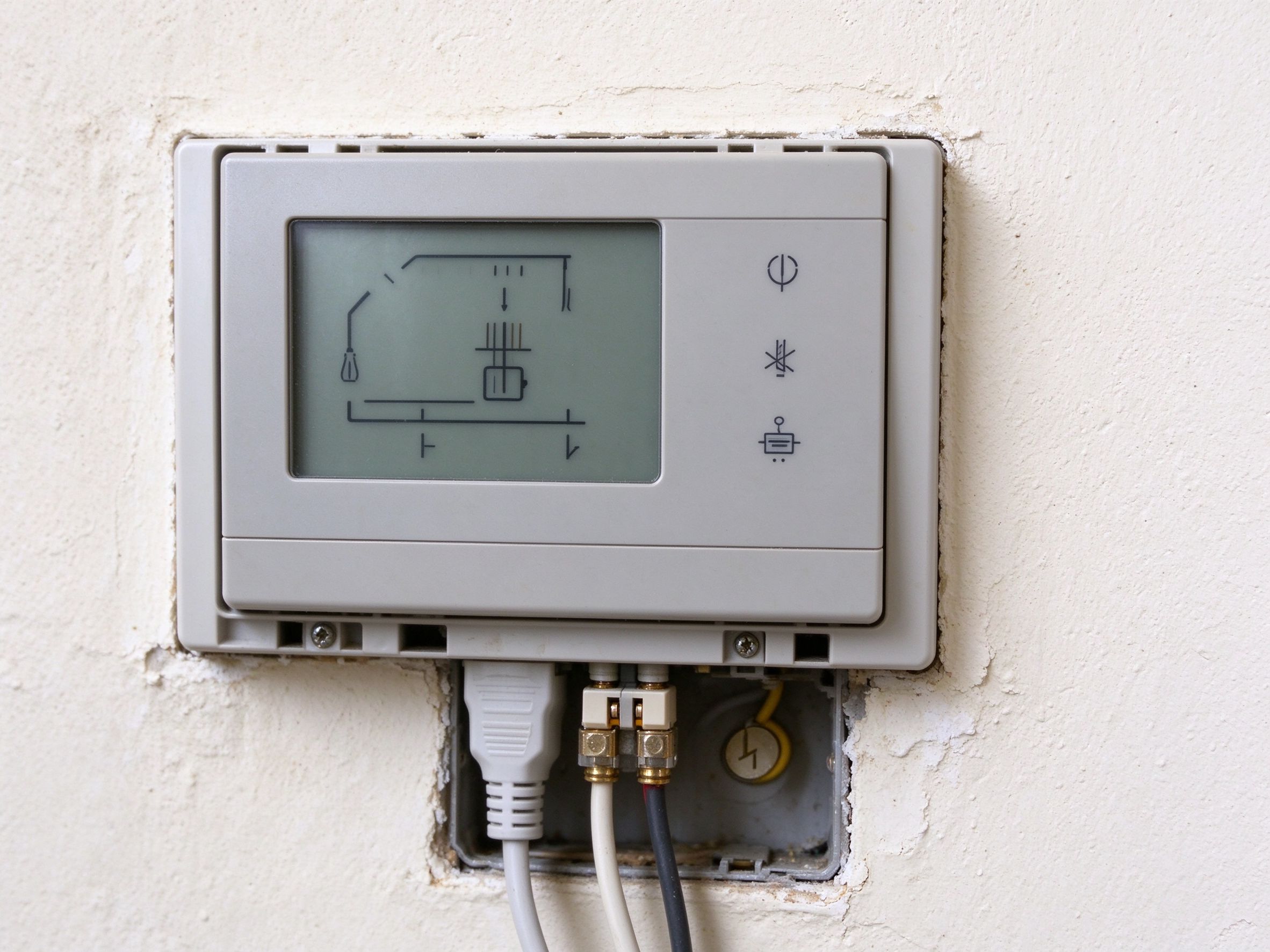
For a zoned system, plan one circuit per zone with its own probe and thermostat; combining film sheets on one circuit is fine, but keep the total load under the thermostat’s rated switching capacity, usually 16 A. If you are buying a complete kit, check that the thermostat, probes and connectors ship with the element rather than being sourced separately — mixed-brand accessories are the leading cause of “no heat” service calls that turn out to be a compatibility or wiring issue. The smart thermostat range ships with floor-probe input as standard, which removes one variable from the wiring plan.
Commissioning is the same for both: measure element resistance against the datasheet before covering, verify insulation resistance to earth, then run the dry-out protocol. Buyers who insist on documented commissioning get fewer false warranty claims — per SunAura factory records, the commissioning sheet is part of every B2B order’s documentation pack, and it is the first thing our support team asks for on a fault call.
8. Common Selection Mistakes Buyers Make
- Choosing by element price per metre instead of installed cost per usable square metre — screed labour can double the cable job.
- Using film in a room full of islands and paying for offcuts; switch to cable or a mat for kitchens with central islands.
- Laying cable too tight to “get more power” — spacing below the datasheet minimum creates hot lines and can trip the floor probe.
- Forgetting the floor covering limit: some vinyl and carpet ranges have a 27–29 °C surface limit; film under a too-thick carpet layer may not reach its rated output safely.
- Mixing technologies in one zone with a single thermostat — the probe reads the average, and one element type will run hotter than the other.
9. Data and Evidence
Per SunAura factory records: the company has manufactured heating elements since 2008 (17 years), operates from the Qingdao Huangdao plant, and exports to 50+ countries. The film line is rated for continuous operation at its declared wattage with a 20-year design life; the cable line is dual-conductor with cold-tail pre-crimped at the factory. Compliance documentation covers CE, RoHS, LVD and EMC; specific test reports are available to B2B buyers on request. For general heat-up and build-up figures cited above, values follow typical EN 1264-class installation practice; actual behaviour depends on insulation, floor covering and local supply voltage.
10. FAQ
Is graphene heating film more efficient than heating cable? Electrical efficiency is near 100% for both — resistance heating converts almost all input to heat. The practical difference is comfort and response: film feels even and heats fast; cable stores heat in screed and releases it slowly.
Can I install film under existing screed? No — film sits above the subfloor on insulation board. If you cannot raise the floor, that rules out film unless you accept a small level change.
Which lasts longer, film or cable? Both are specified for 20+ years; the field variable is installation quality at terminations and connectors, not the element itself.
Do I need a floor probe with either? Recommended with film (fast response, thin layer) and with cable under screed (thermal mass lag). The self-regulating vs constant wattage article covers why the probe strategy differs by element type.
11. What to Choose: A Decision Shortcut
- Choose graphene heating film for large open areas, floating floors, renovations without screed work, and projects where installation time and low build-up decide the job.
- Choose heating cable for irregular layouts, bathrooms, rooms with islands, new-build screed pours, and buyers who want the lowest element cost per square metre.
- Ask for both quotes when the floor plan is mixed; a hybrid (film in open areas, cable around islands) is a legitimate cost-optimised answer that more buyers should consider.
Before you request pricing, prepare the parameter list: room dimensions, floor covering, insulation level, target power density in W/m², number of zones, and expected voltage. With that sheet, a factory-direct heating element price quote is comparable across suppliers and technologies. For a quotation or OEM specification, contact the SunAura sales desk with your floor plan and the electric vs hydronic comparison as background.
— Ethan Sun, Founder & CEO, SunAura Thermal