
Why the Cable Type Changes Your Whole System Cost
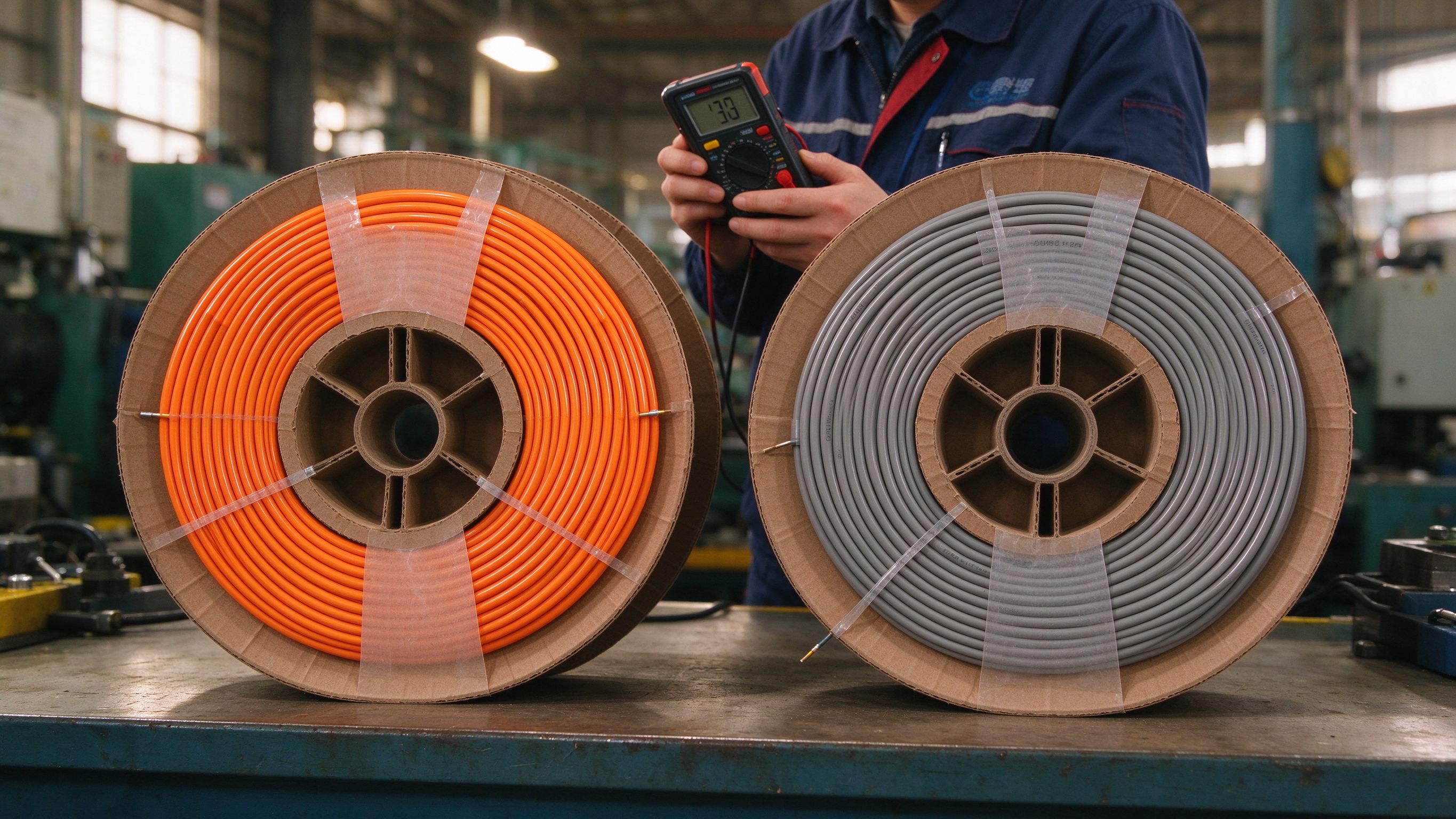
Two heating cables can be coiled side by side in the same warehouse and look almost identical, yet behave completely differently in the field. A self-regulating vs constant wattage heating cable comparison is one of the most common procurement questions we receive, and it is also one of the most consequential: the choice determines the electrical design, the controller, the maximum length per circuit, the safety devices, and the operating cost for the next twenty years. This article gives procurement teams and project engineers a decision framework, a comparison table, and a checklist they can hand to any supplier.
Both cable families are manufactured in our Qingdao (Huangdao) factory, which has produced heating elements for 17 years under ISO 9001 quality management. All performance characteristics quoted here reflect our production and test records (per SunAura factory records) and the common engineering understanding of the two technologies.
How Self-Regulating (PTC) Cables Work — and Where They Shine
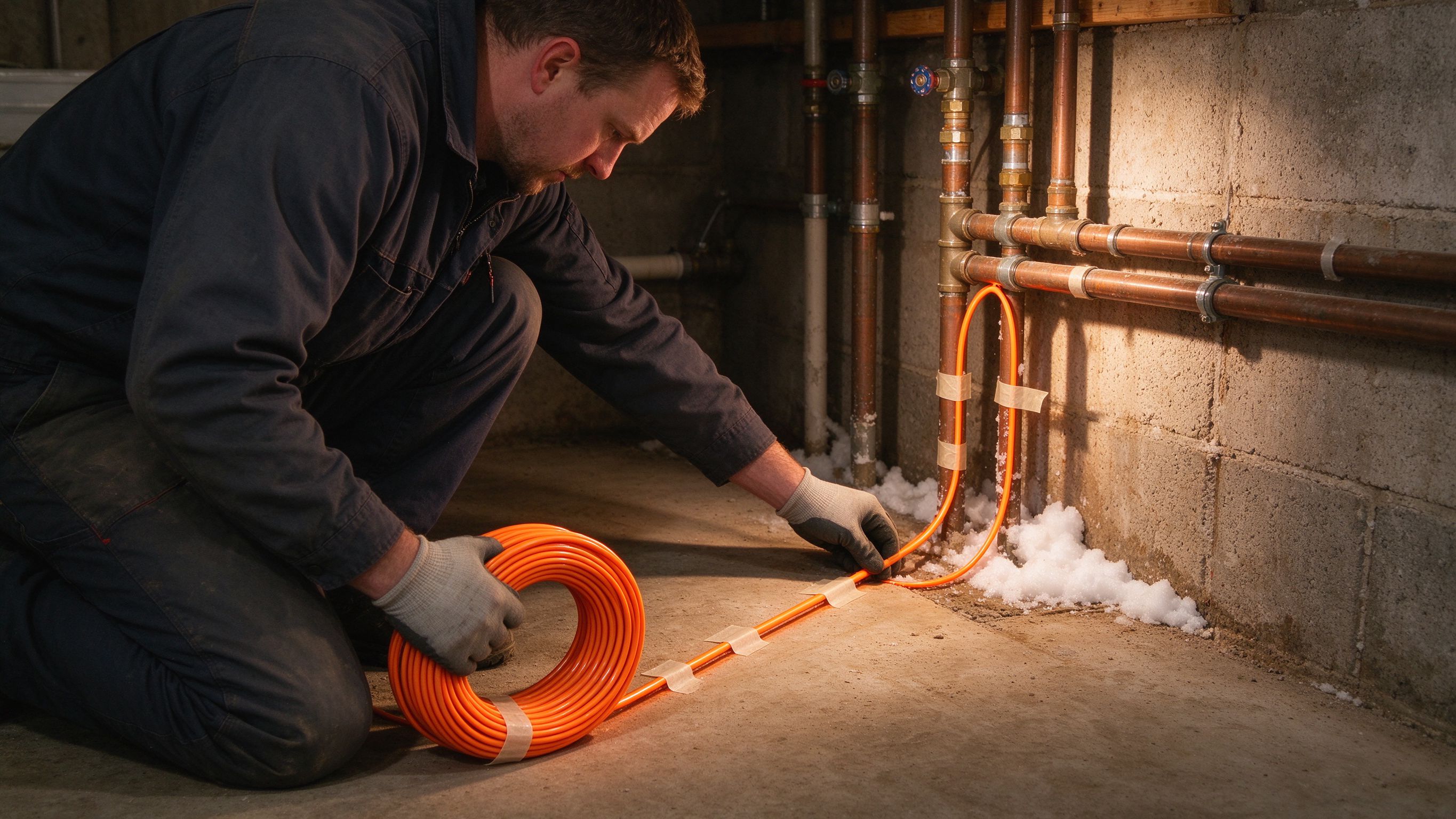
A self-regulating cable is built around a conductive polymer core sandwiched between two bus wires. The polymer has a positive temperature coefficient (PTC): as the cable heats up, the polymer’s resistance rises, so the power output per metre falls. Hot spots cannot persist, because the material itself throttles the energy in the hot zone — this is why the technology is also called PTC self-regulating heating cable.
Practical consequences of PTC behaviour:
- Safe to overlap — where the cable crosses itself or bunches under a fitting, output drops locally instead of overheating.
- Cut-to-length — the cable can be cut and terminated at any point in the field, which simplifies installation on irregular pipe runs.
- No separate over-temperature control needed in many cases — the self-limiting action provides inherent protection, although a thermostat is still recommended for energy control.
- Lower output when warm — under steady-state operating conditions the cable settles at a balance point, so peak W/m is available only when the pipe is cold.
Where it shines: pipe freeze protection, roof and gutter de-icing, valve and flange tracing, tank heating, and anywhere the geometry is irregular, the environment is uncontrolled, or over-heating must be impossible by design.
How Constant Wattage Cables Work — and Where They Shine
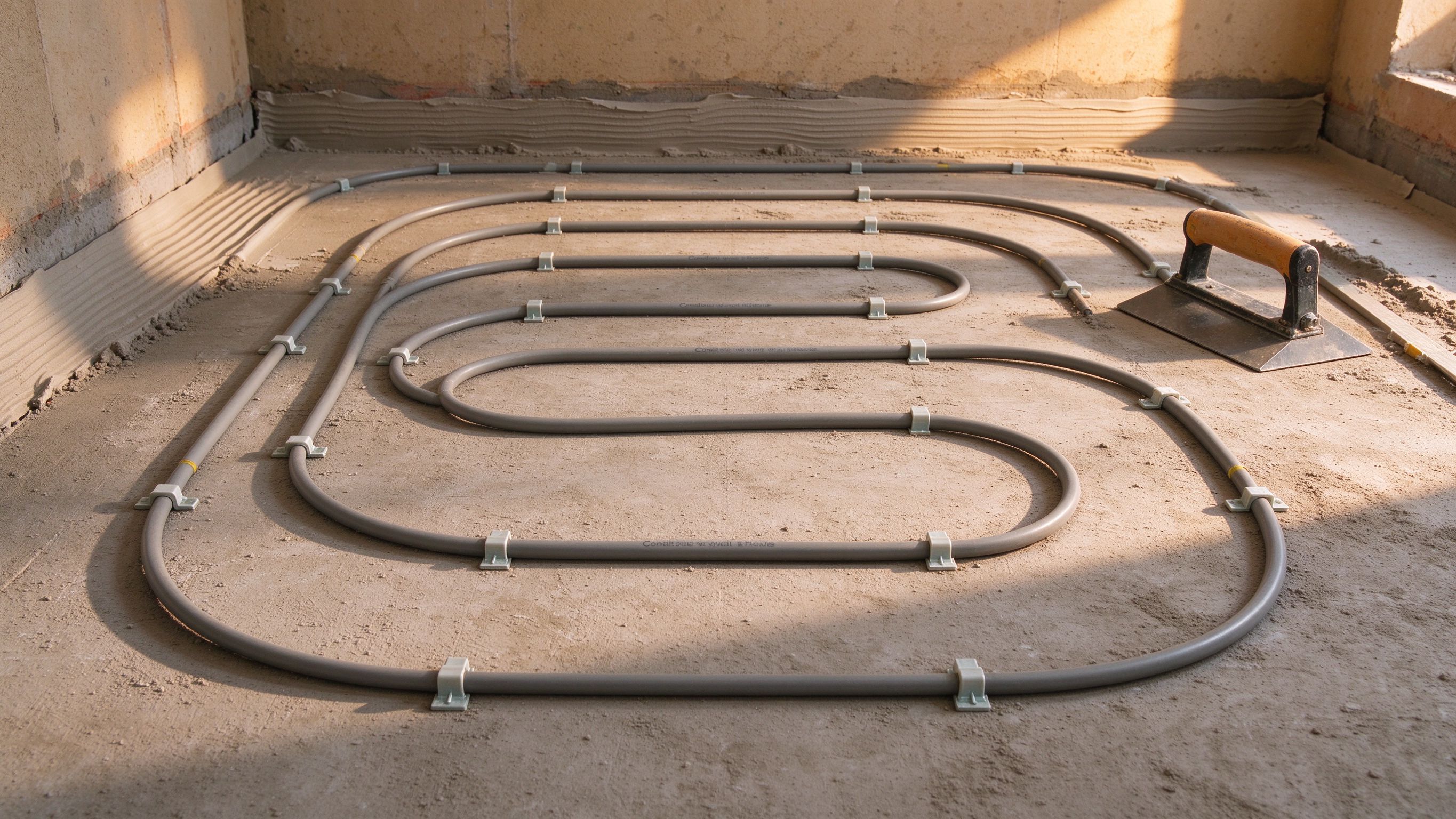
A constant wattage cable uses a continuous resistance heating element (typically alloy resistance wire around a fibreglass core) with a fixed output per metre at a given voltage. Unlike PTC cable, its resistance does not change meaningfully with temperature, so it delivers the same W/m whether the surface is cold or hot. Output is therefore predictable and uniform along the entire length — an advantage for applications that need guaranteed, even heat.
Practical consequences of constant wattage behaviour:
- Stable, predictable output — the design wattage is delivered at rated voltage, which simplifies heat-loss calculations.
- Higher steady-state output available — because output does not droop as the cable warms, constant wattage cable can maintain high surface temperatures where required.
- Must not overlap — fixed output means overlapping creates genuine hot spots; installation must respect minimum spacing.
- Fixed lengths per circuit — output depends on total resistance, so circuits must be designed around specified lengths and cannot be arbitrarily cut in the field.
Where it shines: underfloor heating in screed, roof snow melting, floor warming, and any application where the designer wants deterministic wattage per square metre and has control over layout.
Side-by-Side Comparison: Self-Regulating vs Constant Wattage Heating Cable
| Dimension | Self-regulating (PTC) | Constant wattage |
|---|---|---|
| Output behaviour | Output falls as temperature rises (self-limiting) | Fixed W/m at rated voltage |
| Overlap safety | Tolerates overlap; local output drops | Overlap creates hot spots — forbidden |
| Field cutting | Cut-to-length at any point | Fixed design lengths per circuit |
| Steady-state output | Settles at a lower balance-point output | Full rated output maintained |
| Typical applications | Pipe freeze protection, roof de-icing, valves, tanks, irregular geometry | Underfloor heating, floor warming, roof snow melting, process tracing |
| Control requirements | Inherent overheat protection; thermostat for energy control | Requires correct circuit design and overcurrent/GFCI protection; thermostat standard |
| Cost per metre | Typically higher (PTC core) | Typically lower |
| Best procurement fit | Freeze-protection OEM kits, harsh outdoor duty, cut-to-fit installations | Volume floor heating projects, deterministic W/m² designs |
Notice that the two families are not competing for the same job — they overlap only at the edges. Most projects we see make a mistake when they use one technology for the other’s application: PTC cable in a screed floor where stable wattage is wanted, or constant wattage cable wrapped around irregular valves where overlap is unavoidable.
Application-by-Application Selection Guide
Use the following rules of thumb to map your project to the correct family:
- Water pipes, outdoor hydrants, roof valleys, gutters → self-regulating. Geometry is irregular, the environment is uncontrolled, and cut-to-length simplifies the job. See our pipe freeze protection heat trace cable guide for sizing details.
- Underfloor heating in screed or tile adhesive → constant wattage. The installer controls spacing, the thermostat controls the temperature, and deterministic W/m² makes the heat-loss calculation clean. If you are comparing systems, our electric vs hydronic underfloor heating article covers the system-level choice.
- Roof snow melting with exposed gutter runs → self-regulating where overlaps occur at downspouts; constant wattage where straight runs dominate and output must be guaranteed.
- Food, beverage and process lines → depends on temperature class and exposure; consult the supplier with the exact duty cycle.
- Warm floors in bathrooms and kitchens → constant wattage heating cable or heating mat, sized per the underfloor heating wattage calculation method.
Data & Evidence: Factory Validation
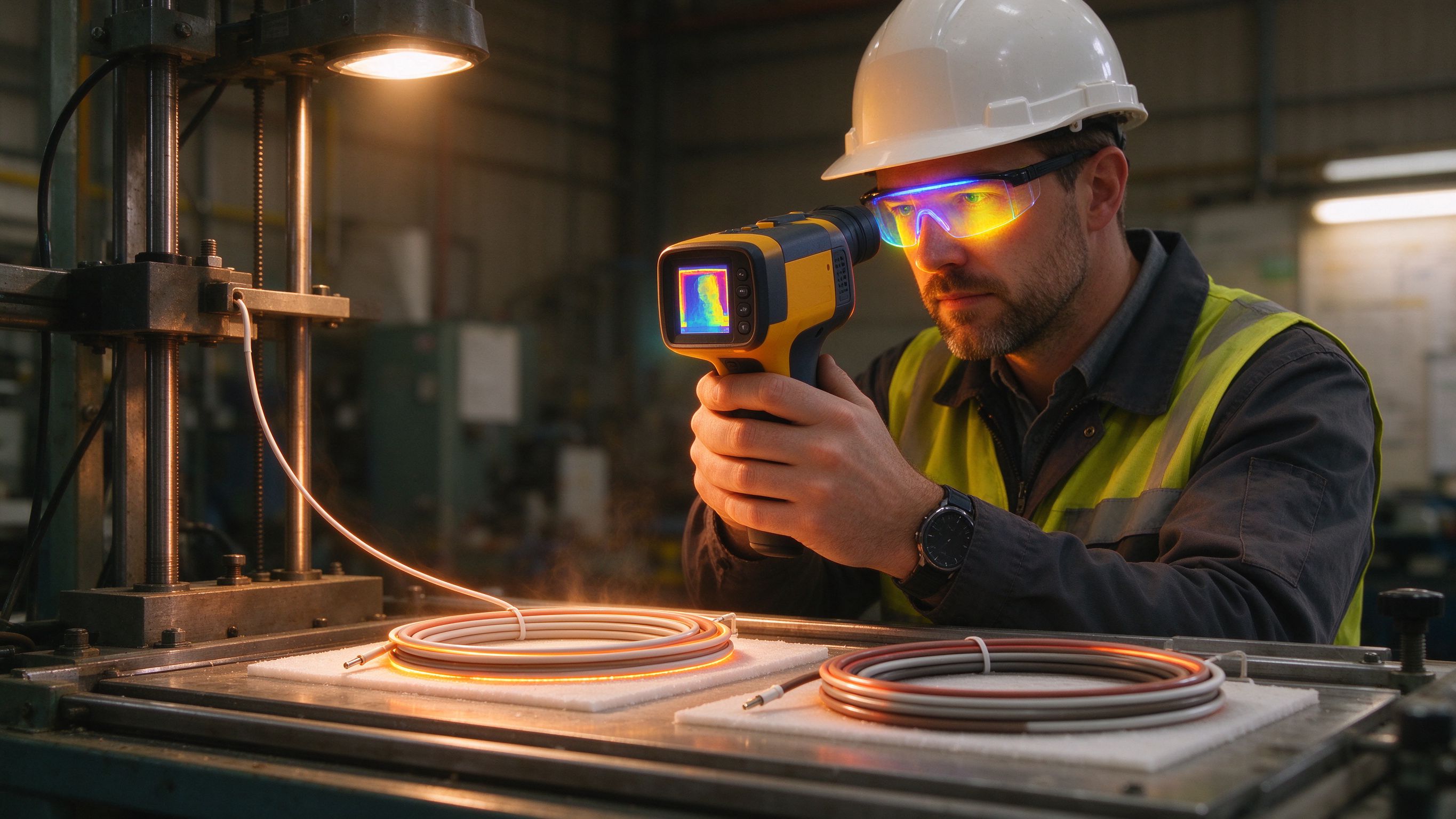
Both cable families leave our factory only after passing the same disciplined test sequence (per SunAura factory records):
- Resistance measurement — every reel is measured and logged; constant wattage reels must match the design resistance within tolerance so the installed wattage matches the calculation.
- Dielectric and insulation resistance tests — performed at the factory before termination and after cold-end assembly.
- Cold start behaviour — PTC constructions are verified for inrush current and warm-up curve on sample basis.
- Heat-ageing and bend tests — jacket and core samples are aged and flexed at rated conditions.
- Traceability — batch records tie every reel to its test data, which is what our factory testing and quality control system is designed to guarantee.
- Compliance — production runs under ISO 9001, ISO 14001 and ISO 45001 management systems; finished products are CE marked and assessed for RoHS, LVD and EMC where applicable. Certificate copies and batch reports are provided on request.
We deliberately do not quote certificate numbers in this article. Ask any supplier for the actual documents and the batch test report for the exact construction on your order.
Procurement Checklist: What to Send a Supplier
To get a correct quotation for either cable family, include these points in your RFQ:
- Application and environment — pipe/floor/roof/tank, indoor/outdoor, wet/dry, ambient temperature range, exposure to chemicals.
- Voltage — 120V, 230V, 240V, or low-voltage DC variants where applicable.
- Output requirement — W/m at rated voltage (and for PTC, the intended balance temperature or duty cycle).
- Geometry — straight runs, overlaps, valve clusters, cut-to-length requirement; this decides the family.
- Control strategy — thermostat, controller, or none; ask whether the supplier provides matching thermostats (we do, including floor heating controllers).
- Terminations and accessories — cold leads, connection kits, clips, labels, OEM packaging for your brand.
- Certification and documentation — CE, RoHS, destination-market marks, and batch reports with each shipment.
- Quantity, MOQ and lead time — and a request for a pre-production sample if you are qualifying a new supplier.
Our team manufactures both technologies in one factory, which makes a factory-direct heating cable procurement simpler than splitting the basket across suppliers: one quality system, one set of test records, one logistics partner.
Electrical Design Notes: Current, Circuit Length and Protection
The electrical design differs between the two families in ways that matter for procurement: maximum circuit length, inrush current, and the protection devices you must specify. A supplier who understands both will catch errors before they reach the site; here is what you need to know to ask the right questions.
Maximum circuit length. Constant wattage cable has a design resistance per metre, so the total length per circuit is dictated by the allowable current and the breaker rating. Ask the supplier for a maximum-circuit-length table for the voltage and W/m you are buying, and design your zones against it. Self-regulating cable is usually ordered in specific lengths for each run, but because its output varies with temperature the current draw also varies — the design must use the cold-start (inrush) value, which is higher than the steady-state value.
Cold-start inrush. PTC self-regulating cable draws a surge of current when first energised, because the polymer is cold and its resistance is low. The inrush typically settles within seconds to minutes as the cable warms, but the circuit breaker and the contactor (if any) must be rated for the cold value. This is a common source of nuisance tripping when a PTC system is specified without considering inrush. Constant wattage cable has no meaningful inrush; its current is stable from switch-on.
Protection devices. Outdoor and wet-area heating circuits should be protected by a residual-current device (RCD/GFCI/ELCB) sized for the circuit. Overcurrent protection must match the cable’s current at rated voltage, and for constant wattage the breaker also protects the element against overload if the wrong voltage is ever applied. Include the protection device type in your RFQ so the supplier can confirm compatibility with the cable’s leakage characteristics.
Control and sensing. Underfloor installations use a floor thermostat with a floor sensor to limit surface temperature; pipe installations often use an ambient thermostat or a dedicated freeze-protection controller. Confirm which control your supplier recommends for the cable family you chose — our range includes thermostats and floor heating controllers that match both cable types, and the correct pairing avoids sensor mismatch issues on site.
Documentation. Request the electrical data sheet with your quotation: rated voltage, nominal W/m, resistance per metre, inrush factor, maximum circuit length, and recommended breaker rating. If any of these is missing, treat the quote as incomplete.
FAQ
Can self-regulating cable be used for underfloor heating? Technically yes, but constant wattage cable (or heating film/mat) is almost always the better choice in screed because you want deterministic wattage per square metre and the layout is controlled.
Does constant wattage cable need a special thermostat? Standard floor heating thermostats work; circuit protection must be calculated correctly for the cable’s current draw. Overlap must be avoided by design.
Why is PTC cable more expensive per metre? The conductive polymer core and manufacturing process cost more than resistance wire; you pay for inherent overheat protection and cut-to-length convenience.
Which cable is better for pipe freeze protection? For most pipework, self-regulating is the industry default because of overlap safety and field cutting. Our pipe freeze protection guide covers sizing and installation.
How do I know which family a supplier is really offering? Ask for the electrical data sheet: a constant wattage cable shows a fixed W/m at rated voltage and a design resistance per metre; a self-regulating cable shows an output curve against temperature and a cold-start inrush factor. If the data sheet is missing, treat the quote as incomplete.
Can one controller run both cable types? Yes, a suitable thermostat can control either family, but the sensor strategy and circuit design differ. Confirm the controller’s rating against the cold-start current for PTC cable and the steady current for constant wattage cable before wiring.
Next Step: Define the Application, Get the Right Cable
The self-regulating vs constant wattage decision comes down to one question: is your environment controlled or not? Controlled layout and predictable wattage point to constant wattage; irregular geometry and uncontrolled outdoor duty point to self-regulating. Define your application, send the checklist above, and SunAura Thermal will confirm the construction, voltage, output, and terminations with you before production.
The decision framework above is deliberately simple: one question — is your environment controlled or not — two answers, and a checklist that closes the loop with any factory.
Contact our export team for wholesale pricing and samples at [email protected].
About the author: Ethan Sun, Founder & CEO, SunAura Thermal. SunAura has manufactured electric heating film, mat and cable in Qingdao, China, for 17 years, supplying CE/RoHS-compliant heating products to more than 50 countries.