
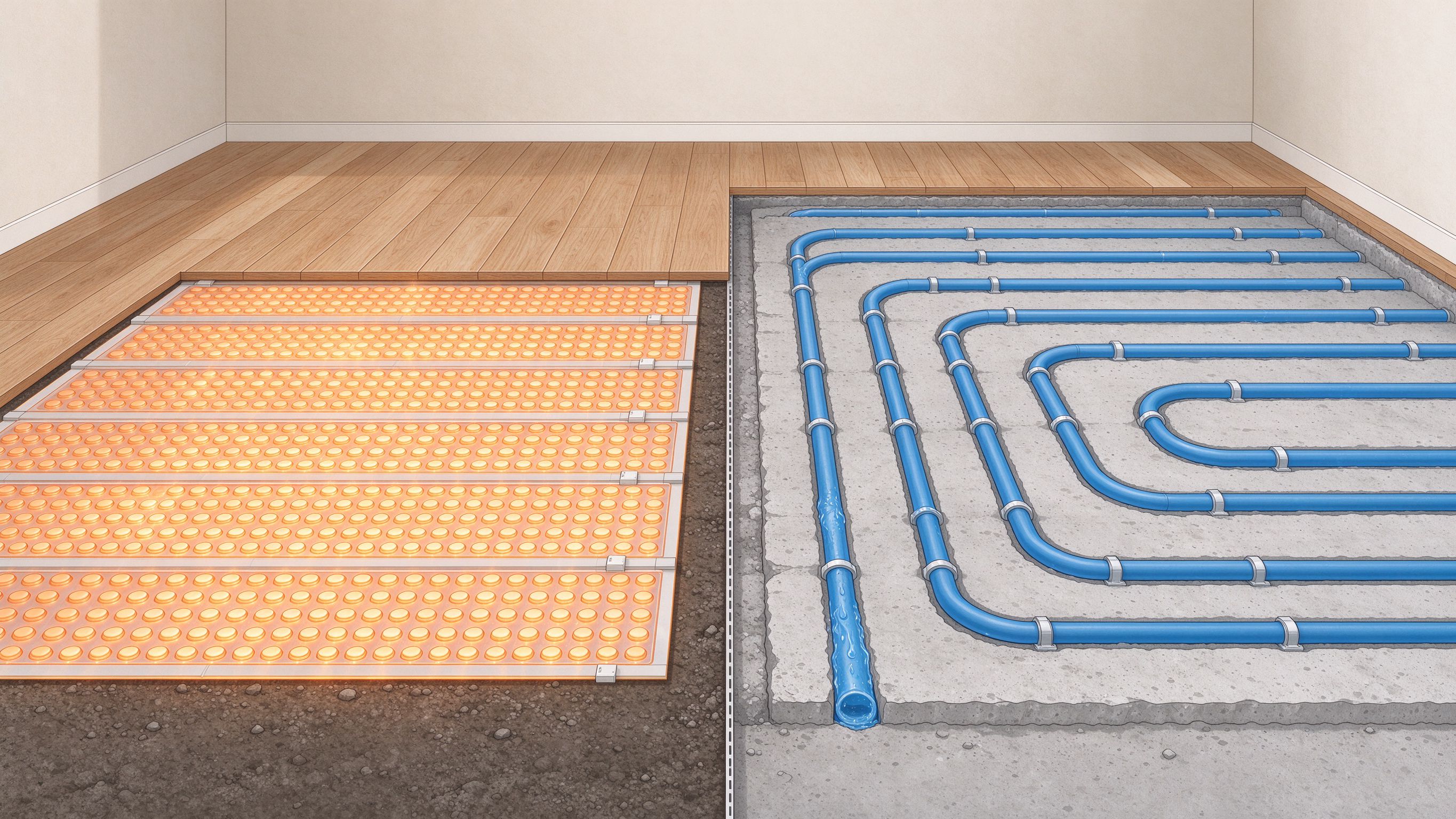
Electric vs Hydronic Underfloor Heating: Efficiency, Running Cost and Fit-Out Comparison
Choosing between electric vs hydronic underfloor heating is one of the most common debates in building projects, and the answer changes with the project. Hydronic (water) systems circulate heated water through pipes embedded in the floor; electric systems use heating film, mat or cable to generate heat directly beneath the floor surface. This guide compares the two technologies on efficiency, running cost, installation time, floor height, maintenance and control, with the factory perspective from a manufacturer that supplies electric systems to more than 50 countries.
The decision is not about which technology is “better” in the abstract. It is about your heat source, your floor build-up, who installs it, and how the room will be used. Read the comparison, check the cost table, and if the electric route fits your project, request an electric underfloor heating wholesale quote with your room sizes.
How the two systems work
A hydronic underfloor heating system uses a boiler, heat pump or district supply to heat water, then pumps that water through pipes laid in loops across the floor, typically embedded in screed or between floor joists. Heat transfers from the pipe surface through the screed to the floor finish. The system needs a manifold, pumps, zone valves and a mixing or control unit, plus the plumbing to connect it to the heat source.
An electric underfloor heating system converts electricity to heat directly in the element: graphene film under a floating floor, heating mats under tile, or heating cable embedded in screed. There is no boiler, no pump, no manifold and no water. A thermostat with a floor sensor controls the element, and the system is effectively independent of any other heating plant in the building.
That structural difference explains most of the operational differences below. Hydronic systems centralise heat generation and distribute it through water; electric systems distribute heat generation itself across the floor.
<img src="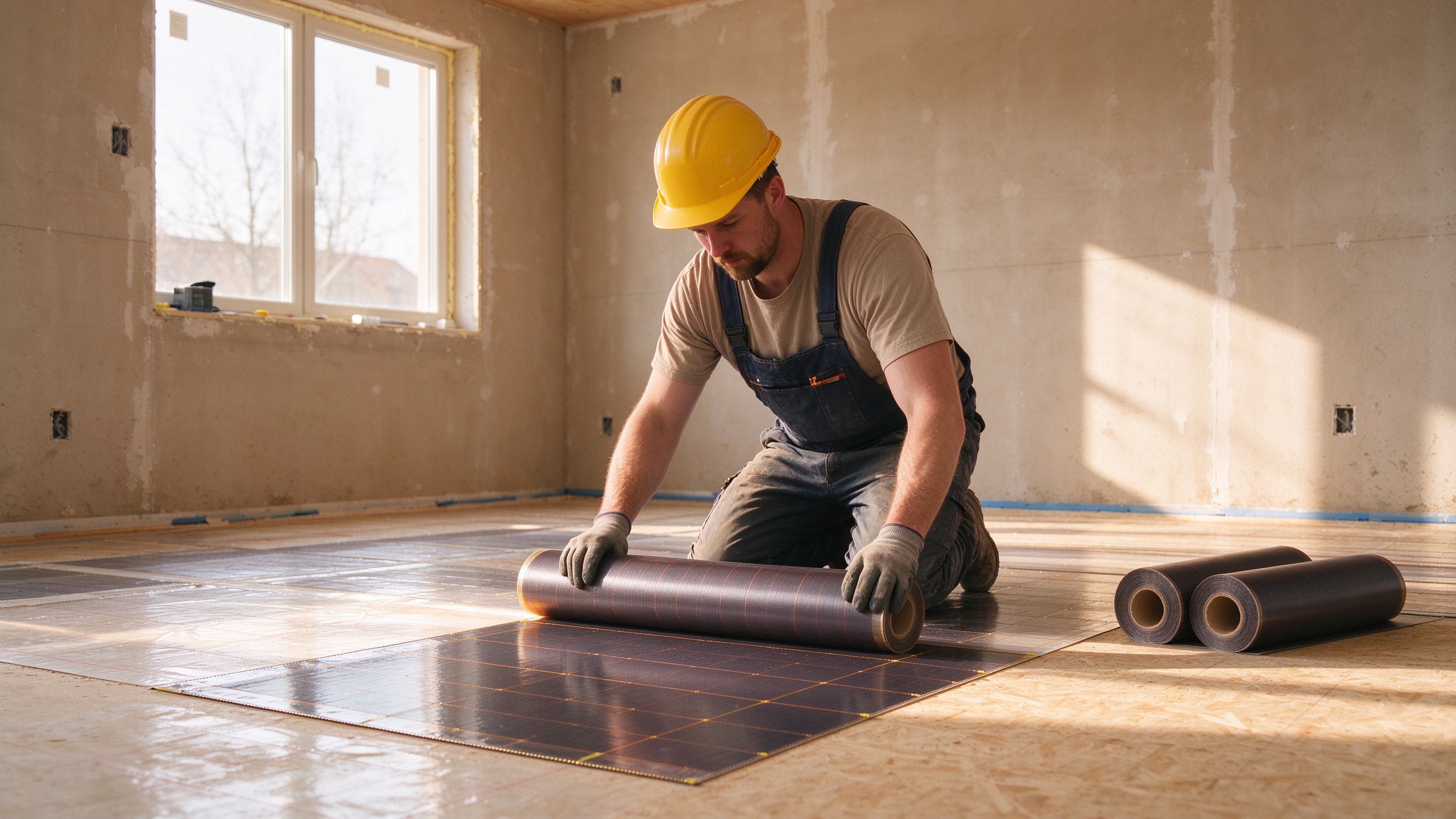 ” alt=”Worker installing electric heating film on a subfloor in a new-build room” loading=”lazy” width=”1280″ height=”720″ />
Efficiency: source efficiency versus distribution losses
Efficiency must be compared at two levels. At the source, a modern condensing gas boiler can convert roughly 90% of fuel into useful heat, while a heat pump can deliver three or more units of heat per unit of electricity. Electric resistance heating converts essentially 100% of the electricity into heat at the element. On paper, hydronic with a heat pump wins the source-efficiency argument; electric resistance wins the simplicity argument.
At the distribution level, electric floor heating has fewer losses: there is no pump energy, no heat loss from distribution pipes, and the element sits directly under the floor, so the heat enters the room where it is needed. Hydronic systems lose heat along pipe runs and through the boiler or buffer tank when the plant is oversized. For small, intermittently used rooms — a home office, a bathroom, a studio — those distribution losses can outweigh the source-efficiency difference, which is why small spaces so often end up electric.
European building regulations increasingly reward the system efficiency, not the element efficiency alone. The EU Energy Performance of Buildings Directive and the ErP energy label framework push projects to combine efficient heat sources with low-temperature emitters such as underfloor heating. Both electric and hydronic underfloor systems are low-temperature emitters; the choice interacts with the heat source you already have or plan to install. The EU Commission’s EPBD documents describe this system-level thinking, and it is the context buyers should use when comparing options.
Running cost: the honest comparison
Running cost depends on local energy prices, not on the technology in isolation. In countries where electricity is expensive relative to gas, hydronic systems with a gas boiler can show lower running cost per kilowatt-hour of heat. In regions with cheap off-peak electricity or high gas prices, electric underfloor heating can be cheaper to run — and simpler to control on a time-of-use tariff.
A practical approach is to compare pence or cents per useful kilowatt-hour delivered to the room:
- Electric resistance: 1 kWh of electricity in, ~1 kWh of heat at the floor.
- Gas boiler hydronic: 1 kWh of gas in, ~0.9 kWh of heat into the pipes, minus pipe and pump losses.
- Air-source heat pump hydronic: 1 kWh of electricity in, 3-4 kWh of heat into the pipes, minus pump and flow-temperature losses.
For a small room heated intermittently, the electric route often costs less in practice because it heats only when needed and responds in minutes. For a large whole-house system running continuously in a cold climate, hydronic with a heat pump usually delivers the lowest annual cost. The electric underfloor heating running costs article works through a per-square-metre example with real tariff assumptions.
Installation time, floor height and disruption
Installation speed is where electric systems win decisively. A graphene heating film or heating mat install is a one-to-two-day job for a typical room: insulation, element, sensor, thermostat, then the floor finish. Film and mat add only a few millimetres to the floor build-up, which makes them the standard choice for renovations where floor height is precious and for floating floors that must not be thickened.
A hydronic system needs pipe laying, screed or anhydrite pour, curing time of several days to weeks, manifold installation, pressure testing and connection to the heat source. The screed alone typically adds 5-7 cm of build-up and a curing period that can delay the project by weeks. In apartment blocks, the floor loading and height constraints can rule out a screed-based water system entirely, which is why retrofit apartments so often use film or mat.
<img src="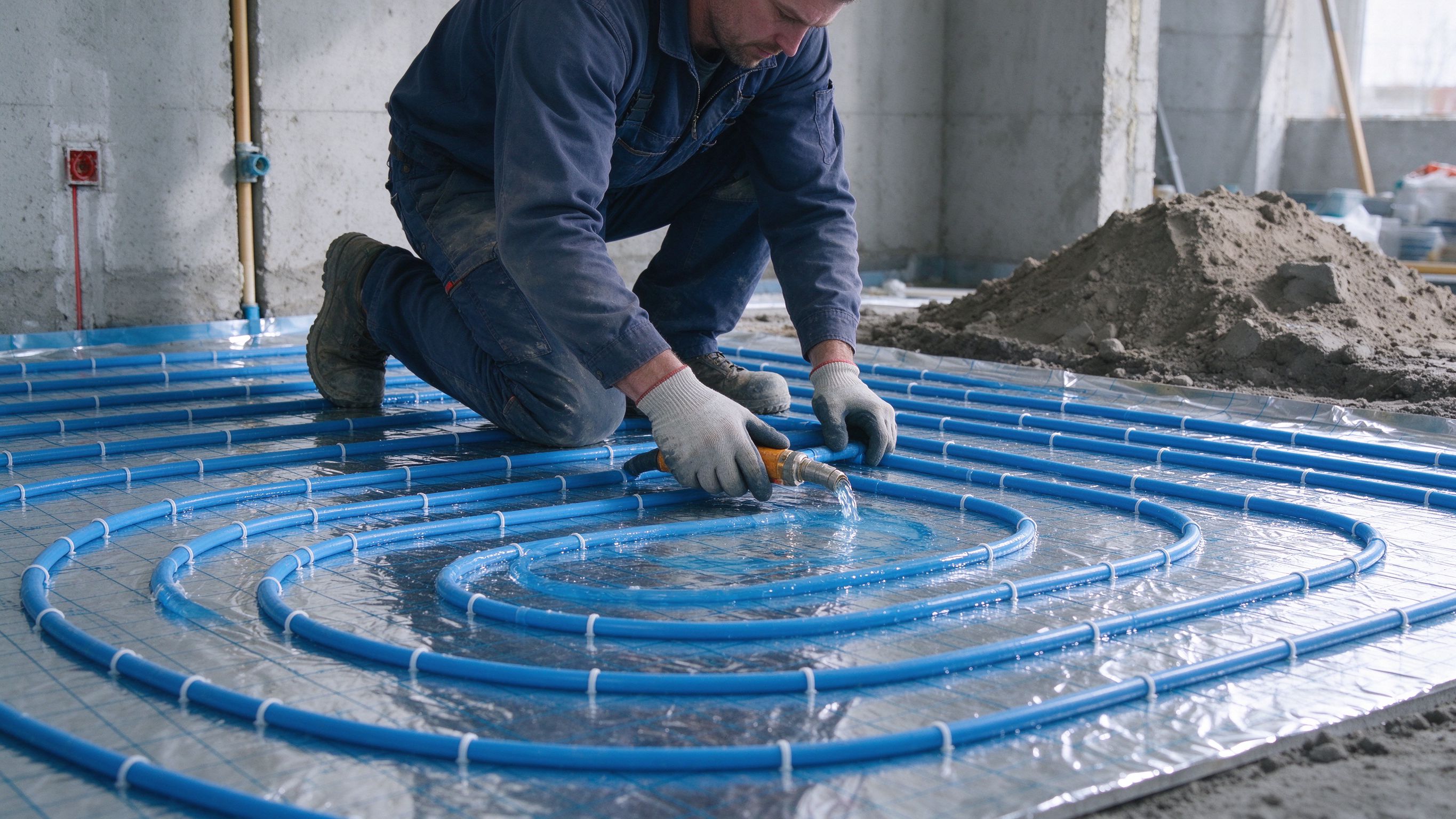 ” alt=”Plumber laying blue water underfloor heating pipes in zigzag loops on insulation boards” loading=”lazy” width=”1280″ height=”720″ />
Maintenance, failure modes and life expectancy
Electric systems have almost nothing to maintain: there is no pump, no valve, no fluid to bleed, and no corrosion. The components with a finite life are the thermostat and the element, both of which are passive and buried under the floor. A correctly installed heating cable in screed has an expected service life of 15-25 years per SunAura factory records, and the element carries a warranty with the batch documentation.
Hydronic systems have moving parts: pumps, zone valves, expansion vessels and the boiler or heat pump itself. They need periodic servicing, pressure checks and, in hard-water areas, attention to scale and corrosion. A water leak in an embedded pipe is a serious event that can damage flooring and require lifting the floor to repair. Proponents of hydronic systems answer that the moving parts are above the floor and serviceable; the pipe itself is expected to last decades if correctly designed.
For a buyer weighing risk, the question is whether they want a heating system with essentially no maintenance under the floor (electric) or a plant room with serviceable equipment and a buried water circuit (hydronic). Both are defensible; the answer depends on the building and the owner’s tolerance for periodic maintenance.
Control and zoning: where electric simplifies everything
Electric underfloor heating controls per room as standard: each room gets its own thermostat and floor sensor, and the element responds within minutes, so zonal scheduling genuinely saves energy. A home office can be warm at 8am and frost-protected by 11am; a spare bedroom can stay off for weeks without affecting other rooms.
Hydronic systems can also zone, but zoning requires multiple manifold circuits, zone actuators and a controller, and each zone still shares the heat source. In practice, water systems are often run as fewer, larger zones to control cost. If fine per-room scheduling is a priority — the pattern that suits intermittently occupied modern homes — electric is the simpler and more reliable way to deliver it, especially with a smart thermostat for underfloor heating on every zone.
Data and evidence: what a 17-year manufacturer observes
SunAura Thermal has produced electric heating elements at its Qingdao Huangdao factory since 2008, under ISO 9001, ISO 14001 and ISO 45001, with CE, RoHS, LVD and EMC compliance for the European market. Per SunAura factory records, the product lines cover graphene film (100-200 W/m²), heating mats (160 W/m² typical) and heating cables, exported to more than 50 countries with batch documentation on every shipment.
The factory observation from thousands of project enquiries is consistent: buyers choose electric underfloor heating when they value installation speed, floor height, per-room control and zero maintenance; they choose hydronic when they have a heat-pump or boiler project, a large continuous heating load, and the budget and programme for a screed installation. Both choices are legitimate; the mistakes happen when a buyer picks a technology for a reason that does not match the project, such as choosing a water system for a single renovated room or an electric system for a 300 m² whole-house heating load on expensive peak-rate electricity.
<img src="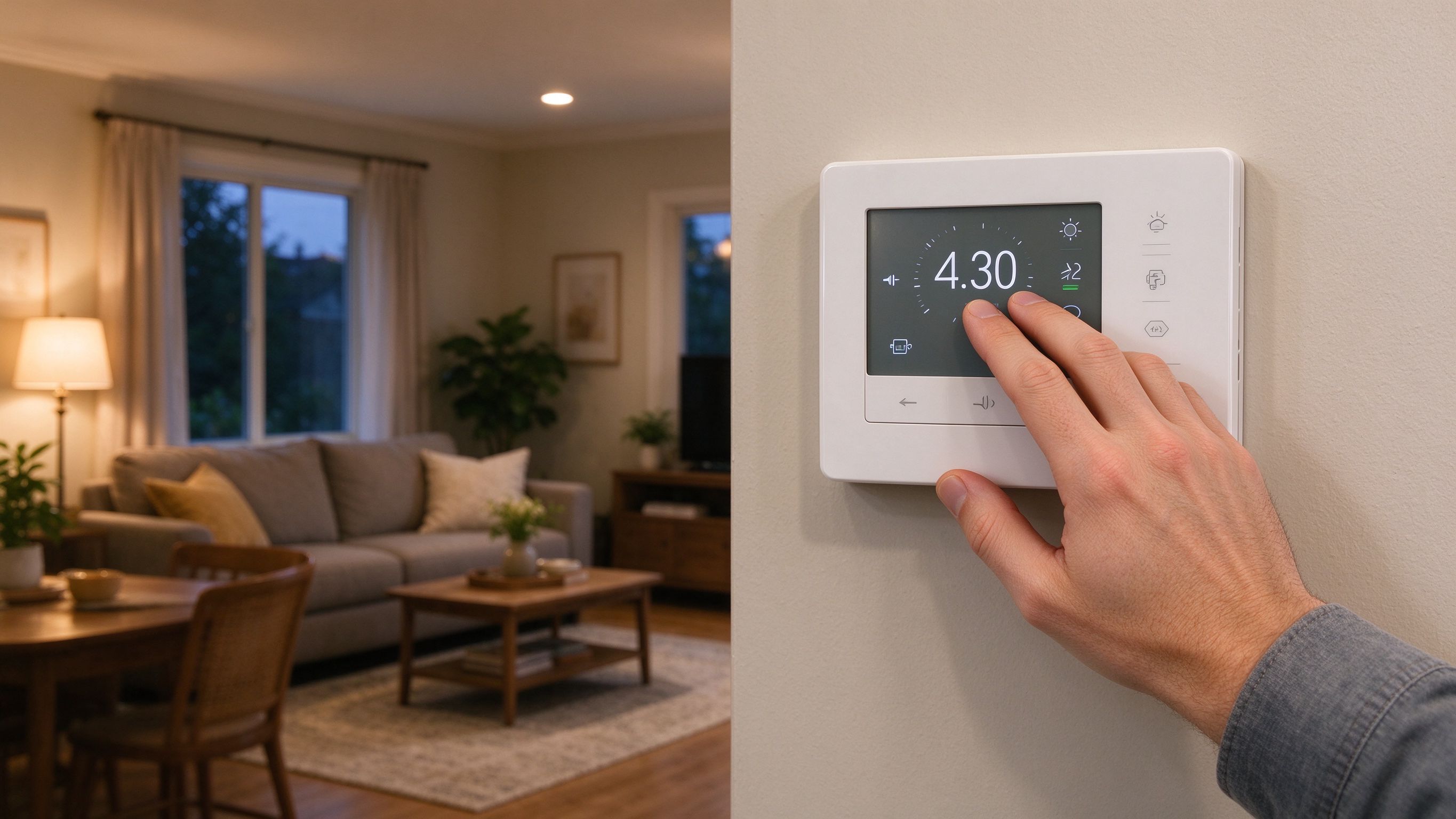 ” alt=”Homeowner adjusting a smart thermostat panel in a warm living room” loading=”lazy” width=”1280″ height=”720″ />
Environmental and policy context
The regulatory direction in Europe favours low-temperature emitters and renewable heat sources, and both underfloor technologies qualify. The EU Energy Performance of Buildings Directive drives renovation and new-build projects toward lower flow temperatures and better system control, which is precisely what underfloor heating delivers: it is the classic low-temperature emitter. The ErP energy label framework also rewards efficient system packages, so the choice between electric and hydronic increasingly sits inside a larger energy strategy that includes insulation, ventilation and the heat source.
For the electric route, the environmental case rests on the electricity mix and the control behaviour. Where the grid is decarbonising, or where a home has solar panels, electric floor heating powered during sunny hours or off-peak windows aligns with the renewable generation pattern. For the hydronic route, the case rests on the heat pump: a well-sized air-source or ground-source pump paired with underfloor pipework delivers the lowest carbon heat of the two routes in most cold climates. The solar powered underfloor heating article shows how PV and electric floor heating work together, and the gas boiler phase-out guide explains the policy timeline homeowners are now planning around.
Frequently asked questions
Is hydronic underfloor heating cheaper to run than electric?
It depends on energy prices. Hydronic with a heat pump is usually the cheapest per unit of delivered heat; hydronic with a gas boiler is competitive where gas is cheap. Electric can be cheaper for small, intermittently used rooms and on off-peak tariffs. Compare delivered cost per useful kWh for your location and tariff before deciding.
Can I add electric underfloor heating to an existing floor?
Yes. Graphene film and heating mat are designed for retrofit: they add a few millimetres of build-up and can go under floating wood floors, tile or vinyl without screed. The heating film and mat ranges are the standard retrofit choice for exactly this reason.
Do electric underfloor heating systems work with heat pumps?
Electric underfloor heating works alongside a heat pump as the space-heating emitter for other rooms, but the electric floor itself is independent. For a whole-house low-temperature system, hydronic pipes fed by a heat pump are the usual choice; for single rooms, electric film or mat is often the pragmatic addition. The underfloor heating with heat pump article covers the hybrid pattern.
Which system has a longer life?
Both are designed for decades of service. A screed-embedded heating cable has an expected service life of 15-25 years per SunAura factory records, with the thermostat as the replaceable component. Hydronic pipe in screed is also expected to last decades; its pumps and valves need maintenance over time. Practical life depends more on water quality, load cycling and installation quality than on the technology label.
How do I size an electric system correctly?
Work from the room heat loss, not a fixed wattage. The underfloor heating wattage calculation guide gives the per-square-metre method for film, mat and cable. When in doubt, send the room plan and floor build-up to the SunAura sales team for a sizing recommendation with documentation.
Where to go next
For the next step, read the complete underfloor heating systems overview, the running cost article and the off-peak electric underfloor heating guide if time-of-use tariffs are available in your market.
Ethan Sun, Founder & CEO, SunAura Thermal. SunAura Thermal has manufactured electric heating elements in Qingdao Huangdao, China, since 2008, and exports to more than 50 countries under ISO 9001/14001/45001 with CE, RoHS, LVD and EMC compliance. Data in this article per SunAura factory records.