
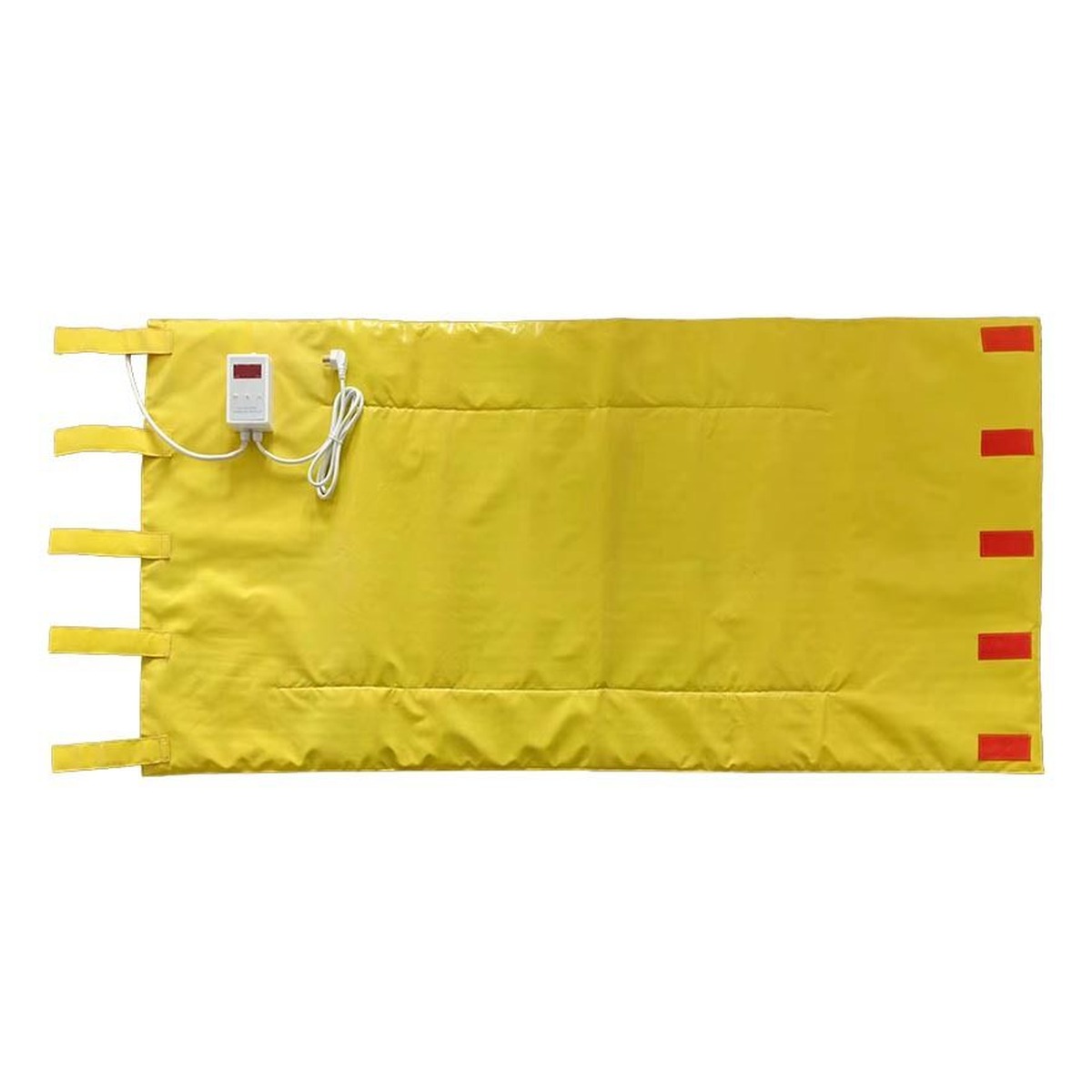
The equipment that cannot be drained still needs to stay warm
Most freeze-protection planning focuses on pipes, and pipes are relatively easy to trace with a linear cable. The harder problem is the equipment attached to those pipes: the pump housing, the valve body, the filter, the pressure regulator, the gearbox and the process instrument. These components have irregular shapes, contain water or process fluid that cannot be emptied between shifts, and rarely come with a factory heating option. When the temperature falls, a frozen pump seal or a seized valve body does more damage than a frozen pipe, because the component itself has to be stripped, repaired or replaced. A flat industrial heating blanket is designed to wrap exactly these awkward geometries and hold them above freezing.
Unlike a fixed heat trace cable, which is installed once and left in place, a flat heating blanket is reusable and repositionable. Quick-release straps and hook-and-loop fasteners wrap the blanket around a pump or valve, the IP44 outer tolerates splash and damp, and the same blanket can move between machines as the maintenance schedule demands. For plants that run seasonal equipment, or that need temporary winter protection rather than a permanent installation, this flexibility is the central advantage: the heating follows the equipment rather than being built into it.
Robert Chen, Process Equipment Engineer, SunAura Thermal
Why components freeze differently from pipes
A pipe is a simple cylinder with a known diameter and a relatively uniform fluid, so its heat loss can be calculated and matched with a trace cable of a given wattage per metre. Equipment is far less regular. A pump housing has thick cast sections and thin seals, a valve has a bonnet and a stem with different masses, and a filter housing holds a volume of liquid that expands as it freezes. The points that fail first are often the smallest and most vulnerable: a mechanical seal, a diaphragm, a sight glass or a drain point. Heating the adjacent pipe does nothing to protect these, because the component’s thermal mass and its exposed surface lose heat on their own.
A flat blanket addresses this by heating a surface area rather than a line. The nickel-chromium element is distributed across the blanket in a uniform pattern, with an aluminium reflective layer spreading the heat so the wrapped surface warms evenly rather than under one band. The blanket is insulated, typically with around 15 mm of insulation between the element and the outer, so the heat is driven inward toward the equipment instead of escaping to the air. Held against the housing with tensioned straps, the blanket maintains the whole component above its minimum safe temperature, including the seals and joints where freezing causes the most expensive damage.
Where reusable blankets beat permanent trace
Permanent electric trace is the right answer for pipework that stays in service all winter and is insulated once. It is less well suited to equipment that moves, that is only used seasonally, or that needs maintenance access. A trace cable bonded to a pump housing has to be removed and reinstalled every time the pump is serviced, and it cannot be transferred to a different machine. A strapped blanket comes off in seconds, lets the technician work, and goes back on afterwards; when the equipment is decommissioned or relocated, the blanket simply moves with it or onto the next asset.
The economics favour reusable blankets wherever the protection is temporary or shared. A single set of blankets can rotate through a fleet of seasonal pumps and valves, rather than each asset carrying its own dedicated heating circuit. The blanket is also independent of the equipment’s power supply and controls, so it can be added to older machines that were never designed with heating in mind. For retrofits and rented equipment, this avoids any modification to the asset itself: the blanket is an external layer that goes on and comes off without a permanent fix.
Construction and electrical protection
Industrial flat blankets use the same proven build as drum jackets, scaled to flat and irregular surfaces. The outer is a silicone-coated fibreglass or waterproof Oxford fabric that resists splash and abrasion, the heating element is nickel-chromium wire, and the aluminium reflective layer and insulation work together to push heat inward. Wattage spans the full 500–5,000 W range depending on the surface area and the required hold temperature, and standard components run below 16 A so they operate from ordinary sockets. Custom dimensions are manufactured to order for large housings and unusual shapes, with the same quick-strap fixing method.
Safety is built around the realities of a plant environment. The IP44 outer is splash-resistant rather than submersible, an overheat cut-out and protective earth are fitted, and insulation resistance is at least 500 kΩ. Installed through a residual-current device, the blankets are intended for damp and outdoor locations, though the controller and plug should be kept above standing water. Export versions are built for the local voltage — 120 V in North America, 230 V in Europe, with 110/220/240/380 V options — and carry CE and RoHS, with FCC or ETL on selected models.
How to specify a blanket for a component
The specification starts from the component rather than a generic heater. Four inputs drive the selection: the equipment type and its surface area, the fluid inside and the minimum temperature it must be held above, the lowest ambient temperature expected, and the supply voltage. A small valve body needs a compact, tightly wrapped blanket; a large pump or filter housing needs a higher wattage over a larger area. Because the blanket is made to the dimensions of the asset, accurate measurements and a note of any obstructions — such as stems, gauges or brackets — matter at the order stage.
For equipment that must stay above a process temperature rather than merely above freezing, the controller range becomes important. A standard adjustable thermostat covers 0–145 °F, which handles virtually all winter protection, while high-temperature variants can hold up to 120 °C for process applications. The sensor should read the equipment surface rather than the air, so the blanket responds to the actual temperature of the component it is protecting.
Typical equipment applications
- Pump housings and mechanical seals that hold fluid overnight and would seize or crack if frozen.
- Valve bodies, actuators and regulators kept operable so a process can be shut down or re-routed in cold weather.
- Filters, strainers and separators whose housings and sight glasses are vulnerable to freeze damage.
- Gearboxes and small lubrication units held at a temperature where the oil remains fluid enough to circulate.
- Process instruments and metering equipment protected from the drift and damage that freezing causes.
Frequently asked questions
Can the blanket be removed for maintenance and reused?
That is the core design. The quick-release straps and hook-and-loop fasteners let the blanket come off in seconds, the technician works on the equipment, and the blanket goes back on. It can also move to a different machine, so a set can be shared across several assets.
Does the blanket replace heat trace on the connected pipes?
No, the two are complementary. Trace cable protects the linear pipework, while the blanket protects the irregular component at the end of it. A complete winter layout usually traces the pipes and wraps the pumps, valves and filters.
How is the blanket held on an irregular shape?
Straps and hook-and-loop fasteners tension the blanket against the surface, keeping the heating element in conductive contact rather than leaving an air gap. Custom dimensions account for obstructions such as stems and brackets.
Is it safe outdoors in rain and snow?
The IP44 outer is splash-resistant and designed for outdoor and damp use through an RCD, with an overheat cut-out and earth. Keep the controller and plug clear of standing water and snow; the blanket is not submersible.
Related reading
The full family of flexible heaters is collected under industrial heating blankets, with the product detail and reference price guide on the drum heating blanket page. The broader use cases are in the applications guide, and for permanent linear pipe protection see our dedicated heat trace cable coverage.
Next step
If pumps, valves or filters are freezing despite the pipes being traced, send the component type, its dimensions, the fluid inside, the lowest ambient temperature and the supply voltage. Our engineers will recommend a blanket size, wattage and controller within one working day. Request an equipment layout or discuss custom blankets for a full winter maintenance programme.