
If you have ever walked into a room where the thermometer reads 21 °C and still felt cold, you already understand the central problem with how most buildings are heated. Air temperature is not the same as human comfort. Comfort is decided by a blend of air speed, humidity, clothing, activity and, above all, the radiant temperature of every surface around you. SunAura designs the graphene wall heating film as a far-infrared wall heater specifically to move that radiant temperature, instead of trying to push more hot air around the room. In this article we explain the comfort science behind that choice, what it feels like on your skin, how it behaves in bedrooms, nurseries, offices and bathrooms, and where the comfort claims stop so you install the product safely.
Written by Sarah Mitchell, Comfort & Applications Specialist, SunAura Thermal.
The Physics of Feeling Warm: MRT and Operative Temperature
Human beings do not actually sense air temperature. We sense the balance of heat flowing in and out of our own skin. When that balance is neutral, we are comfortable; when more heat leaves the body than we produce, we feel cold; when heat piles up, we feel hot. A room thermometer only tells you one side of that equation, the temperature of the air touching your arms and face. The other side is radiative exchange with the walls, the floor, the ceiling, the window glass and any warm or cold surface in the line of sight.
Heating engineers summarise this with two quantities. Mean Radiant Temperature (MRT) is the weighted average temperature of all the surfaces surrounding a person, adjusted for the angle each surface presents to the body. Operative temperature combines MRT with air temperature and air speed into a single number that predicts what a seated, lightly clothed person will actually feel. Standards such as ASHRAE 55 and ISO 7730 are built around these quantities because, decades of field studies have shown, two rooms with identical air temperature but different surface temperatures produce measurably different comfort votes.
The practical consequence is the familiar observation that drives our product work: two rooms at the same air temperature can feel 2 to 3 °C apart. If the walls are cold, the window is large and the floor is tiled, your body radiates heat outward faster than it can be replaced, and you feel chilly even though the air around your head says 21 °C. If the walls themselves are warm radiating surfaces, that outward heat loss is cut, and the same 19 or 20 °C air temperature feels cosy. This is why radiant heating lets people set the thermostat lower without losing comfort, and why our customers often describe the SunAura panel as feeling warmer than its surface number suggests.
A graphene wall heating film changes MRT directly. The film is bonded to an interior wall and heated to a controlled 45 to 55 °C working surface. That wall stops acting as a cold heat sink absorbing radiation from your shoulders and starts acting as a gentle emitter sending long-wave infrared back toward you. The air in the room warms only as a secondary effect. The first thing you notice when you walk in is not a rush of warm air; it is that your skin stops feeling exposed, the way you feel standing in front of a sun-warmed stone wall on a cool afternoon.
This is also why radiant heating behaves well at lower air temperatures. ASHRAE 55 and ISO 7730 describe comfort bands that are defined by operative temperature, not dry-bulb air temperature. When the radiant field is healthy, a room held at a slightly lower air temperature still lands inside the comfort band. We avoid quoting exact setpoint reductions in Celsius because they depend on window area, insulation, ceiling height and clothing level, but the directional effect is consistent across installations: customers report they can run their homes a couple of degrees cooler on the thermostat and feel warmer on the skin.
What Convection Does to Comfort: Stratification, Draft and the Cold Floor
Most conventional electric heaters, fan heaters, oil radiators and gas-fired systems heat the air first. That air then carries heat around the room. This works, but it has three structural side effects that quietly fight comfort.
Warm air rises, so the ceiling gets the warmest layer
Hot air is less dense than cool air. The moment a convector releases warmth, that warmth climbs. In a typical living room you end up with a stack of temperatures: 26 °C near the ceiling, 22 °C at standing head height, and 18 to 19 °C at ankle and floor level. People feel this immediately as a “hot head, cold feet” sensation. You can raise the thermostat by a degree or two to warm the floor, but the ceiling gets even hotter, and the air-conditioning-like effect of overheated upper air encourages stuffiness and a dry throat by the end of an evening.
Radiant wall heating bypasses this stratification almost entirely because it does not rely on moving air. The wall radiates downward and outward toward people and furniture, and the floor itself warms slowly by contact with furniture and re-radiation. The result is a much flatter vertical temperature profile, with less overheating at head level and noticeably less of that “I am roasting above the shoulders and my toes are ice” complaint.
Drafts, doorways and the rush of lost heat
Forced-air systems and fan-assisted heaters are, by design, moving a column of air. Open a door to the outside, and that moving column pours out the opening within seconds, taking its heat with it. Even without a door opening, fast-moving air across your skin increases convective heat loss, which the standards call draft. Draft is the single most common reason people say a room “feels cold even though the heater is on”.
A fanless radiant wall panel does not push air. Open a door and the room loses heat more slowly because there is no jet of warm air escaping through the gap. Close the door and the warm wall mass continues to radiate. This is one reason the product behaves well in hallways, living rooms that open to the kitchen, and home offices where the door is opened and closed all day.
Dust, fibres and the “head hot, feet cold” problem
Every forced-air fan picks up dust from floor level, lifts it into the airstream and blows it around the room. Over a winter season, that cycle deposits dust on shelves, re-suspends pet dander and pushes fine fibres through the breathing zone of people sitting on the sofa. Convection heating also tends to concentrate heat where the heater is mounted (usually at the wall under a window), leaving the centre of the floor, the desk and the feet cold by comparison. The discomfort is structural: warm air goes up, people sit down.
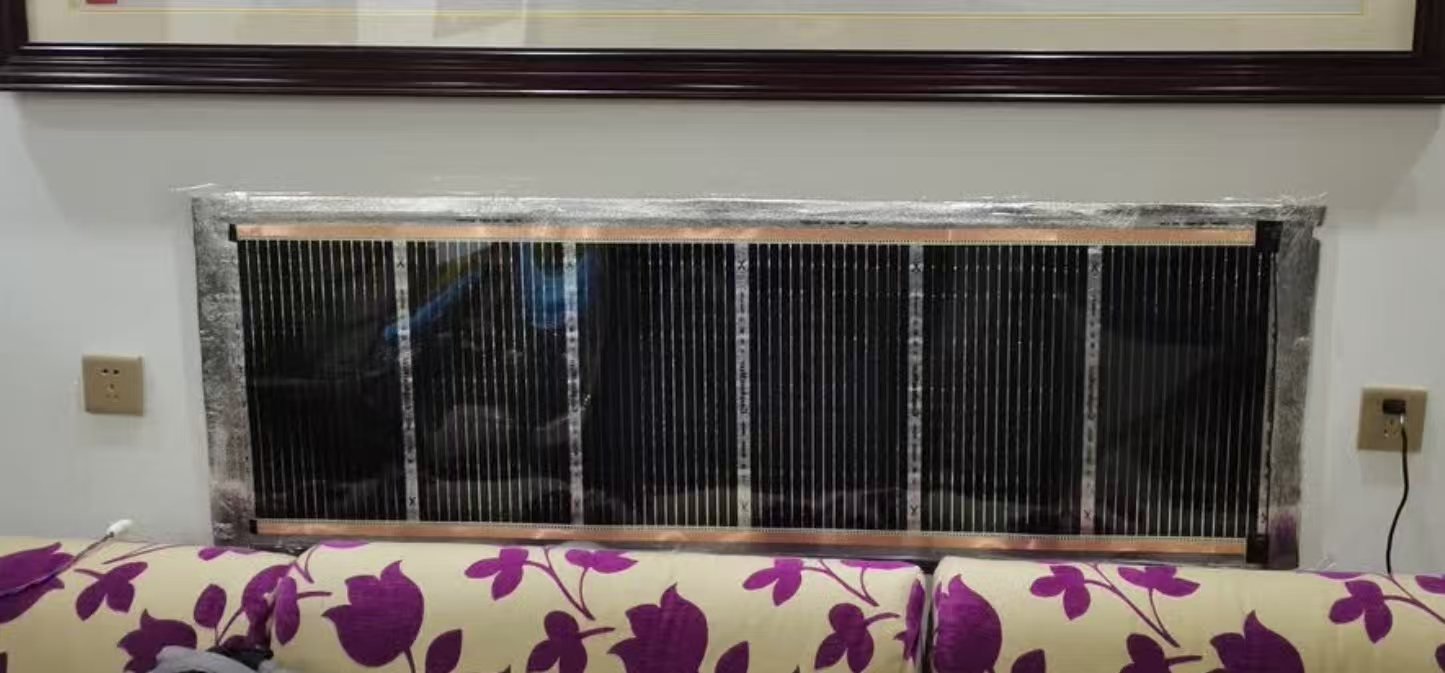
The SunAura film is flexible and thin enough to mount on walls that convection radiators cannot easily reach: behind a sofa, below a painting, around an inside corner, under a window run. Because it radiates toward the people in the room rather than toward the ceiling, it warms the actual sitting and standing zone, not just the volume of air above it.
Far-Infrared Warmth on the Skin: Why It Feels “On” Almost Immediately
When you turn on a fan heater, you wait. The element glows, the blower spins up, the airflow warms, and only after several minutes does the room air reach the setpoint. A radiant wall heater behaves differently. The SunAura film reaches its working surface temperature in about one minute from a cold start, and the radiative effect on your skin is perceptible within that same minute. You do not have to wait for the whole room to heat up. You step into the room, face the wall, and the infrared energy is absorbed by your skin and by the surface of your clothing.
This is not magic and it is not medicine. It is the same physical mechanism that warms you when you stand in front of a fireplace or in sunlight through a window. The film emits long-wave far-infrared radiation in a band that ordinary building materials, fabric and skin absorb well. That absorbed energy shows up as local warmth where you are, rather than as a gradual rise in the thermometer across the room.
We deliberately keep the working surface at 45 to 55 °C under thermostat control, with an uncovered surface typically around 60 °C and a measured demonstration value of about 67.7 °C. The numbers matter here: a cooler, larger radiating surface covers more area at a gentle intensity, which is exactly the comfort profile people prefer. A small glowing element at several hundred degrees produces heat that burns, dries the air in front of it, and dominates the room with a hot spot directly underneath. A large wall at hand temperature does the opposite. It feels like being near a warm wall.
We want to be precise about what this is not. We do not make medical claims about penetration, therapy, detoxification or any other health benefit attributed to far-infrared panels by other sellers. What we can say, on the basis of physics and customer feedback, is that the radiative exchange feels different from convection: it reaches you directly, it does not depend on air movement, and it warms the surfaces of your clothing and skin rather than only the air between you and the wall. If you have a chronic condition, ask your doctor about heating choices. For everyone else, the relevant benefit is simply that the room feels warmer faster and more evenly.
Humidity and Indoor Air Quality: No Fan, No Dust, No Dry Throat
Two comfort complaints recur every winter in homes that run fan heaters or ducted warm-air systems: the air feels dry, and the room feels dusty. Both complaints have the same cause. The fan is doing extra work that a radiant wall heater never does.
Humidity perception
Heating air reduces its relative humidity, that part is physics and applies to every heating method. What changes between products is how the heated air is delivered. A fan blowing across your face accelerates the evaporation of moisture from your skin and from the lining of your nose and throat. That evaporative cooling, combined with the lower absolute humidity of warmed winter air, is what people describe as “dry air”. It is not only the humidity number on the wall; it is the air speed across your face.
A fanless radiant panel has no airstream. The air in the room warms slowly and barely moves. Your skin loses moisture at a more normal rate, and the winter “dry throat” sensation many people associate with electric heating is noticeably milder. We avoid promising specific humidity percentages because they depend on outdoor air, ventilation rate and whether the home has a humidifier. What we can say qualitatively is that customers who switch from fan heaters report softer winter indoor humidity, and they do not need to run humidifiers as aggressively.
Dust, allergens and asthma-friendly operation
A fan is, mechanically, a dust mover. It pulls air from near the floor, lifts settled dust, skin flakes, pet dander and carpet fibres into the breathing zone, and blows them across the room. Over a six-month heating season that is a non-trivial aerosol load, and it is felt most acutely by households with allergy sufferers, asthmatics, babies and people who work from home in the same room all day.
The SunAura film has no fan, no blower, no air outlet. It heats the wall. Dust that settles on the floor stays settled unless a person walks through it. There is no heated airstream to suspend particles. The film is also fully shielded in construction, which the factory documents as producing effectively no electromagnetic radiation emission during operation, a feature we call out specifically for nurseries and home offices where equipment runs within a metre of the body all day.
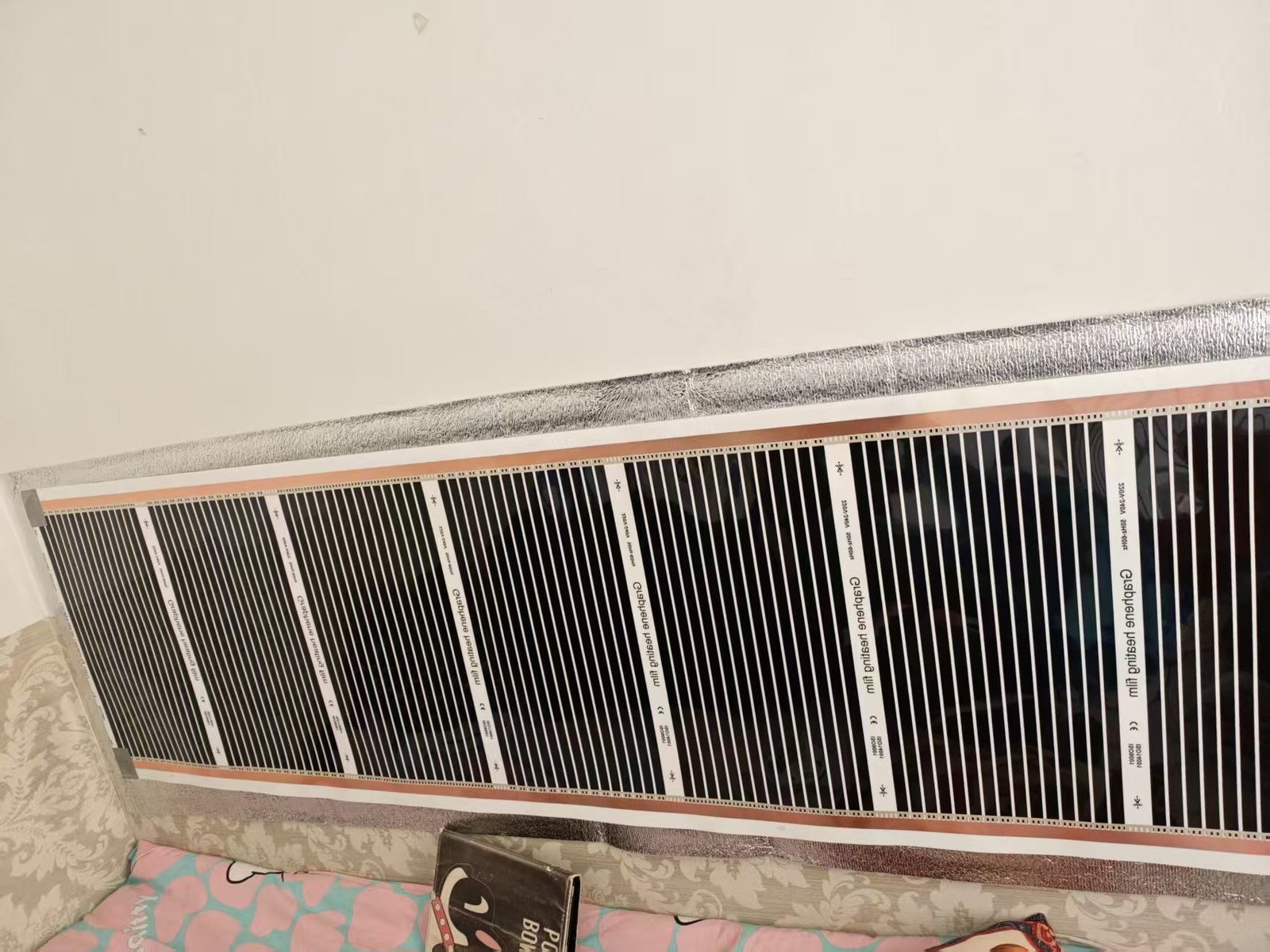
None of this replaces ventilation, air cleaning or medical treatment for allergies. What it means in practice is that adding a fanless radiant wall heater does not add a new dust source to the room, the way adding a fan heater would. For an asthmatic child’s bedroom, that is a meaningful difference on top of the silence.
Sleep, Silence and Bedrooms: Why Heaters Belong in Bedrooms When They Are Invisible
Bedroom heating is the most demanding comfort environment in a home. You are motionless for eight hours, your metabolism is lower than during the day, your hands and feet cool down naturally at night, and you need silence, low light and stable temperature to fall and stay asleep. Most portable electric heaters fail at this in one of three ways: they are loud, they cycle on and off with a click, or they blow hot air directly at the bed.
No fan, no relay chatter
The SunAura film has no moving parts. The in-line High / Low / Off thermostat switches resistive load, and the only mechanical sound in the room is that occasional relay click, which you can position outside the bedside if it bothers you. There is no blower whine, no rattle, no wind noise. Customers who install the panel above the headboard tell us they stop noticing the unit exists after the first night.
No airstream across the bed
Waking with a dry mouth or a stiff neck is common in bedrooms warmed by a fan heater pointed at the mattress. With a wall film behind or beside the bed, the room warms by radiation and slow air mixing, with no directed air movement. The bed linens stay at a comfortable temperature, the skin does not feel baked, and the dry-throat waking is largely gone.
Surface temperature and safe close proximity
Because the film runs at 45 to 55 °C under thermostat control, it is a wall-temperature surface rather than a glowing element. You can sit close to it, lean against the wall, or have a headboard within a few centimetres, without the burn risk of a radiant bar heater. The uncovered surface typically sits near 60 °C and measured about 67.7 °C in our demo footage, warm to the touch but not hazardous. We will come back to the one important rule, covering, in a later section, because it is the condition that changes the surface temperature sharply upward.
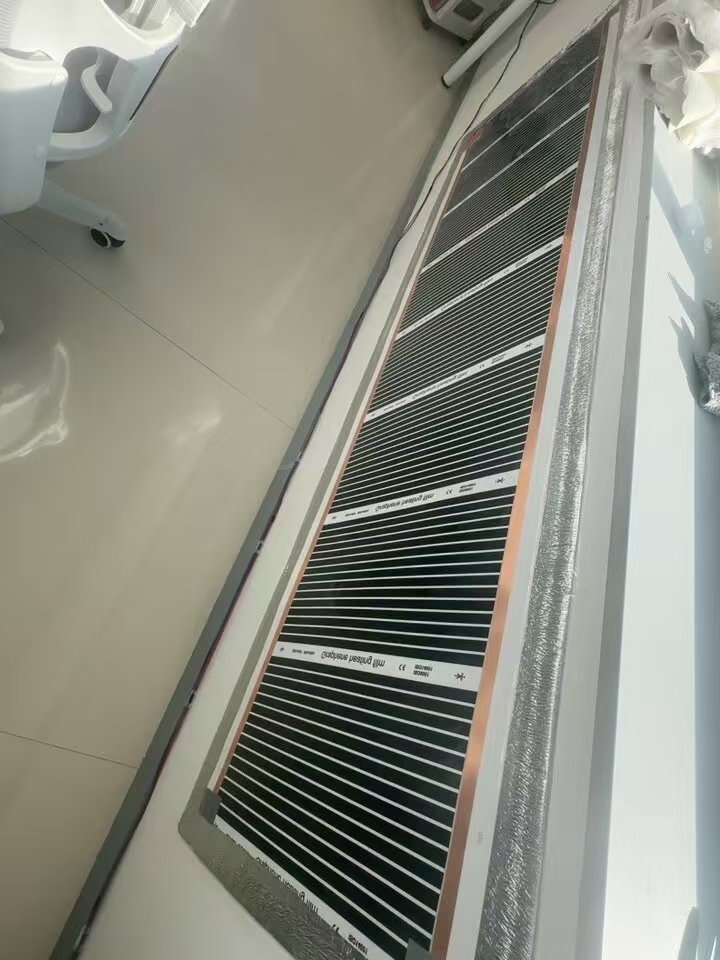
For a primary bedroom, the common installation is a 50×100 or 50×150 cm panel mounted above the headboard, on the wall the sleeper faces or faces away from. The film is plug-and-play into a standard wall socket, so a bedroom upgrade does not require an electrician. For larger master suites, a longer 50×200 cm run or a paired panel on an opposite wall balances the radiant field across the bed.
Vulnerable Groups: Elderly, Infants and People Who Sit Still
Thermal comfort is not equally distributed across a population. Three groups feel cold more acutely than the average young adult, and each of them is better served by radiative wall warmth than by convection.
Older adults and cold extremities
With age, peripheral circulation declines and hands and feet feel cold more readily, even when the rest of the body is at a normal temperature. Older people also tend to have a lower metabolic rate and may sit in one chair for hours, generating little body heat. A fan heater aimed across the room warms the air but does nothing for cold ankles and wrists. A radiant wall panel behind the favourite armchair, or below the window behind it, sends infrared directly to the person’s back, shoulders and legs, raising local skin temperature where the discomfort actually lives. This is the same principle hospitals and care homes use when they choose radiant overhead panels over forced air.
Infants and nursery rooms
Parents want a nursery that is warm but safe: no hot surfaces a toddler can touch, no fan to blow dust into the cot, no noise to wake a sleeping baby, and no glowing element to look at. The SunAura film runs on Low in a nursery, mounted on an open wall well away from the cot, never covered by a curtain, a mobile or a wall sticker. At Low setting the surface temperature stays in the safe range described above, the unit is silent, and there is no electromagnetic field concern because the construction is fully shielded. We still recommend parents follow their own nursery temperature guidance and never drape fabric, toys or bedding against the film.
Desk-bound knowledge workers
A working adult at a desk generates roughly the same heat output as a dim light bulb. Sat in a chair for four hours, hands on a keyboard, the legs and feet are the parts that get cold first, because the chair traps heat around the torso but the lower legs and ankles are exposed to cold air dropping from the window. A short panel mounted behind the desk, aimed at the back of the chair, warms the torso and legs directly, and a second low panel under the window cancels the cold downdraft before it reaches the floor. The person at the desk stops adding layers and stops reaching for the space heater under the desk.
Offices and Long Sitting Days: The Quiet, Draft-Free Workspace
Commercial offices are uncomfortable for the same reason homes are, but amplified. Ceilings are high, windows are large, employees are stationary, and the thermostat is set to a compromise that keeps the accountant in a jumper and the designer in a fan. Convection radiators under windows create a local warm pocket at the window and nothing elsewhere. People in the middle of the room still complain.
Cancelling the cold window downdraft
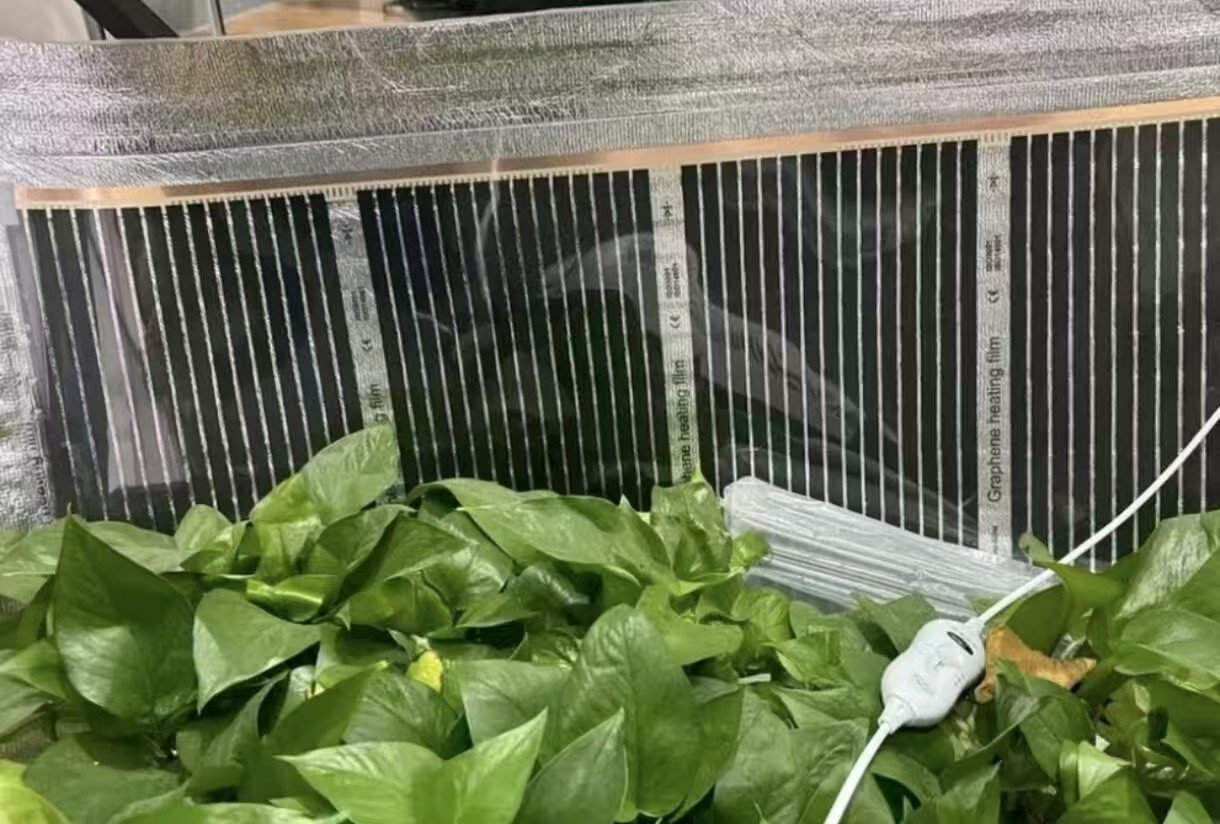
On a cold day, the inner surface of a window is 8 to 12 °C colder than the room air. Cooled air slides down the glass and spills across the floor as a downdraft, reaching the ankles of anyone sitting within two metres of the window. The standard fix is a radiator under the window, but a convector radiator only warms air; it does not heat the window surface itself, so the downdraft keeps falling. A graphene home heating film run directly beneath the window works differently: the wall below the glass warms, the downdraft warms as it crosses that wall, and the radiative field neutralises the cold window surface from the side. The person at the desk no longer feels a cold stream on their shins.
Quiet, undistracted focus
Open-plan offices are already acoustically overloaded. Adding a fan heater under a desk adds a continuous low whine that listeners learn to hate within a week. The wall film is silent. There is no airflow noise, no fan bearing, no vibrating grille. The only sound is the occasional relay click on the in-line thermostat, which can be routed out of the ear of the nearest desk.
No floor space, no obstruction
Offices pay rent by the square metre. A floor-standing fan heater, an oil column or a portable infrared bar takes up floor space you were already paying for, blocks the aisle, and becomes a tripping hazard. The wall film is bonded to the wall, 50 cm wide and effectively zero thickness. Desks, filing cabinets and chairs can sit in front of it as long as the radiative front face is not physically covered by fabric. It is the only heater category that does not consume floor space.
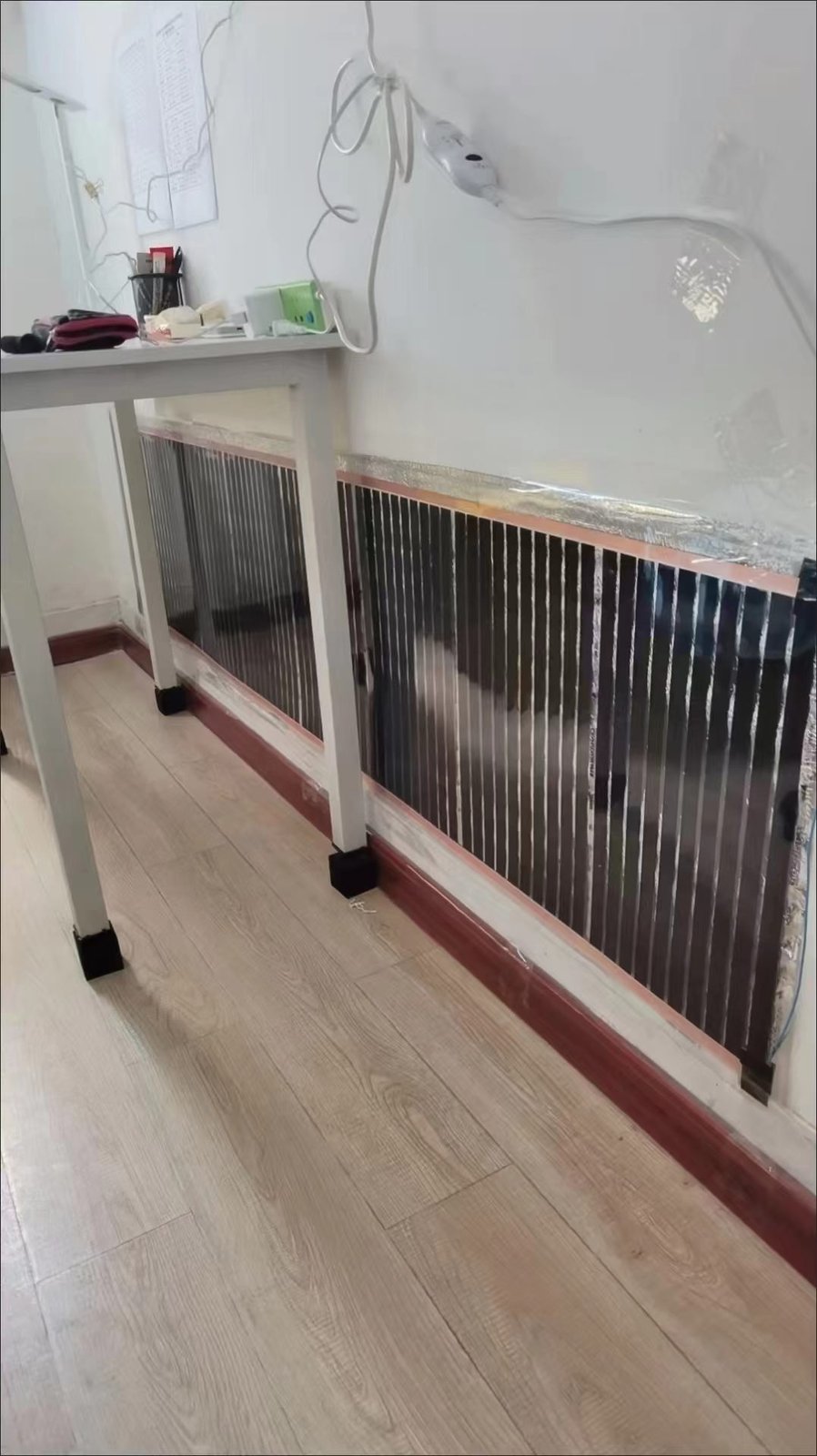
For larger commercial rooms, the panels can be zoned with the SunAura room thermostat range, so a meeting room on one side of the floor and an open-plan desk bank on the other can run at different schedules. This is the configuration most of our wholesale buyers specify for shared offices, co-working spaces and small retail fit-outs.
Bathrooms, Hallways and the Rest of the House
Bathrooms are the coldest functional room in most homes: tiled floors, cold walls, a window that opens to the outside, and body heat lost the moment you step out of the shower. Standard electric bathroom heaters are either a hot glowing bar (which is a burn and glare risk) or a ceiling fan (which blows dust and noise). A thin graphene film bonded to the tile or marble wall above the towel rail or beside the shower enclosure warms the wall itself. You walk out of the shower into a room where the wall is at hand temperature, not a cold surface radiating chill back onto wet skin.
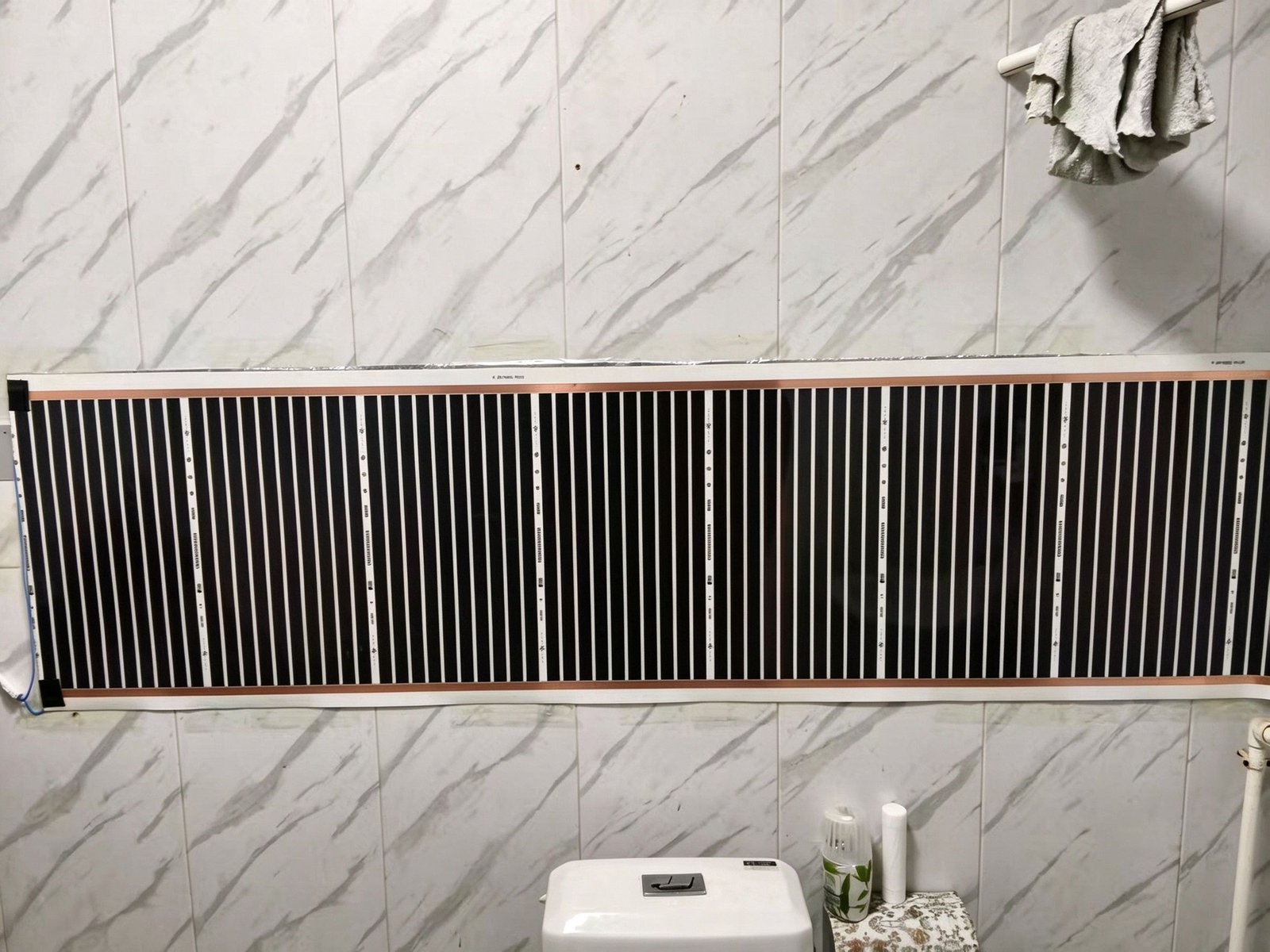
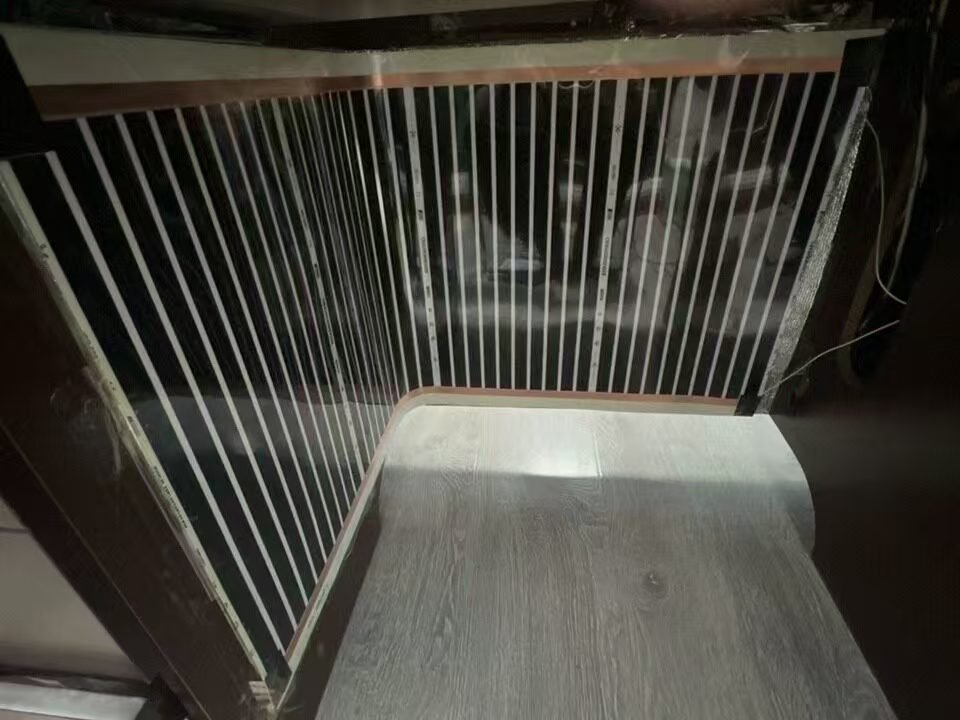
The film is suitable for ceramic tile, plaster, drywall, wood paneling and wallpaper, so bathrooms, hallways and under-stairs storage nooks can all be treated without wet trades. It is also a strong match for rental flats and listed buildings where drilling and wet renovation are restricted, because the film fixes with adhesive and tape positioning, with optional screw fixing only on the factory-printed foil border strips.
Where the Comfort Claims End: The Safety Rules You Must Follow
Every comfort claim in this article is conditional on the product being installed and used the way the factory specifies. A few rules sound obvious until you see them broken, so we state them explicitly. Distributors and installers should pass these on to every end customer.
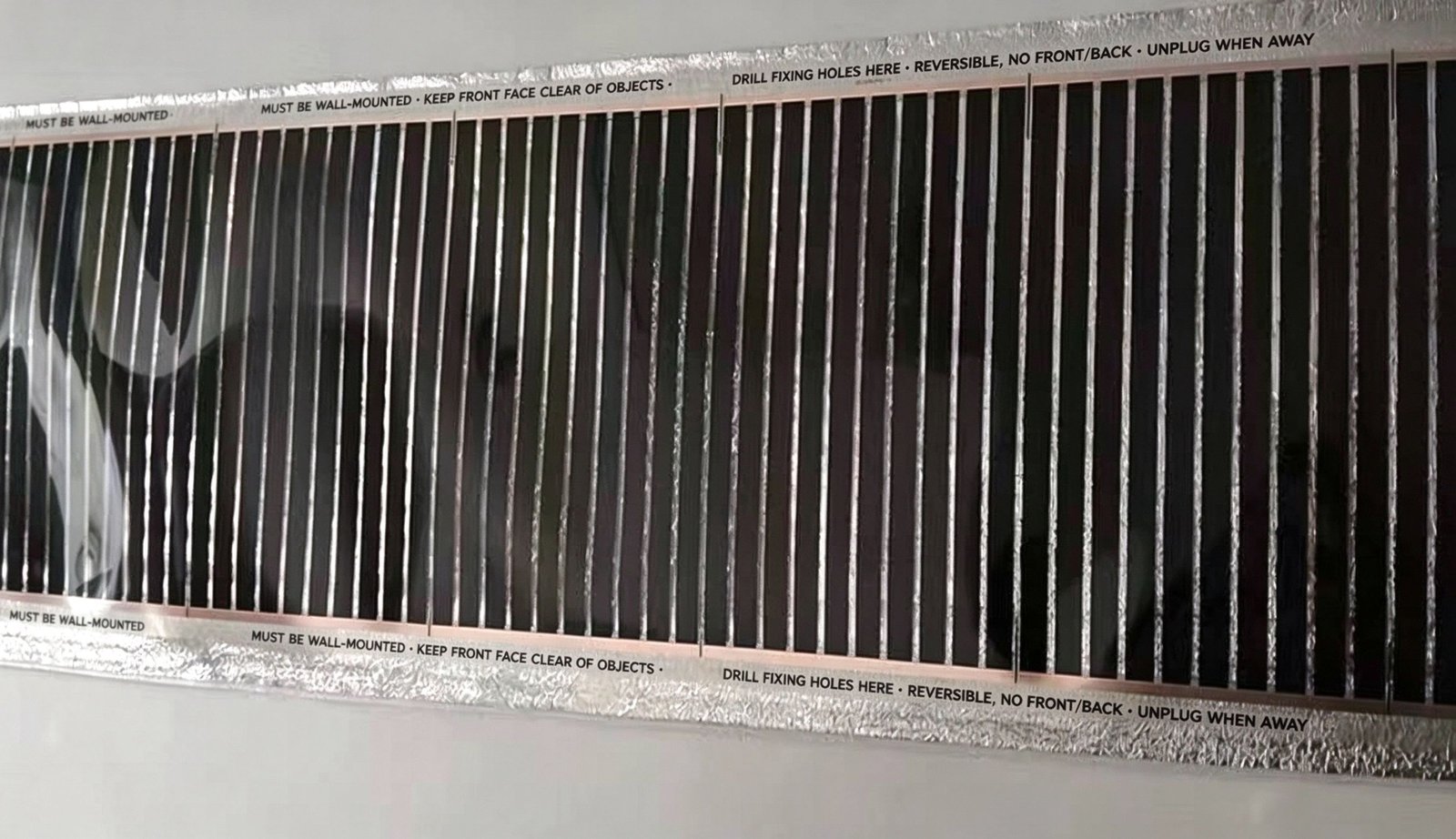
- Wall-mount only. The film is designed to be bonded to an interior wall, where it can radiate freely into the room. It must never be placed on the floor, inside bedding, inside a cabinet, behind a sofa cushion, or inside a curtain box. The wall mounting is part of the heat dissipation design, not a convenience detail.
- The radiative front face must stay clear. Covering the film with fabric, a poster, a throw, a curtain or a piece of furniture stops the surface from losing its radiative energy freely. The surface temperature climbs rapidly above 100 °C. The normal uncovered surface of 50 to 70 °C is what makes the panel safe; covering it is what makes it a fire risk.
- Typical surface temperatures. The thermostat-controlled working temperature is 45 to 55 °C. An uncovered panel typically runs near 60 °C and measured about 67.7 °C in our factory demonstration. Those are the numbers we use when we talk about “warm to the touch”. Covered, the surface climbs well past that range, which is the specific reason the “do not cover” rule is non-negotiable.
- Disconnect when unattended. The standard guidance is to unplug the unit or switch the thermostat to Off when the room will be empty for a long period, and always when leaving the house. The plug-and-play design makes this easy: pull the plug from the socket, no electrician required.
- Nurseries and low surfaces. In a nursery, run the panel on Low, on an open wall that the cot, mobiles and soft toys do not touch. Do not mount it where a standing toddler can reach the surface and press a hand against it for long periods.
- Fix only on the printed strips. When screw fixing is used, drill only through the factory-printed fixing-hole strips on the silver foil border. Never drill through a printed heating stripe. The border strips are designed for it; the heating area is not.
We make this point because “silent radiant wall heater” is sometimes sold online without the safety rules attached. Our position, as a manufacturer exporting to 50+ countries under CE and RoHS, is that the comfort experience is only worth having if the installation is safe. If a buyer pushes back on “no covering”, the answer is not to relax the rule; it is to size the room with additional panels on other open walls instead.
A Comfort Checklist: Room Type, Mounting Position and Level Strategy
The table below is the short version of what we tell distributors when an end customer asks “where do I put this thing?”. It is a starting point, not a substitute for a room-by-room sizing conversation with our applications team.
| Room type | Best mounting position | Level strategy | Typical panel choice |
|---|---|---|---|
| Primary bedroom | Wall above headboard, or beside the bed facing the sleeper | Low through the night, High for the half-hour before bed | 50×100 or 50×150 cm |
| Nursery | Open wall, well clear of cot and mobiles, not reachable by a standing toddler | Low only, timed on the nursery schedule; off when child is out of the room | 50×50 or 50×100 cm |
| Living room | Wall behind the sofa, below framed art, or on the feature wall opposite the main seating | High on family evenings, Low when the room is empty | 50×200 to 50×300 cm, or two paired panels |
| Home office / study | Behind the desk chair, plus a second panel under the window behind the desk | High during working hours, Low on lunch breaks, off overnight | 50×100 behind desk + 50×100 under window |
| Bathroom | Tile or marble wall beside or above the shower / towel zone, away from direct water spray | High for 30 minutes before shower, Low overnight | 50×50 or 50×100 cm |
| Under a cold window | Wall directly below the glass, running the width of the window where possible | High on very cold days, Low on mild days, off in spring/autumn | Length matched to window width, e.g. 50×150 or 50×200 cm |
| Dining room / tea shop | Warm back wall behind the longest bench or seating run | High during service, Low between turns | 50×200 or 50×300 cm per seating side |
| Rental flat retrofit | Largest free interior wall that does not hold furniture against it | Plug-and-play thermostat, no hardwiring | Sized to floor area per factory coverage guide |
Remember that the film’s coverage range depends on whether the room is well insulated, the climate it sits in, and whether the panel is acting as primary heat or auxiliary boost. For primary heat we quote the primary range in our product data; for auxiliary comfort, the upper range applies. When in doubt, send us the room dimensions and a couple of photos and our applications engineers will suggest a panel count.
How Comfort Compares Across the SunAura Range
The wall film is one format inside a wider product family, and buyers often ask how it relates to the other products. The short version is that they share the same graphene far-infrared heating element, the same shielded construction and the same 45 to 55 °C comfort surface; what changes is the form factor and the mounting surface.
The graphene infrared heating painting puts the same film behind a decorative canvas, so a wall becomes both art and heat. It is popular in living rooms and small offices where the customer does not want a visible panel. The graphene far-infrared space heater is the freestanding version, used as a secondary comfort boost where wall mounting is not possible. The custom encapsulated heating film is the bulk film format for OEM and project work, where a buyer integrates the element into their own panel, glass or furniture product.
For a deeper explanation of the film itself, the way graphene-carbon converts electricity into far-infrared radiation, and the safety architecture of the element, our related article on wall heating film installation and use cases and our earlier engineering write-up on how the film works together cover the device-physics side of the story. This article stays on the human side: what that radiation feels like in a real room, and who benefits most.
Frequently Asked Questions
Why does a radiant wall heater feel warmer than a fan heater at the same room temperature?
Because your body exchanges heat with the surfaces around you, not only with the air. A warm wall raises the mean radiant temperature and reduces the heat you lose outward by radiation. At the same air temperature, a room with a warm wall and a room with cold walls do not feel the same; people consistently report the warm-wall room as 2 to 3 °C cosier. This is why radiant heating lets you run the thermostat lower without losing comfort, and why the SunAura film feels warmer than the thermometer suggests.
Is a graphene wall heating film really silent?
The film itself has no fan, no blower and no moving parts, so it produces zero airflow noise. The only mechanical sound in the system is the occasional relay click from the in-line High / Low / Off thermostat as it switches the panel on and off. We position the thermostat away from the bedside for customers who are sensitive to click sounds. It is the closest thing to a silent wall heater for bedroom use that a resistive electric heater can be.
Does far-infrared heating dry the air out like fan heaters do?
Heating any air lowers its relative humidity, that part is unavoidable. The difference is that a fanless radiant panel does not blow a stream of air across your face, so it does not accelerate the evaporation of moisture from your skin and the lining of your throat. Customers switching from fan heaters typically report softer winter indoor air and run humidifiers less aggressively. We describe this qualitatively; exact humidity levels depend on your ventilation and outdoor air.
Can I use the panel in a nursery or child’s bedroom?
Yes, with two conditions. Run the panel on Low, and mount it on an open wall that the cot, mobiles, soft toys and curtains cannot touch. The film is fully shielded, so there is no electromagnetic radiation concern during operation, and it is fanless and silent. Never cover the radiative face with fabric, toys or bedding; covering raises the surface well above its normal 45 to 55 °C working range. Follow your local nursery temperature guidance and switch the panel off when the room is empty.
Where should I mount it under a window to stop the cold downdraft?
Mount the film on the wall directly below the window glass, running as close to the window width as the panel allows. The warmed wall intercepts the cold air that slides down the pane and spills across the floor. Pairing this position with a second panel behind the desk or sofa handles the rest of the room. This is the most common install in home offices and living rooms where the desk sits under a large window.
What surface temperature should I expect, and is it safe to touch?
Under thermostat control the panel works at 45 to 55 °C. An uncovered panel typically runs near 60 °C and measured about 67.7 °C in our factory demonstration. That is warm to the touch but not a burn hazard for brief contact. The safety rule to remember is the reverse: never cover the radiative face, because covering traps heat and the surface climbs rapidly above 100 °C. Keep curtains, posters, throws and furniture away from the front face, and the surface temperature stays in the safe range described above.
Next Step for Your Project
If the comfort case above matches the rooms you are specifying, the next step is to talk through sizing, panel count and plug standard with our applications team. We will confirm panel sizes against your floor area, ceiling height and insulation, and walk through the mounting positions you have in mind. Whether you are a distributor adding a far-infrared wall heater to your winter catalogue, a contractor outfitting a multi-room retrofit, or a developer building a quiet radiant heating zone into a hospitality project, we will respond with factory-lead pricing, CE / RoHS documentation and a sample panel if you need one.
To start a conversation, Request Wholesale Price through the SunAura contact form and tell us the room or project you are heating. We will come back with panel sizing, lead time and OEM / ODM options, including custom plug standards, controller styles and zone-thermostat pairing for multi-room jobs.