
If you are a distributor, importer, HVAC contractor, hotel group, or project developer sourcing a graphene wall heating film supplier in China, you already know the headline numbers are easy to find and the hard numbers are not. Every listing page claims “factory direct”, “CE certified”, “private label welcome”, and “10-year warranty”. After twenty-plus years on the buying side of thermal manufacturing, my team and I have sat on both chairs of this table. This guide walks you through the real procurement workflow we use to qualify a far infrared wall heater OEM partner, from the first website visit to the first container and beyond.
Written by Anna Kowalski, Supply Chain & Sourcing Lead, SunAura Thermal.
We will not repeat the room-sizing exercise you have already seen in our consumer-facing buying guide. This document is written for the buyer who has already decided the product category makes sense and now needs to decide who to buy from, how to structure the RFQ, what to put on the purchase order, and how to keep the relationship honest over the next three years. Treat it as a working checklist you can hand to your own sourcing team.
The Sourcing Landscape: What “Factory Direct” Actually Means in China
Type “graphene heating film manufacturer” into any B2B platform and you will get pages and pages of results. Before you send a single RFQ, understand that those results fall into three structurally different seller types. Mixing them up is the single most common and most expensive mistake first-time buyers make on this category.
The Three Seller Types You Will Encounter
| Seller type | How to spot them | What they are good at | Where they will disappoint you |
|---|---|---|---|
| OEM manufacturer (real factory) | Own production floor, named production lines, consistent SKU list, in-house R&D and QC, publishes audit reports and real certificate numbers | Stable quality, real OEM/ODM flexibility, traceability, honest lead times, engineering support on tricky projects | Higher minimums on fully custom work, slower sales-chat response on trivial questions, will push back when your spec is unsafe |
| Trading company / sourcing agent | No production address, generic stock photos, “we work with 50 factories”, quotes that cover five unrelated product categories (heaters, LED strip, coffee machines) on one page | Good at small mixed containers, helpful with translation and booking, sometimes adds English-speaking hand-holding | No control over QC, no real OEM, price markup on every line, cannot answer technical questions, disappears when a claim needs evidence |
| Brand owner / exporter with own brand, contract manufacturing | Sells under a registered trademark, requires reseller agreements, restricts your ability to private-label their product | Finished, tested, market-ready product with polished packaging | Resists true OEM, will not share test reports with your own lab, channel conflict on your own customers |
How to Judge a Supplier from Its Own Website Before You Email
You can eliminate a large share of bad fits in ten minutes of browsing. A credible graphene wall heating film supplier will, on its own site, show you: a named factory location (Qingdao, Foshan, Tianjin, Chengdu are the known clusters for heating film), a founding year, a stated production capacity, a list of export markets, certificate copies with identifiable numbers, and a product range that makes industrial sense. A trading company’s site will read like a brochure: every photo is stock, every number is a superlative, and there is no mention of how the film is actually printed, laminated, or tested.
At SunAura, our Qingdao plant has been running since 2008. We operate six automated lines dedicated to graphene-carbon heating film and produce on the order of 500,000 m² per month, shipped to more than 50 countries. We publish those numbers because they are verifiable on a factory audit, not because they sound impressive. When a prospect asks us to walk the line, we walk the line. That is the bar you should hold every shortlisted supplier to.
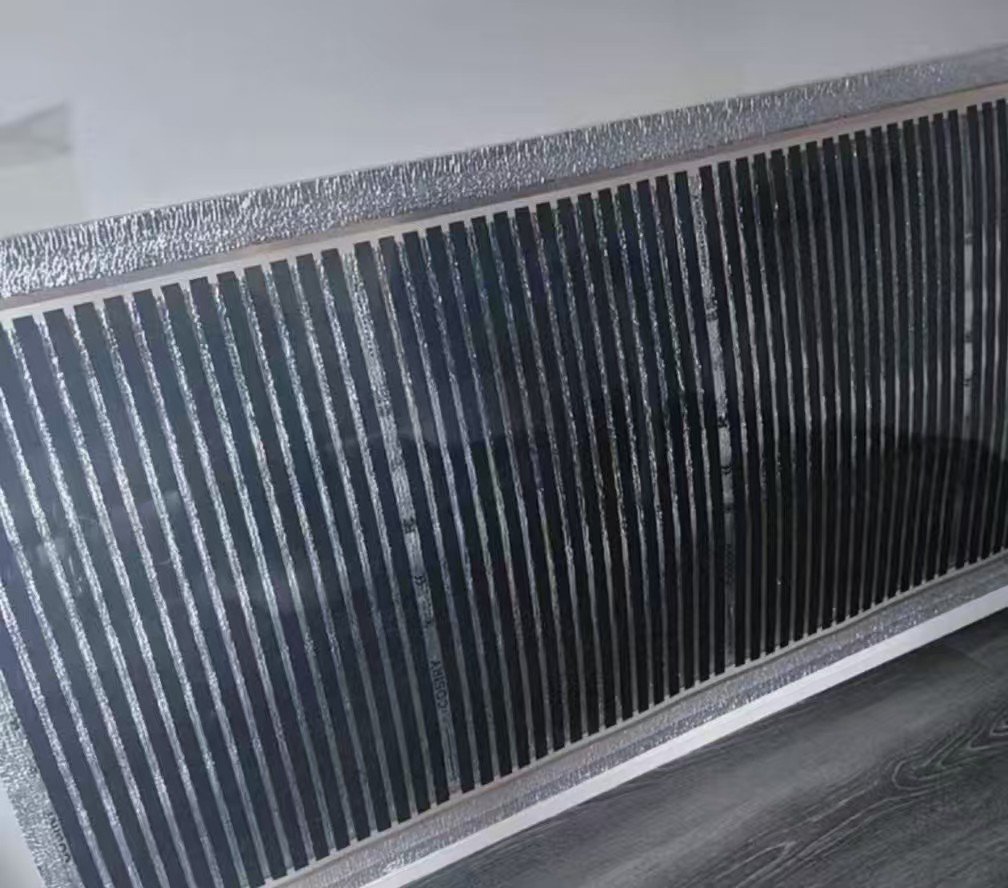
The photo above is a production-shot close-up of our XGF-WALLFILM: the printed graphene-carbon stripes on the PET substrate, the copper busbar contacts, and the silver reflective insulation backing. If a supplier cannot produce a photo of their own line that looks like this, and can only show you lifestyle renders, treat that as your first red flag.
Supplier Evaluation Checklist
Once you have a shortlist of three to five names, score them against a fixed checklist. Do not let a charming sales rep move the goalposts. The table below is the checklist we hand to our own sourcing interns; use it verbatim, or adapt the weights in the scorecard at the end of this article.
| Evaluation dimension | What to ask for / look for | Minimum bar for a serious far infrared wall heater OEM partner |
|---|---|---|
| Founding year and production maturity | When was the factory established? How many production lines? What is monthly output in m² or panels? | Plant operating at least since the late 2010s; multiple dedicated automated lines; monthly capacity in the hundreds of thousands of m² for film categories |
| Production footprint | Single plant or scattered? Own laminating and printing, or bought-in film? | Printing, lamination, cutting and wiring done under one roof so process changes stay traceable |
| Management system | ISO 9001 quality management, ISO 14001 environmental; ask for certificate number and registrar | Certificates in date, registrar traceable, internal audit reports available on audit |
| Product certifications | CE declaration and test report for the exact panel SKUs you intend to buy; RoHS report; EMC and LVD evidence | Reports issued by a recognized lab, covering the actual wattage range and voltage you will import |
| Export history | Which countries already buy this model? Can they share references? Any repeat importer relationships? | Active shipments to 20+ countries; references available in your own market region |
| Product line completeness | Do they make the film, the controller, the reflective backing, the fixing kit, and matching thermostats, or only the film? | Full chain: film, in-line thermostat, room thermostats, accessories, so you are not assembling a Frankenstein BOM from three vendors |
| Engineering support | Can a named engineer walk through a room heat-loss calculation with you? Will they push back on an unsafe installation? | At least one English-speaking applications engineer on staff, not only a salesperson |
| OEM/ODM history | Private-label references? Custom controller designs? Custom cut lengths? Custom plug standards? | Proven track record on at least two of: own-brand packaging, custom plug, custom controller, custom length |
| After-sales infrastructure | How are defects handled? Spare controller supply? Claim process documentation? | Written warranty terms, defined defect-rate tolerance, spare parts held for the warranty window |
| Digital footprint | How long has the domain been live? Are there independent reviews, tradeshow records, LinkedIn posts from named staff? | Domain age matches claimed founding year; named real people, not generic info@ mailboxes |
Use this checklist during the first two email exchanges. A supplier that cannot answer the “which SKUs does your CE report cover” question in writing is telling you something important before you spend a cent on a factory audit.
Building the RFQ Package
The quality of the supplier’s quote is almost entirely a function of the quality of your RFQ. Buyers who write “send me your best price on graphene heating film” get back a price with no basis. Buyers who send a structured RFQ get back a price you can actually compare across three factories. Spend an hour on the RFQ; it saves you a month on negotiation.
What the RFQ Must Contain
- Project context. What is the end use: residential retrofit, hotel rooms, office fit-out, retail display? What is the room or building type? Roughly how many rooms or square meters per year? This tells the supplier whether to quote standard stock panels or start an ODM conversation.
- Voltage and frequency. Our film is rated 220 V at 50 Hz. Confirm your market’s grid. If you are buying for the US or Japan, discuss transformers, 110 V variants, and labeling before pricing, not after.
- Plug standard. EU Schuko, UK BS 1363, Italian, Swiss, Australian, NEMA, Japanese PSE shape. Each plug requires a different cord set and usually a different controller variant. State the plug standard on the RFQ, not on the purchase order.
- Panel sizes and quantities. Our standard panels follow a 50 cm width: 30×50, 50×50, 50×100, 50×150, 50×200, 50×250, 50×300, and 50×400 cm, rated 60 W to 1000 W. Tell the supplier which SKUs and how many of each.
- Controller requirement. Standard in-line High / Low / Off thermostat, or a room thermostat with scheduling and zone control? Do you need a specific controller shell, logo, or button language?
- Certification requirement. CE and RoHS are baseline on our XGF-WALLFILM. If you are shipping to Japan, flag PSE-related documentation early; the paperwork path is confirmed per order rather than assumed. If you have a local notified-body preference, say so.
- Packaging, carton, and label. Plain brown box, full-color retail box, neutral English manual, multi-language manual, retail barcode requirements, drop-test expectations.
- Marking and language. Outer carton markings, side labels, warning pictograms, manual language(s), any local-language safety warning text you want printed on the film itself.
- Target price and annual volume. Even a rough number (e.g. “we expect 2,000 panels in year one and can grow to 8,000 by year three”) lets the supplier tier the quote honestly. Hiding your volume usually means you get a tier-one sample price that never improves.
- Trade term and destination port. State whether you want FOB, CIF, or DDP. Each changes which currency line items appear on the proforma.
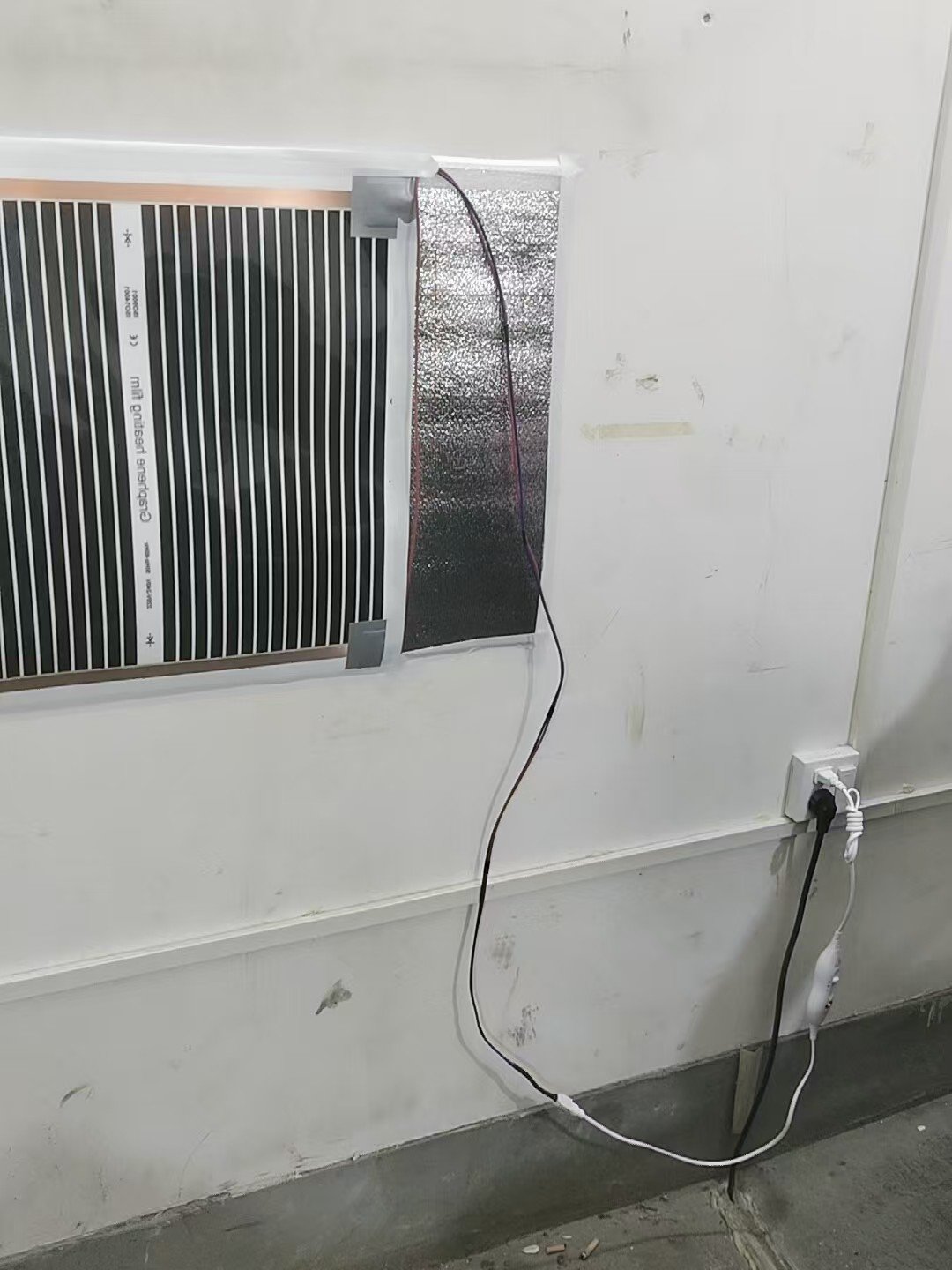
The wiring detail above shows the plug-and-play in-line thermostat and the connection loom that comes standard on XGF-WALLFILM. When you build the RFQ, confirm whether you want this exact loom, an extended cord, a different plug, or a controller that pairs with our room thermostat for multi-room zoning. Every wiring variant has a setup cost and a lead time; pricing them into the RFQ avoids surprise change orders.
What to Expect Back, and What to Reject
A serious supplier will reply within a few working days with: a per-SKU price table by quantity tier, the exact plug and controller variants quoted, the quoted lead time, the payment term, and the list of documents they can provide with the shipment. If the reply is one line (“USD 12.5 per m², MOQ 100 m², DDP your door”), treat it as a conversation opener, not a quote. Ask for the breakdown: film, controller, plug, manual, carton, export packing, and any surcharge for your chosen plug standard.
MOQ, Lead Time, and Order Structure
“What is your MOQ?” is the first question most buyers ask, and it is almost always the wrong first question. The right question is: what is the MOQ for the exact product, packaging, and certification combination I actually want? On a standard SKU with a standard plug and plain box, the MOQ is deliberately flexible on our side, because the line already produces that configuration for other customers. On a fully custom controller shell, custom printed film, or a custom box, the MOQ jumps because tooling, plate-making, and carton printing have setup costs that only make sense at volume.
How Our Film Is Actually Shipped
Our standard film width is 50 cm. That number matters for your freight math. A panel listed as 50×100 cm ships as one piece. A panel that you might assume is 100 cm wide does not ship as a 100 cm wide sheet; it ships as two 50 cm strips placed side by side on the wall. This is not a limitation. It is how flexible heating film is engineered: a single 1 m wide sheet would be stiffer, harder to handle on interior corners, and more likely to crease on site. The 50 cm strip width is the field-proven compromise between coverage and installability.
Realistic order structure for a first buyer:
- Sample stage. 1–3 panels in your chosen sizes, with your target plug, tested in your own showroom before you commit.
- Pilot container. 200–500 panels across 3–4 SKUs, plain packaging, standard controller, your required plug. This validates freight, customs, install instructions, and customer feedback.
- Rolling reorder. Once sell-through is proven, monthly or quarterly repeat orders on the winning SKUs, with private label introduced in parallel.
Lead time on standard stock configurations is measured in days to a couple of weeks for finished panels, because the film itself is produced continuously on the line and cutting to length plus fitting the loom is fast. Custom controller tooling, custom carton printing, and multi-language manual translation are the items that stretch a lead time to six to eight weeks. Build those into your launch calendar from day one.
Samples and Validation
A sample order is not a free product. It is the cheapest audit you will ever run. When the sample box arrives, do not just hang it on a wall and admire the warmth. Test it like your QC team will test the bulk shipment, because the sample is the only thing standing between you and a container of panels that fail in your market.
What to Measure on the Sample
- Rated power tolerance. Hook the panel to a calibrated meter at rated voltage. Our spec is 500 W/m² power density; a 50×200 cm panel should draw around 500 W. Expect a small tolerance band, typically within a few percent. A panel drawing 20 % above rated is a safety and warranty problem; 20 % below is an energy-claim problem.
- Surface temperature uniformity. With the panel on High and the room at a known cool temperature, sweep an infrared thermometer across the surface. Our published spec is ≤ 3 °C variation across the panel. Hot strips that read 20 °C hotter than neighbors point to a printing or busbar defect.
- Warm-up time. Time from cold to working surface temperature. Our factory demo footage shows roughly one minute to operating surface temperature. If your sample takes five minutes, something is wrong with either the controller or the connection.
- Controller behavior. Cycle the High / Low / Off switch. Listen for relay clicks if your controller has them. Check that Low genuinely drops power, not just a fraction. Run it for four continuous hours and feel the controller shell; it should stay warm, not hot.
- Surface temperature ceiling. Uncovered, the film should stabilize around 45–55 °C working temperature, with an uncovered surface in the 50–70 °C range. The point of this test is to confirm the safety margin, not to chase a hotter panel.
- Printed markings and warning strips. Every panel must carry the factory-printed fixing-hole strips on the silver foil border, the warning pictograms, and the red connection loom labeling. If the sample’s warning print looks like an afterthought, your customer support line will be the one that hears about it on the first winter.
- Packaging. Open the carton the way a freight forwarder would. Corners should not be crushed, the film should be rolled or flat-packed without permanent creases, and the controller and cord should be protected against the copper busbars. Creased film can delaminate; scuffed warning labels fail audits.
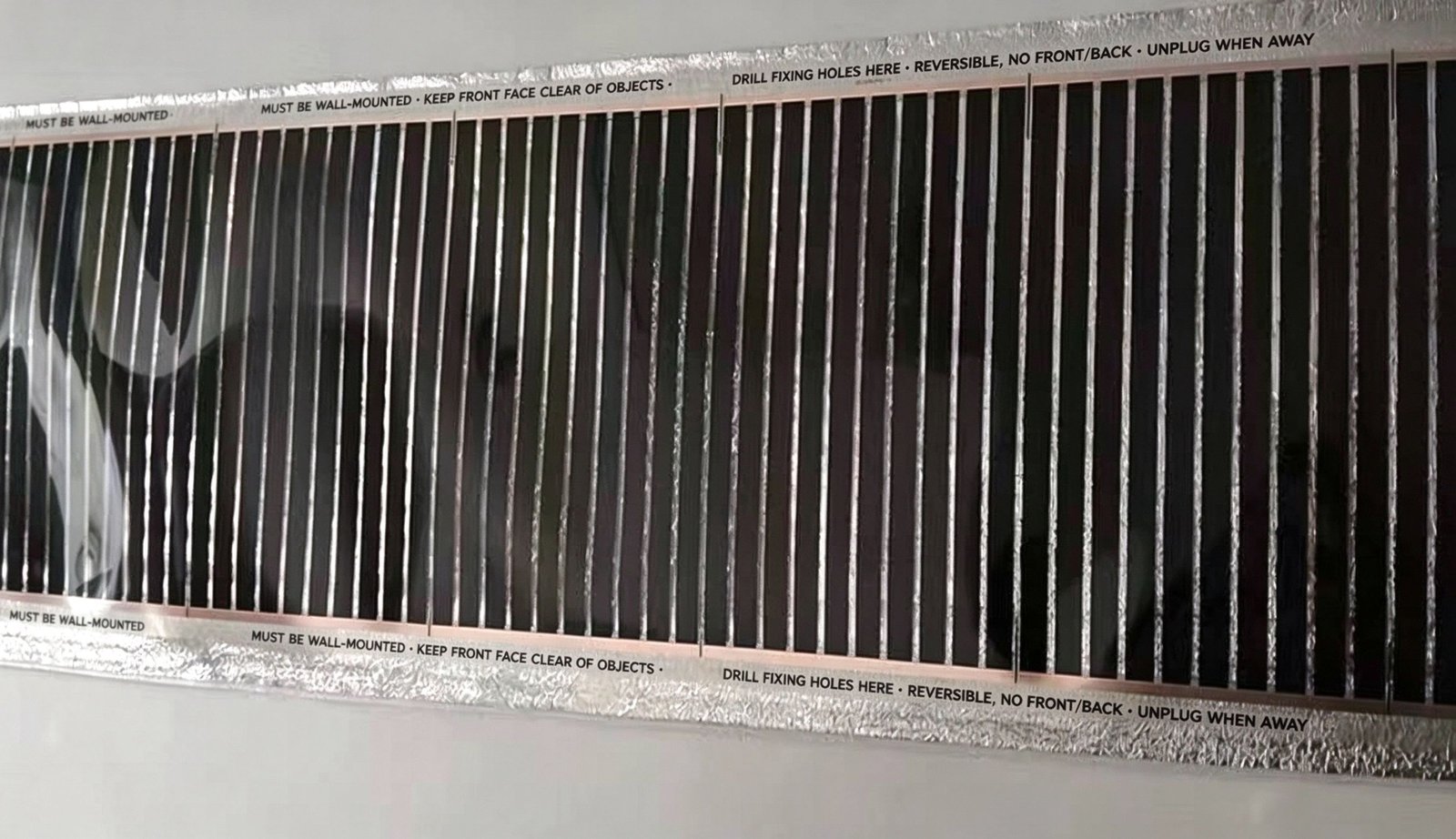
The image above is the factory-printed safety strip on the silver foil border. Notice that the fixing holes are confined to the border zone; installers are instructed to drill only on those printed strips, never through a heating stripe. When you inspect samples, check that this strip is printed consistently on every panel, not stamped on a few. A missing warning strip on bulk product is a return-authorization factory.
Pilot Order Strategy
Once samples pass your bench tests, place a small pilot order with your commercial team, not your engineering team. Let the sales reps quote it to real customers, let your warehouse receive it the way it will arrive on the main container, and let your installers fit it on a real room. The things that break on a pilot order are paperwork, barcode, packaging, and install instructions. None of those show up on a lab bench. Plan the pilot for the summer, so you can reorder by autumn.
Certification and Compliance Evidence
Buyers in Europe, the UK, Australia, and parts of the Middle East treat certification as a checkbox. They should not. The difference between a supplier that holds CE and RoHS reports covering your exact SKUs at your exact wattage and a supplier that holds a generic “similar product” report is the difference between a smooth customs clearance and a seized container.
The Evidence Chain You Should Request
- CE documentation. A Declaration of Conformity naming the product model, the applicable standards, and the signing party, plus the underlying test reports for LVD (electrical safety) and EMC (electromagnetic compatibility).
- RoHS report. Confirming restricted-substance compliance for the materials that touch the film’s outer envelope.
- ISO 9001 and ISO 14001. Quality and environmental management system certificates, with the registrar’s name and certificate number so you can verify them independently.
- Batch traceability. On a B2B shipment, each carton or batch should be traceable back to a production lot. Ask the supplier how they encode lot numbers; a supplier with no lot system cannot support a recall.
- Country-specific add-ons. For Japan, PSE-related documentation is prepared per order rather than assumed, because the route depends on the exact model and importer of record. For the European market, work with your own compliance counsel on the responsible-party and documentation expectations that apply to your brand. We do not advise quoting specific regulatory clauses here because the requirements evolve; your local counsel should interpret them.
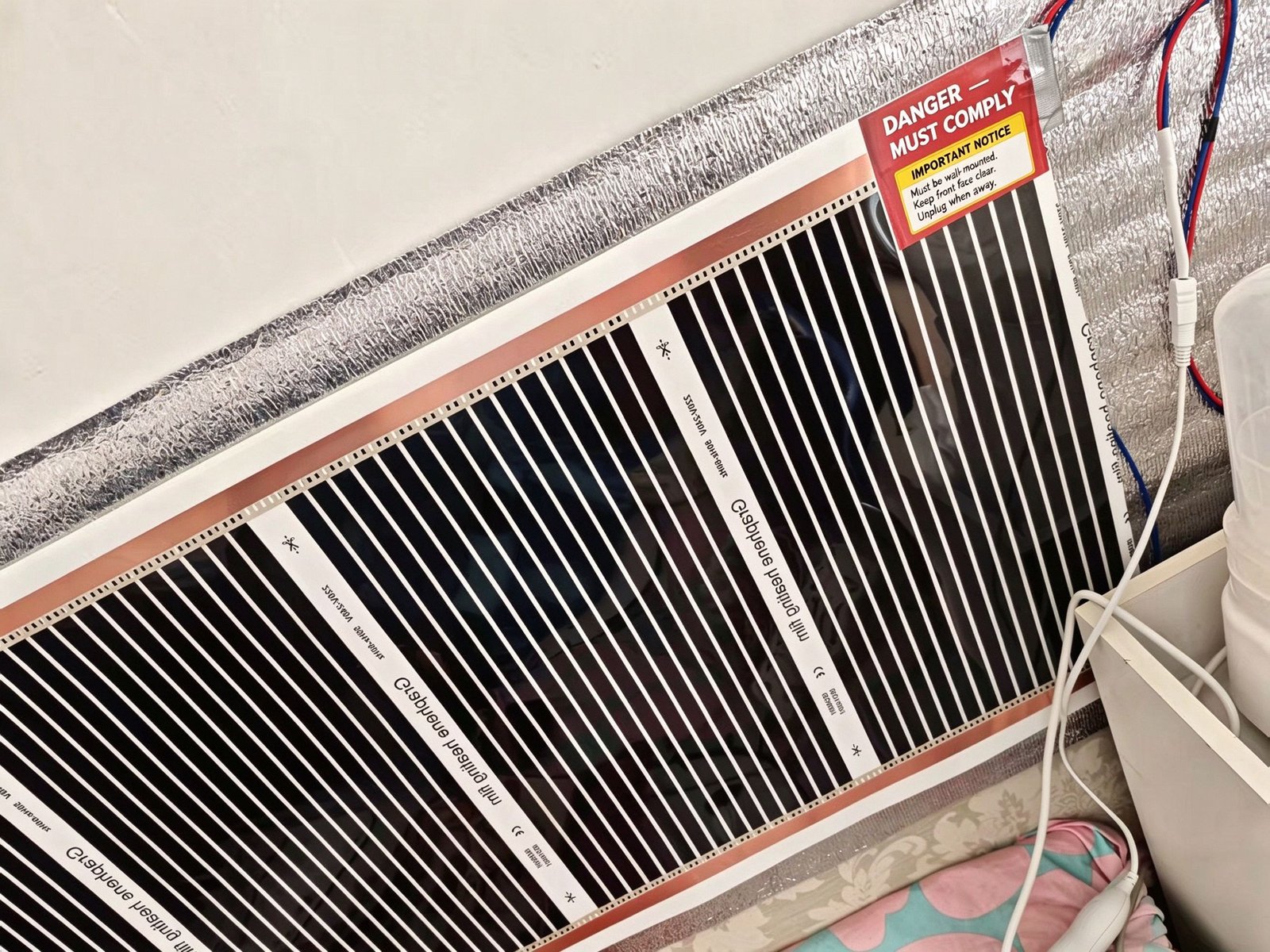
The red connection loom and corner label in the photo above are the kind of detail auditors look for. If the labeling is inconsistent between sample and bulk, your notified body will notice. Keep a sample of every production lot that ships; that archive is your evidence base in the rare event of a claim.
What “CE Report” Really Means in a Quote
When a supplier says “we have CE”, ask three follow-up questions in writing: which exact SKUs does the report cover, what is the report number, and which laboratory issued it. A report that covers a 250 W panel does not automatically cover your 1000 W panel; power density changes thermal and mechanical stress. A report from an unknown lab may not be accepted by your customs authority. Get the names, put them on the RFQ follow-up, and file the answers with your compliance team.
OEM and ODM Capabilities
“OEM” and “ODM” are two different services. Buyers often conflate them and then negotiate the wrong thing.
- OEM (original equipment manufacturer, in the loose sense buyers mean it). The factory makes a proven product under your brand. Your logo goes on the film, the controller shell, the manual, and the carton. The internal engineering does not change. This is fast, low-risk, and the right default for your first two years.
- ODM (original design manufacturer). The factory designs or co-designs a variant for you: a custom controller shell, a custom cut length, a custom plug standard, a zone-thermostat pairing scheme, or a custom-encapsulated form factor. This is slower, carries tooling cost, and is the right move once you know which SKUs sell.
Concretely, on the XGF-WALLFILM platform we support: cut-to-length panels in the standard 50 cm width range, plug variants for EU, UK, and other markets per order, controller shell options including our in-line High/Low/Off thermostat and paired room thermostats for scheduled multi-room control, custom printed manuals and cartons, and custom-encapsulated film builds for non-wall applications. If your project needs a form factor that is not on our standard list, our custom encapsulated heating film page is the right starting conversation; engineering will work backward from your mechanical envelope and target wattage.
Tooling and Ramp Realities
Do not expect a custom controller shell in two weeks. Shell tooling, sample approval, and pre-production runs typically take several weeks to a couple of months. Cut-to-length film and printed packaging are much faster. Plan your product roadmap so that your first container ships with standard shells, and your second container ships with your private-label shell. Trying to launch with everything custom on day one is the classic way to miss a selling season.
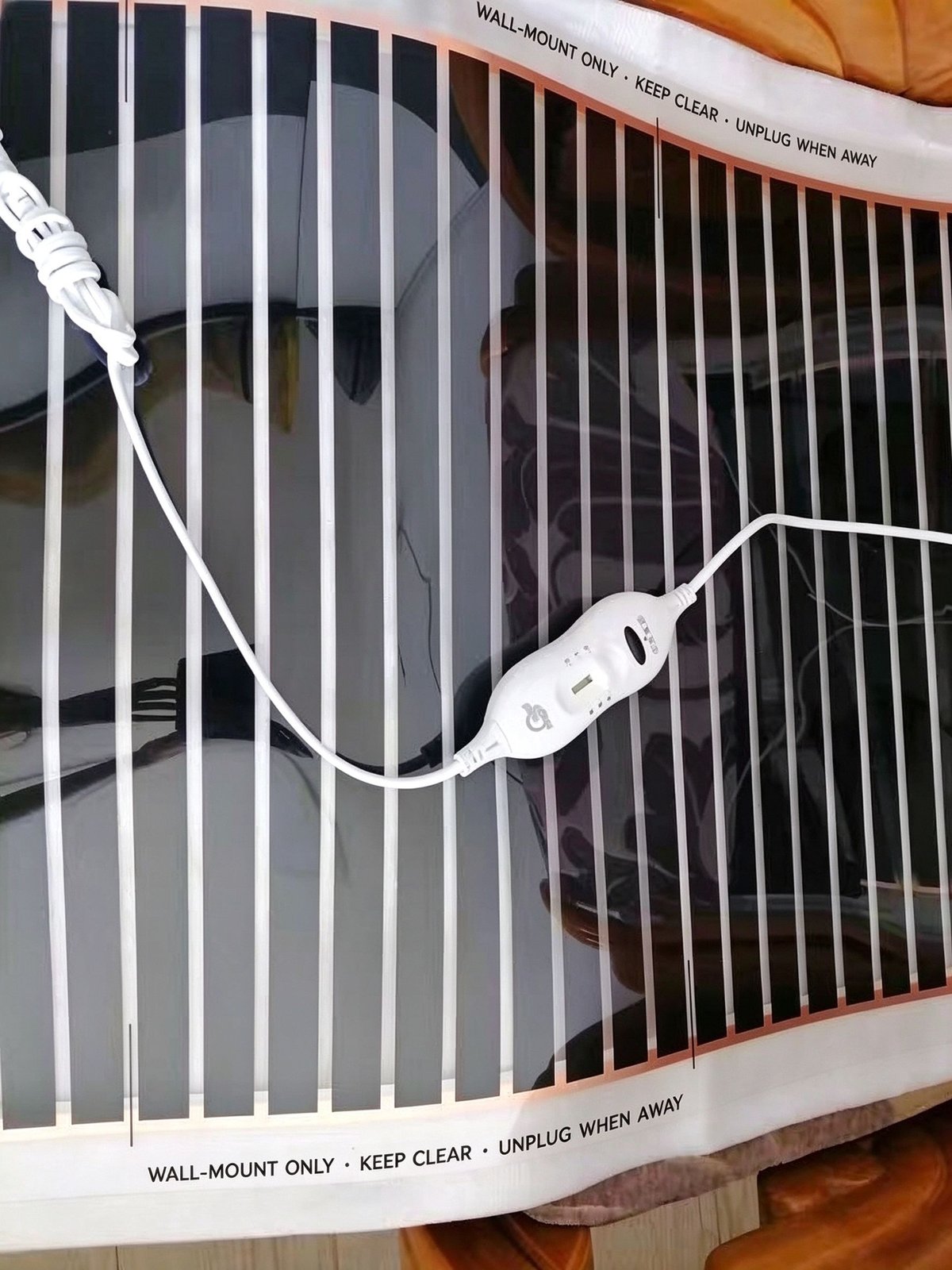
The in-line thermostat in the photo above is our standard controller. If your brand wants a different button layout, a different cord length, or a paired room thermostat that supports weekly scheduling, that is an ODM conversation. Decide early which controller your retail channel expects; re-shipping controllers after a product launch is expensive and confusing for customers.
Warranty and After-Sales Terms
Warranty language in B2B heating film is almost always a negotiation, not a fixed number on a website. The numbers you see on our product page are the consumer-facing baseline; the B2B relationship is documented separately on the partner agreement.
The Three Tiers You Should Expect
- In-box product warranty. The controller carries a 1-year product warranty; the film body carries a 3-year product warranty. These are the terms printed on the retail packaging and the manual, because they are the terms your end customers will hold you to.
- B2B partner framework. Registered B2B partners work under a company-level 15-year warranty support framework. That phrase matters: it is a support framework, not a free replacement promise for 15 years. It means the factory commits to keep spare controllers, keep technical documentation, and keep honoring defect claims within defined rules for the life of the relationship.
- Claims process. Defective units are reported with lot number, photos, and a short description. Verified defects are credited on the next order, replaced in the next shipment, or spare-shipped, depending on volume and urgency. Dispute resolution follows the contract, not the sales rep’s WeChat.
What to Negotiate Before You Sign
- Written defect-rate tolerance. A reasonable contract will specify a threshold (for example, a verified defect rate under a defined small percentage per shipment) above which the supplier covers return freight. Get the number in writing.
- Spare controller allocation. Ask for a defined quantity of free spare controllers per container. Controllers are the most common single failure point, and having spares on your own shelf cuts your customer response time from six weeks to two days.
- Claim window. Define how long after delivery a defect can be reported, and how the lot number ties back to production.
- Force majeure and shortage clauses. Heating film production is sensitive to polymer and copper price moves. Agree in advance how price changes are communicated and whether they apply to open purchase orders.
Inspection and QC
Even a great factory has a bad shift. Your job as a buyer is to make sure the bad shift does not get loaded into your container.
The Three Inspection Gates
- During production (DUPRO). When roughly half the order is assembled, a brief on-site check confirms the first articles match your sample. This catches “the sample was perfect but the bulk tooling drifted” before it scales to a full container.
- Final random inspection (FRI). AQL-style sampling on finished, packed cartons: open a defined number of cartons, check appearance, markings, controller function, carton drop-test simulation, and label accuracy. This is the gate most buyers actually use.
- Container loading supervision. Even if you skip FRI, supervise the loading. Photos of the loaded container, the seal number, and the carton count protect you against “short shipment” arguments once the container leaves the dock.
Common Incoming and Outgoing Issues on This Product Category
- Warning strip print missing or blurred on a subset of panels.
- Controller switch feels loose or clicks inconsistently across a batch.
- Cord length shortened silently from the quoted spec.
- Plug standard wrong on a portion of cartons (the line ran out of Schuko plugs and fitted BS plugs without telling anyone).
- Carton printed with the wrong language manual insert.
- Film creased during packing because the roll was over-tightened.
- Lot number not printed on the outer carton, making traceability impossible on arrival.
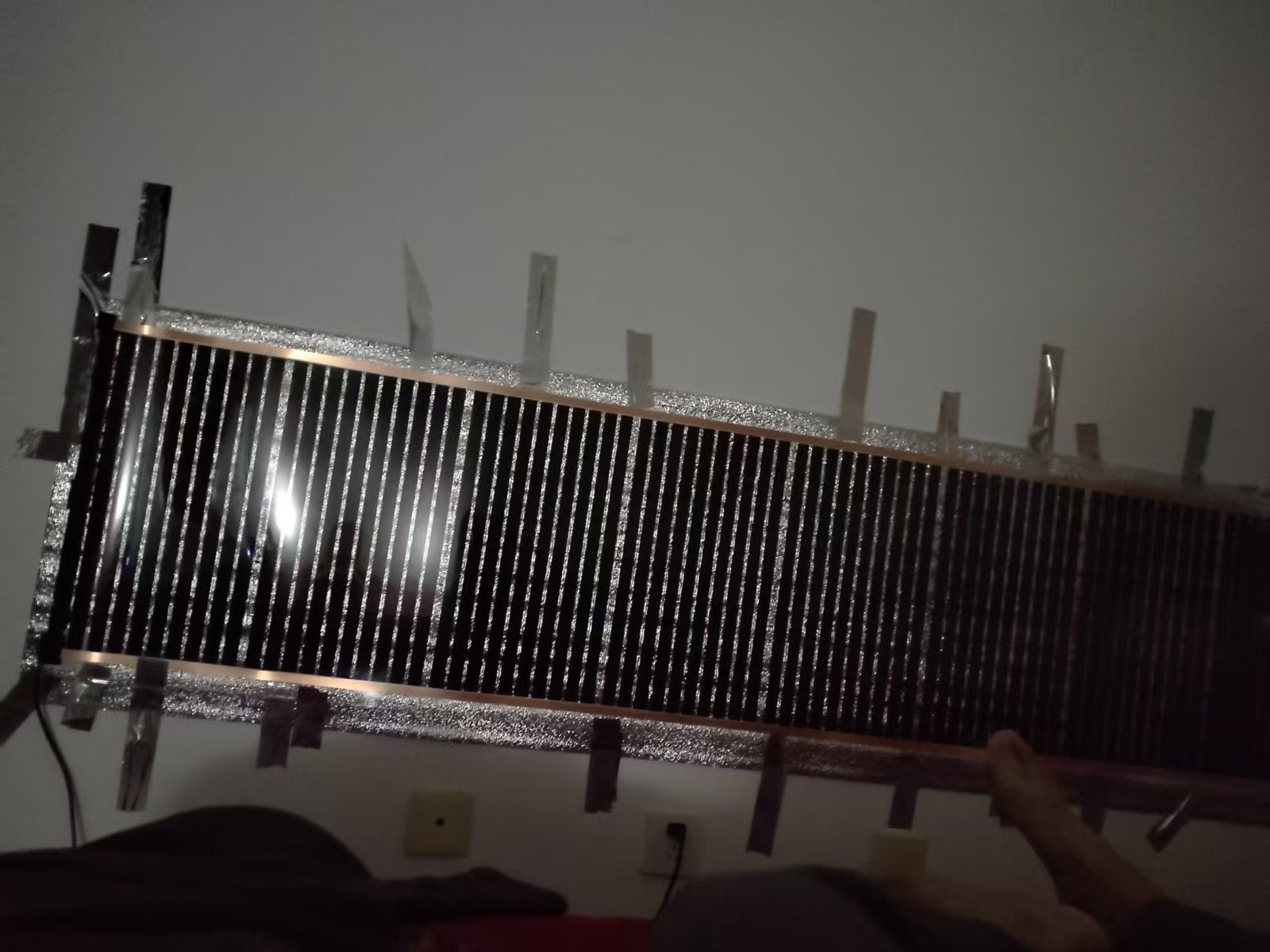
The tape-positioning install sequence in the photo above is part of your customer’s experience. When you do pre-shipment inspection, check that the fixing tape and any auxiliary fixing strips are present in every carton. A missing accessory in 5 % of cartons looks like a tiny number until your installers are standing on a customer’s wall with no double-sided tape. Use a third-party inspection body for the first two to three shipments; after that, your own team can take over once the factory’s process is proven.
Commercial Terms and Red Flags
The technical conversation is only half the procurement job. The commercial terms decide whether the relationship is profitable for both sides or quietly breaks after year one.
Incoterms and Payment Rhythm
For your first orders, FOB your supplier’s nearest port is the cleanest choice: you control the freight forwarder, the insurance, and the destination handling. As volume grows, CIF to your destination port simplifies your work. DDP is attractive but removes a layer of control; only use it with a freight partner you already trust. On payment, expect a deposit against the proforma and a balance against copy of documents or before shipment, depending on order size. As a new importer, do not push for net terms until you have completed at least three clean shipments.
Exchange rate and ocean freight move constantly. We will not quote you a specific number here because it changes month to month; what matters contractually is which currency the PO is issued in, how price revisions are notified, and how a freight spike is shared. Build those into the partner agreement, not into a chat message.
Red Flags You Should Walk Away From
- Quotes that come in 30 % below every other quote on an otherwise identical spec. In a mature product like heating film, that gap usually means a different film construction (thinner encapsulation, cheaper busbar, no silver backing) that will show up as warranty claims in winter.
- Refusal to share test reports beyond a one-page brochure. You do not need the confidential engineering data; you do need the CE and RoHS report numbers.
- Refusal of factory audit or third-party inspection. A factory that refuses a visit in person or a remote video walkthrough is hiding something. The film category is small enough that you can usually find a comparable supplier.
- Warranty claims written only in chat. “Don’t worry, we take care of everything” is not a warranty. Get the defect-rate tolerance, the claim window, and the spare-parts commitment into the partner agreement.
- No named contact for engineering. If every question goes to a sales rep who promises to “ask the factory”, you will not get fast answers when a real installation problem lands on your desk at 8 p.m. on a Friday.
- Plausible but generic claims like “medical grade graphene”, “scientifically proven cures”, or “zero EMF”. Our own product is fully shielded and silent, which is a real and measurable claim; supernatural claims are a marketing and regulatory problem waiting for you in your own market.
- Domain or company history that does not match the sales story. Quick whois and registry checks take five minutes. A company that claims to be established in 2003 but registered the trading entity in 2024 deserves a follow-up call, not an order.
A Supplier Scorecard Template
Use this weighted scorecard on your shortlist. Score each supplier 1 to 5 on each row, multiply by the weight, and total. The supplier with the highest weighted score is usually the right partner, not the one with the lowest unit price.
| Dimension | Weight | What a 5 looks like | What a 1 looks like |
|---|---|---|---|
| Production maturity and capacity | 15 % | Multi-line plant, decades of history, capacity comfortably above your annual ask | Single small line, unknown history, capacity barely covers one container |
| Certification evidence quality | 15 % | CE/RoHS reports covering your exact SKUs, ISO 9001/14001, traceable registrars | Brochure claims only, no report numbers |
| Engineering support | 15 % | Named English-speaking engineer, pushes back on unsafe designs, helps with sizing | Sales-only contact, cannot answer a technical question |
| OEM/ODM flexibility | 10 % | Cut lengths, plugs, controllers, packaging, manual language all confirmed | Only one SKU, one plug, one box |
| Pricing competitiveness | 15 % | Mid-pack pricing with transparent line-item breakdown | Either suspiciously cheap or unaccountably premium with no breakdown |
| Warranty and after-sales | 10 % | Written defect tolerance, spare parts, claim process, 15-year support framework on partner terms | Verbal promises only |
| QC and inspection cooperation | 10 % | Welcomes third-party inspection, provides lot traceability, shares DUPRO photos | Refuses inspection, no lot numbering |
| Communication and responsiveness | 10 % | Replies in under a business day, answers in writing, proactively flags risks | Days of silence, then one-line replies |
Total each supplier out of 5. A serious partner will land between 3.8 and 4.5. Anyone below 3.0 should not make your shortlist, no matter how low the unit price.
Frequently Asked Questions
What is the realistic MOQ on a graphene wall heating film supplier’s first order?
On standard SKUs with a standard plug and plain packaging, the MOQ is deliberately flexible and is structured around sample and pilot quantities rather than a large mandatory pallet. The MOQ climbs once you add custom controller shells, custom printed cartons, or custom cut lengths, because those carry setup and tooling cost. Frame your first order as samples plus a small pilot container, and use the second order to introduce your private label.
Can I really get OEM private label wall heater units shipped from China?
Yes. True private label means your logo on the film, the controller shell, the manual, and the carton, while the engineering stays on the factory’s proven platform. Confirm on the RFQ which surfaces can be printed, what the lead time is for custom cartons, and whether the controller shell has available tooling for your logo. Avoid suppliers that quote private label but cannot show you a photo of a past private-label run.
Which certifications do I actually need on heating film for the EU and UK?
CE and RoHS are the baseline you should hold every shortlisted supplier to, with reports that cover the exact SKUs and wattage you intend to import. For the UK market, work with your own compliance counsel on the local documentation expectations, because the post-Brexit landscape is separate and evolving. For Japan, PSE-related documentation is prepared per order rather than assumed. Do not rely on the supplier to interpret your local law; use the reports as evidence, and have your own compliance sign-off.
How long does it take to develop a custom far infrared wall heater OEM variant?
Cut-to-length film, plug changes, and manual translations can be handled in a normal production lead time. A custom controller shell, a custom-encapsulated form factor, or a zone-thermostat pairing program typically requires several weeks to a couple of months for tooling, samples, and pre-production approval. Plan the product roadmap so that your launch container ships on proven shells, and the ODM variant follows in the next order cycle.
How do I run a supplier audit on a Chinese heating film factory without flying in?
Start with document audit: certificate numbers, test reports, and a remote live video walk of the production line with a named host. For your first serious order, use a third-party inspection body on the ground for a formal factory audit report. This costs a fraction of a business-class flight and gives you an independent, written record that you can share with your own quality team. Combine it with a final random inspection on the first two to three shipments.
What warranty should a B2B buyer expect on a wall heating film order?
The in-box product warranty is typically 1 year on the controller and 3 years on the film body. Registered B2B partners should negotiate a company-level warranty support framework that runs for years beyond that, including spare controller stock, lot traceability, and a defined claims process with agreed defect-rate tolerance. Read the actual partner agreement, not the marketing page, before you sign.
Next Step on Your Sourcing Project
If this checklist matches how you want to buy, the fastest next step is a structured RFQ, not a chat. Send us your project context, your target plug standard, your panel size mix, and your expected annual volume, and we will come back with a per-SKU price table, the relevant CE and RoHS report references, and a sample plan. You can see the product itself, including the full SKU list and controller options, on the graphene wall heating film page, and if your project needs a form factor beyond the standard wall build, our custom encapsulated heating film engineering team is the right starting point. Distributors building a multi-room project should also look at the wider graphene home heating range so you can pair wall film with complementary radiant products on the same showroom floor.
Ready to move from research to a priced quotation? Request Wholesale Price with your RFQ attached, and our supply chain team will turn it around within two working days.