
If you are specifying heating for an apartment, a retrofit flat, an office above a shop, or a rental unit you do not own, you have almost certainly been told that a heat pump is the only responsible answer. Governments subsidise them, utilities write white papers about them, and the press treats them as the default replacement for a gas boiler. In most detached houses with a garden, a dedicated outdoor electrical supply and a decade-plus of ownership, that is good advice. But the question in front of us is narrower and more interesting: when you already have an electric meter, when you cannot put an outdoor unit on the wall, when the space is a single room or a small apartment, and when you want to heat today without a three-month refurbishment, how does a wall-mounted far-infrared radiant film compare with the heat pump and with a reverse-cycle air conditioner?
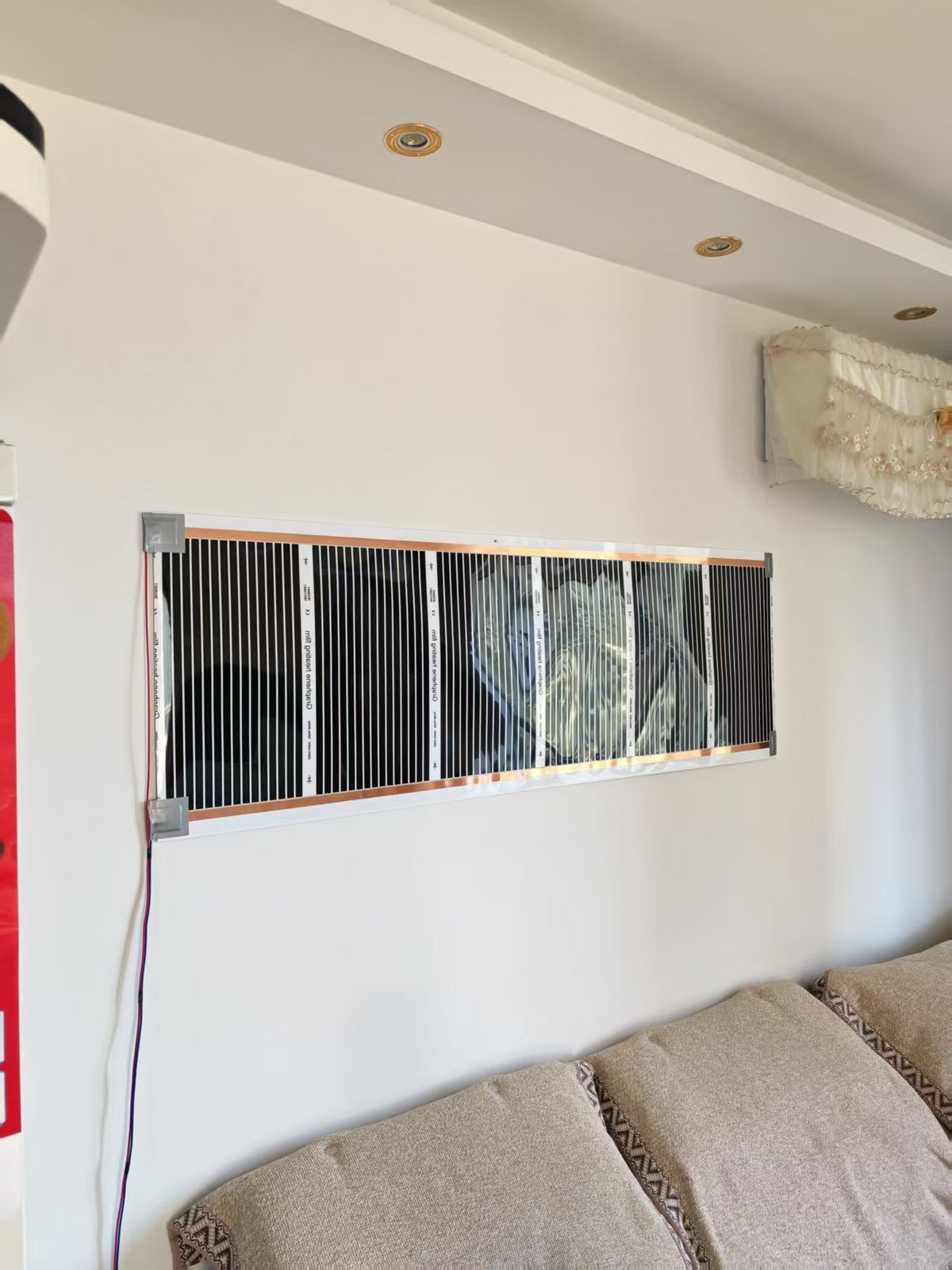
This is a comparison between two genuinely different heating philosophies, not a re-run of the familiar “radiator vs radiator” argument. The SunAura XGF-WALLFILM is a thin printed graphene-carbon resistive film that mounts directly to an interior wall, reaches its working surface temperature in about a minute, and heats by radiation rather than by blowing air. A heat pump, whether an air-to-split monobloc or a ductless mini-split, moves heat from outside to inside using a compressor, refrigerant loop and fan. One converts electricity to heat with a resistor; the other borrows heat from the atmosphere. They are not competing on the same physics, and treating them as if they were is where most online comparisons go wrong. We will keep the comparison honest, because in running-cost terms a modern heat pump usually wins on a whole-building basis. Where the wall film wins is retrofit fit, zoning, comfort, noise and the practical question of what you can physically install.
Written by David Andersson, Heating Systems Analyst, SunAura Thermal.
Two Ways to Turn Electricity into Heat
Before we talk about prices, rooms or subsidies, it is worth being precise about what each device is doing. Once you understand the physics, most of the downstream arguments about running cost, cold-weather behaviour and maintenance follow naturally.
The heat pump: moving heat, not making it
An air-source heat pump does not generate heat. It pumps heat. Inside the outdoor unit, refrigerant evaporates at low pressure and low temperature, absorbing a small amount of heat from the outside air even when that air feels cold. A compressor raises the pressure and therefore the temperature of that refrigerant, and the indoor unit condenses it back to a liquid, releasing the captured heat into your home. The coefficient of performance, or COP, is the ratio of heat delivered to electricity consumed. A well-specified modern air-to-water or air-to-air unit might deliver a COP of 3 to 4 at 7 °C outside, meaning one kilowatt-hour of electricity moves three to four kilowatt-hours of heat into the building. At -7 °C the same unit might be at COP 2.2 to 2.6, and at -15 °C, without careful sizing and electric backup, the number drops below 2.
The price you pay for that COP is a machine full of moving parts: a compressor running at maybe 50 to 120 hertz, an outdoor fan pushing hundreds of cubic metres of air per hour, an expansion valve, a four-way reversing valve, refrigerant piping, condensate drain, filters, an indoor blower and a controller that talks to all of them. You need a place to put the outdoor unit, a line set between the two units, a dedicated electrical circuit, condensate disposal and, in most cities, a building-permit or at least a landlord’s written consent if the unit touches an exterior wall that does not belong to you.
The resistive radiant film: making heat where you stand
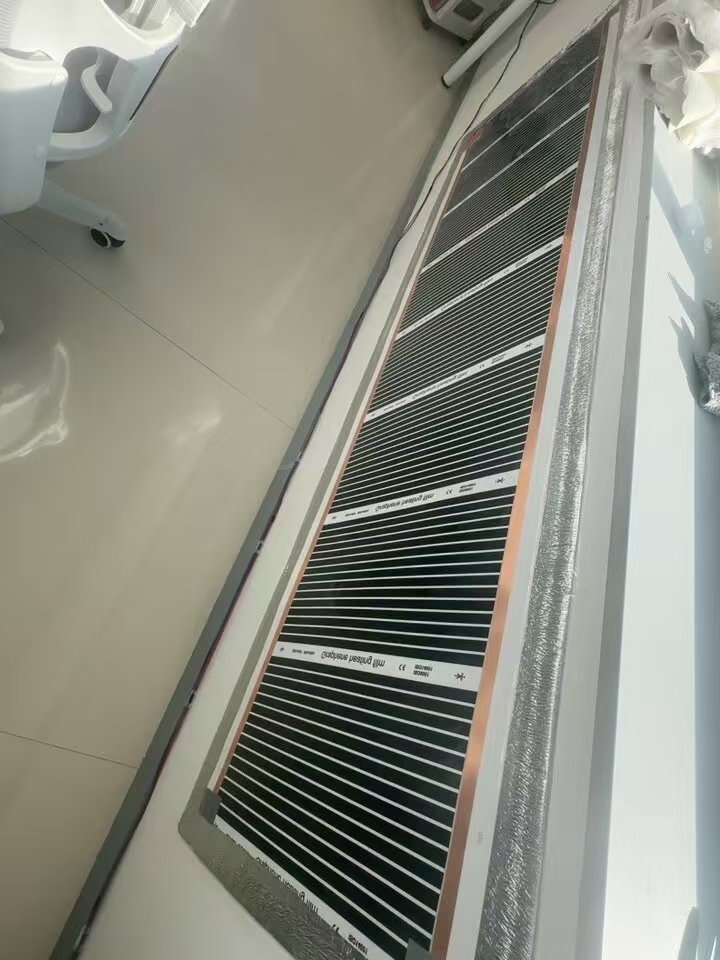
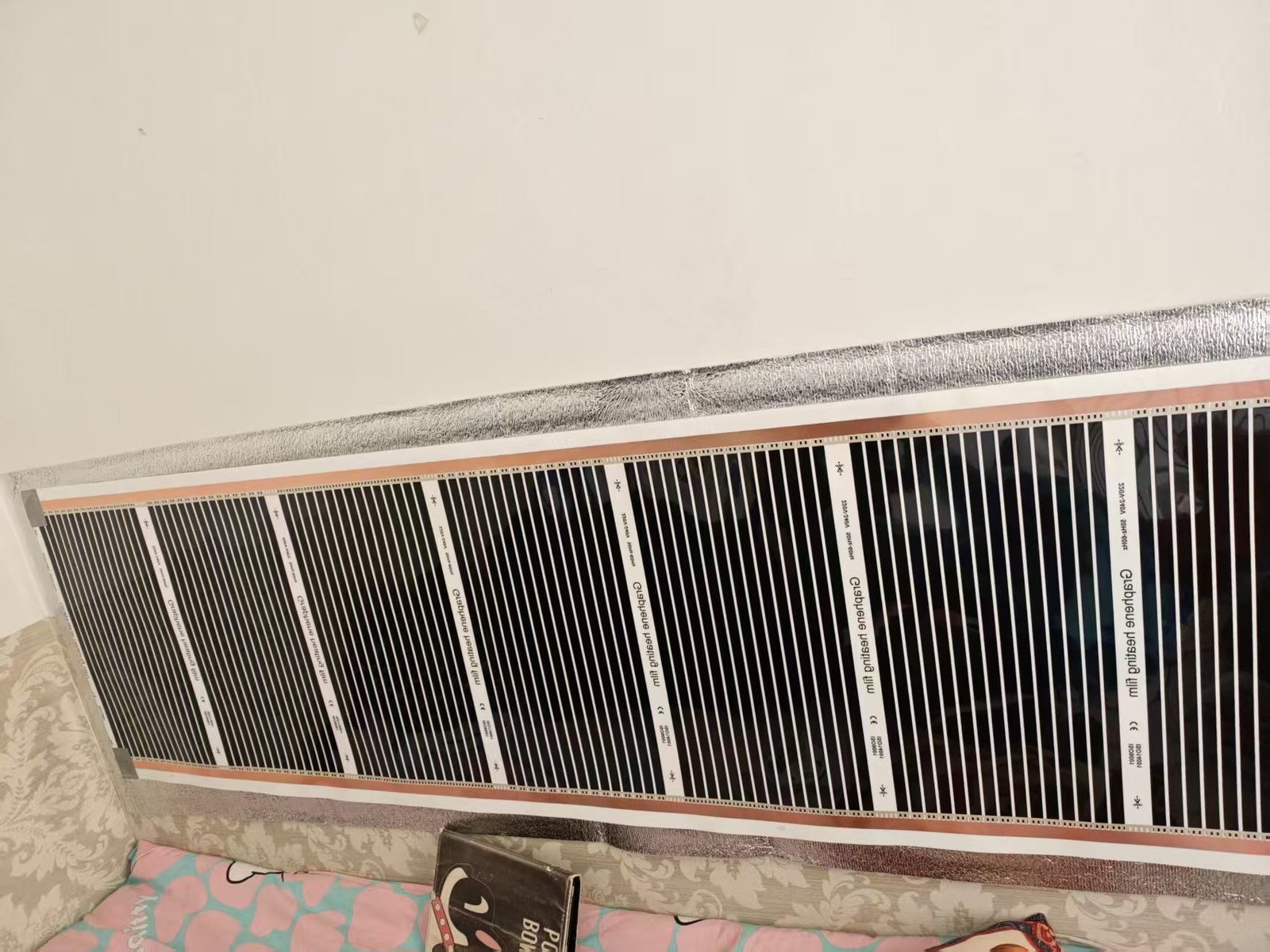
The graphene wall heating film is a much simpler device. A printed graphene-carbon resistive stripe, laminated between a thin polymer layer and a reflective silver backing, is fixed to an interior wall. When 220 V passes through the stripe, electrical resistance turns essentially all of the electricity into heat. The datasheet electric-to-thermal conversion is rated at greater than 99 %, which is the physical ceiling for a resistive heater: a resistor cannot do worse than 100 % by the first law of thermodynamics, and a fan or blower motor would only subtract from that number, so a fanless construction is actually the cleanest way to realise 100 %. There is no compressor, no refrigerant, no outdoor coil, no condensate, no reversing valve and no pump.
The heat leaves the film in two forms. Most of it leaves as far-infrared radiation, absorbed by the walls, floor, furniture and people in front of the wall. The remainder raises the surface temperature of the film itself and the wall behind it, which then convects gently into the room. Because the heat is radiative, the room does not need to be filled with hot air before you feel it. The wall mass, your skin, your chair and your laptop all absorb the radiation directly, which is why occupants report feeling warm at an air temperature that would feel chilly under a convective radiator.
The table below summarises the two philosophies at a glance. We will come back to every one of these rows in the sections that follow.
| Dimension | Air-source heat pump / reverse-cycle AC | Graphene wall heating film (XGF-WALLFILM) |
|---|---|---|
| How it produces heat | Pumps outdoor heat indoors via refrigerant cycle | Resistive conversion on the wall itself |
| Conversion efficiency | COP 2 to 4, falling in deep frost | >99 % electric-to-thermal, fanless |
| Outdoor unit | Required, needs wall or ground mount | None, fully interior |
| Refrigerant circuit | Sealed loop, service charge needed | None |
| Warm-up time | Minutes; building mass keeps it cycling | ~1 minute to operating surface temperature |
| Moving parts | Compressor, two fans, pump, valve | None in the film itself |
| Zoning | Often multi-split, limited per-room | Per-panel, per-room, per-socket |
Capital Cost: What You Actually Pay
Manufacturers publish equipment prices. Installers publish turnkey prices. Buyers, in our experience, almost never compare the two. If you are deciding between a heat pump and a set of wall films for a real project, the number you need is the turnkey installed cost, not the unit price on a distributor’s shelf. The figures below are indicative, drawn from typical European and Northern Asian retrofit quotes we have seen through our distribution channel; your local contractor will price them differently, but the ratios are what matter.
What a heat pump installation really costs
A single-split air-to-air heat pump, sized for a 60 to 90 m² apartment, typically lands between EUR 4,500 and EUR 7,000 all-in. That number is made up of: the indoor and outdoor units (roughly EUR 1,500 to 2,500), refrigerant line set and wall penetration (EUR 300 to 600), electrical supply upgrade and dedicated circuit (EUR 400 to 900 if the board needs work), mounting brackets and sound insulation (EUR 200 to 400), commissioning and leak test (EUR 200 to 400), and a day or two of labour. An air-to-water system feeding radiators or underfloor heating in a detached house, with a buffer tank, hydraulic connections and plumber time, easily runs EUR 12,000 to 20,000 before any wall finishes are restored. In listed buildings, on balconies that face a neighbour’s window, or on the ground floor of an apartment block with no permitted outdoor-unit position, the cost can rise further or the installation may not be permitted at all.
A reverse-cycle air conditioner, sold as summer cooling plus winter heat, is the budget cousin. A mid-wall inverter split unit for one room might be EUR 1,500 to 2,500 installed. In cooling season it is a good device. In heating season, at 5 kW nominal, it will struggle to keep a bedroom above 18 °C on a -5 °C evening unless it is oversized, and it will blow a noticeable draft across the bed.
What a wall-film installation really costs
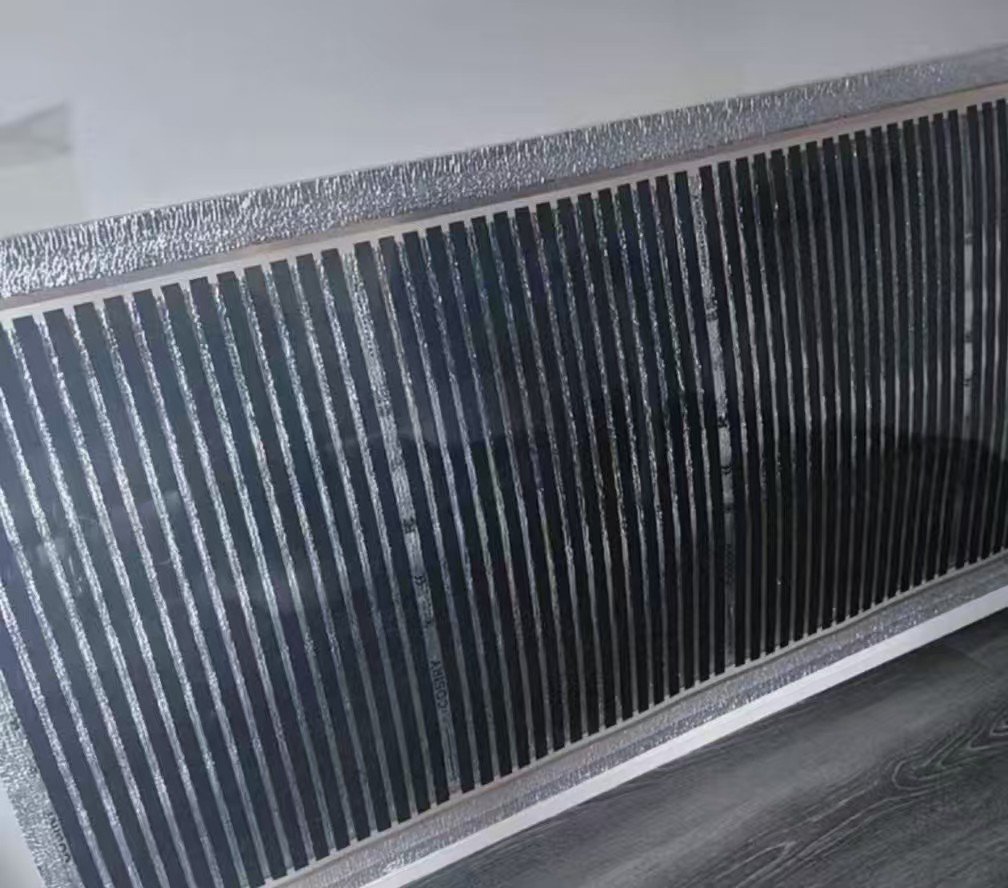
The XGF-WALLFILM is sold by the panel. At 500 W per square metre of film, a 50 cm by 200 cm panel is 500 W and covers roughly 5 to 7 m² as a primary source or 7 to 9 m² as an auxiliary source, depending on insulation and climate. A typical 15 m² bedroom needs one 50 cm by 200 cm panel or two 50 cm by 100 cm panels, plus an in-line thermostat. A 25 m² living room might take two 50 cm by 300 cm panels at 750 W each, paired with a room thermostat for scheduled zoning.
Material cost per square metre of film is a fraction of a split-system quote, and installation is the bigger difference. A plug-and-play panel on drywall, wallpaper or tile, using the factory-printed adhesive strips and positioning tape, takes one person under two hours. No electrician is required because the unit plugs into a standard 220 V socket. No refrigerant, no condensate pipe, no outdoor penetration. Across a 100 m² apartment with three heated rooms, a wall-film retrofit typically comes in at a small fraction of a heat-pump quote, measured in the low-thousands of euros rather than five figures. The numbers are indicative; exact pricing depends on your plug standard, panel mix and whether you opt for zone thermostats, but the order of magnitude is unambiguous.
| Cost line | Air-source heat pump (single split, apartment) | Graphene wall film, 3-room apartment |
|---|---|---|
| Equipment | EUR 1,500 – 2,500 | EUR 600 – 1,200 (panels + thermostats) |
| Mounting hardware | Brackets, line set, condensate drain | Adhesive strips, printed fixing holes |
| Electrical work | Dedicated circuit, possibly board upgrade | Standard socket, no electrician |
| External wall penetration | Required, often walled up later | None |
| Permit / landlord consent | Usually required | Rarely required |
| Labour time | 1 – 2 days | 2 – 6 hours per room |
| Indicative installed total | EUR 4,500 – 7,000 | EUR 1,500 – 3,500 (illustrative) |
The honest caveat: a heat pump in a detached house, amortised over ten to fifteen years of running savings, can still win on total cost of ownership because the COP advantage compounds every winter. But the upfront gap is real, and for a tenant, a short-lease landlord, or a buyer who cannot touch the exterior wall, the heat-pump price is not actually available. The comparison is not a choice between two numbers; it is a choice between two numbers, one of which you may not be allowed to spend.
Running Cost: An Honest Comparison
This is the section where most manufacturer comparisons bend the numbers. We will not. A heat pump, on a whole-building basis, usually costs less to run than direct electric resistance heating, and we will say that plainly. The interesting question is whether that advantage survives when you account for zoning, setback, radiant comfort and the fact that most households do not heat every room to 21 °C at 06:00 in the morning.
The physics of the comparison
Take a kilowatt-hour of electricity. A wall film converts it into 1 kWh of heat at the wall, almost all of which ends up warming the room. A heat pump at COP 3 converts that same 1 kWh of electricity into roughly 3 kWh of heat inside the home. On paper, that is a three-to-one advantage to the heat pump. At EUR 0.30 per kWh, the heat pump delivers space heating at an effective fuel cost of EUR 0.10 per kWh of heat, while the wall film delivers it at EUR 0.30 per kWh of heat. If both systems were asked to maintain the same air temperature for the same number of hours, the heat pump would win by a wide margin, and there is no point pretending otherwise.
The worked example: 100 m² apartment, one heating season
Let us build the example honestly. A reasonably insulated 100 m² apartment in a continental climate, heated from October to March, has a typical seasonal heat demand of about 8,000 to 12,000 kWh per year. Take 10,000 kWh as a round baseline. At EUR 0.30 per kWh of electricity:
- Heat pump route, average seasonal COP of 2.8: electricity consumed = 10,000 / 2.8 = 3,571 kWh. Cost = EUR 1,071.
- All-direct-electric radiant route, assuming the same 10,000 kWh of heat delivered: electricity consumed = 10,000 kWh. Cost = EUR 3,000.
That is a gap of roughly EUR 1,900 per season, and on that basis alone the heat pump looks decisive. But the example contains three hidden assumptions that do not survive contact with how real people actually live in apartments.
Assumption one: every room is heated to the same setpoint, all winter. Most households heat the living room in the evening and the bedroom at night, and leave the spare room, the guest bathroom and the home office at setback. A multi-split heat pump is expensive to zone: each additional indoor head adds material and refrigerant volume, and the outdoor unit has to be oversized to serve them. A wall film, by contrast, is one panel on one wall plugged into one socket. You run the bedroom panel from 22:00 to 07:00, the living-room panel from 17:00 to 23:00, and the bathroom panel for 20 minutes before your shower. You do not heat rooms you are not in. In a three-room scenario, the wall-film strategy might deliver 5,000 kWh of heat rather than 10,000, dropping the annual electricity bill to around EUR 1,500.
Assumption two: the air setpoint and the comfort setpoint are the same. They are not. Radiant heating raises the mean radiant temperature of the room. A room with warm walls feels comfortable at an air temperature of 19 to 20 °C, where a convective system blowing air at you needs 21 to 22 °C to feel the same. Each degree of air setpoint reduction is roughly a 5 to 8 percent reduction in heat demand. If the wall film lets you drop the thermostat from 21 °C to 19.5 °C while staying equally comfortable, the heat demand falls by 10 to 15 percent before you have changed a single panel.
Assumption three: the heat pump runs at its rated COP all winter. In a continental climate, with a stretch of -10 °C to -15 °C weather for two or three weeks, the seasonal COP drifts down toward 2.0 or 2.2, and the unit runs on electric backup on the coldest nights. A wall film does not care what the outdoor temperature is. It is at 45 to 55 °C on the wall regardless of whether it is snowing or raining outside.
Re-running the example with those three adjustments, a realistic mixed strategy looks like this. A small heat pump or reverse-cycle unit provides the whole-apartment baseline, holding the living room and hallway at 18 °C. Wall films top up the bedroom, bathroom and home office to comfort when occupied. Total heat delivered might be 7,500 kWh, of which 6,000 kWh comes from the heat pump at COP 2.8 (2,143 kWh of electricity, EUR 643) and 1,500 kWh comes from wall films (1,500 kWh of electricity, EUR 450). Total annual heating cost: EUR 1,093. That is essentially the same number as the all-heat-pump scenario, but with far better zoning, far better bedroom comfort and a much smaller outdoor unit. In a small apartment where no outdoor unit fits at all, the wall-film-only route with aggressive setback lands around EUR 1,200 to 1,500 per season, which is within roughly 20 to 30 percent of the theoretical heat-pump optimum, while costing a fraction as much to install and fitting through the door on a Saturday afternoon.
When the wall film genuinely wins on running cost
There are three narrow but real cases where direct-electric radiant comes out ahead on the bill, not just on the bill after installation. The first is the single-occupant, single-room scenario: a home office used four hours a day, a studio flat occupied by one person, a holiday let used ten weekends a year. The second is high-electricity-tariff environments with cheap off-peak rates and lightweight thermal mass, where a short radiant burst feels warmer than a long convective soak. The third is partial-space heating alongside an existing heat pump, where the film lets you set the heat pump back two degrees and avoid its low-temperature cycling losses. We will come back to that hybrid in a later section.
When the heat pump genuinely wins on running cost
Equally plainly: if you are heating a 120 m² or larger home, occupied all day, with a competent heat pump correctly sized for your climate and your insulation, the heat pump will beat a wall-film-only installation on the electricity meter, every winter, by a comfortable margin. No amount of radiant comfort adjustment closes a 3-to-1 physics gap at COP 3. We do not pretend otherwise, and any supplier who tells you their resistive heater is cheaper to run than a heat pump across a whole house is doing bad arithmetic.
Comfort, Noise and Cold-Weather Performance
Cost is not the only thing occupants experience. Comfort is what they notice at 22:30 when they are trying to sleep, and it is where the two systems diverge most clearly in day-to-day use.
Air movement and draft
A reverse-cycle indoor unit delivers heat by blowing air across a coil. Even on the lowest fan speed, there is measurable airflow, and on a bedroom wall above the headboard that airflow is felt as a slow draft across the pillow. Many buyers respond by turning the fan speed down, at which point the coil freezes up and the unit goes into defrost. Radiant wall heating has no fan at all. The wall warms, the room surfaces warm, and you feel the effect on your skin and the back of your neck, without any air moving. It is the difference between standing near a warm radiator in a silent room and standing in front of a forced-air vent.
Noise
Heat pumps and air handlers are quiet, in the way a refrigerator is quiet: maybe 30 to 40 dB indoors, and noticeably louder at the outdoor unit, particularly in defrost cycles. For a living room or a shop, that is fine. For a bedroom, a study or a recording space, even a quiet compressor is audible at night, and outdoor-unit noise is a common source of neighbour disputes in apartment blocks. A wall film has no fan, no compressor and no relay chatter. The only sound in the room is the room itself. Buyers who specifically want a silent wall heater for bedroom use, or an electric wall heater no fan will tolerate, almost always mean they have tried a ductless split and decided it was loud enough to bother them.
Defrost and low-temperature behaviour
Air-source heat pumps extract heat from outside air. When the outdoor coil drops below freezing and the humidity is high, frost builds up on it. The unit stops heating the house for five to ten minutes, reverses the cycle, dumps warm outdoor air outside and draws heat from inside the house to melt the frost. During that cycle the indoor fan may blow cold air. In a prolonged cold snap, say a week of -8 to -12 °C, that can happen several times a day. Owners learn to live with it; visitors notice. A wall film does not defrost, because it lives on the inside wall. Its working temperature is 45 to 55 °C, controlled by the in-line thermostat, and it does not care what the outside air is doing.
In very cold climates, heat-pump output also declines. A unit rated at 5 kW at 7 °C might deliver 3 kW at -7 °C, and the designer has to add electric backup or oversize the outdoor unit. The wall film delivers its rated wattage on the coldest night of the year exactly as it does on the mildest. It is not a heat pump and it does not pretend to be one. It is a point-source heater on a wall, and it performs like one.
Humidity, Air Quality and Dust
Heating systems do not just change temperature; they change how the air feels on your skin and in your throat. This is under-discussed in most cost comparisons, and it matters.
Dryness and humidity
A heat pump or an air conditioner, particularly in cooling mode, dehumidifies the air. In heating mode, it brings the indoor relative humidity down by heating dry outdoor air and mixing it with indoor air. In winter, indoor RH already sits at 25 to 35 percent in most heated homes, and a forced-air system pushes it lower. Occupants respond with dry throats, chapped lips, static on carpets and dry skin. A radiant wall film does not blow air. It does not bring in outdoor air, and it does not dehumidify anything. The indoor humidity stays at whatever the building envelope is holding. Many of our buyers who switch from a ductless split to a wall film report that the room feels less drying, and that they run a humidifier less often.
Dust and allergens
Forced-air systems move dust around. A filter catches some of it, but a fan running at 200 or 300 cubic metres per hour is still recirculating the contents of the room: skin flakes, pet dander, pollen tracked in on shoes, dust from the carpet. People with asthma, children with eczema, and owners of cats that shed in winter notice this. A wall film moves no air. Dust settles where it settles. The radiant surface warms the wall gently and does not lift particles off the floor. For a buyer looking for a wall heater with no electromagnetic radiation and no dust movement, this is part of the same story: a fanless, shielded, quiet wall surface.
Retrofit Fit: Apartments, Heritage and Rentals
This is where the comparison stops being abstract. The physics and the running cost are well documented on the internet. The retrofit reality is not.
The apartment problem
Most multi-storey apartment buildings were not built with heat pumps in mind. There is no designated outdoor-unit position on the balcony, no unobtrusive path for the line set between units, and no electrical spare on the consumer unit. The local building code may restrict where outdoor units can be mounted on the facade, and your neighbours below may object to the noise. The landlord may not permit drilling through the exterior wall at all. In many European cities, putting a condenser on the balcony faces planning restrictions, and on the ground floor the unit may be too close to a boundary.
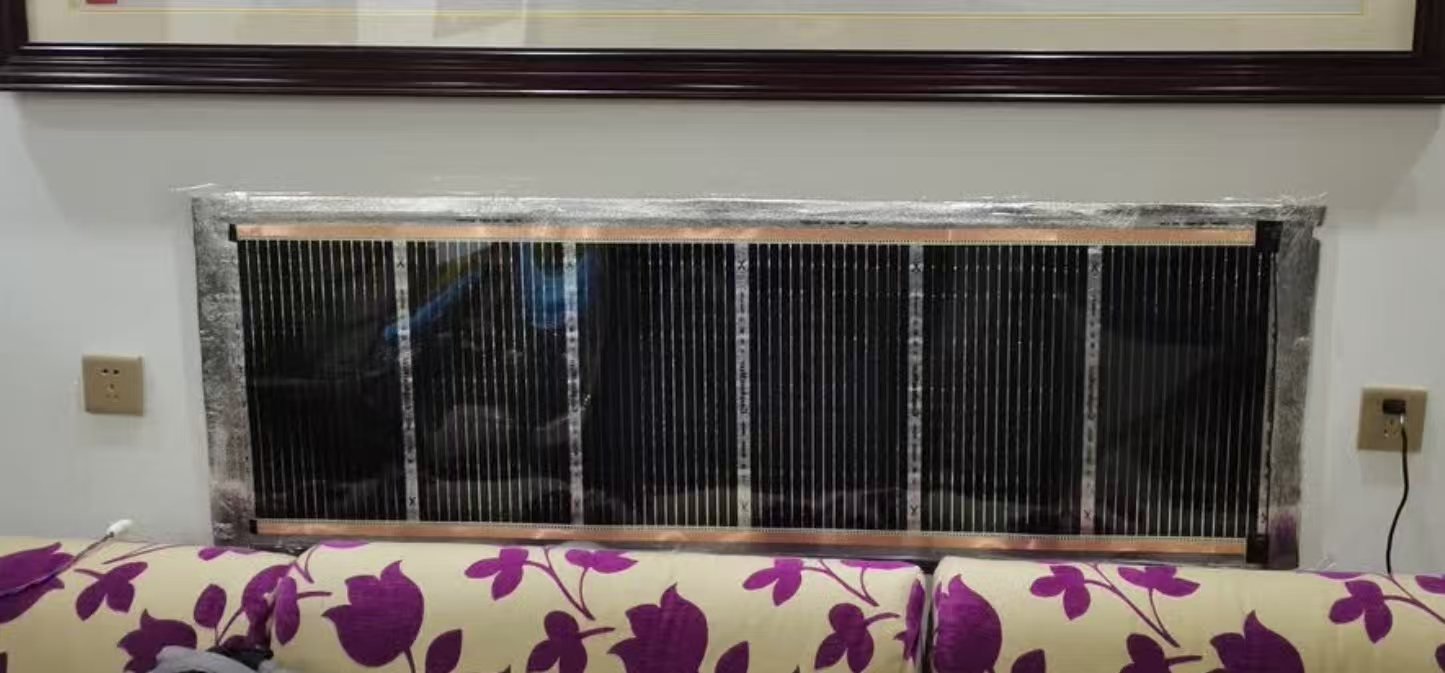
The XGF-WALLFILM does not care about any of this. It mounts on an interior wall. It plugs into a standard socket. There is no external penetration, no refrigerant line to run through the floor slab, no condensate pipe dripping onto the balcony below, and no landlord approval required beyond, perhaps, a chat about whether you can stick something on the painted wall. When you move out, you unplug it. The adhesive-fixed film leaves no pipe chase, no hole in the facade and no appliance on the street. For a tenant, a short-lease rental, or a serviced apartment that changes hands every twelve months, that is the entire argument.
Heritage and older buildings
Listed buildings, stone-walled cottages and period conversions carry a second problem: you cannot drill big holes in the facade, and you often cannot run plastic pipe along the skirting. A wall film, fixed to an interior plaster or tile wall, leaves no trace. It is also compatible with wallpaper, ceramic tile, wood paneling and drywall, which means it can go over the existing finish rather than behind it. No wet trades, no skirting boards removed, no floor lifted. That is the practical definition of a thin wall heating panel for retrofit.
Single-room and fast-response scenarios
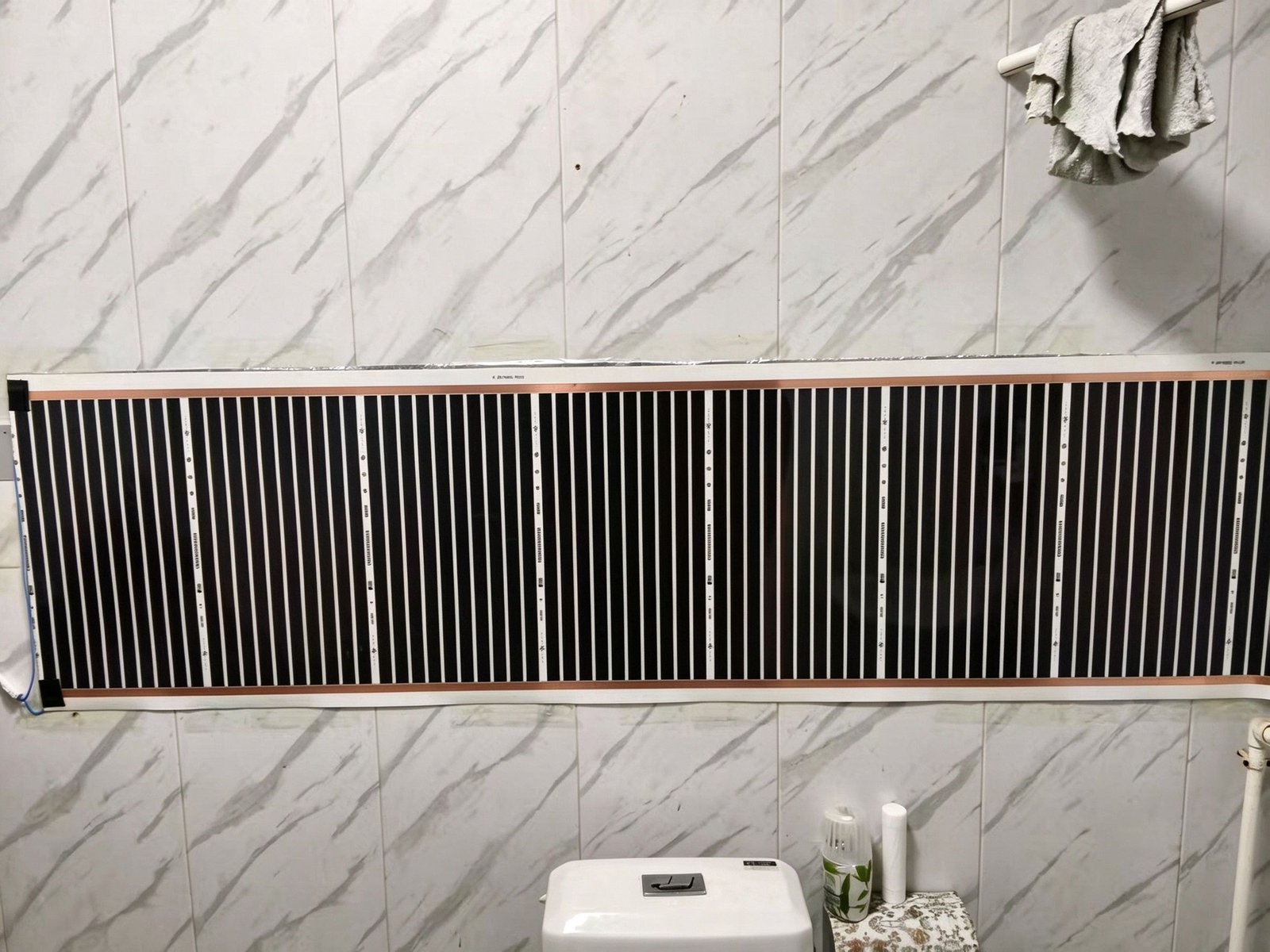
There is a set of heating jobs where a heat pump is absurd on the face of it. A bathroom, used for twenty minutes in the morning. A home office occupied four hours a day. A guest room used twice a month. A holiday cottage heated for one weekend out of four. A heat pump has minimum run times, standby losses, defrost cycles and a slow warm-up. It wants to run for hours. A wall film reaches operating surface temperature in about a minute, you walk in, it is warm, you walk out, you switch it off. It is the right tool for intermittent, localised, on-demand heat.
Maintenance and Service Life
A heat pump is a piece of mechanical equipment. It has a compressor that runs for thousands of hours a year, a fan bearing that wears, filters that clog, condensate drains that block, an expansion valve that can stick, and a refrigerant charge that can leak. Most manufacturers recommend an annual service, typically EUR 100 to 200 a year, and a major component replacement outside warranty can run into four figures. The outdoor unit needs its fins cleaned, its drain checked and its sound insulation inspected. In coastal climates, the coil corrodes. In dusty climates, the filter clogs in a season.
The XGF-WALLFILM has none of that. There is no fan, no compressor, no filter to change, no condensate drain to clear and no refrigerant to recharge. The film itself is a printed resistive stripe laminated between polymer layers. Our standard in-box warranty covers the controller for one year and the film body for three years. For registered B2B partners, we operate a 15-year warranty support framework, which is the number distributors ask for when they are selling into hospitality and multi-unit projects. The practical implication is that a wall film on a wall, once installed and left alone, will keep radiating for as long as the laminate is intact and the surface is not covered.
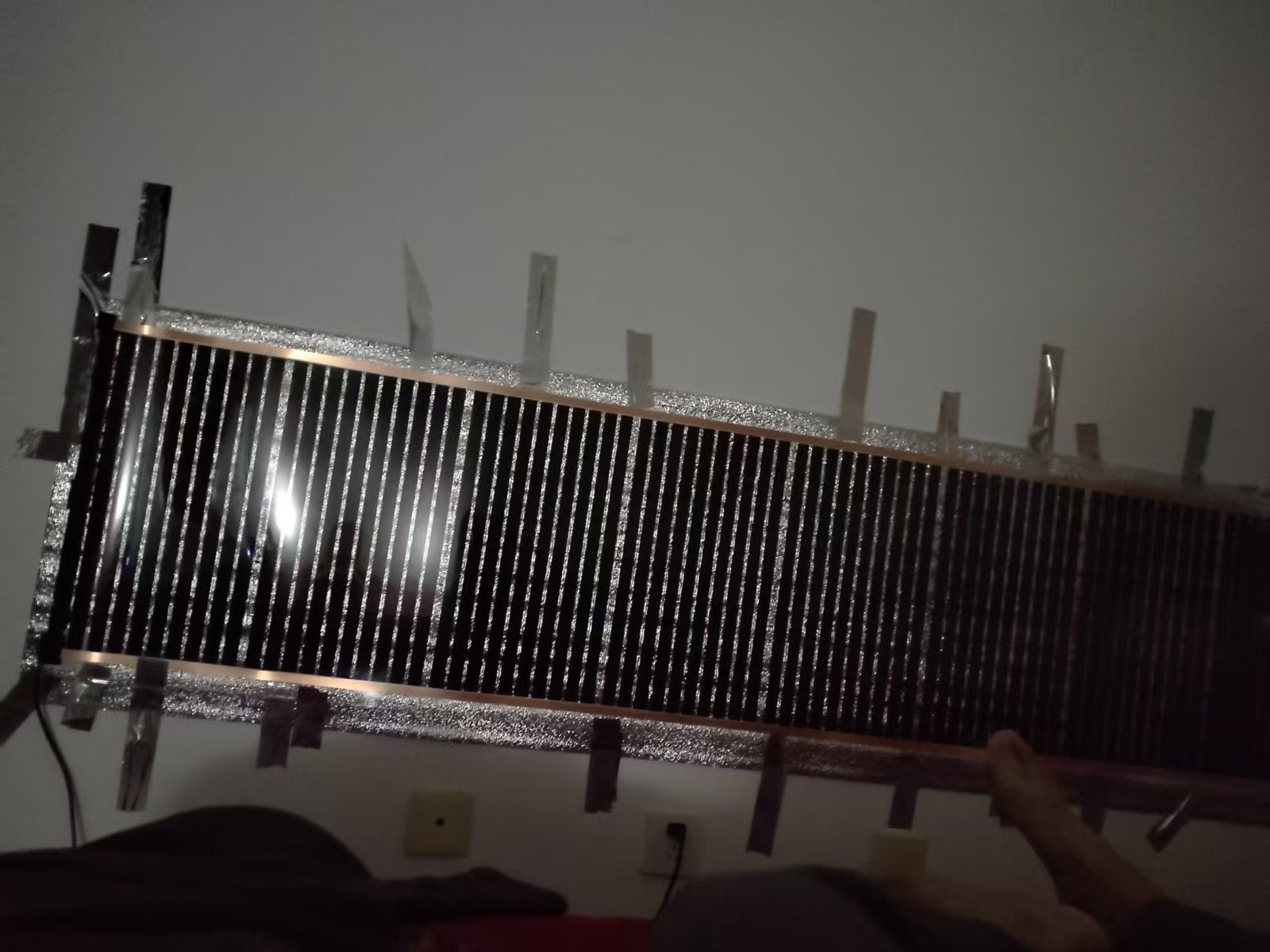
The caveat, and we say this plainly: the film must be installed and used within its safety rules. It has to stay on the wall, never on the floor, never inside bedding, never behind a cabinet. The radiating front face has to stay clear, because covering it lets the surface climb past 100 °C quickly. In a nursery or a children’s room, run it on the Low setting on an open wall. Disconnect when unattended. These are not marketing caveats; they are operating instructions, and they are on the warning label on the foil border of every panel.
The Hybrid Strategy Most Projects Should Consider
Once you accept that neither device is universally right, the interesting design becomes the hybrid. This is the configuration we end up recommending to most of our distribution partners, once they have sat down with a real customer and a real floor plan.
Base load from the heat pump, top-up from the film
In a detached or semi-detached house where you are already fitting a heat pump, size the outdoor unit for the whole-building baseline at 18 to 19 °C. Then add a wall film in the rooms where occupants actually feel cold: under the bedroom window to kill the cold downdraft, on the bathroom wall behind the door, on the home-office wall behind the desk, and above the child’s bed. The heat pump holds the building; the film delivers local comfort where the air temperature would otherwise need to be cranked up to compensate. Total installed cost rises only marginally, occupant comfort rises noticeably, and the heat pump spends more of its time running at its efficient middle load rather than cycling on and off trying to satisfy a single bedroom’s peak.
Baseboard or radiator replacement in apartments
In an apartment where you cannot add an outdoor unit, the wall film stands in for the whole heating system. Pair it with a room thermostat for scheduled control, run the living room panel in the evening, the bedroom panel overnight, and treat the bathroom panel as a short pre-shower boost. You can size it using the same coverage guide we publish: 50 cm by 200 cm for a 5 to 7 m² primary zone, 50 cm by 300 cm for a 7 to 10 m² primary zone, and so on. If you are comparing against an underfloor retrofit you never want to dig up, the underfloor heating calculator on our site will show you the energy comparison; the wall film is the above-floor equivalent, with none of the screed and none of the wet trades.
Holiday lets, hospitality and commercial walls
Short-let operators, tea rooms and small restaurants care about two things: fast warm-up when the door opens, and zero maintenance in the off-season. A wall film delivers both. A heat pump, left idle for months in an uninsulated corner, complains. A wall film, switched off, simply waits. The same logic applies to offices above shops that are only occupied four days a week: run the film when you are there, leave it off when you are not. The graphene home heating range pairs naturally with this way of working, because each panel is its own independently switchable zone.
A Decision Table by Scenario
We have written the argument in prose. Here is the same argument compressed into a decision table, so you can point at your row and move on.
| Scenario | Recommended primary heat | Why |
|---|---|---|
| Detached house, outdoor unit available, long ownership horizon | Air-source heat pump, sized for whole-building load | COP advantage compounds over many winters; capital cost amortised |
| Semi-detached with a small garden and a permitted wall position | Heat pump + wall film in bedrooms and bathroom | Hybrid: low whole-building running cost, local radiant comfort where it matters |
| Apartment, rented, no exterior wall permission | Wall film, zoned by room | No outdoor unit, no refrigerant, no drilling facade; unplug when you leave |
| Owner-occupied flat, balcony position but noisy neighbour | Wall film, possibly a small ductless split for cooling only | Avoids outdoor-unit noise dispute; cooling handled by a reversible unit used mainly in summer |
| Listed or heritage property | Wall film over existing plaster, tile or wallpaper | No facade penetration, no wet trades, no planning consent |
| Bathroom, used 20 minutes a day | Wall film on marble or tile above the door | Instant radiant warmth, no blower on damp air, no condensate |
| Child’s bedroom or nursery | Shielded wall film on Low, on an open wall above the headboard | Silent, fanless, no EMF emission; no cold draft over the bed |
| Home office, four hours a day | Wall film behind desk, under window | Warms feet and back instantly; no compressor noise during calls |
| Holiday cottage, occupied 10 weekends a year | Wall film, zoned per occupied room | No minimum run time; no frost-defrost argument while the place is empty |
| High electricity tariff, zoning-heavy occupancy | Wall film with scheduled thermostats, plus heat pump where available | Pay only for the rooms and hours you actually occupy |
| Commercial tea shop, restaurant or retail wall | Wall film on wood or tiled wall behind seating | Warms customers’ backs, silent during conversation, zero floor footprint |
| Cold-climate detached house with frequent -15 °C weeks | Air-to-water heat pump with radiators, plus electric backup | Wall film is a point source; whole-house deep frost needs a system sized for it |
Side-by-Side: Twelve Dimensions Compared
If you are preparing a procurement comparison and need one table to hand to a contractor, here is the full twelve-row summary. The numbers in the heat-pump column are typical for a correctly sized mid-market inverter unit; your exact quote will vary. The wall-film column is taken directly from our XGF-WALLFILM datasheet.
| Dimension | Air-source heat pump / reverse-cycle AC | Graphene wall heating film XGF-WALLFILM |
|---|---|---|
| Heating principle | Refrigerant cycle, pumps outdoor heat indoors | Resistive far-infrared radiation at the wall |
| Efficiency | COP 2 to 4 at 7 °C, falling in frost | >99 % electric-to-thermal, independent of outdoor temperature |
| Warm-up time | Minutes to reach comfortable air temperature | ~1 minute to operating surface temperature |
| Outdoor unit required | Yes, wall or ground mounted | No, fully interior |
| Refrigerant and service | Sealed loop, annual service, refrigerant recharge | None, no service interval |
| Noise indoors | Indoor fan and compressor hum, 30 – 40 dB | Silent, no fan, no compressor |
| Air movement | Forced airflow, draft, dust circulation | No airflow, no dust lift |
| Setback and zoning | Multi-split expensive; indoor units per room | Per-panel per-socket, scheduled with room thermostats |
| Retrofit impact | Facade penetration, line set, electric board work | Adhesive to existing wall, plugs into socket |
| Warranty | 5 – 10 years on compressor, subject to annual service | Controller 1 year, film body 3 years; B2B 15-year support framework |
| Upfront installed cost (small apartment) | EUR 4,500 – 7,000 indicative | EUR 1,500 – 3,500 indicative |
| Best fit | Whole-house, long-ownership, outdoor-unit access | Apartments, rentals, retrofit, local comfort, bathrooms, bedrooms |
Frequently Asked Questions
Is a heat pump or an infrared wall heater cheaper to run?
On a whole-house basis, a correctly sized heat pump usually wins, because a COP of 3 means one unit of electricity delivers three units of heat. The gap narrows when you heat only the rooms you occupy, because infrared wall heating lets you zone per panel and run a bedroom for seven hours instead of heating the whole flat all day. It also narrows on cold nights when the heat pump drops toward COP 2. Treat the heat pump as the low-whole-house-cost option and the wall film as the low-zoned-cost option.
Can a wall heater replace an air conditioner in winter?
In a room, yes. A reverse-cycle air conditioner blows warm air and makes noise; a wall heating film warms the wall and the people in front of it silently. In a whole house, a single wall film does not have the output to replace a ducted system, but a set of zoned panels, one per room, will hold an apartment at comfort without any outdoor unit. If you need summer cooling as well, keep a reverse-cycle unit for cooling and use the wall film for winter comfort.
Do I need planning permission to install a graphene wall heating film?
No. Because the film is fixed to an interior wall and plugs into a standard socket, there is no external wall penetration, no refrigerant, no new outdoor unit and no building-services alteration. In a rented flat, check your tenancy agreement for rules about fixing items to painted walls, but the adhesive-mounted panels leave no pipe chase and no structural hole.
How many watts do I need for a bedroom?
Our coverage guide suggests 5 to 7 m² of primary heated space per 500 W panel (50 cm by 200 cm), and 7 to 9 m² as an auxiliary. A 12 to 16 m² bedroom typically takes one 500 W panel above the headboard or under the window. Confirm sizing with our engineering team, because insulation, window area and ceiling height move the number.
Is far-infrared wall heating safe for a child’s room?
Yes, with the same operating rules you would apply to any heater: keep the radiating face clear, run it on Low on an open wall, and unplug when the room is unattended. The film is fully shielded, so there is no electromagnetic radiation emission, and there is no fan to blow dust toward the bed.
What is the lifespan of a graphene wall heating film compared with a heat pump?
A heat pump, with annual servicing, is typically designed for 10 to 15 years, after which the compressor or refrigerant loop becomes the limiting item. A wall film has no moving parts and no service interval. Our in-box warranty covers the controller for one year and the film body for three years; for registered B2B partners we run a 15-year warranty support framework. In practice, undamaged films on interior walls keep radiating well beyond that.
If your project fits the retrofit, rental, apartment or local-comfort profile that a heat pump cannot reach, talk to our engineering team about panel selection, plug standards and zone-thermostat pairing. We supply the graphene wall heating film as a graphene home heating system cut to your lengths, with CE and RoHS certification, and we work with distributors, installers and heating-system integrators across 50-plus countries. Request Wholesale Price with your room schedule, and we will size the panels and come back with a quote and a layout.