
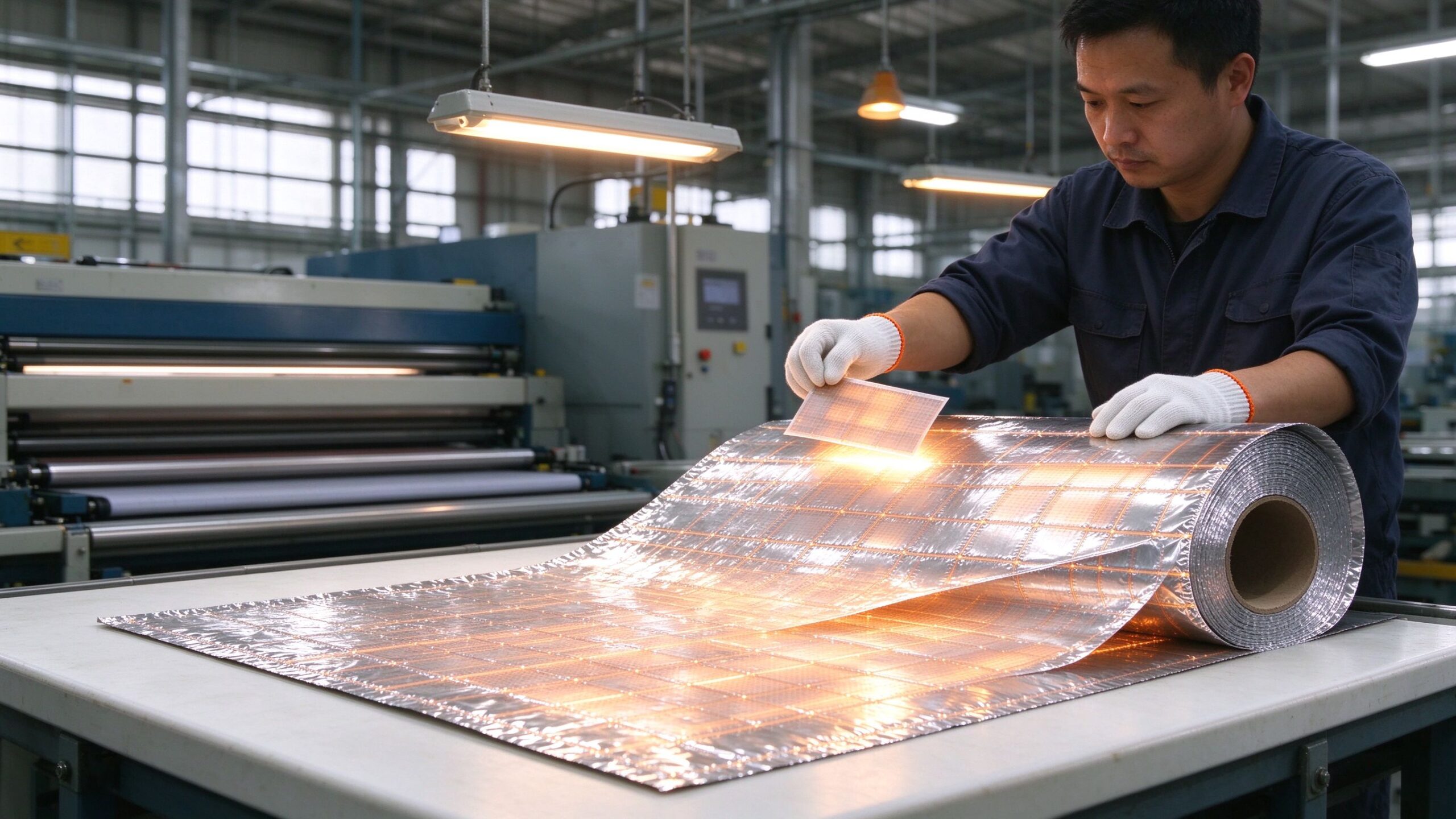
Heating Film Substrate: PET vs Polyimide and How the Carrier Film Decides What Your Project Can Do
Most buyers comparing electric heating film spend their time on wattage and price per square metre, then discover six months later that the film they ordered cannot survive the temperature the application actually needs. The carrier substrate — the plastic film the carbon or graphene heating layer is laminated onto — is the part of the specification that quietly sets the ceiling on everything else: maximum surface temperature, power density, flexibility, dielectric strength, and how long the element lasts in a humid floor.
Two substrates dominate the market: PET (polyester, polyethylene terephthalate) and polyimide (PI). They look similar in a sample book. They behave nothing alike in service, and the price difference between them is roughly five to ten times per square metre. This guide compares them on the parameters that decide a project — continuous temperature, power density, build-up, cost band, and the applications where each one is the wrong buy.
What the substrate actually does in a heating film
A heating film is a sandwich. The active layer — carbon paste, graphene/carbon hybrid ink, or etched metal foil — is encapsulated between two dielectric films, bonded with an adhesive that has to survive the same thermal cycling as the element. The substrate performs four jobs at once:
- Electrical insulation. It separates live conductors from the floor covering and from anyone standing on it. Dielectric strength is measured in kilovolts per millimetre, and it is the reason a 0.25 mm film can carry mains voltage safely.
- Thermal coupling. Heat has to leave the active layer and reach the floor surface. A thicker film adds thermal resistance; a film with trapped air bubbles adds a hot spot.
- Mechanical support. It carries the element through screed pours, tile adhesive shrinkage, furniture loads and the daily expansion of a heated floor.
- Chemical and moisture barrier. In bathrooms, kitchens and pool decks, the film has to resist hydrolysis and plasticiser migration from adhesives and underlays.
Because the substrate is the barrier, its temperature rating — not the heating element’s — is usually what limits the product. A carbon heating ink can run far hotter than the polyester carrying it. When a supplier quotes “120 °C rated”, ask which layer that number belongs to.
PET film: the default for floor and ceiling heating
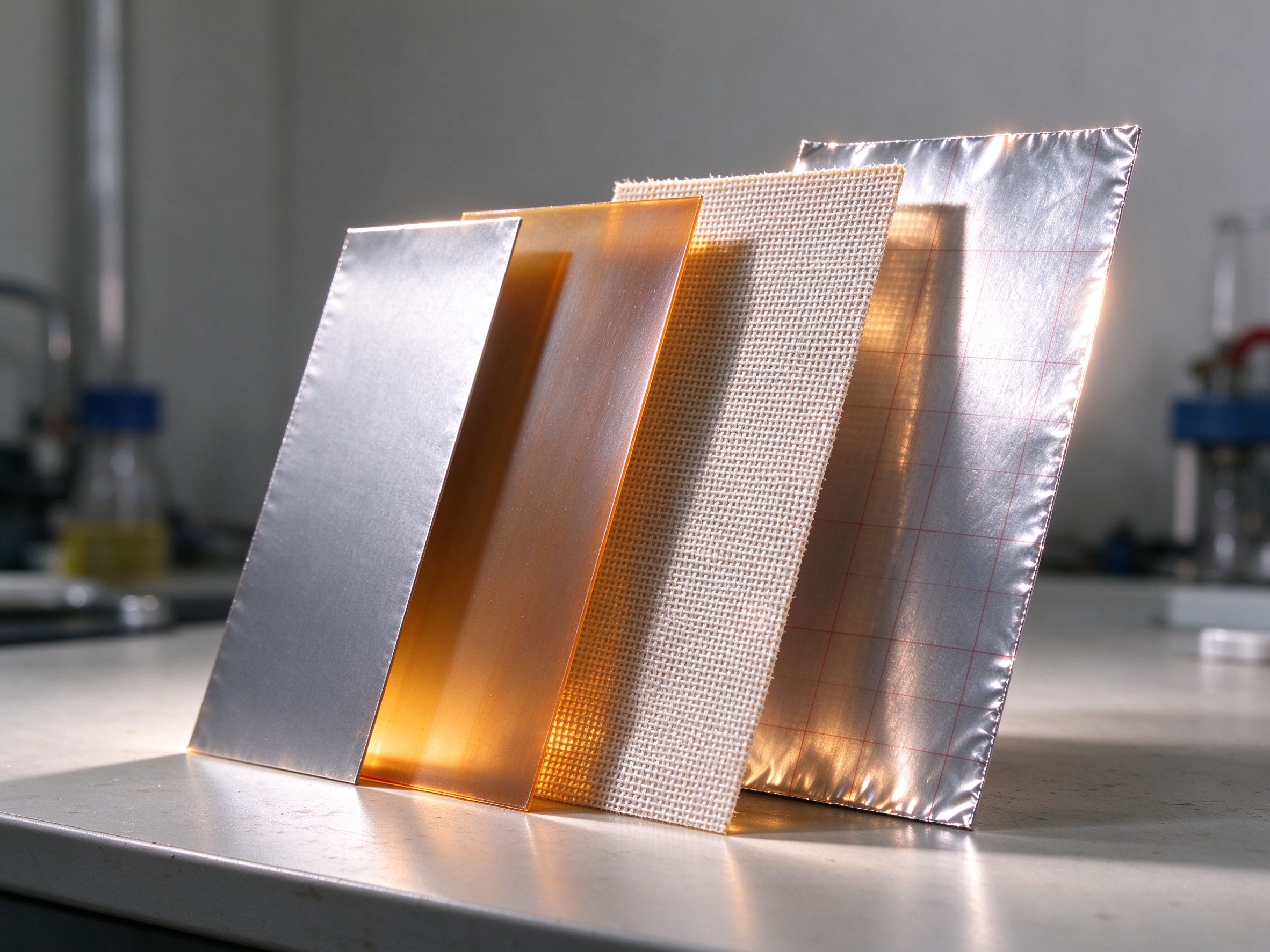
PET is the workhorse substrate of the underfloor and ceiling heating market, and for most residential and light commercial work it is the correct choice rather than the compromise choice.
The relevant ratings for the grades used in heating film are a continuous service temperature around 70–80 °C, short-term excursions to roughly 100 °C, and a dielectric strength in the 20–30 kV/mm range for the 0.188–0.35 mm thicknesses normally specified. Those numbers sound modest next to polyimide, but a floor heating system almost never needs more. European floor heating practice caps the floor surface at 29 °C for occupied rooms under EN 1264 guidance, and most laminate and engineered wood manufacturers cap the surface under their boards at 27 °C. A film bonded under tile and running at 26–28 °C surface temperature is operating with a huge margin below its own limit.
Three properties make PET practical for installers. It is dimensionally stable under moderate heat, so a 0.5 m wide roll does not walk out of alignment while adhesive sets. It accepts low-temperature lamination, which keeps the active layer and the adhesive from being cooked during manufacturing. And it is available in wide, consistent rolls at a price that keeps a 100–160 W/m² floor system inside a normal renovation budget.
The limitation is moisture and heat together. PET is vulnerable to hydrolysis when it is held at elevated temperature in a permanently damp environment, and to embrittlement after long exposure at the top of its range. In a correctly built wet-area floor — waterproofing membrane above the heating film, tile adhesive, grout, and a thermostat that caps surface temperature — the film never sees that combination. In a floor where the waterproofing was skipped, or where a 200 W/m² film is run at full output against a 30 °C cap that the installer defeated, it eventually does.
Polyimide film: where the extra temperature headroom pays
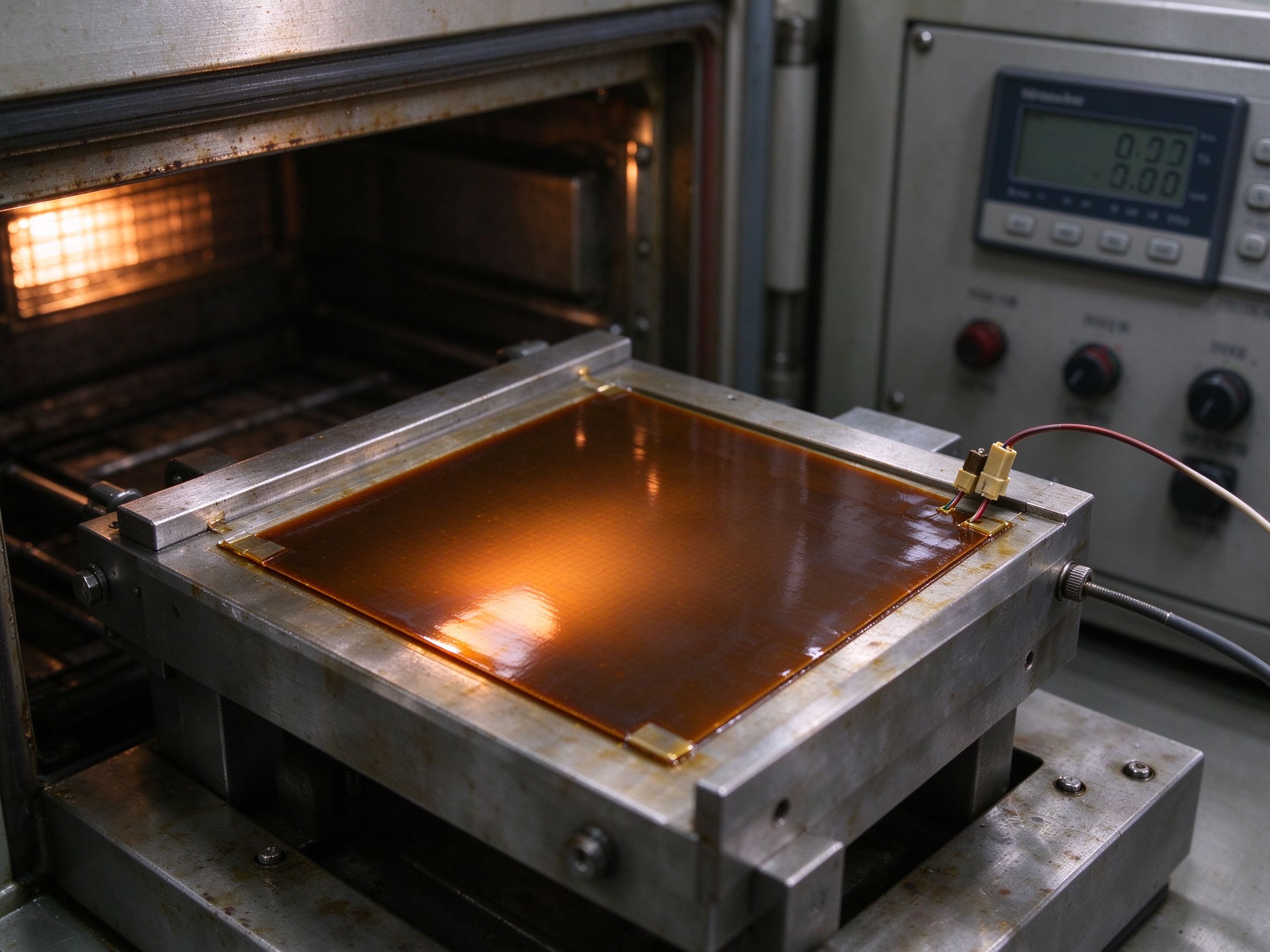
Polyimide is an aromatic polymer film with a continuous rating around 200–260 °C depending on grade, short-term tolerance well above that, and dielectric strength in the same range as PET but retained at temperatures where PET has already softened. It also holds up better against solvents and many oils, and it tolerates repeated flexing without cracking.
That headroom is worth paying for in four situations:
- Industrial and process heating where the element surface must run above 100 °C — drying tunnels, press platens, laboratory equipment, pipe and vessel trace heating.
- Automotive and battery conditioning, where the film sits close to a heat sink that can be hot in its own right and where vibration cycling is continuous.
- Appliances and medical devices that must survive sterilisation cycles or repeated cleaning at temperature.
- High power density in small areas — 300–600 W/m² elements where a PET carrier would need a much larger area to stay inside its rating.
The costs are real and worth stating plainly: material cost is several times higher, minimum order quantities are usually larger because the film is slit from narrower master rolls, lead times are longer, and the supply base is thinner. For a 120 m² apartment floor heating project, specifying polyimide buys nothing except a higher invoice. The floor still cannot exceed 29 °C, and the extra temperature capability is stranded.
Side-by-side comparison: what each carrier can and cannot do
| Parameter | PET film (0.25 mm typical) | Polyimide film | Silicone-coated glass cloth | Aluminium-composite film |
|---|---|---|---|---|
| Continuous surface temperature | 70–80 °C | 200–260 °C | 150–200 °C | 70–90 °C |
| Practical power density | 80–220 W/m² | 200–600 W/m² | 150–400 W/m² | 80–200 W/m² |
| Typical thickness | 0.188–0.35 mm | 0.05–0.25 mm | 0.6–1.5 mm | 0.5–1.2 mm |
| Dielectric strength | 20–30 kV/mm | 20–30 kV/mm, retained hot | 15–20 kV/mm | 15–20 kV/mm |
| Flexibility / bending radius | Moderate | High | High | Low |
| Moisture and hydrolysis resistance | Fair (poor if hot and damp) | Good | Good | Fair |
| Relative material cost | 1.0 (baseline) | 5–10× | 3–5× | 1.5–2.5× |
| Best-fit applications | Floor, ceiling, wall heating | Industrial, automotive, appliance | High-power mats, harsh washdown | Thin retrofit mat with spreader plate |
| Main weakness | Temperature and moisture ceiling | Cost, MOQ, lead time | Thickness, weight, cost | Rigid, creases at edges |
Read the table as a fit chart, not a ranking. The aluminium-composite column exists because a spreader plate changes how heat distributes under a thin floor build-up; it is not a competitor to PET on temperature.
Selecting the carrier by application, not by headline rating
Buyers who get this wrong usually start from “which is the better material”. The workable question is “what surface temperature and what environment does my application actually produce”, and then choose the cheapest carrier that clears it with margin.
Residential floor heating (tile, screed, dry-lay). PET at 0.25 mm, 100–160 W/m², mains voltage, floor probe thermostat capping surface temperature. Below 27 °C under laminate and engineered wood, 29 °C under tile in occupied rooms, higher in bathrooms only where the flooring allows it. This is the volume application and PET is the economical answer.
Ceiling and wall radiant panels. PET again. Ceiling film runs at higher surface temperature than a floor — 40–55 °C is common — but still far inside PET’s rating, and the low mass of a ceiling build-up means fast response rather than high output.
Wet areas: bathrooms, showers, pool decks, commercial washrooms. PET, but only with a proper waterproofing layer above the element and an RCD-protected circuit. Here the risk is not thermal, it is hydrolysis plus water ingress at cable entries and mat edges. Specify sealed junctions, IP-rated terminations, and a thermostat with a floor probe rather than air-only sensing.
Industrial process and equipment heating. Polyimide, or silicone-coated glass cloth where the surface is washed down or mechanically abraded. A PET element in a 120 °C drying application will not fail on day one; it will fail after a few thousand hours, which is worse, because the warranty claim arrives after the line has been validated.
Vehicles, battery packs, marine and off-grid. Polyimide where the element must sit against a hot surface, low-voltage PET where the constraint is 12 V or 24 V supply and surface temperature stays low. The two are not interchangeable, and the voltage decides more of the design than the carrier does.
Power density is a system number, not a substrate number
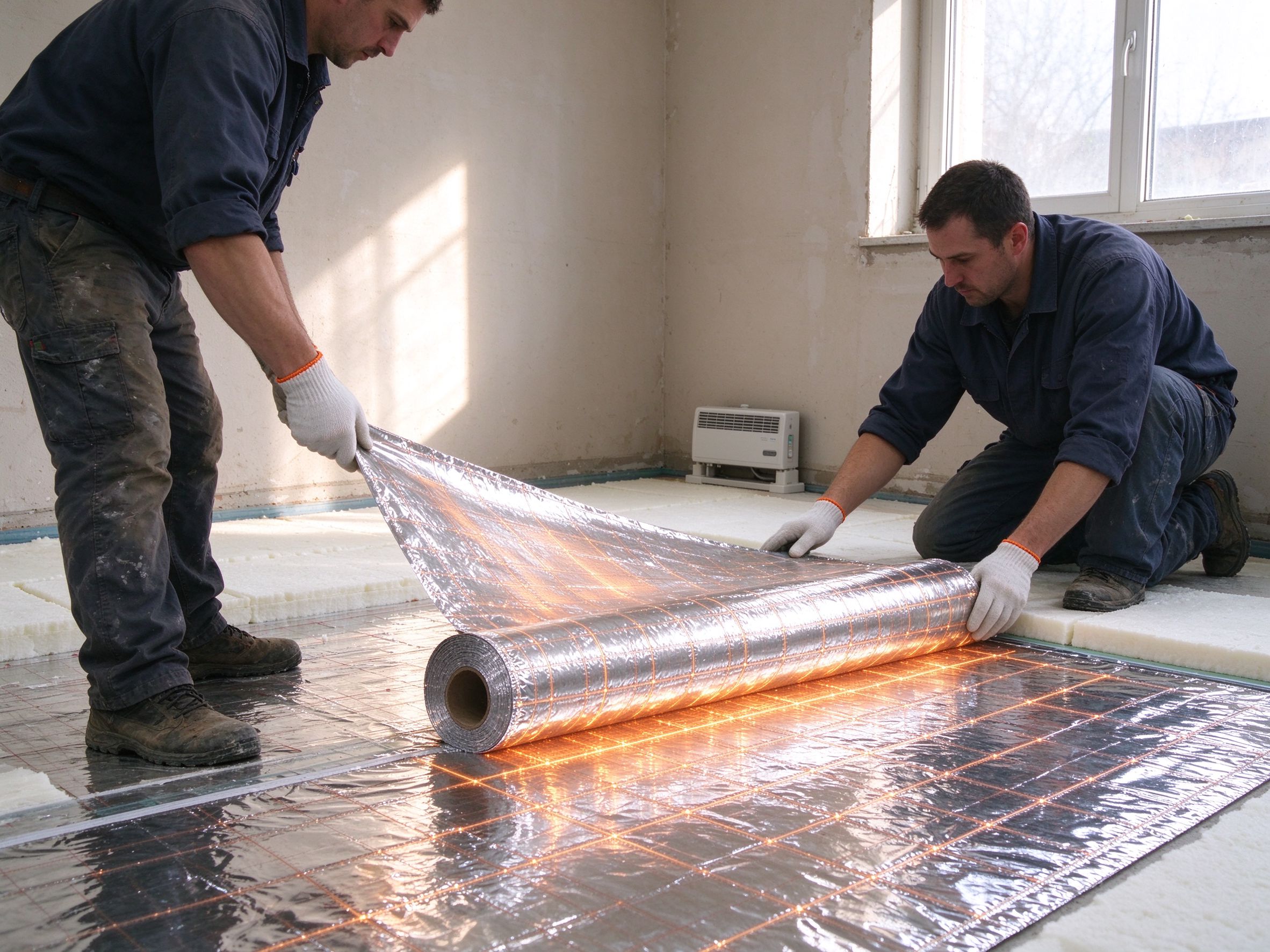
A supplier catalogue that lists 160 W/m² for both a PET and a polyimide product can mislead a buyer into thinking the two perform the same. They do not, because the number describes electrical input per square metre, not the temperature the active layer reaches.
What actually happens: input power has to escape through the covering. Under 10 mm porcelain tile on a screed, the heat path is efficient and the element runs only a few degrees above the floor surface. Under a thick carpet with a high tog rating, or under a floor where the insulation below the element is missing, the same wattage produces a much hotter element and a much lower useful output. This is why a film rated at 220 W/m² can be safe under tile and unsafe under a rug, and why installers who add a 30 % power margin “for cold weather” sometimes create the very hot spot that fails three winters later.
The practical rule used in most European electric floor heating design: choose wattage from the room’s heat loss and the covering’s thermal resistance, then confirm that the resulting element temperature stays at least 30 °C below the carrier’s continuous rating. For PET that means keeping element temperature under roughly 50 °C, which the 27–29 °C floor cap already guarantees in normal rooms.
What to send before you ask for a quotation
Suppliers price very differently depending on how complete the brief is. A one-line enquiry gets a one-line answer with a wide price band. Sending these eleven items gets a specification and a firm price band:
- Application and room type (floor, ceiling, wall, industrial surface, vehicle).
- Total heated area in square metres, and the shape — long runs versus broken rooms.
- Required power density in W/m² at nominal voltage, and whether a margin is needed for heat-up time.
- Supply voltage and phase: 120 V, 230 V, 240 V, or 12/24 V DC.
- Carrier preference or constraint, plus the maximum surface temperature the application will see.
- Floor build-up from structure up: insulation, screed or dry-lay, adhesive, covering, and the covering’s thermal resistance.
- Control strategy: floor probe thermostat, air thermostat, zoned manifold of thermostats, BMS integration.
- Termination requirement: factory-sealed junction, field-terminated with crimp and heat-shrink, or plug-in connector.
- Certification and documentation needed for the destination market (CE and LVD declaration, RoHS, test reports, declaration of performance for the build-up).
- Order shape: MOQ, annual volume, private label or OEM packaging, and required lead time per shipment.
- Warranty terms and spare-part availability in years, not just the headline number.
Five specification mistakes that show up in claims data
1. Buying polyimide for a domestic floor. It solves a temperature problem the floor does not have, and it consumes budget that should have gone into insulation or a better thermostat.
2. Using PET film where the covering traps heat. A thick rug or a mattress placed over an uncontrolled 200 W/m² zone raises element temperature far above the design value. Furniture layout belongs in the design, not in the installation instructions.
3. Specifying thickness as a proxy for quality. A 0.35 mm film is not automatically better than 0.25 mm. What matters is void-free lamination, adhesive class, and the dielectric test actually performed on the finished roll.
4. Ignoring the junction. Most field failures are at the termination, not in the film. A factory-sealed, IP-rated junction with a strain-relieved cable entry is worth more than an extra 0.05 mm of carrier thickness.
5. Mixing thermostat and element from different ecosystems without checking compatibility. A thermostat designed for a 20 kΩ NTC probe will read the wrong floor temperature when paired with a 10 kΩ probe, and the resulting over- or under-heating is then blamed on the film.
Which carrier should you choose?
If your project is a house, apartment, hotel room, office, school or retail floor, and the floor surface will stay between 26 and 29 °C, specify PET at 0.25 mm and put the saved money into insulation and zoning. If the project is a pool deck, shower area or commercial washroom, PET still fits — provided the waterproofing and RCD protection are specified together with it. If the element must run above 100 °C, sit against a hot surface, or survive repeated flexing and chemical exposure, specify polyimide or silicone-coated glass cloth and accept the cost.
For a mixed catalogue, the sane product strategy is one PET platform covering 80–90 % of volume in 100, 130 and 160 W/m² variants, and a polyimide platform built to order for industrial accounts. Buyers who need both should ask for the same lamination and test standard across both, so the field behaviour is predictable.
Data and evidence
SunAura factory records for the Qingdao Huangdao plant: heating element manufacturing since 2008 (17 years of production), ISO 9001, ISO 14001 and ISO 45001 certified management systems, CE / RoHS / LVD / EMC conformity across the film, mat and cable lines, and export to more than 50 countries. Every film roll is dielectric-tested and the batch record is retained; resistance values are logged against the design value so a field measurement years later can be compared with the original.
External reference points used in this comparison: EN 1264 guidance on floor surface temperature limits for occupied rooms, EN 60335 / IEC 60335-2-96 for flexible sheet heating elements, and the material data published by PET and polyimide film manufacturers for continuous service temperature and dielectric strength. Figures are given as ranges because grade and thickness move them; they are not certificate numbers and should not be read as one.
FAQ
Is polyimide heating film better than PET? It is better only where the application needs surface temperature above roughly 100 °C, sustained flexing, or chemical exposure. For floor and ceiling heating it is an unnecessary cost.
Can I use a 220 W/m² PET film under tile? Yes, if the floor cap is enforced by a floor probe thermostat and the covering is tile or stone. The same film under carpet is a different risk and needs a lower wattage or a load-limiting control.
How long does a PET heating film last under a tiled floor? A correctly specified and correctly installed system is designed for the life of the floor, commonly stated as 20–25 years. The failures that shorten that are almost always installation-side: damaged conductor during tiling, wet junction, or a defeated floor temperature limit.
Does a thicker film mean higher dielectric safety? Up to a point, but lamination quality and the test performed on the finished product matter more. Ask for the routine dielectric test result, not just the material datasheet.
Can the same film be used at 120 V and 240 V? Only if the element is designed for both. Resistance and conductor spacing are set at design time; connecting a 240 V element to 120 V gives a quarter of the output, and the reverse destroys it.
Next step
Send the eleven-point brief above and the build-up drawing, and we will return a film specification — carrier, thickness, wattage, junction type and control — matched to the covering and the room. Start from the graphene heating film product range, or use the heating film versus heating cable comparison if you are still deciding between element types. For the control side, the floor temperature settings guide explains how the 27 °C and 29 °C caps are applied room by room, and the K5 floor probe thermostat page lists probe types and switching capacity. If your build-up is a dry-lay panel system, check the dry-lay versus screed comparison before fixing the wattage.
Ethan Sun, Founder & CEO, SunAura Thermal