
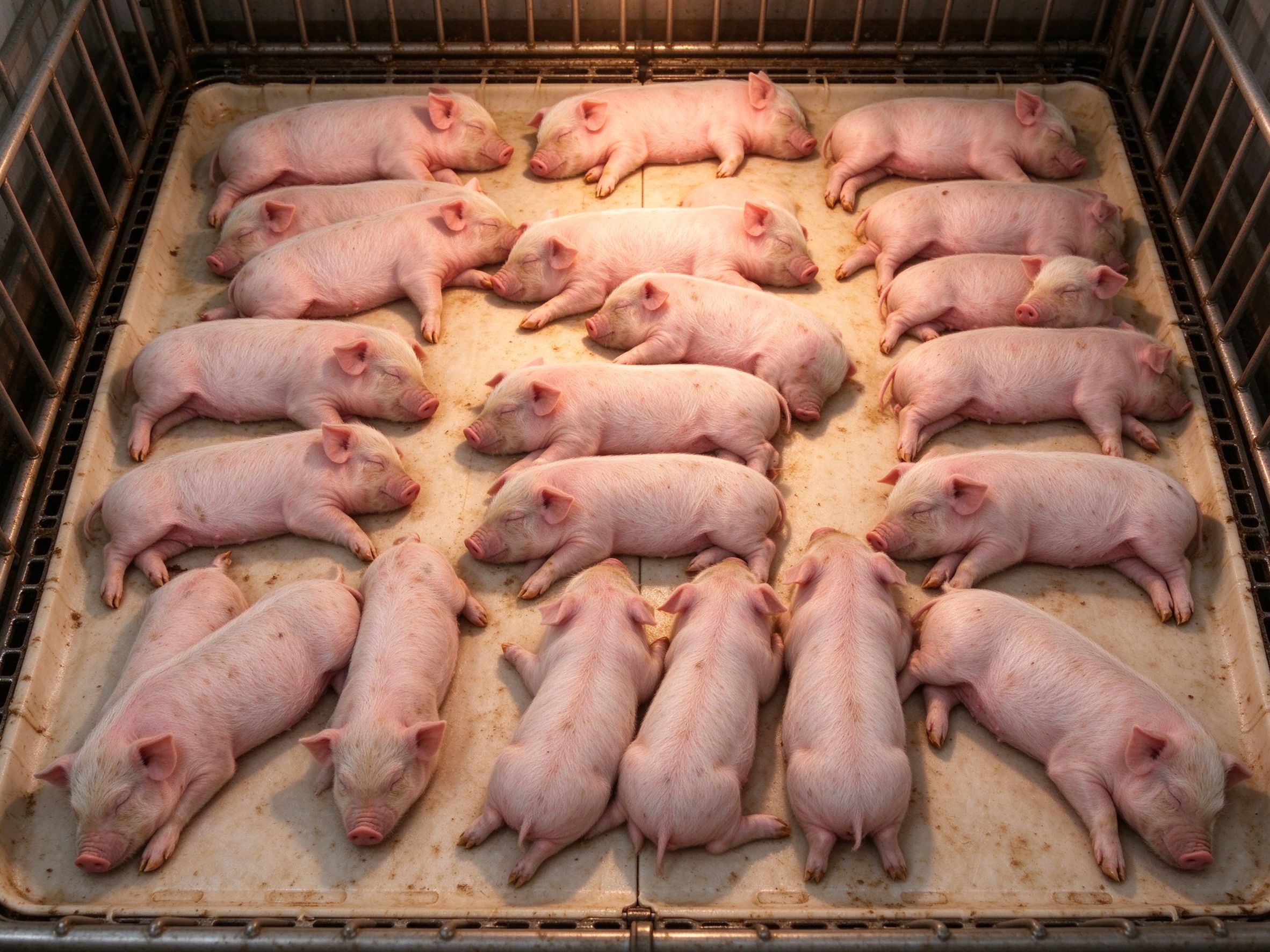
Heating Film Under Slatted Pig Floors: Why Bare Film Fails and What Actually Works
“We want to lay heating film under the slatted floor so the piglets get warm from below.” It is one of the most reasonable-sounding requests we get from pig farms, and it is also the one that ends up in a ripped-out pit nine times out of ten. In a farrowing crate or a nursery pen, the slatted floor is not a floor in the building sense. It is a drainage surface suspended over an open slurry channel, and everything installed underneath it lives in that channel.
This article sets out what the pit does to a heating film, why the version people usually imagine cannot work, and the three arrangements that do work in real barns — including the one that genuinely puts the film under the surface the piglets lie on.
1. What is actually under the slats
The dimensions are fixed by the pit, not by the heating design. In farrowing and nursery houses the slat gap runs 3–5 mm for piglet areas and up to 10 mm in nursery pens, while sow slats open to about 20 mm. Below them sits a closed slurry channel: 0.6–1.5 m deep, 0.8–2.4 m wide, running the length of the house, sloped 1–2 % towards the drain for a chain or wire scraper that passes once or twice a day. A high-bed nursery raises the whole floor 0.3–0.5 m above the pit.
That channel is a wet, ammonia-loaded, mechanically swept void. Air moves through it continuously, because the slats above are open and the house extracts air. Any surface placed in it is cooled by that airflow, and any cable placed in it is in the path of the scraper.
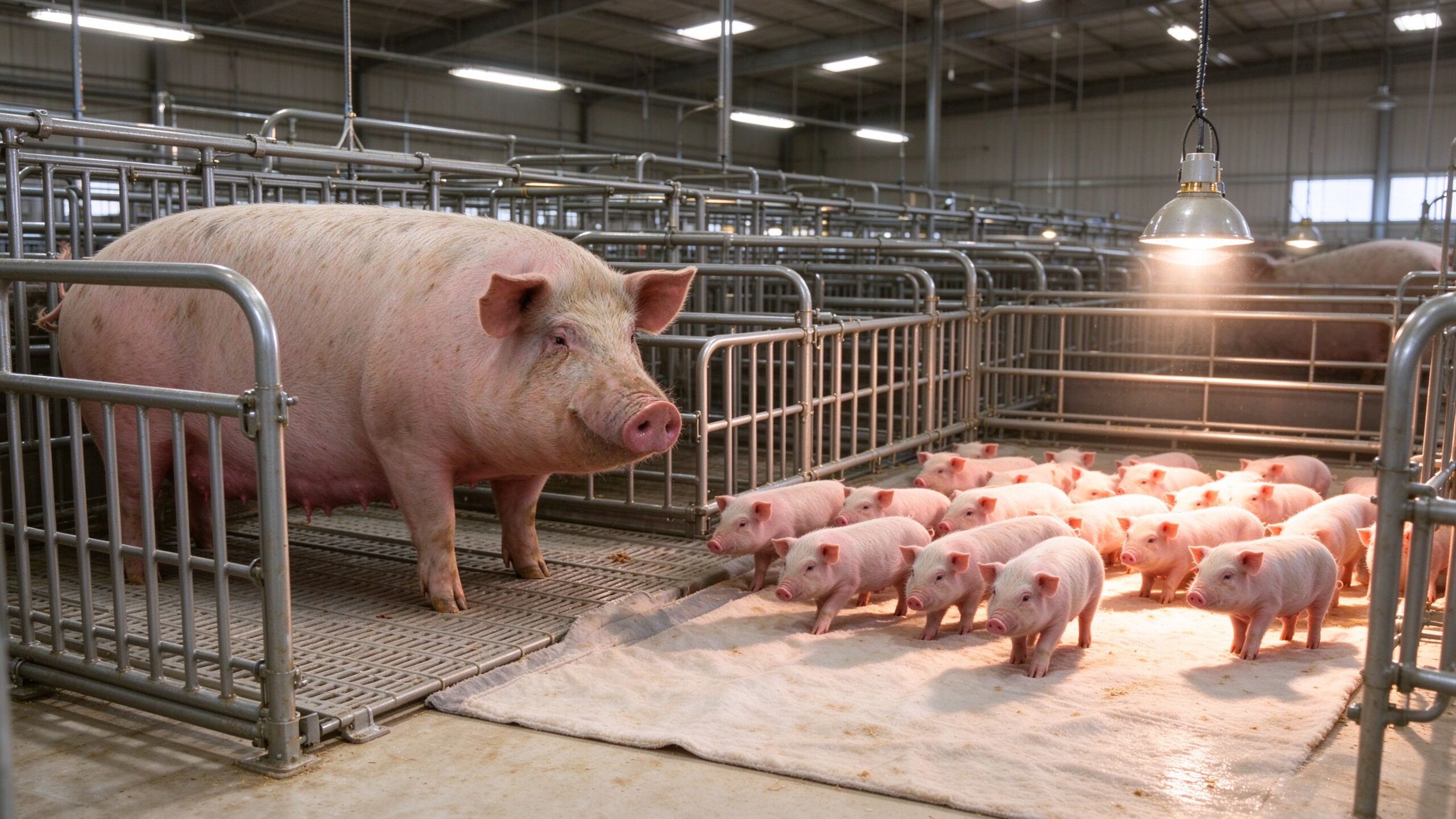
2. Four reasons bare film under the slats fails
Slurry contact. Urine, washdown water and manure land on the film all day, every day. A heating film is a PET or PA laminate with a carbon or metal heating layer; continuous immersion in urine plus ammonia vapour attacks the laminate and the terminations long before the heating element itself gives up. The first failure is usually at the joint, not in the element.
The scraper. Chain, wire and reciprocating scrapers run along the pit floor. A film spanning between slat supports is also a film deflected by pig load from above and swept from below. One missing fixing, one dropped scraper blade, and the circuit is gone — invisibly, because nobody looks into the pit.
The heat goes the wrong way. With an open channel underneath, the film heats the air in the pit and the slat ribs, not the piglets. Slats are open by design; the very property that keeps the pen dry is the property that lets the heat escape downwards and sideways instead of conducting up through 30–40 mm of rib into a piglet’s chest.
No access. A failed film under a slatted floor is not a service call, it is a rebuild: the slats come out row by row, the pit is entered, and the house is out of production. Compare that with a heating plate that lifts off the floor in ten seconds.
There is also an electrical argument. A pig house is a washdown environment with hoses, foam and disinfectant. Anything at animal height needs 30 mA residual current protection as a minimum, and a sealed, low-voltage arrangement is the more defensible choice wherever animals can chew, stand on or urinate on the connection.
3. Route A — composite heating plate on top of the slats
This is what almost every farrowing house actually uses, and it is the arrangement most often mistaken for “film under the floor”. The plate is a sandwich: heating film in the middle, a reflector layer below it, a load-bearing anti-slip top panel (FRP, PE or reinforced plastic) and a thin PVC base. Standard single plates are about 890 × 498 mm, double plates about 1270 × 648 mm, with a 3 m lead and a controller able to drive up to roughly 20 plates.
The film is underneath the surface the piglets lie on — it is simply underneath a removable panel rather than underneath the building. That changes everything that matters: the panel is the lying surface, the heat has 5–10 mm to travel instead of 40 mm of open rib, the plate can be lifted out and hosed down, and a dead plate is a swap rather than a dig.
Design points: cover 0.3–0.5 m² of creep area per piglet, so a 12-piglet litter needs two single plates or one double plate plus a corner; never let a plate bridge a slat gap where a piglet can trap a leg; keep the plate clear of the crate rail so the sow cannot stand on it; route the lead out of the pen and up, never along the floor.
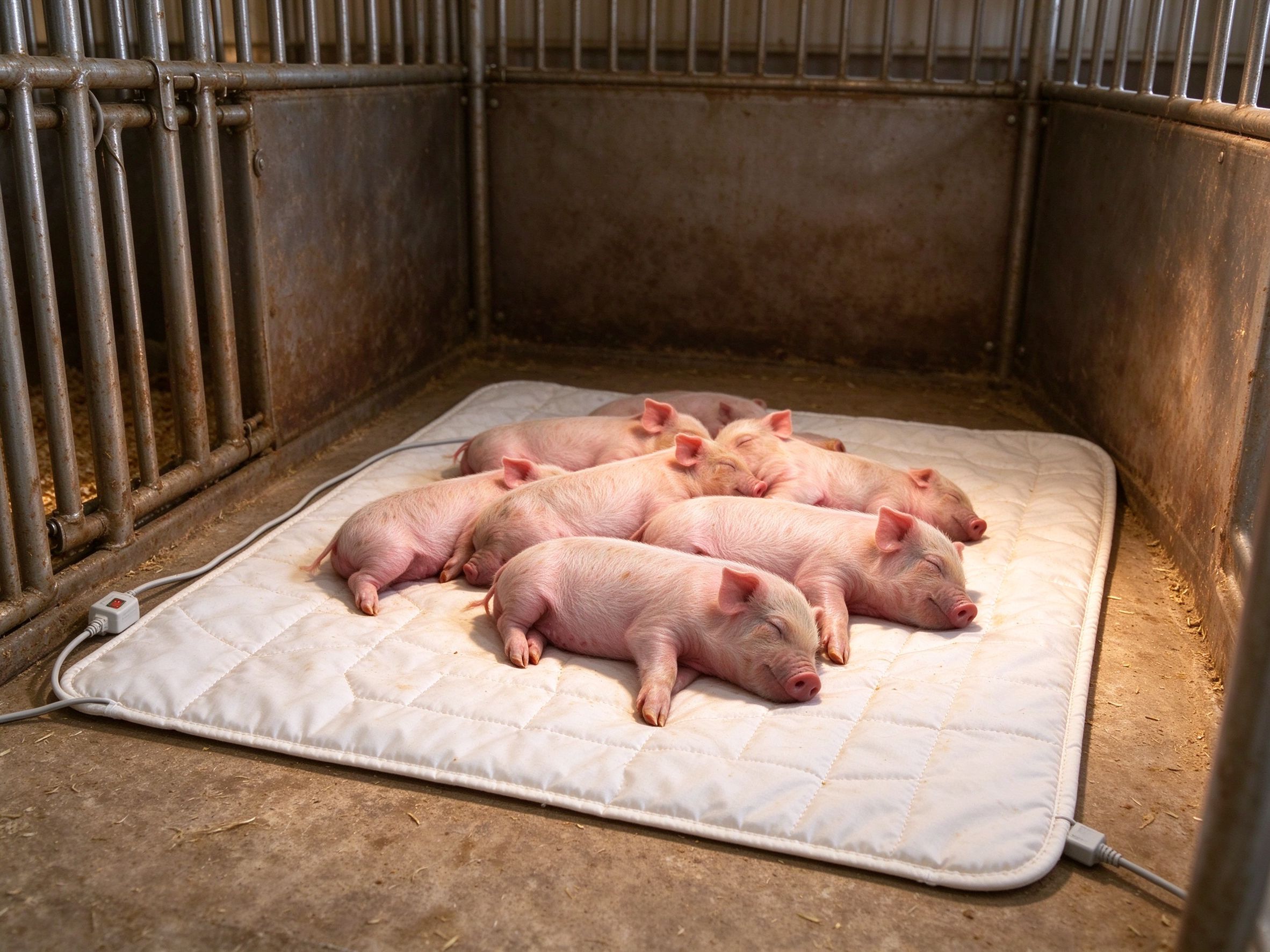
4. Route B — heated solid creep slab, film beneath the panel
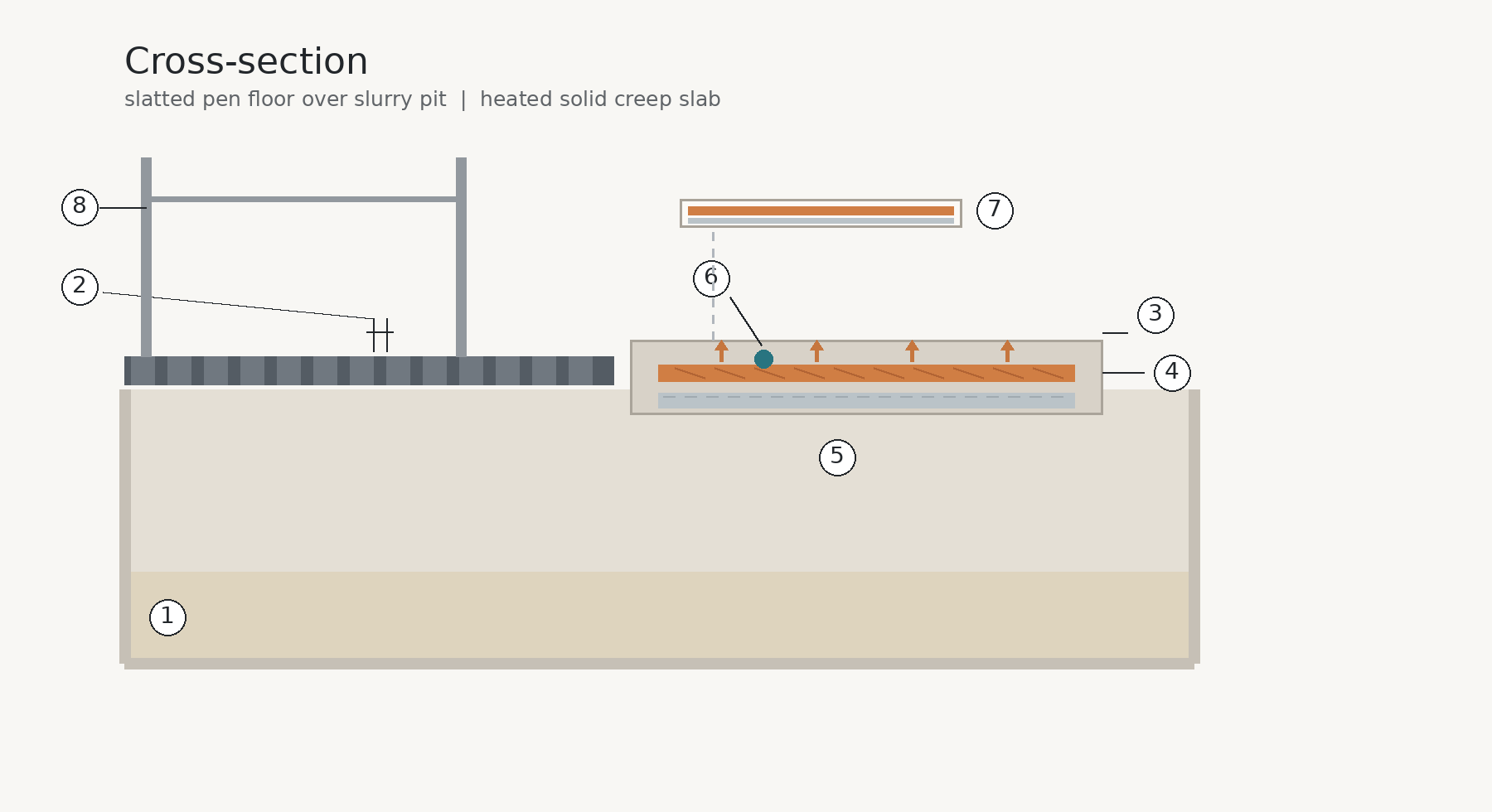
If the requirement is a floor that is warm to the touch and permanent, the honest version is a solid heated slab in the creep half of the pen, with the film under the panel and the rest of the pen left slatted. Build-up from the pit upwards: pit-wall corbels or a steel frame, 20–30 mm insulation board, reflector, heating film, then a 40–60 mm concrete or FRP slab on top, finished with a 1–2 % fall away from the lying zone so washdown water leaves rather than pools.
Two details decide whether this survives: the floor sensor goes 20 mm below the slab surface, not on top where manure packs insulate it; and the film is laid flat and uncreased, because a crease under a poured slab is a hot spot, and a hot spot under concrete is unrepairable.
Response is slow — expect 4–6 hours from cold to setpoint, which is why the slab is switched on the day before farrowing, not on the day.
5. Route C — high-bed concrete bed with embedded cable or hot-water pipe
The Chinese high-bed nursery pattern pushes this further: a brick-walled bed roughly 2.24 × 1.12 m, filled and compacted, reflector membrane on top, 20 mm hot-water pipe at 200 mm spacing in an S-layout, then 50 mm of fine concrete screed polished flat, with the adjacent half of the pen built as a metal slatted net at the same height. Pigs sleep on the solid half and dung on the net. The concrete stores the heat and releases it slowly, which is ideal for a nursery that runs continuous batches and terrible for a room that needs heat in twenty minutes.
Electric cable can replace the pipe in the same build-up where a boiler is not available, at the cost of a slower recovery and a harder repair. Either way this is a new-build or full-refit measure, not a retrofit into an existing slatted pen.
6. The numbers that decide the design
Floor temperature, not air temperature, is the controlled variable in a creep area. The reference figures below combine the US extension guidance for swine floor heating — 90–95 °F floor for newborns, stepped down 3–5 °F per week to 70 °F — with the Chinese husbandry standards for air temperature and humidity in farrowing and nursery houses.
| Stage | Floor surface target | House air target | Heat density | Heated area |
|---|---|---|---|---|
| Birth to weaning (0–28 d) | 32–35 °C (90–95 °F) | 18–21 °C for the sow | 130–200 W/m² (12–19 W/ft²) | 0.3–0.5 m² per piglet |
| Weaning to 25 kg | 24–28 °C | 26–28 °C | 100–150 W/m² | 0.3–0.4 m² per pig |
| 25–60 kg | 20–24 °C | 20–22 °C | 80–120 W/m² | sleeping area only |
| Finishing | 16–22 °C | 16–22 °C | 60–100 W/m² | optional, open-front houses |
Extension literature quotes 12–40 W/ft² (roughly 130–430 W/m²) for electrically heated pig floors, the high end being newborn creep areas in uninsulated houses. In a modern insulated farrowing room with a plate on the slats, 150–200 W/m² is usually enough, because the plate only has to hold a 0.5 m² surface, not lift a whole room. Humidity is held at 50–75 %; above that the floor runs wet and the plate loses most of its output to evaporation.
7. Electrical safety in a washdown barn
Four rules cover almost every incident we hear about: a dedicated circuit with 30 mA residual current protection, tested quarterly; connectors and leads kept out of the washdown zone and above floor level; a controller with a remote floor sensor, so the setpoint follows the slab and not the air; and, where the installation is within reach of animals, a low-voltage (24–48 V) arrangement with sealed IPX7 joints. Ammonia-resistant sheathing matters more than the IP number at the termination, because that is where moisture actually accumulates.
8. Installation sequence
For a composite plate (Route A): clean and dry the slats, check they are level and that no plate spans a gap, place the plate in the creep area clear of the rail, run the lead up and out of the pen, mount the controller in the dry corridor, connect through the RCD, and run a 24-hour test before stock arrives.
For a solid slab (Route B): shutter the creep zone, fix insulation, lay film flat with no creases or overlaps, add reflector, place the sensor 20 mm below finished level, pour and cure the slab for at least 7 days, then heat in stages (25 °C, 30 °C, setpoint, one day each) to drive out residual moisture before the first litter.
9. Commissioning and the setpoint curve
Switch on 24 hours before the sow is due, so the surface is already 35 °C when the first piglet lands. Hold 35 °C for the first week, then reduce about 1.5 °C per week, reaching 24 °C at weaning. Bedding for the first 24–48 hours is still worth it, and a heat lamp over the creep for the first 48 hours is the standard supplement — placed at the sow’s rear at farrowing, then moved into the creep to teach piglets where the warm floor is. Running the floor in summer is also legitimate: a warm patch pulls piglets out from under the sow, which is exactly where crushing happens.
10. Failure modes we actually see
Manure packed on the plate or slab, which insulates it and hides the problem until the litter is cold. A sensor buried under that pack, so the controller reads 40 °C and cuts the power. A thermostat measuring air temperature in a room that swings 8 °C between day and night. A connector left in the washdown zone. A creased film under a poured slab. And, most often, a plate sized to the piglet rather than to the litter — one 0.45 m² plate in a 12-piglet creep area is a cold corner with a warm centre.
11. Which route for which farm
| Situation | Recommended route | Why |
|---|---|---|
| Existing farrowing crate, slatted floor, no rebuild | A — composite plate on the slats | Removable, washable, no civil work, repairable in minutes |
| New farrowing house or full refurbishment | B — heated solid creep slab | Permanent surface, stored heat, no plate to misplace |
| New nursery, continuous batches | C — high-bed concrete with cable or pipe | Best comfort per pig, slow but stable |
| Open-front finishing house, winter only | A or B, low density | Floor heat is a comfort and dunging-habit measure here, not a growth measure |
12. Questions we get asked
Can the film go straight onto the slats, without a plate? No. Slats abrade the laminate, urine sits on it, and piglets chew anything at nose height. The plate exists to be the wear surface.
Can it go under the slats? Not in a working pit. If you want the film under the lying surface, build a solid creep slab (Route B) and put the film under that panel.
230 V or 24 V? 230 V with 30 mA RCD is normal for a sealed composite plate with the lead kept out of reach. 24 V is the safer default where cables are accessible to animals or where washdown is aggressive.
How many watts for one farrowing crate? One 0.45 m² plate at 150–200 W/m² draws about 70–90 W, which is all a creep area needs in an insulated room.
Will the plate make piglets ignore the sow? It will make them choose the warm corner for sleeping and return to the sow to feed, which is the behaviour you want; it also cuts crushing losses.
If you are sizing a system for a specific house — floor type, slat gap, pit depth, batch size — the livestock and poultry house heating section collects the arrangements by building type, and the farrowing room case study shows what a 300-sow unit changed and what it cost. For cable and plate geometry in tight pens, the notes on bend radius and spacing apply to heated slabs as well.