Snow Melting Mat 300 vs 500 W/m²: Choosing Power Density
Why the Watt Figure Decides the Whole Design
Two outdoor mats can look identical in a catalogue photo and behave nothing alike. One is built at 300 W/m², the other at 500 W/m². That single number sets the melting rate, the circuit size, the running cost per storm hour and whether the surface is dry ten minutes after the snow stops or wet for the rest of the afternoon. It also decides whether a standard 16 A thermostat can switch the zone directly or whether the load has to go through a contactor.
Buyers who compare only price per square metre usually end up with the wrong figure, because the cheap mat is often the low-density one and the site needs the high-density one for four weeks of the year. This guide sets out where 300 W/m² is enough, where 500 W/m² earns its extra load, and what else changes when you move between the two.
What Power Density Actually Does
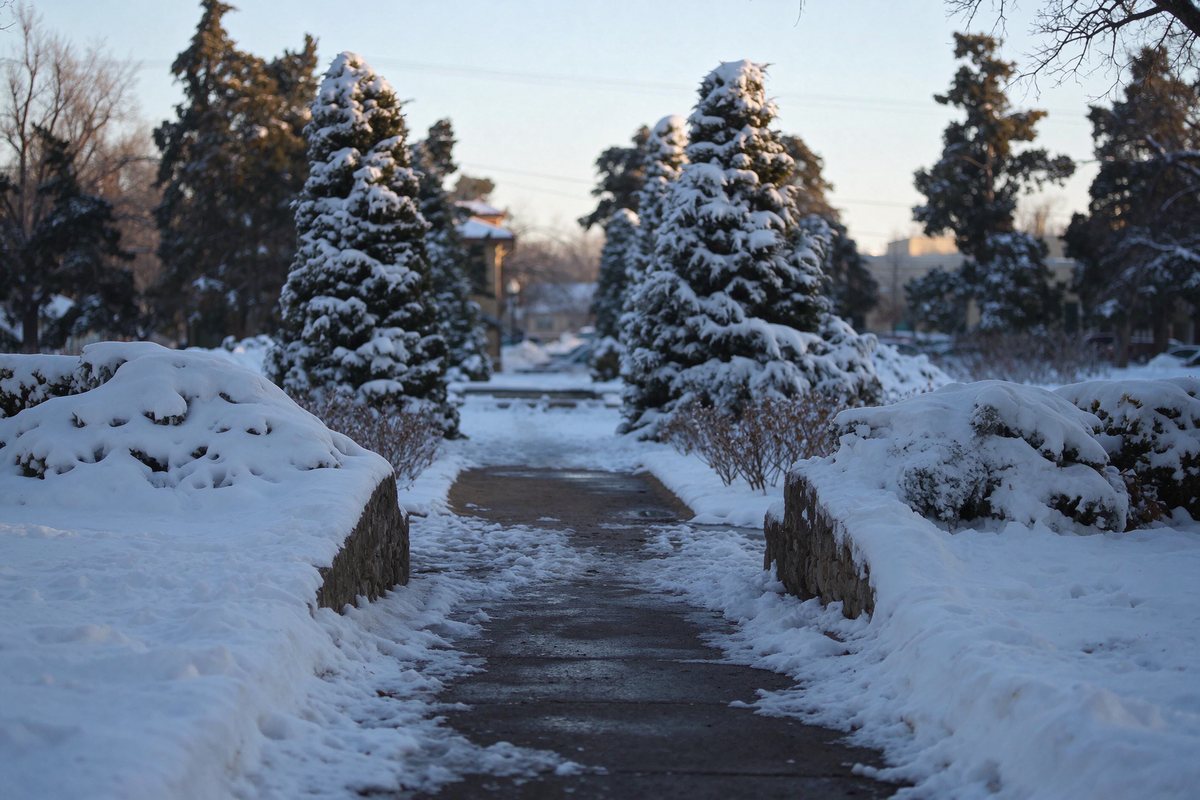
A cleared walking path between snow banks on both sides.
Power density is the electrical wattage applied to one square metre of heated surface. It is not the same as total connected load. A 6 m² walkway at 300 W/m² draws 1.8 kW; the same area at 500 W/m² draws 3.0 kW. The difference in cable, mat coverage and panel capacity follows from that.
The energy has three jobs on a snowy surface. First, raise the surface above freezing. Second, melt the snow that lands on it, which takes about 334 kJ per kilogram of ice — the latent heat of fusion, a fixed physical cost nobody can design away. Third, evaporate the meltwater if the surface is to stay dry, which takes roughly 2.26 MJ per kilogram of water. The first job is small. The second and third dominate, and they scale directly with how fast snow arrives.
That is why density is usually expressed as a melt rate rather than a wattage. In steady conditions, and after accounting for losses into the slab and the air, a 300 W/m² mat clears roughly 20 to 30 mm of fresh dry snow per hour at around −5 °C. A 500 W/m² mat clears roughly 40 to 55 mm per hour, and holds that rate when the snow is wet and heavy instead of dry and fluffy. Published design tables in the ASHRAE HVAC Applications handbook follow the same logic: surface loads around 250–350 W/m² for light snow, and 400–600 W/m² for heavy or wind-driven snow.
Side-by-Side: What Changes Between 300 and 500 W/m²
Item
300 W/m² build
500 W/m² build
Typical melt rate at −5 °C
20–30 mm/h fresh dry snow
40–55 mm/h, including wet snow
Dry-off after snowfall
30–60 min residual dampness
10–20 min, surface dries faster
Connected load, 10 m²
3.0 kW
5.0 kW
Current at 220 V
13.6 A
22.7 A
Switching
Often direct on a 16 A thermostat
Contactor required above 16 A
Cable or mat coverage
Lower watt per metre, wider spacing
Higher watt per metre, tighter spacing
Running cost, 1 h at €0.25/kWh
€0.075 per m²
€0.125 per m²
Best fit
Coastal winters, light snow, sheltered sites
Continental winters, wet snow, exposed slopes
Weak point
Struggles in wet snow and drifting
Higher demand charge and panel stress
The table hides one important asymmetry. Going from 300 to 500 W/m² raises the connected load by two-thirds, but it does not raise the capital cost by two-thirds. The mat itself costs more per square metre; the excavation, insulation, paving and control work are largely unchanged. On a 20 m² driveway, the difference in installed cost is usually a few hundred euros, while the difference in a February storm can be a full day of manual clearing.
Climate Mapping: Which Zone Needs Which Figure
Start with the design snow load rather than with the average winter temperature. A site that sees 15 cm of dry snow four times a winter behaves differently from a site that sees 40 cm of wet lake-effect snow in a single week.
Mild coastal winters. Occasional 5–10 cm falls, air temperatures rarely below −3 °C, snow often turns to sleet. 250–300 W/m² is normally enough, provided the surface is insulated and drainage is correct.
Central European continental winters. Repeated 10–20 cm falls at −5 to −10 °C, snow stays dry and cold. 300–350 W/m² clears the surface, with 400 W/m² on exposed entrances.
Nordic, Alpine and North American snow-belt sites. 30–60 cm storms, drifting, freeze-thaw cycles. 400–500 W/m² is the working range, and the control strategy has to start the system before accumulation, not after.
Freezer-adjacent or shaded sites. North-facing slopes, courtyards between buildings, loading docks under overhangs. Add 50 W/m² to the climate figure, because the sun never helps.
Note what the climate map does not say: it does not say that 500 W/m² is “better”. A 500 W/m² mat on a mild coastal walkway is a system that reaches setpoint quickly and then cycles on a thermostat, spending capital on capacity that is used two nights a year. The right figure is the one that clears the design storm within the response time the site actually needs.
Surface Type Moves the Number More Than Latitude
Two sites in the same city, one asphalt and one open-jointed stone pavers, do not need the same density. The surface decides how much of the heat reaches the snow and how much is lost sideways and downward.
Asphalt. Dark, dense, good thermal contact. 300 W/m² goes a long way because the sun and the black surface help during daylight. The risk is softening at high surface temperature, so a slab sensor and a limit matter.
Concrete. Similar contact, lighter colour, slower to warm. Budget 10–15 % more density than asphalt for the same response time.
Interlocking pavers with sand joints. Water drains through the joints, which is good for ice, but the joints also let heat escape and let cold air in. On an uninsulated base, a substantial share of the output goes into the sub-base. Budget 350–400 W/m² unless the base is insulated.
Open-jointed or gravel surfaces. Air moves through the voids. Melting performance drops sharply; these surfaces are usually treated as “keep the top layer from bonding” rather than “clear to the stone”.
Insulation under the heating element changes the arithmetic more than most buyers expect. A 30–50 mm rigid insulation board under the mat cuts downward losses enough that a 300 W/m² system can outperform an uninsulated 400 W/m² system on the same driveway. SunAura builds outdoor mats and cables for both insulated and uninsulated assemblies; the density recommendation is set against the build-up, not in isolation.
Slope, Drainage and Edge Losses
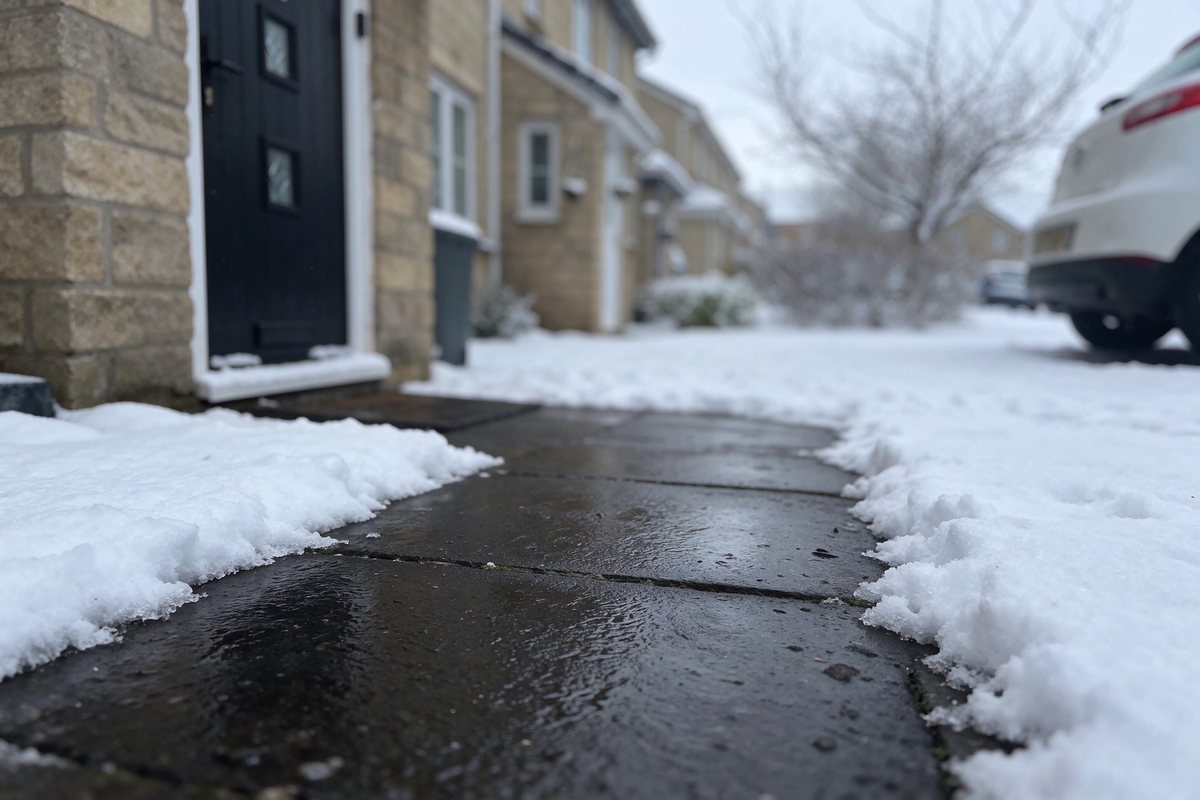
Wet paving at a doorway with residual snow at both edges.
Slopes are where density decisions get expensive. Water running down a ramp carries heat away and refreezes at the toe if the lower section is unheated. Ramps steeper than about 8 % usually justify one density step higher than the adjacent flat walkway, and the toe of the ramp needs its own coverage rather than being left to the drain.
Edge losses matter on small areas. A 2 m² landing has a high perimeter-to-area ratio; the cold surroundings pull heat sideways all night. Small zones are therefore often specified at the higher density even in a mild climate, simply because the losses are proportionally larger. The opposite is true of a 40 m² parking apron, where the core stays warm and the perimeter strip is the only weak point.
Electrical Consequences Buyers Forget
The 500 W/m² option is not only a mat specification. It is a panel specification. Check three things before ordering.
Circuit capacity. 10 m² at 500 W/m² is 5 kW, about 22.7 A at 220 V. That is a dedicated 25 A circuit, not a spur off an existing lighting circuit.
Switching device. Most wall thermostats switch 16 A. Above that, a contactor or a panel-mounted relay is required. Budget for it in the quote rather than discovering it at commissioning.
Supply voltage and mat availability. The same nominal density exists in 110 V, 220 V and 240 V builds; in North America 240 V at 500 W/m² keeps current per square metre lower than a 120 V equivalent. Mixing voltages on one zone is a common source of failed inspections.
On larger sites, the choice between 300 and 500 W/m² also decides how many zones the panel needs. Higher density per square metre means fewer square metres per circuit, which means more circuits and more control channels. That is a real cost, and it is why some designers use 500 W/m² only on the ramp and the entrance, and 300 W/m² on the long flat run.
Running Cost Arithmetic, Not Marketing
The energy a snow melting system uses is mostly the energy needed to melt snow, not the energy needed to keep a slab warm. A 300 W/m² zone that runs 60 hours in a winter uses 0.3 kWh per m² per hour, or 18 kWh per m² per season. At €0.25/kWh that is €4.50 per m² per season. A 500 W/m² zone on the same duty cycle uses 30 kWh per m², or €7.50. The gap is real, but it is small next to the cost of a cleared commercial entrance, and it shrinks further when the higher-density zone finishes its cycle sooner.
Idle losses are the number to control. A dry slab held at 2 °C in −5 °C air loses roughly 60–120 W/m² depending on insulation and wind. Running a mat at full output to hold an idle temperature wastes more than any difference between 300 and 500 W/m². A sensor-driven control that heats only when moisture and low temperature coincide is the bigger saving.
Selection Framework by Scenario
Scenario
Suggested density
Reason
Residential walkway, sheltered, mild winter
250–300 W/m²
Light snow, short duty cycle, low capital
Residential driveway, continental winter
300–350 W/m²
Dry snow, repeated falls, insulated base
Commercial entrance, high footfall
350–400 W/m²
Must be clear before opening, no manual clearing
Ramp or slope above 8 %
400–500 W/m²
Drainage carries heat away, refreeze risk at toe
Exposed driveway, wet snow, drifting
500 W/m²
Wet snow needs latent heat plus evaporation
Small landing under 3 m²
400 W/m²
Perimeter losses dominate
Pre-Quote Parameter Checklist
Send these to any supplier before asking for a price. A quote without them is a guess.
Heated area in m², plus a sketch with lengths and widths.
Surface type and build-up: asphalt, concrete, pavers, resin; insulation board thickness and position.
Design snow load and design air temperature for the site, not the city average.
Required clear time: before opening, within one hour of snowfall, or overnight only.
Supply voltage and phase at the panel; available spare capacity in amps.
Drainage: fall direction, gully positions, whether the toe of a slope is heated.
Control intent: manual, timer, moisture sensor, or building management system.
Outdoor rating required at connections, and whether the mat will be buried under a wearing course.
Five Mistakes That Show Up in Every Audit
Choosing density from a catalogue headline. “300 W/m²” is a nominal figure; the delivered wattage per square metre depends on mat coverage and supply voltage tolerance.
Leaving the base uninsulated. The cheapest place to fix a weak snow melting system is under the mat, before the pavers go down.
Heating the middle and forgetting the edges. Ice forms at the boundary with the cold surrounding surface, which is exactly where people step off.
No contactor on a 500 W/m² zone. A 16 A thermostat on a 22 A load fails in the first cold snap, usually at night.
Starting the system after the snow. Density buys melt rate; controls buy timing. A 500 W/m² mat switched on after 20 cm has accumulated still has to melt 20 cm.
When to Choose 300 W/m² and When to Choose 500 W/m²
Choose 300 W/m² when the site sees mostly dry snow under 15 cm, the surface is insulated, the area is large and flat, and the owner accepts a slower clear time. It is the sensible default for residential walkways and sheltered driveways in coastal and central European winters, and it keeps the circuit inside the range a standard thermostat can switch.
Choose 500 W/m² when snow arrives wet and heavy, when the surface is exposed to wind or shade, when the zone is a ramp or a small landing with high perimeter losses, or when the site cannot tolerate a wet surface after the storm. Accept the contactor, the 25 A circuit and the higher demand charge as part of the design, not as an afterthought.
For mixed sites, split the design. A 300 W/m² run on the flat driveway and a 500 W/m² strip on the ramp and entrance gives most of the performance for a fraction of the connected load. SunAura supplies both densities in 110 V, 220 V and 240 V builds, and the mat layout can be drawn zone by zone from the same sketch.
Evidence and Data
Per SunAura factory records, the company has manufactured electric heating mats and cables since 2008 and operates six automated production lines with an in-house quality laboratory in Huangdao, Qingdao. Outdoor mats are produced under an ISO 9001:2015 quality management system with ISO 14001 and ISO 45001, CE, RoHS, LVD and EMC compliance, and outdoor connections rated to IP67. Wattage tolerance is recorded per production batch rather than quoted as a single nominal figure.
Design loads and melt rates in this article follow the snow-melting chapter of the ASHRAE HVAC Applications handbook and the general method used in IEC 60800 for resistive heating cables, adapted to the densities SunAura actually builds. Latent heat values are standard physical constants, not vendor claims. Where a figure depends on build-up, it is stated as a range rather than a single number.
Source: SunAura Thermal (www.sunaura.ltd), manufacturer of electric snow-melting mats, heating cables and outdoor heating systems from Qingdao, China. Product references: https://www.sunaura.ltd/products/snow-melting-mat-240v-500w/ (240 V, 500 W/m²), https://www.sunaura.ltd/products/snow-melting-mat-220v-300w/ (220 V, 300 W/m²), https://www.sunaura.ltd/products/snow-melting-mat-110v-300w/ (110 V, 300 W/m²), https://www.sunaura.ltd/snow-melting-cable/ (snow melting cable for driveways and ramps), and the build-up guide at https://www.sunaura.ltd/patio-snow-melting-heating-9/.
We use cookies to improve your browsing experience, analyse site traffic and personalise content. By accepting, you consent to our use of cookies. You can choose "Essential only" to continue without non-essential cookies. Read our privacy policy