
EMF is the question that appears in almost every heating-film inquiry and is rarely answered clearly. Buyers ask whether the film is safe, get a short yes or no, and have no way to judge what they are actually buying. The honest answer needs a little physics. A film does produce low-frequency fields, as every mains-powered device does, but the construction can be shielded, and the real protection is documented in the build and the test paperwork rather than in a single reassuring word.
This guide explains what EMF actually means, where the fields in a film come from, how a shielded construction reduces them, which standards and marks do real work, and exactly what a buyer should ask for before placing an order. The product figures are SunAura factory data. The safety framework follows the public guidance that standards bodies publish for low-frequency fields and electrical equipment.
EMF: two different fields, not one
The first confusion is the term itself. Electromagnetic field covers two linked fields, and they behave differently, which is why a single EMF number is not enough.
The electric field comes from the presence of voltage. It exists whenever a conductor is energised, even before any current flows. Electric fields are relatively easy to block: a conductive shield connected to earth contains them, and the shielding in a film or cable is effective against this component.
The magnetic field comes from current flowing through the element. It is the harder field to shield because it is not stopped by a simple conductive screen in the same way. The standard engineering answer is either to arrange the conductors so the fields cancel, as in a twin-conductor layout where the supply and return run close together, or to rely on the low field strength that a spread-out planar element produces at the floor surface. The distance from the element matters too; by the time the field reaches the occupied space above the floor, it has dropped sharply.
When a manufacturer describes a film as EMF shielded, the claim usually means the electric field is screened by the construction and the magnetic field is reduced by the conductor layout and the planar, spread geometry. Asking which component is being addressed, and seeing the test report, tells you far more than the label alone.
Where the fields in a film come from
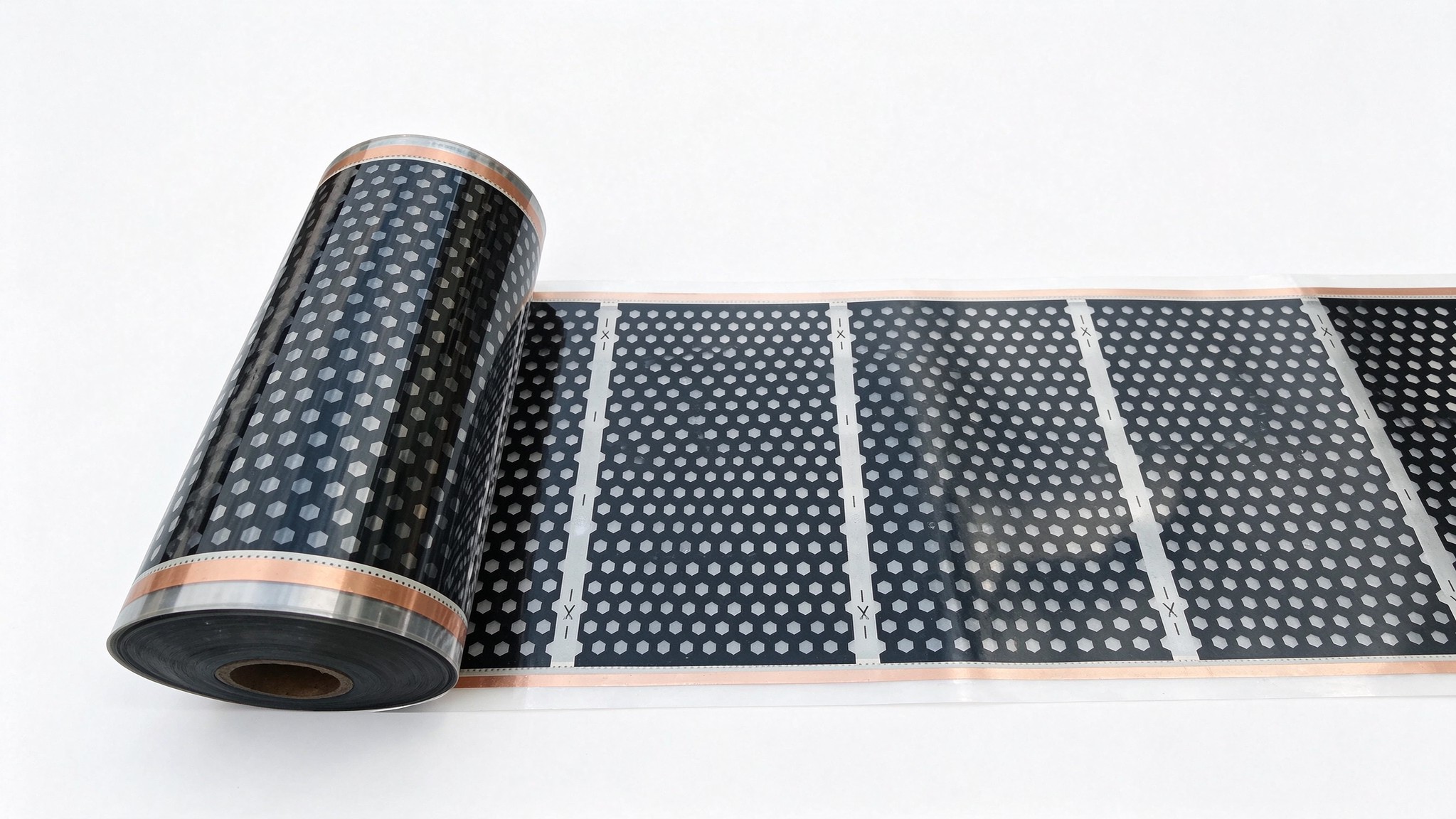
The graphene heating film is a continuous resistive layer fed by copper busbars along the edges. Current spreads across the printed coating rather than concentrating in a single wire, which already changes the field profile compared with a thin cable carrying the same current. A current spread over a wide planar surface produces a more distributed, lower local field than the same current confined to one narrow conductor.
The busbars are the parts carrying the collected current, so they are the main source to understand. The printed film itself heats across the whole face and is not a hot wire. This geometry is the reason a well-built film can be described as low field even though it is a mains element. The shielded construction then adds a conductive layer that screens the electric field, and the way the leads are arranged keeps the magnetic component low.
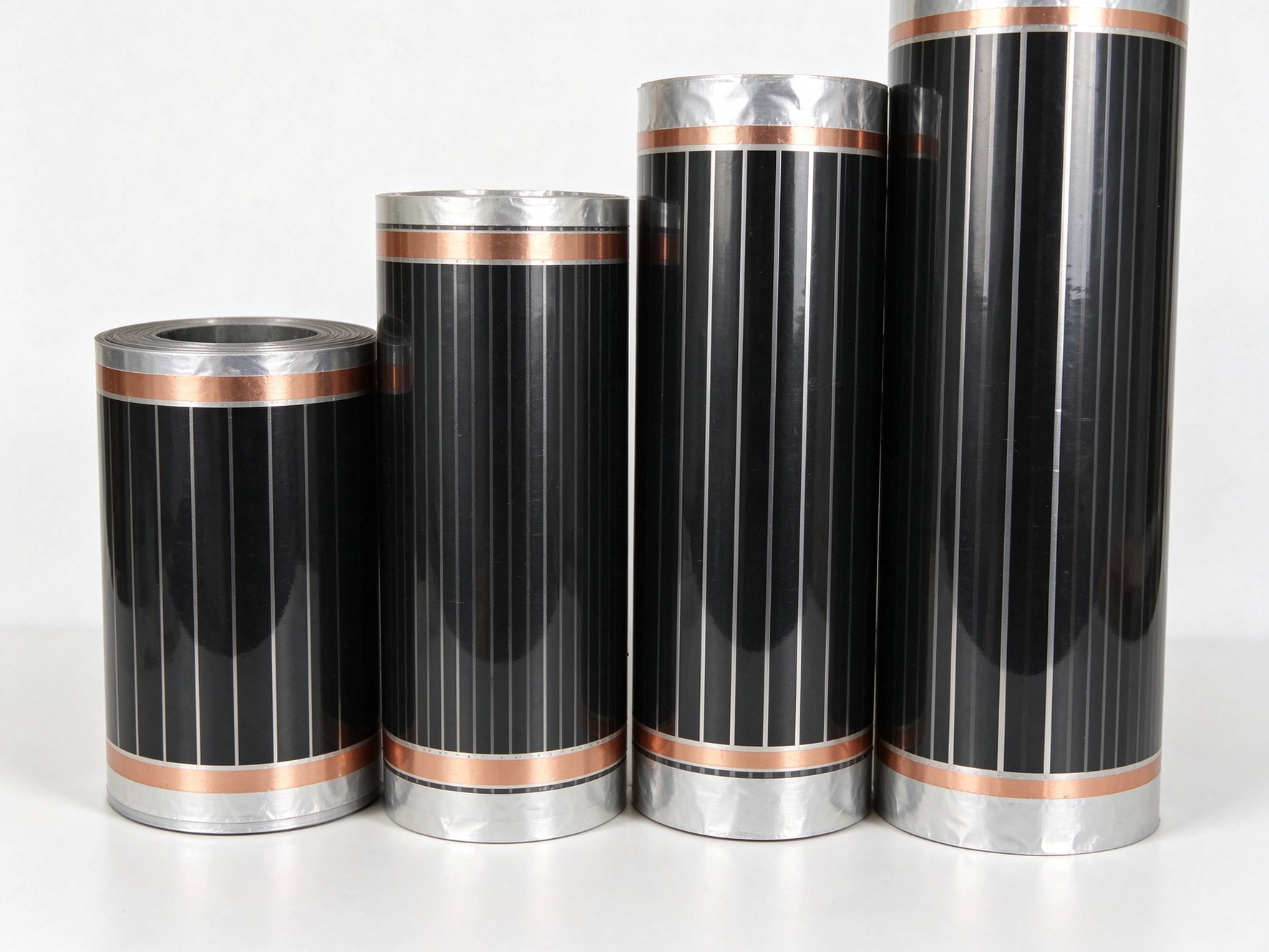
The wall film line takes the construction the furthest. The graphene wall film is built as a fully shielded element with a stated no electromagnetic radiation emission design, and it adds a reflective insulation backing. Because a wall panel is mounted in the room rather than under the floor, the shielding is specified more aggressively there. The same shielding principles are available in the floor builds.
How shielding works in a film build
Shielding is a construction feature, not a coating added at the end. Two mechanisms do the work, matching the two fields above.
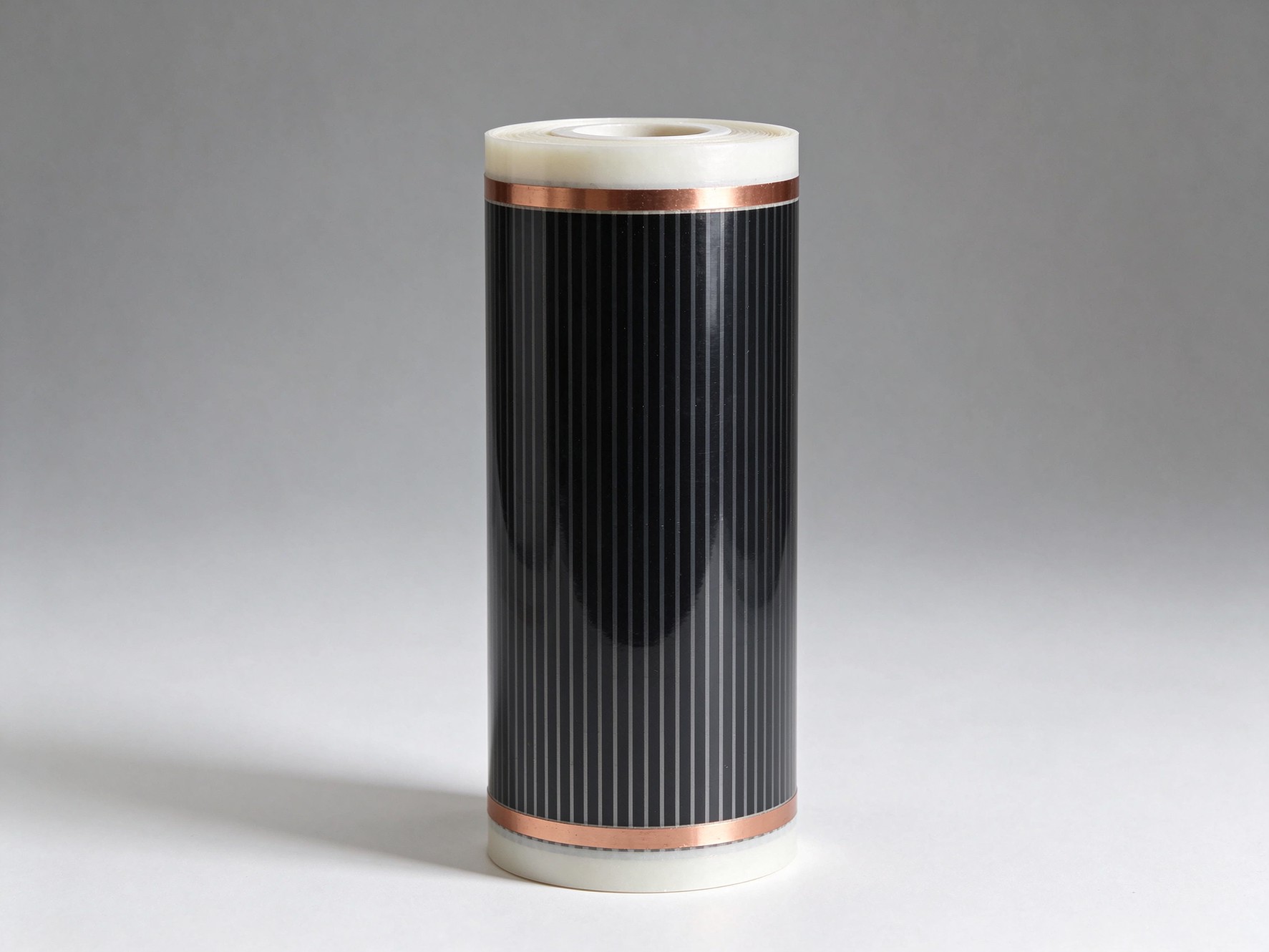
Electric-field screening uses a conductive layer that sits between the energised element and the room, bonded to earth so the field terminates on the screen rather than reaching the surface. This is the part that makes the shielded description meaningful for the electric component, and it is tested as part of the production electrical checks.
Magnetic-field reduction relies on geometry rather than a screen. Running the supply and return paths close together lets the opposing fields cancel, and spreading the current across the planar film lowers the local field at any one point. There is no material that simply absorbs a low-frequency magnetic field the way a lead shield handles high-frequency radiation, so any honest specification points to the conductor layout and the measured field rather than claiming a magical barrier.
What this means in practice is that the documents matter. A shielded build should be backed by a field measurement taken under a defined method, showing the field at a specified distance from the film. That report is the evidence. A verbal low-EMF claim with no measurement and no defined test distance is not verifiable and should be treated as marketing rather than engineering.
Far-infrared is not the EMF you are asking about
Buyers often conflate two things because both use the word radiation. They are completely different.
The film heats by far-infrared radiant heat, the same band of thermal radiation that any warm surface emits, including a sun-warmed wall. This is how the heat crosses from the floor to the room and the occupants, and it is the intended, useful output. It is not the low-frequency electric and magnetic field that the EMF question is about. Infrared is thermal radiation at a much higher frequency than the 50 or 60 hertz mains fields, and the two should not be confused in the specification.
So a film can be both an infrared emitter, by design, and a low-field electrical element, by construction. There is no contradiction. The infrared delivers the heat; the shielding and the conductor layout keep the low-frequency fields in check. If a sales answer treats infrared as evidence of low EMF, or treats EMF shielding as if it blocked the useful heat, that answer is muddled and worth a second question.
Standards and exposure guidance
Low-frequency field exposure is covered by public guidance rather than left to each manufacturer. Independent expert bodies publish reference levels for electric and magnetic fields at mains frequencies, and many countries adopt those into their own regulation. The useful point for a buyer is not a single number quoted out of context but whether the product is assessed against a recognised framework and whether the measured field sits within the reference levels at the occupied distance.
Electrical equipment is also covered by equipment safety and electromagnetic compatibility rules. A film supplied for the European market is built to the low-voltage and EMC requirements and carries the CE mark against them, with RoHS restricting the materials. These are product compliance marks rather than field-exposure limits, but they confirm the element has been assessed against the relevant electrical and electromagnetic requirements rather than being an untested generic film.
The disciplined way to read this is to separate the two questions. Ask whether the measured low-frequency field is within the public reference levels, and ask whether the product carries the electrical safety and EMC marks for the target market. Both should be answered, and neither substitutes for the other.
Certification marks: what each one means
| Mark / test | What it covers | What it does not prove |
|---|---|---|
| CE | Conformity with applicable EU product requirements, including LVD and EMC | Not a field-strength number on its own |
| RoHS | Restriction of hazardous materials in the element | Does not measure EMF |
| EMC assessment | Electromagnetic compatibility of the equipment | Does not replace an exposure-level check |
| IP67 (sealed film) | Waterproof jacket for wet-room builds | Not an EMF mark |
| Hipot / dielectric test | Insulation withstand, 3750 V on the sealed line | Confirms insulation, not field exposure |
| Field measurement report | Measured field at a defined distance and method | Only as good as the test method stated |
Notice the pattern. The product marks confirm electrical safety, material compliance and waterproofing. The field measurement report is the document that actually answers the EMF question. A complete specification includes both, and a buyer should expect the report to state the test method and the distance rather than presenting a bare number.
Dielectric safety: the hipot test
One safety test deserves a specific note because it is often mistaken for an EMF test. The dielectric withstand, or hipot, test applies a high voltage across the insulation to prove it can contain the working voltage. The sealed wet-room film is tested to 3750 V against a 220 V working voltage, a wide margin, and every batch is checked.
This confirms the insulation is sound and there is no breakdown path, which is central to electrical safety and to why the encapsulated film is safe in damp spaces. It is not a measurement of the low-frequency field, so do not let a hipot figure be offered as the answer to EMF. The two tests protect different things: hipot proves the insulation contains the voltage, while the field report shows the field at the occupied distance is within the reference levels.
What buyers should actually check before ordering
This is the core of the guide. A short list of requests that separates a documented shielded build from an unsupported claim.
- Ask for the field measurement report, with the test method and the distance stated, not just a low-EMF label.
- Confirm which field is addressed: the electric field through screening and the magnetic field through the conductor layout and planar geometry.
- Check the product marks for the target market: CE with the low-voltage and EMC requirements, RoHS, and the waterproof rating where the build is wet.
- For a wet room, confirm the sealed film and the hipot test, plus the RCD and floor sensor in the installation.
- Confirm the voltage build matches the market, since the element is produced at 110 V or 220 to 230 V and cannot be switched later.
- Ask how the shielding is constructed rather than accepting a single adjective; a real answer describes the screen and the conductor arrangement.
- Keep the documents with the project file, because they are the evidence a distributor or an inspector will ask for.
Comparison: shielded versus unsealed builds
| Aspect | Shielded sealed film | Standard dry film | Ultra-thin mat |
|---|---|---|---|
| Electric-field screen | Yes, bonded construction | Screened build available | Shielded, EMF-shielded spec |
| Magnetic-field approach | Layout plus planar spread | Planar spread geometry | Planar spread, aluminium layer |
| Waterproof | IP67 sealed | For dry enclosed builds | Membrane needed if wet |
| Dielectric test | 3750 V hipot | Standard tests | Standard tests |
| Best use | Wet rooms, high-spec rooms | Dry residential floors | Locked-height retrofit |
Common misconceptions
Treating infrared as EMF. The far-infrared output is useful thermal radiation, not the low-frequency field the safety question concerns. The two operate at different frequencies and answer different questions.
Expecting a material to absorb magnetic fields. Low-frequency magnetic fields are reduced through conductor layout and cancellation, not a simple barrier. A claim of a magnetic shield that works like a lead screen is a warning sign.
Taking a hipot number as an EMF result. The 3750 V test proves insulation withstand, not field exposure. Ask separately for the field report.
Trusting a label with no test distance. A low-EMF figure is meaningless without the method and the distance at which it was measured. The report has to state both.
Assuming all films are identical. The shielding construction and the documentation differ between manufacturers and builds. The aluminium mat, the sealed film and the standard film each have their own documented build rather than one shared generic claim.
How a field measurement is actually taken
A reported number is only as trustworthy as the method behind it, and the difference between a professional measurement and a consumer meter is worth understanding.
The instrument. A proper low-frequency field meter uses a calibrated probe and reports the field in the units the reference levels use, with a stated accuracy. A cheap consumer gauss meter can give a rough sense of relative field strength but is not a calibrated instrument, and readings between two different devices are not directly comparable. A compliance report should name the instrument and its calibration rather than quoting a bare number.
Single-axis versus three-axis. A field has a direction. A single-axis probe only reads the field aligned with the probe, so rotating the probe changes the reading even when the field itself is unchanged. A three-axis probe sums the components and gives a value that does not depend on how the meter is held. A serious measurement uses a three-axis instrument or carefully rotates a single-axis probe to find the maximum rather than taking one convenient reading.
The distance and the load. The report has to state where the probe sits relative to the film and whether the element is running at its rated current, because the magnetic field scales with the current. A measurement taken a few millimetres from the busbar and one taken at floor or standing height are answering different questions. The meaningful figure for exposure is the field at the occupied distance under the real operating load, not the closest possible reading chosen to look dramatic.
Distance and real-world exposure
The geometry of a floor build does a lot of the work, and this is the part most short answers leave out.
Low-frequency fields fall off quickly with distance from the source. The element is not at the room surface; it sits below the floor, separated by the insulation, the film, the floor construction and the finish. By the time the field reaches the occupied space above the floor, where people actually are, it has dropped well below the level measured directly at the element. A report that only quotes the near-surface field without carrying the measurement to the occupied distance overstates the real exposure.
Two more factors lower the practical exposure. The film is not energised at full output continuously; the thermostat cycles it, so the element is only drawing current for part of the time. And the current is spread across the planar film rather than concentrated in one conductor, which keeps the local field low at any single point. Put the spread geometry, the distance through the floor and the cycling together and the field a person actually experiences is far smaller than the rated element might suggest on paper.
The honest way to present this is still to show the measured figure at the defined distance under load, rather than asserting that distance alone makes the field disappear. It does not disappear, but it drops sharply, and the documented measurement is what confirms it sits within the reference levels in the space the customer occupies.
Data and evidence
The safety framework follows the public reference-level approach that independent expert bodies publish for low-frequency electric and magnetic fields at mains frequencies, together with the low-voltage and electromagnetic compatibility requirements that apply to electrical heating equipment. The product figures come from SunAura records: the printed graphene-carbon element on PET, the fully shielded wall film, the IP67 sealed film with a 3750 V hipot test, the shielded aluminium mat, the 110 V and 220 to 230 V builds, and the CE and RoHS documents issued with shipments under ISO 9001 quality management.
The factory has produced heating elements since 2008 and exports to more than 50 countries. We recommend buyers request the field measurement report and verify it against the recognised framework and the local code, rather than relying on a single adjective, and we do not quote exposure figures outside the documented test method.
Frequently asked questions
Does a heating film produce EMF?
Like every mains device it produces low-frequency electric and magnetic fields, but the electric field is screened by the construction and the magnetic field is reduced through the conductor layout and planar geometry. The field measurement report shows the result at the occupied distance.
Is far-infrared the same thing as EMF?
No. Far-infrared is the thermal radiation that delivers the heat. The EMF question concerns the 50 or 60 hertz fields from the supply. They are different frequencies and different questions.
Which document actually proves the EMF performance?
The field measurement report with the test method and distance stated. The CE, hipot and waterproof marks prove other things and cannot replace it.
Can a shield block the magnetic field completely?
A simple screen does not work the way it does for the electric field. Magnetic fields are reduced through cancellation and spread geometry, and the report should reflect that honest approach rather than claiming a perfect barrier.
What extra protection does a wet-room build need?
The sealed IP67 film with the hipot test, plus an RCD and a floor sensor in the installation and the waterproof membrane. The documents confirm each part.
Final recommendation
Stop treating EMF as a yes or no label and treat it as a documentation question. Expect the electric field to be screened by a bonded conductive layer and the magnetic field to be reduced through conductor layout and the spread planar geometry, then ask for the field report with its method and distance. Keep the two safety questions separate: the field report against the public reference levels, and the product marks for low-voltage, EMC, materials and waterproofing, with the hipot test proving the insulation rather than the field. Specify the fully shielded sealed film in wet rooms and high-spec builds, the shielded standard film on dry floors, and the ultra-thin shielded mat where the height is locked. A build that can produce every one of those documents is a build you can verify. That, rather than a single reassuring word in a sales message, is what safe actually means in a real, verifiable installation.