
Ethan Sun, Founder & CEO, SunAura Thermal
Ask any distributor why a floor heating order slipped this winter and the answer is rarely the material. It is the crew. The electrician who can lay a mat, terminate a cold lead and commission a thermostat is the same person every other trade on the site is waiting for, and there are fewer of them each year. In several European markets the average age of a heating installer is now in the late forties, and the number of apprentices entering wet-trade heating work has been falling for a decade.
For a buyer, that changes what “good value” means. A system that costs 12 % more per square metre but takes 40 % less site labour is cheaper to deliver, because the scarce input is not the film — it is the hour. This article looks at where the labour actually goes in each of the four common electric floor constructions, which ones survive a shortage best, and how to write a specification that prices labour risk instead of ignoring it.
How tight is the labour market, and where does it bite
The shortage is not evenly distributed. It shows up in three places, and each of them has a different effect on a project.
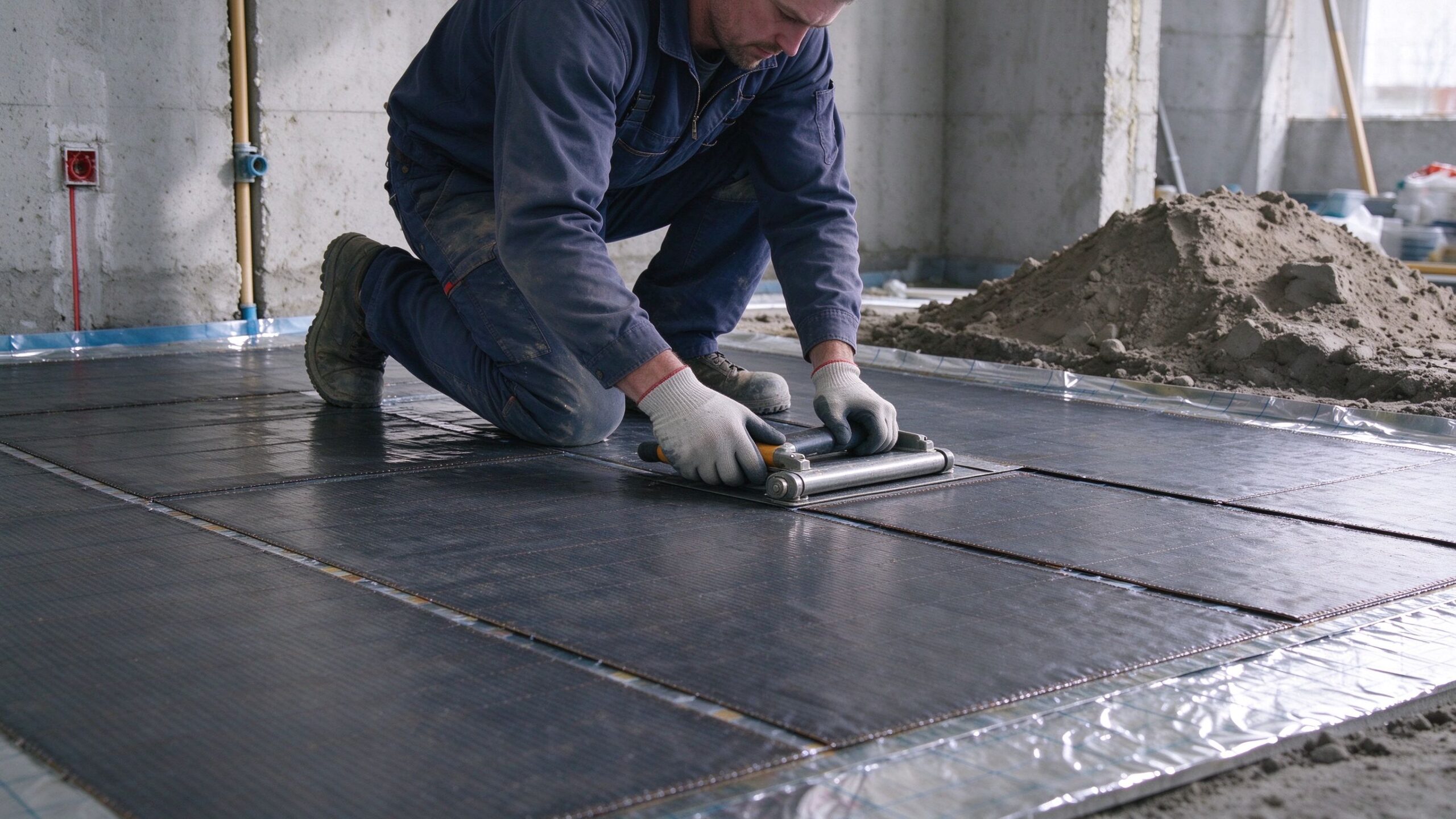
First, first-fix electricians. The trade that pulls cable, terminates cold leads and signs off the circuit is the bottleneck on almost every electric floor job. A crew that can lay 120 m² a day in a dry system will lay half that in a screeded system, because the screed has to go in after them and they cannot move on until it does.
Second, commissioning. A thermostat that needs its floor probe positioned, its floor-limit parameter set and its zone schedule programmed takes an hour per zone if the person doing it has done it before, and half a day if they have not. On a school or an office fit-out with twelve zones, that is the difference between one visit and three.
Third, remedial work. The most expensive labour in any floor project is the second visit — the one where somebody has to lift flooring, find a joint, and re-terminate. A system with fewer field-made joints needs fewer of those visits, and the saving compounds as crews get scarcer.
Per EN 1264 guidance and the installation instructions that accompany certified floor heating systems, the electrical work is a defined sequence: substrate preparation, insulation and membrane, heating element, continuity and insulation testing, then the floor build-up. What the standards do not fix is how many of those steps require a skilled person on their knees. That is a product decision, and it is where the four constructions diverge.
Where the hours go: four electric floor constructions compared
The table below uses typical site figures from installer feedback on residential and light commercial projects, expressed as person-hours per square metre for the heating scope only. They exclude screed curing, flooring and electrical rough-in, which every system needs.
| Construction | Site labour | Skilled labour share | Field joints per 10 m² | Weather / programme risk | Best fit |
|---|---|---|---|---|---|
| Heating cable in screed | 0.45–0.65 h/m² plus 3–7 days curing | High — cable layout, fixing, testing | 1–2 per zone, made on site | High — curing blocks the following trades | New build, floors where mass and acoustic separation are wanted |
| Heating mat in thin screed or self-levelling | 0.30–0.45 h/m² plus 1–3 days cure | Medium — mat is pre-spaced | 1 per mat, factory lead if ordered sealed | Medium | Renovation where a 10–15 mm build-up is acceptable |
| Dry-lay film or mat under floating floor | 0.15–0.25 h/m², no curing | Low — roll, cut, connect, test | 0–1 per room | Low — no water, no cure, immediate follow-on | Timber, laminate, engineered wood, fast programmes |
| Prefabricated panel with integrated element | 0.20–0.30 h/m², panel fit only | Low at the panel stage, medium at connection | 1 per panel joint | Low | Repeatable layouts, schools, offices, modular buildings |
Read the last three columns together and the shortage story becomes clear. The screeded cable system is not unaffordable because of its material cost — it is exposed because it locks up two scarce resources at once, skilled cable labour and programme time. A dry-lay film system at 0.20 h/m² uses about a third of the site labour of a screeded cable system and hands the floor back to the next trade the same day. On a 200 m² retrofit, that is roughly 50 person-hours saved, which at a loaded labour rate of €45–65 per hour is €2,250–3,250 — more than the material difference on most domestic projects.
That does not make cable obsolete. Cable in screed still wins where floor mass is wanted for acoustic performance, where the finished floor is tile on a thick bed, or where the project is new build and the screed was going in anyway. The point is to choose the construction for the labour market you are buying into, not for the one that existed when the specification was first written.
What the shortage does to lead times and scheduling
Material lead time and labour lead time are now comparable problems, and buyers who plan only one of them get caught. A film order from stock ships in weeks; a crew that can install 300 m² in a school holiday window may be booked three months out. When those two calendars slip against each other, the material sits on site and the programme moves anyway.
Four scheduling practices reduce the exposure, and all of them are things a buyer can write into the order rather than hope for.
Order cut-to-length, not rolls. A roll that arrives at 1.2 m × 20 m and has to be trimmed into six room-sized pieces adds site cutting time and cut-edge risk. Factory-cut lengths matched to the room schedule remove both. The trade-off is that cut lengths are usually priced higher per square metre and are non-returnable, so the schedule has to be right.
Ask for factory-sealed cold leads. A sealed lead is a joint the installer does not have to make. It reduces the skilled-labour content of each connection point from a task to a plug, and removes the most common warranty failure from the site entirely. The cost is flexibility: a sealed lead fixes where the connection sits.
Stage the commissioning separately. Laying and commissioning are different skills. Sending the crew that lays 200 m² in a day back to program twelve thermostats is a waste of the scarce resource. Separating the two visits, with a pre-filled zone schedule and pre-set parameters, cuts commissioning time by roughly half in our own project records.

Build a testing record into the handover. Continuity, insulation resistance and a photographic record of every joint cost about twenty minutes per zone and save the return visit that nobody has labour for. It also gives the buyer something to hold the installer to, which matters more when crews are moving between sites quickly.
Pricing labour risk instead of ignoring it
Most quotations compare material cost per square metre. That comparison is incomplete in a shortage, because the labour line is where projects actually overrun. A more useful comparison is total installed cost per square metre, built from four numbers: material, site labour hours at the local loaded rate, programme delay cost, and expected remedial cost.
Take a 25 m² living room retrofit as an example. A screeded cable system at €28/m² material plus 0.55 h/m² labour at €55/hour comes to €28 + €30 = €58/m², before curing delay and before any remedial allowance. A dry-lay film system at €34/m² material plus 0.20 h/m² labour comes to €34 + €11 = €45/m². The film is dearer on the material line and cheaper on the installed line, by about 22 %. That is the comparison a buyer should be making, and it is the one most quotation templates do not invite.
Two caveats belong with that example. The film system assumes a suitable floating floor and a flat substrate; on an uneven slab the levelling cost belongs to both systems and can swamp the difference. And the labour rate is local: in markets where heating labour is cheap and plentiful, the screeded system’s material advantage holds. The calculation is not a universal answer, it is a method.
Which buyer should choose which system
The decision framework comes down to four questions, in this order.
Is there a screed anyway? If the project is new build and a structural screed is being poured regardless, cable in screed adds little labour and the floor mass is free. Choose cable.
Is the finished floor timber or laminate? A dry-lay film or mat under a floating floor is the correct answer, and it is also the fastest. Cable in a thin screed under timber is possible but adds build-up height and curing time for no benefit.
Is the programme compressed? School holiday windows, occupied retrofits and retail fit-outs all punish curing time. Dry-lay and prefabricated panel systems are the only constructions that hand the floor back immediately.
How many zones, and who commissions them? Above about eight zones, the commissioning burden becomes a separate labour problem. Pre-set thermostats with a documented zone schedule, and a supplier who will pre-configure the units, are worth more than a small material discount.
Where the answers conflict — a school with a structural screed and a two-week holiday window, for instance — the tie-breaker is remedial risk. The construction with fewer field-made joints and a documented test record is the one that will not need the crew that does not exist.
The enquiry sheet for a labour-constrained project
Eight items make quotations comparable when labour is the constraint, and most of them are not on a standard price list.
One: person-hours per square metre for the heating scope, stated by the supplier rather than assumed by the buyer. Two: whether cold leads are factory-sealed, and the standard lead length. Three: whether film or mat can be ordered cut to the room schedule. Four: the maximum run length at the project voltage, since a run that needs splitting adds a joint. Five: the test procedure and what documentation is supplied at handover. Six: thermostat configuration — whether zones can be pre-set at the factory. Seven: the remedial procedure if a joint fails under the finished floor, including whether the system is repairable in situ. Eight: lead time for a repeat order of the same cut lengths, because phased handover is common on larger projects.
Four assumptions that cost money
“Labour will be available when we need it.” In a shortage, availability is a schedule input, not a promise. Book the crew before the material.
“Cheaper per square metre is cheaper.” Material price per square metre and installed cost per square metre are different numbers, and the gap widens exactly when labour is tight.
“Curing time is free.” It is not. It occupies the critical path and blocks every trade behind the floor, which is a cost carried by the main contractor, not the heating supplier.
“A joint is a joint.” A factory-sealed lead and a site crimp are not equivalent connections, even when both read continuity at handover. One of them is the reason warranty returns cluster at the cold lead.
Data and evidence
The labour figures above are typical site values from installer feedback across residential and light commercial projects, expressed per square metre of heated area; they are indicative ranges, not a substitute for a local quotation. The construction sequence and testing requirements follow EN 1264 guidance and the installation instructions supplied with certified systems.
Factory side: SunAura Thermal has manufactured heating film, mat, cable and controls since 2008 — seventeen years from the Qingdao (Huangdao) plant, under ISO 9001, ISO 14001 and ISO 45001, with CE, RoHS, LVD and EMC documentation and distribution into more than 50 export markets. We do not publish certificate numbers in marketing copy; current documentation comes with the quotation.
Product side: factory-cut lengths, sealed cold leads and pre-configured thermostats are all standard options on our film and mat lines rather than custom engineering, which is why they can be quoted with normal lead times.
Field side: in our warranty records, cold-lead joints account for the majority of failures that require a second visit. That is the number behind the recommendation to specify sealed leads wherever the layout allows it.
FAQ
Does a labour shortage make electric heating more expensive than hydronic? Not necessarily. Electric systems generally need fewer trades on site — no boiler, no manifold, no pressure testing — and dry-lay constructions need no curing. Where hydronic wins is in large new-build projects with an existing mechanical contractor already on the programme.
Can I install film myself to avoid the crew problem? Laying is straightforward; terminating and testing is not, and in most markets the circuit must be signed off by a qualified electrician. Self-installation usually shifts cost to commissioning and to risk, rather than removing it.
Why are sealed cold leads more expensive? Because the joint is made under factory control with a documented contact resistance, and the lead is encapsulated before it leaves. You are buying the elimination of a site task, not just a length of cable.
Is a 10 mm build-up realistic for a retrofit? For dry-lay film under a floating floor, yes — the film plus underlay typically fits within 8–12 mm. For tile, the adhesive and tile add more and the substrate has to be flat, which is where retrofit budgets usually move.
How many zones can one thermostat handle after a shortage-driven redesign? One thermostat per zone is the clean answer; paralleling circuits on one device is limited by its derated current rating, not by the number of rooms. Above roughly 2,900 W on a 16 A device, a contactor or a second thermostat is the correct solution.
Next step
If your programme is constrained by crew availability, send the room schedule with floor finish, substrate and target handover date. We will return two constructions side by side — one dry-lay, one with a screed — with the person-hours, lead times and installed cost per square metre for each, so the comparison is made on the number that actually decides the project. The screed versus dry-lay comparison covers the build-up detail, the electric versus hydronic analysis covers the trade mix, and the heating mat range lists the cut-to-length and sealed-lead options. For thermostat scheduling across multiple zones, start with our notes on temperature settings by room type.