
Why a cold drum stops the whole production line
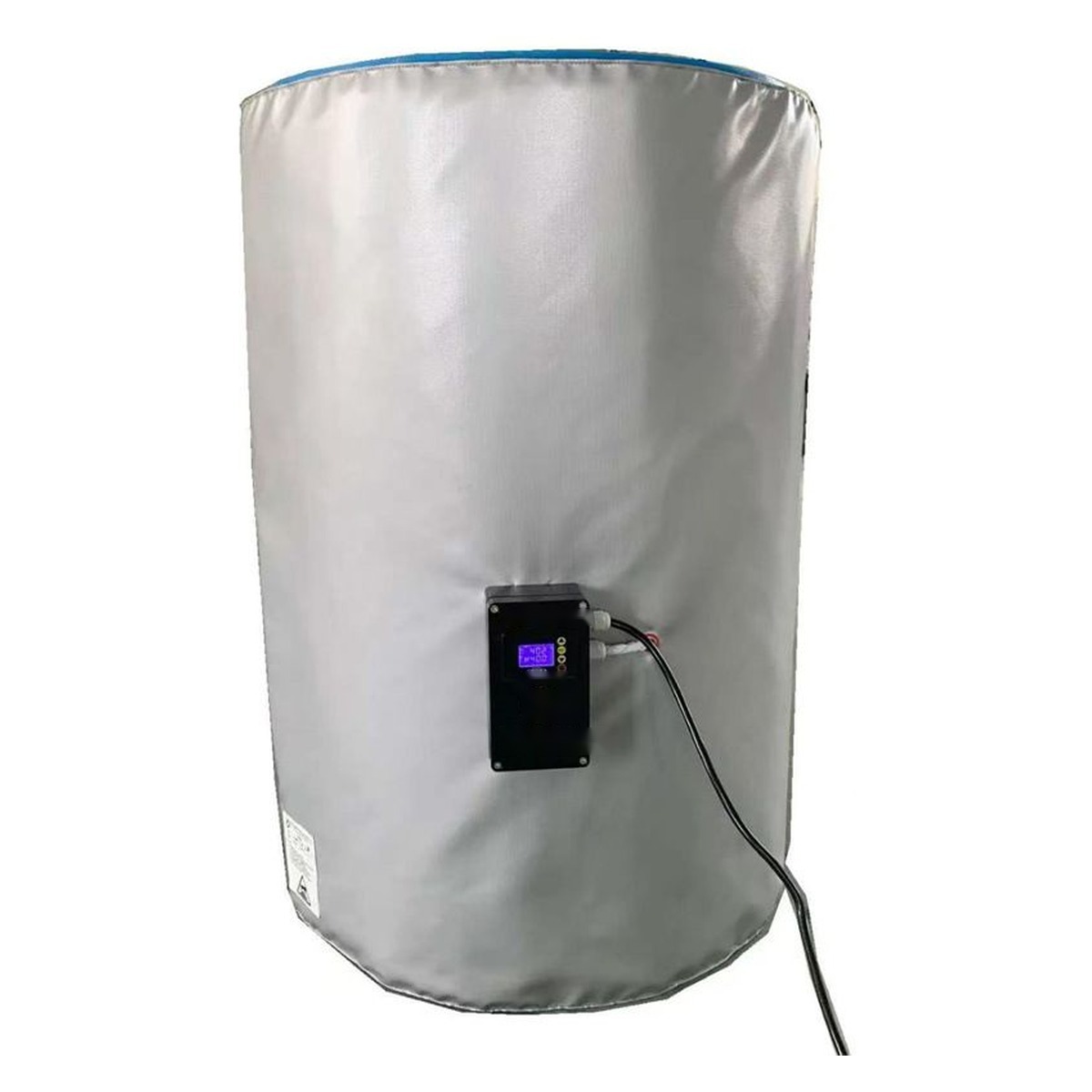
On a winter morning, the most expensive piece of equipment in a plant can be a 200 L (55 gal) drum that will not pour. Oil, grease, resin, adhesive, biodiesel and many food concentrates are Newtonian only on paper; once the temperature drops, viscosity climbs steeply and the pump loses prime, the dispensing gun stalls, or the contents simply sit as a near-solid plug at the bottom. Teams respond with space heaters, propane torches and steam lances, all of which heat the air or one small patch of steel rather than the liquid itself. A drum heating blanket solves the same problem at the source: it wraps an insulated electric element around the barrel and holds the wall at a controlled temperature until the entire contents return to a pumpable viscosity.
This is not a comfort-heating product. A 1,300–2,000 W full-wrap jacket on a standard drum maintains a set point between 0 and 145 °F (−18 to 63 °C), with the thermostat reading the barrel surface rather than the surrounding air. The heat transfers conductively across the whole wall, so the liquid warms evenly instead of being scorched on one side. For buyers who have only ever treated frozen drums as an unavoidable winter delay, the economics are worth examining closely.
James O’Connell, Industrial Applications Engineer, SunAura Thermal
What actually happens to viscous liquids in the cold
Viscosity and temperature are tightly coupled. Many industrial fluids roughly double their viscosity for a fixed drop in temperature, and the relationship is exponential rather than linear. A hydraulic oil that flows freely at 20 °C can become syrupy at 5 °C and effectively unpumpable below freezing. Waxes and paraffinic products cross a true pour point and solidify; honey, molasses and glucose concentrates become so thick that dispensing times multiply; resins and polyurethanes can develop crystals that ruin a batch. The problem is rarely the drum itself — it is the energy and labour spent trying to move a liquid whose viscosity no longer matches the pump or nozzle it was designed for.
Surface heating reverses this by warming the boundary layer first. As the layer of liquid touching the steel wall warms, it becomes less dense and rises, setting up gentle natural convection that slowly mixes the drum without a stirrer. A full-wrap jacket accelerates this because the entire wall contributes, rather than a single heated band. Within a predictable warm-up window — which depends on the fluid, the set point and the ambient temperature — the drum reaches a uniform, documented temperature and stays there for as long as the jacket is powered.
Full-wrap versus half-wrap: choosing the right jacket
Drum heating blankets are sold in two broad layouts, and the choice depends on how cold the drum gets and how quickly it must recover. A full-wrap jacket, typically about 1,900×880 mm for a 200 L drum, covers virtually the entire side wall and delivers the fastest, most even recovery after an overnight freeze. It is the default choice for outdoor storage, unheated warehouses and high-viscosity products. A half-wrap or band jacket, around 1,900×500 mm, heats a lower band and costs less; it suits partially insulated drums, milder climates or fluids where only the bottom layer thickens.
Both layouts use the same construction logic: a silicone-coated fibreglass or waterproof Oxford outer, a nickel-chromium heating element laid in a uniform pattern, an aluminium reflective layer that spreads the heat and prevents hotspots, roughly 15 mm of insulation, and quick-release straps that hold the jacket tight against the wall. A loose jacket wastes energy into the air gap; a properly tensioned one keeps the heating element in conductive contact. The controller is either a simple dial thermostat or a digital unit with a readable set point, and high-temperature variants can hold up to 120 °C for specialist products.
Operating cost and safety compared with improvised methods
Open-flame and improvised heating carry costs that do not appear on a purchase order. A propane torch pointed at a steel drum creates a local hotspot that can degrade the product, damage the drum, and — with flammable contents — present a real fire hazard. Space heaters warm an entire room to reach one barrel, which is enormously wasteful in a draughty warehouse, and steam lances introduce water where it often does not belong. A drum jacket applies roughly 1.3–2 kW directly to the container and only runs until the set point is reached, after which the thermostat cycles. Because the insulation keeps the heat against the wall, the energy goes into the liquid rather than the building.
Electrical safety is engineered in rather than left to the operator. Production jackets carry an IP44 splash-resistant rating, insulation resistance of at least 500 kΩ, an overheat cut-out and a protective earth, with current normally kept below 16 A so they run on standard sockets. They are designed for outdoor and damp locations when supplied through a residual-current device, though the controller and plug should always be kept above standing water. Export models are built for the destination market’s voltage — 120 V for North America, 230 V for Europe, with 110/220/240/380 V options — and carry CE and RoHS, with FCC or ETL on selected models.
How to size a jacket for a real drum
Sizing always starts from the fluid, not from a wattage guess. Four inputs determine the answer: the product and its required hold temperature, the lowest ambient temperature the drum will see, the container’s surface area and material, and the available supply voltage. A 200 L steel drum of gear oil held at 15 °C in a −5 °C yard is a different calculation from a 25 L pail of adhesive kept indoors. As a rule of thumb, standard 200 L drums use 1,300 W at 120 V or 2,000 W at 220 V, while larger IBC containers and high-throughput applications move up to 3,000 W and beyond across the 500–5,000 W product range.
Custom dimensions are common. The same heating technology is built for half-wrap and full-wrap drums, IBC ton-containers up to about 4,400×1,100 mm, and flat industrial blankets for equipment. Buyers specifying a non-standard size should confirm the dimensions, the required certification and the controller type at the order stage, because these are manufactured to order rather than adjusted on site.
Where drum blankets earn their keep
- Lubricants and hydraulic oils kept outdoors or in unheated stores, so pumps and dispensers work from the first shift.
- Biodiesel, waste oils and paraffinic products that cross a pour point and would otherwise need a full day to recover.
- Resins, adhesives and coatings held at a stable temperature to protect batch quality and avoid crystal formation.
- Honey, molasses, syrups and food concentrates warmed gently and evenly without hotspots or contamination.
- Chemical drums whose contents must stay above a minimum handling temperature for safe decanting.
Frequently asked questions
Can I leave the jacket switched on overnight?
Yes, that is the intended use. The thermostat cycles around the set point and the overheat cut-out provides a second layer of protection, so a jacket can hold a drum at temperature continuously. Ensure it is connected through an RCD and the straps are tensioned correctly.
Will it work on a plastic HDPE drum?
It works on both steel and HDPE within the controller’s range, because the element heats the wall evenly rather than applying a concentrated flame. Respect the lower temperature limit of plastic and use a calibrated controller so the wall never exceeds it.
How long does a cold drum take to reach pouring temperature?
There is no single figure: it depends on the fluid, the drum size, the set point and the ambient. A full-wrap jacket is significantly faster than a band because the whole wall contributes; your supplier can estimate the warm-up time from the four sizing inputs.
Does the jacket replace a heated store room?
For drum handling, it usually does so far more efficiently, because energy is applied to the container rather than the air in a building. A heated room still makes sense for operator comfort, but the barrels no longer depend on it.
Related reading
The full technical detail, including the dimension table and the reference price guide with sources, is on the drum heating blanket product page. The broader family is collected under industrial heating blankets, and the cross-scene overview of where these jackets are used is in the applications guide. For fixed pipework rather than barrels, see our heat trace cable coverage.
Next step
If frozen or high-viscosity drums are costing you shift time, send the product type, drum size, lowest winter temperature and supply voltage. Our engineers will come back within one working day with a jacket size, wattage and controller recommendation, along with the certification needed for your market. Request an industrial layout or talk to us about custom dimensions for an entire fleet of drums.