
The Question Buyers Ask and the Answer That Needs Numbers
Every buyer of electric floor heating eventually asks about electromagnetic fields. The question usually arrives in one of two forms: “Is this safe to sleep on?” or “Why does one supplier advertise low-EMF and another say it does not matter?” Both deserve a technical answer rather than a marketing one, because electromagnetic field levels in a floor heating system are measurable, they vary by design, and they are regulated by standards that are public. This article explains where the fields come from, what the measurements show in different element designs, which standards set the reference values, and how a buyer can read a supplier’s EMF claim instead of guessing. The honest conclusion is reassuring: electric floor heating operates at mains frequency in a category where the reference levels are many times below the international guideline limits, and the design choices that reduce fields further are simple and documented.
The context matters before the numbers. Household electricity in most countries is 230 V at 50 Hz (120 V at 60 Hz in North America), and any device that carries current produces an electric field and a magnetic field at that frequency. The relevant question is never whether a field exists — it exists around every appliance, cable and light — but how strong it is and how it compares with the reference levels set by public health and standardisation bodies. Floor heating is a low-power, low-current application: a typical heating circuit draws less current than a kettle or a hair dryer, and the current is distributed across many metres of element, which spreads the field over the floor area. That basic geometry is why the measured levels are low to begin with.
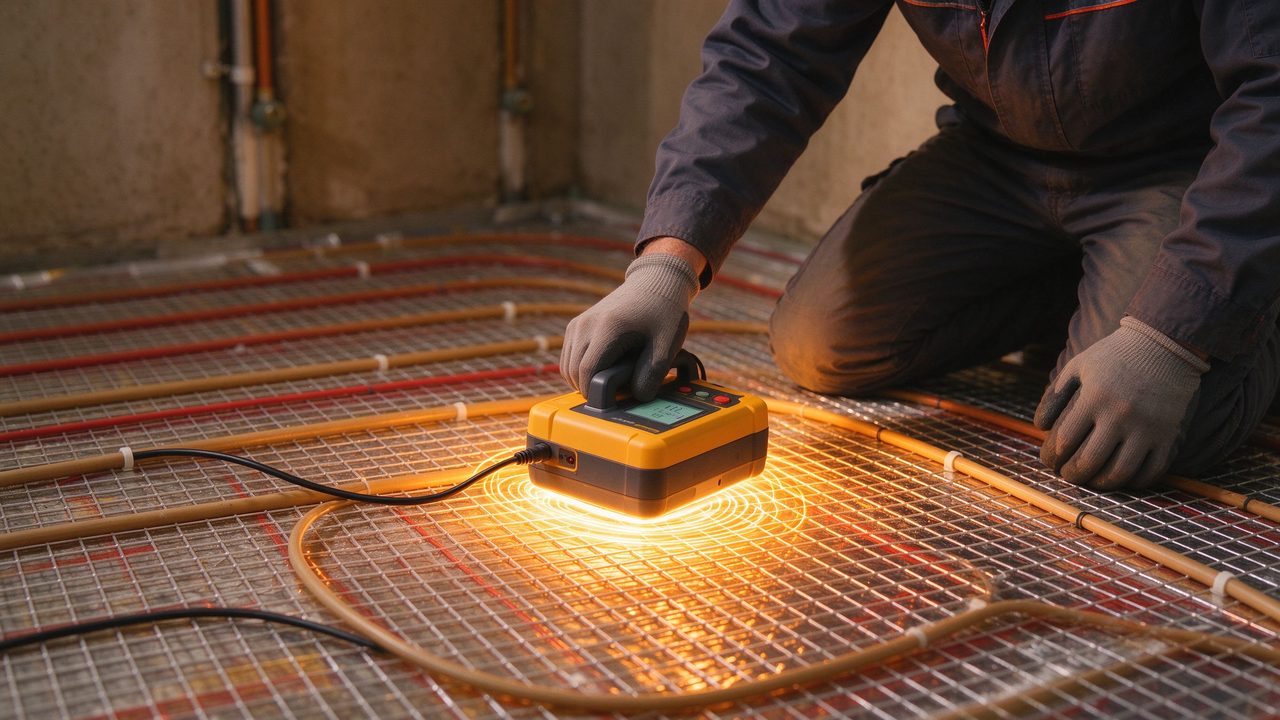
Where the Fields Come From: A Short Physics Primer
Two separate quantities need separating. The electric field is produced by voltage and is measured in volts per metre (V/m); the magnetic field is produced by current and is measured in microtesla (µT) or milligauss (mG). In a floor heating system the electric field at the surface depends mostly on the cable or film construction and the earthing arrangement — a screen or shielding layer in the element, and a correctly earthed system, reduce the electric field at the surface substantially. The magnetic field depends on the current in the conductors and on how close the conductors are paired: because the supply and return conductors in a heating circuit are close together, their magnetic fields largely cancel at a short distance, which is why the measured magnetic field a few centimetres above a well-installed element is very small.
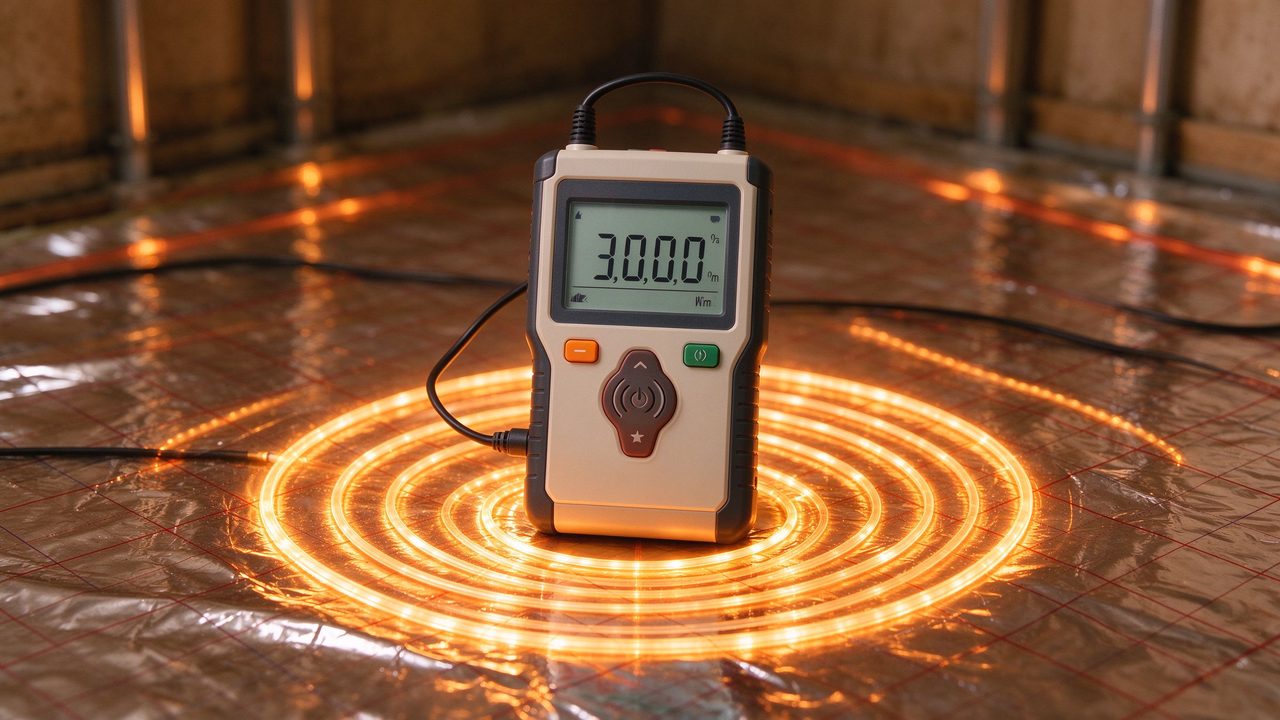
The geometry explains the marketing too. A design that routes the supply and return conductors side by side, or a film whose bus bars are paired, will measure lower magnetic fields than a design with widely separated conductors. This is the physical basis of the “low-EMF” claim: it is not a mystery technology, it is conductor layout plus shielding plus earthing. A buyer comparing suppliers should therefore ask how the element is constructed and ask for the measured values, not for adjectives. The measurement method matters as well: readings are taken with a calibrated meter at a defined distance (typically at the surface and at 30 cm), over the element and between elements, and the values depend on the load at the time of measurement, so the measurement conditions belong in the datasheet.
What the Standards Say: The Reference Levels
The reference framework is public and consistent. The International Commission on Non-Ionizing Radiation Protection (ICNIRP) guidelines set reference levels for public exposure to 50 Hz fields: 5,000 V/m for the electric field and 100 µT for the magnetic field. These are the levels used by the World Health Organization and by most national regulators as the basis of exposure limits. Measured values in residential electric floor heating are typically orders of magnitude below those levels — a surface reading of a few microtesla or less for the magnetic field, depending on the measurement point and the load, is the normal range. The gap between the measured values and the reference level is the whole story: the system operates at a small fraction of the guideline, and the low-EMF design variants sit even lower.
It is important to state clearly what the reference levels are not. They are not a “safe/unsafe” threshold in the sense of a hard line discovered from floor heating data; they are public-exposure guidelines for 50/60 Hz fields in general, set with large safety margins relative to the thresholds at which established biological effects occur. No regulatory body sets a floor-heating-specific limit, because the exposure is so low that it does not approach the general guideline. A supplier claiming “certified EMF-free” or inventing a floor-heating-specific standard is describing marketing, not regulation — the correct position is “measured at X, against the ICNIRP/WHO reference levels of 100 µT and 5,000 V/m, the system operates at well under 1%.”
Design Choices That Lower the Measured Values
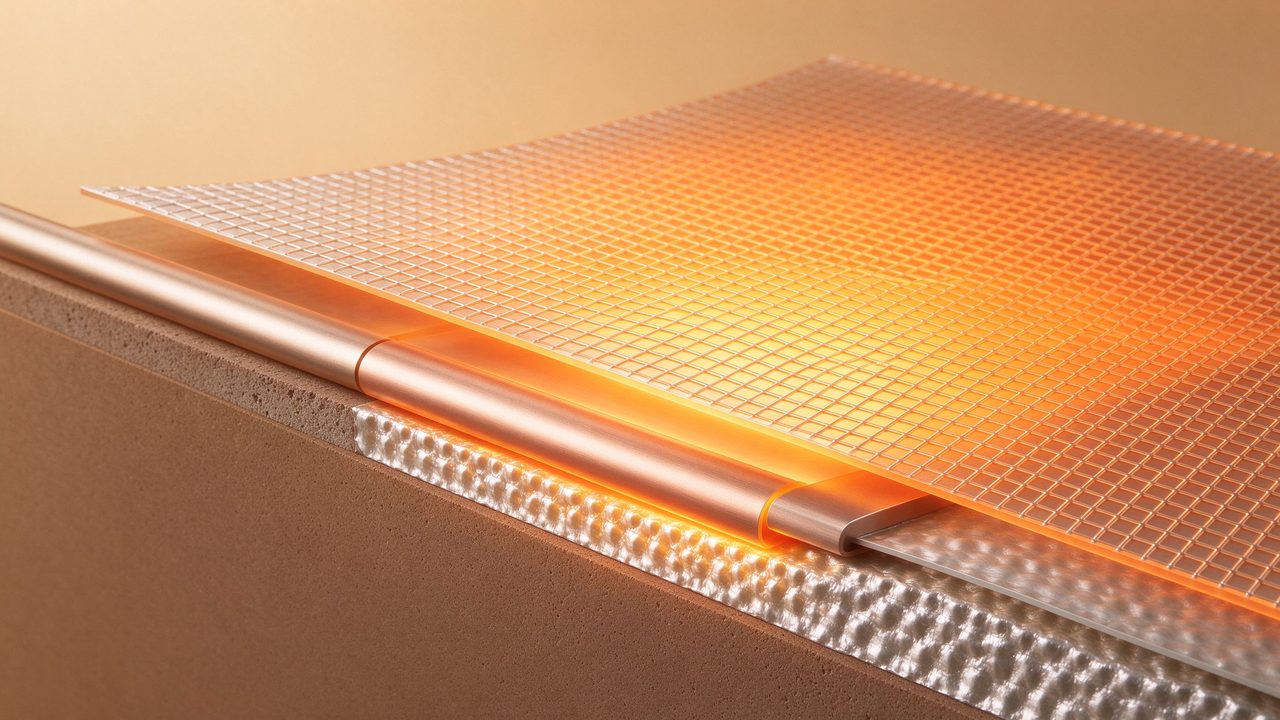
Three design choices materially reduce the measured fields, and all three are verifiable. The first is conductor pairing: elements that route supply and return close together cancel most of the magnetic field at the surface — this is the defining feature of a low-EMF underfloor heating design. The second is shielding: a conductive screen or foil layer in a film, or a screened construction in a cable, reduces the electric field at the surface and is also good practice for other reasons, because a screen helps distribute the heat uniformly. The third is earthing: a correctly earthed system with the protective conductor connected as the manufacturer specifies holds the electric field at the surface at the lowest level the design allows.
Installation practice matters as much as the product. A heating circuit whose supply and return leads are routed side by side to the junction box keeps the fields cancelled right up to the connection point; a circuit whose two leads are pulled apart across the floor creates an unnecessary loop. The element spacing and the build-up depth also influence the surface reading, which is why the measurement protocol belongs in the commissioning sheet — measured at defined points, at defined load, and recorded. This is the discipline we apply in our factory testing and in the commissioning documentation our export team supplies (per SunAura factory records), and it is the same discipline a buyer should demand from any supplier: not a claim, a measurement.
Data and Evidence: The Testing Behind the Claim
The evidence a buyer should request is a measurement, not an adjective. The datasheet should state: the measurement instrument and calibration, the measurement points (surface and 30 cm, over element and between elements), the load at measurement, and the values in V/m and µT. The comparison line should cite the reference: ICNIRP guidelines of 5,000 V/m and 100 µT for public exposure at 50 Hz, and the WHO position that these form the basis of health protection. Any supplier that cannot produce that sheet is describing marketing; a supplier that can produce it is documenting a product.
On the manufacturing side, the claim is backed by the same factory record system as everything else we ship: 17 years of heating element and control manufacturing at our Huangdao plant in Qingdao, China, under ISO 9001, ISO 14001 and ISO 45001 management systems, with CE, RoHS, LVD and EMC compliance on the product range, and exports to more than 50 countries (per SunAura factory records). The construction features that keep measured levels low — paired conductors, screen layers, earthed screens — are part of the product design and are described in the technical data sheets, so a buyer can verify the design before ordering, not after.
Frequently Asked Questions
Are electromagnetic fields from electric floor heating a health concern? Measured levels in floor heating are orders of magnitude below the ICNIRP public-exposure reference levels (100 µT magnetic, 5,000 V/m electric at 50 Hz), which are the basis of WHO-aligned national limits.
What is a normal magnetic field reading above a heated floor? With the circuit under load, readings in the single-digit microtesla range or lower at the surface, depending on the design and measurement point, are the normal range — a small fraction of the 100 µT reference.
What does “low-EMF heating film” mean technically? It means the element construction pairs the supply and return conductors closely and uses screen layers and proper earthing, which reduces the measured electric and magnetic fields at the surface. It is a verifiable design feature, not a certification.
Is EMF shielding the same as insulation or safety certification? No. CE, RoHS, LVD and EMC are regulatory compliance marks; EMF field levels are a measured physical quantity reported against guideline reference levels. They serve different purposes and should not be conflated.
Should I choose a system based on the EMF claim alone? No — choose on the full specification: heat output, insulation requirement, control features, safety documentation and measured EMF values. A low measured field with a weak control system is still a weak system.

Sourcing a System with Measured, Documented EMF Values
For buyers who want the measurement, not the marketing, the specification request is straightforward: ask for the EMF measurement sheet with instrument, points, load and values, ask how the element construction achieves the numbers, and ask how the installation guidance preserves them (paired leads, earthing, commissioning measurement). As an EMF tested heating mat manufacturer and a supplier of low-EMF film, we include the construction details and measurement guidance in our technical documentation, and we support low-EMF heating film supplier requests with datasheets that state the values. Contact our Qingdao export team for the technical file, and we will send the data to evaluate on the evidence.
<How to Read a Supplier’s EMF Claim in Three Minutes
A three-minute reading drill separates a measurement from marketing. Step one: look for the numbers — a datasheet that states values in V/m and µT, with the measurement distance, the load and the instrument, is a measurement; a datasheet that only says “low EMF” or “safe” without values is a claim. Step two: look for the comparison — the reference should be named, normally ICNIRP public-exposure guidelines (100 µT, 5,000 V/m at 50 Hz), and the datasheet should place the measured values relative to it; a claim that invents a floor-heating-specific “certification” without naming a standard body is marketing. Step three: look for the construction — paired conductors, a screen layer, and an earthing instruction in the installation guide are the physical features that make the numbers true; if the datasheet has values but the installation guide does not mention earthing and lead pairing, the values will not survive a real installation. Three minutes, and the supplier’s position in the measurement-vs-marketing spectrum is clear.
The same drill works for the whole safety file, not just EMF. CE, RoHS, LVD and EMC marks state regulatory compliance; the EMF sheet states a measured physical quantity against guideline levels; the factory test record states the production evidence. A complete file has all three layers, and each layer answers a different question. Our technical documentation is organised that way — compliance marks, construction data, measured values and test records — so a buyer can check each question independently. That organisation is a documentation habit, and it is the one we apply to every order, whether it is a single heating film roll or a container programme (per SunAura factory records).
The practical bottom line for a buyer is short. Electric floor heating operates at levels far below the international public-exposure references, and the design features that lower the measured values — paired conductors, screens, correct earthing — are standard, verifiable engineering, not special technology. The right question to a supplier is not “is it safe?” but “what are your measured values, against which reference, measured how?” A supplier who answers with numbers earns the order on evidence; a supplier who answers with adjectives is describing marketing. That distinction is exactly the difference this article has argued throughout, and it is the one that separates a technical purchase from a hopeful one.
Finally, a note on measurement honesty for installers. The numbers in a datasheet are measured under laboratory conditions with a calibrated instrument; a field reading taken with a different meter, at a different distance, or with the circuit only partially loaded will differ. That is normal and expected — the datasheet is the reference, and the commissioning measurement is a verification against that reference within the tolerances of the instrument. Any installer who promises a “zero” reading is describing an ideal, not a measurement; every real system has measurable values, and the honest position is the values themselves and their distance below the guideline. That is the standard we hold in our own factory testing, and it is the standard we document for our customers.
Related Products & OEM Inquiries
Looking for low-EMF underfloor heating solutions or a factory-direct OEM/ODM partner? Explore our complete electric underfloor heating systems and graphene far-infrared heating film range, then request a quote for your project — we supply distributors, installers and brands in 50+ countries.