
What Is the EPBD and Why Does 2026 Matter?
The Energy Performance of Buildings Directive (EPBD) is the European Union’s central law on building energy performance, and the recast adopted in 2024 — implemented through national laws through 2026 — shifts the EU’s building stock toward much lower energy use. In short, the directive sets a trajectory in which existing buildings are progressively renovated to higher energy classes, new buildings move toward zero-emission standards, and fossil heating systems face a clear end date in the member-state plans that implement it. For electric underfloor heating, the practical consequence is not a ban and not a penalty — it is a requirement to be part of a documented, efficient building. A buyer in the EU in 2026 will increasingly need heating systems that carry real efficiency evidence, integrate with renewables, and meet the reporting requirements of national renovation passports.
This article translates the EPBD into plain buying language for contractors, distributors and homeowners: what the directive actually requires, how electric radiant heating fits the zero-emission trajectory, how the EPBD interacts with the ErP energy label that already applies to heating controls, and what documentation a buyer should demand so that a heating system is EPBD-ready on paper as well as in practice. The goal is to separate what is legally required from what is commercially promoted, because in a fast-moving regulatory year the most expensive mistake is buying a system that looks modern but does not survive the documentation check in a renovation grant application.
What the EPBD Actually Requires for Buildings
The directive’s core mechanism is the energy class. Member states define national energy performance certificates (EPCs) with classes A to G, and the EPBD requires that national plans make the worst-performing buildings the priority, progressively renovating them so that by 2033 the entire non-residential stock — and by 2040 the residential stock — is out of the lowest classes. The exact thresholds are set by each member state, which is why the same heating system can be treated differently in two countries. What is uniform is the direction: buildings must reduce final energy demand, and the heating system is one of the two or three variables that decide the class, alongside the building envelope.
Two elements of the recast matter most for electric heating. First, new buildings must be designed for on-site or nearby renewable energy, which favours systems that can run on self-generated electricity — solar PV combined with an electric floor heating system is a natural pairing, since the floor can be scheduled around solar production. Second, member states must phase out subsidies for standalone fossil-fuel boilers and make the economics of heat pumps and efficient electric heating more attractive through national grant schemes. The EPBD itself does not list products; it sets the building-level requirement, and each heating technology competes on documented performance.
How Electric Underfloor Heating Fits the Zero-Emission Trajectory
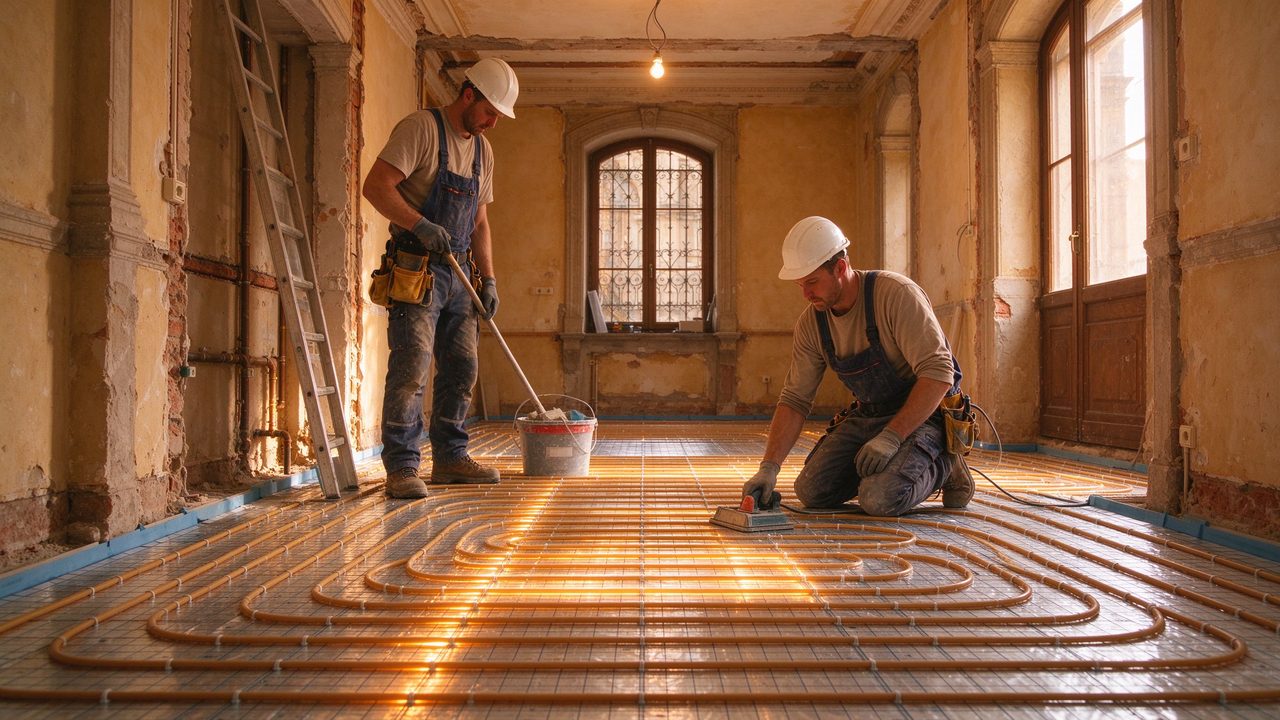
Electric radiant heating has two structural advantages in the EPBD world. The first is efficiency at the point of use: a well-insulated room heated by an area source can reach comfort at a lower set-point than a convective system, because radiant heat is delivered directly to people and surfaces. The second is electrification readiness: the system runs on electricity, so its carbon intensity follows the grid and any on-site PV. When a building adds solar capacity, an electric floor heating system can shift its schedule into solar hours without any hardware change — a capability that a boiler-based system does not have. That is why the combination of PV and EPBD underfloor heating requirements 2026 is being treated seriously in renovation planning: it is one of the few heating paths that improves its environmental profile every year the grid decarbonises.
None of this means electric heating is automatically compliant — it means it is compliant when the building envelope and the documentation are right. The energy class is calculated on the building, and a heating system only earns its place if the insulation, the control system and the metering are in order. A contractor advising a client should therefore treat the EPBD as a design constraint: heat-loss calculation, insulation upgrade where needed, zoned controls, and a documented system file. That is also exactly what an efficient floor heating installation looks like on the ground, so regulatory alignment and good engineering turn out to be the same work.

EPBD vs ErP: Two Rules, One System File
Buyers often mix up the EPBD and the ErP regulation, and the distinction matters for documentation. The ErP regulation is product-level: it sets eco-design requirements and energy labels for products such as space heaters, including the energy label for underfloor heating controls that we explained in a previous guide. The EPBD is building-level: it sets the performance class of the building itself. Both apply to the same installation, which means a compliant project carries two layers of evidence — the product labels for the heating element and controller, and the building’s energy certificate with the heating system documented in the calculation.
The practical rule for a buyer: ask for both layers. The thermostat and the heating elements should carry the relevant CE marks and energy-label documentation, and the installer should provide the heat-loss calculation and the system file that feeds the building’s EPC. A supplier that can produce the product layer but not support the building layer leaves the buyer doing the paperwork. Our own documentation pack covers the product layer — CE, RoHS, LVD and EMC — and our sales engineers routinely prepare the technical data that installers need for the building calculation (per SunAura factory records).
Heat Pump vs Electric Heating Under the EPBD: The Honest Comparison
The EPBD discussion inevitably raises the heat pump comparison, and the honest answer is that it depends on the building. A heat pump is extremely efficient in a low-temperature system, and we make the case for low-temperature compatibility elsewhere on this site — an underfloor heating system is the ideal emitter for a heat pump because it can run at low flow temperatures. Where a heat pump is not practical — small flats, listed buildings, rapid retrofits, sites with no outdoor space — direct electric heating with zoned controls and good insulation is a legitimate EPBD-compliant path, and in many national calculations the combination of a well-insulated envelope, PV and efficient electric heating achieves a better class than a poorly installed heat pump in an uninsulated shell.
The honest buyer’s test is the calculation, not the technology label. National EPC software does not care whether the emitter is a heat pump or a heating film; it cares about the delivered energy, the controls, and the primary energy factors applied to electricity in that member state. That is why the EU building renovation mandate electric heating conversation should always end in the same place: get the heat-loss number, choose the emitter that fits the building, and document everything. When a client asks whether electric floor heating is “allowed” in 2026, the answer is not a product list — it is a calculation and a system file.
Data and Evidence: What to Demand Before You Buy
For a heating system to be EPBD-ready, the evidence starts at the product level and ends at the building level. At the product level, demand the electrical safety documentation (CE, LVD, EMC), the material compliance (RoHS), and the rated electrical data: nominal wattage per square metre, nominal voltage, insulation resistance and the maximum floor surface temperature. At the building level, demand the heat-loss calculation, the control strategy (zones and schedules), and the documentation that the installer will hand to the EPC assessor. A manufacturer should be able to supply the first layer from a single document pack; our export team does this daily from our Huangdao, Qingdao plant, which has operated heating element manufacturing for 17 years under ISO 9001, 14001 and 45001 systems, exporting to more than 50 countries (per SunAura factory records).
One more document is worth demanding in 2026: the energy label for the control system. The ErP energy label for heating controls classifies the control package, and it is part of the product layer that an EPC assessor may reference. A thermostat with floor-probe control and scheduling is the minimum that keeps the label sensible; without a floor probe, the system cannot demonstrate accurate floor temperature control, which weakens both the label and the building calculation.
Frequently Asked Questions
Does the EPBD ban electric underfloor heating? No. The EPBD sets building-level energy requirements; it does not ban electric heating technologies. National implementation decides how each technology competes, and efficient, documented electric systems with good controls remain compliant.
Is electric floor heating allowed in new buildings under the EPBD? Yes, when the building design meets the national energy class. In practice this means a well-insulated envelope, zoned controls and, increasingly, PV-ready electrical design.
What documents do I need for EPBD compliance? The product layer — CE/RoHS/LVD/EMC, rated electrical data, energy label for controls — and the building layer — heat-loss calculation, control strategy and the installer system file that feeds the EPC.
How does the EPBD affect retrofit grants? National grant schemes increasingly require the building to reach a defined class after renovation, which makes the system file and the heat-loss calculation decisive. A documented, efficient electric floor heating system is eligible where the calculation supports it.
Can existing electric floor heating be upgraded for EPBD compliance? Usually yes: adding proper zoning, a floor-probe thermostat and documentation can materially improve the system’s contribution to the building class without replacing the floor.
Sourcing EPBD-Ready Heating Systems
If you are a distributor or installer building an EPBD-ready product range, the practical requirements are a supplier with full CE documentation, an electric underfloor heating supplier Europe can rely on, and the technical data needed for national EPC calculations. We supply heating film, mat and cable factory-direct, with complete certification packs, OEM branding and project support. For bulk programmes, we are a CE certified heating mat exporter with documented batch test records. Contact our Qingdao export team to request the certification pack and sample quote.
Renovation Passports and the Documentation Chain
The EPBD recast introduces renovation passports — building-level documents that set out a staged renovation roadmap for each building, moving it to a higher energy class over time. A renovation passport changes the buying decision: instead of a one-time purchase, the heating system becomes a step in a documented sequence. For electric underfloor heating this is a natural fit, because a zoned electric system can be installed in one stage and extended or combined with PV later without rework. The passport records the heat-loss calculation, the insulation state and the installed systems, and every future step references that record. A buyer who installs a heating system without feeding the paperwork into the building file is creating a gap that will surface at the next sale, grant application or compliance check.
The documentation chain has a practical shape. The product layer (CE/RoHS/LVD/EMC, rated data, energy label) is supplied by the manufacturer; the installation layer (heat-loss calculation, zone plan, commissioning record) is produced by the installer; and the building layer (EPC, renovation passport) is managed by the owner with the assessor. Each layer references the one below it, so a missing product certificate breaks the chain just as surely as a missing commissioning record. Suppliers who ship complete documentation packs are not being bureaucratic — they are protecting the buyer’s renovation passport. This is the standard our export team applies to every EU-bound order, and it is the reason the certification pack is included as a default, not an upsell (per SunAura factory records).
The timing question buyers ask most often is whether to wait. Waiting rarely helps: the EPBD trajectory only tightens, national grant schemes are tied to the building class, and a heating system installed today with complete documentation is already ahead of one installed hastily next year. The practical decision rule is to buy systems that are electrification-ready and documentation-complete, because both qualities remain valuable no matter how the national rules land. That is the approach we recommend to every EU distributor, and it is the approach this article has argued from the start: the EPBD is a building-level framework, and a well-documented electric floor heating system fits it without friction.
Related Products & OEM Inquiries
Looking for EPBD-ready underfloor heating or a factory-direct OEM/ODM partner? Explore our complete electric underfloor heating systems, then request a quote for your project — we supply distributors, installers and brands in 50+ countries.