
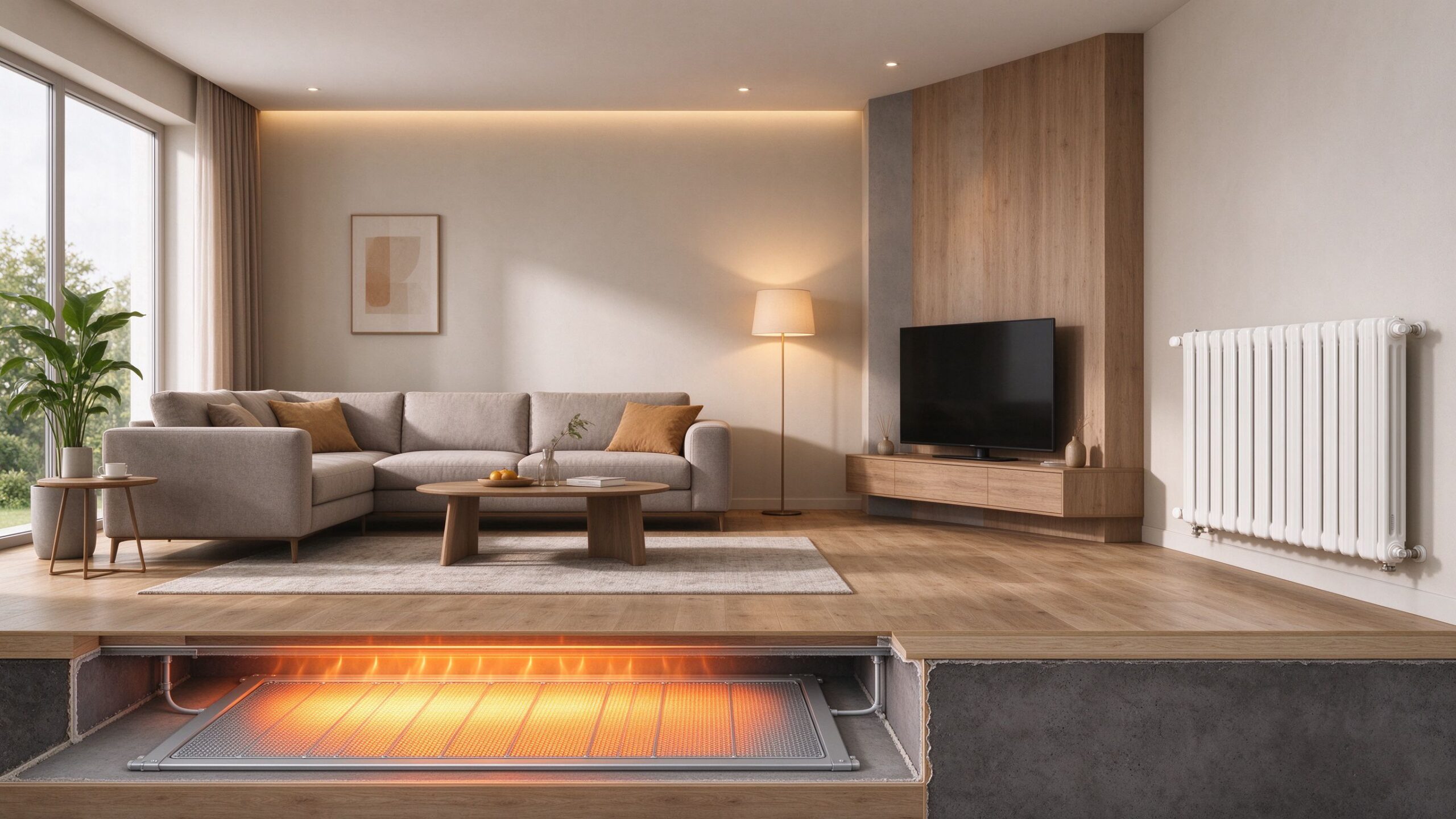
Two Ways to Heat a Room, Two Very Different Cost Curves
When a buyer compares underfloor heating vs radiators, the decision usually comes down to one question: what does each system actually cost over its life, and which one suits the building? Radiators are cheaper to buy and quick to install; electric underfloor heating is invisible, comfortable and increasingly popular in renovations and new builds across Europe. But the comparison is not only about comfort — it is about installation cost, running cost, floor build-up, control, and how each system behaves with modern heat sources and energy prices.
This article compares the two systems across the dimensions a buyer or contractor needs, gives a selection framework for different project types, and ends with a procurement checklist for anyone sourcing electric floor heating from a factory. Factory data below reflects SunAura Thermal production records in Qingdao, China, where the company has manufactured heating elements for 17 years (per SunAura factory records).

How Radiators Work — and Where They Are Still the Right Choice
A radiator heats a room by convection and a little radiation: hot water (or electric oil) warms the panel, the air next to it rises, and the room warms from the panel outward. The system is simple, well understood, and installers everywhere know how to size and fit it.
Practical consequences of radiators:
- Low installation cost — no floor build-up, no screed, no floor-level wiring or pipework; the unit is hung and connected.
- Fast heat-up — a radiator can take a cold room to comfort temperature in 20–40 minutes, which suits intermittent use.
- Easy retrofits — radiators work with existing boiler or electric systems and can be added room by room.
- Higher mean water temperature — hydronic radiators typically need 55–70 °C flow temperatures, which lowers heat-pump efficiency compared with a 30–35 °C floor circuit.
- Walls and floor space occupied — radiators take wall or floor space, and heat distribution is uneven near the unit.
Where radiators still win: tight budgets, quick retrofits, rooms used rarely, and buildings without the floor build-up allowance for underfloor systems.
How Electric Underfloor Heating Works — and Where It Wins
Electric underfloor heating turns the floor into a large low-temperature radiant panel: heating film, mat or cable sits below the finished floor, and warmth radiates evenly from the entire surface. Because the heat source is spread over the whole floor, the room feels warm at a lower air temperature than with radiators.
Practical consequences of underfloor heating:
- Even, comfortable warmth — no cold spots, no hot air near the panel; the floor itself is warm underfoot.
- Free wall and floor space — nothing visible; furniture and curtains can stand anywhere.
- Compatible with low-temperature heat pumps — a floor circuit runs at 30–35 °C, which lets a heat pump work in its most efficient range.
- Slower response — the floor mass takes time to heat and cool, so it suits continuous or scheduled use rather than quick bursts.
- Floor build-up needed — film and mat add little height (0.5–2 mm for film), but screed-embedded cable adds more; plan the floor build-up accordingly.
Where underfloor heating wins: new builds, full renovations, bathrooms and kitchens where radiators are awkward, and any project aiming for low-temperature heat-pump compatibility.

Underfloor Heating vs Radiators: Comparison Table
| Dimension | Electric underfloor heating | Radiators |
|---|---|---|
| Installation cost (materials + labour) | Higher (floor build-up, electrical work) | Lower (simple hanging + connection) |
| Heat-up time | 30–90 min to comfort from cold | 20–40 min |
| Comfort profile | Even radiant warmth, warm floor | Convection, warmer near the unit |
| Space occupied | None visible (in the floor) | Wall/floor space, pipes or conduit |
| Heat-pump compatibility | Excellent (30–35 °C circuit) | Lower efficiency (55–70 °C needed) |
| Response to intermittent use | Slower | Faster |
| Best project fit | New builds, renovations, wet rooms, HP systems | Budget retrofits, rarely-used rooms, quick fixes |
For buyers comparing systems, the honest summary is: radiators are cheaper to install and faster to respond; underfloor heating is more comfortable, invisible, and the right partner for heat pumps. The decision is a project decision, not a product popularity contest.
Selection Framework: Which System for Which Project
Use these patterns when planning a project:
- New build with a heat pump → underfloor heating, electric or hydronic, sized for low water temperature; radiators would force the heat pump to run at higher temperatures and lose efficiency.
- Bathroom or kitchen renovation → electric underfloor heating (film or mat); a radiator in a bathroom is awkward, and the warm floor dries the room faster.
- Full house renovation with existing radiators and a gas boiler → keep radiators in rarely-used rooms, add electric floor heating in bathrooms and the kitchen; hybrid layouts are common and practical.
- Budget retrofit of a single cold room → a radiator or an electric panel heater is the lowest-cost fix; upgrade to floor heating when the floor is being redone anyway.
- Off-peak electric tariff available → electric underfloor heating with scheduled control can exploit night rates; see our off-peak electric underfloor heating guide for the cost math.
If you are sourcing electric floor heating for a renovation programme, the product family (film, mat or cable) matters as much as the system choice — our electric vs hydronic underfloor heating comparison covers the next level of the decision.
Data & Evidence: What the Factory Verifies
When electric floor heating replaces radiators, the buyer relies on the product’s stated wattage and durability. Our factory verifies the following on every production run (per SunAura factory records):
- Resistance and wattage verification — finished film, mat and cable are resistance-tested so the installed wattage matches the specification within tolerance.
- Dielectric and insulation testing — every production batch passes high-voltage and insulation-resistance tests with logged results.
- Thermal uniformity checks — heating film and mat are sampled and checked with thermal imaging for even heat distribution.
- Compliance — production runs under ISO 9001, ISO 14001 and ISO 45001 management systems; products are CE marked and assessed for RoHS, LVD and EMC where applicable, with certificates and batch reports provided on request.
We do not list certificate numbers here — verify the documents against your specific order.
Procurement Checklist for Electric Floor Heating
If your project is moving toward electric underfloor heating, send suppliers this checklist:
- Room-by-room area and floor type — square metres per zone, tile/laminate/vinyl/screed, and any insulation under the floor.
- Wattage requirement — W/m² target per room; reference the wattage calculation guide if unsure.
- System voltage — 120V, 240V or low-voltage DC where applicable; confirm the site supply with an electrician.
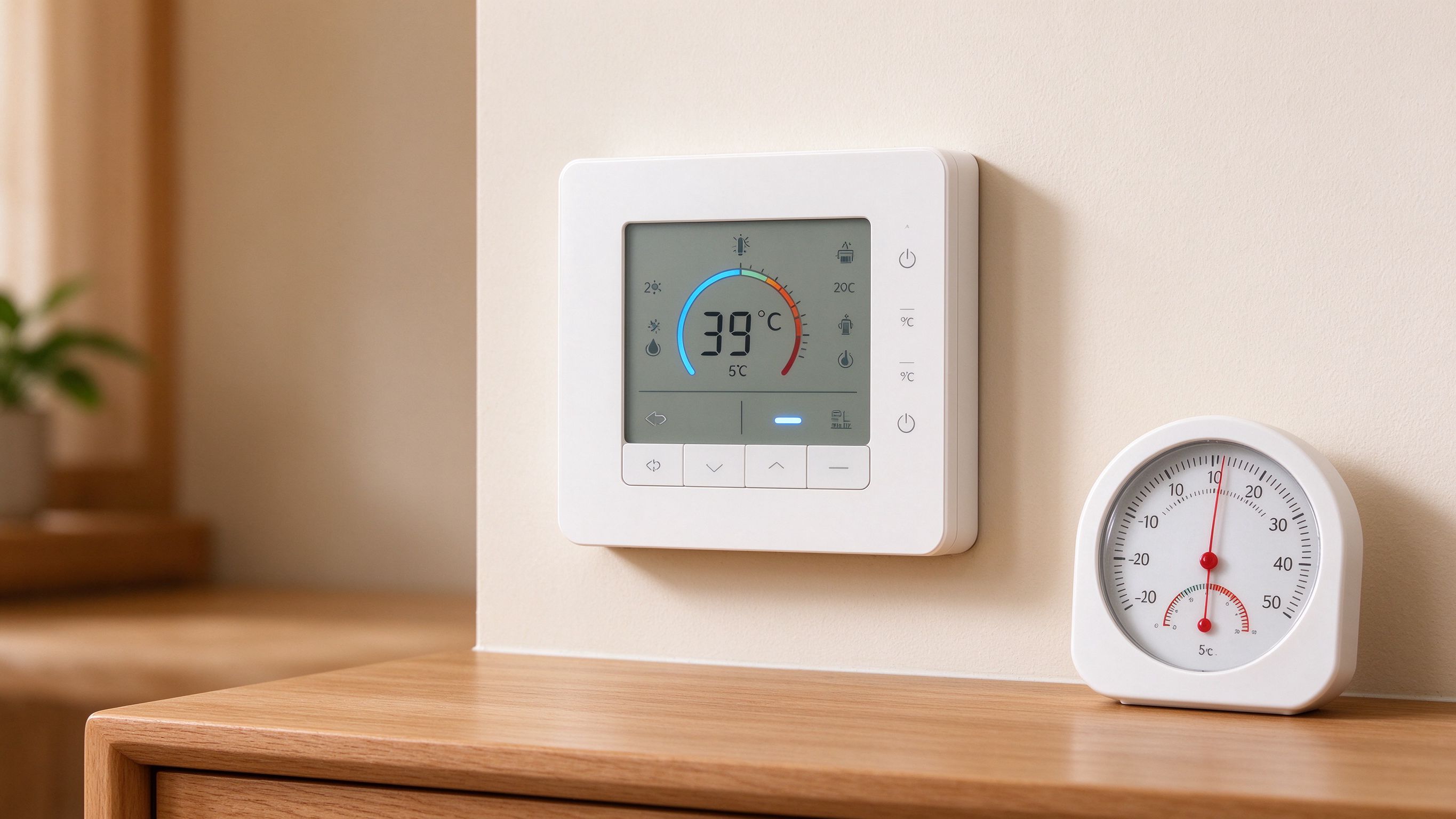
- Control strategy — thermostats per zone, floor probe or air probe, WiFi or touchscreen; see our floor heating thermostat range.
- Product family — film, mat or cable; describe the floor build-up and renovation constraints and the supplier will confirm the best fit.
- Installation responsibility — DIY or contractor; some products (film and mat) suit DIY far better than screed cable.
- Certification and documentation — CE/RoHS documents, batch reports, MOQ, sample policy, and lead time.
SunAura Thermal supplies heating film, mat and cable to distributors and installers across Europe and North America, with factory-direct pricing for bulk programmes. For projects replacing radiator systems, our engineers will confirm wattage, layout and control before production.
Running Cost: A Worked Example
Numbers make the running-cost comparison concrete. Take a 20 m² living room with 120 W/m² installed — 2400 W total. With electric heating, both a radiator and underfloor heating convert nearly all input to heat, so the comparison is about heat demand, not appliance efficiency.
- Radiator, intermittent use: the room is heated for 6 hours a day at full load on cold days, roughly 14.4 kWh/day, because the radiator stops heating when the room reaches temperature and the heat is lost faster after switching off.
- Underfloor heating, continuous control: the floor runs at lower mean power because the thermostat holds a steady temperature — typically 40–60% of rated load averaged over a cold day, or roughly 9.6–14.4 kWh/day for the same comfort, with the floor’s thermal mass holding warmth between cycles.
- With zoning: multi-zone control (see our multi-zone thermostat guide) holds empty rooms at setback, which trims demand further.
The honest conclusion: in a well-insulated building, both systems land in a similar running-cost band; the underfloor system’s advantage appears in comfort, in heat-pump compatibility, and in zoning flexibility, while radiators win on first cost and response speed. For a full cost model with your local tariff, the wattage calculation guide gives the input numbers.
Installation and Build-Up Differences
The physical differences matter for renovation planning:
- Radiators need wall space, pipe or conduit runs, and clearance for airflow; installation is fast and can happen any time.
- Heating film and mat are laid before the finished floor: film adds 0.3–0.5 mm under a floating floor, mat adds 3–5 mm in tile adhesive, and cable is embedded in screed with a greater build-up. The floor work must be scheduled with the heating layout.
- Electrical work for electric floor heating needs a dedicated circuit per zone in most installations, with RCD/GFCI protection in wet areas — plan the panel capacity early.
- Renovation sequencing is the deciding factor in many projects: if the floor is being redone anyway, underfloor heating costs little extra; if the floor stays, a radiator or panel heater is the pragmatic choice.
Insulation and Building Fabric: The Shared Variable
Both radiators and underfloor heating are only as good as the building they heat. The single biggest variable in the comparison is insulation, not the heat emitter:
- Floor insulation decides floor-heating economics. Electric underfloor heating works best when heat loss through the floor is controlled — insulation under the element (or under the screed) keeps warmth in the room. In an old house with an uninsulated concrete slab, much of the heat goes into the ground, and no emitter choice fixes that.
- Wall and window insulation decides radiator economics. A radiator in a draughty room loses its heat quickly after switching off, which pushes users to run it longer. Draft-proofing and loft insulation improve both systems equally.
- Retrofit sequencing. The best order for most projects is: insulate the building fabric first, then choose the emitter. Buyers who do the opposite end up paying for heating that escapes through the structure.
This is why renovation programmes pair underfloor heating with insulation upgrades — the two investments multiply each other’s effect. For buyers sourcing electric floor heating as part of such a programme, specify the floor’s U-value with the wattage calculation so the system is sized against real heat loss, not a rule of thumb.
FAQ
Is underfloor heating more expensive to run than radiators? For the same heat output and insulation level, electric underfloor heating and electric radiators cost about the same per kWh — both convert nearly all input to heat. The real differences are installation cost, comfort, and how well each works with heat pumps or off-peak tariffs.
Can I install electric floor heating under an existing floor? Yes — heating film and ultra-thin mats can be installed as dry-lay under laminate or vinyl with minimal height gain, and cable or mat can go into a bonded overlay on existing screed. This is why underfloor heating has become a renovation default.
Do I need to remove my radiators? No — many projects keep radiators in some rooms and add floor heating in others. A hybrid layout lets you modernise the rooms that matter while keeping the budget in check.
Is electric underfloor heating suitable as a primary heat source? Yes, when the floor is well insulated and the wattage is designed for the heat loss — typically 100–150 W/m² for primary heating in a well-insulated room, and 60–100 W/m² for comfort warming. The wattage calculation guide walks through the numbers.
Next Step: Define the Project, Then Source the System
Underfloor heating vs radiators is not a one-size answer — it is a project answer. Define the building, the heating source, the floor build-up and the budget, and the right system becomes obvious. When the answer is electric floor heating, send the checklist above to our export team for a factory-direct quotation.
Contact us at [email protected] for bulk pricing and samples.
About the author: Ethan Sun, Founder & CEO, SunAura Thermal. SunAura has manufactured electric heating film, mat and cable in Qingdao, China, for 17 years, supplying CE/RoHS-compliant heating products to more than 50 countries.