
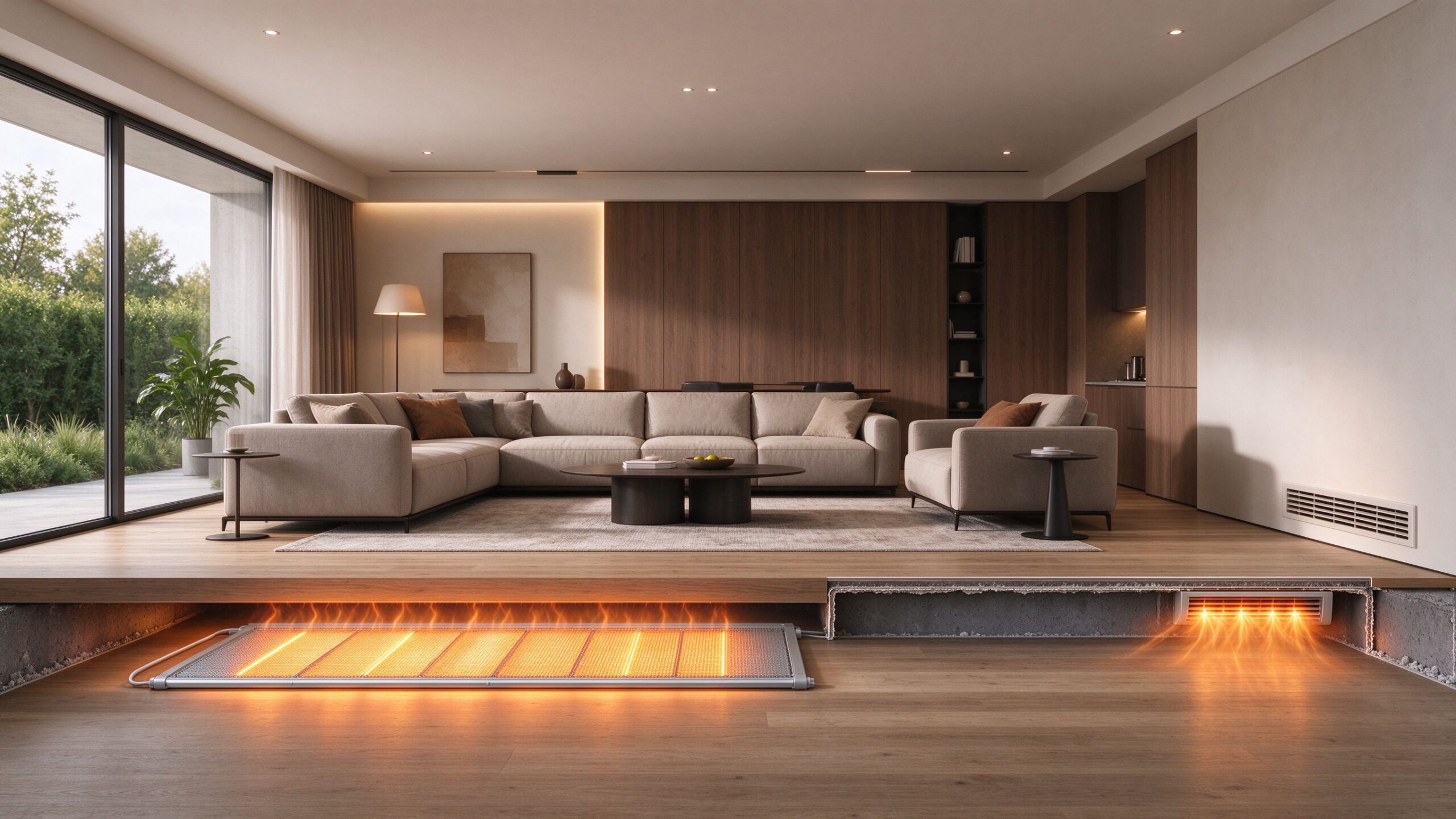
For a North American homeowner or a builder comparing heating systems, the oldest and most familiar option is forced air — a furnace or heat pump pushing warm air through ducts. The challenger is radiant floor heating, and the question “electric floor heating vs forced air” now shows up in almost every renovation brief. The two systems work in completely different ways, cost differently to run, and fit different houses. This guide compares them on the dimensions that matter — comfort, efficiency, running cost, zoning, installation and long-term maintenance — and tells you which one belongs in which project, using factory-level data from SunAura Thermal for the electric floor heating side.
How Forced Air Heating Works
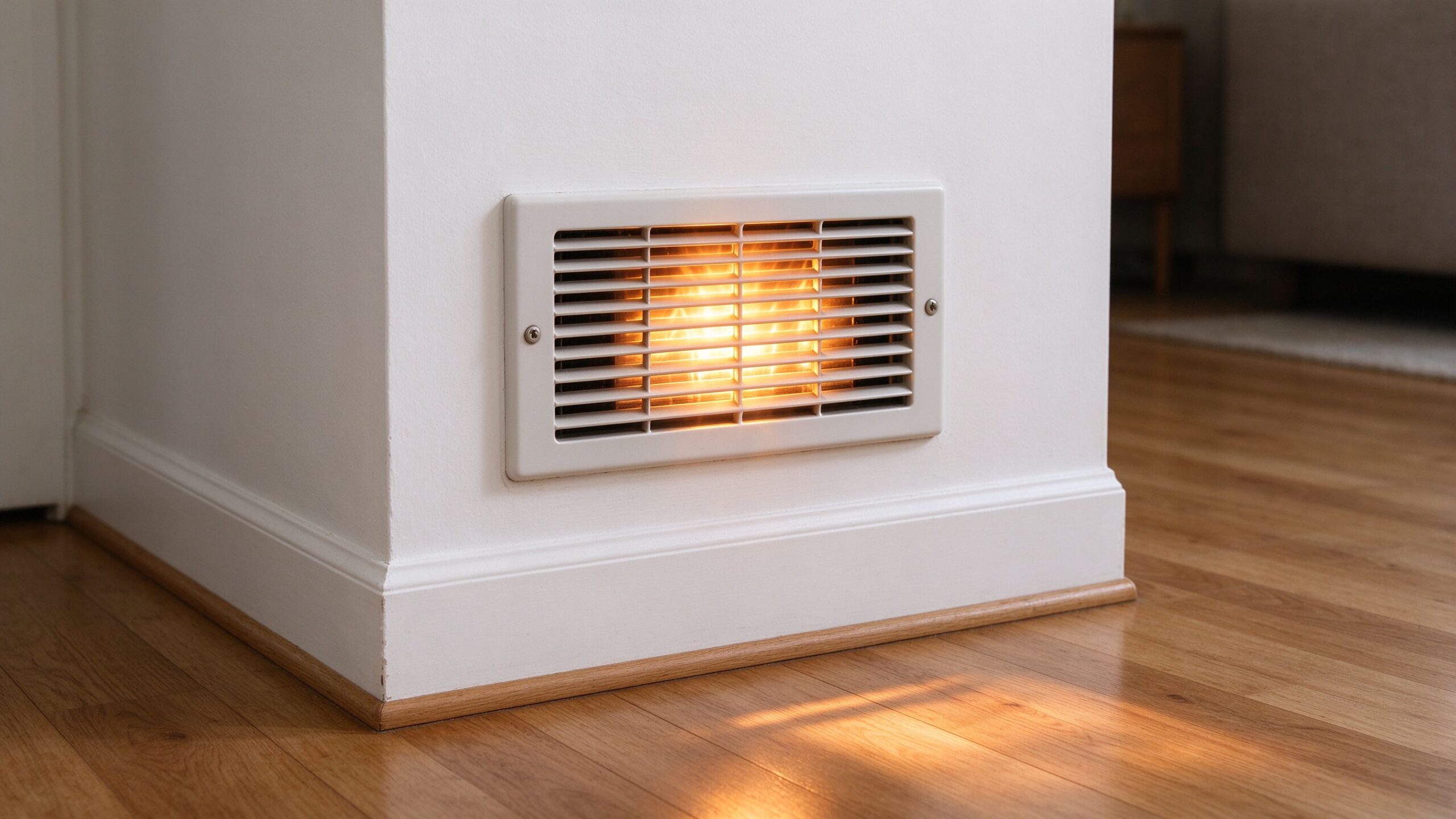
A forced air system heats the whole house from a central unit. A furnace burns gas or a heat pump moves heat, and a blower pushes warmed air through ductwork to registers in each room. The thermostat switches the system on when room air cools below the set point, and the blower circulates air until the temperature recovers.
The strengths are well known: it is the cheapest system to install in a house that already has ducts, it responds quickly because the air is the medium, and the same ducts can deliver cooling in summer. The weaknesses are equally well documented. Air is a poor thermal conductor, so the system needs a high air temperature (21–23°C) to make occupants comfortable. It circulates dust, pollen and dry air. Rooms far from the blower run warmer or colder depending on duct balance. And because the thermostat reads air temperature, the system cycles on a short hysteresis, so rooms overshoot and undershoot around the set point all day.
How Electric Underfloor Heating Works
Electric underfloor heating turns the floor itself into the radiator. A heating element — graphene heating film, a heating mat or a twin-conductor cable — is laid under the finish, and a thermostat controls it through a floor sensor. The floor surface warms to roughly 24–29°C, and the heat transfers to the room by radiation and natural convection.
Radiant heat behaves differently from convective heat. The occupant is warmed directly, so the air temperature can be set 2–3°C lower for the same perceived comfort. Because the floor is a large low-temperature emitter, the temperature distribution is even — no cold spots by windows and no hot air at the ceiling. And because there is no blower, there is no dust circulation and no forced-air noise. The same floor-sensor logic described in our thermostat guides means the system switches on the element only as long as the floor needs it, avoiding the hunting cycles of air-temperature control.
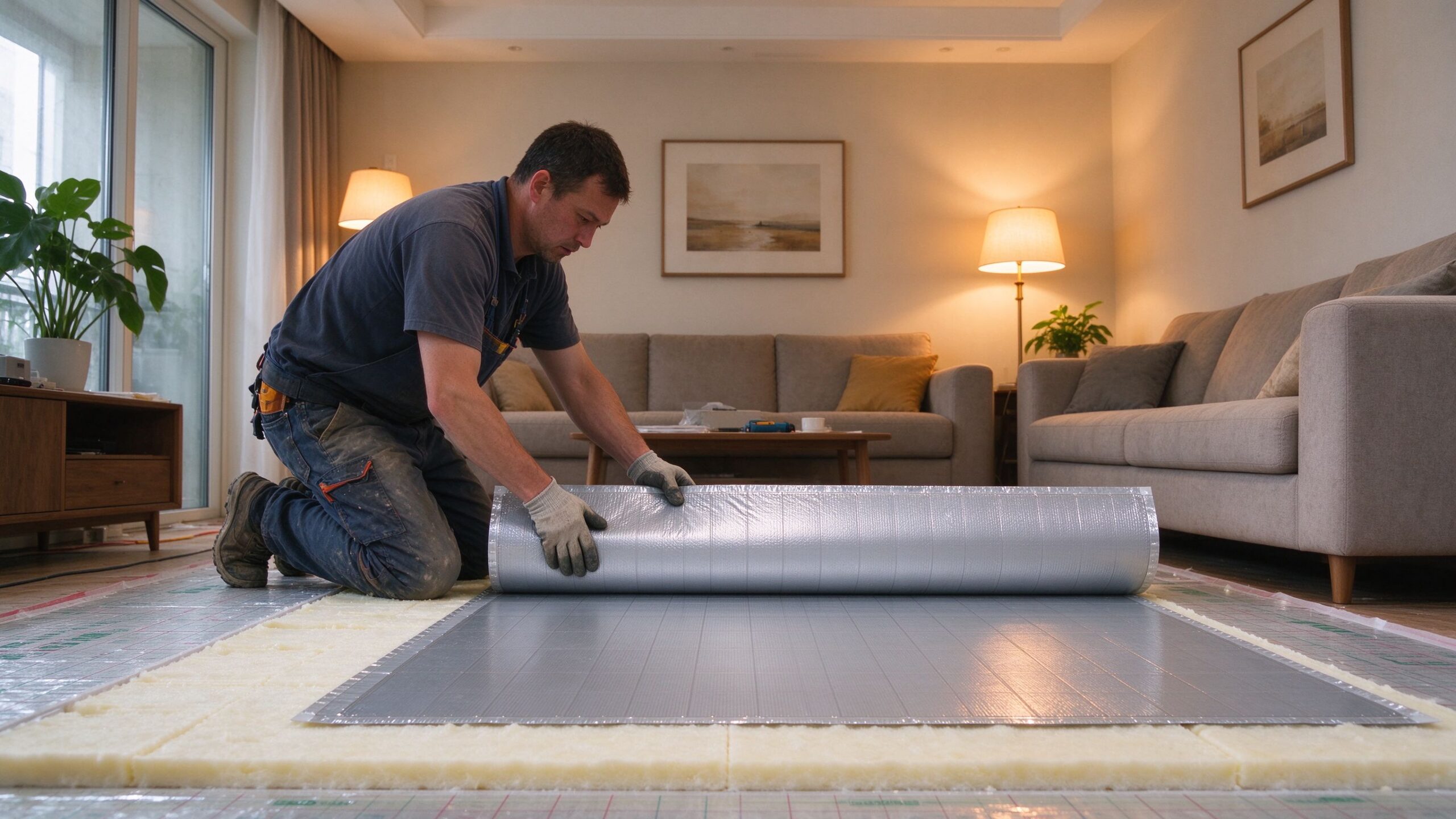
Electric underfloor heating is most efficient when the floor has insulation below it and the thermostat is set correctly. It is a system that rewards planning: the build-up matters, the insulation matters, and the sensor position matters. None of that is difficult, but it is unfamiliar to trades used to dropping ducts into a crawl space.
Electric Floor Heating vs Forced Air: Side-by-Side Comparison
The comparison below covers the decision dimensions for a typical single-family retrofit or new build. Running-cost figures are indicative for a well-insulated 30 m² living area with 150 W/m² heating film at 8 hours of operation per day during the heating season, based on SunAura factory test data and common North American electricity rates (per SunAura factory records; actual costs depend on local tariffs and insulation).
| Dimension | Electric underfloor heating | Forced air (gas furnace / heat pump) |
|---|---|---|
| Heat medium | Floor surface radiation, 24–29°C | Warm air through ducts, 35–55°C at register |
| Perceived comfort | Even, no cold spots, warm feet | Air temperature swings, cooler near floors |
| Air quality | No dust circulation, no noise | Circulates dust, pollen; can be dry |
| Zoning | Per-room thermostat, independent | Zones need dampers and extra controls |
| Installation | Under finish; needs floor build-up access | Needs ductwork; best if already present |
| Retrofit suitability | Good in rooms being re-floored | Expensive if ducts absent |
| Cooling in summer | No | Yes, with AC |
| Response time | Slower (thermal mass), steadier | Fast air response |
| Running cost profile | Depends on tariff; strong off-peak pairing | Depends on gas/electricity price |
| Maintenance | Nearly none once installed | Filter changes, duct cleaning, blower service |
| Whole-house coverage | Better per-room; can do full house | Natural full-house system |
Running Cost: Where the Numbers Actually Land
Running cost is the most quoted and most misquoted comparison. Three variables dominate: insulation quality, operating hours and the electricity tariff. In a well-insulated home, a 30 m² living zone with 150 W/m² film draws about 4.5 kW at full output. At 8 hours of effective operation per day over a 120-day season, that is roughly 4,320 kWh per season. At US$0.16/kWh, that is about US$690 per season for that zone — before any off-peak discount.
Two adjustments change the picture. First, a floor sensor and correct programming cut effective run time; our field data shows well-controlled systems run at 60–75% of the nominal figure, not 100%. Second, on an off-peak or time-of-use tariff, the same zone can drop materially, which is why we publish dedicated guidance on off-peak electric underfloor heating. Against a gas furnace, electricity is usually more expensive per unit of heat — but the comparison is only fair when the house is insulated, the floor is properly controlled, and no duct losses are counted against the furnace.
For a heat pump, the calculus is different: a heat pump at COP 3–4 running warm air is genuinely cheap to run, and pairing a heat pump with underfloor heating is a strong combination. Our industry-insights article on electric vs hydronic underfloor heating covers that hybrid case in detail. The honest summary is: electric underfloor heating wins on comfort, zoning and retrofit simplicity; forced air wins where ducts already exist and where cooling is required.
Zoning and Control: Where Radiant Floors Change the House
Zoning is where the two systems diverge most in practice. A forced air system divides a house into a handful of zones, each needing dampers, zone controllers and extra wiring, and even then the ducts share air between rooms. Electric underfloor heating is zoned per room by definition: each room has its own thermostat, its own floor sensor and its own heating loop, so an unused bedroom stays cold while the living room runs. This granularity changes how a family actually uses a house. Occupants heat the rooms they occupy, cut waste in rooms they do not, and the thermostat schedule follows the daily routine instead of a whole-house temperature.
Smart controls extend the difference. A WiFi thermostat such as the SunAura K2M or K9 gives per-room scheduling, floor-sensor limits and app control, so the system adapts to occupancy rather than running on a fixed cycle. None of this is possible with a single forced-air thermostat short of a full duct damper retrofit. For families that live in a few rooms most of the day, per-room electric zoning is frequently the larger real-world saving — often larger than the headline efficiency difference between electricity and gas.
Which Project Should Choose Which System
New builds with full HVAC: forced air or heat pump, with floor heating in key zones
If you need cooling anyway, you need ducts or a mini-split. In that case, put forced air (ideally a heat pump) in the ducted zones and add electric underfloor heating in bathrooms, kitchen, entry and the primary living area where the comfort gain is highest. This hybrid is what most of our North American distributor projects end up doing.
Retrofits where floors are being replaced: electric underfloor heating
When the floor is coming up anyway — tile, laminate, engineered timber — the marginal cost of heating film or mat is small, and you gain a heated zone with no ducts. This is the strongest case for electric underfloor heating, and it is why renovation fit-outs are the fastest-growing segment in the non-residential market.
Open-plan living areas with high ceilings: underfloor heating for the occupied layer
Forced air warms the ceiling first; radiant floors warm the occupants. In a double-height living room, floor heating keeps the occupied zone comfortable without overheating the upper air, which is an efficiency win that does not show up in a simple kWh comparison.
Basements, garages and workshops: floor heating for cold slab problems
A slab that never warms makes the whole room feel cold even with a furnace blowing. Electric floor heating under tile or over concrete in basements, workshops and garages fixes the “cold feet on concrete” problem that forced air cannot.
Common Misconceptions
Three myths come up in almost every North American enquiry. First, “electric floor heating is always more expensive to run” — true only on flat tariffs with poor control; with a floor sensor, good insulation and off-peak rates the gap narrows sharply. Second, “you cannot have floor heating under hardwood” — engineered timber with a published surface limit is fine when the system uses a floor sensor and the manufacturer’s maximum temperature is respected. Third, “radiant floors make the room stuffy” — the opposite: with no blower, there is no forced circulation, and occupants control the temperature directly. None of these are marketing points; they are the operating physics of low-temperature radiant systems.
Data and Evidence: Factory Records and Field Results
SunAura Thermal has manufactured electric heating elements since 2008 and exports to more than 50 countries from its Qingdao Huangdao plant (per SunAura factory records). On the efficiency side, our test data for graphene heating film show a uniform surface temperature within ±2°C across the element under lab conditions, which translates into even floor warmth and fewer hot/cold patches than convective systems produce. On the certification side, the product line carries CE, RoHS, LVD and EMC compliance, and the factory operates under ISO 9001, ISO 14001 and ISO 45001 management systems. These records matter because the comfort comparison in this article depends on the floor being a controlled, certified emitter — not an uncontrolled space heater.
Buying Checklist: Questions for Your Supplier
- Insulation spec — what R-value does the supplier recommend below the element, and does the wattage quote assume it?
- Thermostat and sensor included? — confirm the controller model, the floor sensor and the programming capability before comparing prices.
- Wattage per square metre — 120–150 W/m² is typical for living areas; confirm the quote matches your build-up and climate.
- Certification files — CE, RoHS, LVD and EMC declarations should accompany the order (SunAura ships these with every export order).
- Sample policy — order a film or mat sample and a thermostat with your first enquiry to bench-test heat-up behaviour.
- Lead time and packaging — get the production lead time and packaging method in writing for your project schedule.
- After-sales — installation drawings, commissioning support and spare-part availability for sensors and thermostats.
FAQ
Can electric underfloor heating replace forced air completely?
In a well-insulated home without cooling needs, yes — many European projects heat the entire house electrically. In North America, most buyers keep a heat pump or AC for summer and add floor heating to key zones, which is usually the best total-cost solution.
Is a heat pump with underfloor heating better than gas forced air?
For running cost, usually yes on efficiency; for retrofit cost, it depends on whether ducts and a heat pump already exist. See the electric vs hydronic comparison for the full picture.
Does floor heating raise the floor height?
Dry-lay film adds as little as 2–3 mm plus underlay; mats and cable in adhesive or screed add only the adhesive/screed thickness. This is why retrofit projects favour film under floating floors.
What about cooling in summer with a floor system?
Electric underfloor heating does not cool. If summer cooling is essential, plan a ducted or mini-split system alongside it. The two systems do not conflict.
Specify and Order
When you are ready to compare real quotes, review the graphene heating film and electric heating mat product pages for the element options, and the wattage calculation guide to size your zone correctly. For the hybrid case, read electric vs hydronic underfloor heating, and for tariff strategy the off-peak electric underfloor heating guide.
SunAura Thermal, a heating element factory in Qingdao since 2008, supplies heating film, mat and cable plus smart thermostats to distributors in more than 50 countries. For factory-direct pricing and a project quote, contact Ethan Sun, Founder & CEO, SunAura Thermal, at [email protected] or use the enquiry form on the product page — include your floor build-up, insulation R-value and electricity tariff, and the engineering team will respond with a sized proposal.