
What Is Far-Infrared Heating Film?
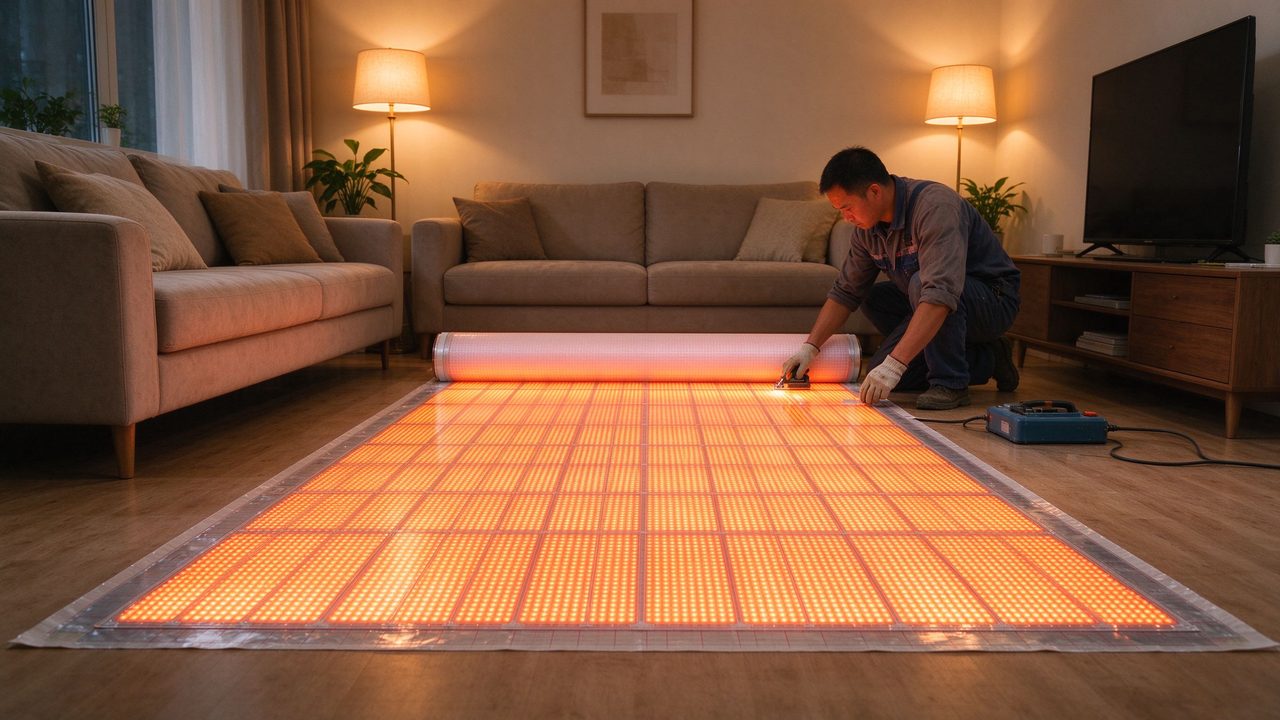
Far-infrared heating film is an electric heating element that produces warmth primarily as long-wave infrared radiation, typically in the 5–20 µm range, rather than by heating the air first. A thin conductive layer, usually printed carbon or graphene-based, is laminated between polyester films, and when current passes through it the layer radiates heat that is absorbed directly by floors, walls and people. This is the same wavelength band in which the human body naturally radiates heat, which is why the warmth feels even and immediate. For underfloor use the film is laid flat under the finished floor covering, connected to a thermostat with a floor sensor, and switched on zone by zone. It is one of the thinnest practical heating elements on the market, often under 1 mm thick, which makes it a natural choice for retrofit projects where every centimetre of build-up height matters.
Far-infrared heating film for underfloor installation is not a niche laboratory idea — it is a production product with standardised widths, wattages and connection systems, supplied in rolls that installers cut to room dimensions. Because the emitting layer is printed, the heat output is inherently uniform across the surface, which answers the most common complaint about electric floor heating: patches of cold or hot floor. The uniformity is a function of the manufacturing process, not of installation luck, and that is an important distinction for anyone comparing heating film with other electric elements. This article explains how the technology works, where it performs best, how to evaluate it against carbon film and cable alternatives, and what factory evidence a buyer should ask for.
How Far-Infrared Radiation Heats a Room Differently
The physics matters because it changes the feel of the room and the energy bill. Convective heating — radiators, forced air — warms the air, and the air then warms you. Radiant heating transfers energy directly to surfaces and people, so the air temperature can be set lower while comfort stays the same. The U.S. Department of Energy describes radiant heating as delivering heat directly to the floor and the people in the room, which is why radiant systems are often paired with slightly lower thermostat set-points than forced-air systems without a loss of comfort. Far-infrared film performs in exactly this category, with the additional characteristic that its long-wave output is well absorbed by dense materials such as concrete, ceramic tile and stone.
Two practical consequences follow. First, the floor itself becomes a warm surface: standing on a heated floor with bare feet is comfortable at air temperatures where a cold floor would feel draughty. Second, the heat is delivered where people actually are, so a far-infrared film system responds faster to occupancy changes than a high-mass system and wastes less energy heating empty space above head height. For a home occupied for set periods — morning and evening — this responsiveness converts directly into a lower running cost profile, because the system can be scheduled tightly around the occupied hours. The combination of thin construction, even surface temperature and radiant delivery is why far-infrared heating film has become a mainstream option in renovation markets.
Far-Infrared Heating Film vs Carbon Film and Heating Cable
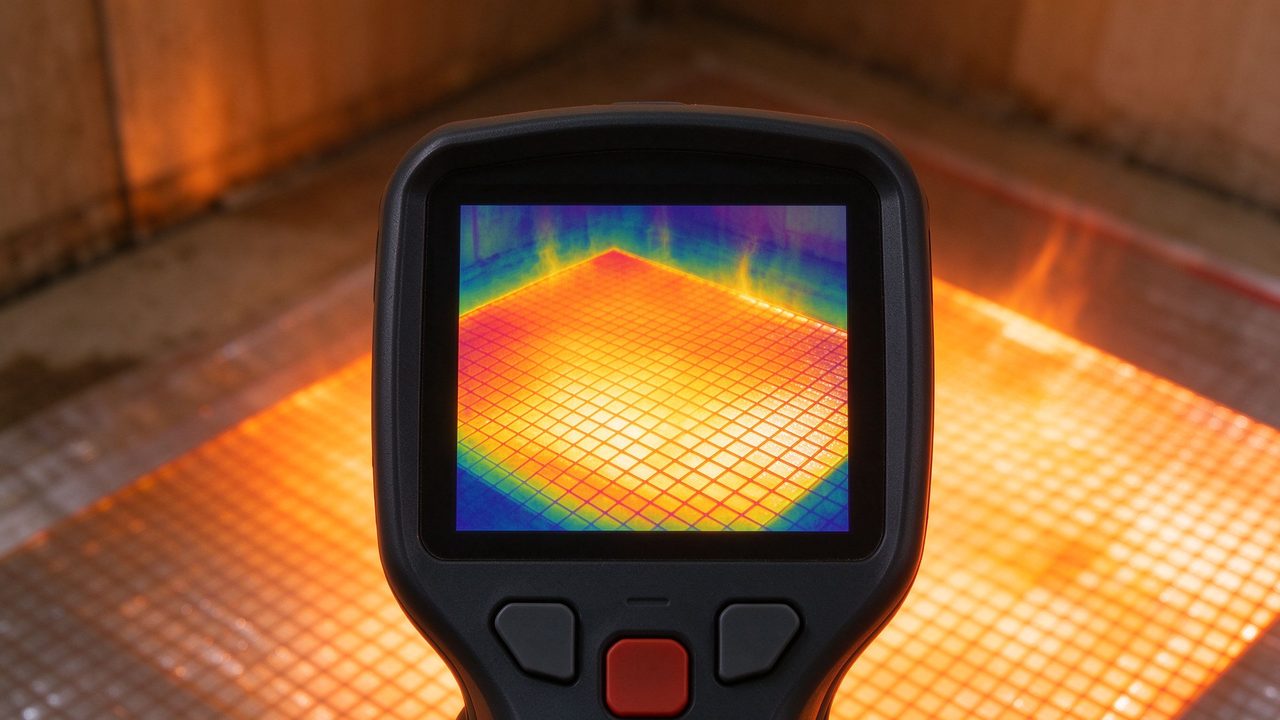
The comparison a buyer actually faces is between far-infrared film, standard carbon film, heating mats and heating cable. Far-infrared film and carbon film are both printed-conductor films; the difference is mostly in the emitter formulation and the resulting radiation spectrum, and in practice the terms overlap in the market. What separates film from cable is more structural. Heating cable is a line source — it produces heat along a wire — so the floor surface temperature has a measurable ripple: warm directly above the cable, cooler between runs. Heating mat and film are area sources; the heat is spread over the whole surface, which gives a more even floor temperature and typically allows lower maximum surface temperatures for the same comfort.
Evenness is not just a comfort issue; it affects the floor covering. A highly uneven surface temperature can stress adhesives and create visible lines on vinyl or laminate over time, which is why flooring manufacturers publish maximum temperature limits. An area source such as far-infrared heating film for underfloor installation keeps the surface closer to one uniform temperature, which makes it easier to stay inside flooring warranties. The trade-off is that film is a fixed-size element — you cannot cut it through the conductor — so room layouts must be planned with full strips or parallel runs, exactly like a heating mat. Cable, by contrast, can be cut to length, which suits irregular rooms. The practical rule: film and mat for regular open areas, cable for complex geometry.
Where Far-Infrared Heating Film Performs Best
Far-infrared film earns its keep in four scenarios. The first is the low-profile retrofit: an existing room with a finished floor that cannot be lifted much. Because the film is under 1 mm and can be dry-laid between an underlay and a floating floor, it converts a room to electric heating with a build-up of a few millimetres. The second is zonal heating: film is supplied in strips that are wired per zone, so a living area, a study and a hallway can each run on their own schedule — heat only the rooms in use. The third is rooms with dense floor finishes such as tile or stone, where the radiant absorption is excellent and the thermal mass of the finish smooths the output. The fourth is sensitive flooring: because the surface temperature can be held low and even, film is one of the safer choices under engineered wood and vinyl in renovation work.
A low-EMF heating film design matters to a growing number of residential buyers. In a properly designed film, the current path is arranged so the electromagnetic field largely cancels between adjacent conductors, keeping the field close to background levels at normal distances. Buyers with sensitive requirements should ask the supplier for a measured EMF specification, and the factory record should be able to show it. This is a real, verifiable product property — not a marketing slogan — and it is one of the reasons far-infrared film is specified for bedrooms and children’s rooms more often than cable.
Installation Rules That Decide Long-Term Performance
Installation discipline is what separates a warm floor from a floor that fails in year three. The element area must be planned so no film strip crosses under a permanent partition — expansion and floor movement are expected, and a film crossing a wall line can be stressed. The cold lead must be routed to the connection point with a proper strain-relief, and the floor sensor must be fixed in the heated zone between two film strips, never under a film strip, because the sensor measures floor temperature and a sensor sitting directly on an emitter reads too hot and short-cycles the system. Insulation under the film is not optional: an uninsulated concrete slab can draw more heat downward than the room receives, so a suitable insulating board should sit between the film and the subfloor in most builds.
The electrical side follows the same rules as any electric floor heating: a dedicated circuit, a residual current device, and a thermostat rated for the connected load, with the floor probe as the primary temperature control. For floating floors, the manufacturer’s maximum surface temperature must be respected, and the flooring must be acclimatised before installation. These are standard, documented steps, and every one of them is in the installation guidance that ships with our film range. When installers follow the sequence, the failure modes that dominate warranty claims — sensor misplacement, uninsulated slabs and crossed partition lines — simply do not appear.
Data and Evidence: What the Factory Can Document
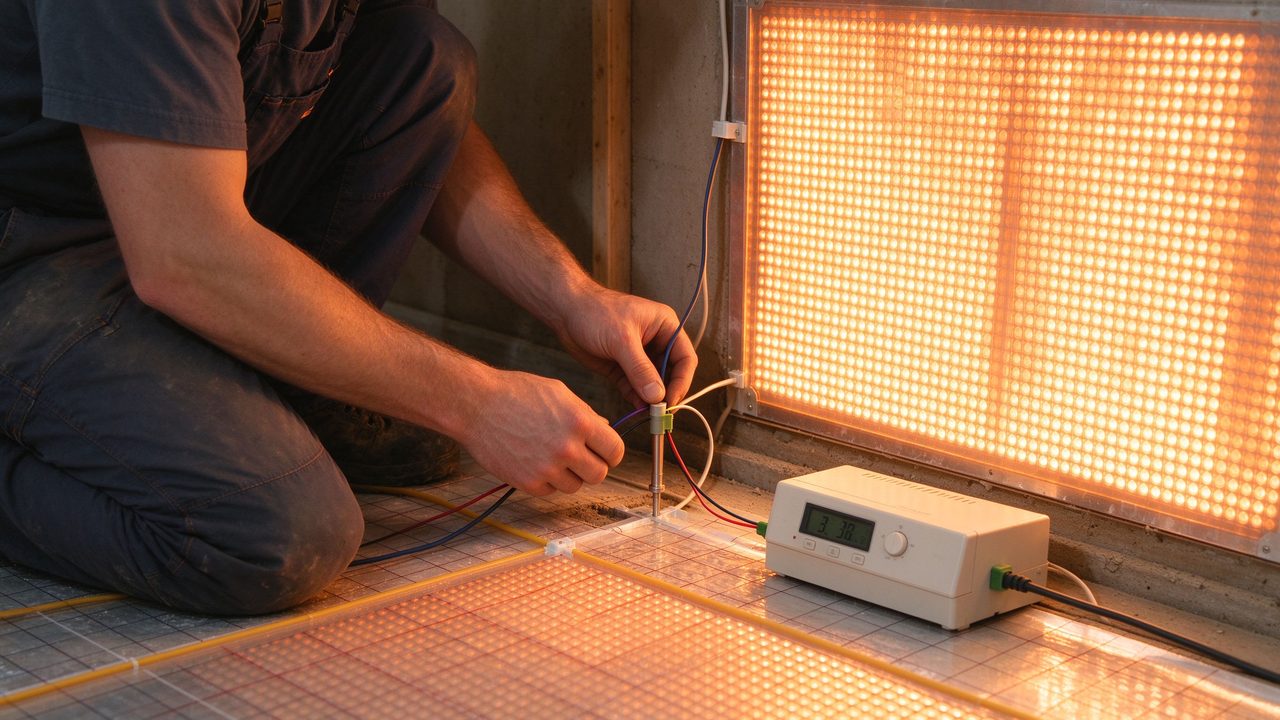
Seventeen years of continuous heating-element manufacturing at our Huangdao plant in Qingdao, China, sit behind the film range, and the factory operates under ISO 9001, ISO 14001 and ISO 45001 management systems with CE, RoHS, LVD and EMC certification on the product line, exporting to more than 50 countries (per SunAura factory records). The film’s key documented properties are the rated wattage per square metre, the surface temperature at rated voltage, the insulation resistance after manufacture, the dielectric withstand, and the measured EMF at a defined distance. A serious buyer asks for these numbers in writing, not for a catalogue photograph, because they are the numbers that appear again in the installation manual, the warranty and the insurance file.
The evidence also includes the test protocol: every roll is tested for continuity and insulation before it is packed, and sample rolls are run through thermal imaging to confirm the surface temperature profile. That is the difference between a heating film factory and a film laminator — the first documents what it ships, the second only ships. When you compare flexible heating film wholesale offers, the price difference between suppliers is often exactly the difference between a documented test protocol and a promise.
Frequently Asked Questions
Can far-infrared heating film be installed under any floor covering? It can be used under floating floors — laminate, engineered wood, vinyl and LVT — and under glued-down tile and stone, each with its own build-up and temperature limits. The flooring manufacturer’s maximum surface temperature must always be respected.
Is far-infrared heating film safe to use in bedrooms? Yes. The film is a sealed, double-insulated element with no exposed live parts, and a low-EMF layout is available. It is routinely installed in bedrooms and children’s rooms, controlled by a thermostat with a floor sensor.
How much height does the system add to the floor? The film itself is under 1 mm thick; with insulation and underlay the total build-up is typically 5–15 mm for a floating floor, which is why it is popular in low-profile retrofits.
Can heating film be cut to fit the room? Never cut through the printed conductor. Film is installed as full strips or in parallel runs planned at layout stage; the strips are connected at the cold lead end only.
What wattage should be specified? Common specifications are 100–160 W/m² for primary heating in insulated rooms, depending on heat loss; the sizing should be based on a heat-loss calculation, not on guesswork.

Sourcing Far-Infrared Heating Film for Your Project
Whether you are a distributor building a heating film programme or a contractor quoting a retrofit, the same checklist applies: documented wattage and surface temperature, a written test protocol, EMF specification on request, and a factory that answers with data instead of adjectives. Our film is supplied factory-direct with heating film factory price quotations, OEM branding and project-specific sizes, and every order ships with the test records for the batch. To discuss a project or request samples, contact our Qingdao export team — we quote by project, not by catalogue.
Zonal Control and Scheduling: The Energy-Saving Half of the Story
The technology is only half of the energy story; the control strategy is the other half, and it is where far-infrared film delivers its biggest savings. Because film is installed as independent strips, each room or zone can be wired to its own thermostat circuit. A home with four zones can heat the living area in the evening, the bedrooms before sleep, and leave the study at standby — the unoccupied zones simply do not consume. In retrofit projects this zonal layout is often the difference between an electric floor heating bill that looks acceptable and one that looks alarming. The control hardware matters too: a thermostat with a floor probe and a weekly schedule holds the surface temperature precisely, avoids overshoot, and pre-heats the floor ahead of occupancy instead of running flat-out all day.
Manufacturers’ experience, including our own project files, is consistent: projects that install zoned controls and a schedule use measurably less energy than identical projects left on a single thermostat with manual switching. The mechanism is not mysterious — heating empty rooms is the largest single waste in electric floor heating, and zoning removes it. For a distributor selling heating film, the control package is therefore not an accessory; it is part of the energy performance story that the buyer will experience every month. This is also why our film range is sold together with thermostat options, and why the installation guidance in every order includes a zone-planning sheet (per SunAura factory records).
Related Products & OEM Inquiries
Looking for far-infrared heating film for direct or wall heating or a factory-direct OEM/ODM partner? Explore our graphene far-infrared heating film range, then request a quote for your project — we supply distributors, installers and brands in 50+ countries.