
This heated jacket buying guide is written for brand owners, workwear distributors and procurement teams who have already decided that active heated outerwear belongs in their catalog or uniform program — and now need a repeatable way to compare wholesale heated jacket offers on a level playing field. Sourcing a heated jacket manufacturer is not the same as sourcing a regular insulated jacket: the product bundles an electrical heating system, a USB power interface, a textile shell and a safety case, and each of those layers changes the unit economics, the compliance burden and the after-sales risk. A jacket that looks identical on a spec sheet can differ substantially once you inspect the heating element, the seam construction, the control logic and the QC process. We use our own 5V USB graphene heated jacket as the reference product throughout this guide; every decision dimension below maps to a real option you can ask a manufacturer about. This guide walks through the decision dimensions, the OEM/ODM conversation, the cost structure, a supplier scorecard and a checkable sourcing checklist you can carry into your next RFQ.
Written by Anna Kowalski, B2B Sourcing & Procurement Specialist, SunAura Thermal.
Last updated: November 8, 2026
Start by defining the wearer, the job and the environment
The most expensive sourcing mistake is writing the RFQ before the use case is fixed. “A heated jacket” is not a product; it is a category that spans a delivery rider waiting at a cold depot, a motorcyclist on a highway, a construction worker on a winter site and a camper sitting still at a campsite. Each of those wearers imposes a different combination of mobility needs, shell durability, expected runtime and layer system. Before you ask any factory for a price, write down four things: who wears it, what they do in it, how long they are outside per shift, and what the ambient conditions are (wind, rain, whether they are moving or stationary). That profile decides every downstream choice — voltage, number and placement of heating zones, shell waterproofing, fill weight and even whether a jacket is the right garment at all.
For stationary or slow-moving outdoor work, a full-coverage shell jacket is usually the right starting point. For active workers who already wear base and mid layers and mainly need core warmth, a vest may be the more cost-effective buy. We cover that trade-off in detail in our comparison of a heated jacket versus a heated vest versus an insulated coat; if your program spans both, it is worth reading before you commit to a single garment. The technical side of how the heat is actually generated — printed graphene–carbon film, far-infrared wavelength band and the 5V control loop — is covered separately in how heated jackets work, and it is worth understanding before you audit a factory’s claims.
The decision dimensions: what to pin down before you compare quotes
When you compare two wholesale heated jacket offers, the temptation is to line up unit prices. That is premature. The following dimensions should be agreed in writing (or at least benchmarked) before price becomes the deciding factor. Treat this as the specification skeleton your RFQ will be built on.
- Voltage and power source. The reference product on our line is a 5V DC jacket powered over USB from a power bank carried in an inner pocket. 5V is the low-voltage, consumer-safe standard that lets the jacket share a power bank with phones and other USB gear; it is not a high-voltage garment system. Confirm the supplier builds to the same 5V class rather than a proprietary battery pack that locks you into one accessory supplier.
- Heating element technology. Ask what the heating elements are made of. Our reference jacket uses printed graphene–carbon film, which heats up in about three seconds and emits far-infrared in the 5–14 μm band with electrothermal conversion efficiency above 99%. Element chemistry matters for durability, wash life and feel against the body; it is worth understanding the difference between graphene film, carbon fiber and resistance wire before you compare offers (we cover this in our material-science comparison).
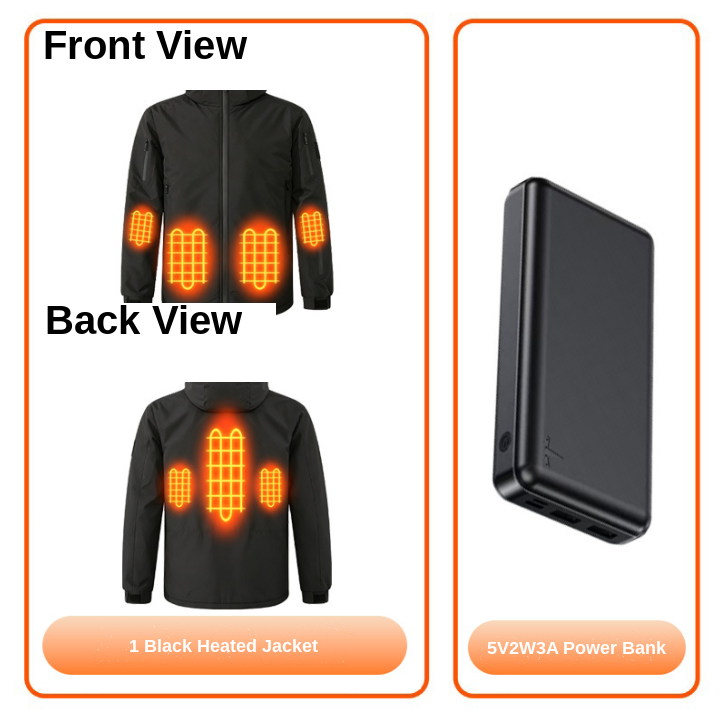
- Heating zones and placement. Zones are the patches of heating film distributed across the chest, back and pockets. Zone count and placement are an OEM variable — you can ask the manufacturer to adjust them for your use case. Do not accept a generic “multiple zones” answer; ask for a diagram showing where the film sits and which zones switch together.
- Control levels. The reference jacket has three selectable heat levels, switched by a button on the chest. Confirm the number of levels, the switch location, and whether the jacket remembers its last level on power-up. Three levels is a reasonable baseline; anything more is a feature you should price explicitly.
- Shell and seam construction. The reference shell is windproof and waterproof with sealed/taped seams. For outdoor workwear this is non-negotiable — unsealed seams will leak in rain and degrade the jacket’s wind barrier. Ask for the shell fabric weight, the seam tape method and whether the waterproofing is a coated laminate or a DWR finish (the two behave differently over time).
- Insulation/fill. The reference jacket uses synthetic insulation. Synthetic fill dries faster and performs better when damp than down, which is usually the correct choice for workwear. Confirm fill type and roughly how it layers over workwear.
- Sizing and fit. Heated jackets are often worn over base and mid layers, sometimes over harnesses or tool belts. Confirm the size run, whether the fit is regular or roomy-over-layer, and whether the factory will produce your branded size spec.
- Washability. The reference jacket is machine washable after the power bank is removed. This is a basic expectation for workwear; confirm the washing method, whether the control module must be disconnected, and ask for a wash-cycle test report before bulk order.
- Safety and certification evidence. At minimum, expect the supplier to run its product line through CE and ISO-aligned processes rather than hand-wave compliance. We cover what to ask for in the certification section below.
Power source, USB compatibility and how runtime really works
Runtime is the question buyers ask first, and it is also the one most often misquoted by suppliers. A heated jacket draws its power from a USB power bank carried in an inner pocket — the bank is not a fixed component of the jacket, and it is not bundled as part of the garment in our reference product. That means runtime is not a fixed number on the jacket’s spec sheet: it varies with the capacity of the power bank you choose, the heat level selected, the ambient temperature and how often the heating cycles on and off. On the highest level the jacket will draw the bank down faster; on the lowest level it will last longer. Heat-up time itself is short — about three seconds on the reference jacket — so the wearer gets to target warmth quickly rather than waiting ten minutes.
The practical sourcing implication is that you should treat the power bank as a separate, specified component. Agree on the minimum bank capacity your program will ship with, the port and cable length, whether the bank sits in a dedicated inner pocket, and whether you are sourcing banks from the factory or supplying your own. If you supply your own banks, confirm they are capable of the output the jacket expects and that the USB cable and connector are a standard consumer part rather than a proprietary plug. For buyers who need a broader low-voltage heating platform beyond garments, our low-voltage heating cloth supports 5V/12V/24V and is the building block the jacket film is derived from.
Shell, fill, sizing and washability
From a procurement standpoint the textile half of the jacket is where most after-sales defects actually show up, even though buyers spend most of their negotiation time on the electronics. The windproof, waterproof shell with taped seams is the barrier that makes the active heating useful at all; without it, the heat escapes as fast as it is produced. Synthetic insulation adds passive warmth on top of the active heating, so the wearer is not relying on the elements alone. Standard colors on the reference product are blue and black, with custom colors available through OEM — useful if your brand requires a specific workwear color.
Washability is the other hidden quality lever. Because the jacket contains a control module and heating film, it is washable only after the power bank is removed; the factory should be able to tell you exactly how the connector and control unit are protected, and how many wash cycles the film and seams survive. Ask to see a washed sample rather than trusting the marketing line. For sizing, request a size spec sheet and, where possible, a wear trial with real end users before you lock the size run — a jacket that fits a slim rider is the wrong garment for a layer-wearing construction crew.
OEM/ODM: what you can actually customize
One of the reasons brands work with an in-house heated jacket manufacturer rather than a trading company is the breadth of OEM/ODM customization. On our reference line the adjustable dimensions are: size run, color, heating zone layout, logo placement and packaging. That is the standard menu. In practice that means you can:
- Request custom shell colors beyond the standard blue and black to match your brand or your customer’s PPE palette.
- Move or add heating zones to match the wearer — for example, more coverage on the upper back for a rider, or pocket warmth for a worker who keeps hands out of gloves.
- Place your woven or printed logo on chest, sleeve or back, and specify hangtags, inner labels and retail or workwear packaging.
- Adjust the size run to your market — European sizing, North American sizing, or a bespoke size chart for a uniform program.
What you should not expect is infinite flexibility on the electrical architecture itself. The 5V USB platform, the three-level control and the printed graphene–carbon film are the built system; customizing those is an ODM project with a different MOQ and timeline. If you are evaluating a wholesale private-label program, build on the proven platform rather than asking for a from-scratch electronic redesign on a first order. If you are comparing categories, note that the matching heated vest on our line uses a five-zone layout and is a good companion SKU for programs that need both covered-torso and full-coverage garments.
MOQ, samples and factory audit
MOQ is a negotiation point, not a published number on a website, and it moves with the level of customization. A plain stock-color order with your logo printed will have one threshold; a custom shell color, custom zone layout and custom packaging will have a higher one and a longer lead time. Do not anchor on a single MOQ number from a sales call — get it in writing, tied to a specific spec, before you place a sample order. Samples are non-negotiable: order at least one sample in the intended size, wear it in the intended environment, and check the heat-up, the three levels, the pocket fit for your chosen power bank and the hand-feel of the shell.
For anything beyond a trial order, plan a factory audit — or, at minimum, a live video audit of the production line and the QC bench. The most important thing to verify is whether the factory makes its own heating elements in-house. A manufacturer with in-house graphene film capability (our Qingdao line is set up this way) controls element quality and lead time; a trader that sources film from a sub-supplier has less control over both. Ask about the QC stations between film lamination, shell sewing, electronic test and final inspection, and ask to see the defect-rate tracking. We cover the broader procurement discipline — RFQ structure, spec writing and supplier grading — in our B2B procurement guide for graphene heating programs; the same process applies when the product is a jacket rather than a heating panel.
What drives the landed unit price
When two quotes look close on unit price, the difference is almost always hidden in the cost structure. A wholesale heated jacket price is built from roughly these layers, and understanding them keeps you from comparing a loaded quote against a stripped one:
- Heating system. Printed graphene–carbon film elements, the control board, the USB connector and the wiring harness. In-house element production tends to be more consistent on both price and quality than outsourced film.
- Shell and textile. The waterproof, windproof laminated shell fabric, taped seams, synthetic insulation, zippers, pockets and the actual cut-and-sew labor.
- Electrical compliance and QC. Test stations, aging checks, wash testing and the documentation package. A quote that ignores this is cheaper on paper and expensive on returns.
- OEM customization. Custom colors, custom size runs, custom zone layouts, logo application and custom packaging each add cost; ask which of these your quote includes and which are excluded.
- Power bank (if bundled). If the jacket ships with a bank, the bank’s capacity and certification are a separate cost line. If it ships without a bank, make sure your customer understands the jacket needs a USB bank to work.
- Logistics and duties. Sea freight, inland cartage, import duties and any testing or certification done in your destination market. Always compare landed cost, not ex-works price.
The judgment to develop is spotting a quote that is cheap because one of these layers is missing rather than because the factory is efficient. A quote that has no wash test, no aging test, no seam-tape specification and no power-bank compatibility note is not a bargain; it is a returns problem in six months.
Supplier selection scorecard
Once you have two or three shortlisted factories, score them on the same criteria rather than relying on a gut call. The table below is the scorecard we recommend. Weight each row according to your program, score each supplier 1–5 (5 is best), and multiply. The row weights are an example — adjust them to your own priorities.
| Criterion | Suggested weight | What to verify on the factory floor or in the sample | Score 1–5 |
|---|---|---|---|
| In-house heating element production | 20% | Does the factory laminate its own graphene–carbon film, or buy finished elements? In-house control means tighter QC and shorter changes to zone layout. | |
| OEM/ODM flexibility | 15% | Can it change size run, shell color, zone placement, logo and packaging without an engineering surcharge that kills the program? | |
| 5V USB platform standardization | 10% | Is the jacket built on an open 5V USB interface that accepts common power banks, or a proprietary pack that locks you into one accessory SKU? | |
| Shell & seam quality | 15% | Windproof/waterproof shell, taped seams, synthetic insulation. Inspect a washed sample and run water along a seam. | |
| Control & wash testing | 10% | Three-level control works as specified; machine-washable after bank removal; ask for wash-cycle and heat-cycle aging data. | |
| Certification evidence | 10% | CE/ISO program-level evidence, test reports, technical file openness. See the certification section below. | |
| MOQ, sample turnaround & lead time | 10% | MOQ matches your pilot order; sample lead time; bulk lead time; reorder cadence for repeat seasons. | |
| Communication & documentation | 5% | Responds in your timezone, provides spec sheets, BOM, labeling files and pre-shipment photos. | |
| After-sales & defect handling | 5% | Agreed defect-rate threshold, replacement policy for failed control boards or film, and a clear claims process. |
When you score, be explicit about why you gave each number. A supplier that scores low on in-house element production but high on communication is not disqualifying — it is a trading-company profile, and you should price in the sub-tier risk accordingly. A supplier that scores high on paper but will not let you audit or send a third-party QC is a supplier to cross off regardless of price.
Common pitfalls when sourcing heated jackets
After several sourcing cycles, the same mistakes come up. None of them are fatal, but they are all avoidable:
- Comparing jackets on price alone. The cheapest quote usually has a missing layer — no wash test, no taped seams, a generic power bank, or an element bought from a sub-supplier. Compare landed, spec-matched cost.
- Buying runtime as a spec. Runtime depends on the power bank and the heat level. Do not let a supplier quote a single runtime hour number without stating the bank capacity, level and ambient; if they refuse to state the assumptions, treat the number as marketing.
- Ignoring the power bank ecosystem. A jacket that only works with a proprietary pack is a future supply-chain headache. Prefer an open 5V USB interface.
- Skipping the wear trial. A sample in a meeting room is not a sample on a winter construction site. Trial the jacket in the real environment with real users before bulk order.
- Under-specifying the shell. If the wearer is in rain or wet snow, a DWR-coated shell without taped seams will fail in a season. Tape the seams on the spec sheet.
- Locking the logo into the electronics. Prefer a platform where logo, color and packaging are independent of the heating system, so a rebrand does not require an electronics redesign.
- Treating certification as a sticker. Ask to see the actual test reports and the production-line process, not a certificate poster on a wall.
Checkable sourcing & inspection checklist
Use this as a working document through RFQ, sampling and pre-shipment. Tick each item off before you move to the next stage.
- ☐ End-user profile written down: who, what job, how long outdoors, ambient conditions.
- ☐ Garment type chosen: jacket vs vest vs insulated coat, with a documented rationale.
- ☐ Voltage confirmed: 5V DC over USB, open interface, not a proprietary pack.
- ☐ Heating element technology identified (printed graphene–carbon film vs alternatives) and placement diagram received.
- ☐ Number and placement of heating zones agreed for the target use case.
- ☐ Number of heat levels confirmed (three on the reference jacket) and switch location agreed.
- ☐ Shell specified as windproof and waterproof with sealed/taped seams.
- ☐ Insulation/fill type agreed (synthetic for workwear) and layering fit considered.
- ☐ Power-bank spec defined: capacity, port, cable length, inner-pocket fit; runtime assumptions written with the bank and level stated.
- ☐ Size run and fit (regular vs roomy-over-layers) agreed and a size spec sheet received.
- ☐ Washability confirmed: machine wash after bank removal; wash-cycle test requested.
- ☐ OEM options locked: custom colors, logo placement, zone layout, packaging.
- ☐ Sample ordered, worn in the real environment, and signed off before bulk.
- ☐ MOQ and pilot order size agreed in writing, tied to a specific spec.
- ☐ Factory audit or live video audit completed; in-house film production verified.
- ☐ QC stations and defect-rate threshold documented; after-sales replacement terms agreed.
- ☐ Certification evidence reviewed (see below).
- ☐ Landed cost calculated including freight, duties and destination-market testing.
RFQ guidance and what to ask for
A good RFQ does not ask “how much for a heated jacket”. It hands the factory a finished spec and asks them to price against it. Include the end-user environment, the required voltage (5V USB), the preferred heating-element technology, the zone placement you want, the shell and seam specification, the fill type, the size run, the logo and packaging requirements, the target order quantity and the target timeline. Ask the supplier to return: unit price at your quantity tier, sample lead time, bulk lead time, what is included (shell, film, control, packaging) and what is excluded (especially power bank), the available certifications, and a list of comparable customers if possible. The same RFQ discipline we apply on our panel heating programs — written specs, quoted assumptions, landed-cost comparison — is described in the B2B procurement guide; borrow its structure and apply it to the jacket.
Certification and safety evidence
For a low-voltage 5V USB garment, the safety case is simpler than for mains-powered heating equipment, but it is not zero. You should expect your supplier to run its product line through CE and ISO-aligned processes and to be able to show the documentation on request. We do not claim a specific certificate number for the jacket on this page; the right way to verify is to ask the supplier for the actual test reports and the technical file, and to check that the reports cover the garment configuration you are ordering. Our own program-level CE and ISO dual certification across the product line is documented separately in our certification overview; read that before you write the certification clause into your purchase order, so you know what evidence to ask for. If you are shipping into a market with additional PPE or electronics requirements, budget for destination-market testing separately — it is a cost line the factory quote usually does not include.
Frequently asked questions
Q: What MOQ should I expect when sourcing heated jackets wholesale?
A: There is no single number. MOQ depends on how much you are customizing: a stock-color, logo-only order sits at a lower threshold than a custom shell color, custom zone layout and custom packaging. Get the MOQ in writing tied to your exact spec, and treat the sample order as a separate line. Plan a pilot order that is large enough to test the market but small enough to absorb if the fit or the shell needs revision.
Q: How do I compare two heated jacket manufacturers fairly?
A: Compare them on the same spec, not on the headline unit price. Use the scorecard above: in-house element production, OEM flexibility, 5V USB openness, shell and seam quality, control and wash testing, certification evidence, MOQ and lead time, communication, and after-sales. Score 1–5 on each, weight to your priorities, and land on a supplier that matches your program rather than the cheapest quote.
Q: Is 5V USB enough to keep outdoor workers warm?
A: The reference jacket is built on a 5V DC USB platform with printed graphene–carbon film elements that heat up in about three seconds and emit far-infrared warmth in the 5–14 μm band, on three selectable levels, backed by a windproof waterproof shell with taped seams and synthetic insulation. Whether it is “enough” depends on the environment and the wearer; that is why we start with the use-case definition. Runtime is set by the power bank you choose, not by the jacket itself.
Q: Can the jacket be customized with our brand logo and colors?
A: Yes. Standard colors are blue and black, with custom colors available through OEM. You can also adjust size run, heating-zone layout, logo placement and packaging. The 5V electronic platform itself is fixed; customizing the electronics is an ODM project with a higher MOQ and longer timeline.
Q: What should I ask for in a sample before a bulk order?
A: Order the sample in the size and shell color you intend to ship, wear it in the real working environment, and test all three heat levels, the pocket fit for your chosen power bank, the heat-up time, and a wash cycle after removing the bank. Inspect the seams for taping and the shell for windproof feel. Sign off the sample in writing before bulk production starts.
Q: How does runtime on a heated jacket actually work?
A: Runtime is not a fixed jacket spec. The jacket draws power from a USB power bank in an inner pocket (not bundled with the garment). Runtime depends on the bank’s capacity, the heat level selected, the ambient temperature and how often the heating cycles. On a higher level the bank depletes faster; on a lower level it lasts longer. When you quote runtime, always state the bank capacity and the level alongside the number.
Q: What certifications should a heated jacket supplier show?
A: Expect a CE- and ISO-aligned product-line process, plus the actual test reports for the garment configuration you are ordering — not just a certificate on a wall. Reference our certification overview for what program-level evidence looks like, and budget separately for destination-market PPE or electronics testing if your region requires it.
Q: Should I source a jacket or a heated vest for my program?
A: It depends on mobility and layering. A jacket gives full shell coverage, wind and water protection, and active heating across the torso; a vest gives core warmth under layers with less restriction. Read our jacket versus vest versus insulated coat comparison and, if in doubt, sample both for your end users. The matching 5V USB graphene heated jacket and the five-zone heated vest are built on the same platform, so you can carry both SKUs without duplicating supplier relationships.
Ready to talk specs?
If you have a defined use case and a target quantity, the next step is a sample and a spec conversation. Send through the end-user environment, the size run, the OEM options (color, logo, zone layout, packaging) and your target timeline, and we will quote the 5V USB graphene heated jacket against your spec — including sample lead time, bulk lead time and the landed-cost breakdown. Request a quote and sample from our sourcing team here.
Related reading
- How printed graphene–carbon film heats a 5V USB jacket in about three seconds
- Choosing between a heated jacket, a heated vest and an insulated coat
- The 5V USB graphene heated jacket product page (wholesale / private label / ODM)
- B2B procurement guide for graphene heating programs
- CE and ISO product-line certification: what evidence to expect
- Low-voltage heating cloth (5V/12V/24V) — the element platform behind the jacket