
If you are weighing heated jacket vs heated vest options against a conventional insulated coat, you are really comparing three different ways to solve the same problem: keeping a human body comfortable in cold air. A heated jacket is an active heated shell that warms both the core and the arms while also blocking wind and rain. A heated vest is an active core-warming layer that leaves the arms free and is designed to go under or over other clothing. An insulated coat is a passive garment that relies on synthetic fill or down to trap body-generated air, with no electrical heating at all. The right choice depends on how much the wearer moves, how long they are exposed, what they already wear in layers, and what the jacket or vest will actually be used for on a Tuesday in January. This buyer’s comparison works through the trade-offs on body coverage, warmth, mobility, portability, battery runtime, price tier, and real-world scenarios, and it closes with a side-by-side look at the three heating element types most commonly found in heated outerwear: printed graphene film, carbon fiber, and traditional resistance wire.
Written by James O’Connell, Product Comparison & Applications Engineer, SunAura Thermal.
Last updated: November 8, 2026
What a heated jacket actually is
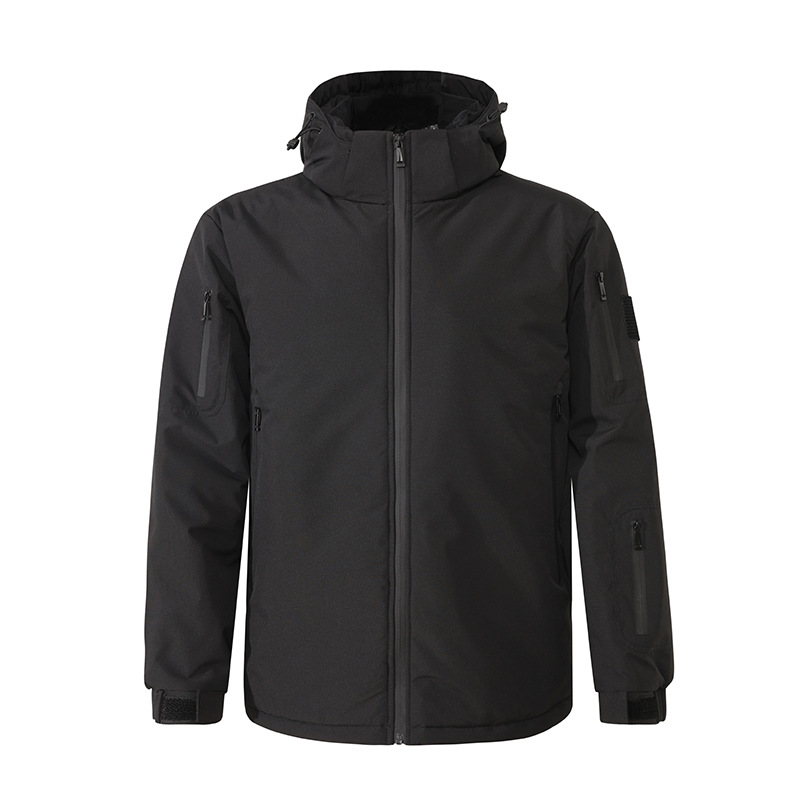
A heated jacket, in the configuration we build at SunAura, is a windproof and waterproof outer shell with sealed, taped seams and synthetic insulation fill, into which flexible heating elements are bonded. The garment runs at 5 V DC over USB, drawing power from a standard USB power bank carried in an inner pocket; the bank itself is not included with the jacket, which is intentional because buyers and OEMs usually want to choose capacity themselves. The elements are printed graphene–carbon film that reaches working temperature in about three seconds and emits far-infrared radiation in the 5–14 μm band, with an electrothermal conversion efficiency above 99 percent. Three selectable heat levels let the wearer trade warmth for runtime. Once the power bank is removed, the jacket is machine washable. Standard colors are blue and black, with OEM/ODM customization across size, color, heating zone layout, logo and packaging.
The important product-engineering point is that a heated jacket is two systems in one garment. The first is the shell: it stops convective and evaporative heat loss the same way any good winter outer layer does. The second is the active radiant heating, which adds energy to the core body rather than relying on the wearer to shiver it up. Our heated jacket product page (a 5V USB graphene heated jacket) lists the rated voltage, heat-up time, shell construction and OEM options in full. If you want the physics behind why 5 V and printed graphene film work at all, our sister article on how heated jackets turn USB power into far-infrared warmth walks through the mechanism in detail.
Typical wearers on our program are outdoor workers, motorcyclists, campers and anyone facing prolonged cold exposure — people who cannot simply step inside when the temperature drops. That use case shapes the jacket’s design: it is built to be the outermost layer, not a base layer, and it is sized to go over work clothing or a fleece mid-layer rather than replace them.
What a heated vest is, and why its 5-zone layout matters
A heated vest drops the sleeves and the outer shell job. It is a close-fitting or lightly layered garment that heats the core — chest, upper back, and sometimes the neck and small of the back — while leaving the arms completely free. The vest on our product line (page ID 3010, the heated vest with 5 heating zones) uses a 5-zone layout that distributes film across the upper torso rather than concentrating heat in a single patch. That matters because the torso contains the heart, lungs and major blood vessels; warming it is the most efficient way to keep overall body temperature stable without wasting energy heating limbs that are already moving and generating their own heat.
Design intent is the key difference between the two garments. A vest is a layering piece. It is meant to be worn under a work jacket, a ski shell, a hi-vis vest, or over a shirt and undershirt, and the wearer supplies their own wind and rain protection on the outside. If your team already owns good outer shells, a vest is often the more economical way to add active heat to an existing wardrobe rather than replacing every shell.
Because the vest has no sleeves and no heavy shell fabric, it is also the more packable of the two: it rolls into a smaller pocket, weighs less on the body, and does not constrain shoulder or elbow movement. That is why it is popular with warehouse workers, drivers, hikers under a hard shell, and anyone whose job involves repetitive arm motion. The trade-off is that the arms, hands and shoulders get no direct heat, and the wearer still needs a separate windproof layer for exposed conditions. The heated vest product page should be checked for the exact zone diagram and current connector details before specifying it into a program.
What an insulated coat does (and does not) do
An ordinary insulated coat — a down parka, a synthetic-fill work coat, a quilted puffer — contains no electrical heating elements at all. It works by trapping a layer of still air between the fabric and the body; that trapped air is the insulation, and the fill is just the scaffolding that keeps it from collapsing. A well-insulated coat is genuinely effective, and for many users it is the correct choice. It has no battery, no switch, no cable, no wash-out worries about electronics, and no runtime ceiling. It works indefinitely until it gets wet or worn out.
The failure modes of passive insulation are well known. It stops working well when it gets wet, because water displaces the trapped air and conducts heat away from the body. It also loses value in high wind, because wind penetrates or drives through the fabric and strips away the warm air layer. And it only works as well as the body’s own heat generation: a sedentary person standing still on a cold morning in an unheated bus stop will get cold even in a thick parka, because there is no metabolic heat to trap. An insulated coat also tends to be bulky: the more fill you add for warmth, the more it constrains arm movement and the harder it is to pack.
None of this makes the insulated coat a bad product. It means the insulated coat and the heated garments solve different failure modes. The insulated coat is the right answer when the wearer is moving around enough to generate their own heat, when the cold is mild to moderate, and when the wearer can tolerate bulk. It is the wrong answer when the wearer is sedentary for long stretches, when wind and rain defeat passive shells, or when the customer is paying a premium for thermal comfort that no amount of fill can deliver on a frozen roadside at 6 a.m.
Graphene vs carbon fiber vs resistance wire: the hidden hardware
When a buyer compares heated garments at the product level (jacket, vest, coat), they are usually comparing the outer form. Underneath, three element technologies dominate the market, and they behave differently even when the voltage and the pocket power bank look the same.
Printed graphene–carbon film. This is what our heated jacket uses. The heating layer is a thin, flexible film printed onto a fabric substrate, rather than a wire sewn into channels. It heats almost instantly (about three seconds to working temperature on our shell), distributes heat broadly across the area it covers rather than in lines or spots, and emits in the 5–14 μm far-infrared band that aligns with how the human body naturally radiates heat. Electrothermal conversion is above 99 percent, which means nearly all of the incoming electrical energy becomes usable heat rather than waste. The material-science background is covered in our post on graphene heating film and why it behaves differently from wire heaters, and the thermal-comfort case for far-infrared radiation is covered in the companion piece on far-infrared radiant heat and perceived warmth.
Carbon fiber heating wire. Carbon fiber is a step up from traditional resistance wire: it is lighter, more flexible, and more corrosion-resistant, and it still tends to be arranged as thin wire bundles stitched into the garment. It heats along the line of the wire rather than across a broad film, which can produce a “railroad track” feel if the spacing is poor. It is a common mid-range option and a reasonable baseline. Our direct comparison of the two film-and-wire approaches lives in the post graphene heating film vs carbon fiber heating, which covers bend fatigue, uniformity and wash-life differences.
Traditional resistance wire (nichrome and similar). This is the older technology: a resistive metal wire, usually sewn into strips. It heats quickly and cheaply, but it tends to produce hot spots directly on the wire path, it is stiffer against the skin, and it fatigues at fold points over repeated bending and washing. It is the technology you find in the lowest-cost heated vests and in many first-generation heated gloves. It is not bad; it is just a different engineering trade-off. The broader comparison across graphene film, carbon fiber and PTC/carbon-crystal styles is in our article graphene heating film vs carbon crystal and PTC heaters, which is the right read if you are specifying elements for an OEM program rather than buying a single garment.
For the buyer choosing between a jacket and a vest, the element choice matters less than the coverage choice — but it is still worth asking the manufacturer which element is inside, because it drives warmth uniformity, wash durability, and how the garment feels against clothing.
Comparison table 1: body coverage and warmth profile
| Dimension | Heated jacket | Heated vest | Insulated coat |
|---|---|---|---|
| Outer coverage | Full torso plus arms, as the outermost shell | Torso only; no sleeves; worn under or over other layers | Full torso plus arms, as a passive outer or mid layer |
| Heated area | Active elements on the torso, with OEM-configurable zone layout | 5 heating zones distributed across the upper torso | None; relies on trapped body heat |
| Heat delivery | Active far-infrared radiant heat plus shell insulation | Active radiant heat on the core only | Passive trapped-air insulation only |
| Wind and rain protection | Windproof, waterproof outer shell with taped seams | Depends on the outer layer worn over the vest | Varies by fabric; many insulated coats are not fully waterproof |
| Warmth at rest | High: active heat plus shell, works even when the wearer is sedentary | Medium-high: core stays warm, arms and shoulders rely on outer layers | Medium: drops sharply when wet or windy, or when the wearer is stationary |
| Warmth during heavy exertion | Moderate: can overheat if the shell is closed and heat is on high | Good: core heated, arms vent naturally as they move | Good when dry, but sweaty fill loses insulation later |
The takeaway from this table is that warmth is not a single number. The jacket gives you active heat plus a weatherproof shell in one garment; the vest gives you active heat on the core but pushes the shell problem onto whatever the wearer puts over it; the coat gives you weather and insulation with no active heating at all.
Comparison table 2: mobility, layering and packability
| Dimension | Heated jacket | Heated vest | Insulated coat |
|---|---|---|---|
| Arm and shoulder mobility | Slightly constrained by the shell and sleeves; built as an outer layer | Unrestricted arms; the standard choice for repetitive upper-body work | Constrained by fill bulk; thicker coats reduce overhead reach |
| How it layers | Designed as the outer shell; minimal layering needed over a base or mid layer | Designed as a layering piece under a shell, over a shirt, or under a hi-vis vest | Usually the outer layer; needs a separate shell in rain |
| Ventilation during exertion | Moderate; shell blocks wind but can trap heat during heavy work | Best of the three; arms and shoulders vent as the wearer moves | Worst of the three; bulk traps heat even after exertion stops |
| Packability / pack-down size | Moderate: shell fabric plus inner battery pocket adds volume | High: thin, rolls small, easy to stow in a kit bag or locker | Low: synthetic or down fill takes significant packed volume |
| Bulky under work equipment | Outer-layer fit; does not usually fit under coveralls or harnesses | Thin profile; fits comfortably under coveralls, hi-vis layers and harnesses | Bulkiest; difficult to wear under harness or coveralls without bunching |
For workwear programs where crews already wear hi-vis, tool belts or harnesses, the vest’s thin profile is often the deciding factor. The jacket wins when the wearer does not have an existing shell and wants the whole system in one garment.
Comparison table 3: power, runtime and price tier
| Dimension | Heated jacket | Heated vest | Insulated coat |
|---|---|---|---|
| Power source | 5V DC USB, from a power bank carried in an inner pocket (bank not included) | Low-voltage USB power bank carried in a pocket; capacity chosen by the buyer | None required |
| Heat-up time | About 3 seconds on our printed graphene–carbon film | Comparable low-voltage film warm-up; confirm on the vest spec | N/A |
| Heat levels | Three (3) selectable levels on the jacket | Multi-level control typical of the category; confirm on the vest spec | N/A |
| Runtime | Varies with power-bank capacity and the selected heat level; higher levels drain faster | Varies with power-bank capacity and the selected heat level; typically fewer elements than the jacket | Unlimited |
| Washability | Machine washable after the power bank is removed | Remove battery/controller before washing; follow the vest care label | Machine wash or dry clean per the fabric care label |
| Wholesale price tier | Mid to premium: shell, taped seams, insulation, film elements and battery pocket all add cost | Entry to mid: no sleeves, no shell fabric, fewer components | Entry to mid: passive garment with no electronics; premium fill pushes it upward |
A note on runtime: we deliberately do not publish a runtime number in hours, because runtime is determined by the power bank the buyer pairs with the garment, not by the garment itself. A 10,000 mAh bank on low heat will outlast a 5,000 mAh bank on high heat by a wide margin. When you build a program, spec the bank alongside the garment rather than treating runtime as a fixed spec. The buying walk-through for that decision is in our companion piece on how to source wholesale and OEM heated jackets. Low-voltage safety and EMF considerations for 5 V and 12/24 V film are covered in our notes on low-voltage heating and EMF safety and on the 12 V / 24 V low-voltage heating film range.
Comparison table 4: best-fit scenarios and target users
| Scenario | Heated jacket | Heated vest | Insulated coat |
|---|---|---|---|
| Outdoor construction or roadside work, full shift | Best: shell plus active heat in one garment | Good if crew already owns weatherproof shells | Inadequate on long sedentary shifts in wind |
| Motorcycling, scooter commuting | Best: windproof shell blocks convective cooling at speed | Poor on its own; needs a separate motorcycle jacket | Passive insulation is no match for highway wind chill |
| Camping, hunting, sitting in a blind | Best: sedentary use is where active heat earns its cost | Good as a layering piece under a hunting shell | OK around the campfire, cold when sitting still |
| Warehouse, loading bay, repetitive lifting | Overkill: sleeves and shell are unnecessary indoors | Best: thin, unrestrictive, core-warming under coveralls | Fine for short walks, bulky for long shifts |
| Hiking, skiing under a hard shell | Too warm once moving; shell already exists | Best: core heat under an existing waterproof shell | OK for resort skiing, wet-sweat risk on long tours |
| Office-to-car commuting, city walking | Over-specified | Unnecessary for most commutes | Best: simple, no battery, everyday use |
| First OEM program, test budget | Higher entry cost | Lower entry cost, easier to pilot | Cheapest to spec, no electronics qualification |
Which one to buy, by scenario
The tables above describe the trade-offs; the question most buyers actually ask is which one to put in the cart. The short answer is that it depends on the wearer’s day. Here are the recommendations we give to distributors and brand owners.
Choose the heated jacket when the wearer is outside for long stretches, exposed to wind and rain, and does not already own a separate weatherproof shell. This is the motorcyclist, the roadside worker, the winter camper, the delivery driver standing around in a depot yard. The jacket’s value is that the shell and the heating are one system: taped seams block the wind and rain that defeat passive insulation, while the 5 V graphene film adds radiant heat to the core in about three seconds. You can see the shell, the three heat levels and the OEM options on the heated jacket product page. For a B2B program, this is the SKU you build a brand around, because it is the one that delivers a visibly different experience from a regular winter coat.
Choose the heated vest when the wearer already has a shell and only needs core warmth, or when arm freedom matters more than full coverage. This is the warehouse team wearing coveralls, the hiker with a hardshell already in the pack, the warehouse forklift driver, the angler under a bib. The 5-zone layout on our 5-zone heated vest puts heat across the upper torso rather than concentrating it in one patch, and the thin profile layers under workwear without bulk. The vest is also usually the lower-entry-cost SKU, which makes it the right pilot product for a brand testing whether heated outerwear sells in their market before committing to a full jacket program.
Choose an insulated coat when the cold exposure is short, the wearer is already active, or the customer simply does not want to manage a battery. A commuter walking from car to office, a person spending twenty minutes at a bus stop, a shopper moving between heated stores — passive insulation is the right tool. It is cheaper, simpler, and has zero failure modes. A heated garment is not a universal upgrade; it is a targeted upgrade for people whose bodies are losing the fight against cold for hours at a time.
Choose a mixed program when you are outfitting a team rather than one person. In most workwear accounts, the right answer is not one SKU for everyone. Site supervisors and outdoor crews get the jacket; warehouse and yard crews get the vest; office staff and short-exposure roles get a conventional insulated layer. That mix also lets you present a price ladder to the buyer: entry-tier vest, mid-tier jacket, premium OEM-printed jacket with custom zones and logo. Our OEM/ODM program supports that ladder directly, because we build the graphene film elements in-house on our Qingdao line and can vary size, color, zone layout, logo and packaging per order.
Choose the heating element on the same logic you choose the garment. If the garment is for long, wash-heavy, high-flex use, printed graphene–carbon film (what our jacket uses) is the most uniform and wash-friendly option. If it is a cost-sensitive pilot where the garment will be replaced often, carbon fiber wire is a reasonable mid-tier baseline. Traditional resistance wire belongs in the lowest-cost tier and in disposable or rarely washed items. The engineering detail behind that ranking is in the two deep-dive posts: graphene film vs carbon fiber heating and graphene film vs carbon-crystal and PTC.
When an ordinary insulated coat is the correct answer
It is worth stating plainly that an insulated coat is not a second-best choice. In several common situations it is the better choice, and a buyer who spec’s a heated garment where a passive coat would do is spending money on a battery system the wearer will never use.
- Short exposure. If the wearer is outside for less than twenty minutes at a time, walking between heated buildings, the heat-up time of the jacket and the bulk of the power bank are not paying back. A well-insulated coat is simpler.
- Active, moving wearers. A runner, a cyclist pedaling hard, a construction worker on a continuous dig — their bodies are already producing plenty of heat. Insulation traps it; adding active heat usually makes them overheat and unzip the garment anyway.
- Budget-conscious everyday wearers. A heated jacket carries the cost of the shell plus elements plus a battery pocket plus the power bank the customer must buy separately. A quality insulated coat undercuts that total landed cost and has no learning curve for the end user.
- Wet, wash-heavy, or low-maintenance environments. If the garment will be abused, washed daily, or handed to wearers who will forget to remove the battery before laundry, a passive insulated coat removes a whole failure mode.
- Mild winters. In climates where winter nights rarely drop below freezing, the marginal benefit of active heating is small. The heated category is built for sustained cold exposure, not for November in a mild coastal city.
The flip side is equally clear: when the wearer stands still for hours, when wind chill is severe, when the wearer is a motorcyclist moving at speed, or when the wearer is older and circulates less well, passive insulation stops being enough and active heated outerwear earns its cost. That is the line to draw in your product catalog, not “heated vs not heated” as a status symbol.
Frequently asked questions
Q: Is a heated jacket warmer than a heated vest?
A: It depends on what “warmer” means. The jacket heats a larger area — the torso plus the sleeves — and it also provides its own windproof, waterproof shell with taped seams. The vest heats only the torso, but on our vest that torso coverage is spread across 5 heating zones. If you measure warmth at the core, the two are comparable when the vest is worn under a good outer shell. If you measure total-body warmth in exposed wind and rain, the jacket wins because it also blocks the convective cooling that a vest cannot. The vest’s advantage is not warmth per area; it is mobility and layering simplicity.
Q: Can I wear a heated vest under my regular winter jacket?
A: Yes — that is exactly how a heated vest is designed to be used. It is a thin layering piece meant to go under an existing shell, over a base shirt, or under a hi-vis vest or coveralls. The benefit is that you add active core warmth without buying a whole new outer shell, and the arms stay unrestricted. The only practical constraint is making sure the inner pocket for the USB power bank still has room when layered, and that the outer shell is loose enough to accommodate the vest plus the bank.
Q: How long does the battery last on a heated jacket?
A: Runtime is not fixed by the garment; it is set by the power bank you pair with it and the heat level you select. The jacket runs at 5 V DC over USB and uses a power bank carried in an inner pocket, but the bank itself is not included. Higher heat levels drain the bank faster than lower levels, and a larger bank extends runtime in roughly proportion. When you spec a program, choose the bank capacity alongside the garment so you can quote a realistic runtime range rather than relying on a single marketing number. The jacket has three selectable heat levels, which is the main runtime lever the wearer controls.
Q: Is graphene heating better than carbon fiber or resistance wire?
A: For most heated-garment use cases, printed graphene–carbon film behaves better than wire-based elements: it heats in about three seconds, distributes warmth across a broad area rather than in lines, flexes with the fabric, and has an electrothermal conversion efficiency above 99 percent. Carbon fiber wire is a reasonable mid-tier option and is more durable than traditional nichrome resistance wire, but it still produces line-shaped heat. Resistance wire is the cheapest and stiffest option and is prone to fatigue at fold points. The full engineering comparison is in our posts on graphene film vs carbon fiber and graphene film vs carbon-crystal/PTC heaters.
Q: Do I still need an insulated coat if I buy a heated jacket?
A: Usually no. A heated jacket already has synthetic insulation fill built in, plus a windproof and waterproof outer shell, so it functions as the outer winter layer on its own. You would typically wear a base or mid-layer underneath it rather than another insulated coat over it. The exception is extreme cold, where some wearers add a shell or a puffer over the heated jacket as an additional wind block — but that is a niche configuration, not the default. If you are buying a heated vest rather than a jacket, you do need an outer shell over it, because the vest does not provide its own weather protection.
Q: Can heated jackets be machine washed?
A: Yes, on our heated jacket. The rule is that you must remove the USB power bank and disconnect the controller before washing; once the electronics are out, the jacket itself is machine washable. The heating elements are printed film bonded into the garment rather than loose wires, which is what makes washability practical. Always check the specific care label on the vest or jacket you are spec’ing, because generic heated garments vary, and always treat the battery as a non-washable component.
Q: Is 5V USB heating safe? Will it give me an electric shock?
A: 5 V DC is well below the voltages associated with mains-shock risk, and it is the same voltage you already use to charge a phone. The garment is powered by a self-contained USB power bank in an inner pocket, so there is no mains connection near the body. Low-voltage heating film at 5 V, 12 V and 24 V is the standard architecture for wearable heated textiles precisely because it is safe to wear against skin and wash around. For the EMF and safety discussion behind that, see our low-voltage heating and EMF safety write-up. At the program level, our production line operates under the relevant CE and ISO framework; certification specifics for a given order should be confirmed on the CE and ISO product-line certification page before quoting.
Q: Can I order a heated jacket as an OEM or private-label brand?
A: Yes. Our heated jacket program supports OEM/ODM customization across size, color, heating zone layout, logo and packaging, and we build the graphene heating elements in-house on our Qingdao line. Standard colors are blue and black; custom colors are available. The vest and the low-voltage heating cloth (which supports 5 V, 12 V and 24 V configurations) can be bundled into the same program. If you are a distributor, workwear brand or procurement team, the starting point is the RFQ process covered in our buying guide, and the certification evidence is on the CE/ISO product-line page.
Need a side-by-side quote for heated jackets, heated vests, or a mixed OEM program? Tell us your target markets, expected order volumes, preferred shell colors and any logo or packaging requirements, and we will send back a configuration sheet with the jacket and vest options compared line by line. Request a sample or wholesale quote from the SunAura Thermal team.
Related reading
- Explore the 5V USB graphene heated jacket product page
- Explore the 5-zone heated vest product page
- How do heated jackets work? Graphene, far-infrared and 5V USB science
- Heated jacket buying guide: wholesale and OEM sourcing
- Graphene heating film vs carbon fiber heating: engineering comparison
- Low-voltage heating cloth (5V/12V/24V) for wearable and industrial use