
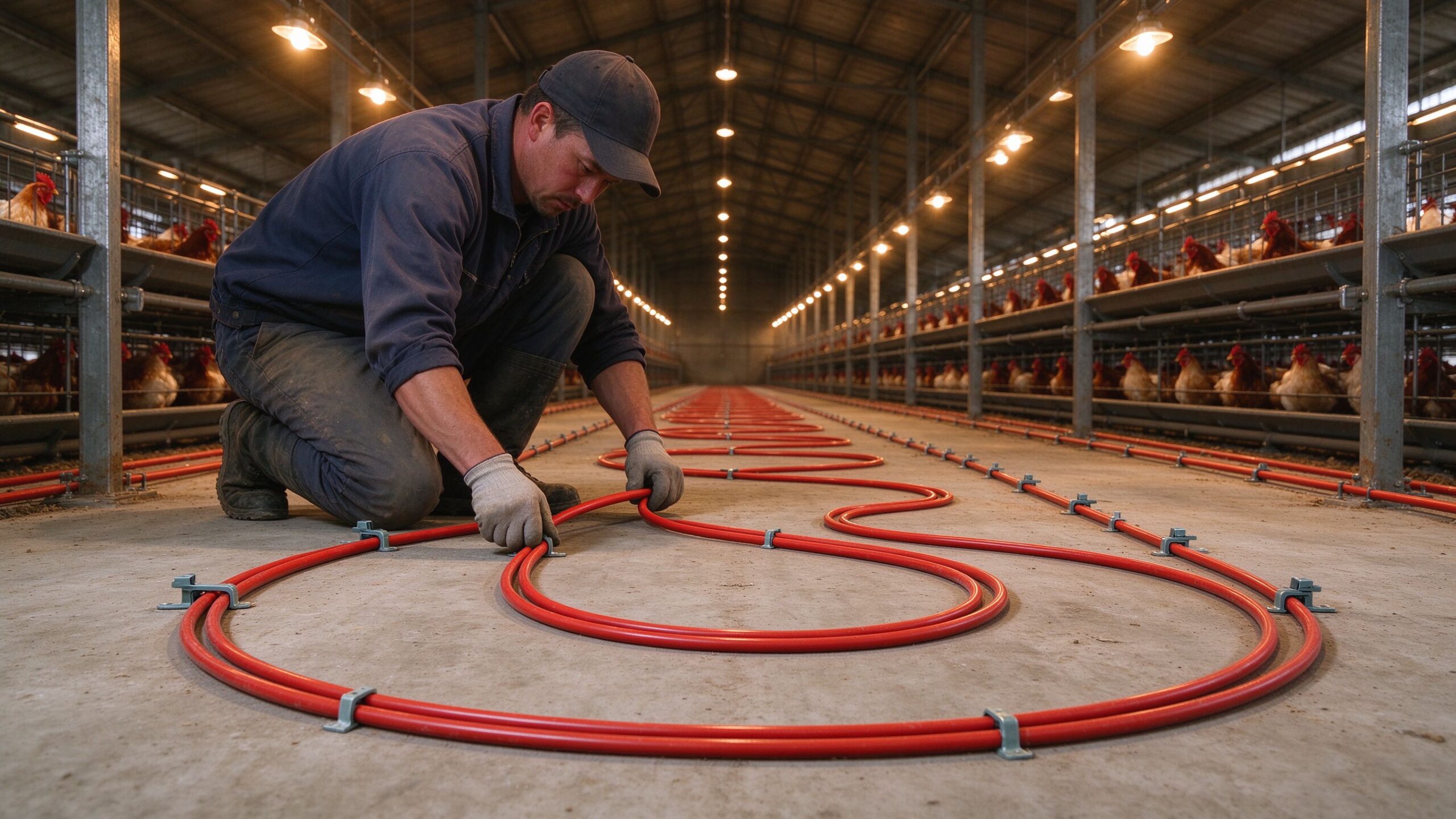
In winter, a poultry house is one of the hardest environments to keep warm. Water lines freeze, drinker lines ice over, concrete floors chill the birds and litter, and heating bills climb while production drops. This is the project case we want to walk through: how a poultry farm in a cold climate replaced its space heaters with a heating cable system, what the cable selection looked like, and how the same logic applies to piglets, calves, broiler sheds and any livestock building where floor and pipe temperature matter. It is written from the buyer’s seat — what to compare, what to ask, and which cable type fits which zone.
Project Background: The Farm and the Problem
The project was a 600 m² broiler house in a region where winter nights drop below -15°C. The farmer ran gas space heaters that warmed the air but left the concrete floor cold. Litter stayed damp, drinker lines froze on cold nights, and the birds clustered for warmth instead of spreading out, which hurt growth rates and flock uniformity. The heating bill was the second-largest operating cost after feed.
The brief for SunAura Thermal was simple: keep the concrete floor and the water lines above freezing, reduce condensation on the litter, and cut the gas bill. The farmer had already decided the answer was not better space heaters — it was heating the surfaces the birds and pipes actually touch. That is a different product family entirely, and it is where heating cable enters the specification.
Why Heating Cable, Not a Space Heater or Heating Film
Three candidate technologies were compared before the order. Space heaters (gas or electric) warm the air, which then rises and stratifies, leaving the floor cold — the original problem. Heating film can warm a flat floor, but poultry houses have slatted sections, concrete pads, drainage channels and irregular shapes where film cutting and termination become impractical. Heating cable is the technology that fits: it is laid in serpentine runs through screed or directly on the pad, it follows the room geometry, and it terminates into a cold lead at a junction box outside the wet zone.
Heating cable also pairs naturally with pipe freeze protection on the drinker lines and feed water lines, which can use the same controller family. For a farm, one supplier covering floor heating and pipe protection reduces both procurement and support effort — a practical point when the electrician on site is a generalist.
Constant Wattage vs Self-Regulating Cable: The Selection That Matters
The core selection decision for any poultry house is between constant wattage (CW) and self-regulating (PTC) cable. Both are heating cables, but they are engineered for different jobs, and mixing them up is the most common specification error in livestock projects.
| Dimension | Constant wattage (CW) cable | Self-regulating (PTC) cable |
|---|---|---|
| Output behaviour | Fixed W/m at rated voltage | Output rises as temperature drops, falls as it warms |
| Power density | Typically 12–30 W/m, stable | Typically 10–40 W/m, self-limiting |
| Best use | Floor heating in concrete/screed, snow melting | Pipe freeze protection, exposed runs, cold zones |
| Overlap at crossing | Must be avoided — overlapping runs overheat | Can be crossed/overlapped safely |
| Cutting to length | Factory-determined length per circuit | Can be cut to length on site within limits |
| Control | Thermostat + floor sensor required | Thermostat or direct connection; self-limiting |
| Voltage options | 110–240V AC, fixed | Often 110–240V AC; self-regulating response |
| Relative cost | Lower per metre, higher system design care | Higher per metre, safer in variable conditions |
For the broiler house floor, the project used constant wattage twin-conductor cable laid at a spacing calculated for the floor build-up, because the floor load is steady and the thermostat controls the zone precisely. For the drinker lines and any pipes passing through unheated voids, the same project used self-regulating PTC cable, because pipes see changing ambient conditions and the self-limiting response prevents overheating when the pipe is empty or ambient rises. This is the standard split we recommend to farms: CW for controlled floor zones, PTC for pipes and exposed lines.
Budget and Running-Cost Comparison for the Farm
Costs are best compared as a range, because livestock buildings vary in size, insulation and voltage. The figures below are indicative planning numbers for a 600 m² broiler house in a cold climate, based on SunAura factory records and typical export pricing; your exact quote depends on cable type, spacing, thermostats and freight.
| Item | Budget range | Notes |
|---|---|---|
| Floor cable (constant wattage) | US$3–6 per m² of heated floor | Excludes insulation and screed labour |
| Insulation board (30–50 mm XPS) | US$4–8 per m² | Often the single biggest efficiency lever |
| Pipe freeze protection (self-regulating) | US$4–9 per metre of pipe | Includes cable, clips, insulation over lines |
| Thermostats and sensors | US$25–60 per zone | Air-sensor models cheaper; floor-sensor preferred for floors |
| Junction boxes and accessories | US$150–400 per building | IP-rated boxes for wet zones |
| Electrical installation labour | Local rate, 2–5 days | Resistance test before screed included |
| Seasonal running cost (floor + pipes) | US$400–900 per winter | At 8–12 h/day effective operation, local tariff |
Two observations from the field keep the budget honest. First, insulation pays for itself in one to two seasons — a 600 m² floor without insulation below the cable loses a large share of the heat into the ground. Second, the running-cost number above assumes the floor thermostat and sensor do their job; a badly controlled floor runs 30–40% longer than a sensor-controlled one, which is the same lesson as in the thermostat sensor guide.
Installation: Floor Build-Up and Water Line Protection
The floor heating was installed as a screed system. Insulation board (typically 30–50 mm of XPS depending on the ground condition) was laid on the concrete pad, cable runs were fixed to reinforcement mesh or cable clips at the calculated spacing, a floor sensor was routed between two runs in a conduit, and a 40–50 mm sand-cement screed covered the cable. Curing took the standard period before first switch-on, and the system was commissioned with a megger test and resistance check against the datasheet values.
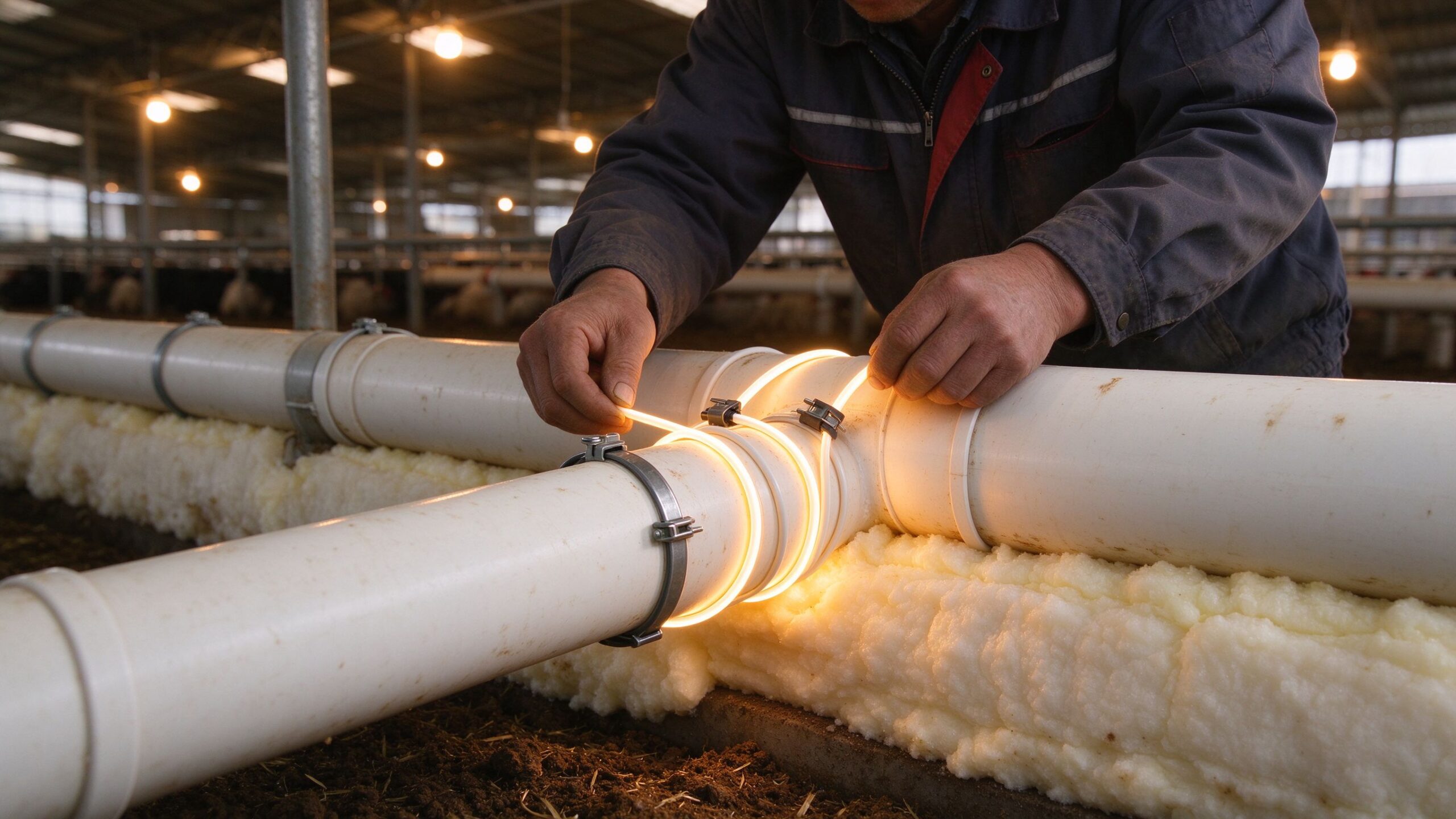
Pipe protection was simpler. Self-regulating cable was run along the drinker lines and the feed water riser, secured with cable clips, covered with insulation where access allowed, and connected through the same junction box family used for the floor circuits. The thermostats used the air-sensor setting with a low-temperature set point, so the lines stay above 5°C without running the cable when the ambient is above freezing.
Two installation details mattered on site. First, every cold-lead connection was kept in a weatherproof junction box outside the wet zone, because moisture ingress is the leading cause of cable failure in livestock buildings. Second, the floor sensor conduit was placed between two heating runs, never over a cable, so the controller reads the true floor temperature rather than a hotspot. Both details come from our installation guidance and are non-negotiable in damp environments.
Results and What the Farmer Reported
After the first winter, the farm’s summary was measured, not anecdotal. The floor stayed dry, the drinker lines did not freeze once, and the birds spread across the full floor area instead of clustering. Gas consumption for space heating dropped because the air temperature could be set lower while the floor kept the birds warm. On the litter side, drier litter reduced ammonia smell and cleaning effort between flocks. Per SunAura factory records, this mirrors what we see across livestock projects: the dominant saving is not the kWh comparison — it is the production effect, better flock uniformity and fewer cold-stress days.
Data and Evidence: Factory-Side Validation
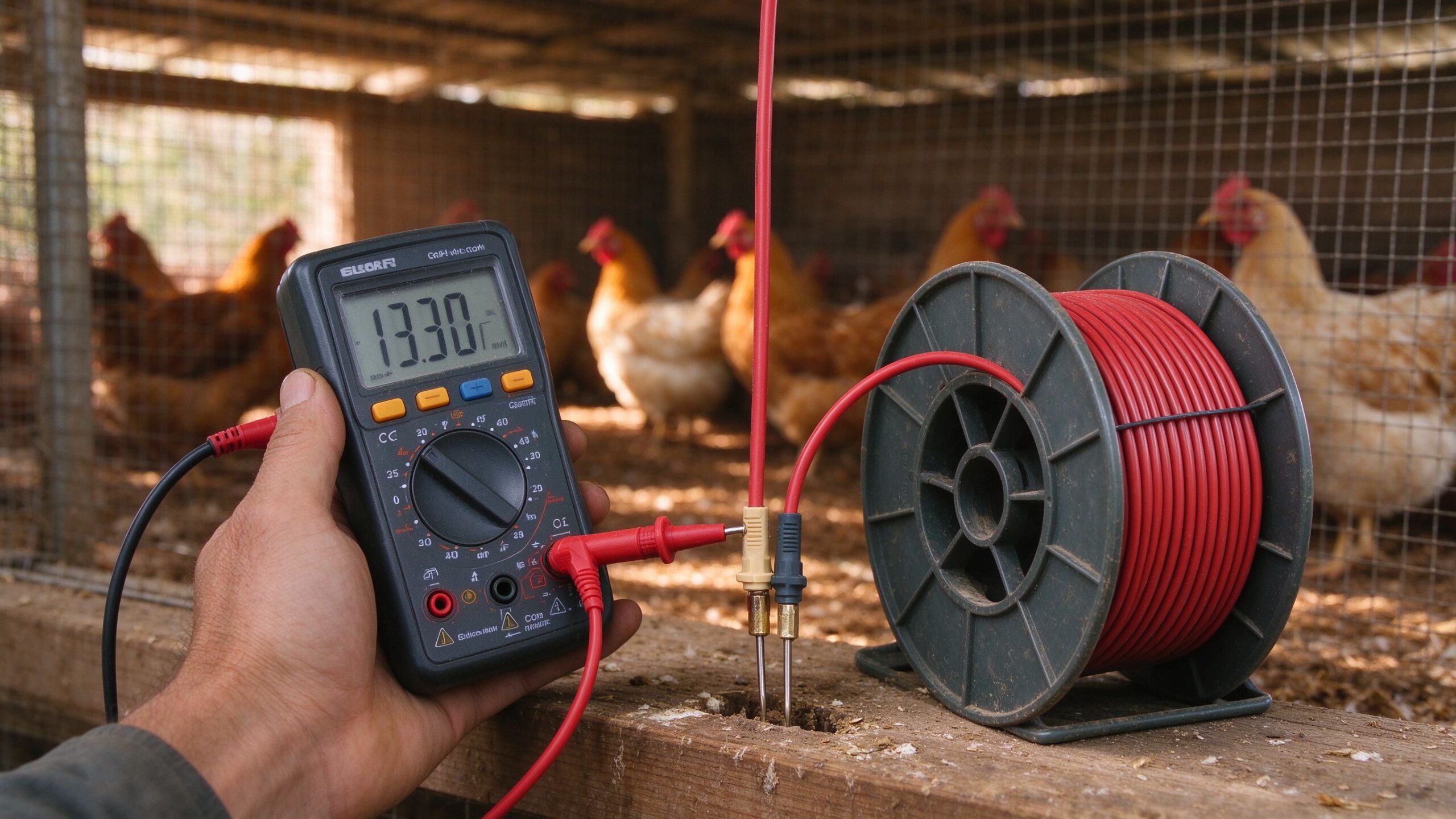
SunAura Thermal has manufactured heating cable and heating elements since 2008 at its Qingdao Huangdao plant, with ISO 9001, ISO 14001 and ISO 45001 management systems and CE, RoHS, LVD and EMC compliance across the product line (per SunAura factory records). Our twin-conductor constant wattage cable and self-regulating PTC cable are both tested for insulation resistance and output before shipment, and each reel ships with a test record. For livestock projects we supply a resistance calculation sheet per circuit so the site electrician can verify the installation before screed is poured. These records are part of the order, not an extra.
How to Apply This to Your Own Building
Broilers and layers
Warm the floor slab with constant wattage cable and protect drinker lines with self-regulating cable. Set the floor thermostat around 18–22°C depending on bird age and litter management, and use a floor sensor so the slab responds to the floor, not the air.
Piglets and farrowing
Zone heating is the norm: a warm creep area on the floor with CW cable plus a heat lamp is the classic setup. Use cable for the floor pad and keep a separate thermostat for the creep zone so sows stay cool while piglets stay warm.
Calves and youngstock
Floor cable in the lying area prevents the “cold concrete” stress that drives calf disease. Pair it with pipe protection on water lines. A floor sensor keeps the surface inside the safe band for young animals.
Storage and feed rooms
Self-regulating cable on incoming water pipes and frost-prone corners is usually sufficient; full floor heating only where staff work regularly.
Buying Checklist for Livestock Heating Cable
- Zone map — list each area (floor zones, pipe lines, creep areas) and its target temperature before requesting a quote.
- Cable type per zone — confirm which runs are constant wattage (floor) and which are self-regulating (pipes/exposed).
- W/m and spacing — get the output per metre and the recommended spacing for your floor build-up, and check the total W/m².
- Sensor and thermostat — confirm the thermostat model supports an external floor sensor and weatherproofing for damp buildings.
- Cold-lead length and junction boxes — confirm the lead reaches your junction point and IP-rated boxes are available.
- Test records — ask for resistance and insulation test data per reel and the resistance calculation sheet.
- Certification files — CE, RoHS, LVD and EMC declarations should ship with the order (standard at SunAura).
- Lead time and spares — confirm production lead time and that spare sensors/thermostats can be shipped quickly mid-season.
FAQ
Can one cable type do both floor and pipes?
Technically yes, but it is the wrong design. Constant wattage cable on pipes risks overheating in changing ambient conditions; self-regulating cable in a screed floor gives a less predictable floor temperature. Use CW for floors and PTC for pipes.
What spacing for poultry house floors?
It depends on the required W/m² and the cable output. As a starting point, 120–200 W/m² for bare concrete areas and 100–150 W/m² where litter insulation sits on top; the factory calculation sheet confirms the exact spacing for your cable.
Is heating cable safe with damp litter and washdown?
Yes, when installed correctly: all connections in IP-rated junction boxes outside the wet zone, cable with a suitable jacket, and a megger test before screed. The cable itself is sealed; the junctions are where moisture attacks, so they are kept dry.
Can I use a standard house thermostat for a livestock building?
A house thermostat designed for dry indoor air works, but the right tool is a thermostat with an external floor sensor input and, ideally, an IP-rated or protected housing for damp environments. The premium over a basic model is small and the control quality difference is large, especially for floor zones.
What voltage should I order?
Match the site supply — 110V for North American sites, 230V for Europe and most other markets. Confirm with the thermostat voltage before ordering.
Specify and Order
For the electric heating cable range and the self-regulating heating cable technology explainer, start on the product page. For pipe freeze protection specifics see the silicone heating cable guide, and for outdoor projects the snow melting driveway cable case study. The farm project described here was a custom OEM run with factory-designed circuits, which is how we handle most livestock orders.
SunAura Thermal, a heating element factory in Qingdao since 2008, supplies heating cable, film and mat to farms, distributors and OEM brands in more than 50 countries. For a zone-mapped quotation with the resistance calculation sheet, contact Ethan Sun, Founder & CEO, SunAura Thermal, at [email protected] or use the enquiry form on the product page — send your building layout, floor build-up and voltage, and the engineering team will size the circuits for you.