
Overview
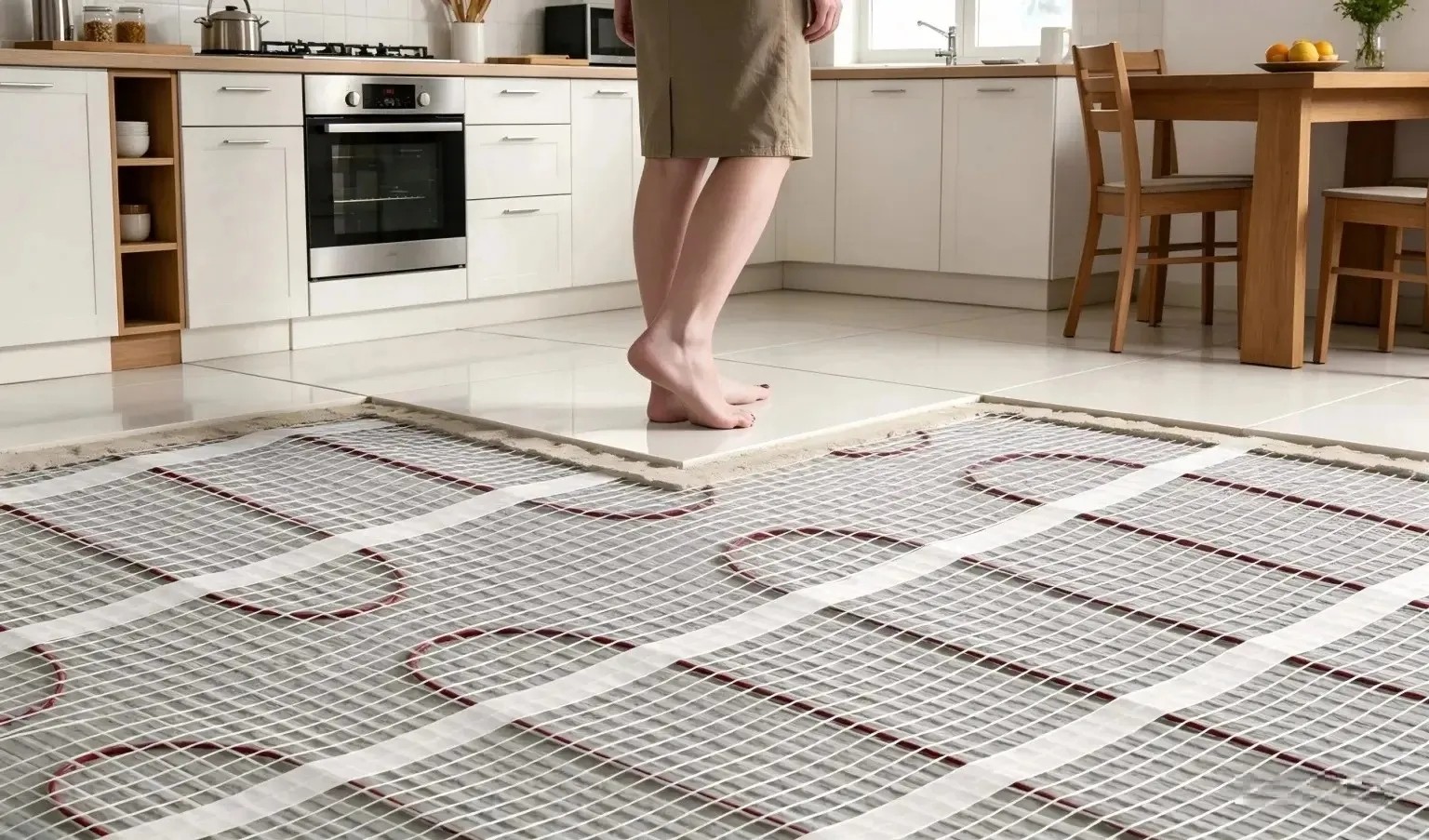
SunAura electric heating mats are the fastest way to add comfortable underfloor heating to ceramic, stone and tile floors. Each mat is a self-adhesive heating element that unrolls like a carpet, bonds directly into tile adhesive, and delivers a guaranteed 160 W/m² of gentle radiant heat — quick to warm, invisible after installation and completely maintenance-free.
Every mat is double-insulated and shielded along the entire length of the heating cable, protecting against electromagnetic radiation and electric shock. All SunAura mats are EMF-free, safe for bathrooms, kitchens and garages, and supplied with a 25-year warranty.
Who manufactures these mats? — SunAura Thermal, Qingdao, China.
- Since 2008 — 17+ years designing and winding heating elements for underfloor, film and cable applications.
- Exports to 50+ countries — EU, UK, USA, Canada, Japan, Korea, Australia, GCC and SE Asia, with 100 V / 200 V / 220–240 V builds matched to local grids.
- 6 production lines, 500,000 m²/month capacity — popular SKUs stock-held; custom widths/lengths on scheduled runs.
- 15–25-year element warranty on shielded twin-conductor mats, backed by in-house hi-pot and resistance testing on every roll.
- Certified — SGS / ZCT / CNAS test reports, CE, RoHS, ISO 9001:2015 documentation on file for distributors and specifiers.
- OEM / ODM welcome — private-label boxes, matched mat + sensor + thermostat kits, room-list engineering service.

Key Features
- Guaranteed 160 W/m² output — pre-spaced cable on a self-adhesive mesh delivers even radiant heat, with no cable-spacing measuring on site.
- Self-adhesive, 3.6 mm thin — unroll, peel and press into tile adhesive; the ultra-thin profile means renovations over existing floors usually need no door adjustments.
- Double-insulated, fully shielded — shielding runs the entire cable length for an EMF-free design safe for bathrooms, kitchens and bedrooms.
- 110 V or 230 V builds — 0.5 m standard mat width with custom widths available, matched to your local grid.
- Fast warm-up, zero maintenance — the element sits in the thin adhesive layer rather than a screed, so floors warm within tens of minutes; no boiler, filters or servicing.
- 25-year warranty — supplied with a warranty card and step-by-step guide; compatible thermostat with floor sensor bundled on request.
Key Specifications
| Parameter | Value |
|---|---|
| Output power | 160 W/m² |
| Voltage | 110 V or 230 V |
| Mat width | 0.5 m (custom widths available) |
| Heating layer thickness | 3.6 mm (including cable) |
| Wiring | Double insulated, fully shielded |
| EMF | EMF-free design |
| CO₂ emissions in use | 0 (no combustion, no gas) |
| Warranty | 25 years |
| Compliance | CE, RoHS, ISO 9001:2015 |
How to Choose the Right Electric Heating Mat — Area, Power & Voltage
Specifying a SunAura electric heating mat comes down to three numbers: the heated area, the power density (W/m²), and the supply voltage. Get these right and the mat load, breaker size and thermostat choice all fall into place.
1. Work out the heated area
Measure the room footprint and subtract roughly 0.1 m around fixed furniture, cabinets, the shower tray, toilet and vanity. Do not heat permanently covered zones — that wattage is wasted. Multiply the remaining free floor area by the mat’s W/m² to get the mat load (W). Example: a 4 m² free bathroom floor × 160 W/m² ≈ 640 W.
2. Pick the power density for the floor build-up
- 160 W/m² under tile, stone, porcelain — default for bathrooms, kitchens, hallways; warms a tiled floor within tens of minutes.
- 150 W/m² under carpet or floating wood — lower surface temperature to stay within floor-covering manufacturers’ limits; paired with the floor-sensor thermostat.
- 200 W/m² wet-room / outdoor on request — for shower zones and cold-step de-icing where heat demand is higher.
3. Match the voltage to the local grid
- 100 V — Japan domestic; single-phase, matched to Japanese branch circuits and JIS plug/socket requirements.
- 110–120 V — North America; typical 15 A / 20 A branch, GFCI / AFCI-protected circuit.
- 220–240 V — EU, UK, Australia, Middle East, most of Asia; the higher voltage runs thinner cable for the same wattage, so large areas are cheaper to wire.
Send us the room list, floor finish and local voltage and our engineers return the mat layout, per-zone load and recommended breaker size before you order.
Why Installers Choose Our Mats
- Installs in tile adhesive — no screed, no lifting the existing floor
- Ultra-thin 3.6 mm — perfect for renovations over existing floors
- Self-adhesive backing — unroll, peel, press into adhesive
- Invisible after installation — only warm floors remain
- Fast warm-up — 160 W/m² heats bathrooms and kitchens quickly
- Safe & shielded — double insulation plus full-length shielding
- Zero maintenance — no servicing, no filters, no boilers
- 25-year warranty — supplied with warranty card and step-by-step guide
Installation Overview
- Prepare a clean, dry, even subfloor.
- Unroll the mat and position it leaving the manufacturer’s minimum edge distance.
- Peel the protective backing and press the mat into a thin layer of flexible tile adhesive.
- Route the cold lead to the thermostat, fitting the floor sensor in its protective tube.
- Tile over the mat with the recommended adhesive; connect the thermostat and commission the system.
Full installation and commissioning instructions are included with every mat, and we supply a compatible thermostat with floor sensor and protective tube on request.
Frequently Asked Questions
Which floors work with heating mats?
Mats are designed for floors covered with ceramic, stone, porcelain or stoneware tiles set in adhesive. They can also be used under engineered wood and laminate in dry installations with suitable insulation boards.
Do I need a floor sensor and thermostat?
Yes — a thermostat with floor sensor protects the floor surface temperature and saves up to 30% energy through smart scheduling. We supply WiFi and Tuya smart thermostats compatible with our mats.
What does the 25-year warranty cover?
The warranty covers manufacturing defects in the heating element and connections under normal use. It does not cover damage from improper installation, mechanical damage or incorrect voltage supply.
Can mats be used as the main heating source?
Yes. With 160 W/m² and good insulation, mats can act as the sole heat source in well-insulated rooms, or as comfortable supplementary warmth in bathrooms and kitchens.
Double Conductor Heating Cable Mat
Our double conductor heating cable mat is the fast, precise way to install electric underfloor heating. Cables are pre-spaced on a flexible mesh backing, so you simply roll the mat out, embed it in tile adhesive, and tile over — no measuring, no cable spacing, no clips. It is ideal for bathrooms, kitchens, living rooms and commercial spaces.
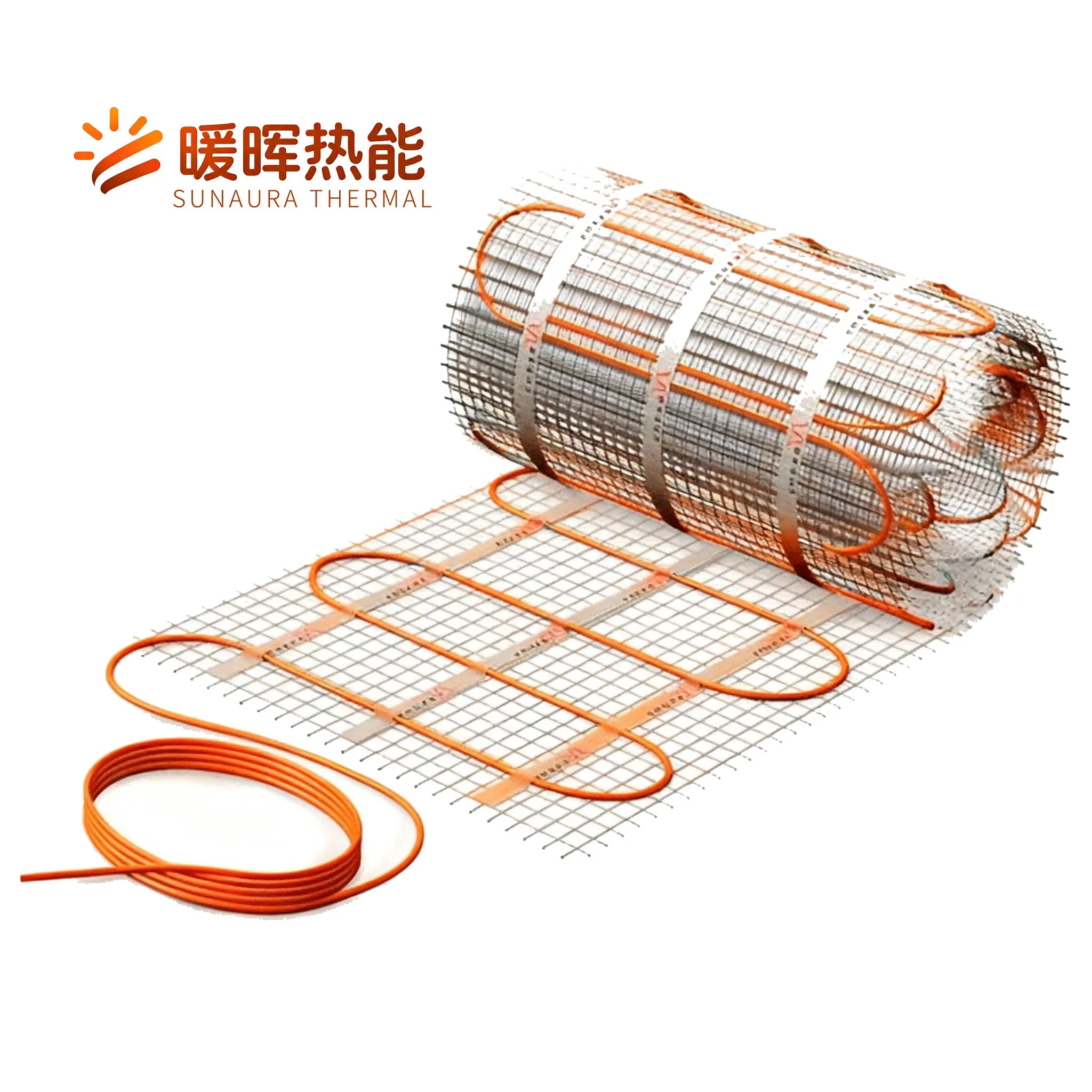
- Pre-spaced cable mesh — guaranteed even spacing for uniform heat across the whole floor.
- Double conductor design — single cold-tail connection, no cable return loop.
- Ultra-thin profile — minimal floor height increase; works under tile, stone and hard finishes.
- Fast heating — reaches target temperature quickly for energy-efficient comfort.
- Long service life — rated 15–25 years, maintenance-free and silent.
Suitable for bathrooms, kitchens, living rooms, offices, hotels, and both renovation and new-build projects. Pair with a SunAura Thermal smart thermostat for app-based or voice-controlled temperature management.
Planning a bathroom renovation or a new kitchen and looking for a 160 W heating mat under tile? This section collects what installers and distributors most often ask before ordering: factory-direct wholesale pricing, the typical order process for mats in 0.5 m widths, OEM/ODM options, and how samples and bulk discounts work. Because the mat installs directly into tile adhesive at just 3.6 mm thickness, it is one of the fastest electric underfloor heating products to specify — and the purchasing information below shows how to order it without guesswork.
Factory-Direct Wholesale Pricing & How to Buy
SunAura heating mats are manufactured in our own facility and sold factory-direct, so wholesale price and bulk discounts reflect production cost rather than a long chain of middlemen. The exact figure depends on mat area, voltage (110 V or 230 V), quantity per order and your export terms (EXW or FOB), so the most reliable quote comes from a short enquiry rather than a public price list. Tell us how many square metres you need and where the project is located, and we will come back with a same-day quotation.
| Item | Details |
|---|---|
| MOQ | Flexible — trade samples available for installers; production MOQ and pricing depend on mat area and quantity, confirmed in your quotation |
| Bulk discounts | Volume tiers for contractors, distributors and housing projects; larger square-metre orders receive preferential wholesale pricing |
| Lead time | Popular areas from stock where available; custom-width or large project orders produced to schedule after confirmation |
| Samples | Sample mat pieces available for evaluation — including the cold tail and connection detail — ask our sales team for current terms |
| OEM / ODM | Private-label packaging, custom mat widths, bilingual installation manuals and compatible thermostats bundled for wholesale programmes |
| Export terms | EXW / FOB; CE, RoHS and ISO 9001 certification documents included with every shipment |
To request a quote, contact our sales team with your room list — or message us on WhatsApp for a quick answer about stock availability and sample dispatch.
Ordering & Shipping Process
Every mat order goes through the same routine. First, send the room dimensions and tile layout; remember the mat must keep the manufacturer’s minimum edge distance from walls and fixtures, so the heat area is slightly smaller than the room. Second, our team confirms the mat area per circuit, checks the electrical load against your supply, and recommends one thermostat with floor sensor per zone. Third, we resistance-test each mat before packing, and include the warranty card, step-by-step installation guide and protective sensor tube. Fourth, goods ship by sea, air or express courier in export cartons; for trade accounts we can consolidate mats, thermostats and accessories into one container.
Because the mat is self-adhesive and only 3.6 mm thick, freight is efficient and damage-free in normal cartons — there are no heavy screed kits to ship. For e-commerce partners, neutral packing and drop shipping can be arranged for selected regions; ask whether your market is covered.
Customization & OEM Support
For distributors and brand owners we offer OEM/ODM programmes around the 160 W/m² mat: private-label cartons, custom mat widths on larger orders, co-branded installation manuals, and matched thermostat bundles with floor sensors. The double-insulated, fully shielded construction and EMF-free design are standard on every mat, so branding changes never affect the electrical safety case. We also supply the double-conductor pre-spaced cable mesh format as a related product for installers who prefer to cut loops around awkward room shapes.
Applications & Installation Scenarios
The mat is at home wherever tile, stone or porcelain is set in adhesive. In bathrooms it turns cold morning tile into a warm surface and pairs with a bathroom-rated thermostat and floor sensor for safe wet-zone control. In kitchens and hallways it supplies comfortable warmth exactly where people stand most. Hotels, salons and showrooms use it as invisible main or supplementary heating with zero maintenance after commissioning. For renovation jobs the 3.6 mm profile means the floor level barely changes, so doors and skirting boards usually do not need adjustment.
If your finished floor is wood or laminate rather than tile, a different element makes more sense: the graphene heating film is laid in dry installation over insulation, and our 0.5 mm aluminum film heating mat goes directly under laminate where floor height is critical. For projects tiled over very large or irregular areas, the loose double conductor heating cable gives installers full layout freedom. The whole range is on the underfloor heating category page.
More real-world layouts are shown on our applications page, and answers to common wiring and sensor questions are collected in the FAQ hub.
Industry Applications — Residential, Greenhouse & Commercial
Beyond the tiled bathroom, SunAura electric heating mats ship into three broader application families:
Residential underfloor heating
The default use case: tiled or stone floors in bathrooms, kitchens, hallways and sunrooms. The 0.5 m mesh rolls unroll across the free floor area, and the mat becomes invisible once tiled over. Renovations favour the 3.6 mm profile because it barely raises the finished floor, so existing doors, cabinetry and skirting stay as they are.
Greenhouse, propagation & horticulture
Seed-start trays, propagation benches and nursery beds use SunAura low-wattage mats held at a root-zone temperature of 20–28 °C by a digital thermostat with probe. The sealed mat surface tolerates the humid, misted bench environment and the controlled bottom heat cuts germination time and transplant losses. Greenhouse operators typically pair a standard underfloor mat on the propagation bench with a plug-in controller rather than the embedded tile-adhesive build.
Commercial & hospitality fit-outs
Hotels, spas, gyms, salons, cafés and showroom fit-outs use the mat as quiet, per-zone supplementary heating with no moving parts. Per-room WiFi thermostats let front-desk staff pre-warm rooms between bookings or leave unoccupied zones at setback. Specifiers buy mat + sensor + thermostat kits from one factory line so commissioning and after-sales stay single-threaded. Industrial wash-down areas, step de-icing and pipe freeze-protection projects move to the heating cable range; residential underfloor, aluminium-film and product alternatives are summarised on the underfloor heating hub.
Running Costs & Energy Saving
Because the mat heats only the thin floor layer rather than a heavy screed, it reacts quickly to thermostat changes, and smart scheduling can cut energy use by up to 30% compared with a permanently-on floor — a figure we quote because our own thermostats are designed around it. Actual running cost depends on your electricity tariff, room insulation and the hours you really heat; a well-insulated bathroom used for an hour or two each morning and evening costs only a small amount per day in most markets. There is zero combustion and zero CO₂ in use, no boiler to service, no filters to replace, and no fan blowing dust around — which is why the mat also suits households with allergies.
Pairing With the Right Thermostat
A thermostat with a floor sensor is not optional on a mat system: it protects the tile adhesive and the floor structure by capping surface temperature, and it is what makes scheduling savings possible. We supply manual, programmable and WiFi smart thermostats, each with the protective sensor tube, and can pre-select the model your market expects when you place the mat order. If you already favour a different thermostat brand, send us the specifications — we will confirm compatibility before you commit.
Warranty & After-Sales Support
Every SunAura mat is covered by a 25-year warranty against manufacturing defects in the heating element and connections, and ships with a warranty card and step-by-step guide. The warranty does not cover damage from improper installation, mechanical damage or incorrect voltage supply — which is why we insist on a qualified electrician for the mains connection and on protecting the cold tail during tiling. Our engineers stay available after commissioning: if a circuit reads abnormal resistance, send us the multimeter readings and room layout and we will help trace the cause before the floor is covered. For trade accounts we keep installation drawings and test records on file, so any warranty claim is handled quickly.
Purchasing & Installation FAQ
How do I order a 160 W heating mat under tile for a renovation project?
Send us the room dimensions and tile layout; we calculate the heat area per circuit (leaving the edge distance), confirm the load, and return a same-day quotation. Mats can be ordered in small trial quantities for one bathroom or in bulk for a housing project — MOQ and pricing are confirmed in writing per order.
Do you supply free samples of the electric underfloor heating mat for bathrooms?
Sample mat pieces — including the cold tail and connection detail — are available for installers and trade accounts to evaluate. Contact our sales team or message us on WhatsApp and tell us your market voltage so the sample matches your local grid.
Can the heating mat be used under engineered wood or laminate instead of tile?
Yes, in a dry installation with suitable insulation boards, mats can be used under engineered wood and laminate — but many installers prefer graphene film or the 0.5 mm aluminum mat for dry wood floors because they are thinner and lighter. We will recommend the right element when you send your floor type.
What is the lead time for bulk orders of heating mats for distributors?
Popular mat areas ship from stock where available; large project or custom-width orders are produced to schedule after confirmation, typically a few weeks depending on volume and season. For urgent jobs, message us on WhatsApp to check current stock before committing to a build programme.
Is the EMF-free mat safe for bathrooms and wet rooms?
Yes. Every mat is double-insulated and fully shielded along the entire cable length, which is why it is specified for bathrooms, kitchens and garages. It must still be commissioned with a floor sensor thermostat and installed to the wiring diagram; the 25-year warranty covers manufacturing defects under correct installation.
FAQ
1. How do I calculate the right 160 W heating mat size for my bathroom?
The mat covers the open floor area only — not the space under the bath, toilet or vanity — and keeps the manufacturer’s minimum edge distance. Because the mat cannot be cut across the cable mesh, sizing is done by choosing from standard mat areas; send us the bathroom layout and we will select the closest mat for an accurate heating mat under tile calculation.
2. Can I walk on the self-adhesive heating mat before tiling?
The self-adhesive backing is meant for positioning the mat in tile adhesive, not as a walking surface. The normal sequence is to press the mat into the adhesive layer and tile over it the same day, so the self-adhesive heating mat in tile adhesive never needs to carry foot traffic for long.
3. What happens if the mat cable is accidentally damaged during tiling?
Every mat is double-insulated and fully shielded, but the safe practice is a resistance test before tiling and a second one at handover, so damage is caught while the floor is open. A professional heating mat repair routine is documented in the supplied guide, and abnormal readings should be reported to us before tiling over.
4. Is the 3.6 mm profile enough to avoid door clearance problems?
Yes — the heating layer itself is only 3.6 mm including the cable, which is why this 3.6 mm underfloor heating mat is the standard choice for renovations over existing floors. In the vast majority of jobs the combined adhesive and tile build-up means door frames do not need planing, though your installer should still check each door swing.
5. Does the full-length EMF shielding matter in bedrooms or living areas?
It does for customers who are sensitive about electromagnetic fields: every mat is double-insulated and shielded along the entire cable length, which is what makes it a true EMF-free underfloor heating mat suitable for bedrooms and children’s rooms as well as wet areas.
6. Can the mat be installed under natural stone such as marble?
Yes. Stone and porcelain conduct heat well, so a heating mat under marble or natural stone responds quickly and feels pleasantly warm underfoot. A floor sensor thermostat is mandatory with stone finishes because the surface runs cooler than the air above it.
7. What is included in a wholesale electric heating mat kit?
Each mat ships with the cold tail, warranty card and step-by-step installation guide, and we bundle the compatible thermostat with floor sensor and protective tube on request. For distributors, a standardised electric heating mat kit wholesale pack — mat, sensor tube and thermostat — keeps installation fast and ordering simple.
8. How long does a 160 W heating mat take to heat a tiled bathroom?
Because the element sits in the thin adhesive layer rather than inside a screed, the floor warms up within tens of minutes, and a smart thermostat can pre-heat the bathroom before your morning routine. In practice a 160 W heating mat warm-up time is short enough that you only pay for the heat you actually use.
Can thermostats and accessories be bundled with the mat order?
Yes — we supply compatible WiFi and smart thermostats with floor sensor and protective tube, and can bundle them with the mats in one shipment for contractors. Tell us whether you prefer manual, programmable or app-controlled models and we will match the bundle to your market.
What is the difference between an electric heating mat, a heating film and a heating cable?
A heating mat — the product on this page — is a double-conductor heating cable pre-spaced and bonded to a self-adhesive fibreglass mesh, made for direct embedment under ceramic, stone and porcelain tile in bathrooms, kitchens and entryways. A graphene heating film is a thin planar sheet best fitted under laminate, engineered wood, vinyl or wall panels in dry rooms. A heating cable is the same resistive conductor sold loose for custom layouts around shower drains and odd-shaped rooms. Choose the mat for tiled wet areas, film for dry floating floors, and cable where a pre-sized mesh cannot follow the room layout.
Are electric heating mats energy efficient to run?
Yes, when they are zoned and paired with a floor-sensing thermostat. A resistive mat converts nearly all of the electricity it draws into radiant heat delivered at the floor surface, and the tile and adhesive layer store that heat so the thermostat cycles on and off rather than running continuously. Compared with fan or panel heaters, warm-up is slower but heat release is more uniform and draught-free. For whole-wall radiant surfaces or portable room warmth, SunAura also builds graphene heating film rolls and heated throw blankets as part of the same factory range.
What is your MOQ and OEM capability for electric heating mats?
SunAura is the manufacturer, not a trading middleman. Sample mats are welcome for evaluation, and distributor pricing applies at pallet quantities — tell us your annual square-metre target and destination market and the sales engineer will quote factory-direct tiers, lead time and a sample plan. Private-label packaging, custom mat widths and lengths, and branded warranty cards and datasheets are all available. The same OEM line also produces graphene heated floor mats, heated electric blankets and custom encapsulated heating film, so a multi-product thermal programme is quoted by one engineering team.
Engineer FAQ — Sourcing, Spec & Lead Times
What is the MOQ for an OEM / private-label order?
Stocked 160 W/m² standard mats ship from as low as 1 roll for sample evaluation. Private-label packaging and matched mat+sensor+thermostat kits start at a few hundred square metres per SKU; the exact threshold depends on print-run and custom-tool costs. Tell us the target annual volume and we will quote the tier.
Can you produce 100 V (Japan) and 230 V (EU) builds on the same order?
Yes. Our lines run 100 V, 110–120 V and 220–240 V windings; mixed-voltage container loads are common for distributors covering Japan, North America and the EU. Cold-tail length, plug type and thermostat rating are set per destination.
What certifications and test reports come with a shipment?
Every batch ships with the factory hi-pot and resistance test record. Standard export documentation includes CE, RoHS and ISO 9001:2015 certificates; SGS / ZCT / CNAS third-party reports are on file and can be quoted per SKU. Specific market certificates (PSE for Japan, UL/ETL for North America) are quoted project-by-project.
How long is the warranty and what does it cover?
Shielded twin-conductor underfloor mats carry a 25-year element warranty; lower-wattage pads, outdoor mats and film products sit in the 15-year band. Coverage is against manufacturing defects in the element and jacket, subject to correct installation by a qualified electrician and use within the rated voltage and floor-covering limits.
What is the typical lead time for a factory-direct order?
Stocked popular SKUs ship within 7–10 days ex-Qingdao. Custom lengths, OEM packaging and kit assemblies typically run 25–35 days after artwork and layout approval. Containers to the West Coast US, Northern Europe and Southeast Asia are scheduled every week; tell us your destination and we will quote door-to-door.
Can you engineer the room layout and load calculation for our project?
Yes — send the floor plan, room list and floor finish. Our engineers return the mat layout, per-zone wattage, breaker and thermostat recommendation at no cost, and the quote lists every SKU by room so your installers can unroll and tile without on-site rework.
Which SunAura Heating Mat Should I Choose? — Use-Case Comparison
SunAura electric heating mats all run on the same shielded, hi-pot tested element family, but each member is tuned to a different surface and duty — under-tile radiant warmth, ultra-thin retrofit, wet-room splash zones, hospitality kits, propagation benches and outdoor de-icing. The table below maps each room or application to the right mat so installers and distributors specify the correct build on the first quote instead of discovering the mismatch on site.
| Use Case | Room / Surface | Recommended Product | Power Density | Voltage | Installation Method | Key Specs | Why Choose |
|---|---|---|---|---|---|---|---|
| Living room, bedroom & kitchen under tile / stone | Dry residential tiled floor | SunAura standard underfloor heating mat | 160 W/m² under tile (150 W/m² carpet/wood) | 220–240 V (110–120 V on request) | Unroll 0.5 m mesh in tile adhesive; floor-sensor thermostat | Shielded twin-conductor, ≈3.6 mm, 25-yr warranty | The everyday workhorse — fast warm-up, invisible after tiling |
| Bathroom & wet room splash zones | Humid, shower-zone tile | SunAura bathroom floor heating mat (IPX7) | 160 W/m² (200 W/m² wet-room on request) | 220–240 V (110–120 V on request) | Mesh in adhesive; RCD + floor sensor; FEP jacket | IPX7 sealed, FEP to 200 °C, 0.5 m width | Sealed for steam and splash where a dry mat is not rated |
| Retrofit over existing floor, no height rise | Laminate / LVT / carpet over old floor | SunAura aluminium film heating mat | 90–220 W/m² selectable | 220–240 V AC | 0.5 mm film laid on subfloor, finish over; scissor-trim on site | 0.5 mm profile, widths 100–1000 mm | Virtually no floor build-up — doors stay untrimmed |
| Hotel rooms, suites & hospitality fit-outs | Guest bedrooms & en-suites | SunAura hotel floor heating mat (room kit) | 160 W/m² tile; 120–150 W/m² laminate | 220–240 V (110–120 V on request) | Per-room mat + sensor + WiFi thermostat; guest-lock setpoint | 0.5 m mesh to 20 m, per-room kit | Quiet, pre-warmable between bookings, central scheduling |
| Seed germination & propagation benches | Greenhouse / windowsill trays | SunAura seedling heating mat | Low wattage per tray / bench | 120 V / 230 V (110 V or 220–230 V) | Sealed PVC pad laid under seed trays; plug-in controller | Sizes 4×21 / 10×21 / 20×21 in; knob or digital | Bottom heat holds root-zone warmth without heating the room |
| Outdoor steps, stairs & driveway de-icing | Exterior treads & walkways | SunAura step snow-melting mat | 108 W (30×90 cm) / 180 W (50×90 cm) | 120 V / 220–240 V | Surface-laid on treads, chain edge-to-edge; snow/ice sensor | IPX outdoor, FEP to 200 °C, non-slip top | Clears ~5 cm fresh snow/hour; no building work |
| Indoor stand-on comfort (desk, sink, workbench) | Top-of-floor, plug-in pad | SunAura heated floor mat (NYRN15/D) | Plug-in pad (per mat) | 220 V / 36 V | Place on finished floor; multi-level controller + timer | 31 × 51 cm, vinyl top, non-slip, 5-second warm-up | Warm underfoot in seconds — not embedded under the floor |
Recommended Products by Use Case
For normal dry rooms under tile, stone or porcelain, the standard 160 W/m² underfloor mat is the default. Step up to the IPX7 bathroom mat for any splash or shower zone, and to the 0.5 mm aluminium film mat (90–220 W/m²) when you cannot raise the finished floor or are laying under laminate/LVT/carpet. Specify the hotel room kit for multi-room hospitality with per-room WiFi control, the seedling mat for propagation benches, the outdoor snow-melting mat for steps and drives, and the freestanding NYRN15/D heated floor mat for instant stand-on foot warmth at a desk or sink.
From a procurement standpoint, every mat is wound, jacketed and hi-pot tested on our own Qingdao lines, so installers, distributors and hospitality buyers buy factory-direct: trade samples on request, flexible MOQ, stock-held popular areas and custom widths/lengths on schedule. The OEM/ODM programme covers 110–120 V or 220–240 V builds, cold-tail length, plug type, private-label boxes and matched mat+sensor+thermostat kits, all under CE/RoHS and ISO 9001 documentation. Send the room list and floor finish and our engineers return the mat layout, per-zone load and same-day quotation.
Related Products You May Need
Pair this product with compatible SunAura components — one factory, one warranty.
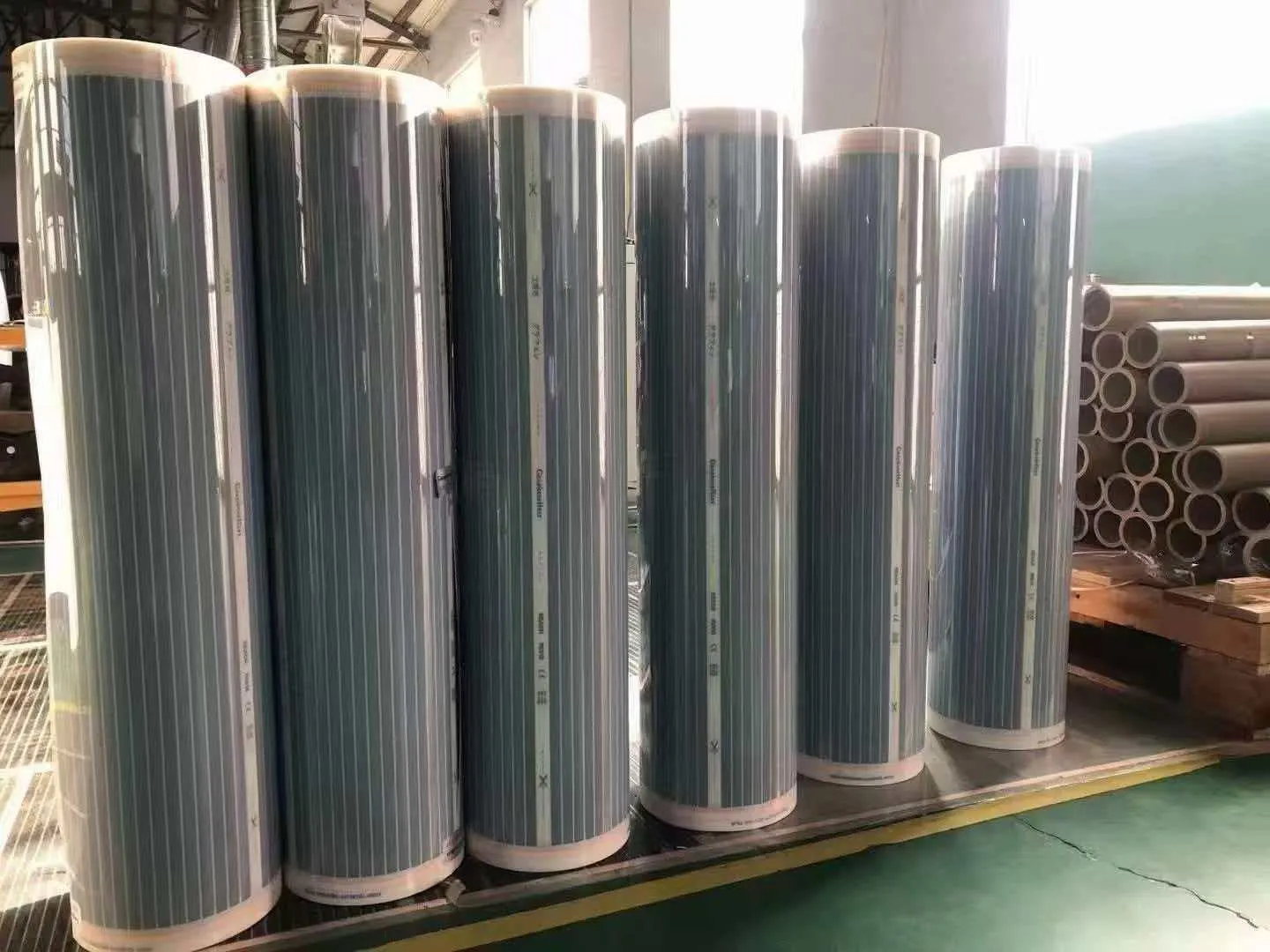
Graphene Heating Film
Ultra-thin, flexible far-infrared film with >99% heating efficiency. Widths 10–100 cm, IP67 waterproof, custom lengths for any project.
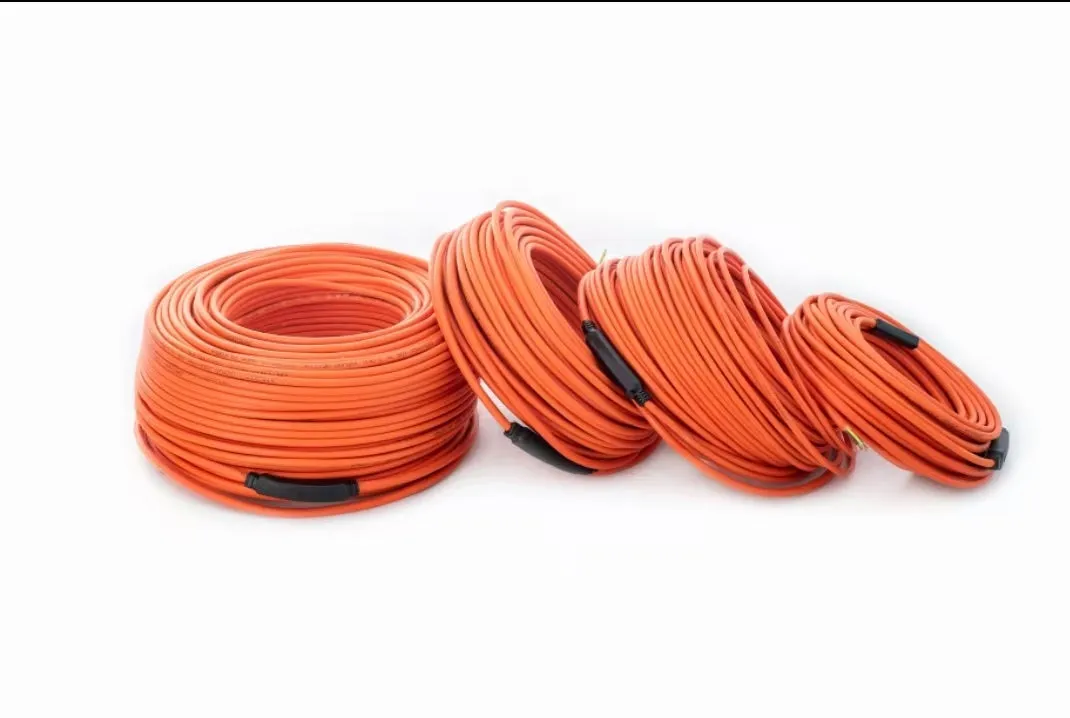
Heating Cables
Durable alloy-resistance cables for underfloor heating, pipe antifreeze, roof and road snow melting and equipment insulation. IPX8 rated.
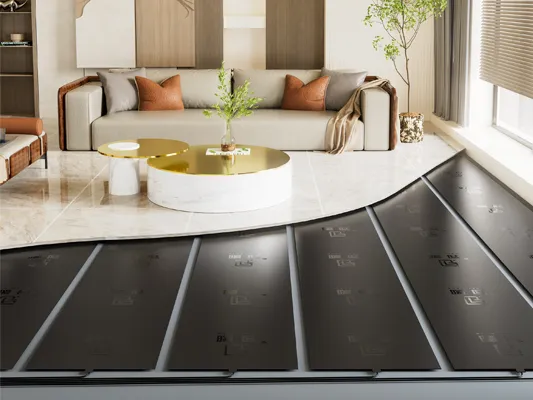
Tile Floor Heating
Graphene film underfloor heating for ceramic, porcelain and stone floors — fast warm-up, EMF-free, no screed required.
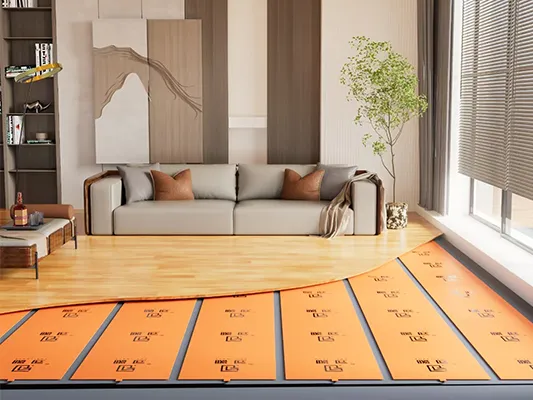
Wood Floor Heating
Low-profile film heating engineered for engineered wood and laminate floors, with insulation options for energy savings.